



 by Tom Gurney
Tom Gurney BSc (Hons) is an art history expert with over 20 years experience
Published on June 19, 2020 / Updated on November 13, 2026
Email: tomgurney1@gmail.com / Phone: +44 7429 011000
Five Dancers with Veil and Crowns: Introduction
The woman in the middle lifts a wreath just above her head. On either side, a dancer raises one end of a veil, making a broad arch over her. The two women at the edges have wreaths of their own and more room to swing their drapery. All five move on a strip of ground so narrow that it barely interrupts the black behind them. Antonio Canova painted the group around 1798–99. The tempera on paper is in the Museo Gypsotheca Antonio Canova in Possagno. [1] [2]
The difference between the little ring of the wreath and the large curve of the veil gives the painting its centre. Both shapes are made by lifted hands, but they depend on different arrangements of bodies. The woman under the veil holds the wreath herself. It takes the two dancers beside her to keep the cloth aloft. The women at the ends extend that movement across the picture through smaller loops of fabric and wreaths held away from the body. [1]
Five Dancers with Veil and Crowns Antonio Canova
At a Glance
- Artist and dateAntonio Canova, about 1798–99. [1] [2]
- Medium and collectionTempera on paper, Museo Gypsotheca Antonio Canova, Possagno. [1] [2]
- Printed versionGiovanni Martino De Boni after Canova, plate M-292_3 at the Istituto Centrale per la Grafica, Rome. [3]
Contents
- From the wreath to the feet
- What the veil connects
- Other groups of five
- From tempera to copper and paper
From the wreath to the feet
Start with the dancer facing out. Her hands are close together above her head, and her elbows open to either side. The line of her body then narrows at the waist, widens where the skirt gathers out, and narrows again at her feet. A crease down the front takes the eye towards the ground. The skirt spreads farther on either side than the feet do, so the body can look poised and the garment still seem to be moving. At the shoulders, small folds of fabric turn back beside the arms. They pick up the larger flare below the waist. [1]
The women immediately to her left and right face inward. Each extends one leg into the open space beside the middle figure. Their other feet are closer to the ground, where the weight of each pose is easier to read. Their skirts ride higher over the lifted legs and leave long stretches of the shin visible. Above, each woman reaches towards the veil with one hand and carries a wreath higher with the other. The two profiles lead the eye back towards the middle face. There is a space between each extended foot and the centre skirt, just as there is a space between the central wreath and the cloth above. Those gaps keep the three poses legible. [1]
At the far left, the dancer offers her wreath towards the group at about shoulder level. Her other hand lifts a loose end of drapery near her head. At the far right, the woman holds her wreath close to her head and reaches into the interval beside her with an open hand. The turns in their drapery follow different paths. The left end drops beside the arm, while the cloth at the right curls out behind the dancer. Their rose-coloured skirts frame the paler dresses within. The ends of the composition answer each other in colour while the difference between their arms and feet keeps the dance from looking like a reflection. [1]
Videos on Canova
Explore Canova’s workshop methods and the settings for his sculpture.
From Sketch to Stone | Canova: Sketching in Clay
Watch sculptor Fred X. Brownstein recreate a Canova Venus, using clay, plaster and marble.
Watch on YouTubeWhat the veil connects
The shared cloth is highest over the middle dancer. Look at its two ends. Each turns up again beyond the hand that holds it, so the arch has a short outward flourish at either side. A warmer edge separates the fabric from the black behind it. Within the arc, the wreath and the woman’s raised arms sit clear of the cloth. At the bottom of the painting, the pale strip of ground runs much straighter than anything above it. Small tufts interrupt it without giving the dancers a setting to recede into. The shallow space makes the five silhouettes, and the differences in how they meet the ground, unusually clear. [1]
The museum connects these dark-ground temperas with the ancient wall paintings Canova saw at Herculaneum in 1779. The Pompeii exhibition checklist placed this work and the companion tempera of dancers holding crowns alongside ancient examples from the Vesuvian sites, including a dancer with flowers from Herculaneum. The comparison helps explain the interest in a clearly outlined moving figure against a dark field. Canova uses that device across a whole row. The people who have to hold the veil are also dancers, and the outline depends on what they are doing together. This is one of several ways Canova’s paintings develop movement through the spacing of figures and the behaviour of their clothes. [1] [2]
Other groups of five
Possagno distinguishes Cinque danzatrici con velo e corone from Cinque danzatrici che reggono corone, or Five Dancers Holding Crowns. In De Boni’s print after the second design, the cloth behind the middle dancer falls in a deep loop, and wreaths are raised on either side of her. Her arms open out into the movements of her neighbours. In the design with the arched veil, she brings her hands together above her own head, and the cloth rises above them. The prints give each arrangement its own plate, so a title that mentions five women and crowns can be checked against the position of the central hands and fabric. [3] [4]
The museum also lists Cinque danzatrici che si tengono per mano, or Five Dancers Holding Hands. The National Edition indexes that title separately. Here the neighbouring hands are occupied with the veil. In Three Graces Dancing, a detail of a different tempera, the outside figures raise a wreath over the centre figure. The crown in Five Dancers with Veil and Crowns is going onto the head of the woman who holds it. Even within similar groups of raised arms and wreaths, that small change shifts attention from a gesture made for another dancer to one she performs herself. [1] [5] [6] [7]
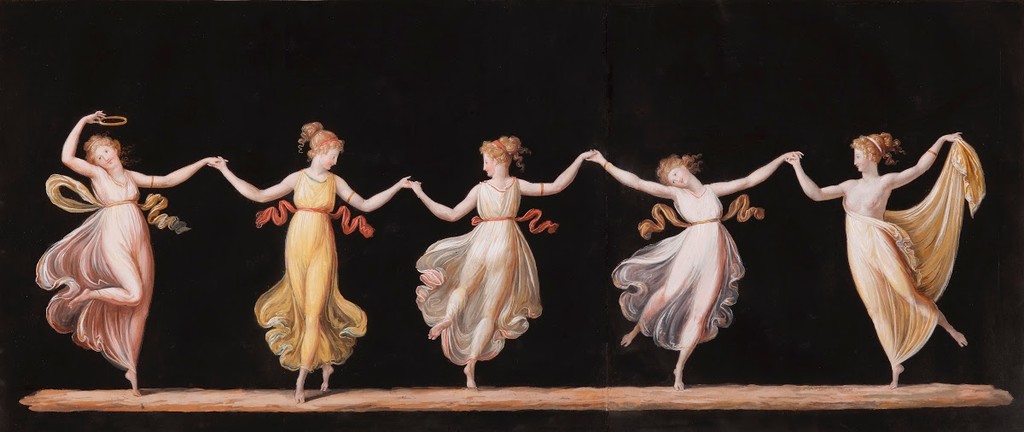
In another group of five dancers by Canova, linked hands carry the eye across the line of figures. Museo Gypsotheca Antonio Canova, Possagno. Image source. Public domain. Resized from source.
From tempera to copper and paper
A payment dated 19 August 1811 identifies De Boni’s work on the copper plate by the woman in the middle who is about to crown herself. The national catalogue gives the archival reference for that payment in its entry for a Possagno impression dated 1992. The Istituto Centrale per la Grafica dates the engraved plate M-292_3 to about 1811. It catalogues its own impression, S-CL2173_38, to 1870–1934. The dates refer to three separate things a viewer might encounter under the same title. Canova painted the design in the late 1790s. De Boni made the plate more than a decade later, and the two documented impressions were pulled later still. [1] [3] [8] [9]
The Rome impression is about 43 centimetres high by 73 centimetres wide within a sheet roughly one metre across. The blank paper outside the engraved border gives the dance a second frame and makes the long field look more like a panel. [9]
The Rome impression preserves the dark field and the thin line of ground. Etching and engraving put the folds and edges into a range of light and dark marks. The veil’s bands can be followed from the bright upper edge into the shadow below, and finer lines run down the dresses towards the feet. The pink and cream differences that separate the dancers in the tempera give way to differences in tone and texture. The engraver’s treatment gives particular weight to the white wreaths and the spaces around the lifted legs. Those shapes carry the rhythm of the painted design into a sheet printed in black ink. [1] [9]
Explore Canova’s works
Browse the sculptures and paintings covered in this guide. Several entries compare versions or examine details of a larger work.
Discussion
Look again at the images and ideas explored in Five Dancers with Veil and Crowns. These editorial prompts invite your observations.
Reader Insights
How does the veil connect the dancers across the picture?
What does each dancer contribute to the rhythm of the group?
Join the Conversation
Share a detail, comparison or question about Five Dancers with Veil and Crowns below.
References
- Museo Gypsotheca Antonio Canova, Five Dancers with Veil and Crowns, collection record and image, c. 1798–99. View source.
- Pompei e l’Europa 1748–1943, exhibition checklist, entries for the two Canova temperas and Vesuvian works. View source.
- Istituto Centrale per la Grafica, De Boni after Canova, Cinque danzatrici con velo e corone, engraved plate M-292_3. View source.
- Istituto Centrale per la Grafica, De Boni after Canova, Cinque danzatrici che reggono corone, impression S-CL2173_41 and plate M-292_6. View source.
- Museo Gypsotheca Antonio Canova, Tempere canoviane, list of individual titles. View source.
- Edizione Nazionale delle Opere di Antonio Canova, Scritti II, index of works, Baccanti che danzano. View source.
- Fondazione Federico Zeri, Ratto di Elena and Danza di Venere e delle Grazie davanti a Marte, paired temperas, with photographs. View source.
- Catalogo Generale dei Beni Culturali, Cinque danzatrici con velo e corone, Possagno impression and 1811 payment, catalogue 0500432731. View source.
- Istituto Centrale per la Grafica, De Boni after Canova, Cinque danzatrici con velo e corone, impression S-CL2173_38. View source.


 Antonio Canova.jpg)

