



 by Tom Gurney
Tom Gurney BSc (Hons) is an art history expert with over 20 years experience
Published on June 19, 2020 / Updated on November 13, 2026
Email: tomgurney1@gmail.com / Phone: +44 7429 011000
Sculptures: Introduction
Small dark dots run across the pale plaster bodies of Cupid and Psyche at the Metropolitan Museum of Art. They are the heads of metal pins. One of the most difficult things about carving a group like this was getting its figures to meet in exactly the right places. Cupid bends down, Psyche reaches up, and their heads are close without touching. The pins helped the workshop carry those distances from plaster into marble. On the finished sculpture, the gap becomes part of the story. On the model, the pins show some of the work it took to get there. [1]
Canova gave marble a wide range of work to do. It could show the weight of a man lowering himself onto a seat, the pressure of a hand against a throat or the folds of a shroud disappearing into a doorway. A hero in the round and a mourner set against a church wall asked different things of the sculptor. Following the evidence from clay to plaster to marble shows where Canova could keep an idea fluid, where he had to commit to its dimensions and where the material or the commission prompted him to change it. [2] [3]
Antonio Canova Sculptures
At a Glance
- RangeCanova made mythological groups, portraits, religious figures and funerary monuments. His models include rapidly worked clay sketches, highly finished terracottas and plasters prepared for carving. [2] [3]
- CompareCompare the Louvre marble of Psyche Revived by Cupid’s Kiss with the Met’s 1794 plaster, which was made for the second reclining marble. [1] [4]
- ModelsPossagno preserves many models from the Roman workshop. The corresponding marbles can be found in collections and buildings across Europe and the United States. [5]
Contents
- Clay sketches and presentation models
- Full-scale plaster, pointing and carving
- Finishing and looking in the round
- Sculpting for a church wall
- Versions, replicas and workshop authorship
- How to identify a Canova sculpture
- From the studio to the museum
Explore Canova’s sculptures
 of Napoleon Bonaparte Antonio Canova.jpg)


 Antonio Canova.jpg)


Clay sketches and presentation models
In the small terracotta for Venus and Adonis, in Possagno and dated about 1787 by the National Gallery of Art, the shape of the figures matters more than the detail of their faces. Broad strokes of the fingers gather the two bodies into an embrace. From behind, there is a deep impression where Canova pushed his thumb into the clay. Conservator Anthony Sigel’s examination traced the modelling to handwork and suggested it may have taken as little as half an hour. The pressure of a thumb or the sweep of a finger could change where a body leaned and how tightly it held its partner. [6]
The 1794 plaster in Possagno and the finished marble in Geneva give the farewell greater clarity. Venus inclines towards Adonis, drawing his face back into the encounter, while the orientation of his foot suggests that he is already about to leave. The dog is best seen from behind, where it makes the coming hunt part of the scene and gives the sculptor a different texture to set against the two bodies. The broad problem posed by the terracotta survives into the later works. Canova had to make an embrace convincing while giving one of the bodies a reason to turn away. [7] [8]
In the late terracottas for Adam and Eve Mourning the Dead Abel, Canova varied where the parents sit and how their bodies close around their son. On the Possagno sketch, Sigel identified turns of an oval-tipped tool used to make Adam’s and Abel’s left eyes. The modelling of the hands is equally telling. Canova rolled and bent a piece of clay for Abel’s arm, then pinched Adam’s wrist and hand into a grasp. The two bent arms echo one another. Their connection reads immediately even at a scale where a fully described face would have been hard to see. The surviving sketches record different solutions for a subject Canova never carved in marble. [6] [9]
The roughness of a sketch can preserve the order in which a sculptor made decisions. In the Abel group, the bent arm was a piece Canova could form separately, set against another figure and adjust before the clay hardened. It is worth looking at the joined surfaces as well as at the more conspicuous tool marks. A small head may be little more than a mass with eyes, yet its angle can tell you which figure has noticed the body and how that figure responds. Sigel distinguishes the cutting and marking effects of different tools from the broader pressure of the hand. Once a clay study was fired, those traces became permanent. The National Gallery of Art estimates that only about sixty of Canova’s terracotta studies survive, a small selection of the decisions once visible in the studio. [6] [9]
Other models could make an idea legible to a patron. The 1783 terracotta for the seated pope in the Tomb of Clement XIV was painted white, giving it something of the appearance of marble. Its fine finish led the National Gallery of Art exhibition team to suggest that it was shown to the patron. Small crosses on the surface were added for the copying process. A single object could thus have a life as a proposal and as a tool. A highly finished clay study called Piety, also made for this commission, preserves an early idea for one of the allegorical figures that Canova went on to change. The care taken over a model tells us how seriously an option was considered, even when the design moved on. [3]
The clay and plaster studies for The Three Graces show how even a small adjustment could alter the group’s character. An early 1812 terracotta catches one of the women with her head thrown outward. In another study from the same year, the figures settle into a closer grouping. Follow their heads as well as their arms. A face turned away opens the group and leaves space around its outline. Tilting the faces inward draws the eye back among the three women. The 1813 plaster in Possagno carries that quieter arrangement at full scale, with metal points across the surface for the next stage. [9]
A small model could also be refined enough to show how a public figure would be read. Canova’s last surviving small-scale study for George Washington, a plaster dated 1817, stands about eighty centimetres high. The breastplate has an elaborate design, and a sword and baton take the place of the crown and sceptre that Canova had included in an earlier study. The tablet’s short inscription still invokes country, liberty and law. In the full-size plaster of 1818, the words identify Washington’s farewell address. The models allow the change in the text to be followed independently of changes in posture and dress. What began as an inscription summarising civic virtues became an address from a particular person to a particular audience. [10] [11]
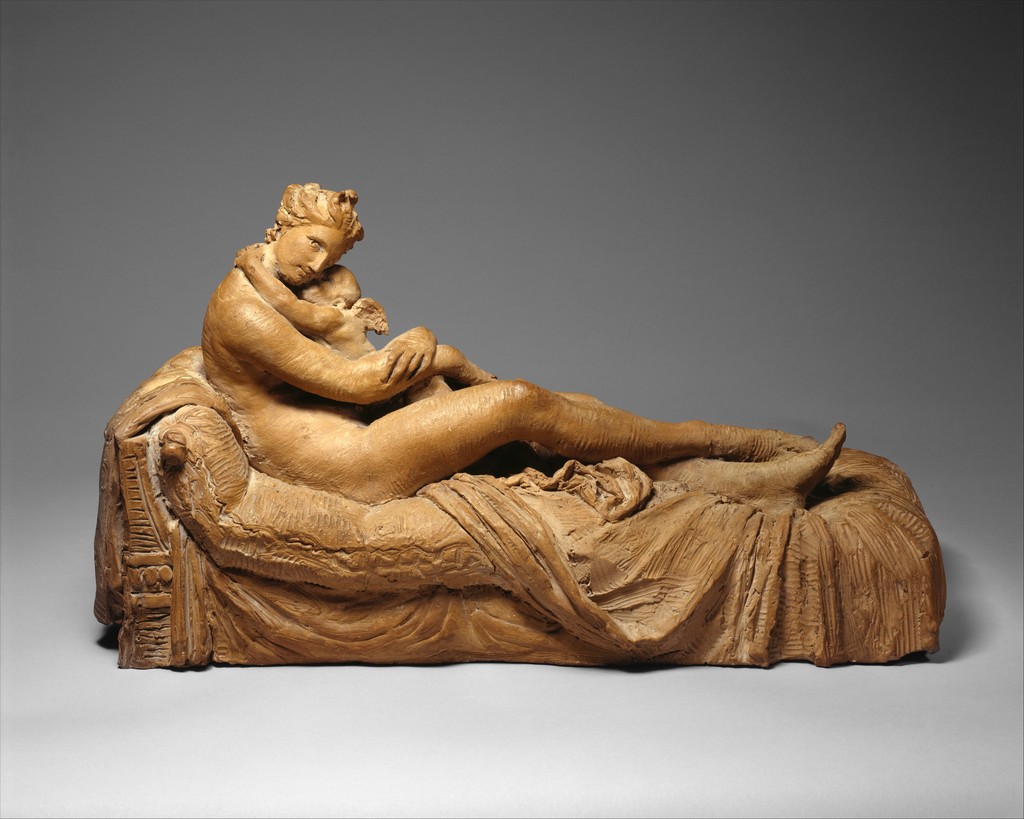
The Met’s terracotta Venus and Cupid shows how a reclining design could be worked out on a small scale. The Metropolitan Museum of Art. Image source. CC0 / Public domain. Resized from source.
Full-scale plaster, pointing and carving
An artist modelling in clay could work by adding material or scraping it away. A carver working in marble needed to know how much stone to leave before making a cut. A full-size clay model could be moulded and cast in plaster, giving the studio a durable surface from which to measure. Pointing meant locating positions on that plaster and transferring them to corresponding positions in the block. A group as deeply undercut as Cupid and Psyche needed measurements for projecting features as well as the recesses between them. A misplaced cut could take away the stone needed to form a wrist, a cheek or a fold. [1] [3] [12]
Casting introduced its own decisions. The Museo Canova’s account describes taking a negative mould from the large clay and then casting a positive in plaster. The clay was generally sacrificed in removing it from the mould, while a further positive could be taken and the most suitable cast prepared for work. The studio reinforced the plaster and dealt with the seams and defects left by casting. This helps explain why a survival in plaster need not imply a corresponding survival in clay at the same size. A smooth-looking plaster can still bear the evidence of assembly or repair, just as a cluster of metal points can tell you which cast actually served as a measuring surface. [13]
The small points belonged to a system. The museum traces Canova’s acquaintance with pointing to the Rome workshops of the restorers and copyists Bartolomeo Cavaceppi and Carlo Albacini. Principal points established positions at projecting parts of the form, and further points could be found in relation to those using compasses. Weighted lines suspended from matched frames provided reference positions for the plaster and block. On a hand, a point near the end of a finger and another nearer its root would give the carver limits within which to establish the curve. A rougher surface could be carried close to those depths while leaving a thin surplus for the later passes. [13]
Francesco Chiaruttini’s 1786 drawing of Canova’s Roman workshop makes the division of work visible. On the right, a full-scale plaster of Clement XIV stands beside the unfinished marble. Above the two are frames for weighted lines, which allowed assistants to establish a common set of positions from which to measure. Two people operate a rope drill at the marble. The drawing captures different jobs going on in the same space. The plaster held the dimensions of the design while the carvers brought the block to the point where the features could be refined. [3]
The same drawing shows a difficulty that the large outline of the pope alone would conceal. The museum identifies the pope’s right hand, absent from the unfinished marble, resting on a stool elsewhere in the room. Assistants are also at work on the accompanying figures, while visitors stand between the two groups of workers and a small model occupies a shelf. The sculpture could be seen at several stages by someone visiting the workshop. The room offered a patron or traveller a chance to see the scale of a commission, the degree of finish already achieved and the work still under way. It also helps explain the distinction between Canova’s responsibility for a design and the many operations needed to realise it. [13] [14]
The Met’s 1794 Cupid and Psyche, object 05.46, is a surviving example of the measuring surface. Canova prepared it for the second reclining marble, commissioned by Prince Nikolai Yusupov. The pins show how much attention the workshop gave to the shape of a body as it turned in space. Look past the contours in a photograph and follow the points over the rounded surfaces. They sit on forms that a silhouette alone could scarcely describe. The same plaster later passed to Canova’s assistant Adamo Tadolini, who used it to produce additional versions. That afterlife explains why a close match in pose can lead back to a common model while the finished objects have different dates and makers. [1]
A full-scale plaster can also preserve a sculpture that no longer exists intact. Canova’s seated George Washington was unveiled at the North Carolina State House in 1821, and the marble was destroyed in the fire there in 1831. The 1818 plaster from Possagno still shows the tablet held forward as Washington writes his farewell address. There is also a surviving marble fragment with the artist’s signature. Taken together, the plaster and the fragment answer different questions. One preserves the figure at the size Canova intended, while the other belongs to the stone that reached Raleigh. [15] [11] [16]
The Prince Regent’s Mars and Venus shows the practical limits of translating a design into stone. The Royal Collection attributes the roughing-out to Tadolini with some caution and describes apparent delays when faults emerged in the marble. From the front, the two figures nearly fill the viewer’s attention. At the back, a tree stump partly veiled by Venus’s drapery fills the space between them. The figures were carved from a single block, while the tip and upper shaft of Mars’s spear are painted wood. The intended outline therefore depended on an addition made in another material. The tree stump, the narrow spear and the space between the two faces make different demands on the people doing the work. [17]
A conservation study of the full-size plaster Perseus at Florence’s Accademia makes the structure inside a cast unusually clear. This is the plaster Canova sent to Florence in 1803, a separate object from the example in Possagno. The Florentine conservators identified an iron armature and a coarser plaster mixture inside a finer outer layer. The arms were cast separately. Wedge-shaped steel keys fitted into iron loops to hold them in position. A photograph of the intact figure gives the impression of continuous modelling from shoulder to arm, while the joints explain how a group with such projecting limbs could be assembled. The conservators also found an original surface treatment containing oils, pigments and waxes, which gave the plaster some of the gloss associated with marble. A polished appearance alone is therefore a poor guide to the material. [18]
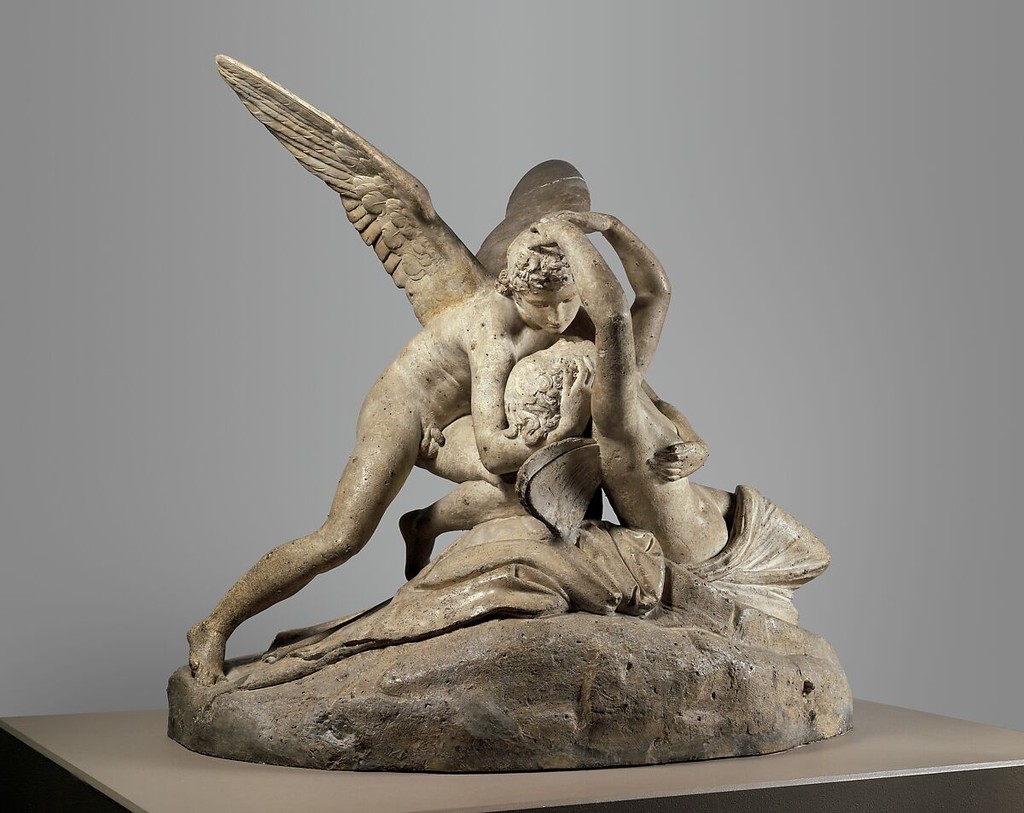
Canova’s full-size plaster for the second reclining Cupid and Psyche preserves its metal pointing pins. The Metropolitan Museum of Art. Image source. CC0 / Public domain. Resized from source.
Finishing and looking in the round
Polish was one of Canova’s tools for distinguishing materials. In the Cleveland Museum of Art’s Terpsichore Lyran, notice the difference between the smooth face, the ridged curls and the texture of the dress. The twisting belt is easier to pick out because the stone immediately around it has been worked differently. Canova was known for attending personally to the final surfaces of his marbles after assistants brought them close to their intended form. Individual works show how that practice could change the way light travels across a body or breaks on a fold. [9] [19]
The Galleria Borghese records a specific treatment on Pauline Borghese as Venus Victrix. Canova applied acqua di rota, the water used to cool an iron grinding wheel, to create a pinkish sheen. The carving sets the sitter’s flesh against a mattress that seems to give under her weight. Viewers at Palazzo Borghese could see the portrait by torchlight, and the couch concealed a mechanism that allowed the sculpture to turn. As the viewpoint changed, the profile of the lifted torso and the fall of the drapery came into view in succession. The base helped to determine how the sculpture could be seen, just as the finish determined what the changing light would reveal. [20]
Canova’s contemporaries differed over what the last stages of work achieved. The museum’s account sets Leopoldo Cicognara’s admiration for the sculptor’s finishing hand alongside the reservations of the German critic Carl Ludwig Fernow, who wrote in 1806 about the emphasis Canova placed on sensual surfaces. A feature that gives the stone the appearance of flesh can also make the viewer more aware of the artist’s powers of imitation. The issue can be tested against a specific detail. On Pauline’s portrait, the polished shoulder reads as skin partly because the adjacent folds and curls break the light. If the entire work had the same finish, the sheen would tell the viewer much less about what the marble represents. [20] [13]
Look back to the early Venetian Daedalus and Icarus for a different use of space in a figure group. The Museo Correr draws attention to the opening between father and son, enclosed by the thread that runs from Daedalus’s hand to the wing. Their bodies have distinct characters. Daedalus has the features and posture of an older craftsman bent to his work, while Icarus’s youth comes through in his more idealised form. Following the thread gives the eye a reason to go from one figure to the other, and the light falling through the gap helps keep their bodies distinct. [21]
Canova could also give a single hero very different relations to the space around him. The V&A’s Theseus and the Minotaur shows a victor resting on the body of the creature he has killed. The bent limbs and lowered head give the eye time to follow the weight of the seated figure down into the fallen body. In Theseus and the Centaur, the hero’s raised arm and the centaur’s limbs extend the action outwards. From the side, the knee driven into the centaur and the hand at his throat explain how the bodies hold together. The raised club helps complete the silhouette in the Vienna marble. Possagno’s catalogue describes the original club as missing from its 1805 plaster. The marble now confronts visitors as they ascend the staircase of the Kunsthistorisches Museum. There the group can first be seen from below, with Theseus’s arm silhouetted high above the centaur’s body. [22] Even a small difference in what survives can affect a viewer’s sense of where the action is about to go. [23] [24]
The Penitent Magdalene uses different materials to direct attention towards an object she holds. In the Genoa version, the cross is gilded bronze. The body kneels, the shoulders incline and the hands open low in front of her. The colour of the cross draws the eye to that low point in the composition. The Padua plaster, which the city museums identify as a model for the Genoa marble, shows how the hair falls across the bare back and how the cloth gathers at the waist. At that stage much of the emotion was already carried by the posture, the lowered face and the space between the arms and torso. The Genoa catalogue traces the design back through a drawing and two clay studies. [25] [26]
A low relief asks the sculptor to make a sense of depth within a much shallower space. In the plaster reliefs Canova made on subjects from classical literature and the life of Socrates, the Museo Correr notes the clean profiles, the few planes of depth and the unbroken backgrounds. Imagine a figure taking a step in one of those reliefs. The line where the foot touches the ground and the overlap between limbs must tell you how far the figure advances. In Theseus and the Centaur, the placement of a foot or a hoof can be checked from another side. In relief, much of that information has to be given in the view from the front. [27]
Videos on Canova
Explore Canova’s workshop methods and the settings for his sculpture.
How does an artist copy the 200-year-old techniques of master sculptor Antonio Canova?
A sculptor demonstrates how Canova’s workshop methods can be used to recreate a marble Venus.
Watch on YouTubeSculpting for a church wall
Canova could plan a memorial around the approach of a viewer and the space available in a church. His terracotta study of Religion for the Tomb of Clement XIII in St Peter’s has an incomplete back. The National Gallery of Art noted that the figure in the monument was never meant to be seen in the round. In front, the drapery gives the body a distinct silhouette and produces shadows deep enough to register within the larger ensemble. A separately preserved plaster of Religion’s head is full size. The two models give a sense of the difference between working out the way a figure will read at a distance and preparing its features at the scale they will have in the building. [3]
On the Funeral Monument to Maria Christina of Austria, installed in Vienna’s Augustinian Church in 1805, the figures are arranged in relation to a dark doorway cut into a pale pyramid. The Houston plaster of the veiled woman carrying the urn shows how Canova modelled the forward movement in an individual figure. Her head inclines, and the folds running diagonally across her body carry the movement onward. Set that figure against the monument and her lean acquires a destination. The group advances from the open steps towards the doorway, where the darkness makes the contours of the figures harder to follow. Movement that might be explored by walking around a mythological group is here expressed through a succession of figures crossing the viewer’s field of vision. [3] [28] [29]
Canova also had to reckon with viewing height when he designed reliefs for the Tempio at Possagno. From late 1821 to the spring of 1822 he modelled seven subjects for a planned series of thirty-two metopes, the panels that would sit in the frieze. The surviving working plasters in Venice include the Annunciation. The clay designs were cast in plaster, and casts travelled from Rome to Venetian sculptors who were to translate the designs into Istrian stone. The same sequence of materials could therefore serve an architectural commission with other carvers working at a distance. Where a freestanding group rewards a close view of a gap between limbs, a panel high above the entrance has to make its main relationships legible from the ground. [30] [31]
Versions, replicas and workshop authorship
In some cases Canova varied a design for a second patron. When the Duke of Bedford visited the Roman studio in 1814, he saw the Graces that had been commissioned by Joséphine de Beauharnais and sought to acquire them. Her son Eugène wanted his mother’s sculpture, so Canova offered Bedford a version with alterations. The V&A identifies differences in the marble, in the shape of the pillar and in the width of the central figure’s waist. Looking only at the figures’ heads would miss changes in the material and in the support that share their visual space. The Hermitage holds the marble made for Joséphine. The V&A and National Galleries of Scotland share the Bedford marble. At Woburn Abbey, that version stood in a top-lit rotunda on a base that allowed it to turn. Seeing the group from the back brings the hands and drapery into view while the faces disappear. The installation gave those views their own place in the experience of the work. [32] [33]
The label “Workshop of Antonio Canova” describes a different relationship. The Met’s Venus Italica, object 2003.21.1, is a Carrara marble variant dated probably about 1822–23. The museum records its purchase from the studio by the Marquess of Londonderry in late 1826 or early 1827. The Pitti marble is catalogued under Canova’s own name. The Uffizi account explains how an intended replacement for the ancient Medici Venus became a new design. Canova’s standing Venus gathers a cloth around her body as she emerges from a bath, with a vessel at her feet. The Met and Uffizi also use different dates in describing the first marble. The Met gives 1810 for its first execution, while the Uffizi dates its object 1812 and documents its arrival at the gallery that year. Dates belong with the objects and events the museums identify. [34] [35]
The way Venus draws the cloth to her chest in Venus Italica also makes it a useful comparison for a second standing design, the Hope Venus. Hugh Honour’s archival study traces the latter to Thomas Hope and identifies his original marble in Leeds. In Hope’s sculpture, Venus covers her breast with her hand and gathers the cloth lower down, so the gesture registers separately from the drapery. The National Gallery of Art’s marble, about 175 centimetres high, is catalogued as a later copy commissioned by Hope himself. The National Trust has a related figure at Hughenden at about 102 centimetres, with its own qualified attribution. A search for Canova’s standing Venus can bring all of these objects together on the same screen. Compare the position of the cloth at the chest and the tighter arrangement of the hair in the later design. Once the design is established, size and ownership history distinguish the Leeds, Washington and Hughenden objects far better than the pose alone. [36] [37] [38]
The Met’s Reclining Naiad is credited to Canova and his studio. The Earl of Darnley commissioned the marble, which assistants completed after Canova’s death and delivered in 1824. The Met identifies small depressions in its surface as possible traces of pointing. This is a different kind of evidence from the metal pins still present in the Cupid and Psyche plaster. The depressions are subtle and their identification remains tentative. They matter because the assumption that a finished marble has effaced every trace of measurement would cause a viewer to overlook them. [1] [39]
The National Gallery of Art’s Naiad is a separate marble acquired from the studio by the Marquess of Londonderry. The gallery notes that earlier publications conflated it with the Darnley commission. Both marbles show a reclining figure turning her head back over her shoulder. Even their lengths are close. The patrons and accession numbers are more reliable guides than a short title or a single photograph. In Paris, Florence, New York or Washington, the identifying details on a museum’s label can tell a story that the shape alone leaves open. [39] [40]
The two marbles of Perseus with the Head of Medusa show how a variation can also be structural. Pius VII bought the first for the Vatican, where it occupied the niche left by the Apollo Belvedere after the French took that statue to Paris. Canova’s figure shares something of Apollo’s stance, though the extended arm and the hero’s gaze lead towards Medusa’s head. The later marble, made for the Tarnowskis and now at the Met, omits the supporting strut beneath Perseus’s extended arm and gives the drapery a stronger swing. The contract called for a version closely resembling the Vatican work. Compare the space under the lifted arm to see where Canova took the opportunity to revise the design. [41] [42]
The Vatican marble also gave conservators a way to test what the surviving plaster in Florence could still tell them. When they examined the plaster, they found that its torso had shifted out of alignment and that fractures and losses had interrupted the original surface. The Vatican marble and the Possagno plaster offered independent evidence about the inclination of the figure. The conservators used those comparisons to recover its alignment, and the Vatican marble also informed the reintegration of larger missing parts. They secured the restored plaster to a specially made steel plate beneath its timber base. A comparison of the Florence plaster with the Met’s second marble is rewarding precisely because their differences have different causes. The museum’s second marble records a revision Canova made for a patron, while the Florence plaster also bears the history of how an object was assembled, damaged and conserved. [41] [42] [18]
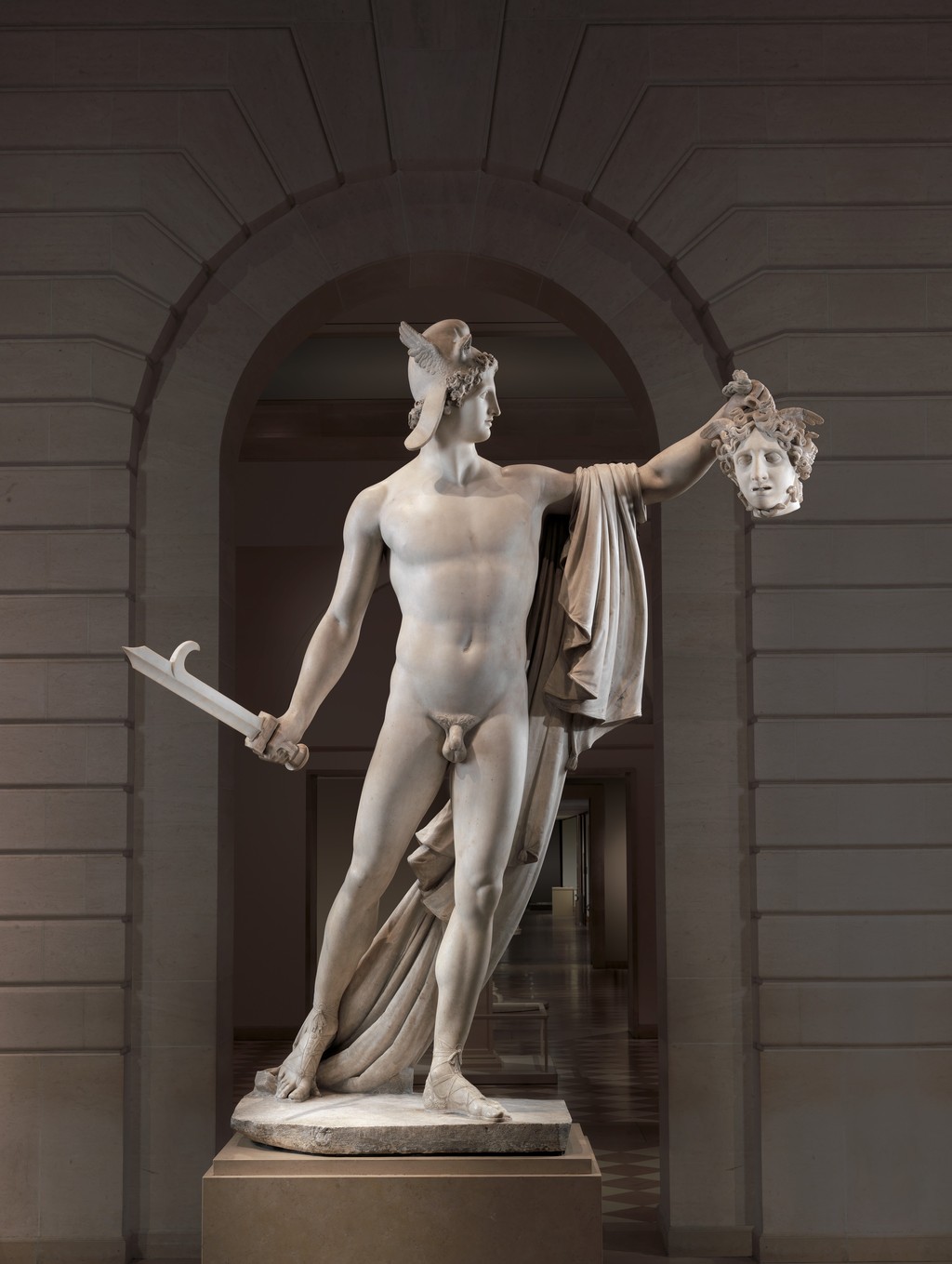
The Met Perseus shows a later version of a composition Canova first carved for Rome. The Metropolitan Museum of Art, 67.110.1. Image source. CC0 / Public domain. Resized from source.
How to identify a Canova sculpture
Start with the collection and accession number. The Louvre’s reclining Psyche, MR 1777, is a marble dated 1787–93. The Met’s Cupid and Psyche, 05.46, is the full-size plaster of 1794 prepared for the second reclining marble. The Louvre’s standing pair, MR 1776, has a different pose and inventory number. Two museums may use similar English titles even where the material, commission and design differ. In this instance the position of Psyche’s body will quickly separate the standing and reclining compositions. The accession number distinguishes objects within the reclining design. [1] [4] [43]
Next, read the dates and the maker line together. The Art Institute of Chicago’s Bust of Paris, 1984.530, is a marble from 1809 by Canova, who dedicated it to his friend and correspondent Antoine Quatremère de Quincy. The Met’s standing Paris, 2003.21.2, is dated about 1822–23 and attributed to the workshop. The Met records that both this marble and its Venus Italica were unfinished when Canova died and completed by his assistants. [35] [44] On the bust, the cap and turn of the neck establish the shepherd’s identity and suggest his attention to what he sees. The standing design also uses the position of the arms and legs to direct that attention. The Met gives two dates on the same label because it is telling two histories. November 1812 is when Canova completed the first standing marble, made for Joséphine and now in the Hermitage. The later date and the workshop credit identify the New York marble. [45] [44]
The same questions apply to prints and casts. In prints after Canova, the maker’s name may identify the person who translated the sculpture into another medium. An engraving by Pietro Bettelini after a drawing by Giovanni Tognolli records a view of Canova’s Theseus and the Centaur. Its Rijksmuseum record credits the engraver, draughtsman and sculptor with separate roles. A print fixes one view, while a plaster made for the workshop preserves dimensions around the figure. Possagno’s collection owes its breadth to Canova’s half-brother Giovanni Battista Sartori, who arranged to transfer works from Rome after the sculptor’s death. The surviving models can be studied alongside marbles that went to distant patrons, and some preserve designs that never reached stone. A useful first comparison is to put two views of a marble beside its model and follow the same hand, fold or gap in each. That is where differences of scale, finish and viewpoint become easiest to see. [5] [24] [46] [47] [48]
The portability of copies was part of their appeal. The Met preserves a leather and paper box of small plaster impressions made by Francesco Carnesecchi between 1822 and 1844. It resembles a book. Open one side for impressions reproducing works by Canova and the other for Thorvaldsen. These impressions were taken from engraved gems, and a whole group could fit into the palm of a hand. They preserve a history of looking at sculpture through another object, at a size a traveller could carry. The box belongs in the story of Canova’s reputation even though a cast of this kind gives little evidence for how he modelled a body in clay. [49]
From the studio to the museum
A quill, three clay-modelling implements and a marble chisel survive at Chatsworth. The collection traces their arrival through Lady Abercorn and records a handwritten notice dated in Rome on 31 December 1822. They were once displayed in a shallow vessel beside the colossal Bust of Napoleon. The quill is as telling as the chisel in a room full of sculpture. Correspondence and drawings were part of the daily work by which a design was commissioned and developed. The tools link Chatsworth to the sculptor’s working life, while the nearby sculptures can have other relationships to his hand. The same collection attributes its two Canova Lions to Francesco Benaglia and Rinaldo Rinaldi, who worked from casts after the lions in Canova’s Clement XIII monument. The tools, the colossal head and the carved lions reached the collection by distinct routes. [50]
In Possagno, the room holding the models belongs to a later chapter of the sculptures’ history. Sartori commissioned Francesco Lazzari to design a building for the works brought from Rome. Its large hall was lit from above. The plasters suffered considerable damage when a shell hit the building at Christmas in 1917 and the roof collapsed. A photographic survey in the Italian national catalogue documents the damaged collection and the work of identifying fragments. That history gives a reason to look closely at a plaster’s condition before attributing a missing feature to Canova’s design. An omission might belong to the workshop process or to the object’s much later history. Evidence from a finished marble, a contemporary image or another cast can help establish which. [51] [52]
Carlo Scarpa’s 1950s addition in Possagno introduced a different way of lighting the models. Windows and skylights bring light in from several directions, and the pool outside can reflect light towards the plaster of The Three Graces. The figures occupy a space where the brightness of the surrounding walls can change over the course of a visit. Looking at the group there, the transitions between the shoulders and the gaps beneath the arms become easier to follow from successive positions. The Bedford marble had its own arrangement for changing the view at Woburn Abbey. The plaster in Scarpa’s wing and the marble on its turning base each show how much the experience of this particular group depends on the room around it. [32] [53]
Explore Canova’s works
Browse the sculptures and paintings covered in this guide. Several entries compare versions or examine details of a larger work.
Discussion
Look again at the images and ideas explored in Sculptures. These editorial prompts invite your observations.
Reader Insights
What can a clay model tell you that the finished marble leaves out?
Where can you see the imprint of an earlier model in a finished sculpture?
Join the Conversation
Share a detail, comparison or question about Sculptures below.
References
- The Metropolitan Museum of Art, Cupid and Psyche, object 05.46. View source.
- National Gallery of Art, Canova: Sketching in Clay, exhibition overview. View source.
- National Gallery of Art, Canova: Sketching in Clay, exhibition labels. View source.
- Musée du Louvre, L’Amour et Psyché à demi couchée, MR 1777 (in French). View source.
- Museo Gypsotheca Antonio Canova, Canova around the world. View source.
- Anthony Sigel, Thinking in Clay: How Antonio Canova Made His Sculptures, National Gallery of Art adaptation of Sigel’s catalogue essay. View source.
- Museo Gypsotheca Antonio Canova, Venus and Adonis, plaster, inv. 66. View source.
- Musée d’art et d’histoire de Genève, Métamorphoses, p. 45, Vénus et Adonis (in French). View source.
- National Gallery of Art, Who Is Antonio Canova? 10 Things to Know. View source.
- The Frick Collection, Bozzetto for George Washington, 1817 plaster. View source.
- The Frick Collection, Modello for George Washington. View source.
- C. D. Dickerson III and Emerson Bowyer, Canova: Sketching in Clay, with contributions by Anthony Sigel and Elyse Nelson, National Gallery of Art and Art Institute of Chicago, 2023. View source.
- Museo Gypsotheca Antonio Canova, Il processo creativo e la tecnica scultorea (in Italian). View source.
- The Metropolitan Museum of Art, Antonio Canova (1757–1822), collection essay. View source.
- The Frick Collection, Canova’s George Washington, exhibition overview. View source.
- The Frick Collection, Fragment of George Washington (base and signature). View source.
- Royal Collection Trust, Mars and Venus, RCIN 2038. View source.
- Opificio delle Pietre Dure, La statua in gesso del Perseo trionfante di Antonio Canova, conservation report (in Italian). View source.
- Cleveland Museum of Art, Terpsichore Lyran (Muse of Lyric Poetry), 1968.212. View source.
- Galleria Borghese, Paolina Borghese Bonaparte as Venus Victrix, inv. LIV. View source.
- Museo Correr, Sale Neoclassiche e Collezione canoviana (in Italian). View source.
- Kunsthistorisches Museum, Museum, account of the main staircase and Canova’s Theseus Slaying the Centaur. View source.
- Victoria and Albert Museum, Antonio Canova – an introduction. View source.
- Museo Gypsotheca Antonio Canova, Theseus Defeating the Centaur, plaster, inv. 163. View source.
- Musei di Genova, Maddalena penitente, marble and gilded bronze, inv. PB 209 (in Italian). View source.
- Padova Musei Civici, Maddalena penitente, plaster, inv. 896 (in Italian). View source.
- Museo Correr, The Canova Collection at the Correr Museum, collection guide, section on the bas-reliefs. View source.
- Museum of Fine Arts, Houston, A Figure Representing Virtue, 2000.95. View source.
- Albertina, Das Kenotaph der Erzherzogin Marie Christine in der Augustinerkirche in Wien (in German). View source.
- Gallerie dell’Accademia di Venezia, Annunciation, object record. View source.
- The Metropolitan Museum of Art, Antonio Canova, 2014 exhibition announcement and notes on the Tempio metopes. View source.
- Victoria and Albert Museum, The Three Graces by Antonio Canova, A.4-1994. View source.
- Sergey Androsov, Italian Sculpture, 17th–18th Centuries, State Hermitage Publishers, 2014, cat. 247 (entry in Russian). View source.
- Gallerie degli Uffizi, Venere Italica, inv. 1912 n. 878 (in Italian). View source.
- The Metropolitan Museum of Art, Venus Italica, object 2003.21.1. View source.
- Hugh Honour, Canova’s Statues of Venus, archival study. View source.
- National Gallery of Art, Venus, 2014.136.242. View source.
- National Trust Collections, The Hope Venus, Hughenden, 429099. View source.
- The Metropolitan Museum of Art, Reclining Naiad, object 1970.1. View source.
- National Gallery of Art, Naiad, accession 2003.62.2. View source.
- The Metropolitan Museum of Art, Perseus with the Head of Medusa, object 67.110.1. View source.
- Museo Gypsotheca Antonio Canova, Perseus, plaster, inv. 142. View source.
- Musée du Louvre, L’Amour et Psyché debout, MR 1776 (in French). View source.
- The Metropolitan Museum of Art, Paris, workshop marble, object 2003.21.2. View source.
- Art Institute of Chicago, An Educated Taste: Neoclassicism at the Art Institute, Museum Studies 15, no. 1, p. 39, Bust of Paris, 1984.530. View source.
- Rijksmuseum, Theseus overwint de centaur, RP-P-OB-38.966 (catalogue notes in Dutch). View source.
- Museo Gypsotheca Antonio Canova, Nineteenth-Century Wing. View source.
- Museo Gypsotheca Antonio Canova, Adonis Crowned by Venus, plaster, inv. 23. View source.
- The Metropolitan Museum of Art, Impressions of intaglios after the statuary of Canova and Thorvaldsen, 1992.405.1–.35. View source.
- Chatsworth House Trust, In Plain Sight: Canova’s Tools, collection research. View source.
- Museo Gypsotheca Antonio Canova, Gypsotheca, building and collection history. View source.
- Catalogo Generale dei Beni Culturali, La Gypsotheca Canoviana, historic photographs and catalogue essay (in Italian). View source.
- Museo Gypsotheca Antonio Canova, Ala Scarpa, exhibition wing history (in Italian). View source.