



 by Tom Gurney
Tom Gurney BSc (Hons) is an art history expert with over 20 years experience
Published on June 19, 2020 / Updated on November 13, 2026
Email: tomgurney1@gmail.com / Phone: +44 7429 011000
Damoxenos: Introduction
Damoxenos turns his head towards someone beyond the edge of his base. The shoulder below it rises, the left fist crosses the chest and the other hand stays half open at his side. Below the arms, the legs open out in a long stride. Antonio Canova makes the lower body look ready to move while the shoulders draw in close. The change is easiest to see from the side, where the legs span nearly the full width of the base and the arms almost disappear into the outline of the torso. [1] [2]
The marble stands in the Pio Clementino Museum at the Vatican. Its companion, Creugas, lifts an arm above his head on a separate pedestal. The two athletes face one another in the Cabinet of the Perseus, a recess of the Octagonal Court. Their bodies are far enough apart for visitors to see each pose on its own, yet the turn of each head carries the encounter across the gap. [3] [4] [5]
Damoxenos Antonio Canova
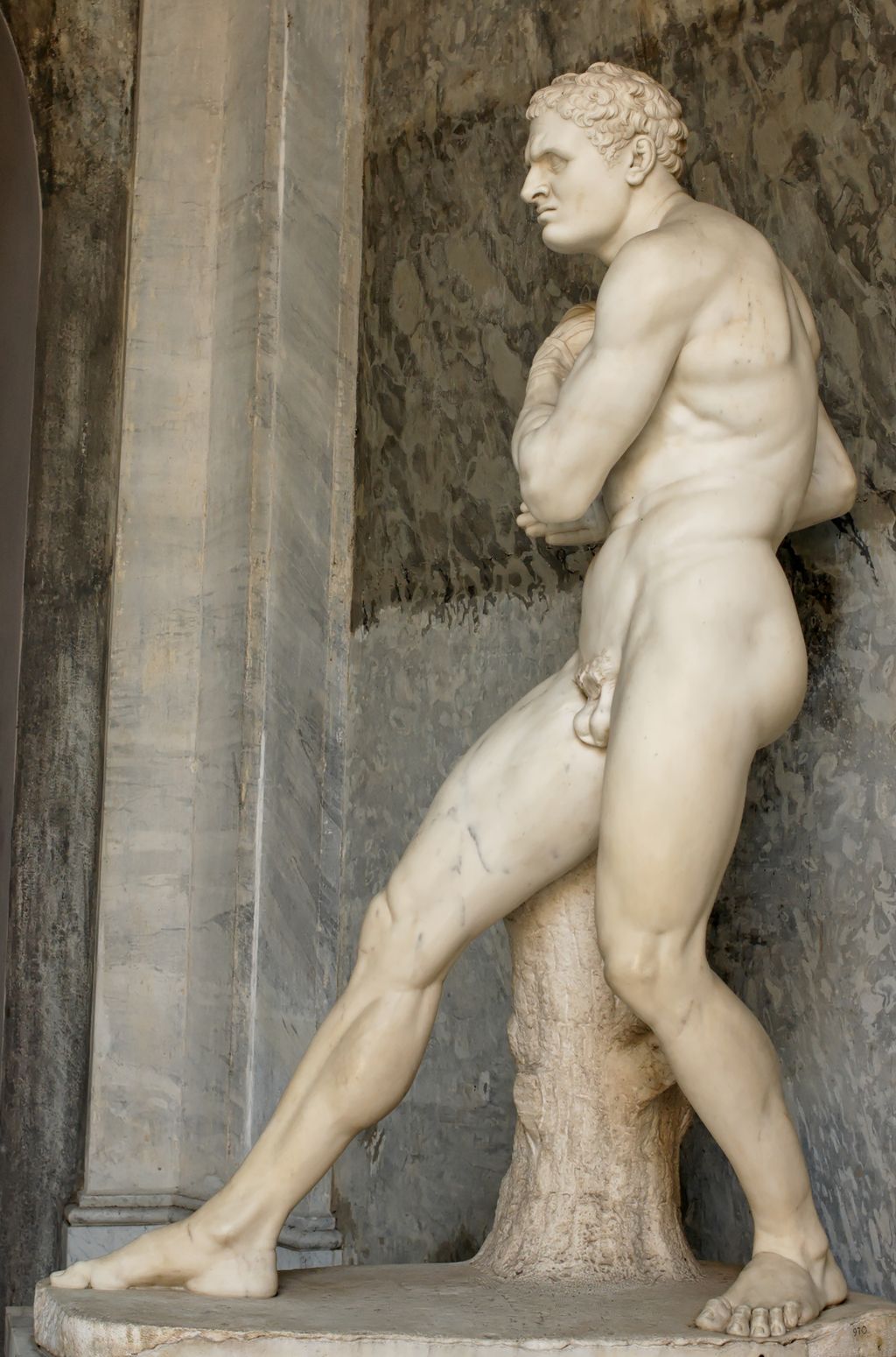
The Vatican marble seen from the side, with the trunk and bent arms visible. Jastrow. Image source. Public domain. Resized for display.
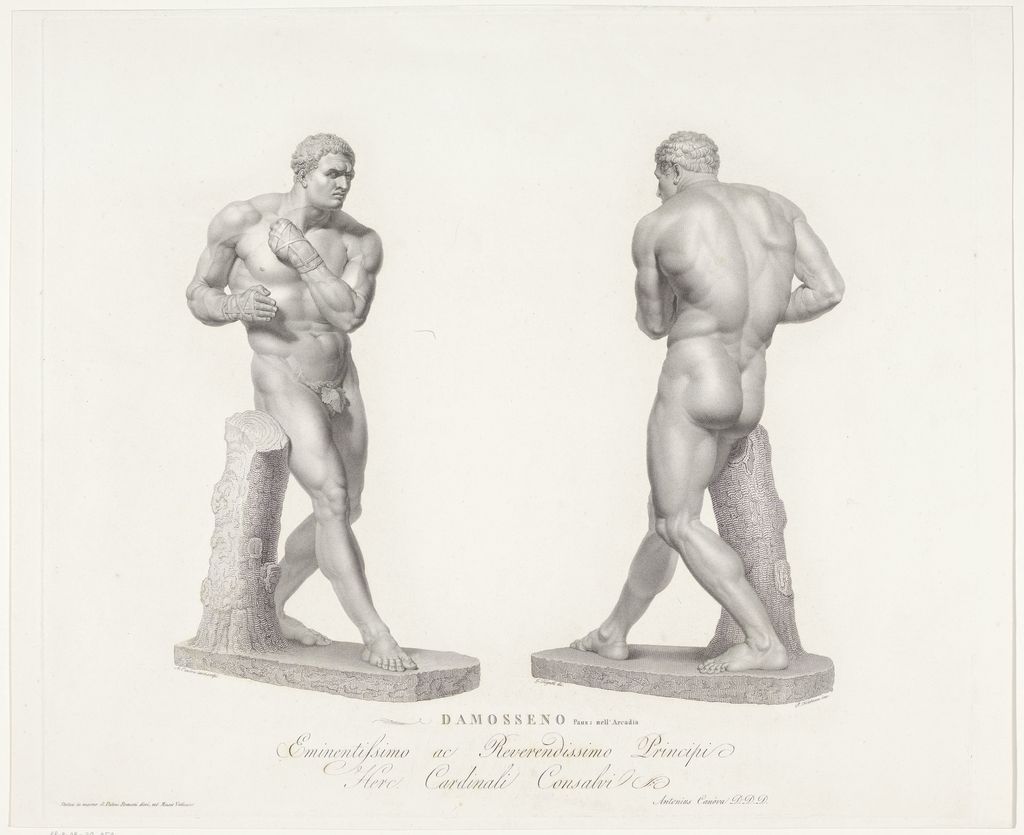
Fontana’s engraving presents front and rear views of Damoxenos. Rijksmuseum. Image source. Public domain. Resized for display.
At a Glance
- SculptorAntonio Canova. [3] [5]
- Marble215 × 130 × 68 centimetres, completed in 1806, Vatican Museums, inventory 970. [3] [5] [6]
- SubjectDamoxenos of Syracuse, the boxer whom Pausanias describes as breaking an agreement with Creugas at the Nemean Games. [7]
Contents
- A wide stance and a close guard
- The contest in Pausanias
- From an early model to the Vatican
- Two views in print and a head in plaster
A wide stance and a close guard
From the oblique angle in Jastrow’s photograph, the long leg makes an uninterrupted diagonal between hip and heel. Its foot extends close to the end of the plinth, with the toes following the direction of the stride. The other knee bends more visibly, and the foot opens towards the viewer. The torso has already turned away from the line of the legs. A bulge of muscle below the shoulder gives way to a shallow hollow above the hip, so the change of direction registers even where the two parts of the body meet. [1] [2]
The two hands become easier to distinguish from the front. The left hand gathers into a fist and comes high across the chest. A band around the wrist leaves a narrow boundary between the fist and the forearm. Below it, the right thumb and fingers are visible in profile, with the fingers gently bent and held together. Fontana’s engraving picks out the bindings on both hands with curved lines. The left forearm crosses the broad plane of the chest, while the right elbow makes a short projection on the other side. The small interval between the hands gives a front view something the side view withholds. [1] [2] [6]
A trunk rises behind the thighs. Seen obliquely, its bark and upright edge make a stable shape among the slanting legs. From the front in Fontana’s print, the cut top of the trunk shows beside the hip. In the view from behind, the trunk appears between the legs, where the bend at each knee is easier to compare. The worked texture carries light in smaller patches than the smooth surfaces of the calves. It helps the eye separate the carved support from the limbs that overlap it. [1] [2]
Damoxenos’s face projects beyond the raised shoulder. The nose and mouth sit in profile in the oblique photograph. The brow draws in above the eye and the lips press together, leaving a short, emphatic line under the nose. In the print’s view from the front, the direction of his gaze is clearer. The head looks past the edge of the paper, while the shoulders stay gathered within the outline. Creugas makes the space above his head part of his gesture. Damoxenos keeps the movement close to his chest and lets his gaze draw attention outwards. [1] [2] [4] [8]
The contest in Pausanias
In the Description of Greece, Pausanias tells how Damoxenos of Syracuse and Creugas of Epidamnus agreed near the end of their match to take one blow each. They made the agreement in the hearing of witnesses as evening approached. Creugas struck first. Damoxenos then delivered the blow that killed him. The Argives treated what Damoxenos had done as several blows and expelled him for breaking the agreement. They gave the crown to Creugas after his death and set up a statue in his honour. Pausanias says he could still see it in the sanctuary of Apollo Lykeios at Argos. [7]
Pausanias mentions the soft rawhide bands that ancient boxers wore on their hands, leaving the fingers bare. Canova’s carved bindings give the bands a visible presence in the story. The open right hand matters because the ancient account contrasts what happened with the single blow the contestants had agreed to accept. The sculpture keeps the moment of contact outside the scene. A visitor can see the head turn, the closed fist and the other hand before knowing which athlete the judges will declare the winner. [1] [2] [7]
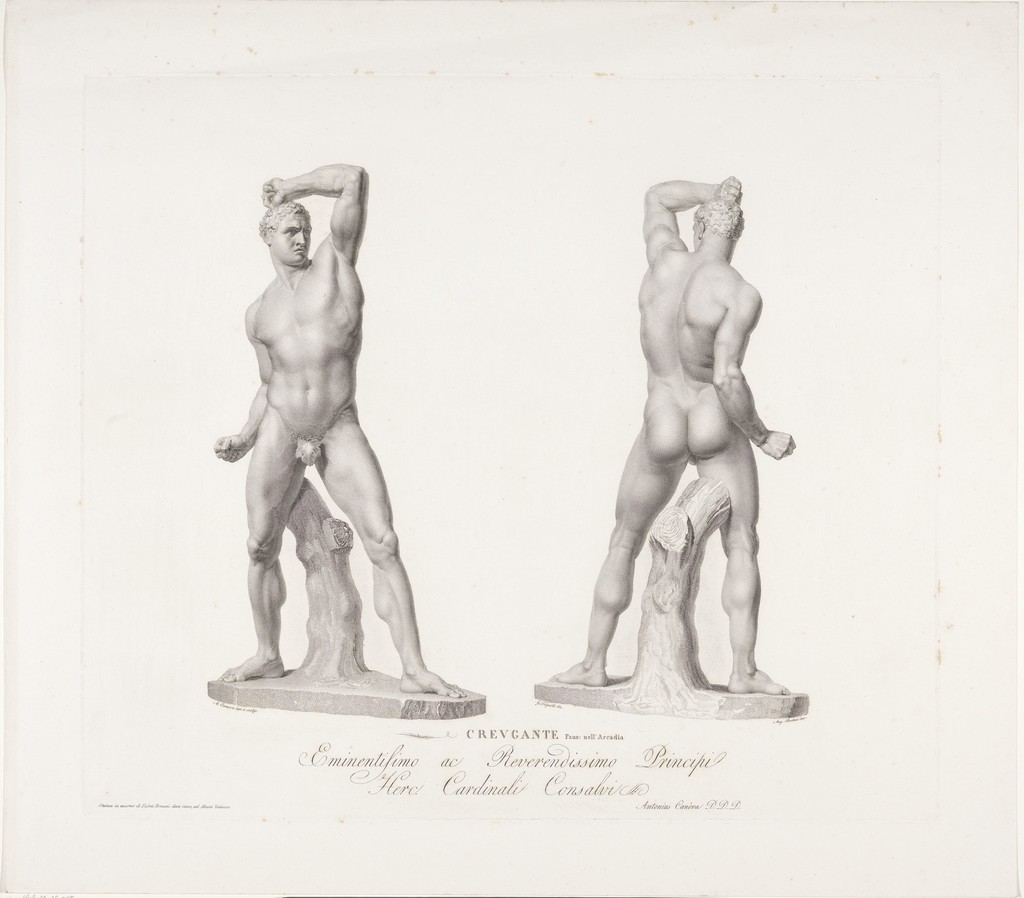
Bertini’s two views of Creugas illustrate the other boxer’s raised-arm pose. Rijksmuseum. Image source. Public domain. Resized from source.
Videos on Canova
Explore Canova’s workshop methods and the settings for his sculpture.
From Sketch to Stone | Canova: Sketching in Clay
Watch sculptor Fred X. Brownstein recreate a Canova Venus, using clay, plaster and marble.
Watch on YouTubeFrom an early model to the Vatican
The Vatican conservation account traces preparatory drawings to 1795 and the first models to the following year. It records a papal purchase in 1802 in connection with the boxers and the Perseus, and describes Canova making a second model for Damoxenos three years later. The Museo Gypsotheca at Possagno and Museo Omero describe the government’s order for Damoxenos as following the purchase of Creugas. They place the companion marble beside Creugas in 1806. The accounts differ on how the later boxer entered the papal collection. Both put the finished Damoxenos several years after Canova’s first work on the pair. [3] [5] [6]
The setting brought the new marble into a court long associated with antique sculpture. Julius II displayed his collection there in the early sixteenth century. Clement XIV and Pius VI later made the court central to the Pio Clementino Museum. When the Apollo Belvedere was taken to France, Canova’s Perseus occupied its place. On the Apollo’s return in 1816, the Perseus moved to another recess of the court, where the two boxers flanked it. The three figures offered different kinds of attention: the hero looks at the head he holds, while each boxer looks beyond his own pedestal. [4] [9] [10]
The Vatican Museums’ conservation team described both boxers as generally well preserved and noted small fissures requiring investigation. Its proposal called for examination of the bases, photographic documentation and careful cleaning that would respect the surface patina. Damoxenos offers different surfaces for a conservator to examine, from the rough trunk and plinth to the smoother shoulder, brow and cheek. The proposal records what the team intended to study and treat. [1] [3]
Two views in print and a head in plaster
Pietro Fontana’s engraving after Giovanni Tognolli places the front and back of Damoxenos side by side. The right hand reads clearly from the front. Turn to the second figure and the shoulder blades come into view, the elbow seems more prominent, and the wide stance becomes a pair of legs angling away from the spine. The Italian national catalogue records that Fontana undertook to engrave the two drawings in July 1815 and received the balance a year later. The Rijksmuseum’s impression bears Canova’s dedication to Cardinal Ercole Consalvi. The dedication sits beneath both views, spanning a sheet that lets the eye compare angles at once. [2] [11]
A nineteenth-century albumen print by James Anderson preserves a single photographic view instead. The Rijksmuseum dates its album leaf to about 1857–75. The caption identifies the Vatican and names the boxer, giving a reader a place as well as a figure. A dark backdrop sets off the figure, including the edge of the right hand just below the nearer elbow. The branch that joins the trunk to the bent leg shows clearly as a separate curve. The pedestal cuts across the lower part of the photograph, with the printed caption just beneath it. Fontana could put a second body on the sheet to explain how the back turns. A museum visitor can recover that change by looking across the figure from another side. [2] [12]
Museo Omero’s Head of Damoxenos changes the scale of the encounter again. The plaster cast is 47 centimetres high and reproduces the head at its actual size. The museum uses it in a display concerned with facial expression. Without the wide stance and the two boxers’ positions in the court, the forehead, tight mouth and short curls receive sustained attention. Those details are part of the Vatican marble too, where the face is seen above the raised shoulder. The cast lets visitors study them close up and by touch. [1] [6]
Explore Canova’s works
Browse the sculptures and paintings covered in this guide. Several entries compare versions or examine details of a larger work.
Discussion
Look again at the images and ideas explored in Damoxenos. These editorial prompts invite your observations.
Reader Insights
How does the twisting pose change when you look from the side?
What do the engraved front and rear views let you compare?
Join the Conversation
Share a detail, comparison or question about Damoxenos below.
References
- Jastrow, Damoxenos, Pio Clementino Museum, photograph of the Vatican marble, 2006. View source.
- Rijksmuseum, Damosseno, Pietro Fontana after Giovanni Tognolli and Antonio Canova, RP-P-OB-39.050. View source.
- Patrons of the Arts in the Vatican Museums, Classical Pugilists Creugas and Damoxenos, Vatican Museums conservation proposal, object dimensions and chronology. View source.
- Holy See Press Office, Antonio Canova nei Musei Vaticani, 20 October 2023, Cabinet of the Perseus and the paired display. View source.
- Fondazione Federico Zeri, Canova Antonio, Damosseno, work record 83273, with Vatican inventory and reference to Giuseppe Pavanello’s catalogue. View source.
- Museo Tattile Statale Omero, Head of Damoxenos, catalogue of the head cast and information on the Vatican original. View source.
- Pausanias, Description of Greece, 8.40.3–5, translated by W. H. S. Jones. View source.
- Jastrow, Creugas, Pio Clementino Museum, photograph of the companion marble, 2006. View source.
- Vatican Museums, Octagonal Court, history of the court and the papal collection. View source.
- Vincenzo Farinella, “Antico/Moderno,” in Chiara Savettieri, ed., Modernità per immagini. Un atlante in venti parole, p. 34 and fig. 10, on the return of the Apollo and display of Canova’s three marbles. View source.
- Catalogo generale dei Beni Culturali, Damosseno, Fontana print, record 0500432585. View source.
- Rijksmuseum, Sculptuur van Damoxenos, Vaticaan, albumen print by James Anderson, RP-F-1993-6-12. View source.


 Antonio Canova.jpg)

