



 by Tom Gurney
Tom Gurney BSc (Hons) is an art history expert with over 20 years experience
Published on June 19, 2020 / Updated on November 13, 2026
Email: tomgurney1@gmail.com / Phone: +44 7429 011000
Paride (Paris): Introduction
Paris turns his face away from the hand that holds the apple. His left elbow rests on a tree trunk hung with cloth, and his raised fingers come close to the back of his cap. His right hand keeps the prize low against his back. From the front the figure looks at ease. A view from behind brings the apple into sight and reveals what this young man has been asked to decide. Antonio Canova’s marble for Joséphine de Beauharnais, now at the State Hermitage Museum, stands 207 centimetres high. [1] [2] [3]
The design survives in plaster and in several marbles. The statue made for Crown Prince Ludwig of Bavaria belongs to the Neue Pinakothek. The one at the Metropolitan Museum of Art remained in Canova’s studio at his death and was completed by his assistants. The three marbles share the same arrangement of head, hands and support, and their separate histories can be followed from the workshop to their first owners. [1] [4] [5]
Paride (Paris) Antonio Canova
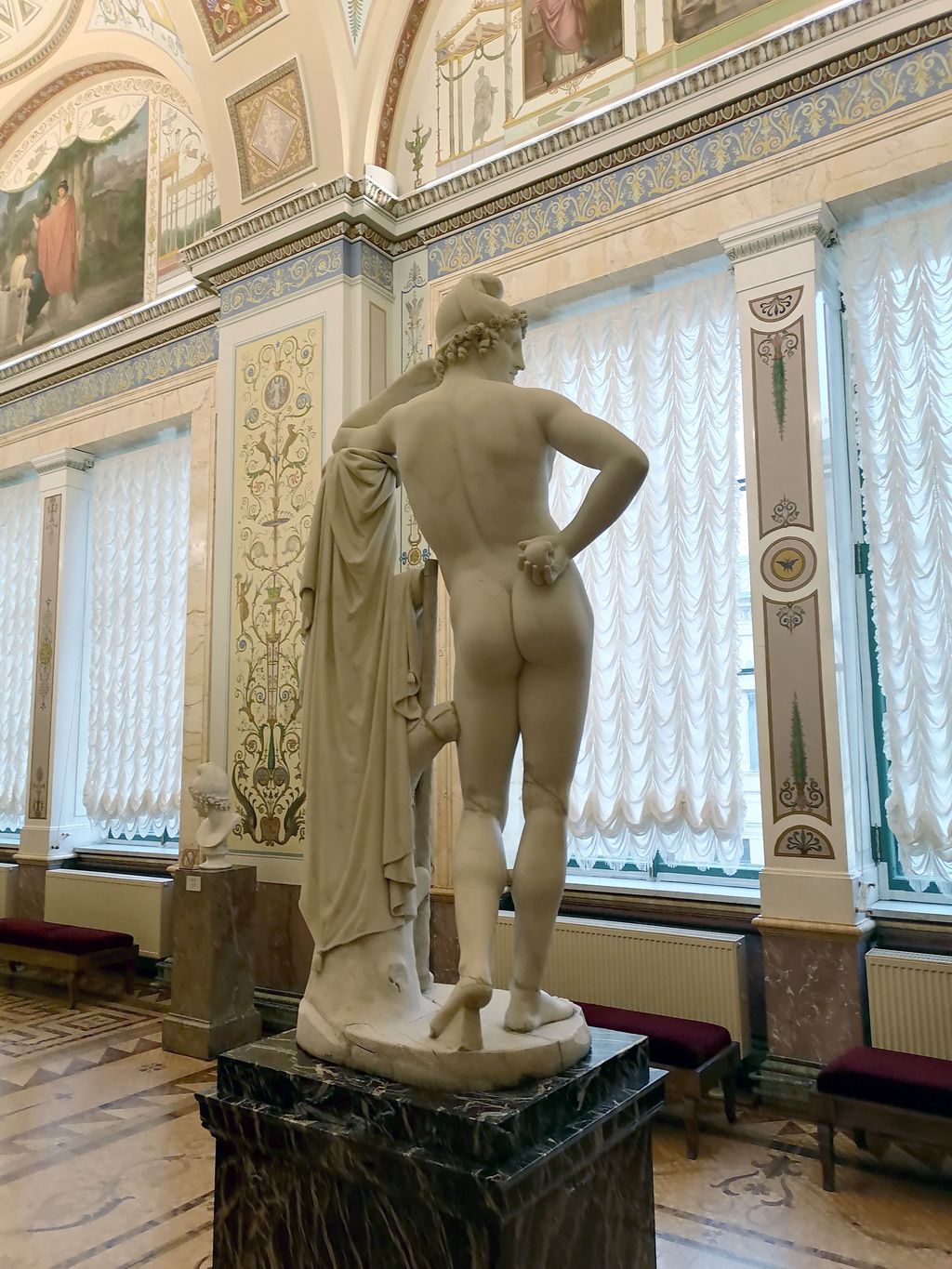
The Hermitage marble from behind, with the apple held against Paris’s back. Netelo. Image source. CC BY-SA 4.0. Resized for display. The resized photograph uses the same licence.
At a Glance
- SubjectParis of Troy, with the apple he awards to Aphrodite. [4] [5]
- Hermitage marbleMade for Joséphine de Beauharnais, in her collection at Malmaison by February 1813, inventory Н. ск. 19. [1]
- Munich marbleCommissioned by Crown Prince Ludwig in 1811 and completed in 1816, inventory WAF B 4. [4]
- New York marbleWorkshop of Antonio Canova, about 1822–23, accession 2003.21.2. [5]
Contents
- The figure from front and back
- An apple for Aphrodite
- From the model to Malmaison
- Ludwig’s version and the studio marble
The figure from front and back
The straight leg carries most of the figure’s weight. The other bends and crosses behind it, with the heel raised. Follow the line of the weight-bearing leg up through the hip and the torso shifts towards the opposite shoulder. The shoulders have the breadth to balance the elbows, which point away from the body. The right elbow projects into open space, while the left presses down against the top of the support. From the front the gap between the legs is narrow enough that the standing foot and the lifted heel can seem to belong to one line. A step to the side makes it easier to see the raised heel and the small area beneath the toes. [2] [3] [4]
The trunk rises almost to the level of the left shoulder. Cloth is fastened there, with folds that hang in loops between the upper end and a lower branch. Narrow ridges of marble cast shadows across the folds. Underneath, the knots and uneven shape of the wood return the eye to the ground. The cloth covers the support where it meets the arm and opens up the separation between the straight line of the tree and the shifting outline of the body. The trunk also gives the bent elbow somewhere to rest, so the fingers can rise to the cap without the whole arm looking strained. [2] [3] [5]
The cap has a tip that folds forward above the forehead, and curls emerge at the temple and over the nape. The rounded crown and the irregular edges of the hair stand out against the smooth cheek. From the back the apple is clear within the right hand. It sits where the forearm crosses the waist, well away from the eye line. Walking round the statue separates two discoveries that a picture of the whole judgement might make at once. The cap and face identify the youth first, and the hand against his back supplies the object that links him to the choice on Mount Ida. [2] [3] [4] [5]
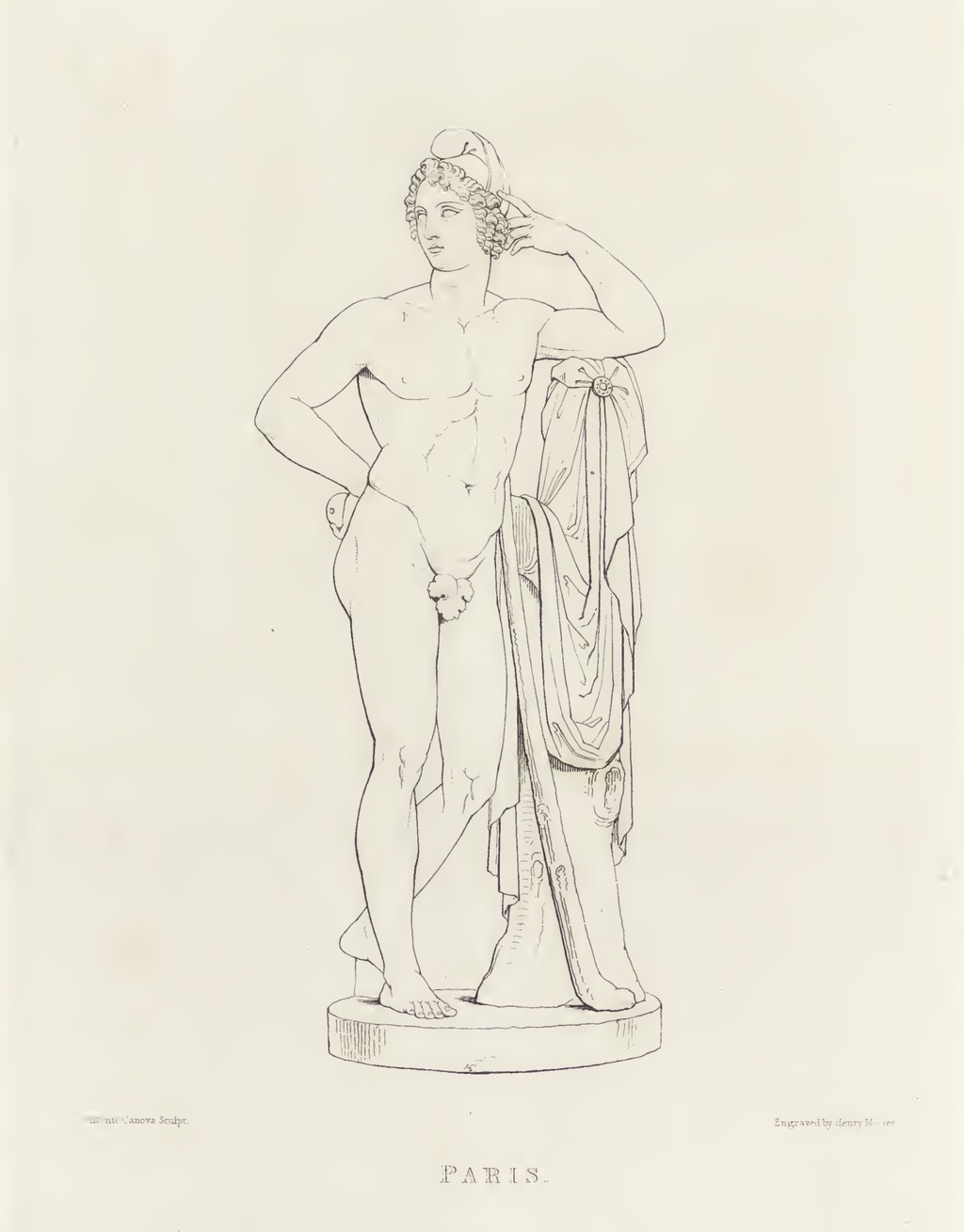
The outline engraving gives a view of Paris with the weight of his body settled over one leg. Henry Moses, after Antonio Canova, engraving published in London, 1824. Getty Research Institute. Image source. Public domain. Scan margins trimmed and image resized.
An apple for Aphrodite
In the account attributed to Apollodorus, Strife throws an apple to be awarded for beauty. Zeus directs Hermes to take Hera, Athena and Aphrodite to Paris, who is also called Alexander, on Mount Ida. Each goddess offers him a reward. Hera offers rule, Athena victory in war, and Aphrodite marriage to Helen. Paris decides in Aphrodite’s favour. Helen is already married to Menelaus, and her departure with Paris leads to the Trojan War. The Met identifies this episode through the apple and describes the cap as Phrygian, a reference to the region in which Paris lived. [5] [6]
Canova gives the three goddesses no bodies and leaves Paris with his hand still closed around the prize. The face turns outward, yet the apple has not moved towards a recipient. The visible action could be a pause while he listens or considers. The contrast between a small gesture and its consequences is clearer when set beside Venus Victrix. In that portrait of Pauline Borghese as Venus, the apple rests in her hand as the prize she has won. In the standing Paris, the view from the back reveals the award while it is still in the judge’s possession. [2] [3] [5] [7]
Videos on Canova
Explore Canova’s workshop methods and the settings for his sculpture.
From Sketch to Stone | Canova: Sketching in Clay
Watch sculptor Fred X. Brownstein recreate a Canova Venus, using clay, plaster and marble.
Watch on YouTubeFrom the model to Malmaison
The plaster model had its own history before Joséphine’s marble. Canova’s workshop accounts record Giuseppe Salvietti working on the clay for Paride between February and March 1807. Canova went on revising the clay. The date scratched on the plaster, May 1807, is associated in the National Edition with that stage. The final payment to the caster Vincenzo Malpieri in June gives a probable date for the completion of the plaster. The Museo Correr identifies the full-length plaster in its collection as the original model. The Museo Gypsotheca Antonio Canova in Possagno records its own plaster as a copy of the Hermitage marble. Both preserve the design, but they stand at different points in its history. [1] [8] [9] [10]
Gaetano Cerrotti received a payment in January 1808 under an agreement for work on the standing Paris. The studio’s assistants used a full-size plaster and measured between fixed points to establish where the surfaces should fall in the block. A record of that stage can precede the finishing date by years. The Met dates the first marble’s completion to November 1812, while the Hermitage catalogue places the finished figure at Malmaison by February 1813. That difference between completion and arrival also helps explain why an early biographer dated the work to 1813. [1] [5] [8]
Alexander I acquired the statue from Joséphine’s heirs in 1815. In Saint Petersburg it joined other works by Canova from Malmaison, including Hebe and the Dancer. The Hermitage catalogue records that the Paris suffered serious damage on the way to Russia and that the sculptor Ivan Martos restored it. The catalogue lists multiple restoration joins and a loss at the left edge of the base. In a close photograph of the lower half, lines cross the standing leg and the stone beneath the trunk. Those visible breaks belong to a marble with a documented history of damage, though a photograph cannot establish when each one was repaired. [1] [11] [12]
Ludwig’s version and the studio marble
Crown Prince Ludwig commissioned a second version in 1811. According to the Neue Pinakothek, Canova began work on a new block the following year and completed the statue in 1816. The Munich figure is a little shorter than Joséphine’s and is carved from white marble with dark grey veining. The museum photograph shows a vein crossing the upper torso. The draped trunk, bent leg and turn of the head repeat the main design, but this line across the chest belongs to the block used for Ludwig’s statue. It is a visible difference in a composition whose outline otherwise changes little. [1] [4]
The New York marble was still unfinished in the Roman studio when Canova died in 1822. His assistants completed it in 1823. Giovanni Battista Sartori, Canova’s half-brother, sold it to the third Marquess of Londonderry in late 1826 or early 1827 together with a workshop marble of Venus. The Met attributes its Paris to Canova’s workshop and gives the figure’s height as 203.2 centimetres. Its photographs show how the same pose reads from two frontal angles. From one the face looks almost straight out. From the other it is closer to profile, with a clear line from the chin to the chest and more space between the fingers and the cap. [5]
Sartori helped send another full-length marble to Asolo. In 1836 he wrote to the town offering a figure carved from Carrara marble in his brother’s Roman studio, at the same scale as the model. He was unsure whether Canova had put a hand to it. The statue was inaugurated in Asolo in 1838. Sartori’s own account shows how a work could have a direct connection to Canova’s studio while leaving the contribution of the sculptor himself open. [13]
The cap and turned face also recur in versions that stop at the neck and shoulders. The Art Institute of Chicago’s Bust of Paris has its own commission and history. A bust makes the face and the folds of the cap the centre of attention. The standing figure gives the head a place within a larger movement that starts at the raised heel, continues through the tilted torso and ends with the eyes looking away from the apple. [2] [3] [14]
Explore Canova’s works
Browse the sculptures and paintings covered in this guide. Several entries compare versions or examine details of a larger work.
Discussion
Look again at the images and ideas explored in Paride (Paris). These editorial prompts invite your observations.
Reader Insights
How does the standing figure carry the weight of the pose?
What does the apple tell you about the moment Canova chose?
Join the Conversation
Share a detail, comparison or question about Paride (Paris) below.
References
- Sergey Androsov, State Hermitage Museum, Italian Sculpture, 17th–18th Centuries, cat. 246, p. 269, Paris, inv. Н. ск. 19. View source.
- Netelo, Hermitage hall 241 – 81 – Antonio Canova – Paris, front photograph of the Hermitage marble. View source.
- Netelo, Hermitage hall 241 – 84 – Antonio Canova – Paris, rear photograph of the Hermitage marble. View source.
- Bayerische Staatsgemäldesammlungen, Paris, Neue Pinakothek, WAF B 4. View source.
- Metropolitan Museum of Art, Paris, Workshop of Antonio Canova, 2003.21.2. View source.
- Pseudo-Apollodorus, Epitome 3.2–3, translated by James George Frazer, Perseus Digital Library. View source.
- Galleria Borghese, Paolina Borghese Bonaparte come Venere vincitrice. View source.
- Edizione Nazionale delle Opere di Antonio Canova, Scritti II, introduction, pp. XVIII–XX and workshop account index. View source.
- Museo Correr, Sale Neoclassiche e Collezione canoviana, original 1807 plaster model. View source.
- Museo Gypsotheca Antonio Canova, Paris, Possagno plaster, institutional record published by Google Arts & Culture. View source.
- Sergey Androsov, State Hermitage Museum, Italian Sculpture, 17th–18th Centuries, English edition, introduction on the history of the collection. View source.
- Netelo, Hermitage hall 241 – 82 – Antonio Canova – Paris, photograph of the lower figure and base. View source.
- Museo Civico di Asolo, Il Museo Civico di Asolo. Guida alle collezioni, catalogue with Sartori’s letters of 21 June 1836 and 1 June 1838 transcribed from the museum archive. View source.
- Art Institute of Chicago, An Educated Taste: Neoclassicism at the Art Institute, Museum Studies 15, no. 1, entry on the Bust of Paris. View source.


 Antonio Canova.jpg)

