

 by Tom Gurney
Tom Gurney BSc (Hons) is an art history expert with over 20 years experience
Published on June 19, 2020 / Updated on September 27, 2026
Email: tomgurney1@gmail.com / Phone: +44 7429 011000
A life between music, drawing and painting
Paul Klee's life moved repeatedly between Bern and Germany. He was born near Bern in 1879, trained as an artist in Munich, raised a family there with the pianist Lily Stumpf, taught for a decade at the Bauhaus and then at the Düsseldorf Academy. In 1933 the Nazi regime forced him from that post. He and Lily returned to Bern, where he continued to work through serious illness until his death in 1940. The familiar images of playful birds, coloured squares and enigmatic signs belong to this history, but they were made in different rooms, under different pressures and with different materials.[1][2]
Music was a constant in the household. So was work: Lily's piano teaching paid the family's bills when Paul's art brought in little income, while he cared for their son and developed his practice. Later their circumstances changed, as his work found collectors, a dealer and a teaching post. The story is richer when their shared domestic life, his artistic contacts and the political events around them remain visible alongside the pictures.[3][4]
At a Glance
- Born18 December 1879, Münchenbuchsee near Bern [1]
- Died29 June 1940, Locarno-Muralto [1]
- FamilyMarried the pianist Lily Stumpf; son Felix [3]
- TeachingBauhaus, 1921–1931; Düsseldorf Academy, 1931–1933 [1]
- Final homeBern, from December 1933 [1]
Paul Klee among artists, schools and works
Der Blaue Reiter circle
Klee's contact and exhibitions, 1911–1914Bauhaus
Klee's teaching, 1921–1931Düsseldorf Academy
Klee's professorship, 1931–1933Lyonel Feininger
Bauhaus master, 1919–1932Paul Klee
Bauhaus master, 1921–1931Wassily Kandinsky
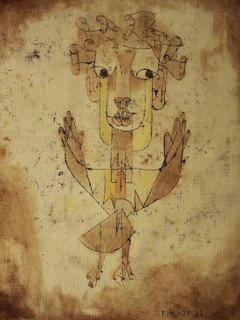
Bauhaus master, 1922–1933Angelus Novus
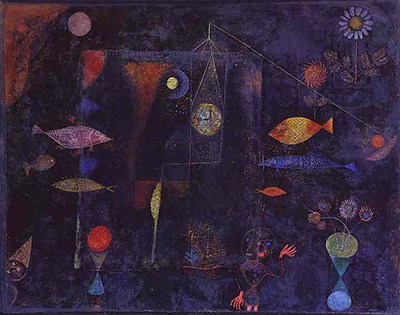
1920Fish Magic
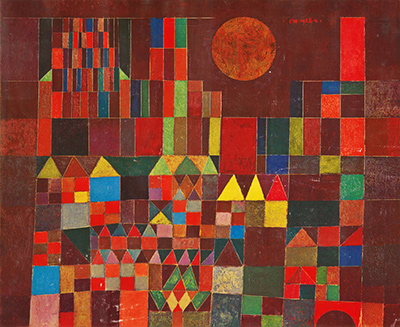
1925Castle and Sun
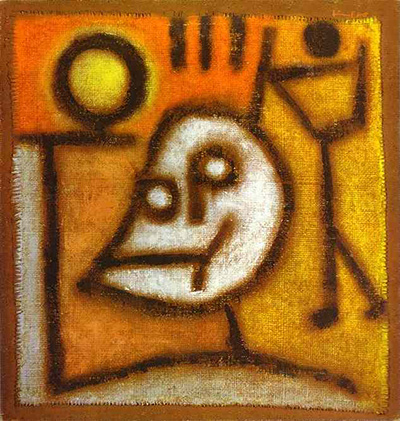
1928Death and Fire
1940Timeline dates follow the Zentrum Paul Klee chronology, Bauhaus institutional history and the object records cited below.
Contents
- Bern childhood and the choice of art
- Lily Stumpf, Felix and a working household
- New contacts in Munich and Paris
- War service, public attention and 1919
- Teaching at the Bauhaus
- Düsseldorf and the break of 1933
- A life visible in materials
- Illness and the last years
- What remained after his death
Four stages of Paul Klee's career
Bern, Munich and the road to Tunisia
Music, formal drawing study, Italy, early graphic satire and new artistic contacts shaped Klee's first public exhibitions. The 1914 Tunisia journey entered an inquiry into colour already under way.
Work and exhibition during wartime
Military service at aviation facilities coincided with continued production and sales through Der Sturm. The 1919 Goltz agreement and 1920 retrospective brought a more established public career.
The Bauhaus and Düsseldorf
At the Bauhaus Klee taught form, colour and ways of constructing images while developing his own work. He moved to the Düsseldorf Academy in 1931 and was suspended after the Nazi takeover in 1933.
Exile, illness and new production
Working from an apartment in Bern, Klee continued to exhibit and make varied works through serious illness. Lily's care and correspondence, local friendships and continued collecting were part of the conditions of those years.
Bern childhood and the choice of art
Klee was born on 18 December 1879 in Münchenbuchsee, near Bern. His father, Hans Wilhelm Klee, taught music; his mother, Ida Maria Frick, was a singer and pianist. The family moved to Bern in 1880. An older sister, Mathilde, also belonged to the household. Klee returned to the family home on visits, made views of Bern's streets and surroundings and eventually lived there again for the final years of his life.[1][5]
He learned the violin and kept playing as an adult. His family's musical world made a professional future in music conceivable, while drawing offered another path. After completing secondary school in 1898, Klee chose art and went to Munich. He later played chamber music with Lily and friends, attended concerts and opera, collected scores and used musical terms as tools for thinking about pictorial order. The music article follows those connections and their limits.[1][3]
In Munich he studied at Heinrich Knirr's private drawing school and entered Franz von Stuck's painting class at the academy, which he left after about five months. In 1901–02 he travelled through Italy with the sculptor Hermann Haller. Confronting ancient and Renaissance art sharpened the problem of finding his own artistic position. Back in Bern, Klee worked independently, making drawings, etchings and early paintings on glass. Formal instruction, travel and extended self-study all shaped his training.[1][5]
The early graphic work is easy to miss if one starts with his later squares. Klee's small etchings and satirical figures use line to invent human types and uncomfortable situations. Their wit has an edge. A Zentrum Paul Klee exhibition on satire traced this tendency through his early drawings and beyond, resisting the comfortable idea that his humour was merely childlike. Graphic invention was part of the foundation on which the later colour pictures grew. The drawings and prints pages give these works the space they deserve.[2][6]
Bern offered more than a room in the family house during these years. Klee renewed friendships with Hans Bloesch, Fritz Lotmar and Louis Moilliet after his return from Italy. Bloesch wrote poems and satirical texts that Klee illustrated; Klee also contributed concert, theatre and exhibition criticism to periodicals Bloesch edited. The work joined his musical life, graphic wit and emerging public voice. Moilliet, himself a painter, worked and travelled with him before becoming one of his companions on the Tunisia journey. Lotmar shared music and discussions about art and later became a trusted medical adviser during Klee's illness. These relationships lasted across the changes in Klee's residence and career.[5]
He was teaching before he became a Bauhaus master. From 1904, Klee gave the young painter Marguerite Frey-Surbek weekly private lessons for about two years. His later response to seeing her paintings exhibited in Bern registers both surprise at her progress and uncertainty about his own painting at that point. His teaching began in this small, personal setting, years before the formal classes in Weimar and Dessau.[5]
Lily Stumpf, Felix and a working household
Klee met Lily Stumpf in Munich in 1899. She had studied piano at the Royal Academy of Music there from 1894 to 1898 and continued at Berlin's Stern Conservatory. This was professional training, distinct from the private musical education Paul had received. Their relationship developed through playing together as well as correspondence. They married in Bern on 15 September 1906 and set up home in Munich. Their son Felix was born on 30 November 1907.[1][3][7]
Lily taught piano and earned the family's main income while Paul's art was not yet selling reliably. He undertook much of Felix's care and worked at the kitchen table in their Ainmillerstrasse apartment. The arrangement joined childcare and artistic labour in the same rooms; it also depended on Lily's paid skill and time. She sometimes appeared as a concert pianist, and the couple continued to make music together. The image of Lily as a passive source of inspiration misses the musician, teacher and wage earner living beside the painter.[3][4][8]
Felix grew up amid this mixture of music, pictures and performance. From 1916 to 1925 Paul made approximately fifty hand puppets for him, using fabric scraps and found materials as well as shaped heads; thirty survive at the Zentrum Paul Klee. They were objects for play and theatre within the family, not paintings waiting to be hung on a wall. Their making connects the household to Klee's pleasure in invented figures and improvised materials, while the particular history of each puppet deserves its own account. A child, pupils, a piano and a painter's improvised workspace were all part of daily life.[9]
As Paul's reputation grew, the family's finances and routines changed. Lily continued to manage relationships and exchange information with artists and friends, including Wassily and Nina Kandinsky. In the years of exile she helped maintain a network that carried news of housing, health, exhibitions and other people. Her letters preserve her own account of those years.[10]
New contacts in Munich and Paris
Klee's first solo exhibition took place in Switzerland in 1910. It opened in Bern with 56 works, then travelled to Zurich, Winterthur and Basel. The Bern press was often reserved or baffled, according to the Zentrum Paul Klee's study of his relationship with the city. This early tour therefore marks the start of a public career, not immediate acclaim. Years later Bern's Kunsthalle would present substantial selections drawn from local collections, a sign that the city continued to be more than Klee's place of birth.[5]
In Munich he met Wassily Kandinsky in 1911 and came into contact with the artists around Der Blaue Reiter, including Gabriele Münter, August Macke, Alexej Jawlensky, Marianne von Werefkin and Franz Marc. He showed 17 works in the group's second exhibition in 1912. Exhibiting with the circle placed his graphic inventions before an interested audience, but he did not become the founder or spokesman of a single artistic movement. His contacts were real and varied; so was his independence.[1][11]
An April 1912 visit to Paris brought direct encounters with Cubist art and with Robert and Sonia Delaunay. A scholarly edition of the Delaunay correspondence dates the studio visit to 11 April. The experience helped Klee think about colour, light and the division of a picture, alongside questions he had already begun to pursue. His later watercolours often retain a drawn or inscribed structure even when coloured areas appear to lead the image.[1][12]
Klee's writing and exhibition work developed alongside these encounters. He translated Robert Delaunay's essay on light for Der Sturm in 1913. At the gallery's First German Autumn Salon that year he showed watercolours and drawings; in 1914 he helped found the New Munich Secession. These activities placed him in several overlapping artistic conversations before the war. Translation, criticism and exhibiting were ways of testing ideas in public as well as routes by which other artists and readers encountered his work.[13]
In April 1914 Klee travelled through Tunisia with Macke and Louis Moilliet. Architecture, streets, light and coloured surfaces entered works made there and works developed afterward. The trip also became a turning point in Klee's account of himself. A much repeated diary declaration about colour and painting should be read as his narrated experience, not as proof that he had first noticed colour in Tunisia. His diary texts were later edited into a retrospective autobiographical form, and his earlier experiments already complicate a single conversion story. The Tunisia article follows the journey, its objects and that later telling in detail.[1][14]
Hammamet with Its Mosque offers a tangible example. The Metropolitan Museum of Art identifies watercolour and graphite on paper mounted on cardboard. Architectural forms remain present, yet translucent colour planes and intersecting lines reorganise the view. One can see an observed place and an experiment in construction at once. Such an object tells us more about Klee's changing practice than the shorthand that one journey turned him into a painter overnight.[15]
War service, public attention and 1919
The First World War brought the deaths of fellow artists Macke and Marc. Klee was called up for military service on 11 March 1916. After infantry training he served at aviation facilities at Schleissheim and Gersthofen, where he continued to make art when he could. This was military service, but the record does not place him as a front-line combat pilot. His wartime production and exhibition history need to be read together: shows at Herwarth Walden's Berlin gallery Der Sturm brought his work to a wider modernist public while the war was still under way.[1][16]
A Berlin Sturm exhibition in February 1917 resulted in enough sales to improve the family's finances, according to a detailed German biographical study. A volume of twenty-four Klee drawings appeared in the gallery's book series in 1918. These were concrete channels for a graphic artist's work to circulate while he was still serving. Their financial effect also changes the domestic story: Lily had supported the household through piano teaching for years, but sales now contributed more substantially to its income. The war did not pause Klee's public career.[13]
In 1919 Klee rented a workspace in Suresnes Castle near Munich. That year also brought the short-lived Munich council republic and arguments about what art institutions might become after the war. Klee's part in this episode is documented more precisely than a simple label such as “political” or “apolitical” allows. In a letter dated 12 April 1919, reproduced in a German archival study, he offered his artistic work to the revolutionary artists' committee. A transcript of its 22 April meeting records his admission and lists him in the painting section of the art commissariat. The evidence shows a specific willingness to participate in cultural change. It does not by itself make him a leader of the government or establish a lasting party allegiance.[17]
The committee's ambitions included exhibitions and changes to art education. The council republic was violently defeated in May. Klee's subsequent career cannot be explained solely by this brief political episode, but omitting it would make his public world look falsely remote from the events around him. The same years saw galleries, critics and dealers shaping the reception and market for modern art. Research into that history has challenged the idea of an artist working outside every institution, while also warning against treating every change of title or style as a calculated sale tactic. The surviving objects, letters and catalogues require closer distinctions than either story offers.[17][18]
On 1 October 1919, Klee signed a three-year sales agreement with the Munich dealer Hans Goltz, later extended to 1925. The contract gave a defined commercial structure to the growing attention. In 1920 Goltz mounted a retrospective of 362 works, and the first monographs on Klee appeared. Exhibitions, publications and a gallery relationship gave his work a visibility that the kitchen-table years had not. The Berlin Nationalgalerie organised his first German museum exhibition in 1923. Walter Gropius had invited him to the Bauhaus in late 1920. The sequence joins artistic development to the practical circumstances that made a teaching career possible.[1][18][13]
Teaching at the Bauhaus
The Bauhaus appointed Klee in late 1920. One institutional account dates the beginning of his post to 10 January 1921, while the Zentrum Paul Klee dates the start of his composition teaching to 13 May. The family moved from Munich to Weimar later that year.[1][19]
Klee taught students to examine the formation and movement of shapes and the relations among colours. A point could lead to a line, a line to a plane; a grid could shift through division and variation. His classes and surviving notes address ways of seeing and making, not a recipe for producing replicas of his paintings. He taught in relation to workshops and other masters, within a school that changed its structure over time. The Bauhaus article follows the classes, students and workshop contexts more closely.[19][20]
That relationship becomes concrete in the weaving workshop. From the summer semester of 1927, Klee offered a design course for its students. A study grounded in his pocket calendar and Gunta Stölzl's account describes lessons in reflection, rotation, displacement, repetition and the division of a plane. The woven works were made by the students and workshop artists, including women whose design work has its own authorship. Klee's contribution was a teaching framework among several sources of their practice. His own pictures from these years can share an interest in repeated and shifted elements without being treated as the designs that the weavers executed.[21]
One student makes the reach of his teaching beyond Dessau visible. Petra Petitpierre studied at the Bauhaus with Josef Albers and Kandinsky, joined Klee's painting class in 1930 and followed him to the Düsseldorf Academy in 1931. After marriage and a move to Murten, her time for art was limited; a renewed meeting with Klee in 1937 preceded her return to work. She later helped restore his paintings and care for the estate.[5]
He published the small Pädagogisches Skizzenbuch (Pedagogical Sketchbook) in 1925. The extensive teaching papers now held in Bern are another body of evidence, and the large volumes commonly called the “Paul Klee Notebooks” were assembled after his death. Those distinctions matter when we ask what Klee himself put into print and what later editors made available. The notebooks article follows the manuscripts and publication history.[22]
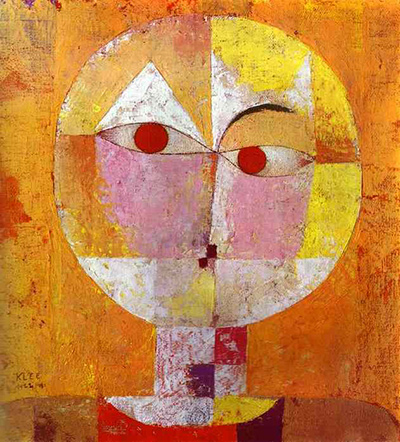
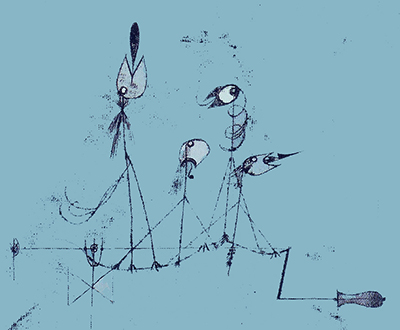
Teaching did not suspend his own work. Twittering Machine (1922) uses an oil-transfer drawing, watercolour and ink to make four birds and a crank seem both comic and uneasy. Senecio (1922) builds a face from broad coloured planes. They have quite different surfaces and viewer demands. Looking at them alongside the teaching notes can be illuminating, provided a particular painting is not presented as a direct illustration of a lesson without evidence.[23][24]
The school moved to Dessau in 1925; Klee and Lily moved there with Felix in 1926. Their home was one half of a Bauhaus master's house shared with Wassily and Nina Kandinsky. Photographs and gifts show a social and artistic relationship that extended beyond faculty meetings. The correspondence between the two households became fuller again after geographic separation in the 1930s, when letters had to carry the everyday news that proximity once made easier.[1][10]
The Bauhaus appointment changed Lily's working life too. She had supported the household through piano lessons for roughly fifteen years, and leaving Munich meant leaving the city where she had built that work. She continued to practise and perform in Weimar and Dessau. She attended Gertrud Grunow's Bauhaus course for three years, took part in concerts with Paul for the school community and kept a guestbook that records musicians and composers visiting their home. Her account of their Weimar farewell concert in March 1925 lists Bach and Mozart alongside other music she performed. She was an active participant in the Bauhaus musical world, with her own interests as a trained pianist and host.[3]
The 1920s also took Klee's work to international audiences. Galka Scheyer brought him together with Kandinsky, Lyonel Feininger and Jawlensky as Die Blaue Vier in 1924, seeking attention for their art in the United States. Klee appeared in a 1925 Paris exhibition associated with Surrealism. The Museum of Modern Art in New York presented his work in March 1930, in a programme that also included presentations of Max Weber, Wilhelm Lehmbruck and Aristide Maillol. Its catalogue names dealers and collectors who lent to the Klee section. His career crossed several countries and artistic circles.[1][25]
Collectors also organised around his work. In 1925 the Braunschweig businessman Otto Ralfs founded a Klee Society whose annual purchases provided an additional source of income. By 1929 Alfred Flechtheim's Berlin gallery represented Klee, and a fiftieth-birthday exhibition there travelled in reduced form to MoMA the following year. The New York presentation thus had a specific path through a German gallery and its lenders. It was part of a developed network of buying, exhibiting and publishing, not an unexplained leap from the Bauhaus classroom to an American museum.[13][25]
He travelled to Egypt in 1928, a journey whose relation to pictorial division and landscape has been discussed through particular works. In Highway and Byways (1929), rising bands and branching paths invite a landscape reading while retaining a visibly measured design. Such pictures also belong to a longer inquiry into rhythm and structure. Travel gave Klee subjects and experiences; Bauhaus study had already given him ways to reorganise a surface.[26]
Düsseldorf and the break of 1933
Klee left the Bauhaus in 1931 to become a professor at the Düsseldorf Academy of Art. The move offered a different teaching position after a decade at the school. The Nazi takeover of power in 1933 soon made his post untenable. An academy report reproduced by the Zentrum Paul Klee records his suspension without notice on 21 April 1933. Its antisemitic allegation about him was a false premise used to justify persecution, not a fact about his ancestry. A formal dismissal followed in October.[27][28]
He and Lily decided in early November to leave Germany. The practical move involved permits and the sale or storage of furniture, books and pictures. They reached Bern around Christmas; Felix remained in Germany at that point. They stayed briefly in the Klee family home, then occupied furnished rooms on Kollerweg from January to May 1934. Lily's 29 December 1933 letter to Felix reports that Paul had begun working amid the difficulty of their changed circumstances. It is a glimpse of one moment, not a certificate that the upheaval was easy for either of them.[29]
The couple moved into an apartment at Kistlerweg 6 in June 1934. Paul used its sitting room as a studio. This was a smaller setting than a romantic image of the solitary painter's grand atelier might suggest, but it became the place of an extensive late oeuvre. Their Bern life was sustained by relationships as well as work. Hanni Bürgi had been an early collector and friend; Hermann and Margrit Rupf had bought Klee drawings from 1914 onward and remained important to the couple after their return. These people had different roles as friends, collectors and advisers. Bern was a place of exile and a place with long-standing ties.[5][8]
Bürgi had met Klee through singing lessons with his father. She continued collecting after her husband's death, despite criticism within her family, and acquired around fifty of Klee's works. Her son Rolf continued that interest and helped Klee with legal matters. The Rupfs' first purchase, in 1914, was a group of three drawings; they bought more over the following years. Their sustained attention meant that Klee returned to a city where people knew particular works, not just his name.[5]
An exhibition at the Kunsthalle Bern in 1935 included more than 270 of Klee's works, focusing on the preceding five years. The show gives a measure of continuing public activity in a period often narrated only through loss and isolation. Yet a Bern exhibition could not undo his removal from German teaching or the attacks on modern art there. It belongs to the complicated geography of his final years: working in Switzerland, separated from old institutions in Germany, and maintaining relationships with collectors and galleries in several countries.[5]
Klee made works in 1933 that face political events directly and others whose meaning remains open. More than 200 expressive pencil drawings from the year have been discussed as a response to the Nazi seizure of power. The Zentrum Paul Klee cautions that he did not present them as a named series or label every sheet as a depiction of a specific event. Their rough, urgent lines nevertheless address subjects including militarism, repression and persecution. Another 1933 image, Leontine, remains playful and satirical. The year does not resolve into a single visual mood. The late-work article follows those differences and the evidence for interpreting them.[30][31]
Fire at Full Moon has been discussed in relation to that summer's violence; its owning museum presents the dating as probable and the political reading as a question. The conditions of dismissal and displacement belong to the picture's history, but they do not supply a ready-made key for every shape. Its visible red form and bright disc can be described before a political meaning is proposed.[32]
In 1937, the Nazi authorities confiscated 102 Klee works from German museums, according to the Zentrum Paul Klee. Some were put into the regime's defamatory Entartete Kunst exhibition. Confiscation, public abuse and the movement of individual works through dealers and collections belong to the material history of his art; they were not merely insults in a critic's column.[1][33]
A life visible in materials
Across these decades Klee moved among prints, drawing, watercolour, oil transfer, painting and constructions on many kinds of support. He often attached paper to cardboard, allowing a small sheet to become a layered object. The physical choices can anchor the biography more securely than an attempt to make every picture illustrate an episode of his life. Approximately four fifths of his oeuvre consists of works on paper, according to the Zentrum Paul Klee. This is one reason the line remains so important even in a career often introduced through colour.[34]
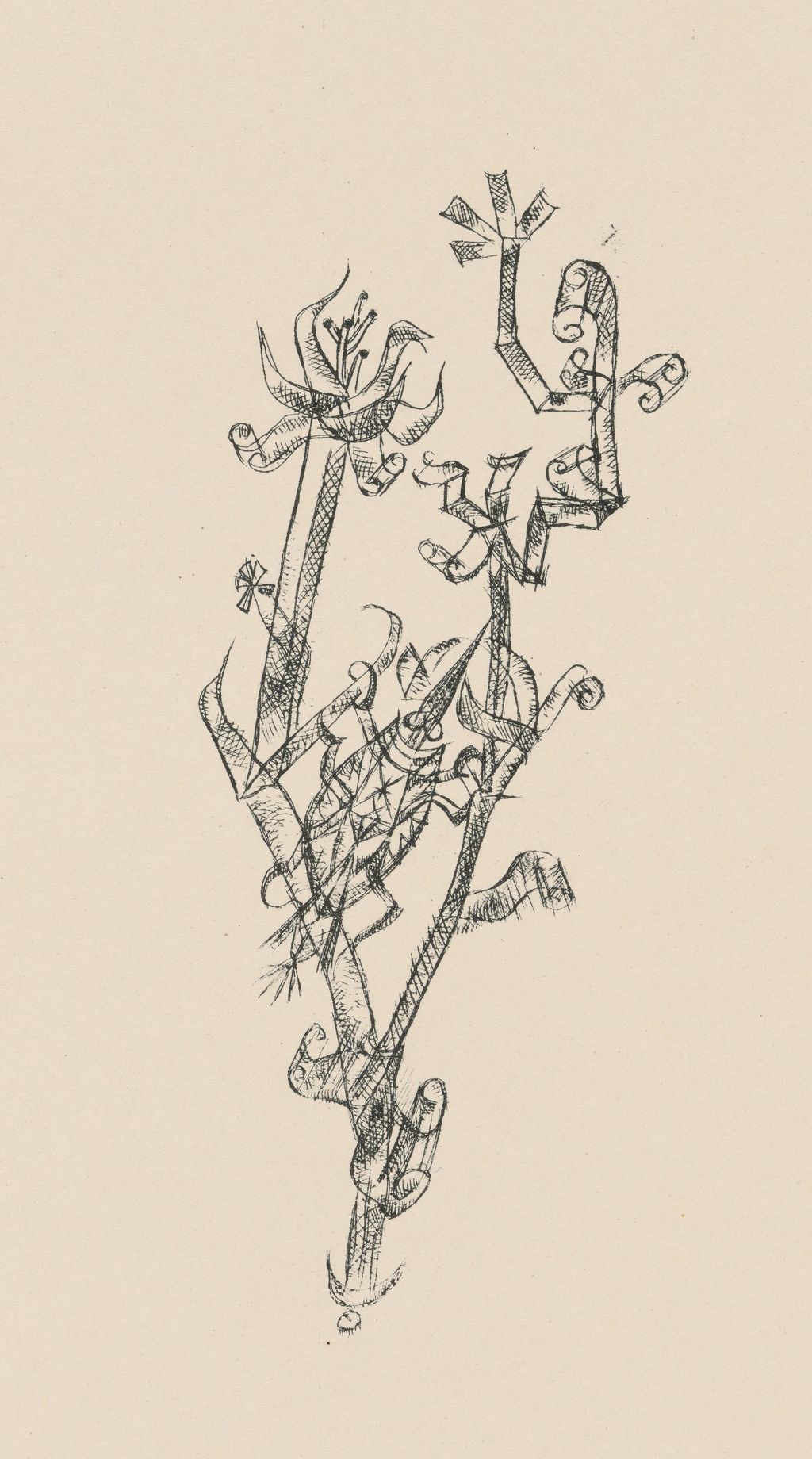
Compare a work from the start of his public success with one from his Bern years. Riesenblattlaus (Giant Aphid, 1920) is a lithograph, documented by the National Gallery of Art as part of a bound volume of contemporary German graphic art. Its insect-like title and intricate line belong to the world of printmaking and circulation, not to an isolated painting on an easel. The editioned work reached viewers through a publication alongside prints by other artists. It shows how Klee's graphic practice could move into a wider public culture at the time of his 1920 retrospective and Bauhaus appointment.[35]
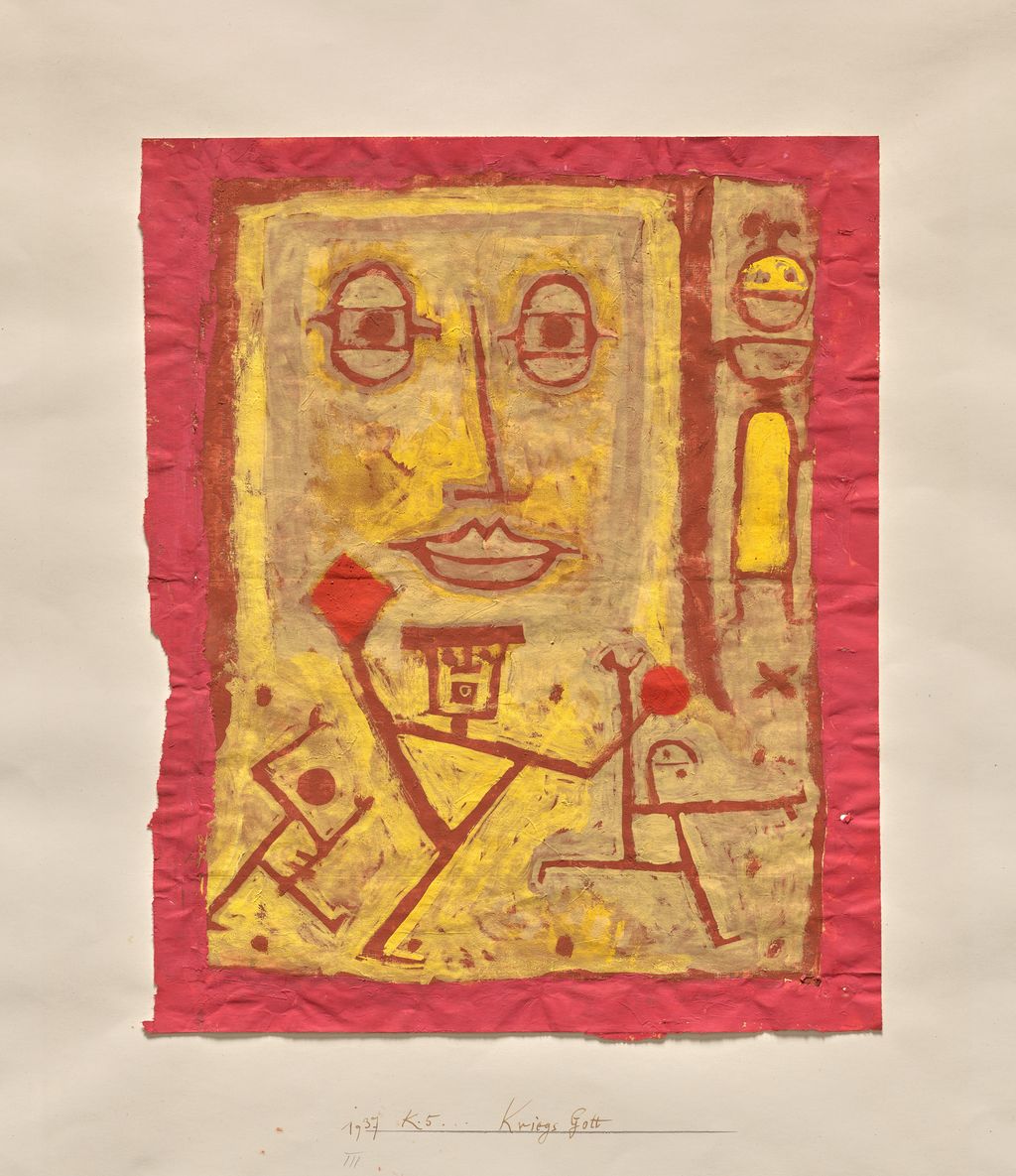
In God of War (Kriegsgott, 1937), now in Cleveland, Klee used gouache and tempera on a sheet of newspaper that he mounted on paper. The museum identifies an article about the Spanish Civil War beneath and among his painted forms. A large face and smaller figures emerge through the colour and the printed page. The newspaper is a material fact; treating every form as a literal diagram of the war would go beyond what the object proves. The work nevertheless makes political news part of the surface itself. Its support, scale and marks make a very different sort of encounter from the 1920 lithograph, while connecting the late image to the wider world Klee was living through.[36]
Illness and the last years
Klee became seriously ill in 1935. The name progressive scleroderma was applied retrospectively after his death; it should not be written as a diagnosis he was given at the start of his illness. The condition changed his working life. The number of works entered in his register dropped sharply to 25 in 1936, then rose again. The Zentrum Paul Klee records 1,253 works in 1939. Those annual figures count works of varied size and medium; they do not mean he completed more than a thousand large paintings in a year.[1][37]
Lily's letters give the illness a household chronology that annual production totals cannot. From late 1935 into early 1936 Paul was largely confined to bed, and Lily reported his condition to friends and dealers. From that period until his death, she handled almost all his correspondence. She also managed much of his care and finances, with help from others at times. In 1939, after years of that work and the strain of the couple's displacement, she herself needed a prolonged rest cure. Her letters describe the cost in her own terms. The late pictures were made within a shared life of care, worry, practical decisions and continuing relationships; Lily's labour helped make time for Paul's work.[38]
There were also periods of travel and concentrated work within these years. In autumn 1937 Paul and Lily stayed in Ascona, in a small house they rented from Maria Marc. Lily's letters describe an improvement in his condition and time spent walking, receiving visitors and working. Klee made pastels there and entered works from the stay in his handwritten register. The trip sits between the severe interruption of 1936 and the extraordinary output of 1939, showing how the pace and circumstances of his work changed.[38]
The visible late work is diverse. Broader marks appear in some pieces, while others retain intricate structures. Death and Fire (1940) brings a face, letter-like forms and its title into an unmistakable encounter with mortality. Insula dulcamara (1938) offers a much larger field with signs that invite several readings. Individual materials and dates matter in both cases. Illness can be part of their history without becoming the only reason a particular line or surface looks as it does.[39]
Klee continued to seek Swiss citizenship. Although born in Switzerland to a Swiss mother, he held German citizenship during his life. A Zentrum Paul Klee chronology records a naturalisation application on 24 April 1939 and no final decision during his lifetime. He died on 29 June 1940 at Locarno-Muralto; the application was granted on 5 July, six days afterward. Describing him only as “Swiss” or only as “German” without the chronology can therefore mislead. His birthplace, passport, home, career and later reception do not all fit the same short label.[1][40]
What remained after his death
Lily Klee lived until 1946 and remained central to the care and continuity of his work. After his death, Kunsthalle Bern mounted a memorial exhibition of 233 works from the estate. After Lily's death, Hermann Rupf and Rolf Bürgi formed the Klee Society in Bern; the Paul Klee Foundation followed. The present Zentrum Paul Klee houses the largest collection of his works and a vast archive, including his handwritten register, teaching papers, letters, personal documents, photographs and materials from his studio. These holdings make it possible to check the life against far more than the familiar anecdotes and reproductions.[5][41]
The Bürgi family archive gives that continuity a more personal shape. It preserves letters sent by both Paul and Lily, photographs and gifts, as well as records of Rolf Bürgi's later work as a business adviser and estate administrator. Documents concerning the Klee Society and the foundation show how a friendship and a collecting relationship became part of the practical work of keeping an artistic legacy together. The archive also holds materials from Klee's studio.[42]
Klee's public image also changed after 1940. Dealers, writers, exhibitions and museums presented him in different ways: as a figure linking early modernism to later artists, as a Bauhaus teacher, as a colourist, as a poet of signs. Reception research has shown how strongly postwar writing helped establish the Klee now familiar in art history. That history need not displace the works themselves. It makes us ask which Klee a particular account chooses to emphasise, and why.[18]
The route through his art is wider than a biography can hold. Begin with the paintings hub for works in many forms, or follow a question through colour, music, drawings and materials and techniques. A close look at one object often brings the life into focus: a line transferred on paper, a title that changes a face, or a colour field made in a particular year, room and set of circumstances.
Explore selected works from Klee’s much larger oeuvre. Titles without a link have an authenticated catalogue identity but no reviewed article yet.
Artworks directory
| Name | Date | Medium |
|---|---|---|
| A Gate | 1939 | Painting and mixed media |
| A Woman for Gods | 1938 | Watercolour and mixed media |
| Ab Ovo | 1917 | Watercolour and mixed media |
| Above Mountain Summit | 1917 | Drawing and mixed media |
| Abstract Trio | 1923 | Drawing and mixed media |
| Acrobats | 1915 | Watercolour and mixed media |
| Actor's Mask | 1924 | Painting and mixed media |
| Ad Marginem | 1930 | Drawing and mixed media |
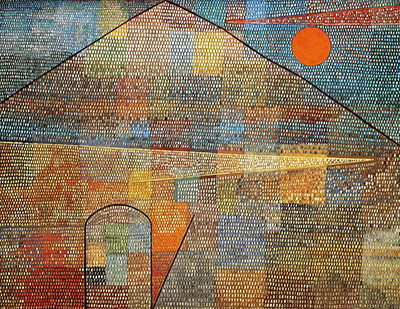
| Ad Parnassum | 1932 | Painting and mixed media |
| Adventurer Ship | 1927 | Drawing and mixed media |
| Affected Place | 1922 | Drawing and mixed media |
| After a Sketch from Zurich | 1914 | Watercolour and mixed media |
| After Drawing | 1919 | |
| After The Floods | 1936 | Watercolour and mixed media |
| All Souls' Picture | 1921 | |
| Ancient Harmony | 1925 | Painting and mixed media |
| Angel Applicant | 1939 | Drawing and mixed media |
| Angel Serves the Desired | 1920 | |
| Angel, Still Female | 1939 | Painting and mixed media |
| Angelus Novus | 1920 | Drawing and mixed media |
| Animal Terror | 1926 | Painting and mixed media |
| Arab Song | 1932 | Painting and mixed media |
| Archangel | 1938 | Painting and mixed media |
| Architecture | 1923 | Painting and mixed media |
| Architecture of the Plain | 1923 | Drawing and mixed media |
| Around the Fish | 1926 | Painting and mixed media |
| Arrival of the Air Steamer | 1921 | Drawing and mixed media |
| Asiatic God | 1924 | Painting and mixed media |
| Astrological Fantasy Portrait | 1924 | Drawing and mixed media |
| Athlete's Head | 1932 | Watercolour and mixed media |
| Aufgehender Stern | 1931 | Painting and mixed media |
| Autumn Flower | 1922 | Painting and mixed media |
| Bad Band | 1920 | Drawing and mixed media |
| Baroque Centaur | 1939 | Painting and mixed media |
| Before the Blitz | 1923 | Drawing and mixed media |
| Before the Snow | 1929 | Drawing and mixed media |
| Besessenes Madchen | 1924 | Watercolour and mixed media |
| Bird Garden | 1924 | |
| Bird Wandering Off | 1926 | Watercolour and mixed media |
| Blossoms in the Night | 1930 | Watercolour and mixed media |
| Blue-Bird-Pumpkin | 1939 | Painting and mixed media |
| Boats in the Flood | 1937 | Painting and mixed media |
| Botanical Theatre | 1934 | Drawing and mixed media |
| Boy in Fancy Dress | 1931 | Watercolour and mixed media |
| Broken Key | 1938 | |
| Brother and Sister | 1930 | Watercolour and mixed media |
| But the Red Roof | 1935 | Painting and mixed media |
| C - C = Fisch | 1931 | Watercolour and mixed media |
| Cacti | 1912 | Painting and mixed media |
| Camel (in Rhythmic Landscape with Trees) | 1920 | Drawing and mixed media |
| Captive Pierrot | 1923 | Drawing and mixed media |
| Castle and Sun | 1928 | Drawing and mixed media |
| Cat and Bird | 1928 | Drawing and mixed media |
| Cathedrals | 1925 | Watercolour and mixed media |
| Chalice of the Heart | 1937 | Painting and mixed media |
| Characters in Yellow | 1937 | Painting and mixed media |
| Chosen Site | 1927 | Mixed media |
| Christmas Picture | 1923 | Drawing and mixed media |
| City of Towers | 1916 | Painting and mixed media |
| Clarification | 1932 | Painting and mixed media |
| Collection of Figurines | 1926 | Painting and mixed media |
| Colorful Architecture | 1917 | Painting and mixed media |
| Comedians' Handbill | 1938 | |
| Comic Opera Singer | 1927 | Painting and mixed media |
| Composition | 1939 | Painting and mixed media |
| Composition with Figures | 1915 | Drawing and mixed media |
| Composition with the Yellow Half-Moon and the Y | 1918 | Watercolour and mixed media |
| Conch–Still Life II | 1939 | Watercolour and mixed media |
| Cosmic Composition | 1919 | Painting and mixed media |
| Crystal Gradation | 1921 | Drawing and mixed media |
| Dance of the Grieving Child | 1922 | Painting and mixed media |
| Dancing Girl | 1940 | Painting and mixed media |
| Das Licht und Etliches | 1931 | Mixed media |
| Death and Fire | 1940 | Painting and mixed media |
| Death for the Idea | 1915 | |
| Demon as Pirate | 1926 | Watercolour and mixed media |
| Diana | 1931 | Painting and mixed media |
| Diavolo Player | 1923 | Drawing and mixed media |
| Die Kapelle | 1917 | Watercolour and mixed media |
| Die Vase | 1938 | Painting and mixed media |
| Doctor | 1930 | Drawing and mixed media |
| Dredger and Sailboat | 1931 | Watercolour and mixed media |
| Ein Tor | 1939 | Painting and mixed media |
| Ein Weib fur Gotter | 1938 | Mixed media |
| Embrace | 1939 | Watercolour and mixed media |
| Episode before an Arab Town | 1923 | |
| Equals Infinity | 1932 | Painting and mixed media |
| Eros | 1923 | Drawing and mixed media |
| Error on Green | 1930 | Watercolour and mixed media |
| Evening Figure | 1935 | Drawing and mixed media |
| Falling Bird | 1919 | |
| Fermata | 1932 | Watercolour and mixed media |
| Fire Clown | 1921 | Watercolour and mixed media |
| Fire Full Moon | 1933 | Watercolour and mixed media |
| Fire in the Evening | 1929 | Painting and mixed media |
| Fish in the Harbour | 1916 | Watercolour and mixed media |
| Fish Magic | 1925 | Watercolour and mixed media |
| Flock of Birds | 1917 | Drawing and mixed media |
| Flora on Sand | 1927 | Watercolour and mixed media |
| Flower Myth | 1918 | |
| Flower Stand with Watering Can and Bucket | 1910 | Watercolour and mixed media |
| Flowering Tree (Abstraction with Reference to a Flowering Tree) | 1925 | Painting and mixed media |
| Flowers in Pots | 1923 | |
| Flowers in Stone | 1939 | Painting and mixed media |
| Forest Witch | 1938 | Painting and mixed media |
| Fright of a Girl | 1922 | Drawing and mixed media |
| Fruits on Red | 1930 | Drawing and mixed media |
| Full Moon | 1919 | Mixed media |
| Föhn Wind in Franz Marc's Garden | 1915 | Watercolour and mixed media |
| Garden in St Germain, The European Quarter near Tunis | 1914 | Watercolour and mixed media |
| Ghost Chamber with the Tall Door (New Version) | 1925 | |
| Ghost of a Genius | 1922 | Drawing and mixed media |
| Girl in Mourning | 1939 | Painting and mixed media |
| Glance of a Landscape | 1926 | Watercolour and mixed media |
| Gluht Nach | 1939 | Drawing and mixed media |
| Golden Fish | 1925 | Watercolour and mixed media |
| Goldfish Wife | 1921 | Watercolour and mixed media |
| Green Plant, Blood, Louse | 1924 | Drawing and mixed media |
| Hafenbild | 1918 | Mixed media |
| Hammamet with Mosque | 1914 | Watercolour and mixed media |
| Harbour with Sailing Ships | 1937 | Painting and mixed media |
| Hauptweg und Nebenwege | 1929 | Painting and mixed media |
| Heavenly and Earthly Time | 1927 | Drawing and mixed media |
| Heroic Fiddling | 1938 | Painting and mixed media |
| Heroic Roses | 1938 | Painting and mixed media |
| Heroic Strokes of the Bow | — | Mixed media |
| Highway and Byways | 1929 | Drawing and mixed media |
| Houses near the Gravel Pit | 1913 | Watercolour and mixed media |
| Howling Dog | 1928 | Painting and mixed media |
| In the Current Six Thresholds | 1929 | Painting and mixed media |
| In the Style of Kairouan | 1914 | Drawing and mixed media |
| Individualized Altimetry of Stripes | 1930 | Painting and mixed media |
| Insula Dulcamara | 1938 | |
| Interior with the Clock | 1913 | Watercolour and mixed media |
| Irma Rossa the Animal Tamer | 1918 | Drawing and mixed media |
| Journey in Corsica | 1927 | Drawing and mixed media |
| Landscape with Bluebirds | 1919 | Watercolour and mixed media |
| Legend of the Nile | 1937 | Painting and mixed media |
| Lemon Harvest | 1937 | Watercolour and mixed media |
| Likeness in the Bower | 1930 | Watercolour and mixed media |
| Limits of Reason | 1927 | Painting and mixed media |
| Little Hope | 1938 | Watercolour and mixed media |
| Magdalena before the Conversion | 1938 | Drawing and mixed media |
| Mask of Fear | 1932 | Painting and mixed media |
| May Picture | 1925 | Painting and mixed media |
| Monument in a Cemetery | 1922 | Watercolour and mixed media |
| Monuments at G | 1929 | Watercolour and mixed media |
| Municipal Jewel | 1917 | Watercolour and mixed media |
| Mural from the Temple of Longing Thither | 1922 | |
| Nach der Uberschwemmung | 1936 | Watercolour and mixed media |
| New Harmony | 1936 | Painting and mixed media |
| New House in the Suburbs | — | Mixed media |
| Old Steamboat | 1922 | Drawing and mixed media |
| On the Edge | 1930 | Drawing and mixed media |
| Once Emerged from the Gray of Night | 1918 | Drawing and mixed media |
| One Who Understands | 1934 | Painting and mixed media |
| Oriental Pleasure Garden | 1925 | Painting and mixed media |
| Park of Idols | 1939 | Watercolour and mixed media |
| Passing by Red Pillars | 1928 | Watercolour and mixed media |
| Persian Nightingales | 1917 | Drawing and mixed media |
| Popular Wall Painting | 1922 | Painting and mixed media |
| Prestidigitator | 1927 | Watercolour and mixed media |
| Rainy Day | 1931 | Watercolour and mixed media |
| Red and White Domes | 1914 | Watercolour and mixed media |
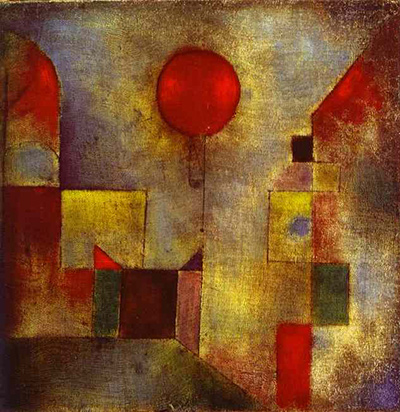
| Red Balloon | 1922 | Drawing and mixed media |
| Redgreen and Violet-Yellow Rhythms | 1920 | Drawing and mixed media |
| Refuge | 1930 | Watercolour and mixed media |
| Rhythmic Rythmical | 1930 | Painting and mixed media |
| Saint of the Inner Light | 1921 | |
| Scaffolding of a New Building | 1930 | Painting and mixed media |
| Scholar in Dealing with Stars | 1926 | Watercolour and mixed media |
| Seated Woman | 1930 | Drawing and mixed media |
| Senecio | 1922 | Painting and mixed media |
| Separation in the Evening | 1922 | Drawing and mixed media |
| Sinbad the Sailor | 1923 | Drawing and mixed media |
| Skeptically Smiling | — | Mixed media |
| Small House in the Garden City | 1928 | Watercolour and mixed media |
| Small Portrait of a Girl in Yellow | 1925 | Painting and mixed media |
| Southern Gardens | 1919 | Watercolour and mixed media |
| Static-Dynamic Gradation | 1923 | Drawing and mixed media |
| Still Life | 1927 | Painting and mixed media |
| Still Life with Gladioli | 1932 | Watercolour and mixed media |
| Strange Garden | 1923 | Drawing and mixed media |
| Stricken City | 1936 | Painting and mixed media |
| Strong Dream | 1929 | Watercolour and mixed media |
| Struck from the List | 1933 | Drawing and mixed media |
| Structural I | 1924 | Drawing and mixed media |
| Sumpflegende | 1919 | Painting and mixed media |
| Temple Gardens | 1920 | Drawing and mixed media |
| The Arrow before the Target | 1921 | Drawing and mixed media |
| The Barbed Noose with the Mice | 1923 | Watercolour and mixed media |
| The Flora of the Heath | 1925 | Watercolour and mixed media |
| The Goldfish | 1925 | Watercolour and mixed media |
| The Hour Before One Night | 1940 | Painting and mixed media |
| The Man in Love | 1923 | |
| The Mask with the Flag | 1925 | Mixed media |
| The Pathos of Fertility | 1921 | |
| The Rhine at Duisburg | 1937 | Painting and mixed media |
| The Way to the Citadel | 1937 | Painting and mixed media |
| Three Houses and a Bridge | 1922 | Watercolour and mixed media |
| Tightrope Walker | 1923 | |
| Tomb in Three Parts | 1923 | Watercolour and mixed media |
| Tomcat's Turf | 1919 | Watercolour and mixed media |
| Tower in Orange and Green | 1922 | Drawing and mixed media |
| Tree and Architecture - Rhythms I | 1920 | Watercolour and mixed media |
| Tree and Architecture - Rhythms II | 1920 | Painting and mixed media |
| Tropical Dawn with the Owl | 1921 | Mixed media |
| Tropische Dammerung | 1921 | Painting and mixed media |
| Twittering Machine | 1922 | Drawing and mixed media |
| Variations (Progressive Motif) | 1927 | Watercolour and mixed media |
| Ventriloquist and Crier in the Moor | 1923 | |
| Viaducts Break Ranks | 1937 | Drawing and mixed media |
| Villa R | 1919 | Painting and mixed media |
| Village Carnival | 1926 | Painting and mixed media |
| Vor dem Blitz | 1923 | Drawing and mixed media |
| Wald-Hexen | 1938 | Painting and mixed media |
| Young Forest | 1925 | Drawing and mixed media |
Discussion
Klee's life brought music, drawing, teaching, family work and political upheaval into the same long artistic career.
The works and documents leave room for close looking as well as careful disagreement about interpretation.
Reader Insights
Which Klee work changes most when you look at its actual surface and materials?
How do Lily Klee's letters and musical work change your view of the Bauhaus and Bern years?
Which episode in Klee's biography would you investigate further, and what evidence would you seek?
Join the Conversation
Share a work, question or source that helped you understand Klee's life. Please keep interpretations tied to what the object or document shows.
References
- Zentrum Paul Klee, “Paul Klee,” institutional biography and chronology (German, checked against English, French and Italian versions), View source.
- Sabine Rewald, The Metropolitan Museum of Art, “Paul Klee (1879–1940),” Heilbrunn Timeline of Art History (2004), View source.
- Bauhaus-Archiv, Musikerinnen und Musiker im Umfeld des Bauhauses (German, 2025), p. 136, Lily's training, teaching and early household work, View source.
- Zentrum Paul Klee, Menschen unter sich exhibition guide (English), family and domestic context, View source.
- Zentrum Paul Klee, “Klee in Bern,” exhibition account (German; English version), family, collectors and later Bern years, View German source.
- Zentrum Paul Klee, Satire – Irony – Grotesque, exhibition guide (English), early and later satirical work, View source.
- Zentrum Paul Klee, Ich will nichts wissen exhibition guide (German), chronology recording Felix's birth on 30 November 1907, View source.
- Zentrum Paul Klee, “Bewegung im Atelier” (German), the Munich kitchen workspace and later studios, View source.
- Zentrum Paul Klee, Kosmos Klee exhibition guide (English), the hand puppets made for Felix, View source.
- Christine Hopfengart, “Wo sind Sie? Herr Klee? Der Briefwechsel von Paul Klee und Wassily Kandinsky,” Zwitscher-Maschine (German, 2016), archive-based correspondence account, View source.
- Lenbachhaus, “Der Blaue Reiter” (German), the circle and exhibition context, View source.
- Heidelberg University scholarly edition, Delaunay correspondence and the April 1912 Paris visit (German), View source.
- Deutsche Biographie, “Klee, Paul” (German), scholarly biographical account of pre-war exhibitions, Sturm sales, the Goltz contract, collectors and international exhibitions, View source.
- Marianne Keller Tschirren, Dreieck, Kreis, Kugel (German dissertation), p. 62 n. 274 and pp. 141–42, the 1914 diary and later redaction, View source.
- The Metropolitan Museum of Art, “Hammamet with Its Mosque,” object record, View source.
- Zentrum Paul Klee, “Klee im Krieg” (German), exhibition research on military service and wartime art, View source.
- Justin Hoffmann, Der Expressionist, study of Fritz Schaefler and the revolutionary artists' committee (German), pp. 21, 26, reproducing Klee's 12 April 1919 letter and citing the 22 April committee transcript, View source.
- Jenny Anger, “How Many Klees Today?,” RACAR 18 (1991), critical review of Werckmeister and Hopfengart on career and reception (English), View source.
- Bauhaus Kooperation, “Paul Klee,” biography and teaching chronology (German), View source.
- Bauhaus Kooperation, “Unterricht: Paul Klee” (German), teaching methods and student work, View source.
- Bauhaus Kooperation, “Klee und die Weberei” (German), design course, pocket calendar and Gunta Stölzl evidence, View source.
- Bauhaus-Archiv, “Bauhausbücher 2: Paul Klee, Pädagogisches Skizzenbuch,” publication account, View source.
- The Museum of Modern Art, “Twittering Machine,” object record and medium, View source.
- Kunstmuseum Basel, Senecio exhibition booklet and object research (German), View source.
- The Museum of Modern Art, “Weber, Klee, Lehmbruck, Maillol,” exhibition history (1930), with Klee catalogue, View exhibition.
- Fundación Juan March and Zentrum Paul Klee, Paul Klee: maestro de la Bauhaus (Spanish, 2013), Marianne Keller Tschirren, “Ritmo,” pp. 127–28, View source.
- Zentrum Paul Klee, Ich will nichts wissen exhibition guide (English), April 1933 Düsseldorf academy report and suspension, View source.
- Zentrum Paul Klee, “Klee & Kandinsky,” exhibition chronology (English version; original German material), 1933 suspension and later dismissal, View source.
- Walther J. Fuchs, “Leben im Provisorium: Mansardewohnung Kollerweg 6,” in Mit Klee durch Bern (German, 2015), pp. 63–65, including Lily's 29 December 1933 letter to Felix, View source.
- Zentrum Paul Klee, “Looking After” (hegen), object guide and contextual essay on the 1933 drawings (English), View source.
- Zentrum Paul Klee, “Leontine,” 1933 object guide (German), View source.
- Museum Folkwang, “Fire at Full Moon,” object record and qualified interpretation (German/English), View source.
- Fondation Beyeler, Klee exhibition chronology (German, 2017), confiscation and display of works in 1937, View source.
- Zentrum Paul Klee, “Sammlung” (German), works on paper and conservation account, View source.
- National Gallery of Art, Washington, “Riesenblattlaus (Giant Aphid),” 1920 lithograph from Deutsche Graphiker der Gegenwart, object record, View source.
- Cleveland Museum of Art, “God of War,” 1937, object and material record, View source.
- Zentrum Paul Klee, “Paul Klee und seine Krankheit” (German) and Catastrophe of the Sphinx (English), illness and retrospective diagnosis, illness source.
- Walther J. Fuchs, “Paul Klee und seine Krankheit revisited,” Zwitscher-Maschine 4 (2017; German with English summary), archive-based study of the household's illness chronology, Lily's correspondence and care, View source.
- Zentrum Paul Klee, Cover Star Klee guide (English), late-work object material, View source.
- Fondation Beyeler / Zentrum Paul Klee, Klee exhibition chronology (French, 2017), 24 April 1939 naturalisation application and later years, View source.
- Zentrum Paul Klee, “Archiv & Forschung” (German), holdings and access, View source.
- Zentrum Paul Klee, “Schenkung Archiv Bürgi” (German, 2012), contents of the family archive and Rolf Bürgi's advisory and estate roles, View source.