


 by Tom Gurney
Tom Gurney BSc (Hons) is an art history expert with over 20 years experience
Published on June 19, 2020 / Updated on September 27, 2026
Email: tomgurney1@gmail.com / Phone: +44 7429 011000
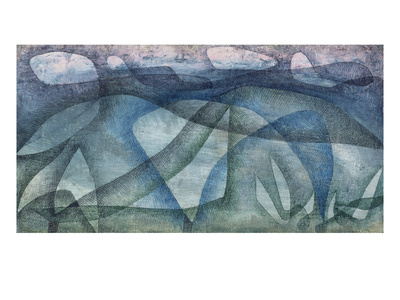
Rainy Day: movement across a gauze surface
Paul Klee's Regentag, or Rainy Day, was made in 1931. Christie's records the signature at lower right and identifies the work as watercolour and gouache on gauze mounted on a prepared board, fixed by the artist to a wooden support. Its 2019 catalogue gives the dimensions as 21.2 × 39.7 cm and cites Klee's own Oeuvrekatalog number 150. The printed Paul Klee, Catalogue raisonné is listed there as volume 6 (2002), page 114, number 5555; that printed entry was not directly consulted for this page.[1]
The broad, shallow image has no single falling line that simply illustrates a drop of rain. Instead, overlapping blue-green and grey curves rise, bend and cross one another. Pale ovals gather near the upper edge. A darker strip lies behind them, while translucent shapes move across the middle. The title invites us to experience shifting weather, but the image resists becoming a straightforward view out of a window.[1][2]
A landscape that will not settle
The lower field contains irregular arching shapes that might suggest hills, waves or vegetation. Some lines loop downward like stems, and others cut across them at an angle. The lighter forms can be read as a landscape seen through a watery veil, yet Klee leaves no stable horizon, building or human figure to anchor that reading. The picture's force comes from a succession of partly legible forms.[2]
Near the top, pale horizontal ovals hover over a narrow, dark blue band. They may recall clouds, but they also act as pauses in the continuous movement below. Across the middle, wide curved ribbons overlap in different shades of blue, green and grey. Their intersections deepen the colour without turning the bands into solid walls. The eye travels along one arc, then meets another moving in a different direction.[2]
The work's long format intensifies that lateral movement. At about forty centimetres wide and twenty-one high in Christie's measurement, the original is modest in scale. The image can be scanned from left to right, but its curves repeatedly pull the gaze back. It is a small composition built on recurrence and interruption rather than a panoramic view of a named place.[1][2]
Christie's essay describes the translucent lines and cool colour range as evoking wind-driven showers and a blurred landscape. That is a useful interpretation of what the picture makes visible. It is not evidence that Klee painted from a specific storm or that a particular arc depicts a raindrop. The earlier version of this page imagined a dream state and a fixed link to the artist's 1914 Tunisia journey. Neither claim follows from the object record or from the image.[1][2]
The layered support
Christie's technical line is unusually precise: watercolour and gouache on gauze, then a prepared board, then a wooden support fixed by the artist. Gauze is a woven surface. Its fine structure can alter how a wash catches and how overlapping colour appears, though the available reproduction cannot replace a close conservation examination. This material description is more informative than calling the work simply a painting in blue tones.[1]
The mixture of watercolour and gouache also matters. Watercolour can leave translucent passages, while gouache can supply denser marks. The image has both pale crossings and more opaque dark zones. The exact sequence of layers cannot be reconstructed from a web photograph, but the catalogue's medium explains why different passages behave differently. Klee's own fixing of the gauze and board makes the support part of his construction of the work.[1][2]
Another publication gives 20.5 × 38.5 cm and describes the work as watercolour on card nailed to a frame, on loan from a private collection to the Zentrum Paul Klee. It appeared in a discussion of Mies van der Rohe's collages, rather than a conservation report. The smaller measurement may refer to a different boundary of the image, or it may reflect abbreviated cataloguing; the available sources do not resolve the difference. Christie's full technical description and dimensions are retained here, with the variation noted rather than silently merged.[1][3]
Date, catalogue and early circulation
The German title Regentag is recorded by Christie's with the 1931 execution date and artist's work-register number 150. The auction catalogue cites the foundation's later catalogue raisonné entry 5555. These two numbers belong to different cataloguing systems and should not be treated as conflicting dates or different paintings. The English “Rainy Day” is a translation of the title, not a second work.[1]
Christie's provenance says Klee consigned the work to Karl Nierendorf in New York in 1938, where it remained on deposit until 1960. It then names James Gilvarry in New York, probably acquiring it in 1960, followed by descent in a New York private collection. The then owner acquired it from that family in 1987, according to the 2019 catalogue. The record does not establish its current ownership or a complete account of every intervening legal transfer.[1]
The exhibition list begins before the New York consignment: Kunsthalle Bern showed it in a Klee exhibition in 1935, Kunsthalle Basel in the same year, and Kunstmuseum Luzern in 1936. It was in San Francisco's Museum of Art in 1939 and Nierendorf Gallery's New York show in 1941. Later listings include the Philadelphia Art Alliance in 1944, exhibitions drawn from Gilvarry's collection in Baltimore, Richmond, Champaign and Santa Barbara between 1960 and 1967, and Zentrum Paul Klee exhibitions in 2016, 2017 and 2019.[1]
Those venues demonstrate that the work has been repeatedly seen and reproduced. They do not mean it belongs to the Zentrum Paul Klee collection: the documentary description of the 2016–17 display calls it a private-collection loan. A generic visitor guide naming Regentag among works associated with the centre is insufficient proof of museum ownership. The distinction matters when describing where the original can be seen today.[1][3]
Lines, rhythm and later reuse
Christie's French and English essays connect the work's intertwined curves with a sense of rhythm, comparing their separate strands to musical voices. That reading is more closely tied to the picture than a general statement that Klee liked music. Still, a visual analogy is not a score: the painting provides no measured beat, instrumentation or melody. Its rhythmic quality lies in the repeated rise and crossing of lines across the gauze surface.[1][2]
The image also had a later life beyond Klee's own painting. A publication on Mies van der Rohe's MoMA collages records that a detail from Regentag appears in his Row House with Interior Court project, after 1938, as a cut-and-pasted reproduction. This is evidence of the work's use in architectural presentation, not evidence that Klee intended it as an architectural picture. Its horizontal sweep could function differently when set into the imagined interior of a collage.[3][4]
Klee made Regentag in the year he left the Bauhaus for a professorship in Düsseldorf. That change is documented in the auction essay, but the blue and grey passages should not be read as a direct emotional diary of it. What the work shows is more specific: translucent arcs, denser darks, a gauze support and a long image field that remains in motion. The title supplies weather; the picture lets the viewer feel the instability of seeing through it.[1][2]
Related artworks
Explore eight other Klee works from the researched artwork cluster.
Ad Marginem
1930
Ad Parnassum
1932
Error on Green
1930
Mask of Fear
1932
Fire Full Moon
1933
Fire in the Evening
1929
Highway and Byways
1929
References
- Christie's, Regentag, Paris Avant-Garde sale, 17 October 2019, lot 23 (French and English): signature, materials, 21.2 × 39.7 cm dimensions, provenance, exhibitions, artist work-register no. 150 and citation to Paul Klee, Catalogue raisonné, vol. 6 (2002), p. 114, no. 5555. The printed catalogue itself was not directly read, View source.
- Christie's, same lot image and bilingual essay: visual reference and an attributed interpretation of the curved lines, cool tones and weather effect. This source is an auction interpretation rather than an artist's statement, View source.
- Docomomo Journal 56, “Mies van der Rohe: The MoMA Collages” exhibition report (English, 2017): private-collection loan, alternative 20.5 × 38.5 cm measurement and identification of a Regentag detail in Mies's collage, View source.
- Museum of Modern Art, Mies van der Rohe, Row House with Interior Court: institutional record for the architectural collage dated after 1938. The Docomomo report identifies the Klee reproduction within it, View source.