


 by Tom Gurney
Tom Gurney BSc (Hons) is an art history expert with over 20 years experience
Published on June 19, 2020 / Updated on September 27, 2026
Email: tomgurney1@gmail.com / Phone: +44 7429 011000
Rhythmisches: variation inside a grid
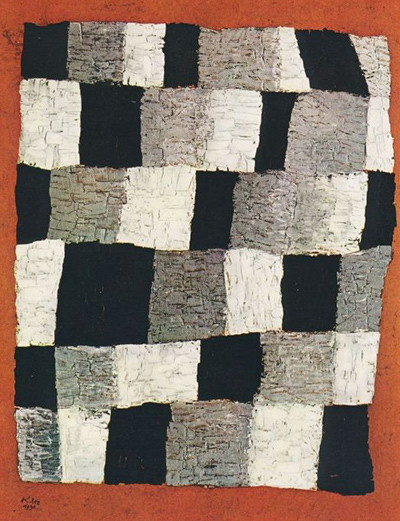
Paul Klee's Rhythmisches is a painting of repeated forms that refuses to behave like a regular checkerboard. Black, grey and white blocks appear to march across a reddish ground, yet their widths, edges and intervals change as the eye follows them down. The title invokes rhythm. It does not supply a tune to hear, and there are no literal musical notes in the painting. Instead, Klee uses repeated colour and measured disruption to make looking unfold over time. The work belongs to the Musée national d'art moderne at the Centre Pompidou, Paris, inventory AM 1984-356.[1]
The museum dates the painting to 1930, records oil on canvas and gives dimensions of 69.6 × 50.5 cm. Its object entry transcribes “1930.E.3 Rhythmisches / Klee” on the stretcher and records Klee's signature and date at the lower left. The frame is described as an original strip supplied by the artist. The same entry cites the printed Paul Klee: Catalogue Raisonné, volume V, number 5320; that is the museum's citation, not a claim that the printed catalogue has been directly consulted for this page. The spelling on the inherited local URL, “Rhythmic Rythmical”, is a legacy English label. Rhythmisches is the owner's title, with En rythme its French rendering.[1]
Image credit: Centre Pompidou, MNAM-CCI/Philippe Migeat/Dist. GrandPalaisRmn, via Wikimedia Commons. The Commons file also lists Sailko and a CC BY 3.0 licence.[1][5]

A grid that slips
From a distance, the composition is almost severe. A broad rectangular field of dark and pale units occupies most of the canvas. Around it, the warm terracotta ground acts like a margin, visibly wider at the top and bottom. The first impression is of a set pattern. Once the eye starts comparing one line with the next, a different system emerges. The blocks are not all squares, the rows do not land on a single unbroken set of verticals, and some divisions seem to lean or swell. The Centre Pompidou describes a three-part black, grey and white sequence unsettled by syncopations and variations from the fourth line onward.[1]
Those variations create movement without a depicted moving thing. A white passage may continue where the viewer expected black; a dark rectangle becomes unusually broad before the sequence tightens again. The corners are softened by paint, and boundaries sometimes look pushed rather than ruled. What seems countable at the start becomes harder to count as the rows accumulate. Rhythm here is not a mechanically repeated unit. It is the tension between an anticipated beat and a small change that forces the eye to start again.[1]
The colours are restricted but not inert. The greys shift with the paint surface, and the whites carry ridges and traces of the darker ground. Thickly laid passages catch light differently from the near-black blocks. Christian Derouet's Pompidou essay notes that the material was applied with a knife. This visible substance matters to the musical analogy. If the design were a purely printed grid, its repeated cells might feel identical. The paint gives each one a slightly different weight and duration, while the red ground keeps the whole structure visibly within a single, bounded field.[1]
No precise musical score is encoded in the picture. The museum calls it comparable to a visual score because of its shifting metre and tonal range. That analogy helps describe a viewer's experience, but it should not be turned into a claim that Klee assigned each block to an instrument or particular note. The old local article did just that, adding generalized claims about drums, synaesthesia and musical notes. The object record supports the more exact observation: Klee made variation within a patterned visual sequence, drawing on musical ideas of rhythm without illustrating a known composition.[1][4]
A painting made in 1930
The date matters. Klee was still connected to the Bauhaus at Dessau when he made Rhythmisches. A Zentrum Paul Klee publication records that he agreed informally in May 1930 to leave the school in April 1931, received confirmation of a Düsseldorf academy appointment during the summer and submitted his resignation in September. The Pompidou essay places the work among larger compositions undertaken in this period, after his 1928–29 Egypt journey, and describes a professional shift toward freer studio painting. The date does not justify reading the irregular grid as a coded personal diary of his departure. It locates the painting among the formal experiments of his last Bauhaus year.[1][3]
The same Pompidou essay reports that Klee's work was gaining public attention on both sides of the Atlantic, including a March 1930 New York exhibition organized by J. B. Neumann at the new Museum of Modern Art. This context helps prevent an impression that the grid was merely a private exercise. It emerged while Klee's paintings circulated internationally and while his relationship to teaching was changing. Still, the exhibition history of Rhythmisches itself must be distinguished from general milestones in Klee's career.[1]
Music had long been part of Klee's life and vocabulary. The Centre Pompidou's educational material notes his violin and piano practice and his sustained interest in musical structure. It also points to works on movement, rhythm and polyphony. These facts make the title intelligible, but the visual evidence remains primary. The painting does not need a listener to know a particular piece of music. Its repeated sequence, interruptions and changes of density are the means by which it asks the viewer to experience a rhythm.[4]
Related rhythms, separate works
Rhythmisches was not Klee's only experiment with a patterned field. The Lenbachhaus in Munich holds Rhythmisches strenger und freier (Rhythmical, Stricter and Freer), also made in 1930. It is a different object: paste colour on paper mounted on cardboard, 47 × 61.5 cm, inventory G 16155, with its own artist work number, 1930,59 (09). Its German collection essay relates it to Dreitakte im Geviert and to the Pompidou's Rhythmisches. It also cites Klee's work-catalogue account of the Munich sheet's thick paste colours worked with a knife.[2]
The Munich essay uses the phrase “magical squares” and traces Klee's checkerboard interests back to Alter Klang of 1925. It stresses how small shifts in the forms and colours prevent these works from becoming ordinary chessboards. That comparison sharpens what is happening in the Paris painting: a visible rule makes the exceptions legible. Yet the works differ in orientation, scale, support and exact colour relations. The Lenbachhaus sheet's artist catalogue description and 1930,59 (09) number cannot be transferred to the Pompidou canvas, whose own stretcher inscription reads “1930.E.3.”[1][2]
The Pompidou entry calls its work oil on canvas, while a separate Pompidou educational page describes oil on burlap. Burlap may be a more specific description of the textile support, but the two public records do not explain the terminology. This page therefore retains the object record's medium line and notes the variant rather than silently treating them as separate paintings or resolving the fibre without conservation evidence. Exact object identifiers, dimensions and visual correspondence show that the records concern the same Rhythmisches.[1][4]
Orientation and reproduction
Orientation matters for a painting constructed from uneven rows. The signed and dated lower-left corner in the current high-resolution reproduction agrees with the Pompidou's inscription record and with the existing local small image. The owner record's bibliography notes that a 1954 publication reproduced the work upside down under the French title Rhythmique. That historical error is a warning against treating every printed image as an equally reliable guide to the composition. The present page follows the owner record and checked image orientation.[1][5]
Reading the sequence
The composition rewards a slow, row-by-row look. It proposes a count, interrupts that count, then lets a new one begin. The reddish ground holds the moving pattern together without making its units uniform. The title supplies a musical concept; the paint makes that concept visible through difference as well as repetition. The result is neither a diagram of music nor a simple abstract checkerboard. It is a deliberately worked sequence in which a rule can be felt most strongly when it changes.[1][2]
Related artworks
Explore eight other Klee works from the researched artwork cluster.
Ad Marginem
1930
Error on Green
1930
Fire in the Evening
1929
Highway and Byways
1929
Ad Parnassum
1932
Castle and Sun
1928
Cat and Bird
1928
Mask of Fear
1932
References
- Centre Pompidou, Rhythmisches (En rythme) (AM 1984-356), object record and Christian Derouet's essay from Collection art moderne (2007); accessed 27 September 2026, View source.
- Lenbachhaus, Rhythmisches strenger und freier (G 16155), German object record and essay from Friedel and Hoberg, Der Blaue Reiter im Lenbachhaus München (2007); accessed 27 September 2026, View source.
- Zentrum Paul Klee, Paul Klee am Bauhaus, multilingual exhibition publication and 1930 chronology; accessed 27 September 2026, View source.
- Centre Pompidou, “Abstraction et musique”, educational essay and artwork caption; accessed 27 September 2026. Its isolated statement that Klee had left the Bauhaus three years before this 1930 painting conflicts with the object record and ZPK chronology, and is not used for dating, View source.
- Wikimedia Commons, Rhythmisches, 1930 - Paul Klee.jpg, file history, high-resolution reproduction and permissions; accessed 27 September 2026. The photograph is credited on the owner object page to Centre Pompidou, MNAM-CCI/Philippe Migeat/Dist. GrandPalaisRmn, View source.