


 by Tom Gurney
Tom Gurney BSc (Hons) is an art history expert with over 20 years experience
Published on June 19, 2020 / Updated on September 27, 2026
Email: tomgurney1@gmail.com / Phone: +44 7429 011000
After the Floods: marks and colour after the break of 1936
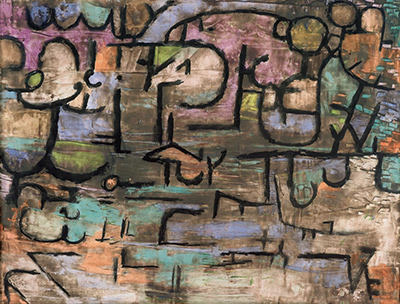
Paul Klee's After the Floods translates his German title Nach der UeberSchwemmung. The Fondation Beyeler identifies the picture as 1936, 7 (7), made with coloured paste and watercolour on Ingres paper mounted on cardboard. It measures 47.9 × 62.6 cm and belongs to the museum's collection as inventory 59.3. These particulars distinguish it from Klee's later Boats in the Flood, another work in the Beyeler collection whose English title sounds similar. The 1936 picture is a broad, horizontal field of subdued colour and dark signs; the 1937 one has its own designation, materials and composition.[1][2]
Across the image, pale pink, earthy tan and cooler green-blue passages meet without settling into a conventional horizon. Thin, dark marks stand, bend and cross through them. Some seem almost like branches or fragments of writing; others look more like small structures emerging from a shifting ground. Blocks of stronger orange and blue-green near the right edge catch the eye. The title invites us to think of water's aftermath, but the picture does not supply a literal report of a particular flood. Its partial signs make recognition possible, then keep it uncertain.[1]
A surface that will not settle
Klee places the picture's strongest lines over colour that appears to have moved or gathered unevenly. The darker strokes are legible as individual gestures, while the surrounding washes and paste-colour areas are harder to divide into separate objects. Their meeting is central to the picture: what might be a branch in one moment can resemble a letter in another. A small vertical cluster may suggest a dwelling, a reed or no stable object at all. These are responses to the reproduced image, rather than identifications documented by the artist.[1]
The loose arrangement also changes how the title works. “After” implies a time following an event, yet the image gives no before scene against which to measure destruction or recovery. The marks can be read as remnants, and the broad colour as a transformed landscape, but both remain interpretations. The old page described washed-away words and asserted a specific primitive-art influence. No work-specific source checked here establishes either claim. The visible ambiguity is more precise and more interesting than an invented narrative.[1][3]
The original capitalization, UeberSchwemmung, should be retained when identifying the object. Translation makes the title accessible, but it does not reproduce Klee's lettering. The owner's record also transcribes marks on the work: Klee's signature at the upper left and “IV” at the lower left. On a piece of the original cardboard, the reverse carries the date, number and title, “1936.7 // nach der UeberSchwemmung.” That qualification about a piece matters. The inscription is evidence for identity, not a reason to describe an intact original reverse that the current mounting does not preserve.[1]
Colour and support
The museum's present object record gives the medium as coloured paste and watercolour on Ingres paper mounted on cardboard. Paste colour here refers to a painting material, not to an assumption that every mark was made with the same brush or in a known sequence. The Zentrum Paul Klee's account of Klee's techniques explains that he used paste-bound colour in grounds from the 1920s and combined it with other media in later work. This context makes the owner's material description intelligible, while it does not reveal the exact recipe or application order of this particular sheet.[1][4]
Paper and cardboard are equally important to the description. The visible picture is a worked paper surface, subsequently mounted on a firmer support. The Beyeler's reference to the reverse inscription on a surviving cardboard piece tells us that the present object has a material history beyond the painted face. It would be misleading to reduce the work to “a watercolour” or to speak as though its coloured fields were an oil canvas. The mixture of coloured paste and watercolour gives the image both an opaque, gathered quality and lighter passages through which the paper still seems to matter.[1]
An earlier Beyeler exhibition caption used the rounded measurement 47.5 × 63 cm and the shorter material wording “paste colour and watercolour on paper.” The current collection record gives 47.9 × 62.6 cm and specifies Ingres paper and cardboard. Those are different descriptions of the same identified work, not evidence of two paintings. This page follows the current owner record for dimensions and medium, while retaining the older exhibition caption as a useful record of how the work was presented.[1][3]
The difficult year of 1936
The date matters because Klee's output fell sharply in 1936 during serious illness. A Zentrum Paul Klee press release counts 25 works that year, followed by renewed intensity in 1937. The Fondation Beyeler's account of his late work likewise describes the illness as a break in his practice and treats After the Floods within the emergence of a new late manner. These sources help place the painting in a difficult period without turning its title into a medical diagnosis or claiming that every black mark records a symptom.[3][5]
There is a further chronological caution. Klee's own annual designation 1936, 7 (7) places the work among his numbered production of that year, but the number alone cannot tell us when every stage of the paper was painted. Nor does the title prove that he witnessed a specific inundation. The work's visual language can be discussed alongside the upheaval of its year, provided that the historical context remains distinct from an explanation Klee did not leave for this image.[1][3]
The Beyeler's 2003 late-work exhibition framed the years after illness as a period of altered artistic energy rather than a simple ending. It described the 1936 interruption and subsequent return to work. Seen in that setting, After the Floods can stand at a threshold in his practice: its spare, dark signs and broad colour fields anticipate an interest in more emphatic marks. That is a contextual reading of the painting's place in a larger sequence, not a claim that this one picture contains the whole later style.[3]
A documented journey
The Beyeler provenance begins with Klee and then Lily Klee after his death in 1940. The Klee-Gesellschaft held the work from 1946. It passed through the Buchholz Gallery, associated with Curt Valentin in New York, from 1948, then to Frederick C. Schang in South Norwalk and New York by 1951; the owner's record places it with him to at least 1953. G. David Thompson in Pittsburgh followed, before the Beyeler collection acquired it in 1959. It has belonged to the Fondation Beyeler since 1991. These entries document successive custody, although they do not by themselves explain every transaction between owners.[1]
Its exhibition history begins during Klee's lifetime. The owner lists Paul Klee. Neue Werke at the Kunsthaus Zürich in February–March 1940. A New York Buchholz exhibition followed in 1950. Later displays include the Fondation Beyeler's 2003 late-work exhibition and its 2017 retrospective. The collection record also lists the Jewish Museum's Paul Klee and Fascism in New York from 20 March to 26 July 2026. An exhibition entry records a loan or presentation at a given time; it does not establish that the work is on view at the museum today.[1][3]
The owning museum cites the printed Paul Klee. Catalogue raisonné, volume 7, as no. 6918, illustrated on page 203. This identification has been checked in the museum bibliography; the printed volume itself has not been inspected for this page. The catalogue number should not be conflated with Klee's own 1936, 7 (7) designation, which is part of the object's inscription history.[1]
Two floods, two works
The comparison with Boats in the Flood helps prevent a common title mix-up. That work is Schiffe in der Überschwemmung, 1937, 222 (V 2), and its blue forms sit in a markedly different, vertical composition. After the Floods is 1936, 7 (7), horizontal, and built from muted fields of paste colour and watercolour. The shared flood language may interest a reader of Klee's imagery, but it cannot make one a study for the other or establish a single event behind both. The museum records establish two separate objects.[1][2]
The force of After the Floods lies in the distance between its precise identity and its open image. We know its annual number, support, dimensions, later owners and exhibited life. We can see marks that almost cohere as a landscape after disturbance. Klee leaves the viewer to decide how much of that landscape remains recoverable. The work holds the aftermath as a visual possibility without resolving it into a single story.[1][3]
Related artworks
Explore eight other Klee works from the researched artwork cluster.
New Harmony
1936
Viaducts Break Ranks
1937
Insula Dulcamara
1938
Fire Full Moon
1933
Struck from the List
1933
Ad Parnassum
1932
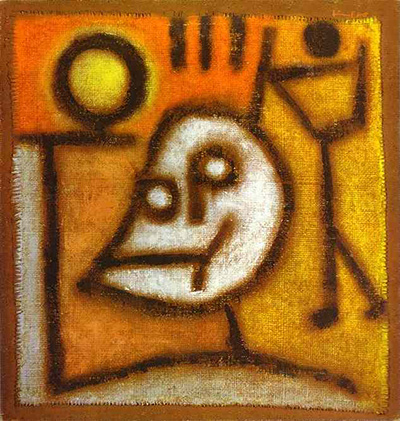
Death and Fire
1940
References
- Fondation Beyeler, Nach der UeberSchwemmung collection record, English; cross-checked against the German record: identity, inscriptions, material, dimensions, provenance, exhibitions and printed catalogue bibliography. The former current-site URLs redirect; these archive URLs serve the individual object records.
- Fondation Beyeler, Schiffe in der Überschwemmung collection record, English: separate 1937 work and annual number, View source.
- Fondation Beyeler, Paul Klee: Die Erfüllung im Spätwerk, German, 2003 retrospective text and caption: illness, later work and earlier rounded object measurements. The museum archive serves this retrospective page directly, View source.
- Zentrum Paul Klee, exhibition material on Klee's painting techniques, German: general account of paste-bound colour and mixed media, View source.
- Zentrum Paul Klee, Klee and Kandinsky press release, English: 1936 work count and 1937 recovery in production, View source.