


 by Tom Gurney
Tom Gurney BSc (Hons) is an art history expert with over 20 years experience
Published on June 19, 2020 / Updated on September 27, 2026
Email: tomgurney1@gmail.com / Phone: +44 7429 011000
Architecture: a rising structure of colour
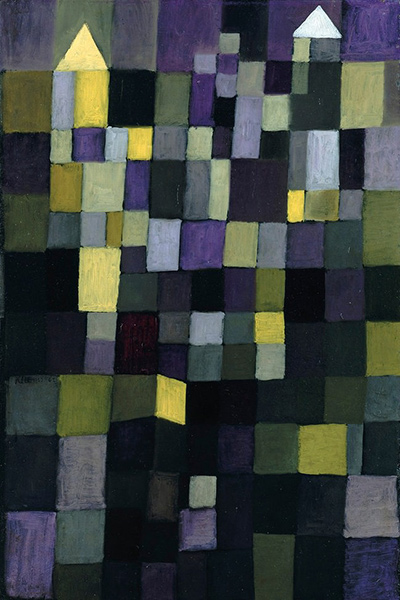
Paul Klee's Architecture is Architektur, 1923, 62, a work now in the Neue Nationalgalerie in Berlin. The owning museum records an oil painting on hardboard, 58 × 39 cm, inventory NG 7/69. It is separate from his smaller 1923 watercolour Architektur der Ebene (Architecture of the Plain) in the Museum Berggruen. The works differ in image, support, scale and ownership.[1][2][3]
At first glance, this Architecture resembles a tall wall built from coloured blocks. Most of its field is dark: violet, blue-black and greenish rectangles surround patches of yellow and pale grey. Near the upper edge, two light triangular forms can be read as roofs. Their position makes the stacked colour appear briefly like a town, towers or a castle. Yet no stable plan of a real building emerges. The blocks are uneven, their edges and tones shift, and the apparent roofs are only two signs within a much larger colour structure.[1]
A building that will not resolve into one building
The Berlin collection essay by Christina Thomson likens the arrangement to a child's building blocks. It leaves open whether the structure suggests a city front, a high-rise or a castle facade. This is a useful limit on description: the painting invites architectural recognition but does not identify a building. A reading that names a specific skyline would add more than the owner record or the image can support.[1]
The tonal movement is stronger than the suggestion of masonry. Yellow, blue-violet, black and white provide a restricted palette, but mixed and neighbouring patches create many variations. The lower field is heavier and darker; toward the top the group becomes denser and brighter. Two pale triangles give the upper edge a crown. The movement from a dark base to light upper accents is why the painting can be read vertically, as if the eye were climbing a structure, even though the rectangles also form a tapestry-like flat grid.[1]
The museum proposes a musical analogy: colour “tones” and a rhythmical arrangement can be experienced as a rising scale. Its essay also sees a textile quality, like weaving or patchwork, and uses Klangteppich, a “sound carpet,” to connect those observations. These are the museum's interpretive comparisons, not evidence that Klee assigned a precise note to each square. The image lets several structures coexist: blocks might rise like a building, repeat like a musical measure or interlock like a woven field.[1]
The familiar description “abstract architecture” is therefore both helpful and incomplete. The roofs and stacked rectangles give the eye a start. The varied colour patches then resist the uniform logic of bricks or windows. A dark rectangle can act as a gap one moment and a solid block the next. The broad field of small decisions matters more than the identification of a single object at its centre.[1]
Oil, support and a material discrepancy
The Neue Nationalgalerie's current record states oil on hardboard (Öl auf Hartfaserplatte) and measures 58 × 39 cm. A scholarly account of the painting's earlier ownership describes oil on a black ground on cardboard, with an image measurement of 57 × 37.5 cm. Both sources identify Berlin inventory NG 7/69 and Klee's 1923, 62, so they concern the same work. The reason for the support and measurement discrepancy is not established by these online records. The present museum label supplies the current catalogue medium and dimensions; the earlier description is retained as a documented difference rather than silently merged with it.[1][2]
The dark ground has a direct visual consequence even without resolving that technical disagreement. Many squares look as though they emerge from or recede into darkness. Bright yellow accents puncture the surrounding violet and black, while pale white-grey notes near the top hold the stack together. The older research description specifies a black ground, and the museum's own curatorial essay stresses the dark-to-light rise. A technical account of layers and support would require direct conservation evidence, which these records do not provide.[1][2]
The painting's size is far larger than the nearby Architecture of the Plain watercolour, whose whole mounted sheet is roughly 28 × 18 cm. Their similar portrait orientation can conceal the difference in a catalogue of equal-width thumbnails. Nor does the common year make their methods interchangeable: one is an oil painting with opaque, block-like passages; the other is a small work on paper with transparent watercolour washes, visible pencil and worked strips at its borders.[1][3]
Bauhaus setting and colour rhythm
Klee made Architecture in 1923, during his Bauhaus teaching in Weimar. The Bauhaus-Archiv describes his instruction in form and colour and the school's workshop-centred education. It also notes that a regular course of architectural study began only in 1927. The title's reference to architecture in 1923 should thus not be taken as proof that the painting was a design for a Bauhaus building or an architectural assignment. Its documented place is in Klee's pictorial exploration of colour, order and rhythmic variation.[1][4]
The Berlin museum's account joins this context to Klee's interest in music. A separate Bauhaus-Archiv study of his lessons documents musical analogies in his teaching from 1921, including the use of melodic movement and rhythmic measures to think through line and surface. That historical context makes the gallery's musical reading plausible, while still leaving this particular painting's “score” open. No identified tune or numbered sequence of notes is documented for it.[1][5]
Several other Klee works of these years explore squares, gradations and rhythmic colour; a current Berlin object record for Abstract Color Harmony in Squares with Vermilion Accents explicitly names Architektur as a related oil-colour field. The relationship is formal and historical, not a reason to collapse the two works into one image or title. This painting's own distinction lies in its unusually strong upward pull and the roof-like triangles above its patchwork grid.[1][6]
A route through the collections
The Neue Nationalgalerie records the work in Klee's possession until 1940, then in Lily Klee's estate. It passed to the collection of Hermann Rupf and Margrit Rupf-Wirz in Bern, and later through Galerie Renée Ziegler in Zürich. The museum acquired it from that gallery in 1968. Its provenance record gives date ranges and in one case “at least 1956”; those qualifications should be retained rather than turned into an exact itinerary.[1]
The scholar Valentine von Fellenberg traced Rupf's collecting through correspondence and exhibition records. She identifies Architektur, 1923, 62, as one of the works acquired from Lily Klee after the artist's death, and describes it as the earliest oil painting and the only example from Klee's abstract coloured-rectangle group in Rupf's collection at that stage. This gives a more specific view of its mid-century ownership than a bare list of names. It does not imply that Rupf commissioned or influenced its 1923 composition.[2]
The provenance further distinguishes the two works. Architecture of the Plain remained within Klee's family and later reached Heinz Berggruen; Architecture travelled through the Rupf collection. Berlin now holds both, but in different museum collections under different inventory numbers. Their titles overlap because Klee used architectural language for more than one visual problem: the translucent plane of the watercolour and the dark, ascending stack of the oil painting.[1][3]
Look back at the high, pale triangles after following the coloured grid from its dark base. They may still resemble roofs, yet they also operate as the last bright beats in a sequence of colours. The painting holds those readings together. Its “architecture” is a constructed relation between pieces of colour, not a precise elevation of a building.[1]
Related artworks
Explore eight other Klee works from the researched artwork cluster.
Sinbad the Sailor
1923
Actor's Mask
1924
Red Balloon
1922
Senecio
1922
Twittering Machine
1922
Ancient Harmony
1925
Crystal Gradation
1921
Fish Magic
1925
References
- Staatliche Museen zu Berlin, Neue Nationalgalerie, Architektur, German owner record and Christina Thomson's object essay, updated 2026: title, 1923 date, oil on hardboard, dimensions, inventory NG 7/69, provenance and interpretation. The page labels its photograph Public Domain Mark 1.0, View source.
- Valentine von Fellenberg, “Hermann Rupf und Paul Klee,” Thesis 8, German, 2006, pp. 105–06 and 174: identifies Architektur as 1923, 62 in the Rupf collection, with a historical medium and measurement description that differs from the current museum label, View source.
- Staatliche Museen zu Berlin, Museum Berggruen, Architektur der Ebene, German owner record: identity, medium, size and provenance of the separate 1923 watercolour, View source.
- Bauhaus-Archiv, “Unterricht”, German: Klee's form and colour teaching within the Bauhaus and the 1927 start of regular architecture study, View source.
- Bauhaus-Archiv, study of musicians in the Bauhaus milieu, German, pp. 139–40: documentary account of music in Klee's teaching, including line, melody and rhythm, View source.
- Staatliche Museen zu Berlin, Abstract Color Harmony in Squares with Vermilion Accents, German owner record: identifies Architektur as a comparator among Klee's oil-colour square structures, View source.