


 by Tom Gurney
Tom Gurney BSc (Hons) is an art history expert with over 20 years experience
Published on June 19, 2020 / Updated on September 27, 2026
Email: tomgurney1@gmail.com / Phone: +44 7429 011000
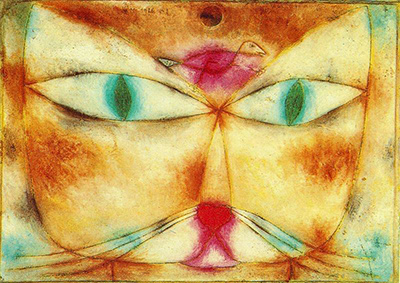
A cat and the bird between its eyes
The cat fills nearly the entire picture. Its ears meet the upper corners, its wide eyes hold the viewer, and whiskers spread across a face built from warm and cool fields. A small red bird appears between those eyes, above a heart-shaped nose. Paul Klee’s Katze und Vogel (Cat and Bird) makes the bird easy to find but difficult to place. Is it in front of the cat, or is the painted forehead a surface on which the cat’s thought has become visible? The picture gives no separate setting that would settle the question. Its simple-looking shapes produce an unusually complicated encounter between an animal, what it may desire, and the person looking at it.[1]
The question is worth keeping open. The bird need not be a literal mark inside a cat’s skull, and no source records Klee explaining a single intended story. Yet the cat’s direct gaze, the disproportionate head and the bird’s position encourage a psychological reading. Early and later museum writers have taken that invitation in different directions. The 1930 catalogue treated the spectator as a possible object of the animal’s watchfulness; later MoMA writing emphasised the bird as a mental image. Their interpretations tell us how the work has been seen. The painting still lets each viewer test those readings against its lines and colours.[1][2][3]
Contents
- The painting and its names
- A face that becomes a whole world
- The cat looks back
- Earlier cats and birds, different pictures
- From Berlin to New York
- Looking again
The painting and its names
Klee made the painting in 1928. His annual work number is given as 1928,73 (Qu3) in a German scholarly work index,[4] while the Catalogue raisonné Paul Klee identifies it as no. 4614 in volume 5. The original 1929 Galerie Alfred Flechtheim exhibition catalogue lists it as “Katze und Vogel,” no. 94. That contemporary German title is a firmer anchor than the shortened “Katz und Vogel” printed in MoMA’s 1930 English catalogue. The English name Cat and Bird is now the owning museum’s title.[1][2][5][6]
MoMA’s present collection record identifies oil and ink on gessoed canvas mounted on wood, measuring 38.1 × 53.2 cm, with accession 300.1975. The painting is a horizontal rectangle, but almost no independent space surrounds the head. The support is a prepared canvas attached to a rigid backing, not merely a free-standing sheet of paper. This matters because the drawn lines and painted fields meet on one firm surface: the bird can appear both as a small depicted creature and as a mark laid over the larger face. The accessible owner description does not, however, say how Klee built each layer, or whether particular dark contours were added before or after the coloured areas. Those would be technical claims requiring a conservation source.[1]
An older university image-archive caption describes the work as oil, pen and ink on gauze on plywood and gives 38.8 × 53.4 cm. Its caption is useful evidence of a cataloguing variant, not a reason to replace the owning museum’s current material or measurements. “Gauze,” “canvas,” “wood” and “plywood” may refer to different levels of technical description; the published sources do not establish that they do. The size difference could reflect measurement practice, but it too remains unexplained. The public object caption therefore follows MoMA, while the technical discrepancy stays open for examination against the museum file.[1][7]
A face that becomes a whole world
Klee gives the animal a frontal, flattened head. The pointed ears rise against the picture’s top edge; the elongated eyes are set apart across its width. Small vertical pupils make the eyes feel unusually alert. Below them, the red nose narrows toward a mouth and the whiskers spread in several directions. Warm tan, pink and ochre areas meet greens and blues near the eyes. These colours do not describe the fur of one identifiable breed. They organise the face so that attention moves from the eyes to the red accents and back again.[1]
The bird is much smaller than the cat, yet its red body attracts the eye. It sits high and centrally, between the animal’s eyes rather than in a corner where it could be treated as an ordinary piece of background scenery. A bird at this scale could be prey glimpsed at a distance. But there is no branch, cage, window or horizon to locate it at that distance. The shape may instead be what the cat imagines or desires. Klee makes that alternative legible without drawing a thought bubble or writing a label inside the painting. The bird occupies the same painted field as the face and has no securely independent space.[1][3]
The nose supplies a second red point below the bird. MoMA has described its shape as heart-like and connected that form to the cat’s desire. The resemblance is visible; the emotional meaning is an interpretation. Together the two red forms create a vertical path down the centre, while the eyes pull attention sideways. The viewer alternates between following the cat’s gaze and looking at the bird it may be holding in mind. This tension is more specific than calling the painting merely “cute,” “eerie” or “childlike.” Its economy of oval eyes, triangular ears and reduced contours does not make its subject simple.[1]
MoMA relates those elementary shapes to Klee’s interest in children’s art. That connection should not be mistaken for a claim that the work was made without planning or that children’s drawings supplied a particular model. Its effect depends on proportion, placement, colour and a restricted set of signs, all handled with care. A face that seems immediately readable becomes less certain when one asks where the bird exists and whom the eyes are watching.[1]
The cat looks back
The earliest museum interpretation located for this painting is in the 1930 MoMA Klee catalogue, prepared shortly after its Berlin showing. Alfred H. Barr Jr. described the bird between the eyes and the force of the cat’s almost hypnotic watchfulness. His account gives the spectator an active role: one might feel caught by the animal’s gaze. The painting encourages that response because the pupils face outward and the large head leaves so little space into which the viewer can retreat. Barr was writing about a new painting, but he was still a critic interpreting it, not reporting Klee’s own explanation.[2]
MoMA’s later Highlights account makes the opposite direction of looking more prominent. It takes the bird as an image in the cat’s mind, a concentration of appetite or fantasy rather than a separate creature sitting in front of the forehead. The museum’s 1976 acquisition announcement had already expressed a similar view, calling the bird a projection of the cat’s fixation. These texts form a history of the museum’s interpretation, not three independent statements of artist intention. The bird’s central position supports the mental-image reading, while its crisp small body also permits the simpler possibility that the cat sees a bird beyond us.[1][3][8]
Neither reading requires assigning the cat one settled emotion. A stare may feel calm, hungry, playful or threatening depending on whether the viewer identifies with the watching cat or with the vulnerable bird. Klee has painted the bird in the cat’s facial field, but he has not painted an attack. There is no chase, capture or visible aftermath. The picture suspends the relation between predator and prey at the moment of attention. Calling it a story with a known ending would add an event the painting withholds.[1][2]
The painting’s German title can open another, more tentative path. Florence Rougerie, writing in French about Klee’s relations between titles and images, notes the idiom einen Vogel haben, in which “having a bird” can suggest being somewhat eccentric or having a fixed idea. She proposes that the bird pictured in the cat’s head plays with that linguistic possibility. Her passage develops the thought alongside a different, later Klee drawing from 1938. It is a useful account of what a German phrase can bring to a reading; it does not demonstrate that Klee conceived his 1928 canvas as an illustration of the idiom. The English title loses that possible wordplay, but readers need not accept the idiom to see the work’s spatial and psychological ambiguity.[9]
Earlier cats and birds, different pictures
Klee had paired cats and birds before 1928. The Zentrum Paul Klee identifies a 1920 pen-and-pencil drawing, Katze und Vogel-Scherzo, with two cats and two birds. Its guide says the drawing served as a preliminary work for the separate 1920 oil-transfer Katze und Vogel (Doppelscene). The drawing’s scene and technique differ from the later, single frontal cat. Its title shows that the pairing interested Klee earlier, but it does not make that sheet a documented study for Cat and Bird eight years later.[10]
The change in pictorial organisation is instructive. Multiple animals can generate a little scene or exchange. In the 1928 picture, the cat has grown until its head almost becomes the whole environment, and the bird appears within that same field. The question shifts from how two animals occupy a place to how one may hold the other in sight or thought. That is a comparison grounded in the works’ visible arrangements, not a claim that Klee followed a straight development from one named drawing to a finished canvas.[1][10]
The work has in turn prompted later stories and teaching activities, including a French illustrated children’s book, Le Chat et l’oiseau. Such responses show the painting’s ability to generate narratives, but those narratives are later creations. The publisher’s story imagines the bird helping a caged cat escape, turning a possible prey animal into a friend and the bird into an image of desired freedom. That is an inventive later response, not an account of Klee’s painted scene. A booklet made to teach with the picture can be valuable as evidence of reception while remaining unreliable for technical facts or Klee’s biography. The 1928 work itself stays stranger and more open than a fable in which cat and bird have assigned roles.[11]
From Berlin to New York
The painting’s early public history is unusually well documented. The original Flechtheim catalogue places Katze und Vogel at the gallery’s Berlin Klee exhibition of 20 October–15 November 1929 as no. 94. MoMA’s provenance research describes it as consigned by Klee to the gallery. The catalogue proves that the work was listed; it gives no buyer or price and is not itself a sale record.[1][5]
The painting was then shown on loan in MoMA’s 1930 Klee exhibition as no. 39. That catalogue generally treated the works as belonging to Klee unless a different owner was named. By the 1934–35 MoMA fifth-anniversary exhibition, the catalogue named Dr F. H. Hirschland as the owner and illustrated Cat and Bird as no. 94. MoMA’s current provenance says the sale to Hirschland passed through J. B. Neumann, New York, by 1934. Its old 1976 announcement says he bought the picture from the 1930 exhibition. The latter may preserve a more exact institutional recollection, but without the original sale papers it is safer to state what the two catalogues establish: a 1930 loan and Hirschland ownership by 1934.[1][2][6][8]
The painting remained in the Hirschland family for decades. A 1949 MoMA checklist names Dr F. H. Hirschland as lender. After his death in 1973, it passed to Suzy Prudden and Joan H. Meijer. MoMA accessioned it in 1975. The museum’s formal credit records a gift in memory of Hirschland together with the Sidney and Harriet Janis Collection Fund. Its 1976 public announcement described the acquisition as partly a gift by the heirs and partly supported through Sidney Janis. These accounts can be read together; neither warrants replacing the recorded family and fund roles with a simple story of a museum purchase from a dealer.[1][8][12]
The catalogue sequence also shows the difference between a work’s making and its public life. The cat and bird were painted in 1928, exhibited in Berlin in 1929, interpreted for a New York audience in 1930, held by a New York family by 1934, repeatedly lent, and finally made part of MoMA’s collection. None of those later readings or transfers changes what is painted. They do explain why the work has become a familiar image and why its documentation contains several voices, each with a different evidential role.[1][2][5][6][8]
Looking again
Return to the small red bird after looking at the whiskers and the eyes. Does it seem to float in space before the cat, or does the face become a screen for the animal’s attention? Follow the red path from bird to nose, then the sideward pull of the eyes. The picture gives enough evidence for both a spatial and a psychological question, and no need to close either one with an invented artist quotation.[1]
The small creature is a bird, and there is no fish in the painting. Rather than supply the cat with an invented thought or an unverified quotation from Klee, we can return to the documented object, its marks and its early viewers. Cat and Bird has a large face, a tiny bird, and a relation between looking and imagining that remains alive every time the viewer meets the cat’s gaze.[1][2][3]
For another use of birds in Klee, see Twittering Machine. The paintings overview places this picture among his changing supports and subjects, while the materials and techniques page explains why a work’s physical construction matters to what a viewer sees.
Explore selected works from Klee’s much larger oeuvre. Titles without a link have an authenticated catalogue identity but no reviewed article yet.
Artworks directory
| Name | Date | Medium |
|---|---|---|
| A Gate | 1939 | Painting and mixed media |
| A Woman for Gods | 1938 | Watercolour and mixed media |
| Ab Ovo | 1917 | Watercolour and mixed media |
| Above Mountain Summit | 1917 | Drawing and mixed media |
| Abstract Trio | 1923 | Drawing and mixed media |
| Acrobats | 1915 | Watercolour and mixed media |
| Actor's Mask | 1924 | Painting and mixed media |
| Ad Marginem | 1930 | Drawing and mixed media |
| Ad Parnassum | 1932 | Painting and mixed media |
| Adventurer Ship | 1927 | Drawing and mixed media |
| Affected Place | 1922 | Drawing and mixed media |
| After a Sketch from Zurich | 1914 | Watercolour and mixed media |
| After Drawing | 1919 | |
| After The Floods | 1936 | Watercolour and mixed media |
| All Souls' Picture | 1921 | |
| Ancient Harmony | 1925 | Painting and mixed media |
| Angel Applicant | 1939 | Drawing and mixed media |
| Angel Serves the Desired | 1920 | |
| Angel, Still Female | 1939 | Painting and mixed media |
| Angelus Novus | 1920 | Drawing and mixed media |
| Animal Terror | 1926 | Painting and mixed media |
| Arab Song | 1932 | Painting and mixed media |
| Archangel | 1938 | Painting and mixed media |
| Architecture | 1923 | Painting and mixed media |
| Architecture of the Plain | 1923 | Drawing and mixed media |
| Around the Fish | 1926 | Painting and mixed media |
| Arrival of the Air Steamer | 1921 | Drawing and mixed media |
| Asiatic God | 1924 | Painting and mixed media |
| Astrological Fantasy Portrait | 1924 | Drawing and mixed media |
| Athlete's Head | 1932 | Watercolour and mixed media |
| Aufgehender Stern | 1931 | Painting and mixed media |
| Autumn Flower | 1922 | Painting and mixed media |
| Bad Band | 1920 | Drawing and mixed media |
| Baroque Centaur | 1939 | Painting and mixed media |
| Before the Blitz | 1923 | Drawing and mixed media |
| Before the Snow | 1929 | Drawing and mixed media |
| Besessenes Madchen | 1924 | Watercolour and mixed media |
| Bird Garden | 1924 | |
| Bird Wandering Off | 1926 | Watercolour and mixed media |
| Blossoms in the Night | 1930 | Watercolour and mixed media |
| Blue-Bird-Pumpkin | 1939 | Painting and mixed media |
| Boats in the Flood | 1937 | Painting and mixed media |
| Botanical Theatre | 1934 | Drawing and mixed media |
| Boy in Fancy Dress | 1931 | Watercolour and mixed media |
| Broken Key | 1938 | |
| Brother and Sister | 1930 | Watercolour and mixed media |
| But the Red Roof | 1935 | Painting and mixed media |
| C - C = Fisch | 1931 | Watercolour and mixed media |
| Cacti | 1912 | Painting and mixed media |
| Camel (in Rhythmic Landscape with Trees) | 1920 | Drawing and mixed media |
| Captive Pierrot | 1923 | Drawing and mixed media |
| Castle and Sun | 1928 | Drawing and mixed media |
| Cat and Bird | 1928 | Drawing and mixed media |
| Cathedrals | 1925 | Watercolour and mixed media |
| Chalice of the Heart | 1937 | Painting and mixed media |
| Characters in Yellow | 1937 | Painting and mixed media |
| Chosen Site | 1927 | Mixed media |
| Christmas Picture | 1923 | Drawing and mixed media |
| City of Towers | 1916 | Painting and mixed media |
| Clarification | 1932 | Painting and mixed media |
| Collection of Figurines | 1926 | Painting and mixed media |
| Colorful Architecture | 1917 | Painting and mixed media |
| Comedians' Handbill | 1938 | |
| Comic Opera Singer | 1927 | Painting and mixed media |
| Composition | 1939 | Painting and mixed media |
| Composition with Figures | 1915 | Drawing and mixed media |
| Composition with the Yellow Half-Moon and the Y | 1918 | Watercolour and mixed media |
| Conch–Still Life II | 1939 | Watercolour and mixed media |
| Cosmic Composition | 1919 | Painting and mixed media |
| Crystal Gradation | 1921 | Drawing and mixed media |
| Dance of the Grieving Child | 1922 | Painting and mixed media |
| Dancing Girl | 1940 | Painting and mixed media |
| Das Licht und Etliches | 1931 | Mixed media |
| Death and Fire | 1940 | Painting and mixed media |
| Death for the Idea | 1915 | |
| Demon as Pirate | 1926 | Watercolour and mixed media |
| Diana | 1931 | Painting and mixed media |
| Diavolo Player | 1923 | Drawing and mixed media |
| Die Kapelle | 1917 | Watercolour and mixed media |
| Die Vase | 1938 | Painting and mixed media |
| Doctor | 1930 | Drawing and mixed media |
| Dredger and Sailboat | 1931 | Watercolour and mixed media |
| Ein Tor | 1939 | Painting and mixed media |
| Ein Weib fur Gotter | 1938 | Mixed media |
| Embrace | 1939 | Watercolour and mixed media |
| Episode before an Arab Town | 1923 | |
| Equals Infinity | 1932 | Painting and mixed media |
| Eros | 1923 | Drawing and mixed media |
| Error on Green | 1930 | Watercolour and mixed media |
| Evening Figure | 1935 | Drawing and mixed media |
| Falling Bird | 1919 | |
| Fermata | 1932 | Watercolour and mixed media |
| Fire Clown | 1921 | Watercolour and mixed media |
| Fire Full Moon | 1933 | Watercolour and mixed media |
| Fire in the Evening | 1929 | Painting and mixed media |
| Fish in the Harbour | 1916 | Watercolour and mixed media |
| Fish Magic | 1925 | Watercolour and mixed media |
| Flock of Birds | 1917 | Drawing and mixed media |
| Flora on Sand | 1927 | Watercolour and mixed media |
| Flower Myth | 1918 | |
| Flower Stand with Watering Can and Bucket | 1910 | Watercolour and mixed media |
| Flowering Tree (Abstraction with Reference to a Flowering Tree) | 1925 | Painting and mixed media |
| Flowers in Pots | 1923 | |
| Flowers in Stone | 1939 | Painting and mixed media |
| Forest Witch | 1938 | Painting and mixed media |
| Fright of a Girl | 1922 | Drawing and mixed media |
| Fruits on Red | 1930 | Drawing and mixed media |
| Full Moon | 1919 | Mixed media |
| Föhn Wind in Franz Marc's Garden | 1915 | Watercolour and mixed media |
| Garden in St Germain, The European Quarter near Tunis | 1914 | Watercolour and mixed media |
| Ghost Chamber with the Tall Door (New Version) | 1925 | |
| Ghost of a Genius | 1922 | Drawing and mixed media |
| Girl in Mourning | 1939 | Painting and mixed media |
| Glance of a Landscape | 1926 | Watercolour and mixed media |
| Gluht Nach | 1939 | Drawing and mixed media |
| Golden Fish | 1925 | Watercolour and mixed media |
| Goldfish Wife | 1921 | Watercolour and mixed media |
| Green Plant, Blood, Louse | 1924 | Drawing and mixed media |
| Hafenbild | 1918 | Mixed media |
| Hammamet with Mosque | 1914 | Watercolour and mixed media |
| Harbour with Sailing Ships | 1937 | Painting and mixed media |
| Hauptweg und Nebenwege | 1929 | Painting and mixed media |
| Heavenly and Earthly Time | 1927 | Drawing and mixed media |
| Heroic Fiddling | 1938 | Painting and mixed media |
| Heroic Roses | 1938 | Painting and mixed media |
| Heroic Strokes of the Bow | — | Mixed media |
| Highway and Byways | 1929 | Drawing and mixed media |
| Houses near the Gravel Pit | 1913 | Watercolour and mixed media |
| Howling Dog | 1928 | Painting and mixed media |
| In the Current Six Thresholds | 1929 | Painting and mixed media |
| In the Style of Kairouan | 1914 | Drawing and mixed media |
| Individualized Altimetry of Stripes | 1930 | Painting and mixed media |
| Insula Dulcamara | 1938 | |
| Interior with the Clock | 1913 | Watercolour and mixed media |
| Irma Rossa the Animal Tamer | 1918 | Drawing and mixed media |
| Journey in Corsica | 1927 | Drawing and mixed media |
| Landscape with Bluebirds | 1919 | Watercolour and mixed media |
| Legend of the Nile | 1937 | Painting and mixed media |
| Lemon Harvest | 1937 | Watercolour and mixed media |
| Likeness in the Bower | 1930 | Watercolour and mixed media |
| Limits of Reason | 1927 | Painting and mixed media |
| Little Hope | 1938 | Watercolour and mixed media |
| Magdalena before the Conversion | 1938 | Drawing and mixed media |
| Mask of Fear | 1932 | Painting and mixed media |
| May Picture | 1925 | Painting and mixed media |
| Monument in a Cemetery | 1922 | Watercolour and mixed media |
| Monuments at G | 1929 | Watercolour and mixed media |
| Municipal Jewel | 1917 | Watercolour and mixed media |
| Mural from the Temple of Longing Thither | 1922 | |
| Nach der Uberschwemmung | 1936 | Watercolour and mixed media |
| New Harmony | 1936 | Painting and mixed media |
| New House in the Suburbs | — | Mixed media |
| Old Steamboat | 1922 | Drawing and mixed media |
| On the Edge | 1930 | Drawing and mixed media |
| Once Emerged from the Gray of Night | 1918 | Drawing and mixed media |
| One Who Understands | 1934 | Painting and mixed media |
| Oriental Pleasure Garden | 1925 | Painting and mixed media |
| Park of Idols | 1939 | Watercolour and mixed media |
| Passing by Red Pillars | 1928 | Watercolour and mixed media |
| Persian Nightingales | 1917 | Drawing and mixed media |
| Popular Wall Painting | 1922 | Painting and mixed media |
| Prestidigitator | 1927 | Watercolour and mixed media |
| Rainy Day | 1931 | Watercolour and mixed media |
| Red and White Domes | 1914 | Watercolour and mixed media |
| Red Balloon | 1922 | Drawing and mixed media |
| Redgreen and Violet-Yellow Rhythms | 1920 | Drawing and mixed media |
| Refuge | 1930 | Watercolour and mixed media |
| Rhythmic Rythmical | 1930 | Painting and mixed media |
| Saint of the Inner Light | 1921 | |
| Scaffolding of a New Building | 1930 | Painting and mixed media |
| Scholar in Dealing with Stars | 1926 | Watercolour and mixed media |
| Seated Woman | 1930 | Drawing and mixed media |
| Senecio | 1922 | Painting and mixed media |
| Separation in the Evening | 1922 | Drawing and mixed media |
| Sinbad the Sailor | 1923 | Drawing and mixed media |
| Skeptically Smiling | — | Mixed media |
| Small House in the Garden City | 1928 | Watercolour and mixed media |
| Small Portrait of a Girl in Yellow | 1925 | Painting and mixed media |
| Southern Gardens | 1919 | Watercolour and mixed media |
| Static-Dynamic Gradation | 1923 | Drawing and mixed media |
| Still Life | 1927 | Painting and mixed media |
| Still Life with Gladioli | 1932 | Watercolour and mixed media |
| Strange Garden | 1923 | Drawing and mixed media |
| Stricken City | 1936 | Painting and mixed media |
| Strong Dream | 1929 | Watercolour and mixed media |
| Struck from the List | 1933 | Drawing and mixed media |
| Structural I | 1924 | Drawing and mixed media |
| Sumpflegende | 1919 | Painting and mixed media |
| Temple Gardens | 1920 | Drawing and mixed media |
| The Arrow before the Target | 1921 | Drawing and mixed media |
| The Barbed Noose with the Mice | 1923 | Watercolour and mixed media |
| The Flora of the Heath | 1925 | Watercolour and mixed media |
| The Goldfish | 1925 | Watercolour and mixed media |
| The Hour Before One Night | 1940 | Painting and mixed media |
| The Man in Love | 1923 | |
| The Mask with the Flag | 1925 | Mixed media |
| The Pathos of Fertility | 1921 | |
| The Rhine at Duisburg | 1937 | Painting and mixed media |
| The Way to the Citadel | 1937 | Painting and mixed media |
| Three Houses and a Bridge | 1922 | Watercolour and mixed media |
| Tightrope Walker | 1923 | |
| Tomb in Three Parts | 1923 | Watercolour and mixed media |
| Tomcat's Turf | 1919 | Watercolour and mixed media |
| Tower in Orange and Green | 1922 | Drawing and mixed media |
| Tree and Architecture - Rhythms I | 1920 | Watercolour and mixed media |
| Tree and Architecture - Rhythms II | 1920 | Painting and mixed media |
| Tropical Dawn with the Owl | 1921 | Mixed media |
| Tropische Dammerung | 1921 | Painting and mixed media |
| Twittering Machine | 1922 | Drawing and mixed media |
| Variations (Progressive Motif) | 1927 | Watercolour and mixed media |
| Ventriloquist and Crier in the Moor | 1923 | |
| Viaducts Break Ranks | 1937 | Drawing and mixed media |
| Villa R | 1919 | Painting and mixed media |
| Village Carnival | 1926 | Painting and mixed media |
| Vor dem Blitz | 1923 | Drawing and mixed media |
| Wald-Hexen | 1938 | Painting and mixed media |
| Young Forest | 1925 | Drawing and mixed media |
Related artworks
Explore eight other Klee works, beginning with works close in date to this one.
Castle and Sun
1928
Fire in the Evening
1929
Flora on Sand
1927
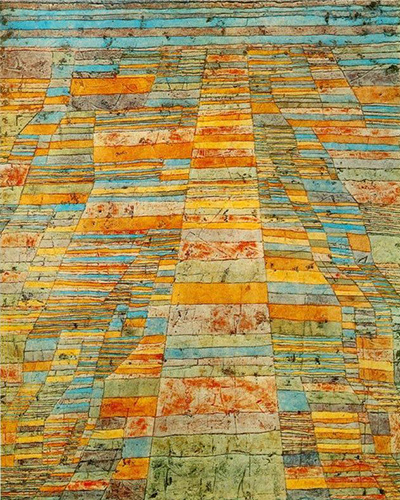
Highway and Byways
1929
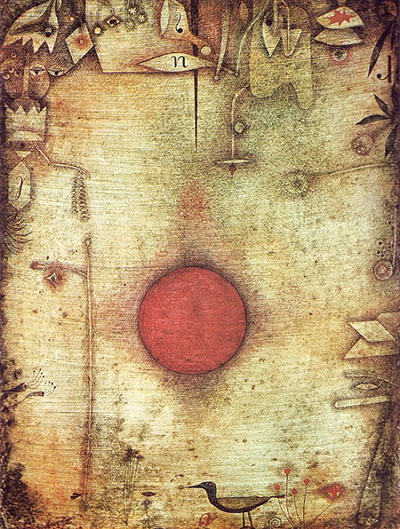
Ad Marginem
1930
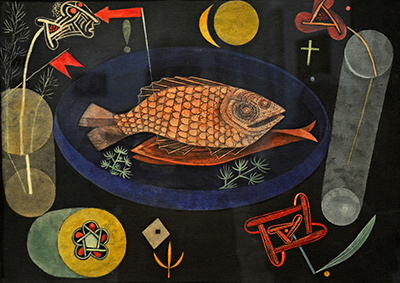
Around the Fish
1926
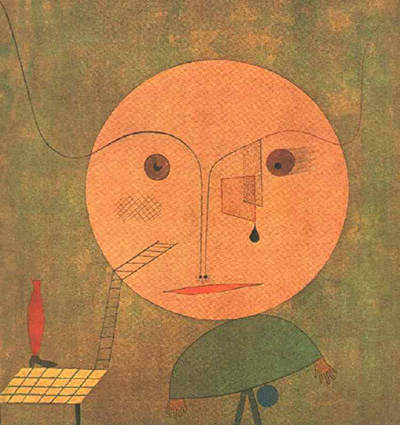
Error on Green
1930
Ancient Harmony
1925
Discussion
The bird's place between the cat's eyes invites several readings of this 1928 painting.
The early exhibition records show how the painting moved from Berlin to New York.
Reader Insights
Does the bird appear before the cat, or as something it imagines? Which marks make you think so?
How does the cat's outward gaze change your sense of its relation to the bird?
Which original record would you examine to narrow the date of the Hirschland acquisition?
Join the Conversation
Share what you can see in the picture and any source that helps you interpret it.
References
- Museum of Modern Art, “Paul Klee. Cat and Bird. 1928,” collection and provenance record, 300.1975 (English), View source.
- Museum of Modern Art, Paul Klee, exhibition catalogue (New York, 1930), no. 39 and A. H. Barr Jr. essay (English), View source.
- Museum of Modern Art, MoMA Highlights, 1999, revised 2004, interpretation carried on the current collection page (English), View source.
- Brigitte Uhde-Stahl, index to Paul Klees geheime Symbolik (Gebr. Mann, 2018), Katze und Vogel entry 1928,73 (Qu3), pp. 129, 174 and 200 listed; the indexed discussion remains unread, View source.
- Galerie Alfred Flechtheim, Paul Klee (Berlin, 20 October–15 November 1929), p. m, no. 94 (German original catalogue), View source.
- Museum of Modern Art, Modern Works of Art: Fifth Anniversary Exhibition (New York, 1934–35), no. 94 (English), View source.
- prometheus Image Archive, “Fish, Cats, Birds …,” image series 42/2020, no. 04, caption from Halle University image database (German; historical technical variant), View source.
- Museum of Modern Art, “Recent Acquisitions: Painting and Sculpture,” press release, December 1976, p. 3 (English; historical interpretation and acquisition account), View source.
- Florence Rougerie, “Ad Marginem, écriture et peinture chez Paul Klee,” Textimage, section 4 (French; interpretive proposal), View source.
- Zentrum Paul Klee, “Katze und Vogel-Scherzo,” digital collection guide (German; distinct 1920 drawing and oil-transfer relationship), View source.
- Géraldine Elschner and Peggy Nille, Le Chat et l’oiseau, later illustrated-story and education reception, Publisher record, View source.
- Museum of Modern Art, 1949 Klee exhibition master checklist, Hirschland lender entry (English), View source.