


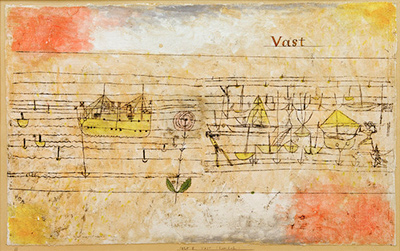
 by Tom Gurney
Tom Gurney BSc (Hons) is an art history expert with over 20 years experience
Published on June 19, 2020 / Updated on September 27, 2026
Email: tomgurney1@gmail.com / Phone: +44 7429 011000
Music lived and music pictured
Music was part of Paul Klee's daily life before it became a way of describing his paintings. He played the violin, performed with other musicians, listened to concerts and opera, and built a collection of scores and records with his wife, the pianist Lily Klee. At the Bauhaus he also used musical time and several simultaneous voices as problems for visual form. These are related activities, but they are not interchangeable. A surviving programme can establish what the Klees played; a teaching sheet can show what Paul asked students to draw; a painting's title can suggest a comparison. None of these alone proves that a particular image contains a concealed score.[1][2][3]
The distinction matters because the familiar phrase “Klee was inspired by music” is both true and too easy. Which music? Who played it? How did an audible event become a line, an interval or a layer of colour? The answers change from one object to another. This guide begins with the Klees' musical practice and follows the evidence into the classroom, selected pictures and later compositions made in response to Klee.[1][2]
Contents
- A violinist choosing a life in art
- Lily Klee was a musician and partner
- What did the Klees play at the Bauhaus?
- The Bauhaus Bach drawing: an actual translation
- Rhythm, time and the movement of a line
- What could visual polyphony mean?
- Three pictures, three different musical questions
- Music composed after Klee
- How to look, listen and check
A violinist choosing a life in art
Christine Hopfengart's archival study reports that Paul received violin instruction at seven and became an extraordinary member of the Bern Music Society orchestra at sixteen. A short Centre Pompidou exhibition account from 1985 gives a different age for his orchestral membership, eleven. The two sources may be using different definitions or records, but the discrepancy should not be smoothed away by inventing a single age. The securely supported point is sustained early violin training and orchestral experience. He did not abandon the instrument when he chose painting as his profession.[2][12]
The Zentrum Paul Klee quotes a letter to his friend Hans Bloesch of 20 November 1898 in which the young Klee figures music as his beloved and painting as a more reluctant attachment. Its playful, theatrical wording is evidence of a decision being felt and performed in correspondence; it is not a permanent ranking of the arts. By 3 January 1900, in a letter to his mother quoted by the same institution, he could report vigorous Bach playing. The original letters and their full contexts remain important checks on any psychological narrative drawn from these brief excerpts.[1][3]
The violin's continuing place is visible in the record of chamber music, not only in retrospective biography. The Zentrum Paul Klee describes Klee playing with Lily and in string quartets with friends. It also holds family scores and recordings. A player has to negotiate a musical line in time, hear the other parts and make a gesture that produces sound. Those experiences help explain why musical examples were available to Klee as practical teaching material. They do not turn every later painted line into a bow stroke. The evidence must still pass through the specific sheet or picture under discussion.[1][2][3]
Lily Klee was a musician and partner
Lily Stumpf, later Lily Klee, trained at Munich's Royal Academy of Music from 1894 to 1898, then at Berlin's Stern Conservatory, according to Hopfengart. She was a pianist who performed and taught. Treating the musical household simply as Paul's source of inspiration erases the trained musician beside him. Their violin-and-piano performances required her choice, preparation and labour; her surviving correspondence and guestbook also preserve parts of the story that Paul's own work register cannot.[2]
The pair met in December 1899 and continued to make music together through their Bauhaus years. Hopfengart cites Gunta Stölzl's 1940 recollection of evenings with Paul on violin and Lily at piano. That is an eyewitness memory written later, valuable for the household atmosphere but not a dated programme for every gathering. In the same study, Lily's attendance over three years at Gertrud Grunow's Bauhaus course is documented. Her interest in that course belongs to Lily's own education and concentration; it does not demonstrate that Paul simply adopted Grunow's system of colour and sound.[2]
The Zentrum Paul Klee's 2025 music guide reports more than 840 compositions in the Paul-and-Lily score collection. The holdings range across solo violin and piano music, sonatas, concertos, quartets, vocal works and opera reductions, with a particular weight toward music of the Classical period. Fingerings, bowings and other marks in a score can sometimes show that a piece was worked on or played. A shelf count does not tell us which item was performed on a given night, and an unmarked score is not proof that the Klees never heard it. The same guide describes their collection of records and notes wear in grooves as another clue to repeated listening. Together the scores and discs make the household musical life more concrete than a list of favourite composers.[1]
Lily's working life also gives the partnership an economic and social dimension. Hopfengart describes her piano teaching and performance, and the Klees' private concerts for the Bauhaus community. The research question is therefore not merely what Paul “borrowed” from music. It is how two musicians sustained a practice inside family life, teaching, friendship and changing professional circumstances. Where a programme survives, it can name repertoire; where only a later recollection survives, the wording should remain correspondingly modest.[2]
What did the Klees play at the Bauhaus?
Hopfengart establishes Klee concerts on 18 January and 8 March 1922. These were performances within the school community, distinct from the public Bauhaus-Abende concert series. The dates are unusually useful because they document music being made while Paul was teaching at the Bauhaus. The first falls two days after the 16 January 1922 Bach diagram in his course notes. That proximity invites a question about conversation between classroom and household performance, but the programmes do not establish that the concert was staged to illustrate that particular lesson.[2][4]
A 5 April 1925 letter from Lily Klee to Galka Scheyer, reproduced in Hopfengart's study from the edited correspondence, gives fuller programmes for three concerts before the Weimar Bauhaus closed. She recalls two Mozart piano quartets and Beethoven's Ghost Trio at the first, then a Brahms violin sonata, music by Max Reger and a César Franck sonata at the second. The farewell programme of 31 March included sonatas by Bach and Mozart, older violin-and-piano pieces, and Lily playing keyboard works by Bach as well as Handel, Rameau and Couperin. The letter is an unusually direct witness to what they performed, even though its wording does not settle every edition, movement or collaborator. The printed critical edition of the letter should be consulted before quoting it at length or filling those details in.[2]
These selections favour Bach, Mozart and other earlier composers, with some nineteenth- and early twentieth-century repertoire. They do not justify the old claim that Klee knew only “classical” music or rejected modern music. Hopfengart documents the Klees' exposure to the 1923 Bauhaus Week, where music associated with Stravinsky, Busoni, Hindemith and Stuckenschmidt was present; Hindemith visited Klee's studio in later years, and a 1927 Bartók concert in Dessau also enters the Klees' record. The Bauhaus-Archiv independently describes the 1923 event's modern-music programming. Liking to play a Mozart sonata is not the same question as what one heard, discussed or admired in a changing musical environment.[2][13]
The surviving concert record is partial. A set of programmes establishes performances; it does not supply a complete calendar of all private music-making. Lily's guestbook, her letters, the scores and the family's recordings may add more. An account of musical influence should preserve this difference between securely dated events and the richer but less precisely dated fabric of rehearsals and listening.[1][2]
The Bauhaus Bach drawing: an actual translation
The clearest evidence that Klee deliberately carried a particular musical passage into visual form is a teaching diagram, rather than a painting with a musical-sounding title. In his January 1922 Beiträge zur bildnerischen Formlehre lessons, Klee considered musical rhythm and metre and then graphed the opening two measures of the Adagio in J. S. Bach's Sonata for Violin and Harpsichord in G major, BWV 1019. Music theorist Stephanie Probst reproduces and closely analyses the surviving folio, BF/55, alongside the musical excerpt. The Zentrum Paul Klee's guide names the source BWV 1019c, fourth movement. Until the sonata's version history is checked in a critical music catalogue, “the Adagio in BWV 1019” is the clearest verified public description.[1][4]
The diagram has a horizontal dimension for time and a vertical dimension for pitch. The length of each mark can show how long a note sounds. Klee varies the weight and shape of the marks too: straight segments distinguish accompanying material, while wavy ones identify the imitating melodic parts in violin and harpsichord. Three voices remain separately traceable. A dotted continuation carries one part over a rest, making a relationship visible that might otherwise disappear on the page. This is a remarkably specific piece of translation because the musical score and Klee's new graph can be compared measure by measure.[4]
Yet it is not a neutral machine output. Probst shows that Klee's changes in line weight also represent his sense of metrical accent and expressive stress. The melodic line suggests how a player might shape a phrase, including the physical imagination of violin bowing. Klee forced chromatic pitches into a grid that began as a simpler diatonic arrangement and drew continuities that reflect an interpretation of the voices. A conventional score already makes sound visible in one way; his graph asks viewers to hear the interplay through another. Calling the exercise merely “the mathematics of classical music” misses its selective and performative character.[4]
Probst compares Klee with Henrik Neugeboren, another Bauhaus-associated artist and musician who later proposed a more systematic visualisation of Bach. The comparison exposes a choice. Even a diagram that measures pitch and duration decides which feature to foreground and how to connect events. Klee's sheet gives voice and expression priority. This is what the surviving exercise can prove. It is a model for asking careful questions of his art, but it is not a master key that converts every coloured square into a note.[4]
Rhythm, time and the movement of a line
The Zentrum Paul Klee's guide describes rhythmic schemes and traces of a conductor's baton in Klee's Bauhaus teaching pages. A beat gives a regular frame, whereas a rhythmic event may arrive early, late, grouped or accented within it. On a sheet, the spacing, thickness and direction of marks can similarly set up expectation and interruption. The analogy helps a viewer describe movement across an image. It does not require the image to be performed at a fixed tempo.[1][3]
In the centre's 2025 exhibition dossier, Segelschiffe (Sailing Ships), a 1927 watercolour, is offered as an example in which traces like conducting movements become boat outlines. The point is not that the picture is a notated composition with boats for notes. A gesture moves from one domain to another: a curve first understood as motion in the air becomes a boundary or direction on paper. The statement is the institution's curatorial reading of an identified work, not a verbatim explanation by Klee for every line in it. Its original object record and catalogue entry remain worth inspecting before a close reading of the sheet.[3]
Klee could also use music as a subject rather than a structure. The Bern guide describes drawings and paintings of performers, opera roles and musicians, often humorous. A figure playing an instrument establishes a pictorial theme; it need not have the same formal organisation as a fugue. Conversely, a pattern can suggest rhythm without showing an instrument. Daniela Gamba's Italian study usefully separates musical subject matter, musical signs and more general relations between making a picture and making music. These are different kinds of connection, and a painting may engage more than one.[1][5]
What could visual polyphony mean?
In music, polyphony concerns more than one relatively independent line sounding together. The centre's guide says Klee distinguished a more single-layer, “homophonic” organisation of a pictorial surface from a “polyphonic” one built through overlapping planes. Transparent colour layers can produce relationships between several visible strata. This is a way of thinking through simultaneous visual organisation, not an assertion that a canvas has literally become audible sound.[1]
The guide's 1935 example, das licht und die Schärfen, is presented as a case of overlapping translucent colour. This connection is strongest when the actual physical layers and visible relationships support it. A title alone is weaker evidence. Nor are all repetitions polyphony: a row of units may have visual rhythm without several independent layers. The colour guide and materials guide can help separate transparent paint, opaque patchwork, repeated marks and later reproductions that flatten the surface.[3]
The Romanian musicologist Lena Vieru Conta tests such comparisons against named works. In Blumenmythos (Flower Myth) she considers repeating crescents and the red ground as something like motifs over a sustained musical drone, yet finds that ordinary categories such as homophony and heterophony do not fully classify the picture. For Föhn im Marc'schen Garten, she proposes a left-to-right, score-like reading of repeated and inverted shapes. These are explicit later analyses, useful for looking and for their acknowledged limits. They do not prove that Klee privately composed a score and encoded it in either painting.[6]
The Centre Pompidou's French account of its 1985–86 Klee et la musique exhibition is evidence of a long history of curators asking such questions. Its discussion of musical structure should be read as an exhibition interpretation. It cannot replace the materials, dates and inscriptions of a particular work, and its conflicting early orchestra age is a reminder to check even a respected institution's compact biography against deeper archival research.[12]
Three pictures, three different musical questions
Kunstmuseum Den Haag owns a 1919 work it titles Composition with Stars (Im Bach'sen Stil), object 0216353. The parenthetical German means “in Bach's style”; the English title adds the star composition. Its dimensions are 42.5 × 53.6 cm. The museum's English and Dutch records agree on gouache and an oil-transfer process, but differ in their brief description of the support: the Dutch entry specifies prepared paper worked with linen, while the English gives linen. That difference should be resolved against the physical object or catalogue before a precise support claim is made. The Bach title makes an analogy deliberate; it does not identify a Bach piece or assign a note to each pictorial sign.[7]
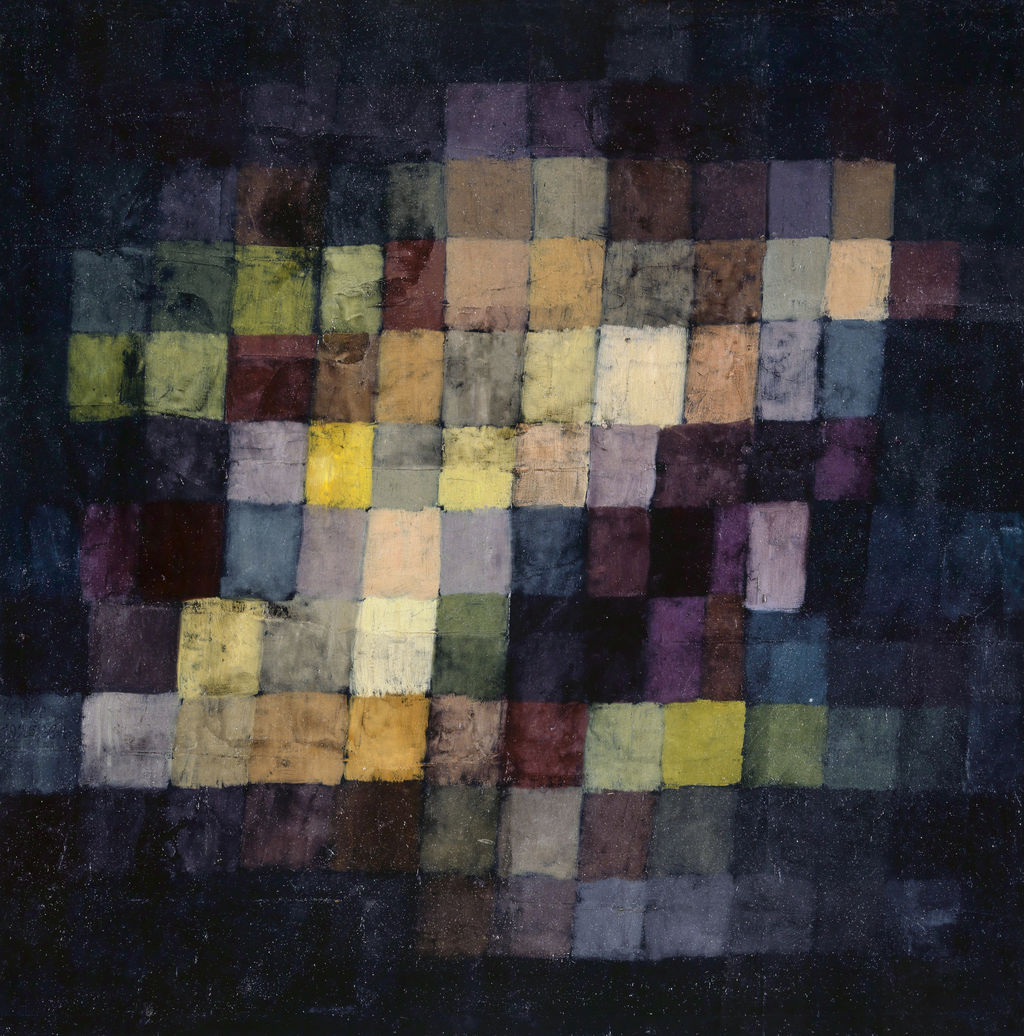
Alter Klang (Ancient Harmony), 1925, offers another kind of musical invitation. Kunstmuseum Basel records it as Klee's 1925,236 (X 6), oil on cardboard nailed to a frame, 38.3 × 38 cm, accession G 1960.25. The picture sets coloured compartments into a dark, uneven grid. A viewer may feel recurrence and variation as the eye moves among the units. But its German title means something like “old sound,” not the name of a piece Klee played. The artwork page examines the painting's actual surface and later interpretations in depth. Its material and visual relationships deserve attention before a metaphor of chords is applied.[8][9]
Klee's 1938 Heroische Bogenstriche (Heroic Strokes of the Bow), discussed by Probst through Régine Bonnefoit's earlier scholarship, poses a third question. Its title itself names the violinist's bow gesture; the changing weight and curvature of painted strokes invite comparison with bodily pressure and phrasing. That is a narrower, more grounded comparison than the claim that the entire painting follows a hidden Bach score. An owning-object record and image-rights check are still needed before close physical description or reproduction here.[4]
These examples show why it is best to ask what kind of evidence a particular work supplies. A title can name a composer, sound or bodily action; a teaching folio can map two measures precisely; visible paint can establish overlaid layers or repeated intervals; a letter can record a performance. The kinds of evidence work together, but they cannot substitute for one another. Gamba's essay is especially useful here because it asks how a picture's organisation can be musical without forcing a one-to-one equivalence with notes.[4][5][7][8]
Music composed after Klee
Music was also made from Klee's pictures, long after he made them. The Zentrum Paul Klee's 2025 guide says its archive has recorded more than 400 scores responding to individual works or to his theory. That is a count reported for that exhibition guide, not an all-time total or a count of works Klee heard. Another current institutional description gives a higher figure; cataloguing dates and definitions should be checked before combining them. The large body of responses shows reception, not necessarily the composer's access to the original painting or to Klee's intentions.[1]
Alter Klang has prompted at least two distinct named compositions. Publisher Tritó describes Benet Casablancas's orchestral Alter Klang as a response to Klee's painting and records a 2007 Madrid presentation. George Crumb's first movement of Metamorphoses, Book II for amplified piano is titled “Ancient Sound, Abstract on Black” after Klee; a University of Colorado programme connects the musical contrast of sustained and higher tones to the painting's dark and luminous parts. These sources document later artists making something new from the picture. Casablancas's orchestra and Crumb's piano do not reveal a lost score inside Klee's 1925 oil painting.[9][10][11]
The direction of influence must remain clear. Bach music in a Klee teaching diagram is a documented input. A concert in 1925 is a documented event. Casablancas and Crumb are documented responses to Klee. A painted title such as Alter Klang opens a question whose answer depends on what other evidence survives. Keeping those directions distinct makes the relationship between music and art more interesting, because it allows for practice, translation, analogy and new creation rather than collapsing them into one vague word, “influence.”[1][2][4][10][11]
How to look, listen and check
Start with the artwork's original title, date, medium, dimensions and collection record. Ask whether a musical claim comes from a surviving statement by Klee, a family letter, a teaching page, the work itself or a later interpreter. If a score is named, check whether the passage and version are actually identified. If a picture is called polyphonic, look for the proposed independent layers or lines; repeated colour alone does not settle the case. If a body image is a reproduction, remember that it may flatten the texture on which an analogy depends.[1][4][5][8]
This method still leaves room for imaginative viewing. Follow a painted line as though it were a phrase, or compare a dark compartment with the return of a low tone. Such comparisons can sharpen attention without becoming undocumented facts about what Klee heard while he worked. His music was lived with Lily, made in performance, reconsidered in teaching and transformed in pictures of very different kinds. The most useful account lets each surviving object tell us how far the connection can actually be traced.[1][2][4]
Discussion
The Klees' scores, performances and recordings show music as an active part of their lives.
A painting's musical title can open a question without turning its shapes into literal notes.
Reader Insights
Which score, letter or concert record changes how you understand the Klees' music?
What detail in a particular painting suggests rhythm or multiple voices to you?
Which musical comparison would you want to check against the object itself?
Join the Conversation
Share the work and source behind your reading.
References
- Zentrum Paul Klee, Fokus. Klee musikalisch, digital exhibition guide (German; English, French and Italian versions also available), especially “Polyphonie,” “Partitur,” “Bildnerische Formlehre,” “Schallplattensammlung” and “Notensammlung,” German guide, View source.
- Christine Hopfengart, “‘Klee-Konzerte’ und Hausmusik – Paul und Lily Klee als Musikerpaar am Bauhaus,” in Musikerinnen und Musiker im Umfeld des Bauhauses (Bauhaus-Archiv, 2025), 135–49 (German), full volume. Includes citations to the 5 April 1925 Lily Klee letter and later Stölzl recollection; those underlying documents have not been read directly, View source.
- Zentrum Paul Klee, Kosmos Klee. Fokus. Klee musikalisch, media dossier dated 28 February 2025, 1–3 (German), institutional PDF. Text and object leads used; press images are not adopted as licensed body art, View source.
- Stephanie Probst, “Pen, Paper, Steel: Visualizing Bach's Polyphony at the Bauhaus,” Music Theory Online 26, no. 4 (2020), especially §§3.1–3.6 and Examples 2–3 (English), full peer-reviewed article, View source.
- Daniela Gamba, “Fare pittorico ed essere musicale nell'opera di Paul Klee” (Italian), full text hosted by the University of Milan. Its publication date and original venue still require confirmation, View source.
- Lena Vieru Conta, “Sintaxe muzicale în «grădinile» lui Paul Klee,” Revista Muzica 6 (2020), 54–93, especially 69–73 (Romanian, with English summary), full article. Her formal analogies are attributed later readings, View source.
- Kunstmuseum Den Haag, “Composition with Stars (Im Bach'sen Stil),” 1919, object 0216353 (English and Dutch), English object, Dutch object. The support wording differs between versions.
- Kunstmuseum Basel, “Eingänge Galerie 1946–1962,” Alter Klang entry G 1960.25 (German), museum accession list, View source.
- Rawpixel, Alter Klang high-resolution reproduction, item 3590280, labelled CC0/public domain and free for business use (English), exact item and licence. Source for the credited body image and visual description, checked against Basel's title and inventory, View source.
- Tritó Edicions, Benet Casablancas, Alter Klang, impromptu para orquesta, publisher's work description (Spanish), publisher record, View source.
- University of Colorado Boulder College of Music, Margaret Leng Tan recital programme, 29 September 2022, pp. C-2–C-4, Crumb's Metamorphoses, Book II and Klee (English), programme PDF, View source.
- Centre Pompidou, Klee et la musique, 1985–86 exhibition archive (French), institutional account. The orchestra age conflicts with 2 and is not presented as resolved, View source.
- Bauhaus-Archiv, “Bauhaus Music Weekend 2023,” institutional retrospective on music at the Bauhaus and the 1923 Week (German), archive page, View source.