


 by Tom Gurney
Tom Gurney BSc (Hons) is an art history expert with over 20 years experience
Published on June 19, 2020 / Updated on September 27, 2026
Email: tomgurney1@gmail.com / Phone: +44 7429 011000
Cosmic Composition: a painted world of signs
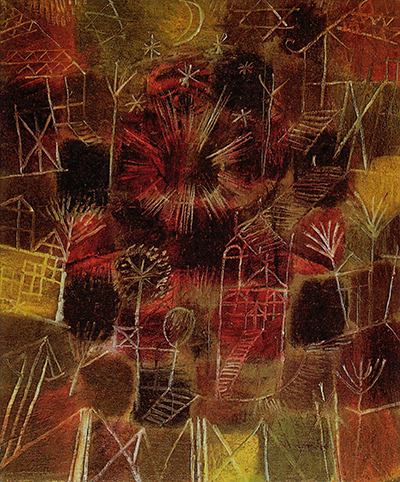
Paul Klee's Cosmic Composition is the English name used here for Kosmische Composition, 1919, 165, now in the Kunstsammlung Nordrhein-Westfalen in Düsseldorf. The museum records oil paint on cardboard, later mounted on a wooden support by someone other than Klee. It measures 49 × 41.5 cm as an image, and its inventory number is 0004. A label on the back reads “1919 165 Kosmische Composition Klee.” The museum lists it as no. 2229 in the printed Catalogue raisonné Paul Klee, a cross-reference reported here from the museum record rather than from direct inspection of that volume.[1][2]
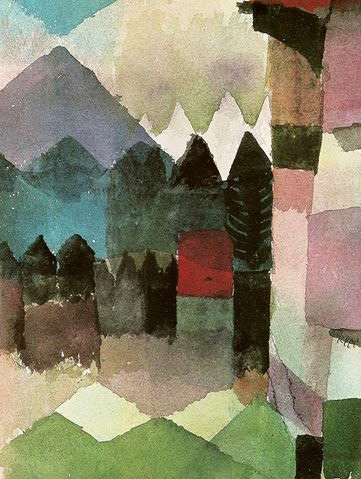
The inherited site image is recognisably the same work as the museum's reproduction. Both show a slim crescent near the top, a burst of short strokes in the centre, and pale linear houses, ladders, branches and star-like forms spread over dark reds, greens and yellows. The museum photograph reveals stronger green and blue passages and more surface detail than the site's 400-pixel file. That comparison confirms the object identity while warning against treating the older web copy as an exact colour record.[1]
Looking through the picture
The composition is upright, but it does not provide a conventional horizon. Houses or house-like outlines occupy the upper corners and reappear below. Thin ladders connect and divide zones of colour, while branching lines resemble trees without settling into a natural landscape. Small radiating marks can be read as stars. The crescent near the upper edge suggests a moon; the larger central burst could suggest a sun. Bringing night and day together is a plausible response to the image, not a documented account of what Klee intended each shape to mean.[1]
Across the middle, a dark red-violet area sends pale streaks in several directions. It is an energetic centre, but the eye does not remain there. One can follow the slant of a ladder to the right, move back along a crossing roofline, then descend to a smaller arch and another set of steps. The marks make a network rather than a single road to a destination. A patch of yellow at lower left and a brighter green toward lower right keep the bottom of the work active as the shapes thin out.[1]
The same line can change its role while being followed. Two sloping strokes suggest a roof until a crossbar turns them into an almost abstract diagram. A vertical with side branches reads as a tree against one patch of colour and as a piece of scaffolding against another. Klee does not need to choose one category for every sign. The structure depends on the viewer's movement among likenesses, while the painting's colour fields and scratches remain visible as marks on a surface.[1]
The title Kosmische Composition encourages a reading on more than one scale. The pale signs can resemble an inhabited place, yet the moon-like arc and scattered bursts make that place seem suspended inside a wider order. It would be easy to describe the picture as a literal map of the universe. Its spatial cues are too mixed for that: some forms appear in front of others, while others seem to float with no stable distance. The result is a constructed pictorial world rather than a representation of an identifiable city or astronomical scene.[1]
Paint, support and early ideas
The museum's German description is more specific than the old page's “oil based painting”: Ölfarbe auf Karton, auf Holzträger montiert (nicht vom Künstler). Oil paint was applied to cardboard; the wooden mounting is later and not Klee's own intervention. A 1941 Museum of Modern Art catalogue called the work “oil on wood.” That historic shorthand records how the object was described at the time, while the current owner's material entry separates painted support from subsequent mount. The web reproduction also shows uneven density, fine incised-looking lines and passages where dark colour sits beside thin pale marks, but it cannot establish every step of Klee's technique.[1][3]
In his Schöpferische Konfession, published in 1920, Klee discussed a “formal cosmos” made from abstract elements and a relationship between art and creation. This is contemporary evidence for the breadth of his thinking about pictorial form. It is not a key to decode this individual painting, nor proof that the crescent, ladders or central burst stand for particular theological beings. The work was made in 1919; the published essay followed a year later. The overlap in language helps situate the title without turning theory into an artist's object label.[4]
The Düsseldorf museum's retrospective account places precisely composed oil paintings among Klee's experiments begun in 1919. It also notes the importance he gave to materials and to works as physical objects. Those broad observations fit the painting's controlled network of fine lines over saturated colour. They should be used at this level of context: the account does not provide a technical analysis of Kosmische Composition specifically.[5]
The old article claimed that a small eye in the background symbolised an all-encompassing force. That reading circulated in later popular descriptions, but the image does not make the supposed eye unambiguous, and the owner record does not name one. An eye-like shape may be perceived among the many crossing strokes. Calling it a documented symbol of God, or claiming the image directly expresses Klee's private religious beliefs, would settle an interpretive question that the sources leave open.[1][4]
A painting with a complex history
The museum traces the painting first to Klee, who probably consigned it to his representative Hans Goltz around 1920. A possible transfer to Gert Heinrich Wollheim in 1921 remains uncertain: Wollheim remembered a painting with this title, but the recollection might concern a different object Goltz offered. The current record places the work with Nierendorf Gallery by 1941, when it was lent to the Museum of Modern Art's travelling Klee exhibition. MoMA's contemporary catalogue lists Cosmic Composition (Kosmische Komposition) as catalogue item 8, gives the date 1919 and names Nierendorf as lender.[1][3]
The work was in Helen R. Resor's collection by at least 1945, later entered G. David Thompson's collection and passed through Galerie Beyeler in 1960. The state of North Rhine-Westphalia bought it that year with 87 other Klee works, a founding group for the museum established in 1961. This sequence is well documented in parts, yet the museum explicitly says that ownership between 1933 and 1945 is not fully resolved. It commissioned deeper provenance research in 2025. A published gap is not proof of a specific loss or transfer; it is a reason to avoid presenting the chain as seamless.[1][2]
The museum still lists the painting as on view at K20 in its current online record. Its familiar English name is useful for finding the work, but the written label on its reverse fixes Klee's original spelling, Kosmische Composition. The picture's crowded little constructions and celestial hints can be enjoyed without reducing them to a single secret message. What remains most persuasive is the movement between scales: intimate roof, tree and stair signs gathered inside a larger field of colour and radiating light.[1]
Related artworks
Explore eight other Klee works from the researched artwork cluster.
Angelus Novus
1920
Flower Myth
1918
Crystal Gradation
1921
Red Balloon
1922
Senecio
1922
Twittering Machine
1922
References
- Kunstsammlung Nordrhein-Westfalen, Kosmische Composition, German owner record, including photograph, medium, measurements, inscription, accession number, provenance and current research note. The owner reports Catalogue raisonné Paul Klee no. 2229; that printed entry was not directly inspected, View source.
- Kunstsammlung Nordrhein-Westfalen, Kosmische Composition, English owner record, checked against the German version. The German record uniquely specifies that the wooden mounting was not done by Klee, View source.
- The Museum of Modern Art, Paul Klee exhibition catalogue, 1941, p. 9, catalogue no. 8 and plate: contemporary title, medium description and Nierendorf Gallery loan, View source.
- Paul Klee, Schöpferische Konfession, p. 36, published 1920 in Tribüne der Kunst und der Zeit, digitised from the original print and used only as general contemporary context, View source.
- Kunstsammlung Nordrhein-Westfalen, “100 x Paul Klee – Geschichte der Bilder”, museum exhibition history and contextual overview, 2012–13, View source.