


 by Tom Gurney
Tom Gurney BSc (Hons) is an art history expert with over 20 years experience
Published on June 19, 2020 / Updated on September 27, 2026
Email: tomgurney1@gmail.com / Phone: +44 7429 011000
Southern Gardens: a garden built from colour and signs
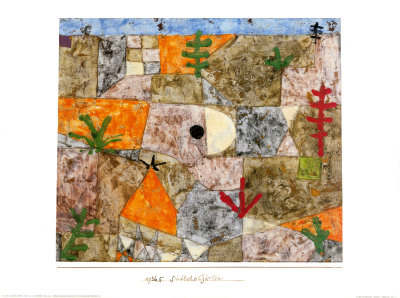
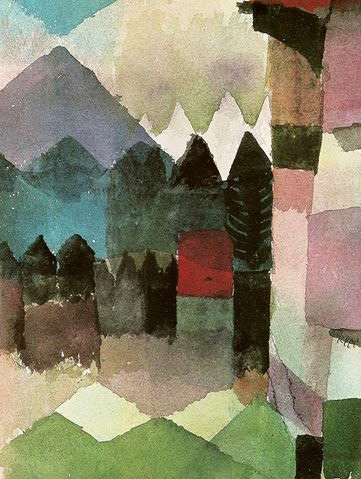
Paul Klee's Southern Gardens presents a garden without the continuous ground, enclosing wall or receding path that might make it a conventional landscape. Angular fields of colour and textured wash fit together across the sheet. Small branching signs punctuate them in red and green. A pale circle and a dark dot interrupt the centre. The eye can move among these elements, but it cannot settle on a single viewpoint. The title gives the picture a place and a subject while the watercolour makes both seem provisional.[1][2]
The work discussed here is the 1919 watercolour and ink on paper mounted on cardboard in the Metropolitan Museum of Art, New York, object 1984.208.2. The Met measures it at 28.9 × 22.5 cm and records the Berggruen Klee Collection as its source in 1984. Its German title is Südliche Gärten. Christian Rümelin identifies it as number 80 in Klee's 1919 annual sequence. These details distinguish it from other works with similar English titles, particularly a different Südliche Gärten dated 1936.[1][2][5]
Reading the garden
Large, uneven compartments spread across the rectangular sheet. Ochre, grey, brown and pale blue areas are crossed by stronger orange shapes. Some edges are ruled or nearly straight; others have the irregular outline of liquid pigment meeting dry paper. That alternation keeps the composition between constructed plan and weathered surface. It can suggest plots of earth, walls or buildings without fixing any one of them as the correct reading.[1]
The small plant-like signs do more explicit work. Red, green and black stems break into short branches at several points, often in a form closer to a pictogram than a botanical illustration. Their varied directions resist a tidy row of trees. The dark circle near the centre and the pale disc beside it can be read as visual pauses among the compartments; the picture supplies no clear legend that would make them a sun, opening or architectural feature. Klee's garden emerges through the relation between these marks and the larger fields rather than through a perspective view.[1]
The paper's mottled areas matter as much as the bright accents. Washes vary in density within each compartment, and some apparently solid patches retain visible flecks and brush variation. Ink sharpens particular boundaries and signs, but it does not close every form. Calling the object simply an oil painting, as the inherited page did in one passage, obscures this material structure: the museum catalogues it as watercolour and ink on paper mounted on cardboard.[1]
A 1919 work with an earlier journey behind it
The word “Southern” invites comparison with Klee's 1914 journey through Tunisia with August Macke and Louis Moilliet. The Zentrum Paul Klee's Mapping Klee project explains that the journey's architecture, light and colour became important to his pictorial thinking. Its account is more precise than the familiar claim that the trip suddenly made him a colourist: it emphasizes the cubical architecture as a spur to new composition and notes that the journey has itself become a myth in Klee's reception.[3]
The Met's Hammamet with Its Mosque, made in 1914, offers a useful comparison because its architecture and gardens remain more recognisable even while its lower part turns into translucent colour planes. Southern Gardens dates from five years later. It need not be a record of a specific Tunisian site. The earlier travel experience can help explain why architecture, planting and colour might be interwoven, but the 1919 title and image do not identify a particular garden. A viewer should be able to see the work without being asked to accept an invented itinerary for it.[1][3][4]
The difference between a view and a constructed image is central here. The compositional blocks resemble a map in their adjacency, yet they do not obey a map's stable scale or symbols. The plant forms give the scene life, yet their sharp colours and schematic shapes refuse naturalism. This makes the garden a field of relationships: enclosure against opening, dense wash against blank paper, and red or green signs against quieter earthen tones. Such a reading follows the visible arrangement and remains open to other associations.[1]
Klee's own classification
Rümelin's German study of how Klee handled his own oeuvre places Südliche Gärten, 1919, 80, among the works Klee designated his Sonderklasse, or special class. In a note discussing that group, Rümelin also lists this work among the relatively small number that were once part of a larger work. This is a significant piece of object history: the composition we know can be understood as a selected and mounted object, rather than presumed to have always existed in precisely this format. Rümelin's study does not, by that fact alone, disclose how the earlier larger work looked; reconstructing its missing portions would be speculation.[2]
The Met's medium description confirms the present construction: watercolour and ink on paper mounted on cardboard. The combination of Klee's own classification, the scholarly annual number and the museum's physical record gives a stronger basis for discussing the work than a generic account of “Klee's garden paintings.” The published Met volume on the Berggruen Klee Collection confirms that Southern Gardens belongs to the museum's group of Klee works, but its full catalogue entry has not been consulted here; no claims are attributed to that unseen text.[1][2][6]
Which Southern Gardens?
An English title alone is an unsafe identifier in Klee's large output. A 1936 Südliche Gärten has a different date and composition, and a separately indexed 1919 work called Southern (Tunisian) Gardens has different measurements. This page concerns the Met sheet, 28.9 × 22.5 cm, Berggruen Klee Collection, object 1984.208.2, corresponding to the German title and 1919, 80 reference. Its small inherited image matches that composition. The date, support, dimensions and collection are part of the identification, not decorative catalogue trivia.[1][2][5][7]
The garden's ambiguity is therefore a property of a particular work, not an excuse to loosen its identity. Klee gave its fragments enough edges to make the surface feel ordered and enough variation to keep the order unsettled. Branching signs suggest growing things; the bright orange and red insertions stop them from disappearing into a neutral plan. Looking back and forth between the close marks and the whole arrangement lets Southern Gardens alternate between a place, a pattern and a memory of landscape.[1][3]
Related artworks
Explore eight other Klee works from the researched artwork cluster.
Angelus Novus
1920
Flower Myth
1918
Crystal Gradation
1921
Red Balloon
1922
Senecio
1922
Twittering Machine
1922
References
- The Metropolitan Museum of Art, Southern Gardens, object 1984.208.2, object data, medium, dimensions, collection and current image-rights notice; accessed 27 September 2026, View source.
- Christian Rümelin, “Klees Umgang mit dem eigenen Œuvre”, in Paul Klee: Jahre der Meisterschaft: 1919–1933 (2001), especially the Sonderklasse note, p. 222, naming Südliche Gärten, 1919, 80; indexed text consulted 27 September 2026, View source.
- Zentrum Paul Klee, Mapping Klee, “Tunesien 1914” and colour sections; accessed 27 September 2026, View source.
- The Metropolitan Museum of Art, Hammamet with Its Mosque, 1914, object essay and materials; accessed 27 September 2026, View source.
- Wikimedia Commons, Südliche Gärten, 1936, Sprengel Museum, distinct title match and image; accessed 27 September 2026, View source.
- The Metropolitan Museum of Art, Sabine Rewald, Paul Klee: The Berggruen Klee Collection in The Metropolitan Museum of Art, publication overview and work listing (1988); accessed 27 September 2026, View source.
- Université du Québec à Montréal, Southern (Tunisian) Gardens record, separate 1919 work identification and dimensions; accessed 27 September 2026, View source.
