


 by Tom Gurney
Tom Gurney BSc (Hons) is an art history expert with over 20 years experience
Published on June 19, 2020 / Updated on September 27, 2026
Email: tomgurney1@gmail.com / Phone: +44 7429 011000
A mask made of letters
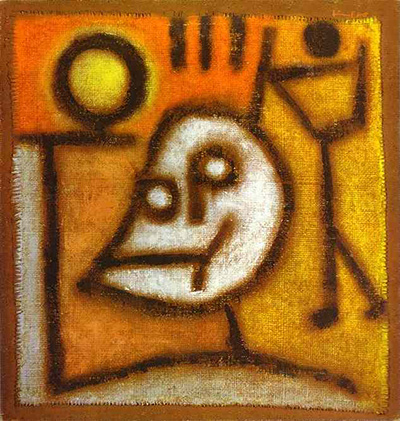
A pale, masklike face fills the centre of Paul Klee’s Death and Fire. Its dark features can also be read as the letters T–O–D, spelling Tod, the German word for death. Around it, heavy black lines cross a field of warm orange and yellow. A bright disk at left and a smaller angular form at right invite further recognition without becoming a settled scene. Klee gave this 1940 painting a title that contains both death and fire. The face supplies a visible link to the first word; the second remains open to several visual associations.[1][2]
The painting was made in the year Klee died. That proximity is important, but it does not tell us the work’s exact day of completion or turn each mark into a medical symptom. Its physical construction, letters, colours and later philosophical reception each have their own evidence. Looking at them separately makes the picture more complex than a last message decoded once and for all.[1][3]
Contents
- Title, numbers, size and collection
- Seeing a face, reading a word
- A late work with a particular surface
- How writers have used the painting
- Looking again
Title, numbers, size and collection
The German title is Tod und Feuer. The artist entered it in his annual work list as 1940,332. A later catalogue raisonné assigns continuous number 9351. These are different cataloguing systems: the first places it in Klee’s 1940 sequence, while the second identifies it across his whole oeuvre. A 2008 Staatliche Museen zu Berlin exhibition checklist lists the work at the Zentrum Paul Klee in Bern and gives its size as 46.7 × 44.6 cm. A 2025 Zentrum Paul Klee guide treats it as part of the museum’s collection. The museum’s image agency also associates it with identifier ZPK000020, though that image-record code should not be mistaken for a verified current accession number.[1][2][4]
The 2008 checklist describes the medium in German as “Öl- und Kleisterfarbe auf Jute auf zweiter kleistergrundierter Jute auf Keilrahmen”: oil and coloured paste paint on jute mounted on a second, paste-primed jute, on a stretcher. Published English versions vary among “paste paint,” “coloured paste” and “glue paint” for Kleisterfarbe. None of these short translations should erase the two jute layers. A 2003 Fondation Beyeler exhibition caption and a dated collection presentation also record original double frame strips. Beyeler rounds the dimensions to 46 × 44 cm; the Berlin checklist’s more precise figure is the useful object caption, with the historical variant retained in the research record.[1][5]
This layered textile support matters to how the image meets the eye. Jute has a pronounced weave compared with a smooth primed canvas. The coloured paste and oil meet the fibres and prepared layer differently from a thin line on paper. Broad dark marks sit among rougher areas of colour, while the pale face remains visually forceful. The available catalogues document the support, but a museum conservation file would be needed to describe its exact ground chemistry, the order of every paint application or subsequent treatment. The older phrase “oil on distemper on jute” is too compressed to do that work.[1][2]
Seeing a face, reading a word
The central pale form can appear as a head, mask or skull. Dark marks supply features, yet those same marks can be followed as T, O and an inverted D. The German word Tod emerges from a face that seems to stare back. The Zentrum Paul Klee’s guide identifies this overlap explicitly. Art historian Claude Cernuschi also examines it in his study of Klee and language, describing how the viewer moves between recognising a face and reading a familiar written word. Neither task cancels the other. The ambiguity is the pictorial event, not a puzzle whose solution makes the face disappear.[2][6]
The letters are not placed below the portrait like a caption. They make up the portrait’s own features. Once the word has been seen, it is difficult to return to a wholly innocent face; once the face returns, the letters cease to behave like ordinary writing on a page. Cernuschi situates this switching within a broader discussion of Klee’s use of linguistic and pictorial signs. His chapter compares visual perception with later cognitive research, but that modern comparison should not be turned into a claim that Klee knew brain-scanning science or intended a neurological experiment.[6]
One can try to find a second spelling of TOD beyond the face. Ōhashi’s 1988 study proposes another arrangement in the figure and nearby circle, treating the word as present in both facial features and bodily gesture. This is a specific scholarly interpretation, but the ZPK and Cernuschi face reading has firmer support in the object-focused sources checked. Ōhashi does not supply a statement by Klee confirming that the additional shapes were intended as a second complete word. A reader can test his proposal without being told that every proposed letter is settled. A small website image is especially poor evidence for the exact orientation of a faint or ambiguous mark.[2][6][8]
The right-hand form may suggest a person, a child or a sign assembled from a few strokes. The disk at left may evoke flame, sun or a source of light because of its yellow colour and the painting’s title. None of these identifications is fixed by an artist statement available for this work. The angular form, disk and central face share the same warm field; their relation creates tension without providing a continuous story. The title Death and Fire names themes, not every object or action pictured.[2]
A late work with a particular surface
Klee died on 29 June 1940. ZPK calls Tod und Feuer one of his last paintings, finished shortly before his death. The annual number 332 establishes an entry in his 1940 sequence, not a day or month. Nor does “one of his last” mean “the final work.” Other 1940 works, including an untitled still life, have their own claims in accounts of his final production. The exact chronology and any studio circumstances should be checked against the artist’s handwritten register and correspondence before a dramatic final-scene narrative is attached to this painting.[1][2]
The mask and letters are stark, but the composition is not simply drained of life. Orange, red-brown and yellow areas vary around the pale centre. Heavy black signs create a loose framework rather than an even outline around every form. Near the lower edge, a lighter strip interrupts the warm field. These relations ask to be looked at as colour and construction, not only as an illustration of the title. The jute’s weave and paste paint give the marks a physical resistance absent from a smooth digital reproduction.[1]
It is tempting to explain the breadth of the strokes as the involuntary result of illness. Klee was seriously ill in the later 1930s, and his health belongs in a biography of the period. Yet the familiar diagnosis of scleroderma was made retrospectively after his death. Researcher Walther Fuchs has cautioned against making the surviving art serve as a clinical chart. ZPK’s own public guide sometimes speaks of late roughness as caused by the illness, but the catalogued material and visual decisions cannot be reduced to that single cause. A broad painted line is still a chosen part of an artwork. Calling the forms “simplistic” confuses economy of form with artistic decline.[2][3]
The ZPK guide suggests the central death mask may be a self-portrait. That is a curatorial possibility, not an identified likeness. The image belongs to an artist who could join human features, signs and painterly gestures in one form. Its 1940 date and mortality word make an autobiographical association compelling, while the absence of a recorded declaration by Klee leaves the exact subject open. The painting can engage death without becoming a literal portrait of its maker awaiting a known date.[2][6]
How writers have used the painting
The work’s afterlife is unusually rich. It has appeared on book covers and in discussions of late style, language and philosophy. The Zentrum Paul Klee’s 2025 Cover Star Klee guide is principally about those later uses. Its German, English and French editions are translations of one curatorial account. They show that the image remains powerful in different reading cultures; they are not three independent pieces of evidence for Klee’s 1940 intention.[2]
The Brazilian scholar Wilcon Pereira, writing in Portuguese in 1974, discussed the painted TOD as part of Klee’s joining of writing and figures. His account is useful as evidence of how critics read Klee’s signs after the artist’s death. It also makes more sweeping claims about the artist’s final years that are not established by the object records or medical evidence used here. The chronology of Pereira’s printed article must not be confused with its later date of online publication.[7]
Japanese philosopher Ryōsuke Ōhashi devoted a 1988 article to Tod und Feuer and Heidegger. He begins with Klee’s writings on line, light and colour, then argues that the painting’s thick dark marks exceed a simple line drawing: they also carry darkness and colour. He reads the red field and black bars as opposing forces, leaving open whether the red can spread or the black can contain it. That attention to an unresolved relation is more useful as a way to look at the painting than as a code that fixes the identity of every shape.[8]
Ōhashi then proposes a more ambitious iconology. The pale face and neighbouring figure become, in his account, overlapping images of a dead person and an angel of death; their conflict opens onto a threat to human existence and to nature. He links this reading to other late Klee works and to the historical fears of Nazism, war and modern technology. These are connections made by a philosopher in 1988, not recorded explanations from Klee in 1940. The article’s later pages compare Death and Fire with Klee’s Saint from a Window: Ōhashi sees danger in the first and a still tentative prospect of rescue in the second. Heidegger named the two pictures together, but the detailed pairing of their colours and symbols is Ōhashi’s, not Heidegger’s own published analysis.[8][9]
In the preface to his 1962 lecture Zeit und Sein, Heidegger imagines the audience encountering two original Klee works from the year of the artist’s death: Heilige aus einem Fenster and Tod und Feuer. He says one would linger before them and relinquish a demand for immediate understanding. He then uses that comparison to prepare listeners for difficult philosophical thought. This is a direct, specific mention of the painting in the primary German text. It is not an analysis of the central face, the letters, the fire or Klee’s state of mind. Heidegger calls the work “Tempera auf Rupfen” in passing, an abbreviated historical description that differs from the later Berlin checklist’s fuller technical wording; the philosophical preface is not the preferred conservation record.[1][9]
The ZPK guide speculates that Heidegger may have seen the picture in a Bern exhibition in 1956 and that it may have appealed to ideas associated with his thought. Those claims remain possibilities until checked against a dated display list and his own notes. His verified 1962 mention is enough to document reception without inventing a conversation between philosopher and painting in 1940. Klee died more than two decades before the lecture. Philosophical associations can enrich a later reading, but they belong to that later moment.[2][9]
Looking again
First look at the pale centre without trying to spell anything. Then search for T, O and the reversed D. Notice which marks have to change jobs to become letters. Move outward to the yellow disk and the smaller dark form, and ask what their placement makes possible without assigning them a fixed role. Finally attend to the support: where does a dark stroke cross rough colour, and where does the light ground show through? Even a limited reproduction can begin this sequence, although the original surface would show more.[1][2][6]
Death and Fire is securely a 1940 work, numbered 1940,332 by Klee, with a two-layer jute support recorded in the Berlin checklist and held at the Zentrum Paul Klee. The word-image in the face is well supported. The painting’s exact personal meaning, a second complete spelling of TOD, and a diagnosis of its style from illness are not established in the same way. Its later readers, from Pereira to Ōhashi and Heidegger, show how a small painted face can provoke sustained thought. Their responses are part of the work’s history, while the mask, letters, warm field and resistant surface remain there for each viewer to inspect anew.[1][2][6][7][8][9]
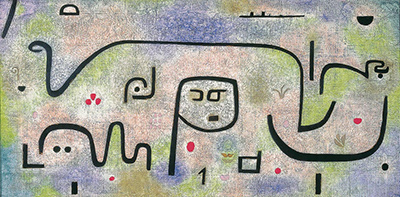
For related late works, see Insula dulcamara, Struck from the List and the late-work overview. Their dates, materials and signs differ; each needs its own evidence.
Explore selected works from Klee’s much larger oeuvre. Titles without a link have an authenticated catalogue identity but no reviewed article yet.
Artworks directory
| Name | Date | Medium |
|---|---|---|
| A Gate | 1939 | Painting and mixed media |
| A Woman for Gods | 1938 | Watercolour and mixed media |
| Ab Ovo | 1917 | Watercolour and mixed media |
| Above Mountain Summit | 1917 | Drawing and mixed media |
| Abstract Trio | 1923 | Drawing and mixed media |
| Acrobats | 1915 | Watercolour and mixed media |
| Actor's Mask | 1924 | Painting and mixed media |
| Ad Marginem | 1930 | Drawing and mixed media |
| Ad Parnassum | 1932 | Painting and mixed media |
| Adventurer Ship | 1927 | Drawing and mixed media |
| Affected Place | 1922 | Drawing and mixed media |
| After a Sketch from Zurich | 1914 | Watercolour and mixed media |
| After Drawing | 1919 | |
| After The Floods | 1936 | Watercolour and mixed media |
| All Souls' Picture | 1921 | |
| Ancient Harmony | 1925 | Painting and mixed media |
| Angel Applicant | 1939 | Drawing and mixed media |
| Angel Serves the Desired | 1920 | |
| Angel, Still Female | 1939 | Painting and mixed media |
| Angelus Novus | 1920 | Drawing and mixed media |
| Animal Terror | 1926 | Painting and mixed media |
| Arab Song | 1932 | Painting and mixed media |
| Archangel | 1938 | Painting and mixed media |
| Architecture | 1923 | Painting and mixed media |
| Architecture of the Plain | 1923 | Drawing and mixed media |
| Around the Fish | 1926 | Painting and mixed media |
| Arrival of the Air Steamer | 1921 | Drawing and mixed media |
| Asiatic God | 1924 | Painting and mixed media |
| Astrological Fantasy Portrait | 1924 | Drawing and mixed media |
| Athlete's Head | 1932 | Watercolour and mixed media |
| Aufgehender Stern | 1931 | Painting and mixed media |
| Autumn Flower | 1922 | Painting and mixed media |
| Bad Band | 1920 | Drawing and mixed media |
| Baroque Centaur | 1939 | Painting and mixed media |
| Before the Blitz | 1923 | Drawing and mixed media |
| Before the Snow | 1929 | Drawing and mixed media |
| Besessenes Madchen | 1924 | Watercolour and mixed media |
| Bird Garden | 1924 | |
| Bird Wandering Off | 1926 | Watercolour and mixed media |
| Blossoms in the Night | 1930 | Watercolour and mixed media |
| Blue-Bird-Pumpkin | 1939 | Painting and mixed media |
| Boats in the Flood | 1937 | Painting and mixed media |
| Botanical Theatre | 1934 | Drawing and mixed media |
| Boy in Fancy Dress | 1931 | Watercolour and mixed media |
| Broken Key | 1938 | |
| Brother and Sister | 1930 | Watercolour and mixed media |
| But the Red Roof | 1935 | Painting and mixed media |
| C - C = Fisch | 1931 | Watercolour and mixed media |
| Cacti | 1912 | Painting and mixed media |
| Camel (in Rhythmic Landscape with Trees) | 1920 | Drawing and mixed media |
| Captive Pierrot | 1923 | Drawing and mixed media |
| Castle and Sun | 1928 | Drawing and mixed media |
| Cat and Bird | 1928 | Drawing and mixed media |
| Cathedrals | 1925 | Watercolour and mixed media |
| Chalice of the Heart | 1937 | Painting and mixed media |
| Characters in Yellow | 1937 | Painting and mixed media |
| Chosen Site | 1927 | Mixed media |
| Christmas Picture | 1923 | Drawing and mixed media |
| City of Towers | 1916 | Painting and mixed media |
| Clarification | 1932 | Painting and mixed media |
| Collection of Figurines | 1926 | Painting and mixed media |
| Colorful Architecture | 1917 | Painting and mixed media |
| Comedians' Handbill | 1938 | |
| Comic Opera Singer | 1927 | Painting and mixed media |
| Composition | 1939 | Painting and mixed media |
| Composition with Figures | 1915 | Drawing and mixed media |
| Composition with the Yellow Half-Moon and the Y | 1918 | Watercolour and mixed media |
| Conch–Still Life II | 1939 | Watercolour and mixed media |
| Cosmic Composition | 1919 | Painting and mixed media |
| Crystal Gradation | 1921 | Drawing and mixed media |
| Dance of the Grieving Child | 1922 | Painting and mixed media |
| Dancing Girl | 1940 | Painting and mixed media |
| Das Licht und Etliches | 1931 | Mixed media |
| Death and Fire | 1940 | Painting and mixed media |
| Death for the Idea | 1915 | |
| Demon as Pirate | 1926 | Watercolour and mixed media |
| Diana | 1931 | Painting and mixed media |
| Diavolo Player | 1923 | Drawing and mixed media |
| Die Kapelle | 1917 | Watercolour and mixed media |
| Die Vase | 1938 | Painting and mixed media |
| Doctor | 1930 | Drawing and mixed media |
| Dredger and Sailboat | 1931 | Watercolour and mixed media |
| Ein Tor | 1939 | Painting and mixed media |
| Ein Weib fur Gotter | 1938 | Mixed media |
| Embrace | 1939 | Watercolour and mixed media |
| Episode before an Arab Town | 1923 | |
| Equals Infinity | 1932 | Painting and mixed media |
| Eros | 1923 | Drawing and mixed media |
| Error on Green | 1930 | Watercolour and mixed media |
| Evening Figure | 1935 | Drawing and mixed media |
| Falling Bird | 1919 | |
| Fermata | 1932 | Watercolour and mixed media |
| Fire Clown | 1921 | Watercolour and mixed media |
| Fire Full Moon | 1933 | Watercolour and mixed media |
| Fire in the Evening | 1929 | Painting and mixed media |
| Fish in the Harbour | 1916 | Watercolour and mixed media |
| Fish Magic | 1925 | Watercolour and mixed media |
| Flock of Birds | 1917 | Drawing and mixed media |
| Flora on Sand | 1927 | Watercolour and mixed media |
| Flower Myth | 1918 | |
| Flower Stand with Watering Can and Bucket | 1910 | Watercolour and mixed media |
| Flowering Tree (Abstraction with Reference to a Flowering Tree) | 1925 | Painting and mixed media |
| Flowers in Pots | 1923 | |
| Flowers in Stone | 1939 | Painting and mixed media |
| Forest Witch | 1938 | Painting and mixed media |
| Fright of a Girl | 1922 | Drawing and mixed media |
| Fruits on Red | 1930 | Drawing and mixed media |
| Full Moon | 1919 | Mixed media |
| Föhn Wind in Franz Marc's Garden | 1915 | Watercolour and mixed media |
| Garden in St Germain, The European Quarter near Tunis | 1914 | Watercolour and mixed media |
| Ghost Chamber with the Tall Door (New Version) | 1925 | |
| Ghost of a Genius | 1922 | Drawing and mixed media |
| Girl in Mourning | 1939 | Painting and mixed media |
| Glance of a Landscape | 1926 | Watercolour and mixed media |
| Gluht Nach | 1939 | Drawing and mixed media |
| Golden Fish | 1925 | Watercolour and mixed media |
| Goldfish Wife | 1921 | Watercolour and mixed media |
| Green Plant, Blood, Louse | 1924 | Drawing and mixed media |
| Hafenbild | 1918 | Mixed media |
| Hammamet with Mosque | 1914 | Watercolour and mixed media |
| Harbour with Sailing Ships | 1937 | Painting and mixed media |
| Hauptweg und Nebenwege | 1929 | Painting and mixed media |
| Heavenly and Earthly Time | 1927 | Drawing and mixed media |
| Heroic Fiddling | 1938 | Painting and mixed media |
| Heroic Roses | 1938 | Painting and mixed media |
| Heroic Strokes of the Bow | — | Mixed media |
| Highway and Byways | 1929 | Drawing and mixed media |
| Houses near the Gravel Pit | 1913 | Watercolour and mixed media |
| Howling Dog | 1928 | Painting and mixed media |
| In the Current Six Thresholds | 1929 | Painting and mixed media |
| In the Style of Kairouan | 1914 | Drawing and mixed media |
| Individualized Altimetry of Stripes | 1930 | Painting and mixed media |
| Insula Dulcamara | 1938 | |
| Interior with the Clock | 1913 | Watercolour and mixed media |
| Irma Rossa the Animal Tamer | 1918 | Drawing and mixed media |
| Journey in Corsica | 1927 | Drawing and mixed media |
| Landscape with Bluebirds | 1919 | Watercolour and mixed media |
| Legend of the Nile | 1937 | Painting and mixed media |
| Lemon Harvest | 1937 | Watercolour and mixed media |
| Likeness in the Bower | 1930 | Watercolour and mixed media |
| Limits of Reason | 1927 | Painting and mixed media |
| Little Hope | 1938 | Watercolour and mixed media |
| Magdalena before the Conversion | 1938 | Drawing and mixed media |
| Mask of Fear | 1932 | Painting and mixed media |
| May Picture | 1925 | Painting and mixed media |
| Monument in a Cemetery | 1922 | Watercolour and mixed media |
| Monuments at G | 1929 | Watercolour and mixed media |
| Municipal Jewel | 1917 | Watercolour and mixed media |
| Mural from the Temple of Longing Thither | 1922 | |
| Nach der Uberschwemmung | 1936 | Watercolour and mixed media |
| New Harmony | 1936 | Painting and mixed media |
| New House in the Suburbs | — | Mixed media |
| Old Steamboat | 1922 | Drawing and mixed media |
| On the Edge | 1930 | Drawing and mixed media |
| Once Emerged from the Gray of Night | 1918 | Drawing and mixed media |
| One Who Understands | 1934 | Painting and mixed media |
| Oriental Pleasure Garden | 1925 | Painting and mixed media |
| Park of Idols | 1939 | Watercolour and mixed media |
| Passing by Red Pillars | 1928 | Watercolour and mixed media |
| Persian Nightingales | 1917 | Drawing and mixed media |
| Popular Wall Painting | 1922 | Painting and mixed media |
| Prestidigitator | 1927 | Watercolour and mixed media |
| Rainy Day | 1931 | Watercolour and mixed media |
| Red and White Domes | 1914 | Watercolour and mixed media |
| Red Balloon | 1922 | Drawing and mixed media |
| Redgreen and Violet-Yellow Rhythms | 1920 | Drawing and mixed media |
| Refuge | 1930 | Watercolour and mixed media |
| Rhythmic Rythmical | 1930 | Painting and mixed media |
| Saint of the Inner Light | 1921 | |
| Scaffolding of a New Building | 1930 | Painting and mixed media |
| Scholar in Dealing with Stars | 1926 | Watercolour and mixed media |
| Seated Woman | 1930 | Drawing and mixed media |
| Senecio | 1922 | Painting and mixed media |
| Separation in the Evening | 1922 | Drawing and mixed media |
| Sinbad the Sailor | 1923 | Drawing and mixed media |
| Skeptically Smiling | — | Mixed media |
| Small House in the Garden City | 1928 | Watercolour and mixed media |
| Small Portrait of a Girl in Yellow | 1925 | Painting and mixed media |
| Southern Gardens | 1919 | Watercolour and mixed media |
| Static-Dynamic Gradation | 1923 | Drawing and mixed media |
| Still Life | 1927 | Painting and mixed media |
| Still Life with Gladioli | 1932 | Watercolour and mixed media |
| Strange Garden | 1923 | Drawing and mixed media |
| Stricken City | 1936 | Painting and mixed media |
| Strong Dream | 1929 | Watercolour and mixed media |
| Struck from the List | 1933 | Drawing and mixed media |
| Structural I | 1924 | Drawing and mixed media |
| Sumpflegende | 1919 | Painting and mixed media |
| Temple Gardens | 1920 | Drawing and mixed media |
| The Arrow before the Target | 1921 | Drawing and mixed media |
| The Barbed Noose with the Mice | 1923 | Watercolour and mixed media |
| The Flora of the Heath | 1925 | Watercolour and mixed media |
| The Goldfish | 1925 | Watercolour and mixed media |
| The Hour Before One Night | 1940 | Painting and mixed media |
| The Man in Love | 1923 | |
| The Mask with the Flag | 1925 | Mixed media |
| The Pathos of Fertility | 1921 | |
| The Rhine at Duisburg | 1937 | Painting and mixed media |
| The Way to the Citadel | 1937 | Painting and mixed media |
| Three Houses and a Bridge | 1922 | Watercolour and mixed media |
| Tightrope Walker | 1923 | |
| Tomb in Three Parts | 1923 | Watercolour and mixed media |
| Tomcat's Turf | 1919 | Watercolour and mixed media |
| Tower in Orange and Green | 1922 | Drawing and mixed media |
| Tree and Architecture - Rhythms I | 1920 | Watercolour and mixed media |
| Tree and Architecture - Rhythms II | 1920 | Painting and mixed media |
| Tropical Dawn with the Owl | 1921 | Mixed media |
| Tropische Dammerung | 1921 | Painting and mixed media |
| Twittering Machine | 1922 | Drawing and mixed media |
| Variations (Progressive Motif) | 1927 | Watercolour and mixed media |
| Ventriloquist and Crier in the Moor | 1923 | |
| Viaducts Break Ranks | 1937 | Drawing and mixed media |
| Villa R | 1919 | Painting and mixed media |
| Village Carnival | 1926 | Painting and mixed media |
| Vor dem Blitz | 1923 | Drawing and mixed media |
| Wald-Hexen | 1938 | Painting and mixed media |
| Young Forest | 1925 | Drawing and mixed media |
Related artworks
Explore eight other Klee works, beginning with works close in date to this one.
Insula Dulcamara
1938
Viaducts Break Ranks
1937
New Harmony
1936
Fire Full Moon
1933
Struck from the List
1933
Ad Parnassum
1932
Mask of Fear
1932
Discussion
The pale face can be seen as a mask and read as the German word for death.
The research separates the painted object, Klee’s late circumstances and later philosophical readings.
Reader Insights
When do the face’s marks first become letters for you?
How do the rough jute and broad dark marks affect the face?
What could the original work register tell us about its completion date?
Join the Conversation
Share what you see or a source that helps explain the work.
References
- Staatliche Museen zu Berlin, Das Universum Klee exhibition work list (2008), entry Tod und Feuer, catalogue raisonné 9351, 1940,332, full German medium and 46.7 × 44.6 cm, View source.
- Zentrum Paul Klee, Fokus. Cover Star Klee, “Tod und Feuer: Paul Klee und Martin Heidegger” (German; 2025 guide, with English and French editions; interpretations and reception qualified), View source.
- Walther Fuchs, “Paul Klee und seine Krankheit revisited,” Zwitscher-Maschine (German, 2017), documentary reassessment of the retrospective illness diagnosis, View source.
- Zentrum Paul Klee image agency via DNP, “Death and Fire,” image record ZPK000020 and abbreviated object caption (Japanese/English; licensed image not reused), View source.
- Fondation Beyeler, Paul Klee: Die Erfüllung im Spätwerk exhibition archive (German, 2003), historical caption for materials, double frame strips and rounded measurement (direct page intermittently unavailable), View source.
- Claude Cernuschi, “Paul Klee and Language,” in Paul Klee: Philosophical Vision; From Nature to Art (McMullen Museum of Art, 2012), pp. 106–33, especially p. 118 on Death and Fire (English; author-uploaded full text), View source.
- Wilcon Pereira, “Escrita: kLee. Klee. kleE. klEe / figura,” Trans/Form/Ação 1 (1974), Portuguese critical reception of word-images, View source.
- Ryōsuke Ōhashi, “Klee to Haideggā: ‘Shi to hi’ no bunseki o chūshin to shite,” Bigaku 39.2 (1988), pp. 1–12 (Japanese original and German abstract; direct reading of the article’s formal analysis on pp. 4–6 and philosophical interpretation on pp. 7–10), View source.
- Martin Heidegger, “Zeit und Sein” (lecture 1962), in Zur Sache des Denkens, Gesamtausgabe 14 (2007), preface p. 5, explicit mention of Tod und Feuer (German primary text), View source.