



 by Tom Gurney
Tom Gurney BSc (Hons) is an art history expert with over 20 years experience
Published on June 19, 2020 / Updated on September 27, 2026
Email: tomgurney1@gmail.com / Phone: +44 7429 011000
A set of working documents
Paul Klee’s “notebooks” are often invoked as though he had left a finished, two-volume explanation of his art. The surviving papers tell a more interesting story. At the Bauhaus he wrote out an early sequence of form lessons in a paginated manuscript book, then developed a much larger collection of teaching sheets that he altered and reused. He published a short Pädagogisches Skizzenbuch (Pedagogical Sketchbook) in 1925. The two large volumes commonly called the Notebooks were arranged and issued after his death. A line or colour diagram can be read differently depending on which of these objects it comes from.[1][2][3]
This page follows the documents rather than treating them as a universal key to Klee’s paintings. Four spreads of the German 1925 book can be examined directly here: they show active lines and passive planes, a tower balanced by successive corrections, the movement of an arrow, and a colour diagram revised because its first arrangement misled. Other claims about his unpublished lesson sheets are tied to the Zentrum Paul Klee’s archive description and to scholarship that has examined the manuscripts. That distinction matters: a printed spread available to inspect is different evidence from a later account of a folio we have not seen.[1][2][4]
Contents
- What exactly are the “notebooks”?
- What did Klee publish during his lifetime?
- An active line is more than a slogan
- Balance is an event, not just symmetry
- Gravity, arrows and the limits of analogy
- A colour scheme Klee revises in front of the reader
- What did later editors make of the papers?
- How can a reader check a notebook claim?
What exactly are the “notebooks”?
The name covers several physical and editorial forms. Klee’s Beiträge zur bildnerischen Formlehre (Contributions to Pictorial Form Theory) is a manuscript book of 192 pages, paginated by him, associated with his first Bauhaus lecture cycle in 1921–22. It is a bounded sequence of handwritten teaching material, even though it was made for lessons rather than published at the time as a book for sale. Martina Scholger’s detailed review of the digital edition identifies line, perspective, balance, composition and colour among its subjects.[1][2]
Klee’s later Bildnerische Gestaltungslehre (Pictorial Design Theory) is different: approximately 3,900 pages of notes in notebooks and loose sheets. He organised much of the material thematically in envelopes and reassembled parts for teaching over several years. The Zentrum Paul Klee describes the archive as a folder of lesson notes alongside the smaller Formlehre book. Scholger reports that Klee envisaged 24 chapters, including general principles, two-dimensional design and three-dimensional form. Those chapter headings are an architecture for thinking through the material, not a list of 24 finished books published by Klee.[1][2]
This difference affects chronology. A loose page may have been drafted, changed, moved and taught again. The order in which it survives can reflect Klee’s own grouping and later archival work by Lily Klee and Jürg Spiller. A modern reader cannot infer from its current folder position alone the date of its first classroom use or a single final version of Klee’s thought. Dated lecture notes, calendars and student records help, but the surviving timetable has gaps. The Bauhaus teaching page follows that chronology in more detail.[2][5]
Calling the archive “two notebooks” also obscures its physical variety. The early lecture book, numerous later leaves, the lifetime printed booklet and two posthumous edited volumes are four different levels of evidence. The most useful first question is therefore: Which document, which edition and which page is being cited?[1][2][3]
What did Klee publish during his lifetime?
His Pädagogisches Skizzenbuch appeared in 1925 as volume 2 of the Bauhausbücher series, published in Munich by Albert Langen. It condensed selected ideas developed in teaching into a small, designed work. The institutional Bauhaus publication lists and the Metropolitan Museum’s library record confirm the volume number and year. The Met describes its own copy as a second edition, so its exact collation should not be silently assigned to every printing.[3][6]
The booklet has a distinct structure. Heidelberg University Library’s digitisation lists four numbered parts, and the printed pages themselves show a progression from lines and surfaces through balance and motion to colour. Klee supplied diagrams and short explanatory text. The forms on the page may seem elementary—a point, arrow, square, weight or coloured pair—but the argument is often about a change in role or relation. A line may act on a plane in one drawing and serve as a boundary in another. The book is a compact set of experiments in visual thinking, not a catalogue of motifs for students to copy into finished pictures.[3][7]
Klee also published Wege des Naturstudiums (Ways of Studying Nature) in the Bauhaus catalogue Staatliches Bauhaus in Weimar 1919–1923. The catalogue’s own contents place his essay alongside contributions by Gertrud Grunow and Wassily Kandinsky; the 1923 publication presented the school and its teaching to a public beyond the classrooms. That text is not a chapter of the later Spiller “notebooks”. Its concern with the artist’s relation to nature belongs to Klee’s lifetime written record, but its original pages need direct consultation before quoting or closely analysing them here.[8][9]
The relation between the 1925 booklet and the larger manuscripts is therefore selective. Scholger calls the printed work a compressed publication drawn from the earlier form teaching. It neither reproduces all 192 manuscript pages nor anticipates every later sheet. Its sequence and design are a published statement by Klee; the much larger archive shows a longer working process.[2][3]
An active line is more than a slogan
One sentence is regularly attributed to Klee: “drawing is a line going for a walk.” That wording is a useful modern paraphrase of an idea in the 1925 booklet, but it should not be set in quotation marks as his exact English sentence. The German opening describes an active line that moves freely, in a walk for its own sake, with the moving point as its agent. The discussion continues through changes of direction, boundaries and the relation of line to the area it forms. It does not say that every Klee drawing is made without purpose, measurement or revision.[10]
Printed pages 10–11 make the later part of that argument more exact. Under the heading “three cases”, the left page shows an active line and passive plane, then a “medial” line whose energy gives a plane effect, then an active filled plane for which the enclosing line has become passive. On the facing page, a larger scheme arranges active, medial and passive regions. A short verbal analogy uses different ways in which a tree can be felled to explain agency. The same visual ingredient can occupy a different role depending on what acts and what receives an effect.[7]
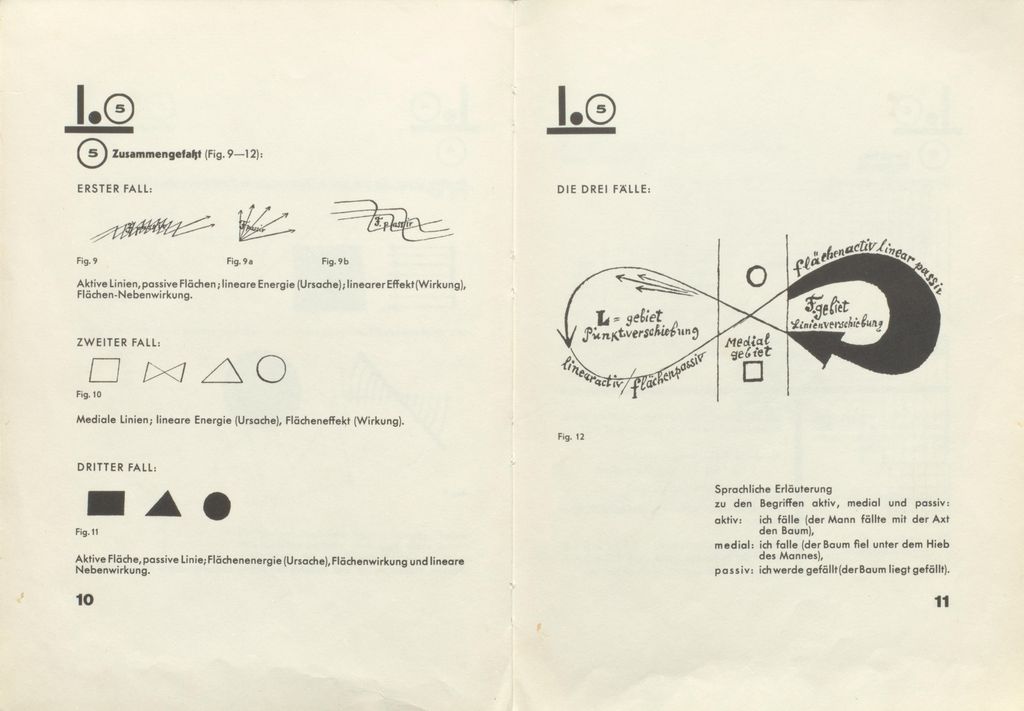
This example is pedagogically useful because the diagrams do not ask students simply to imitate one kind of line. They ask them to observe a relation: what initiates a form, what is changed by it, and how the viewer recognises that change. At the same time, Klee’s terms are his teaching model, not a scientific classification valid for every image. A scholar comparing a particular painting with the exercise would still need the painting’s date, surface and documented relation to the lesson.[5][7]
Balance is an event, not just symmetry
Printed pages 34–35 shift the discussion to weight and correction. Klee draws a horizontal axis tipped by a heavier dark area. A later dark mark on the other side compensates for the visual imbalance. His prose compares a person swaying left and extending a hand or foot to avoid a fall. The analogy gives an immediate bodily example for a visual effect, while the diagram tests the effect with quite spare geometry.[11]
The facing page is headed Turmbau—tower building. Blocks laid one above another alternately pull the construction left and right; a further stone restores the relation. Beside the stack, pivot points become a zigzag. What looked like one stationary tower is also a record of successive disturbances and responses. This makes “balance” more specific than a rule that the two halves of an image must match. Unequal parts can answer one another, and the sequence by which they are placed matters.[11]
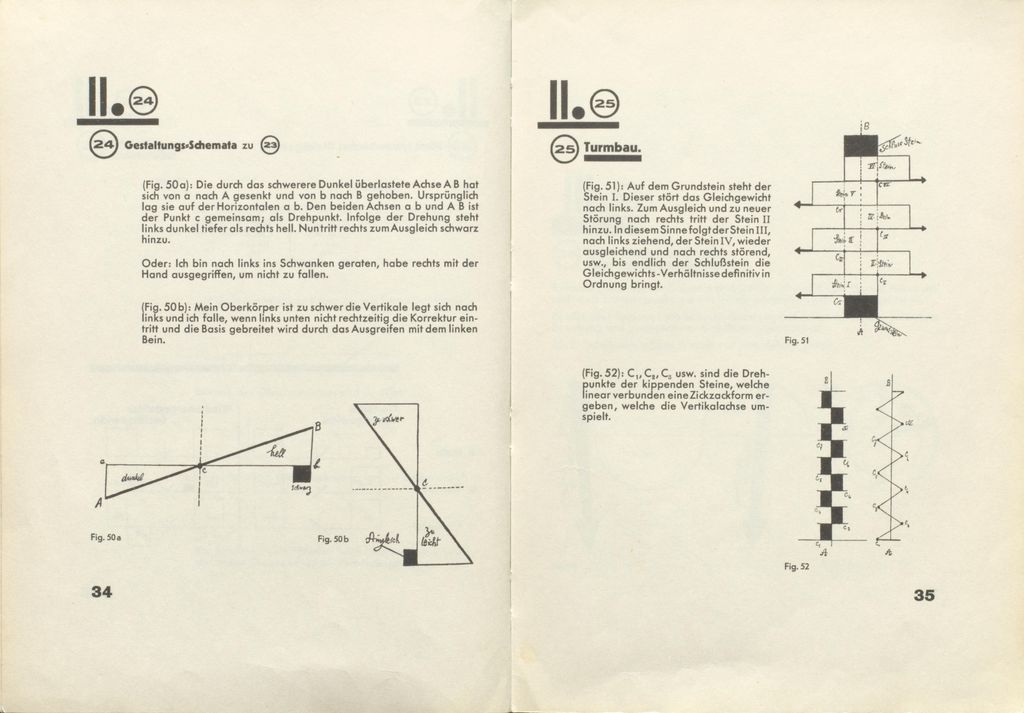
Klee was not describing a real building’s load calculations. He borrowed familiar experiences of weight and leaning to make a pictorial relation discussable. One can use the spread to look at a Klee work in which a dark patch or angled structure changes the sense of balance, but a resemblance alone is not proof that the work illustrates this very page. The booklet is a tool for looking as well as a historical document of teaching.[11]
Gravity, arrows and the limits of analogy
Printed pages 46–47 develop two different paths. One diagram follows an earth-bound rise that returns under gravity; another proposes a curve moving away from Earth. Klee’s accompanying text contrasts earthly attraction with a hypothetical motion beyond it. On the next page, a dark arrow emerges from a marked origin into a field of white, and his prose discusses how direction and contrast focus the eye. These are not physics lessons in the modern experimental sense. They are pictorial analogies constructed from observed or imagined movement.[12]
This distinction prevents two easy misreadings. Klee did not merely draw decorative arrows, but neither can every arrow in a painting be assigned one fixed metaphysical destination. In a named picture it might direct attention, interrupt a field, point to a figure or become the figure itself. The documented booklet spread shows how he reasoned about a graphic element; the interpretation of each artwork still begins with what is visibly present and what the object record can support.[12]
The Zentrum Paul Klee’s account of its Bewegte Bilder exhibition separately identifies unpublished lesson folios about gravity and movement: BG II.21/13, BG II.21/77 and BF 64. It quotes and interprets them in German. Those folio references are valuable routes for a future direct manuscript comparison, especially for his description of water as an intermediate realm where buoyancy changes the relation to gravity. They are not pages of the 1925 booklet, and this page does not claim to have inspected their facsimiles directly.[4]
A colour scheme Klee revises in front of the reader
Printed pages 50–51 offer perhaps the clearest warning against treating his diagrams as immutable laws. Three colour pairs—green/red, blue/orange and violet/yellow—are arranged as opposite movements about a neutral grey. Klee then explains why a tempting next diagram is misleading: it places a green-to-red step against a blue-to-orange step as though those transitions themselves were opposed. He redraws the relations diagonally and eventually arrives at a circular arrangement of the spectral colours.[13]
The point is visible revision. The drawings change because one arrangement falsely implies a relation that Klee does not want to teach. A colour diagram is a made representation whose geometry can clarify or confuse. This is more useful to a reader than imagining a single “Klee colour wheel” that automatically decodes his paintings. The book’s printed final drawing remains one solution within this particular explanation, not an exhaustive inventory of how he mixed pigments or built coloured surfaces.[13][14]
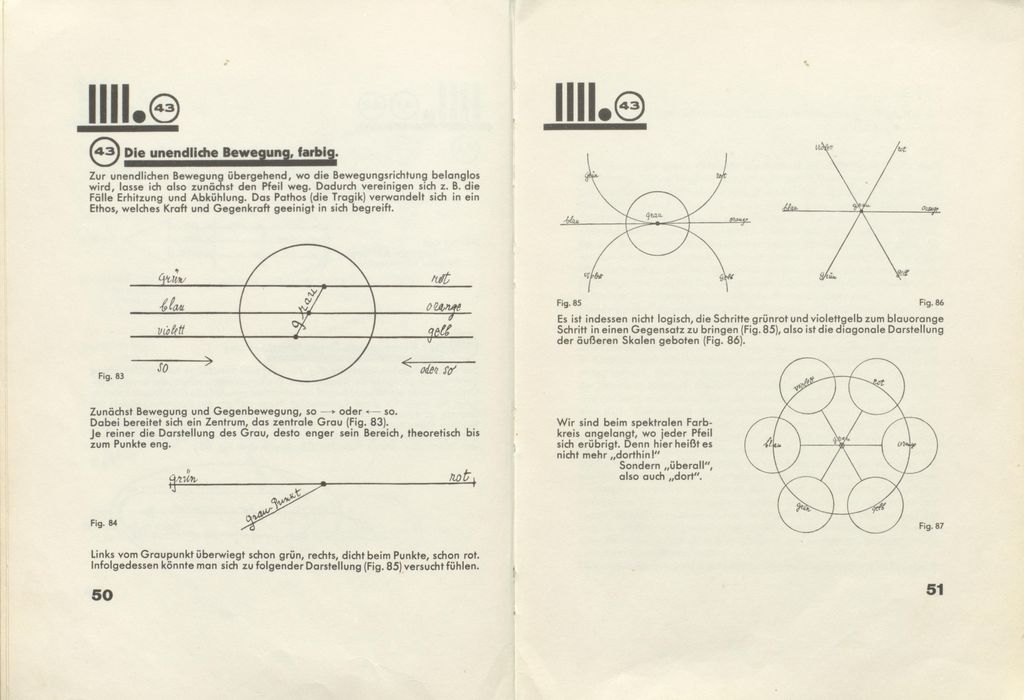
Marianne Keller Tschirren’s dissertation provides a wider teaching context. By reading Klee’s notes and student notebooks, she shows him comparing older colour systems associated with Goethe and Runge with later proposals by Ostwald and Koelsch. His teaching changed by term, and a planned order in his notes did not prove that every part was delivered unchanged. This matters when a painted gradation or grid seems to echo a diagram: the comparison can be productive, but the work is a physical object with its own date and process. The colour page carries that broader question.[5][14]
What did later editors make of the papers?
After Klee died in 1940, his teaching material had to be kept, sorted and made accessible. Scholger reports that Klee had grouped loose notes in thematic envelopes and that Lily Klee and Jürg Spiller later numbered material in its inherited order. Later inventory work at the Zentrum Paul Klee could bring old and new numbers together and describe individual sheets. This archival labour is necessary for research, but it also means that a modern order is an editorial account of a changing set of papers.[1][2]
Spiller edited two substantial German volumes: Das bildnerische Denken in 1956 and Unendliche Naturgeschichte in 1970. Their English counterparts are The Thinking Eye (1961, translated by Ralph Manheim) and The Nature of Nature (1973, translated by Heinz Norden). These titles have made Klee’s teaching famous internationally. They are also posthumous editions, assembled by someone other than Klee. Sibyl Moholy-Nagy’s English Pedagogical Sketchbook translates the separate 1925 booklet; it is not a third title for either large Spiller volume.[2][15][16]
The editorial distinction is not pedantry. Scholger summarises a longstanding criticism of Spiller’s volumes: he rearranged the manuscripts and introduced his own diagrams without always identifying those interventions clearly. The resulting books can make a developing set of notes look like a complete, static system. That criticism does not make the volumes useless; it changes how they should be cited. A claim about Klee’s exact sequence of thought should, where possible, be checked against the original sheet or the later critical digital edition, not inferred from Spiller’s printed ordering alone.[2]
The Zentrum Paul Klee’s digital project, developed in 2008–12, placed facsimiles, transcriptions and descriptions online. Scholger praises its access to the full Gestaltungslehre while identifying limitations: transcriptions presented as images rather than reusable text, unequal facsimile resolution, and insufficient explanation of some layered alterations. Her review is itself a guide to asking better questions. A crossed-out word, later addition or changed sheet number may reveal that Klee reused a lesson; a clean typeset extract may conceal that history.[2]
How can a reader check a notebook claim?
Begin by identifying the kind of source. Is the quotation from Klee’s 1925 published booklet, a handwritten Formlehre page, one of the loose Gestaltungslehre sheets, a student’s copy, or a posthumous edition? Then record the original German title, printed page or manuscript folio, and the edition or archive that supplies it. The Zentrum Paul Klee uses BF and BG identifiers for teaching materials; a printed-book page such as 50–51 is a different locator.[1][2][4]
Next ask what the diagram and text do together. On page 10, the change from active line to active plane is hard to understand if the small drawings are stripped from their labels. On page 35, the tower is more than a shape: arrows and pivot marks show a series of counterweights. On page 51, the sequence of revised colour diagrams is itself part of the argument. A transcription of words alone can miss these relationships; an isolated picture can miss Klee’s qualification beside it.[7][11][13]
Finally separate the document from its later application. A student exercise can show what someone made after a class, but that student remains its maker. A Klee painting can share a rhythm with a teaching example without being a literal assignment sheet. The best interpretation states which relation is observed and what evidence links the two objects. It leaves a gap visible when the relevant classroom record, painting technical file or original folio has not been checked.[5][17]
The notebook legacy rests in this openness to checking. Klee’s pages record a teacher making visual decisions explainable: moving a point, shifting the role of a line, correcting a balance, revising a colour arrangement. The papers were never one sealed code. Their survival, later editing and digitisation let us see how artistic thought was worked through, taught, rearranged and read again.[1][2][7][11][13]
Continue with Klee’s Bauhaus teaching, colours, materials and techniques and biography.
Explore selected works from Klee’s much larger oeuvre. Titles without a link have an authenticated catalogue identity but no reviewed article yet.
Artworks directory
| Name | Date | Medium |
|---|---|---|
| A Gate | 1939 | Painting and mixed media |
| A Woman for Gods | 1938 | Watercolour and mixed media |
| Ab Ovo | 1917 | Watercolour and mixed media |
| Above Mountain Summit | 1917 | Drawing and mixed media |
| Abstract Trio | 1923 | Drawing and mixed media |
| Acrobats | 1915 | Watercolour and mixed media |
| Actor's Mask | 1924 | Painting and mixed media |
| Ad Marginem | 1930 | Drawing and mixed media |
| Ad Parnassum | 1932 | Painting and mixed media |
| Adventurer Ship | 1927 | Drawing and mixed media |
| Affected Place | 1922 | Drawing and mixed media |
| After a Sketch from Zurich | 1914 | Watercolour and mixed media |
| After Drawing | 1919 | |
| After The Floods | 1936 | Watercolour and mixed media |
| All Souls' Picture | 1921 | |
| Ancient Harmony | 1925 | Painting and mixed media |
| Angel Applicant | 1939 | Drawing and mixed media |
| Angel Serves the Desired | 1920 | |
| Angel, Still Female | 1939 | Painting and mixed media |
| Angelus Novus | 1920 | Drawing and mixed media |
| Animal Terror | 1926 | Painting and mixed media |
| Arab Song | 1932 | Painting and mixed media |
| Archangel | 1938 | Painting and mixed media |
| Architecture | 1923 | Painting and mixed media |
| Architecture of the Plain | 1923 | Drawing and mixed media |
| Around the Fish | 1926 | Painting and mixed media |
| Arrival of the Air Steamer | 1921 | Drawing and mixed media |
| Asiatic God | 1924 | Painting and mixed media |
| Astrological Fantasy Portrait | 1924 | Drawing and mixed media |
| Athlete's Head | 1932 | Watercolour and mixed media |
| Aufgehender Stern | 1931 | Painting and mixed media |
| Autumn Flower | 1922 | Painting and mixed media |
| Bad Band | 1920 | Drawing and mixed media |
| Baroque Centaur | 1939 | Painting and mixed media |
| Before the Blitz | 1923 | Drawing and mixed media |
| Before the Snow | 1929 | Drawing and mixed media |
| Besessenes Madchen | 1924 | Watercolour and mixed media |
| Bird Garden | 1924 | |
| Bird Wandering Off | 1926 | Watercolour and mixed media |
| Blossoms in the Night | 1930 | Watercolour and mixed media |
| Blue-Bird-Pumpkin | 1939 | Painting and mixed media |
| Boats in the Flood | 1937 | Painting and mixed media |
| Botanical Theatre | 1934 | Drawing and mixed media |
| Boy in Fancy Dress | 1931 | Watercolour and mixed media |
| Broken Key | 1938 | |
| Brother and Sister | 1930 | Watercolour and mixed media |
| But the Red Roof | 1935 | Painting and mixed media |
| C - C = Fisch | 1931 | Watercolour and mixed media |
| Cacti | 1912 | Painting and mixed media |
| Camel (in Rhythmic Landscape with Trees) | 1920 | Drawing and mixed media |
| Captive Pierrot | 1923 | Drawing and mixed media |
| Castle and Sun | 1928 | Drawing and mixed media |
| Cat and Bird | 1928 | Drawing and mixed media |
| Cathedrals | 1925 | Watercolour and mixed media |
| Chalice of the Heart | 1937 | Painting and mixed media |
| Characters in Yellow | 1937 | Painting and mixed media |
| Chosen Site | 1927 | Mixed media |
| Christmas Picture | 1923 | Drawing and mixed media |
| City of Towers | 1916 | Painting and mixed media |
| Clarification | 1932 | Painting and mixed media |
| Collection of Figurines | 1926 | Painting and mixed media |
| Colorful Architecture | 1917 | Painting and mixed media |
| Comedians' Handbill | 1938 | |
| Comic Opera Singer | 1927 | Painting and mixed media |
| Composition | 1939 | Painting and mixed media |
| Composition with Figures | 1915 | Drawing and mixed media |
| Composition with the Yellow Half-Moon and the Y | 1918 | Watercolour and mixed media |
| Conch–Still Life II | 1939 | Watercolour and mixed media |
| Cosmic Composition | 1919 | Painting and mixed media |
| Crystal Gradation | 1921 | Drawing and mixed media |
| Dance of the Grieving Child | 1922 | Painting and mixed media |
| Dancing Girl | 1940 | Painting and mixed media |
| Das Licht und Etliches | 1931 | Mixed media |
| Death and Fire | 1940 | Painting and mixed media |
| Death for the Idea | 1915 | |
| Demon as Pirate | 1926 | Watercolour and mixed media |
| Diana | 1931 | Painting and mixed media |
| Diavolo Player | 1923 | Drawing and mixed media |
| Die Kapelle | 1917 | Watercolour and mixed media |
| Die Vase | 1938 | Painting and mixed media |
| Doctor | 1930 | Drawing and mixed media |
| Dredger and Sailboat | 1931 | Watercolour and mixed media |
| Ein Tor | 1939 | Painting and mixed media |
| Ein Weib fur Gotter | 1938 | Mixed media |
| Embrace | 1939 | Watercolour and mixed media |
| Episode before an Arab Town | 1923 | |
| Equals Infinity | 1932 | Painting and mixed media |
| Eros | 1923 | Drawing and mixed media |
| Error on Green | 1930 | Watercolour and mixed media |
| Evening Figure | 1935 | Drawing and mixed media |
| Falling Bird | 1919 | |
| Fermata | 1932 | Watercolour and mixed media |
| Fire Clown | 1921 | Watercolour and mixed media |
| Fire Full Moon | 1933 | Watercolour and mixed media |
| Fire in the Evening | 1929 | Painting and mixed media |
| Fish in the Harbour | 1916 | Watercolour and mixed media |
| Fish Magic | 1925 | Watercolour and mixed media |
| Flock of Birds | 1917 | Drawing and mixed media |
| Flora on Sand | 1927 | Watercolour and mixed media |
| Flower Myth | 1918 | |
| Flower Stand with Watering Can and Bucket | 1910 | Watercolour and mixed media |
| Flowering Tree (Abstraction with Reference to a Flowering Tree) | 1925 | Painting and mixed media |
| Flowers in Pots | 1923 | |
| Flowers in Stone | 1939 | Painting and mixed media |
| Forest Witch | 1938 | Painting and mixed media |
| Fright of a Girl | 1922 | Drawing and mixed media |
| Fruits on Red | 1930 | Drawing and mixed media |
| Full Moon | 1919 | Mixed media |
| Föhn Wind in Franz Marc's Garden | 1915 | Watercolour and mixed media |
| Garden in St Germain, The European Quarter near Tunis | 1914 | Watercolour and mixed media |
| Ghost Chamber with the Tall Door (New Version) | 1925 | |
| Ghost of a Genius | 1922 | Drawing and mixed media |
| Girl in Mourning | 1939 | Painting and mixed media |
| Glance of a Landscape | 1926 | Watercolour and mixed media |
| Gluht Nach | 1939 | Drawing and mixed media |
| Golden Fish | 1925 | Watercolour and mixed media |
| Goldfish Wife | 1921 | Watercolour and mixed media |
| Green Plant, Blood, Louse | 1924 | Drawing and mixed media |
| Hafenbild | 1918 | Mixed media |
| Hammamet with Mosque | 1914 | Watercolour and mixed media |
| Harbour with Sailing Ships | 1937 | Painting and mixed media |
| Hauptweg und Nebenwege | 1929 | Painting and mixed media |
| Heavenly and Earthly Time | 1927 | Drawing and mixed media |
| Heroic Fiddling | 1938 | Painting and mixed media |
| Heroic Roses | 1938 | Painting and mixed media |
| Heroic Strokes of the Bow | — | Mixed media |
| Highway and Byways | 1929 | Drawing and mixed media |
| Houses near the Gravel Pit | 1913 | Watercolour and mixed media |
| Howling Dog | 1928 | Painting and mixed media |
| In the Current Six Thresholds | 1929 | Painting and mixed media |
| In the Style of Kairouan | 1914 | Drawing and mixed media |
| Individualized Altimetry of Stripes | 1930 | Painting and mixed media |
| Insula Dulcamara | 1938 | |
| Interior with the Clock | 1913 | Watercolour and mixed media |
| Irma Rossa the Animal Tamer | 1918 | Drawing and mixed media |
| Journey in Corsica | 1927 | Drawing and mixed media |
| Landscape with Bluebirds | 1919 | Watercolour and mixed media |
| Legend of the Nile | 1937 | Painting and mixed media |
| Lemon Harvest | 1937 | Watercolour and mixed media |
| Likeness in the Bower | 1930 | Watercolour and mixed media |
| Limits of Reason | 1927 | Painting and mixed media |
| Little Hope | 1938 | Watercolour and mixed media |
| Magdalena before the Conversion | 1938 | Drawing and mixed media |
| Mask of Fear | 1932 | Painting and mixed media |
| May Picture | 1925 | Painting and mixed media |
| Monument in a Cemetery | 1922 | Watercolour and mixed media |
| Monuments at G | 1929 | Watercolour and mixed media |
| Municipal Jewel | 1917 | Watercolour and mixed media |
| Mural from the Temple of Longing Thither | 1922 | |
| Nach der Uberschwemmung | 1936 | Watercolour and mixed media |
| New Harmony | 1936 | Painting and mixed media |
| New House in the Suburbs | — | Mixed media |
| Old Steamboat | 1922 | Drawing and mixed media |
| On the Edge | 1930 | Drawing and mixed media |
| Once Emerged from the Gray of Night | 1918 | Drawing and mixed media |
| One Who Understands | 1934 | Painting and mixed media |
| Oriental Pleasure Garden | 1925 | Painting and mixed media |
| Park of Idols | 1939 | Watercolour and mixed media |
| Passing by Red Pillars | 1928 | Watercolour and mixed media |
| Persian Nightingales | 1917 | Drawing and mixed media |
| Popular Wall Painting | 1922 | Painting and mixed media |
| Prestidigitator | 1927 | Watercolour and mixed media |
| Rainy Day | 1931 | Watercolour and mixed media |
| Red and White Domes | 1914 | Watercolour and mixed media |
| Red Balloon | 1922 | Drawing and mixed media |
| Redgreen and Violet-Yellow Rhythms | 1920 | Drawing and mixed media |
| Refuge | 1930 | Watercolour and mixed media |
| Rhythmic Rythmical | 1930 | Painting and mixed media |
| Saint of the Inner Light | 1921 | |
| Scaffolding of a New Building | 1930 | Painting and mixed media |
| Scholar in Dealing with Stars | 1926 | Watercolour and mixed media |
| Seated Woman | 1930 | Drawing and mixed media |
| Senecio | 1922 | Painting and mixed media |
| Separation in the Evening | 1922 | Drawing and mixed media |
| Sinbad the Sailor | 1923 | Drawing and mixed media |
| Skeptically Smiling | — | Mixed media |
| Small House in the Garden City | 1928 | Watercolour and mixed media |
| Small Portrait of a Girl in Yellow | 1925 | Painting and mixed media |
| Southern Gardens | 1919 | Watercolour and mixed media |
| Static-Dynamic Gradation | 1923 | Drawing and mixed media |
| Still Life | 1927 | Painting and mixed media |
| Still Life with Gladioli | 1932 | Watercolour and mixed media |
| Strange Garden | 1923 | Drawing and mixed media |
| Stricken City | 1936 | Painting and mixed media |
| Strong Dream | 1929 | Watercolour and mixed media |
| Struck from the List | 1933 | Drawing and mixed media |
| Structural I | 1924 | Drawing and mixed media |
| Sumpflegende | 1919 | Painting and mixed media |
| Temple Gardens | 1920 | Drawing and mixed media |
| The Arrow before the Target | 1921 | Drawing and mixed media |
| The Barbed Noose with the Mice | 1923 | Watercolour and mixed media |
| The Flora of the Heath | 1925 | Watercolour and mixed media |
| The Goldfish | 1925 | Watercolour and mixed media |
| The Hour Before One Night | 1940 | Painting and mixed media |
| The Man in Love | 1923 | |
| The Mask with the Flag | 1925 | Mixed media |
| The Pathos of Fertility | 1921 | |
| The Rhine at Duisburg | 1937 | Painting and mixed media |
| The Way to the Citadel | 1937 | Painting and mixed media |
| Three Houses and a Bridge | 1922 | Watercolour and mixed media |
| Tightrope Walker | 1923 | |
| Tomb in Three Parts | 1923 | Watercolour and mixed media |
| Tomcat's Turf | 1919 | Watercolour and mixed media |
| Tower in Orange and Green | 1922 | Drawing and mixed media |
| Tree and Architecture - Rhythms I | 1920 | Watercolour and mixed media |
| Tree and Architecture - Rhythms II | 1920 | Painting and mixed media |
| Tropical Dawn with the Owl | 1921 | Mixed media |
| Tropische Dammerung | 1921 | Painting and mixed media |
| Twittering Machine | 1922 | Drawing and mixed media |
| Variations (Progressive Motif) | 1927 | Watercolour and mixed media |
| Ventriloquist and Crier in the Moor | 1923 | |
| Viaducts Break Ranks | 1937 | Drawing and mixed media |
| Villa R | 1919 | Painting and mixed media |
| Village Carnival | 1926 | Painting and mixed media |
| Vor dem Blitz | 1923 | Drawing and mixed media |
| Wald-Hexen | 1938 | Painting and mixed media |
| Young Forest | 1925 | Drawing and mixed media |
Discussion
Klee's printed book and surviving teaching sheets invite close, source-specific reading.
A diagram can change meaning when its page or editorial history is lost.
Reader Insights
Which printed diagram makes its process clearest to you?
How would you distinguish a classroom exercise from a finished painting?
Which folio or edition would you want to check next?
Join the Conversation
Share the specific page, figure or source behind your reading.
References
- Zentrum Paul Klee, Archive and research (German; parallel French, Italian and English pages). Describes Klee’s original teaching archive, smaller Formlehre book, approximately 3,900 other pages, student records and onsite research access. The language versions are one institutional source family, View source.
- Martina Scholger, “Paul Klee – Bildnerische Form- und Gestaltungslehre”, RIDE 4 (2016; German), full review. Documents the 192-page manuscript, later note corpus, Klee’s thematic envelopes, later numbering, Spiller criticism, and the 2008–12 digital edition’s strengths and limits. Its incidental 1949 death-year typo is not used, View source.
- Bauhaus Kooperation, Bauhaus books and Klee’s Pedagogical Sketchbook (English/German); Heidelberg University Library, 1925 copy landing page (German). Series number, publication and four-part contents map. Heidelberg page/PDF delivery was unavailable for a full read.
- Zentrum Paul Klee, Paul Klee. Bewegte Bilder (2016–17 exhibition text; German despite the EN route). Identifies and quotes BF 64 and BG II.21/13, /77. The original facsimiles were not directly checked here; claims about them are attributed to the institution, View source.
- Marianne Keller Tschirren, Dreieck, Kreis, Kugel. Farbenordnungen im Unterricht von Paul Klee am Bauhaus, University of Bern dissertation (2011; German), especially printed pp. 23–31, 82–84 and course appendix pp. 193–96. Directly read; source for changing course sequence, comparisons among colour systems and gaps in the term record, View source.
- Metropolitan Museum of Art, Watson Library, Pädagogisches Skizzenbuch copy record (English). Identifies its second-edition 1925 copy, publisher and series; its catalogue details describe this copy, View source.
- Paul Klee, Pädagogisches Skizzenbuch, printed pp. 10–11, Bauhausbücher 2 (Munich, 1925; German), figures 9–12. High-resolution original-book spread read directly. The Commons item marks the scan Public Domain Mark 1.0, View source.
- Bauhaus Kooperation, Staatliches Bauhaus Weimar 1919–1923 (German), and SLUB Dresden, 1923 digitised catalogue record (German). Sources for the original publication and location of Klee’s essay; original essay pages remain to read in full.
- Lars Müller Publishers / Bauhaus-Archiv, 2019 facsimile edition (English). Publisher record confirming the catalogue’s 1923 public-school context and later facsimile publication; no claims are drawn from the unread 2019 edition’s commentary, View source.
- Oskar Bätschmann, “Grammatik der Bewegung” (German; discussing Pädagogisches Skizzenbuch pp. 6–7), and ZPK reference 4. Sources for the “active line” wording and its context; the English slogan is identified as a paraphrase, not a quotation from the original, View source.
- Paul Klee, Pädagogisches Skizzenbuch, printed pp. 34–35, Bauhausbücher 2 (1925; German), figures 50–52. Original-book spread read directly; item-level Public Domain Mark 1.0, View source.
- Paul Klee, Pädagogisches Skizzenbuch, printed pp. 46–47, Bauhausbücher 2 (1925; German), figures 74–76. Original-book spread read directly; item-level Public Domain Mark 1.0, View source.
- Paul Klee, Pädagogisches Skizzenbuch, printed pp. 50–51, Bauhausbücher 2 (1925; German), figures 83–87. Original-book spread read directly; item-level Public Domain Mark 1.0, View source.
- Keller Tschirren, Dreieck, Kreis, Kugel, printed pp. 82–84 and 141–43; see reference 5. Scholarly comparison of Klee’s classroom colour diagrams, other historical systems and his painting practice.
- SLUB Dresden, Form- und Gestaltungslehre catalogue record (German/English), and Scholger reference 2. Bibliographic anchors for Spiller’s 1956 and 1970 German editions, View source.
- ERIC educational bibliography, edition citations (English), and Sitterwerk bibliography (English). Sources for the Manheim and Norden English translations and distinct Moholy-Nagy Sketchbook translation; printing-specific pagination withheld.
- Fabienne Eggelhöfer, study of Lena Bergner’s Bauhaus class notes (2018; German). Student-owned notes/exercises and the limits of equating a teaching scheme with a finished textile, View source.


