



A teacher among makers
Paul Klee taught at the Bauhaus from 1921 until 1931, first in Weimar and then in Dessau. The school gave him students, workshop problems and a sustained occasion to explain how a picture might be made. His classes did not offer a recipe for painting “like Klee”. They asked what happens when a point becomes a line, a shape is shifted or reflected, or one colour changes its relation to another. The surviving record includes his own lecture manuscripts, calendars and letters, as well as students’ notes, exercises and later recollections. Read together, these sources show both the ambition of his teaching and the limits of any single account of it.[1][2][3]
The distinction between a theory class and a workshop matters. Klee taught visual organisation; students and specialist workshop leaders made books, glass paintings and textiles with their own technical knowledge. Lena Bergner’s notes, for example, show her translating formal exercises into a textile practice that became hers. The Bauhaus years were thus an exchange among makers in a changing institution, rather than a line of influence running in only one direction.[3][4][5]
Contents
- When did Klee join the Bauhaus?
- What sort of school did he enter?
- How did a Klee lesson work?
- Colour as relation, not a secret code
- The 1925 Pedagogical Sketchbook
- Weaving: design, technique and student authorship
- His painting and his teaching
- Why did the Bauhaus period end?
When did Klee join the Bauhaus?
Walter Gropius called Klee to the Weimar Bauhaus in late 1920. Sources disagree on the precise date of that appointment: the Bauhaus Kooperation biography gives 29 October in its structured chronology but December in its prose; a Bauhaus-Archiv study says late November. They agree on the more useful distinction that Klee’s post began on 10 January 1921. He did not immediately start the full programme of formal lectures with which he is now associated.[1][2][6]
His first documented composition practicum began on 13 May 1921 and met every two weeks. In a letter to Lily Klee about the first meeting, he described discussing the students’ work and passing around ten of his own watercolours for analysis of their formal and compositional relations. Marianne Keller Tschirren finds a list of some 45–46 prospective students; Klee limited the group to about 30. That first session offers a concrete picture of his practice: looking closely at works already made, comparing how their parts function, and testing an artist’s own examples in a classroom. It does not prove that every later lesson followed that pattern.[2]
The first regular form-theory sequence began on 14 November 1921 and ran to 3 April 1922. Klee repeated and developed parts of it in subsequent terms, with a fuller discussion of colour in winter 1922/23. His notes for the 1923/24 course covered Principielle Ordnung (principial order) and Bildnerische Mechanik (pictorial mechanics). The manuscript was a working instrument: he revised, reused and reordered material. A later table of contents dated 1928 suggests how he wished to organise his ideas; it does not establish that every proposed topic was delivered in every semester. The available timetable evidence even leaves some individual terms uncertain.[1][2]
What sort of school did he enter?
The Bauhaus opened in 1919 with an ambition to bring artistic study and craft work into a new relationship. Its Weimar teaching programme changed as teachers, workshops and institutional aims changed. The practical preliminary course, or Vorkurs, is associated first with Johannes Itten and later with László Moholy-Nagy and Josef Albers. Klee’s form and colour lessons belonged to the broader preliminary education but were not the whole Vorkurs. Wassily Kandinsky also taught theory. Reducing the school’s teaching to a single master’s geometry misses how different classes and workshops met, overlapped and sometimes disagreed.[1][2][7]
At Weimar Klee was assigned to the bookbinding workshop in 1921. After its closure in summer 1922, he had a short metal-workshop responsibility, then glass painting; he also taught drawing and, in some semesters, evening life drawing. Published institutional summaries do not give wholly consistent workshop dates. Keller Tschirren’s reconstruction from schedules and documents supports the sequence more securely than a neat, uninterrupted list of posts. An assignment as a form master did not make Klee the maker of every object produced in a workshop: technical instruction, material handling and final execution involved other teachers and students.[1][2]
The school moved to Dessau in 1925, a shift that changed its setting and strengthened the design and production context in which Klee taught. He continued form teaching there, added work directed at weaving students from 1927, and joined Kandinsky in a free painting class by winter 1927/28. He also had other teaching obligations. These developments complicate a simple division between “Weimar theory” and “Dessau painting”: exercises, workshop design and independent artistic work were present across the period, though their institutional balance shifted.[1][2][4]
How did a Klee lesson work?
The surviving notes are unusually extensive: the Zentrum Paul Klee identifies roughly 3,900 pages of teaching material. The dated Weimar lectures are comparatively full texts; many later Dessau sheets are diagrams with little prose. They therefore need to be read alongside student copies, completed exercises and records of particular terms. A page of Klee’s notes can show an idea available to him without by itself proving how he explained it to a room of students.[2][3][8]
In the Principielle Ordnung, Klee analysed elementary visual components such as point, line and plane and means such as line, light and dark, and colour. In later “special” order, these elements move. A design can shift, turn, mirror or overlay a figure; dividing a surface produces a rhythm. These are operations rather than a fixed collection of Bauhaus motifs. If one small shape is repeated across a page, a simple translation can make a measured sequence; reversing alternate copies changes the relation between edges; a rotation makes the shape address a different direction. Klee wanted students to notice the new organisation generated by the action, not merely to decorate a surface with a recognised sign.[3][4]
Lena Bergner, who studied in Dessau between 1925 and 1930, left a particularly valuable witness. She attended Klee’s general form teaching and his theoretical course for weaving. In later testimony she said he drew sketches on the board, gave brief explanations, and the students copied the schemes before completing exercises at home. She found the method useful for more disciplined design, while remembering that his sparing words could make its meaning hard to grasp until the practical work clarified it. Another student, Helene Schmidt-Nonné, remembered his teaching as thorough. These are distinct experiences, and neither should be promoted into a verdict shared by every Bauhaus student.[3]
Bergner’s records document translation, rotation, reflection and overlay as ways of developing a surface. Her exercises do not merely illustrate Klee’s thought after the fact: they are evidence of a student testing and interpreting a prompt. Their sheets and textile designs belong to her. Eggelhöfer also records occasional critiques of completed woven pieces under Klee’s direction, but explains that the technical teaching of weaving belonged to Gunta Stölzl, the workshop leader. A reader should keep the board diagram, the exercise and the fabric as related but different objects, with different makers and functions.[3][5]
Colour as relation, not a secret code
Klee had investigated colour before he joined the Bauhaus. In teaching, he could set older systems associated with Goethe and Philipp Otto Runge beside newer schemes by Wilhelm Ostwald and Otto Koelsch. Keller Tschirren’s study of his lesson material and student notebooks shows comparison and revision rather than one colour wheel imposed as dogma. A circle or sphere could help students think about order, oppositions and transitions, but the diagram was an analytical tool, not a key that decodes every Klee painting.[2][9]
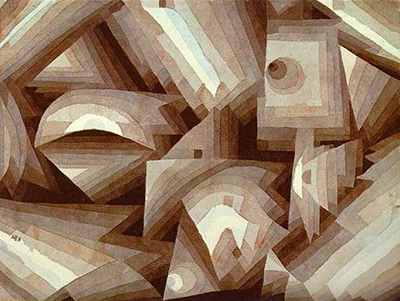
The classroom question was often what happens between colours. A small change in hue or value alters the role of a neighbouring patch; a sequence makes a transition perceptible; a repeated contrast can set up rhythm. Klee’s own paintings can make such questions vivid, though their visual solutions cannot be treated as diagrams transcribed from a particular lecture. A painting has a material support, layering and decisions specific to that object. His Crystal Gradation of 1921 makes a useful adjacent case: its changing bands and geometric order invite comparison with his attention to gradation, but the dated work is not proof of the content of an undocumented class.[9][10]
Music was another way Klee could examine temporal order. A Bauhaus-Archiv study identifies a teaching foldout of 16 January 1922 in which he diagrammed the opening bars of Bach’s sixth sonata in G major for violin and harpsichord, BWV 1019. It is a concrete example of music entering his teaching, without implying that every coloured rectangle represents a musical note or that a painting has a recoverable score. His household’s music making and the Bauhaus’s public musical culture also had their own histories; the Bach diagram alone does not merge them.[6]
The 1925 Pedagogical Sketchbook
Klee’s Pädagogisches Skizzenbuch appeared in 1925 as volume two of the Bauhausbücher series. It brought selected visual ideas about sketching, movement and construction to readers beyond the school. The book’s publication is significant, but it is a short, deliberately shaped work, not a complete transcript of ten years of teaching. A later English title, Pedagogical Sketchbook, and subsequent reprints have helped make it the best-known part of his pedagogy.[1][11]
Three bodies of evidence should be kept separate: the 1925 book published in Klee’s lifetime; his much larger body of working teaching notes, now available in digital facsimile and transcription through the Zentrum Paul Klee; and the posthumous editorial volumes that present selections under titles associated with his “notebooks”. They differ in authorship of arrangement, scope and proximity to actual lectures. Looking only at a memorable printed diagram can make a class seem more complete and settled than the dated documents allow.[2][8][11]
Weaving: design, technique and student authorship
Klee offered a distinct design course for weaving students from summer 1927. There is a possible earlier connection to the workshop in 1923 through Gunta Stölzl’s retrospective recollection, but Keller Tschirren finds no corresponding contemporary timetable entry. The documented later course explored segmentation of the plane, colour and repeated operations. Its teaching belonged within a workshop in which women were often directed by the school’s admission and training structures. Stölzl and the weaving students developed the practical techniques and actual fabrics. Their work should be named as work, not absorbed under the teacher’s name.[2][4][5]
Fabienne Eggelhöfer compares Klee’s pictorial “weave architectures” with designs from the workshop, including notes by Bergner. She cautions that resemblance between a Klee square painting and a textile is not proof that a student copied the painting. Shared procedures—shift, turn, reflect, overlay—could yield related structures through different materials and purposes. A drawn division of a plane may guide an investigation on paper; a woven counterpart must also contend with yarn, loom, density, colour behaviour and use. This is where a general formal principle becomes another maker’s technical decision.[4][5]
Bergner’s later career further resists the idea of a student as a mere receiver. After the Bauhaus she worked in Königsberg, the Soviet Union and Mexico, developing textile work in very different institutional and social settings. Her Bauhaus notes matter because they connect a lesson to subsequent independent practice; they do not prove that all her later decisions originated in Klee’s class. Her surviving study sheets and designs are held with their own authorship and image rights, so this page discusses the evidence without reproducing them.[3]
The Dessau timetable is not entirely settled even at the end. Klee wrote to Lily in September 1930 that he had been relieved of everything except free painting. Yet Kitty van der Mijl Dekker’s diploma records a colour course for weaving in winter 1930/31. Keller Tschirren sets the two documents side by side. The responsible conclusion is that the available records conflict about the exact late teaching load, not that one can silently be discarded.[2]
His painting and his teaching
Klee’s paintings can sharpen a reader’s sense of his classroom questions: a line may imply a path, a repetition can become rhythm, and adjacent colours can create movement without depicting it literally. But a formal similarity is only a starting point for interpretation. To connect a painting securely to a lesson one needs the work’s date, material history, Klee’s own records and evidence of what was taught then. He was an artist who taught, not a painter who simply illustrated a finished curriculum.[2][9]
For example, Crystal Gradation is a 1921 work contemporaneous with his early Bauhaus period; Ancient Harmony belongs to 1925, when the Sketchbook appeared; Ad Parnassum is from 1932, after he had left the school. Their coloured organisations may be compared, but none is automatically a demonstration sheet for a named class. The dedicated colour, materials and notebooks pages can pursue those different questions without collapsing artistic process into pedagogy.[9][10]
This distinction also prevents an inverse mistake. The surviving lessons need not be treated as a dry appendix to the paintings. By asking students to generate forms through operations, Klee had to make tacit choices speakable. He adjusted explanations as the school and its students changed. In some cases, students’ records show where an abstract scheme became comprehensible only when they tried it themselves. The exchange could clarify possibilities for art without every painting serving as classroom evidence.[2][3]
Why did the Bauhaus period end?
By the late 1920s, Klee’s form teaching, specialist weaving course, occasional life drawing and free painting class made a substantial workload. The Bauhaus Kooperation biography explicitly connects that burden with his departure, effective 1 April 1931. He then accepted a professorship at the Düsseldorf Academy, which lasted until the Nazis dismissed him in 1933. The accessible summaries do not permit every motive behind a career move to be reduced to a single cause, and the precise final course schedule remains in question.[1][2][12]
The decade’s legacy is best located in specific documents and specific people. Klee’s dated lectures show a teacher thinking through form and colour. Bergner’s notes show how at least one student received, tested and sometimes struggled with that teaching. The workshop record names other makers whose technical knowledge turned principles into objects. The Pedagogical Sketchbook gave part of the enquiry a public life. Together they show a Bauhaus practice in motion, rather than a fixed set of rules handed down from one famous painter.[2][3][4][11]
Explore the related Paul Klee biography, colours, materials and techniques and teaching notebooks.
Explore selected works from Klee’s much larger oeuvre. Titles without a link have an authenticated catalogue identity but no reviewed article yet.
Artworks directory
| Name | Date | Medium |
|---|---|---|
| A Gate | 1939 | Painting and mixed media |
| A Woman for Gods | 1938 | Watercolour and mixed media |
| Ab Ovo | 1917 | Watercolour and mixed media |
| Above Mountain Summit | 1917 | Drawing and mixed media |
| Abstract Trio | 1923 | Drawing and mixed media |
| Acrobats | 1915 | Watercolour and mixed media |
| Actor's Mask | 1924 | Painting and mixed media |
| Ad Marginem | 1930 | Drawing and mixed media |
| Ad Parnassum | 1932 | Painting and mixed media |
| Adventurer Ship | 1927 | Drawing and mixed media |
| Affected Place | 1922 | Drawing and mixed media |
| After a Sketch from Zurich | 1914 | Watercolour and mixed media |
| After Drawing | 1919 | |
| After The Floods | 1936 | Watercolour and mixed media |
| All Souls' Picture | 1921 | |
| Ancient Harmony | 1925 | Painting and mixed media |
| Angel Applicant | 1939 | Drawing and mixed media |
| Angel Serves the Desired | 1920 | |
| Angel, Still Female | 1939 | Painting and mixed media |
| Angelus Novus | 1920 | Drawing and mixed media |
| Animal Terror | 1926 | Painting and mixed media |
| Arab Song | 1932 | Painting and mixed media |
| Archangel | 1938 | Painting and mixed media |
| Architecture | 1923 | Painting and mixed media |
| Architecture of the Plain | 1923 | Drawing and mixed media |
| Around the Fish | 1926 | Painting and mixed media |
| Arrival of the Air Steamer | 1921 | Drawing and mixed media |
| Asiatic God | 1924 | Painting and mixed media |
| Astrological Fantasy Portrait | 1924 | Drawing and mixed media |
| Athlete's Head | 1932 | Watercolour and mixed media |
| Aufgehender Stern | 1931 | Painting and mixed media |
| Autumn Flower | 1922 | Painting and mixed media |
| Bad Band | 1920 | Drawing and mixed media |
| Baroque Centaur | 1939 | Painting and mixed media |
| Before the Blitz | 1923 | Drawing and mixed media |
| Before the Snow | 1929 | Drawing and mixed media |
| Besessenes Madchen | 1924 | Watercolour and mixed media |
| Bird Garden | 1924 | |
| Bird Wandering Off | 1926 | Watercolour and mixed media |
| Blossoms in the Night | 1930 | Watercolour and mixed media |
| Blue-Bird-Pumpkin | 1939 | Painting and mixed media |
| Boats in the Flood | 1937 | Painting and mixed media |
| Botanical Theatre | 1934 | Drawing and mixed media |
| Boy in Fancy Dress | 1931 | Watercolour and mixed media |
| Broken Key | 1938 | |
| Brother and Sister | 1930 | Watercolour and mixed media |
| But the Red Roof | 1935 | Painting and mixed media |
| C - C = Fisch | 1931 | Watercolour and mixed media |
| Cacti | 1912 | Painting and mixed media |
| Camel (in Rhythmic Landscape with Trees) | 1920 | Drawing and mixed media |
| Captive Pierrot | 1923 | Drawing and mixed media |
| Castle and Sun | 1928 | Drawing and mixed media |
| Cat and Bird | 1928 | Drawing and mixed media |
| Cathedrals | 1925 | Watercolour and mixed media |
| Chalice of the Heart | 1937 | Painting and mixed media |
| Characters in Yellow | 1937 | Painting and mixed media |
| Chosen Site | 1927 | Mixed media |
| Christmas Picture | 1923 | Drawing and mixed media |
| City of Towers | 1916 | Painting and mixed media |
| Clarification | 1932 | Painting and mixed media |
| Collection of Figurines | 1926 | Painting and mixed media |
| Colorful Architecture | 1917 | Painting and mixed media |
| Comedians' Handbill | 1938 | |
| Comic Opera Singer | 1927 | Painting and mixed media |
| Composition | 1939 | Painting and mixed media |
| Composition with Figures | 1915 | Drawing and mixed media |
| Composition with the Yellow Half-Moon and the Y | 1918 | Watercolour and mixed media |
| Conch–Still Life II | 1939 | Watercolour and mixed media |
| Cosmic Composition | 1919 | Painting and mixed media |
| Crystal Gradation | 1921 | Drawing and mixed media |
| Dance of the Grieving Child | 1922 | Painting and mixed media |
| Dancing Girl | 1940 | Painting and mixed media |
| Das Licht und Etliches | 1931 | Mixed media |
| Death and Fire | 1940 | Painting and mixed media |
| Death for the Idea | 1915 | |
| Demon as Pirate | 1926 | Watercolour and mixed media |
| Diana | 1931 | Painting and mixed media |
| Diavolo Player | 1923 | Drawing and mixed media |
| Die Kapelle | 1917 | Watercolour and mixed media |
| Die Vase | 1938 | Painting and mixed media |
| Doctor | 1930 | Drawing and mixed media |
| Dredger and Sailboat | 1931 | Watercolour and mixed media |
| Ein Tor | 1939 | Painting and mixed media |
| Ein Weib fur Gotter | 1938 | Mixed media |
| Embrace | 1939 | Watercolour and mixed media |
| Episode before an Arab Town | 1923 | |
| Equals Infinity | 1932 | Painting and mixed media |
| Eros | 1923 | Drawing and mixed media |
| Error on Green | 1930 | Watercolour and mixed media |
| Evening Figure | 1935 | Drawing and mixed media |
| Falling Bird | 1919 | |
| Fermata | 1932 | Watercolour and mixed media |
| Fire Clown | 1921 | Watercolour and mixed media |
| Fire Full Moon | 1933 | Watercolour and mixed media |
| Fire in the Evening | 1929 | Painting and mixed media |
| Fish in the Harbour | 1916 | Watercolour and mixed media |
| Fish Magic | 1925 | Watercolour and mixed media |
| Flock of Birds | 1917 | Drawing and mixed media |
| Flora on Sand | 1927 | Watercolour and mixed media |
| Flower Myth | 1918 | |
| Flower Stand with Watering Can and Bucket | 1910 | Watercolour and mixed media |
| Flowering Tree (Abstraction with Reference to a Flowering Tree) | 1925 | Painting and mixed media |
| Flowers in Pots | 1923 | |
| Flowers in Stone | 1939 | Painting and mixed media |
| Forest Witch | 1938 | Painting and mixed media |
| Fright of a Girl | 1922 | Drawing and mixed media |
| Fruits on Red | 1930 | Drawing and mixed media |
| Full Moon | 1919 | Mixed media |
| Föhn Wind in Franz Marc's Garden | 1915 | Watercolour and mixed media |
| Garden in St Germain, The European Quarter near Tunis | 1914 | Watercolour and mixed media |
| Ghost Chamber with the Tall Door (New Version) | 1925 | |
| Ghost of a Genius | 1922 | Drawing and mixed media |
| Girl in Mourning | 1939 | Painting and mixed media |
| Glance of a Landscape | 1926 | Watercolour and mixed media |
| Gluht Nach | 1939 | Drawing and mixed media |
| Golden Fish | 1925 | Watercolour and mixed media |
| Goldfish Wife | 1921 | Watercolour and mixed media |
| Green Plant, Blood, Louse | 1924 | Drawing and mixed media |
| Hafenbild | 1918 | Mixed media |
| Hammamet with Mosque | 1914 | Watercolour and mixed media |
| Harbour with Sailing Ships | 1937 | Painting and mixed media |
| Hauptweg und Nebenwege | 1929 | Painting and mixed media |
| Heavenly and Earthly Time | 1927 | Drawing and mixed media |
| Heroic Fiddling | 1938 | Painting and mixed media |
| Heroic Roses | 1938 | Painting and mixed media |
| Heroic Strokes of the Bow | — | Mixed media |
| Highway and Byways | 1929 | Drawing and mixed media |
| Houses near the Gravel Pit | 1913 | Watercolour and mixed media |
| Howling Dog | 1928 | Painting and mixed media |
| In the Current Six Thresholds | 1929 | Painting and mixed media |
| In the Style of Kairouan | 1914 | Drawing and mixed media |
| Individualized Altimetry of Stripes | 1930 | Painting and mixed media |
| Insula Dulcamara | 1938 | |
| Interior with the Clock | 1913 | Watercolour and mixed media |
| Irma Rossa the Animal Tamer | 1918 | Drawing and mixed media |
| Journey in Corsica | 1927 | Drawing and mixed media |
| Landscape with Bluebirds | 1919 | Watercolour and mixed media |
| Legend of the Nile | 1937 | Painting and mixed media |
| Lemon Harvest | 1937 | Watercolour and mixed media |
| Likeness in the Bower | 1930 | Watercolour and mixed media |
| Limits of Reason | 1927 | Painting and mixed media |
| Little Hope | 1938 | Watercolour and mixed media |
| Magdalena before the Conversion | 1938 | Drawing and mixed media |
| Mask of Fear | 1932 | Painting and mixed media |
| May Picture | 1925 | Painting and mixed media |
| Monument in a Cemetery | 1922 | Watercolour and mixed media |
| Monuments at G | 1929 | Watercolour and mixed media |
| Municipal Jewel | 1917 | Watercolour and mixed media |
| Mural from the Temple of Longing Thither | 1922 | |
| Nach der Uberschwemmung | 1936 | Watercolour and mixed media |
| New Harmony | 1936 | Painting and mixed media |
| New House in the Suburbs | — | Mixed media |
| Old Steamboat | 1922 | Drawing and mixed media |
| On the Edge | 1930 | Drawing and mixed media |
| Once Emerged from the Gray of Night | 1918 | Drawing and mixed media |
| One Who Understands | 1934 | Painting and mixed media |
| Oriental Pleasure Garden | 1925 | Painting and mixed media |
| Park of Idols | 1939 | Watercolour and mixed media |
| Passing by Red Pillars | 1928 | Watercolour and mixed media |
| Persian Nightingales | 1917 | Drawing and mixed media |
| Popular Wall Painting | 1922 | Painting and mixed media |
| Prestidigitator | 1927 | Watercolour and mixed media |
| Rainy Day | 1931 | Watercolour and mixed media |
| Red and White Domes | 1914 | Watercolour and mixed media |
| Red Balloon | 1922 | Drawing and mixed media |
| Redgreen and Violet-Yellow Rhythms | 1920 | Drawing and mixed media |
| Refuge | 1930 | Watercolour and mixed media |
| Rhythmic Rythmical | 1930 | Painting and mixed media |
| Saint of the Inner Light | 1921 | |
| Scaffolding of a New Building | 1930 | Painting and mixed media |
| Scholar in Dealing with Stars | 1926 | Watercolour and mixed media |
| Seated Woman | 1930 | Drawing and mixed media |
| Senecio | 1922 | Painting and mixed media |
| Separation in the Evening | 1922 | Drawing and mixed media |
| Sinbad the Sailor | 1923 | Drawing and mixed media |
| Skeptically Smiling | — | Mixed media |
| Small House in the Garden City | 1928 | Watercolour and mixed media |
| Small Portrait of a Girl in Yellow | 1925 | Painting and mixed media |
| Southern Gardens | 1919 | Watercolour and mixed media |
| Static-Dynamic Gradation | 1923 | Drawing and mixed media |
| Still Life | 1927 | Painting and mixed media |
| Still Life with Gladioli | 1932 | Watercolour and mixed media |
| Strange Garden | 1923 | Drawing and mixed media |
| Stricken City | 1936 | Painting and mixed media |
| Strong Dream | 1929 | Watercolour and mixed media |
| Struck from the List | 1933 | Drawing and mixed media |
| Structural I | 1924 | Drawing and mixed media |
| Sumpflegende | 1919 | Painting and mixed media |
| Temple Gardens | 1920 | Drawing and mixed media |
| The Arrow before the Target | 1921 | Drawing and mixed media |
| The Barbed Noose with the Mice | 1923 | Watercolour and mixed media |
| The Flora of the Heath | 1925 | Watercolour and mixed media |
| The Goldfish | 1925 | Watercolour and mixed media |
| The Hour Before One Night | 1940 | Painting and mixed media |
| The Man in Love | 1923 | |
| The Mask with the Flag | 1925 | Mixed media |
| The Pathos of Fertility | 1921 | |
| The Rhine at Duisburg | 1937 | Painting and mixed media |
| The Way to the Citadel | 1937 | Painting and mixed media |
| Three Houses and a Bridge | 1922 | Watercolour and mixed media |
| Tightrope Walker | 1923 | |
| Tomb in Three Parts | 1923 | Watercolour and mixed media |
| Tomcat's Turf | 1919 | Watercolour and mixed media |
| Tower in Orange and Green | 1922 | Drawing and mixed media |
| Tree and Architecture - Rhythms I | 1920 | Watercolour and mixed media |
| Tree and Architecture - Rhythms II | 1920 | Painting and mixed media |
| Tropical Dawn with the Owl | 1921 | Mixed media |
| Tropische Dammerung | 1921 | Painting and mixed media |
| Twittering Machine | 1922 | Drawing and mixed media |
| Variations (Progressive Motif) | 1927 | Watercolour and mixed media |
| Ventriloquist and Crier in the Moor | 1923 | |
| Viaducts Break Ranks | 1937 | Drawing and mixed media |
| Villa R | 1919 | Painting and mixed media |
| Village Carnival | 1926 | Painting and mixed media |
| Vor dem Blitz | 1923 | Drawing and mixed media |
| Wald-Hexen | 1938 | Painting and mixed media |
| Young Forest | 1925 | Drawing and mixed media |
Discussion
Klee's teaching survives in notes, student exercises and later memories.
A design prompt could become very different work in a student's hands.
Reader Insights
Which documented lesson makes Klee's ideas clearest to you?
How does a student's textile differ from the diagram that helped generate it?
Which class or archive record should be checked next?
Join the Conversation
Share the particular work or source behind your reading.
References
- Bauhaus Kooperation, Paul Klee biography (German). Institutional chronology, course and workshop summary, 1925 book, Dessau duties and departure. Its metadata and prose disagree on the exact late-1920 appointment date and some workshop dates; those conflicts are retained above, View source.
- Marianne Keller Tschirren, Dreieck, Kreis, Kugel. Farbenordnungen im Unterricht von Paul Klee am Bauhaus, University of Bern dissertation (2011), especially printed pp. 23–31, 82–84, 141–43 and course appendix pp. 193–96 (German). Full relevant passages directly read. She triangulates Klee’s dated notes, correspondence, calendars, student records and earlier scholarship, and marks gaps in semester evidence, View source.
- Fabienne Eggelhöfer, “Verschiebung, Drehung, Spiegelung: Lena Bergners Aufzeichnungen aus Paul Klees Unterricht”, Bauhaus Kooperation (2018; German). Full essay read. Uses Bergner’s archive notes, exercises and testimony, distinguishes theoretical teaching from Stölzl’s practical instruction and records contrasting student recollections, View source.
- Fabienne Eggelhöfer, “Paul Klees bildnerische Webarchitekturen”, Bauhaus Kooperation (2019; German). Full essay read. Analyses 1927–31 weaving instruction and guards against unproved direct copying from Klee painting to student textile, View source.
- Bauhaus Kooperation, Weaving workshop history (German). Source for workshop practice, Gunta Stölzl and the women who studied and made textiles, View source.
- Bauhaus-Archiv / Museum für Gestaltung, Musikerinnen und Musiker im Umfeld des Bauhauses (2025), pp. 137, 140 (German). Appointment and first-theory chronology; dated 16 January 1922 Bach teaching diagram. The original diagram is not reproduced here, View source.
- Bauhaus-Archiv, Teaching overview (German), and Bauhaus Kooperation, Klee teaching overview (German). Institutional descriptions of the Vorkurs, form teaching and student exercises.
- Zentrum Paul Klee, Research and teaching archive (German), with linked digital edition of Bildnerische Form- und Gestaltungslehre. Source for archive scale and digital access. Direct individual folio URLs were not accessible during this research; folio-specific claims above rely on Keller Tschirren and Eggelhöfer, View source.
- Keller Tschirren, Dreieck, Kreis, Kugel, printed pp. 82–84, 141–43, for comparisons of colour systems and cautions about equating teaching diagrams and paintings; see reference 2.
- The History of Art, Crystal Gradation and Ancient Harmony object pages, with their item-level primary references; Kunstmuseum Bern, Ad Parnassum. Comparisons are chronological and formal, not claims of direct classroom derivation.
- Bauhaus Kooperation, Paul Klee. Pedagogical Sketchbook and Bauhaus books list (German/English). Both identify the 1925 publication as Bauhausbücher volume 2.
- Zentrum Paul Klee, Paul Klee biography (English), cross-checked with the Bauhaus Kooperation biography for the Düsseldorf move and 1933 dismissal, View source.