


 by Tom Gurney
Tom Gurney BSc (Hons) is an art history expert with over 20 years experience
Published on June 19, 2020 / Updated on September 27, 2026
Email: tomgurney1@gmail.com / Phone: +44 7429 011000
An architectural picture with an open pattern
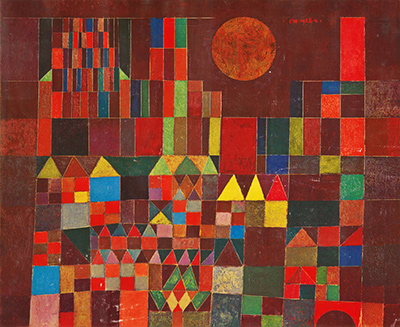
A disc hovers above a packed field of rectangles, narrow bars and triangles. Some combinations begin to look like walls and roofs; others remain coloured compartments. Paul Klee's Burg und Sonne, usually called Castle and Sun in English, holds both possibilities in view. Its original German title points to a built place and a sun, but it does not identify an actual castle, town, season or time of day. The painting's architectural impression comes from its arrangement of parts, not from conventional perspective or a carefully outlined facade.[1]
The surviving records are unusually important here because the original is privately owned. An archival image reproduced by scholar Osamu Okuda identifies the work as 1928,201, oil on canvas, 50 × 59 cm, private collection. A 1930 Museum of Modern Art catalogue, nearer the work's making, lists the same German title under the English “City and Sun” and gives tempera and oil on canvas. MoMA warns in that very catalogue that its medium descriptions may be wrong. The records establish an identifiable work and a real disagreement about material; they do not supply a present conservation report. This page therefore distinguishes the visible composition from claims about its exact paint layers.[1][2]
Explore the details of Castle and Sun
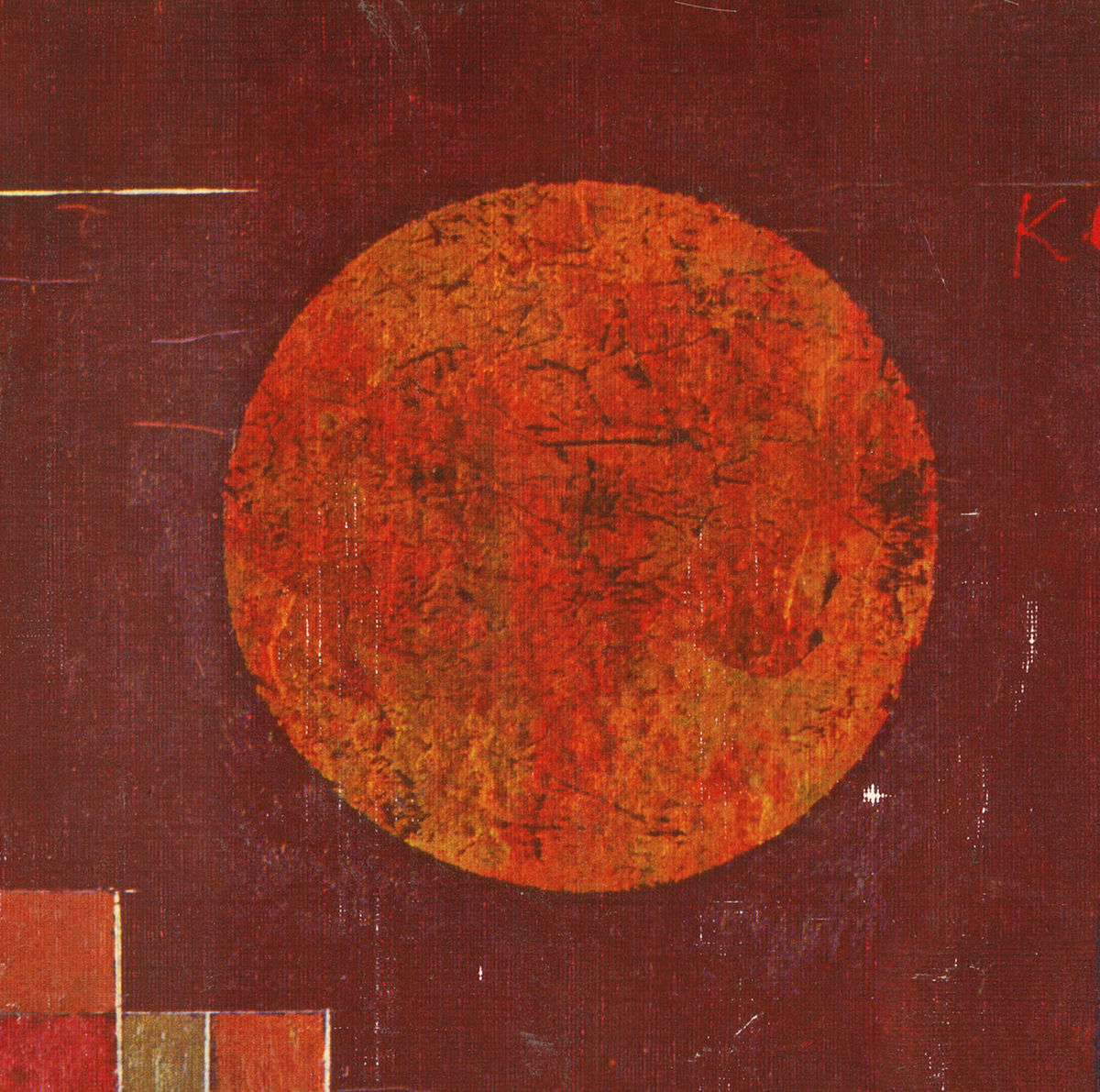
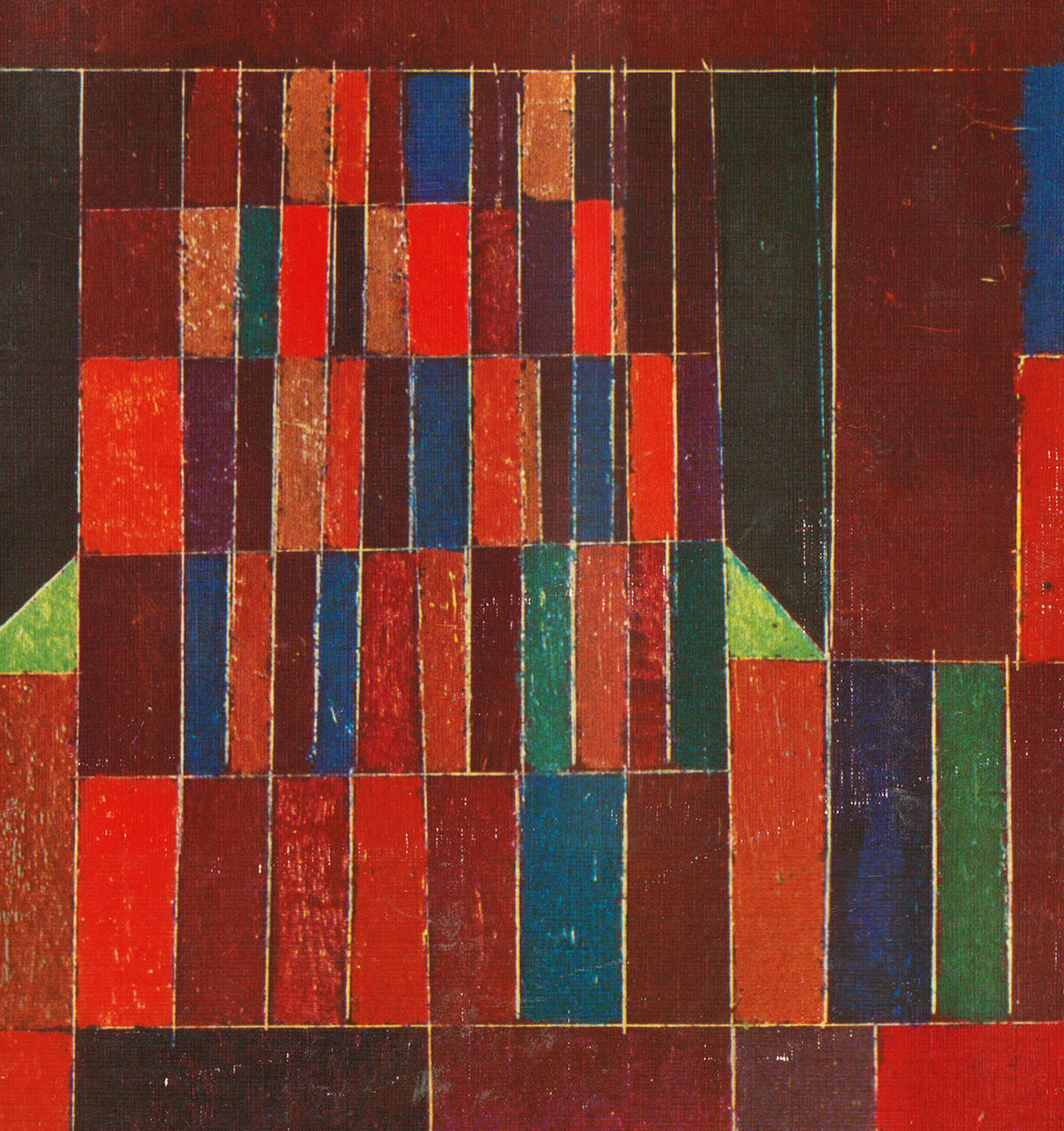
Select a numbered area to examine its detail at high resolution.
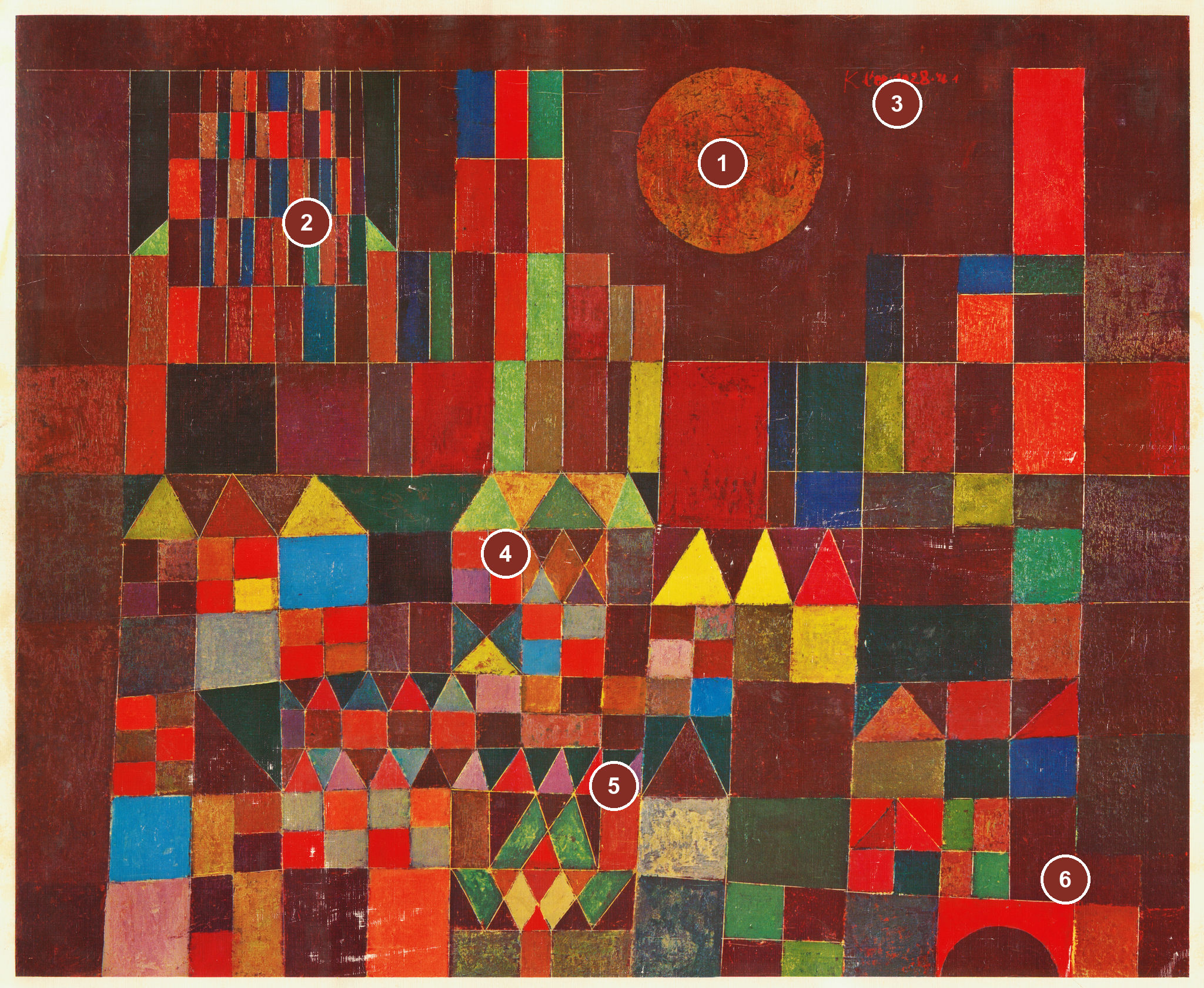
Red sun
Upper-left vertical bars
Klee signature and work number
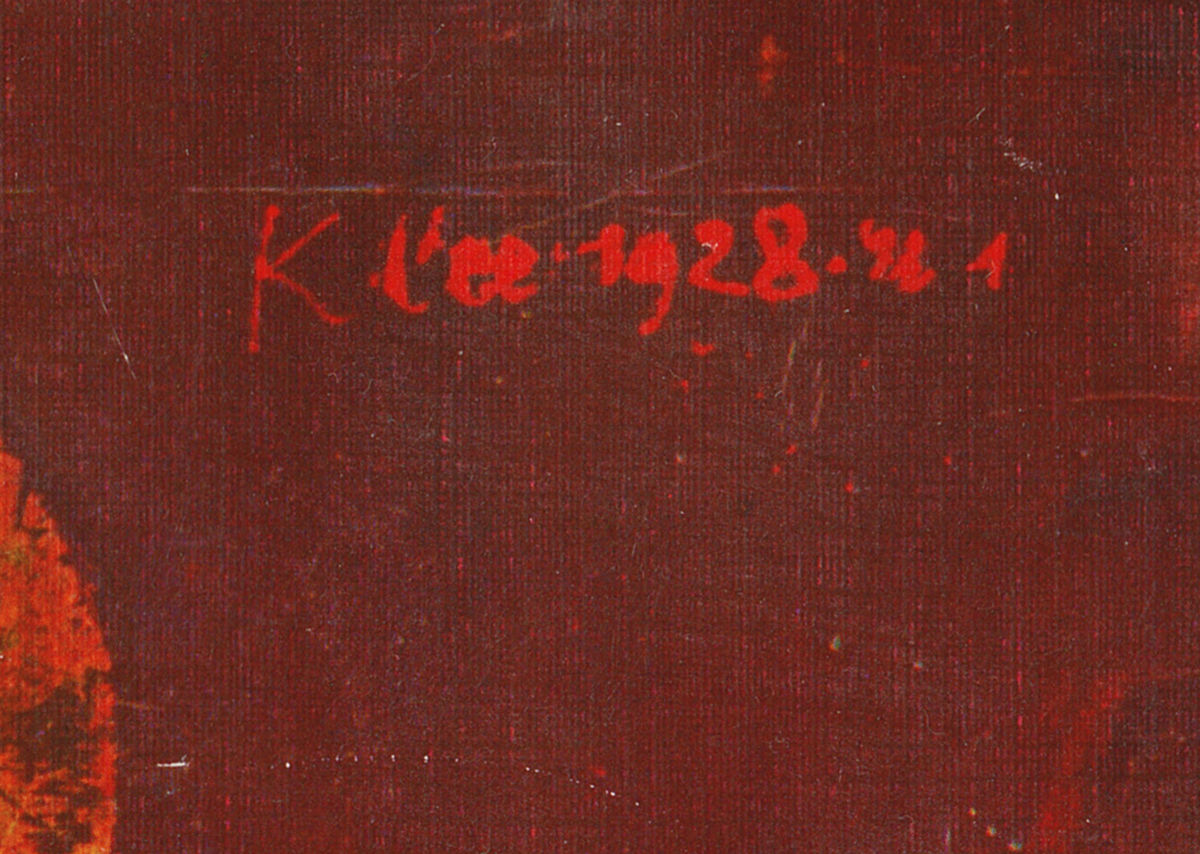
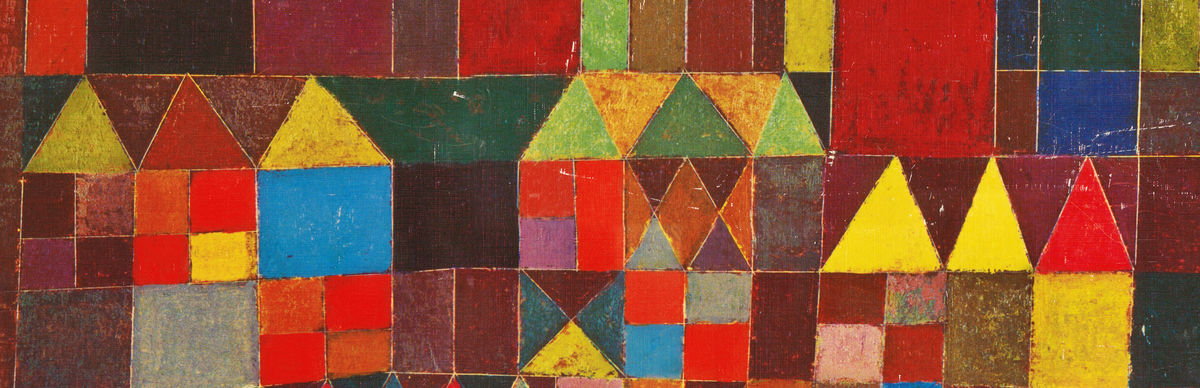
Middle row of rooftops
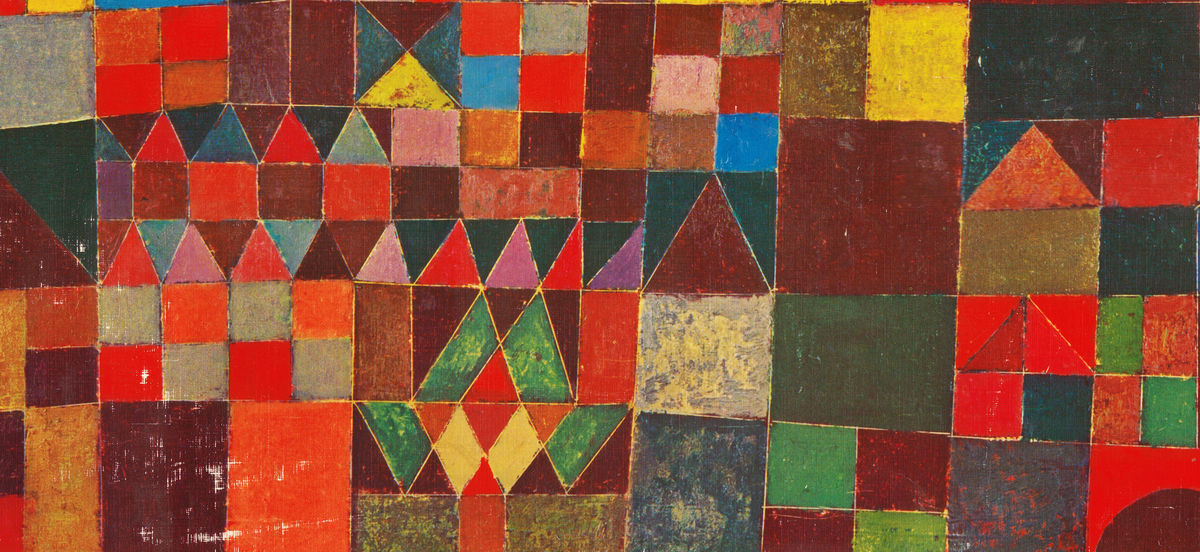
Lower interlocking colours
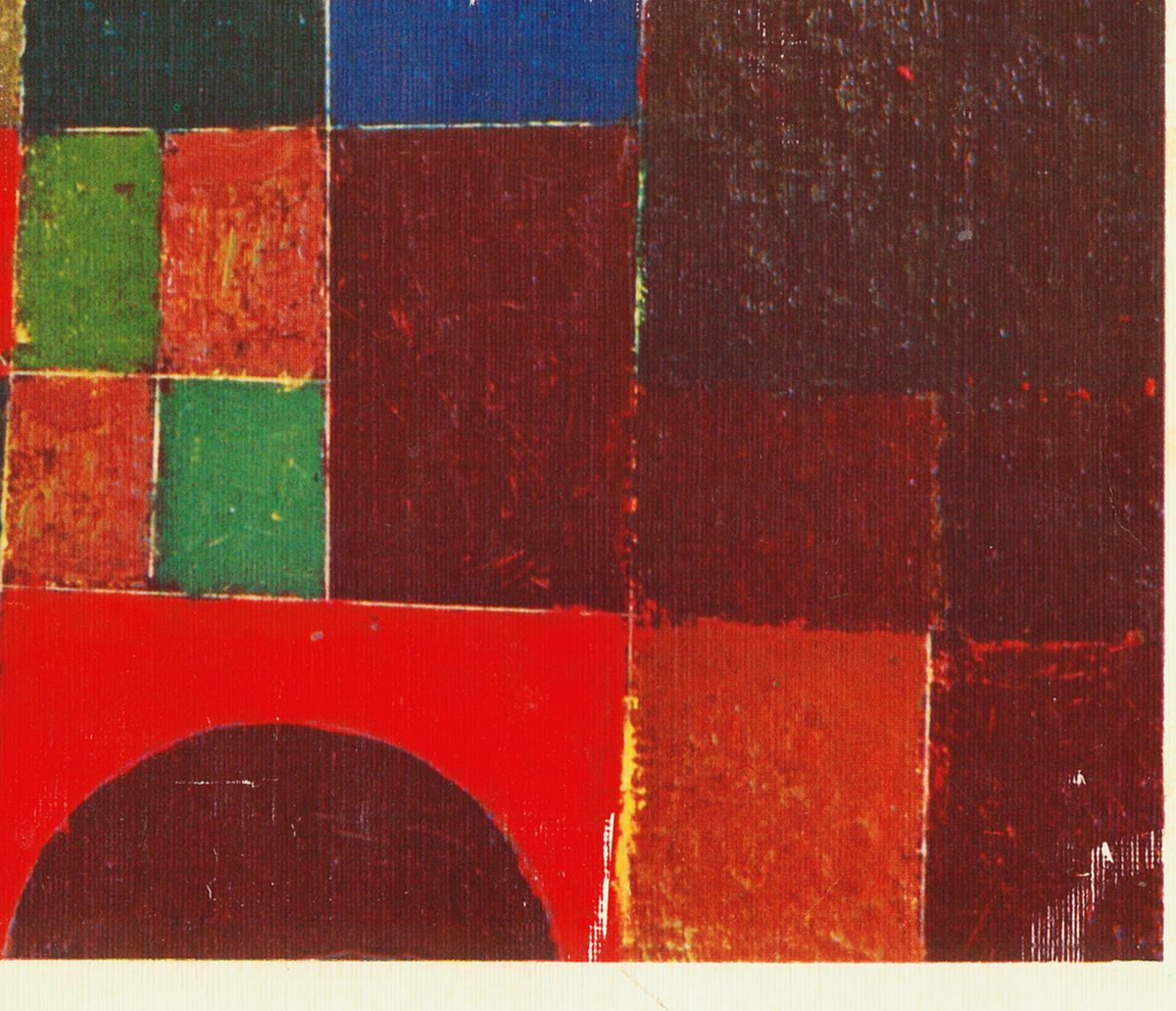
Lower-right arch
Contents
- Which work is Burg und Sonne?
- What is known about the medium and dimensions?
- How does the painting become a castle?
- A comparison: architecture without the same grid
- How does it relate to Klee's square pictures?
- Does the 1928 Egypt trip explain it?
- What can the exhibitions and reproductions tell us?
- Look again
Which work is Burg und Sonne?
Okuda's 2020 German study reproduces a figure credited to the Zentrum Paul Klee archive and captions it Burg und Sonne, 1928,201. Klee's annual notation combines the year with a sequence number. It is not the painting's size, a sale number or a present museum accession. The figure's 50 × 59 cm measurement gives a landscape-oriented canvas, consistent with the reproduction's proportions. It is a relatively substantial painting within a practice that included many small sheets, but its size alone does not make it a mural or an architectural design.[1]
The same title appears as no. 97 in Alfred Flechtheim's Berlin exhibition catalogue for 20 October–15 November 1929. That contemporary list supplies neither medium nor dimensions, but it establishes that a painting called Burg und Sonne was in the dealer's Klee exhibition by then. We cannot derive a purchase or a change of owner from its presence. In MoMA's March–April 1930 Klee exhibition it appears as no. 34, translated “City and Sun,” with the German in parentheses. Two exhibition lists close to the painting's date thus independently anchor the title's early public history.[2][3]
MoMA's introductory note says that, unless another owner is specified, the paintings belonged to Klee and were shown by arrangement with his representatives. No alternate owner appears beside no. 34. This supports an artist-owned loan as catalogued in 1930. It does not tell us the dates or terms of any later sale. Okuda's “private collection” reports a broad present category, without naming a person or city. A later caption that attaches a famous collector's name or a different city may be a lead to investigate, not a continuous provenance. An ownership chain would need dated dealer records, sale catalogues or the privately held object file.[1][2]
The familiar English title “Castle and Sun” gives Burg its most literal architectural sense. MoMA's “City and Sun” is a historical translation, not evidence of a second painted work. It is interesting precisely because a viewer can read the grouped forms as a settlement rather than a single building. The German title keeps that interpretation tied to Klee's recorded work, while the two English versions reveal how an abstract arrangement was framed for audiences. An English label should therefore retain Burg und Sonne whenever the exact identity matters.[1][2][3]
What is known about the medium and dimensions?
Okuda's ZPK archive caption gives oil paint on canvas, 50 × 59 cm. A contemporary MoMA catalogue gives tempera and oil on canvas, with no measurements for this unillustrated entry. Its editors explicitly acknowledge uncertainty about medium identification across the exhibition. The difference may reflect a mixture, an earlier visual judgement, or a later correction, but none of those possibilities is proved by the printed records alone. A responsible caption can state Okuda's oil description and flag the 1930 alternative. Only technical documentation or examination of the original could settle the layers.[1][2]
Other circulating figures are more confused. A modern German teaching PDF gives a square 42.5 × 42.5 cm and a mixed watercolour/oil description despite reproducing the landscape picture. A historical caption found in a Hebrew-language academic book lists 54 × 62 cm and an earlier named collection. These statements cannot be combined into an average size or treated as independent measurements of today's object. The first conflicts with the image's proportions; the second may reflect a historical framing, mount, measurement convention or simply a catalogue error. Neither replaces the ZPK-archive-captioned source or a future direct catalogue raisonné check.[1][8]
The work's printed catalogue raisonné entry and a current owner's technical file have not been directly consulted. The 1928,201 annual number is corroborated through Okuda's archival figure, but this page does not invent a continuous raisonné number, inscription transcription or conservation history. Even a large, apparently detailed online image is a reproduction. It cannot verify whether a patch is pure oil, oil mixed with tempera, underpaint, later retouching or a photographic colour shift.[1][2]
How does the painting become a castle?
Look first for the wide disc in the upper part of the composition. Its round contour differs sharply from the mostly straight divisions beneath it. Klee's title names the sun, giving that disc a role; the painting itself leaves it embedded in the same constructed colour field as the buildings. The disc does not cast a convincing natural shadow across a perspectival scene. It acts as a strong positional and shape contrast within the whole.[1]
Beneath it, rectangles accumulate into tall and low zones. Some are capped by triangles or cut diagonally, so a little group begins to resemble a roof, tower or gate. Narrow vertical bars near the upper left create a denser register than the wider blocks through the centre. Elsewhere, dark boundaries or differently coloured neighbours interrupt a possible wall. The eye repeatedly assembles a building and then loses it in the pattern. This is why “abstract cityscape” can be a useful first description, provided it does not imply a map of an identifiable place.[1]
The grid is less regular than the word suggests. A row may change height; a square may become a narrow rectangle; a diagonal splits one compartment while its neighbour remains intact. Such changes keep the surface active. The sun's circle, the rooflike triangles and a curved or archlike form near the lower right do not belong to one mathematically even lattice. Yet their shared boundaries and the broad dark field hold them together. The picture makes legibility and variation happen in the same place.[1]
Colour also groups and separates the parts. The available reproductions show warm red, orange and yellow zones alongside darker blue, green and violet-grey ones. A warm field can suggest light; a dark boundary can make one block advance. But the local image and Okuda's printed archive reproduction differ noticeably in saturation. Claims about the exact shade of a pigment, its fading, or a precise emotional meaning assigned to each colour would exceed the evidence. The structural contrast between disc and rectilinear city, between broad and narrow units, is firmer than a description of one supposedly definitive colour balance.[1]
The painting is not “simple” because it uses basic shapes. A viewer must decide which borders belong to adjacent buildings, which fragments are roofs and which remain only coloured shapes. Klee withholds the kind of spatial cues that would settle every decision. This creates a visual rhythm of recognition and reconsideration. It is possible to enjoy the work's apparent playfulness while still treating its construction as deliberate and complex.[1]
A comparison: architecture without the same grid
Klee's earlier Baum und Architektur--Rhythmen (Tree and Architecture--Rhythms), 1920, offers a useful comparison because the National Gallery of Art holds and documents an individual original. The NGA gives oil on paper, 27.9 × 38.3 cm, accession 2004.140.41.a. Its object page marks the official image public domain. In that work, dark architectural outlines, pointed upper shapes, an archlike opening and broad painted colour areas suggest structures and movement. The marks remain looser and more open than the compact partitions of Burg und Sonne. This is a comparison of two distinct works and surfaces, not an early “version” of the 1928 canvas.[4]
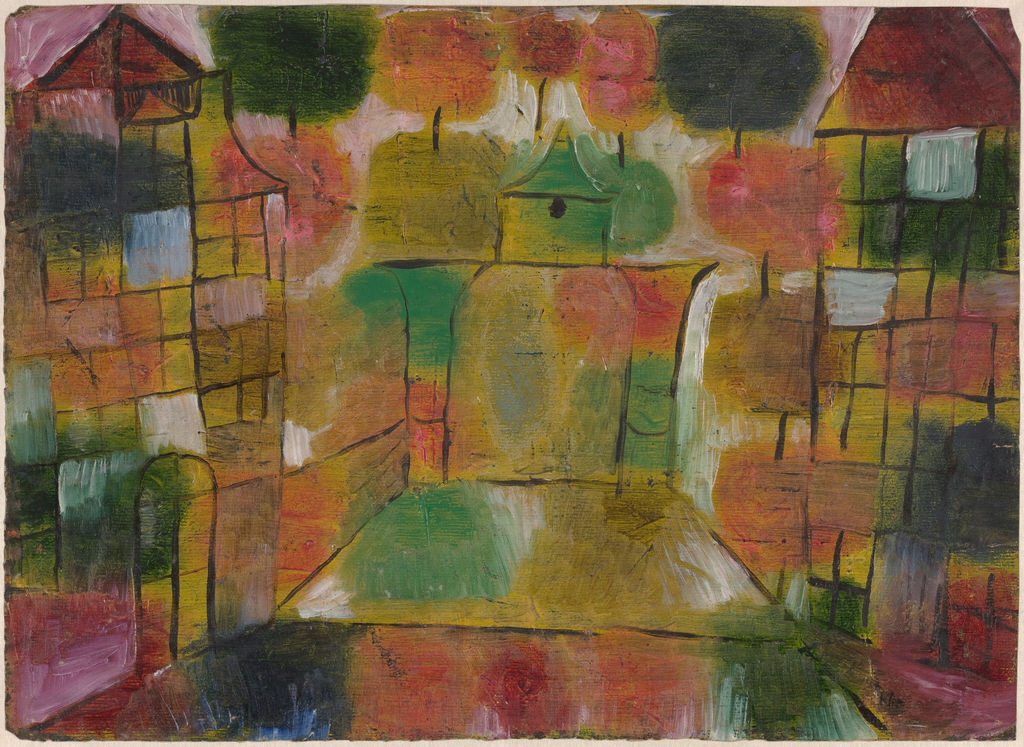
The comparison lets the changing treatment of architecture become specific. In the 1920 sheet, drawn borders and brushwork can suggest a passage among structures without enclosing every coloured area. In the 1928 canvas, repeated vertical and horizontal divisions bring the coloured blocks much closer together, while angled cuts make some units read as rooftops. The existence of both approaches cautions against calling every Klee building picture a “tile” painting. Architecture could be a contour, a group of rhythms, a colour partition or several of these at once.[1][4]
How does it relate to Klee's square pictures?
Okuda's article concerns the late Glas-Fassade, but it traces a focused formal history back through Klee's earlier work. He specifically links diagonally divided cells in the late painting's lattice to Städtebild (rot/grüne Accente) of 1921 and Burg und Sonne of 1928. This is a scholar's comparison of how a vertical-horizontal grid can be disturbed from within. It does not mean Klee planned the 1928 painting as a study for a work made more than a decade later.[1]
The Zentrum Paul Klee's account of Farbtafel (auf maiorem Grau) explains another kind of “square picture”: a 1930 sheet with roughly comparable coloured rectangles and squares on black-prepared paper. The institution relates it to early Bauhaus square pictures and says Klee could draw on colour theory while working intuitively rather than by strict formula. The Farbtafel is a different object with different materials and organisation. Its guide helps define the wider family of repeated coloured units; it does not supply the medium, paint recipe or symbolic key for Burg und Sonne.[5]
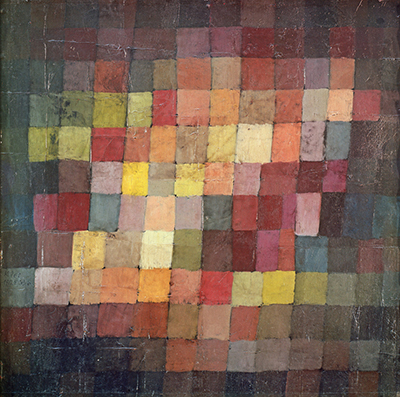
The Lenbachhaus describes Klee's continuing interest in checkerboard-like fields from Alter Klang of 1925 to later rhythmic works. Alter Klang and Neue Harmonie are useful neighbours for comparing variation across repeated compartments. Their titles also draw attention to possible musical language. Yet Burg und Sonne gives the grid an architectural cue and a distinct round disc. It should not be treated as the same picture with a different palette. Nor does the fact that Klee taught at the Bauhaus prove that a particular classroom diagram directly generated this canvas.[6]
The Bauhaus guide covers Klee's teaching, while the colour guide follows his formal exercises and painted use of colour. Here the useful connection is limited: Klee had ways of analysing line, area, rhythm and colour, and the 1928 work makes those elements interact. A stronger claim that the disc stands for a specified colour-theory term, or that each rectangle corresponds to a musical note, would need a work-specific statement or documented sketch. None has been found in the sources consulted for this page.[1][5][6]
Does the 1928 Egypt trip explain it?
Klee travelled to Egypt at the turn of 1928–29. The Zentrum Paul Klee's Mapping Klee project dates the journey 17 December 1928 to 17 January 1929 and explains that he later developed certain Egyptian impressions into strict geometric compositions in the studio. The trip is significant for the period, and the Egypt-related works deserve their own examination. But a painting merely dated 1928 cannot be assigned to that journey without evidence of when within the year it was made and a specific source connecting its forms to the trip. Its exhibition by October 1929 supplies a latest public date, not an origin story.[3][7]
The older page used Klee's famous 1914 Tunisia diary sentence to account for this 1928 picture. His encounter with colour during the earlier journey matters to his biography, but the diary was subsequently edited and the passage is not a statement about Burg und Sonne. Eleven or fourteen years of later work cannot be compressed into a single permanent style supposedly fixed in Tunisia. Comparing this canvas with securely documented neighbouring pictures and the relevant colour studies is more useful than attaching a distant travel quotation to it.[1][7]
Similarly, grouping Burg und Sonne under several broad movements does little unless a precise comparison is made. Geometry alone does not make it a Bauhaus design, a Cubist work and a Surrealist image all at once. Klee taught at the Bauhaus during these years; he was more than loosely “aligned” with it. But his individual use of irregular divisions, clues to architecture and colour relationships still has to be described through this work, not inferred from a school name.[1][5][7]
What can the exhibitions and reproductions tell us?
The 1929 Flechtheim and 1930 MoMA lists show that the painting circulated publicly early. They cannot establish that it was one of Klee's most widely reproduced works or rank its popularity among his images. Today's posters and digital copies demonstrate later distribution, but a count of products at one retailer would be a poor measure of the painting's historical reception. The English “City and Sun” in MoMA's catalogue is more informative: it records how one influential early exhibition presented the German title to an American audience.[2][3]
Digital images of this work circulate with conflicting captions. Some give a square size or call it watercolour; others repeat an unverified former owner. The Zentrum Paul Klee archive caption remains the stronger basis for the dimensions and medium stated here.[1][4]
The printed Catalogue raisonné Paul Klee entry, Klee's own record line and the painting's present technical and provenance file would improve this account materially. They could clarify its inscription, paint mixture, exact measurement and route into private hands. Until those sources are checked, it is better to show the disagreement than to fill it with a plausible but unsupported story. That approach does not prevent close looking; it makes the observations more trustworthy.[1][2]
Look again
Return to the sun disc and follow the partitions beneath it. Which triangles make the surrounding blocks look like roofs? Where does a possible tower dissolve into a row of unrelated shapes? Compare the density of the upper-left strips with the wider units below and with the 1920 architecture sheet's freer outlines. These are questions the available images can support, even while the original paint surface and ownership remain beyond public inspection.[1][4]
Burg und Sonne uses a name, a circle and a field of unequal compartments to keep “castle” and “abstract composition” in play together. Its history is anchored by a 1929 Berlin catalogue, a 1930 New York catalogue and a ZPK-archive figure. The remaining uncertainty about its material and provenance is part of the record, not an invitation to guess. The painting remains most compelling when its visible construction leads the account and the sources tell us how far that account can go.[1][2][3]
Related artworks
Explore eight other Klee works, beginning with works close in date to this one.
Cat and Bird
1928
Fire in the Evening
1929
Flora on Sand
1927
Highway and Byways
1929
Ad Marginem
1930
Around the Fish
1926
Error on Green
1930
Ancient Harmony
1925
Discussion
Castle and Sun asks us to see both a built place and a field of unequal shapes.
The original's private ownership leaves some technical and provenance questions open.
Reader Insights
Which group of shapes first looks like a roof or tower to you?
How does the 1920 architectural comparison change your view of the 1928 canvas?
Which catalogue or object record would help resolve its medium and size?
Join the Conversation
Share the visual detail and source behind your reading.
References
- Osamu Okuda, “Paul Klees Glas-Fassade,” revised 2020 study, Zwitscher-Maschine / Schwabe and Bern University of the Arts, esp. printed pp. 63–66, fig. 22 and caption (German), full open-access article. The figure is credited to the ZPK archive; its publication does not license the figure for this site, View source.
- Museum of Modern Art, Paul Klee, exhibition catalogue issued 11 March 1930, 13 March–2 April 1930, prefatory catalogue note and no. 34, “City and Sun (Burg und Sonne)” (English), digitised primary catalogue, View source.
- Galerie Alfred Flechtheim, Paul Klee, Berlin exhibition catalogue, 20 October–15 November 1929, no. 97, Burg und Sonne (German), Heidelberg digitisation of primary catalogue page, View source.
- National Gallery of Art, Washington, Baum und Architektur--Rhythmen (Tree and Architecture--Rhythms), 1920, accession 2004.140.41.a; medium, dimensions and public-domain image status (English), owner record, NGA image policy.
- Zentrum Paul Klee, Farbtafel (auf maiorem Grau), 1930, digital guide (German), institutional object interpretation, View source.
- Lenbachhaus, Rhythmisches strenger und freier, 1930, owner record and essay by Helmut Friedel and Annegret Hoberg on Klee's square pictures (German), museum page, View source.
- Zentrum Paul Klee, institutional biography (English) and Mapping Klee: Egypt 1928 (German digital exhibition), giving the December 1928–January 1929 travel dates and subsequent geometric studio work.
- Source-comparison leads, not settled object authority: German educational PDF with conflicting square dimensions, consortium file; Hebrew-language academic book image list with another size and historical collector, catalogue lead; Commons image page. The work's printed raisonné entry and owner file are still required to reconcile these claims.
