


 by Tom Gurney
Tom Gurney BSc (Hons) is an art history expert with over 20 years experience
Published on June 19, 2020 / Updated on September 27, 2026
Email: tomgurney1@gmail.com / Phone: +44 7429 011000
Two lights in a field of blocks
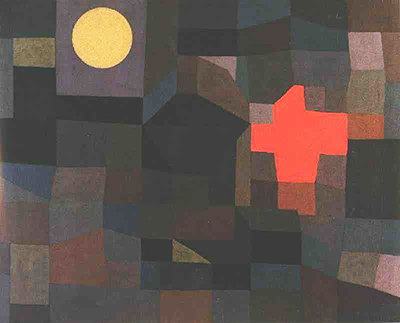
A yellow disc hangs in the upper left of Paul Klee’s Fire at Full Moon. Across a field of dark, closely fitted blocks, a bright red shape opens like a cross or a flame. The title asks us to see moon and fire. Yet the scene refuses to settle into an ordinary night landscape: its ground is built from rectangles, stepped edges and angled planes, with no continuous horizon or clear distance between the two lights. The forms can feel architectural one moment and purely coloured the next.[1][2]
Klee made the picture in 1933. Museum Folkwang, which owns it, thinks it was probably painted that summer, after he had been suspended from his Düsseldorf teaching post. The museum raises a political interpretation but phrases it as a question. That care matters. The painting’s date and Klee’s circumstances are documented; an explanation of what every block or the red form meant to him is not.[1][3]
Explore the details of Fire at Full Moon
Select a numbered area to examine its detail at high resolution.
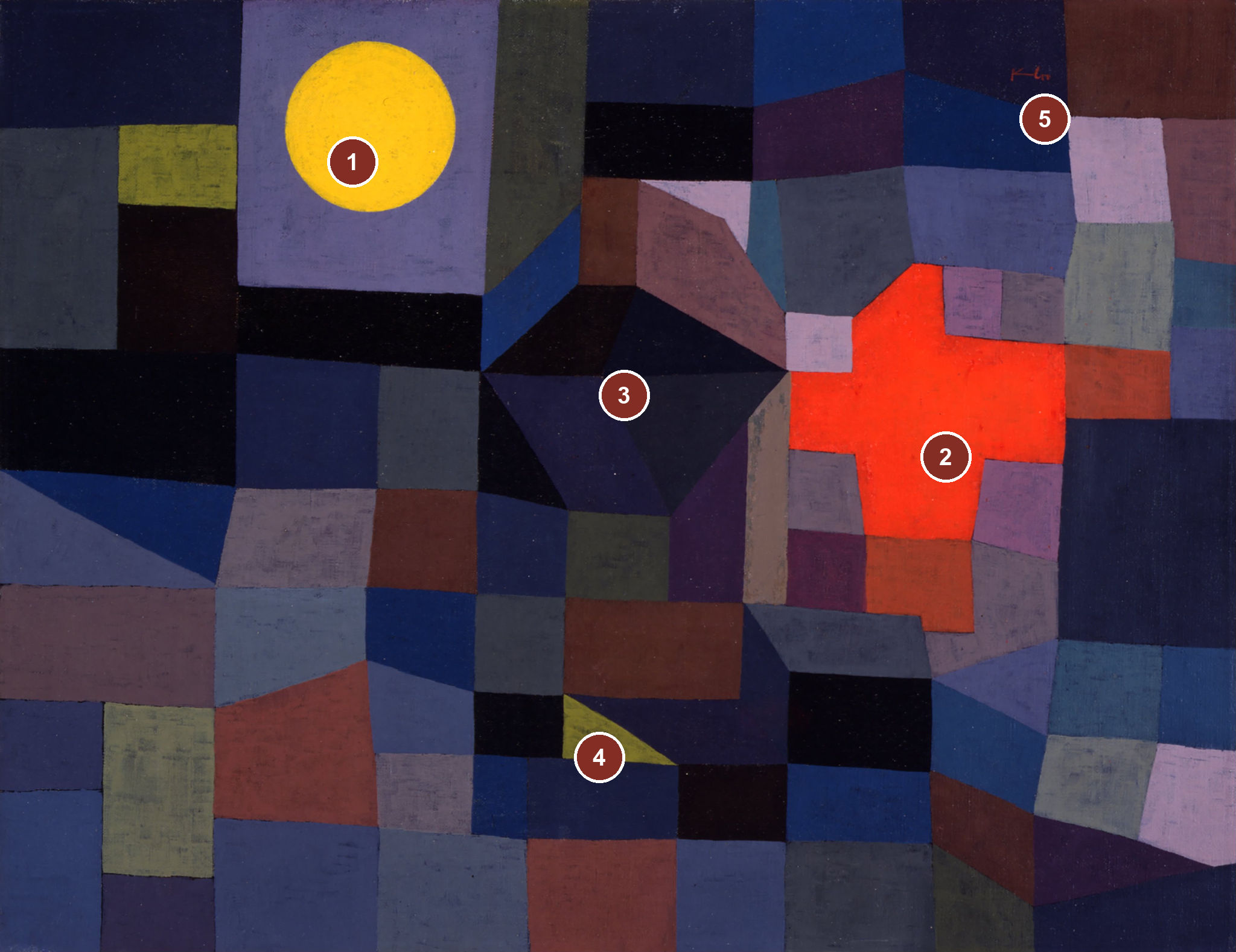
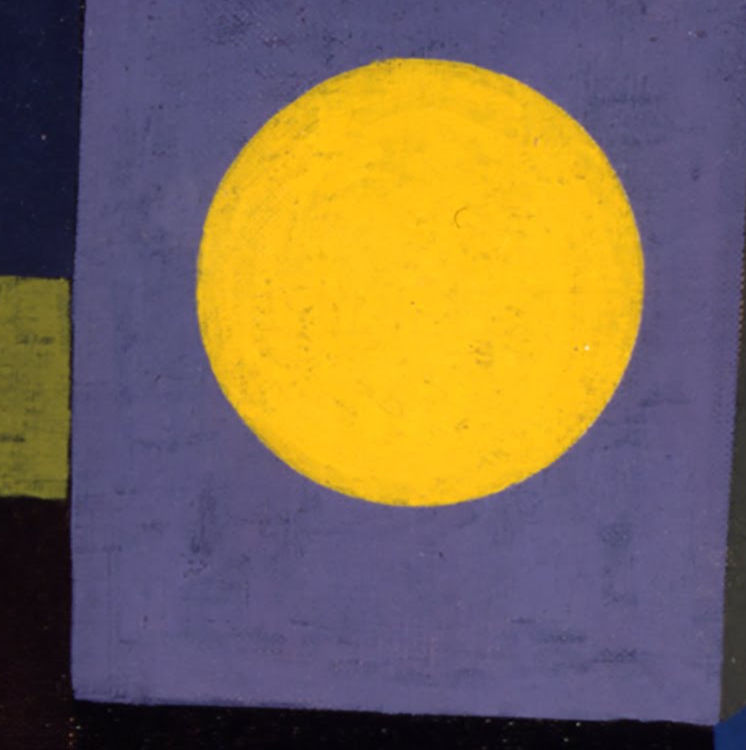
Yellow moon against the violet field
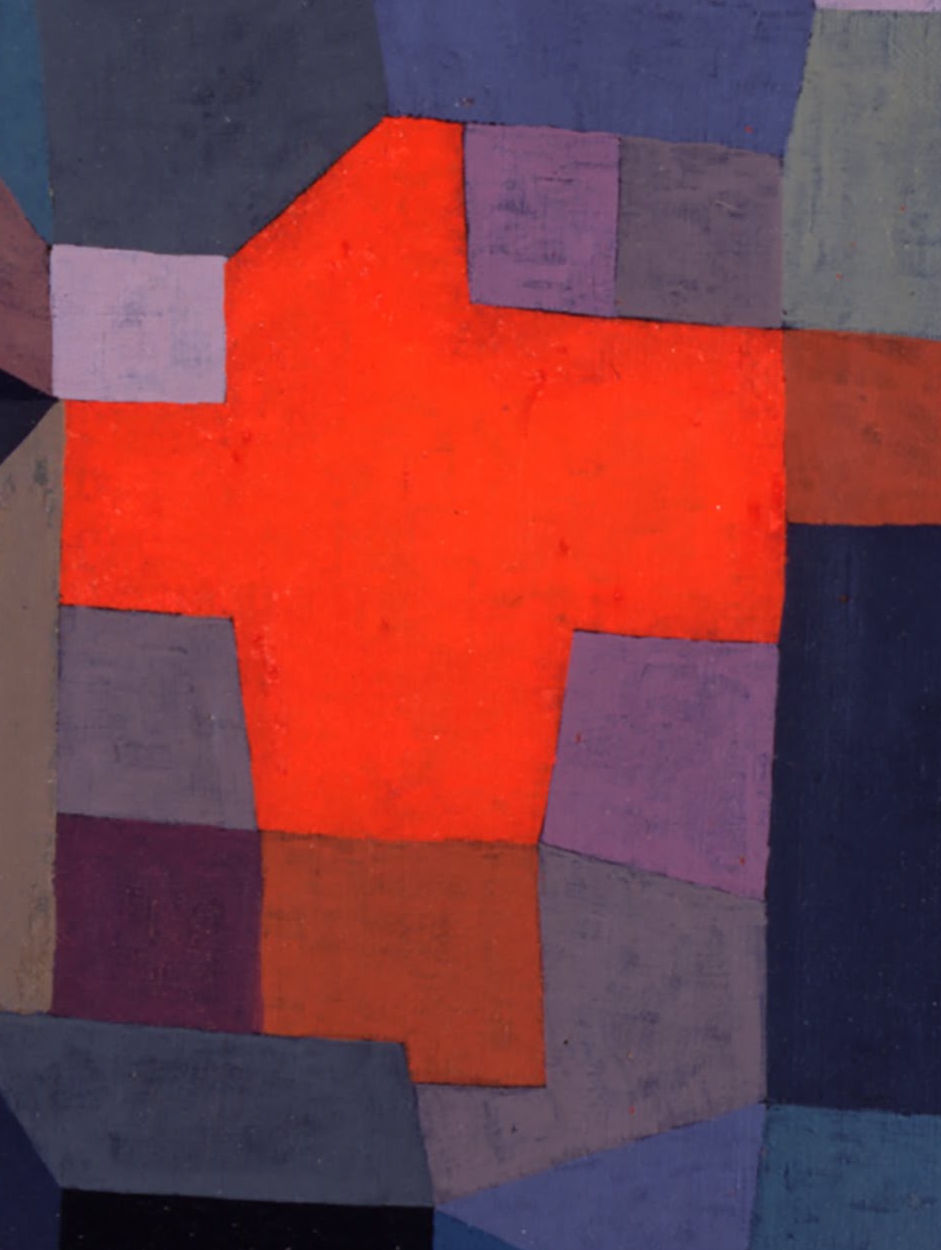
Red form and surrounding blocks
Dark crossing planes at the centre
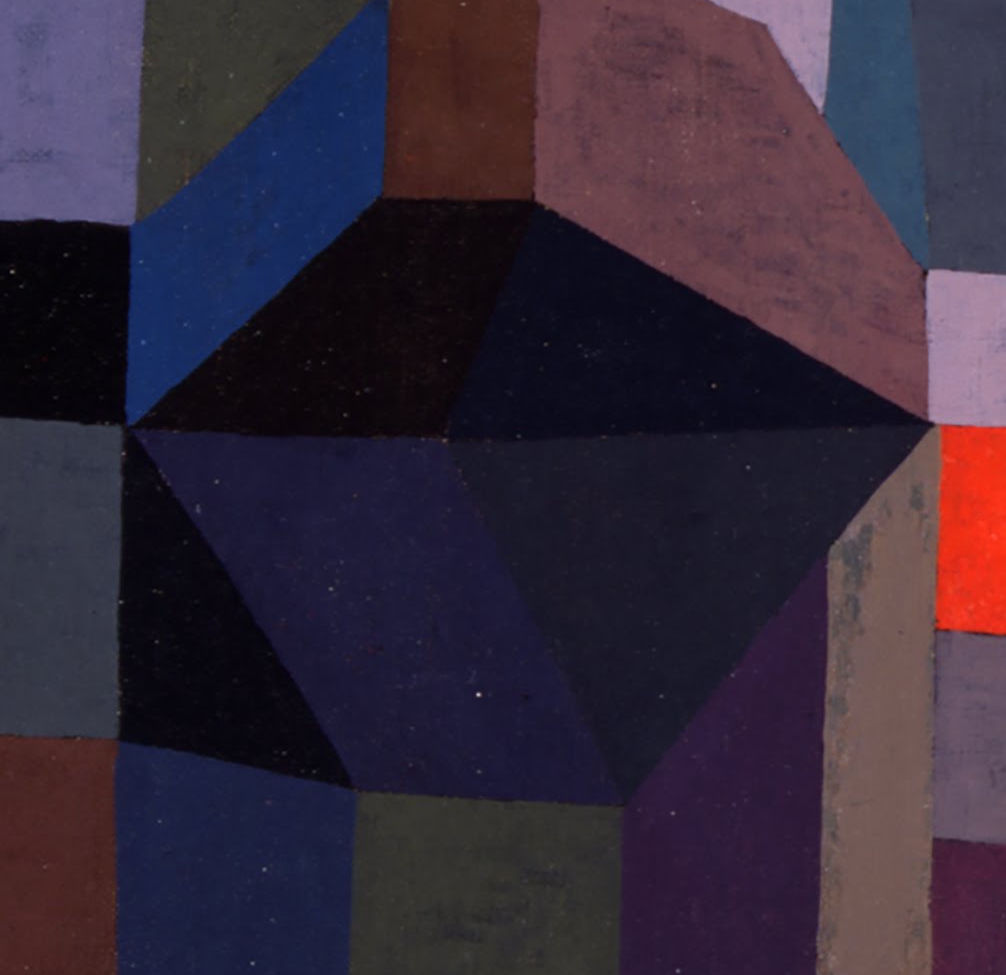
Lower grid of uneven colour blocks
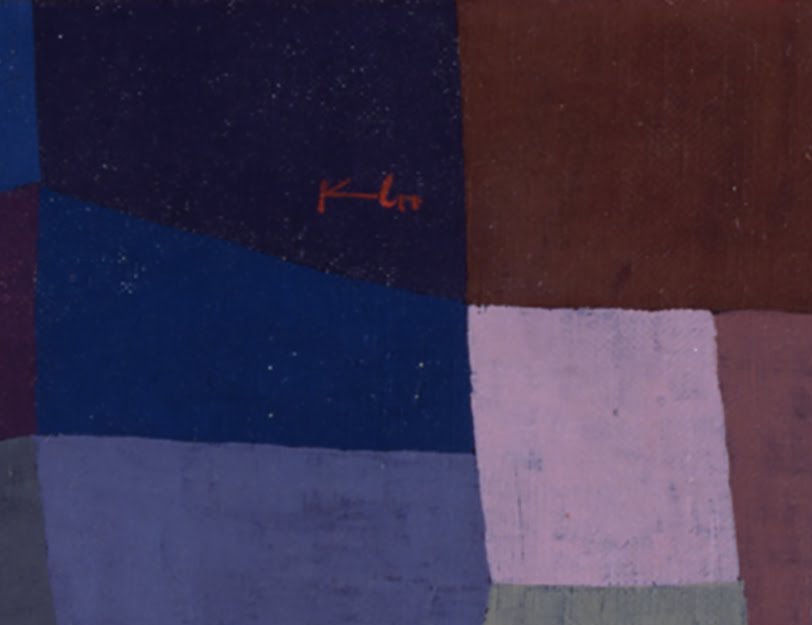
Klee's mark at the upper right
Contents
- Which painting is Fire at Full Moon?
- What do the moon and fire look like?
- Colour against a geometric field
- Does 1933 make this a political painting?
- How did the painting reach Essen?
- Looking again at the two lights
Which painting is Fire at Full Moon?
The original German title is Feuer bei Vollmond. The English Fire at Full Moon appears in the owning museum’s record and the Jewish Museum’s 2026 exhibition checklist. The latter supplies Klee’s annual number 1933, 353. Folkwang records the work under inventory G 284 and gives its size as 50 × 65 cm. An annual number identifies the work within Klee’s own production; the museum inventory number identifies the object in Essen.[1][2]
Folkwang’s medium wording is unusually useful: watercolour over paste colour on prepared canvas. “Mixed media on canvas,” the Jewish Museum’s shorter caption, is not wrong as a broad description but gives less information about the layers Folkwang reports. The result should not be called simply “oil on canvas” on the strength of a commercial image caption. A German postcard listing describes further layers involving an egg coating and oil ground; another reproduction seller mentions wax. Those details have not been checked against a Folkwang conservation report, so they remain technical leads rather than facts about the construction of this object.[1][2][4]
Folkwang’s 50 × 65 cm dimension also differs from an art-print seller’s 44.1 × 57 cm. The two sets have roughly similar proportions, but no accessible document identifies which component the smaller figure measures. It might describe the painted field, another measured component or simply be an error. Rather than inventing a reconciliation, this page follows the owning museum’s current measurement and records the discrepancy for further research.[1][4]
The support matters to looking. Klee’s watercolour sits over another coloured layer on a prepared canvas, rather than being a transparent wash on a bare sheet. That helps explain why “watercolour” alone may conjure the wrong image of loose, pale paper painting. It does not let a viewer diagnose individual underlayers or the precise order of application from a small digital reproduction. Folkwang’s own technical file and the printed catalogue raisonné entry would be needed to say much more about the paint structure.[1]
What do the moon and fire look like?
The yellow disc is near the upper left, contained within a darker rectangular zone. Its circular boundary is sharp against the neighbouring blocks. The red form to the right is larger, irregular and roughly cross-shaped, its arms pressing into adjacent rectangles. The title calls the first a moon and asks the second to be seen as fire; the visible form of the latter is still hard to reduce to a single flame outline. Folkwang itself describes these two colour areas as the composition’s poles.[1][5]
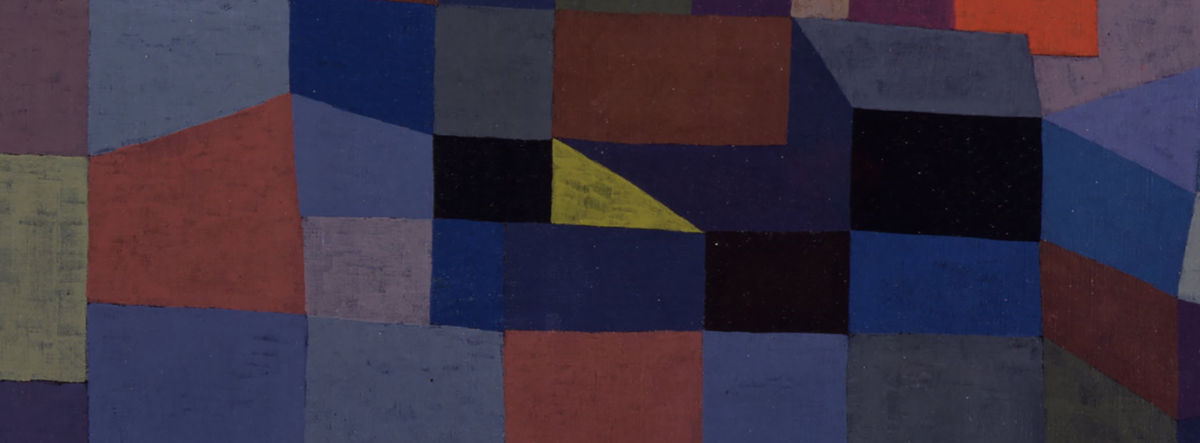
Between the yellow and red, a broad passage of muted greys, browns and dark greenish colours forms no obvious path. Some edges meet cleanly; others change direction at a step or notch. Lower in the painting, a small warm triangle and several offset dark planes can suggest roofs, walls or passages, but a particular building has not been identified. What makes a “landscape” possible here is less a depicted terrain than the relation of the two bright elements to an interlocking field that seems to extend around and between them.[1][5]
The yellow disc and red form do not work identically. The disc is round, compact and detached from surrounding edges. The red is angular and seems fitted into, or cut across, the adjacent grid. Looking from one to the other changes the apparent role of the dark shapes: around the moon they can feel like a night sky broken into planes; around the red they can feel like enclosing architecture or a barrier through which light pushes. These are visual possibilities, not named objects documented by the artist.[1][5]
Folkwang notes that the graphic elements create local effects of perspective. One can test this especially at a stepped junction: a dark block may seem to overlap another, while a diagonal edge can make the next block recede. But these suggestions do not add up to a single viewpoint. A plane that seemed to advance near the top may flatten again as the eye follows its boundary. The work keeps an architectural suggestion without supplying the stable walls, roof and horizon of an illustrated house.[1][5]
This is why a general claim that the whole painting “moves” explains too little. Klee has made a field in which individual edges alter how neighbouring rectangles are read. The eye has to travel; the blocks themselves need not represent objects in motion. The muted colours are likewise not inherently comforting or frightening. Their practical role is to make the moon and red form striking and to keep the field from becoming a bright checkerboard.[1][5]
Colour against a geometric field
The image is organised through many adjacent colour areas, but it does not follow a single repeatable unit. Rectangles vary in width and height; several are interrupted by diagonals or steps. Near the red shape, a line of blocks appears to shift around it. Elsewhere the darker areas merge enough to make an individual boundary less obvious. Klee makes geometry serve an unstable pictorial field rather than a perfectly regular grid.[1][5]
In a 2017 Fondation Beyeler exhibition dossier, Feuer bei Vollmond appeared among Klee’s responses to geometric abstraction. The German and French versions of that dossier are two editions of one institutional account. Their context is useful, but it should not make every rectangle a borrowed De Stijl square or every colour a diagram from a Bauhaus lesson. The specific irregularities of this painting—the inserted disc, open red cross and unequal blocks—are the point of comparison. The dossier’s nearby examples, including Verspannte Flächen and Le rouge et le noir, show that geometric ordering was a continuing problem in Klee’s work, not a single formula mechanically repeated.[6]
Folkwang places the painting within a theory of pictorial forms Klee had developed since 1920, and stresses his concern with relations among meaning, form and the colour of a surface. This is a museum interpretation of the work’s formal setting. It gives a more concrete route into the image than saying that Klee “liked colour theory.” A yellow circle and red angular shape carry meaning because of their names and positions, but also because their brightness and outline have been set against quieter surrounding planes.[1]
Folkwang quotes a letter Klee sent to his wife Lily in September 1933. He described working at that time predominantly through colour, trying to keep light–dark contrasts small and experimenting with grey, red and blue ground tones. A German-language auction discussion of a different 1933 work cites the letter as dated 21 September and points to a 2003 exhibition catalogue transcription. The letter is close to the probable date of Fire at Full Moon and illuminates a current artistic concern; it does not name this painting or identify its red and yellow forms. The painting itself also makes vivid contrast visible, so the letter cannot be treated as a rule Klee perfectly fulfilled in every work.[1][7]
The comparison has a useful limit. Knowing that Klee was trying ground tones helps a viewer pay attention to the dark field as an active set of choices. It does not tell us exactly which grey or red passages were put down first, what pigment they contain, or whether the moon was conceived before the rest of the picture. Those are questions for technical evidence. Art-historical context is most useful here when it makes close looking more exact without pretending to replace a conservation examination.[1][7]
Does 1933 make this a political painting?
Klee’s year in Germany had changed sharply. He had left the Bauhaus for a professorship at Düsseldorf in 1931. A Zentrum Paul Klee archival guide dates his summary suspension after the Nazi takeover to 21 April 1933; formal dismissal and his return to Bern with Lily followed later that year. Folkwang’s probable summer date for this painting places its creation after the April suspension. It is reasonable to bring those events into the account of the work, provided their relationship to its imagery is stated carefully.[1][3]
Folkwang asks whether the title and image might refer to National Socialism and Klee’s removal from the academy, noting the many drawings he made that year with enigmatic titles. Its wording is deliberately interrogative. It does not identify the red shape as a particular party emblem, a burning book or a documented picture of a specific event. The title gives “fire,” but no location, cause or participants. A political reading can be historically alert without becoming a claim that the artist supplied an encrypted message whose key has been recovered.[1]
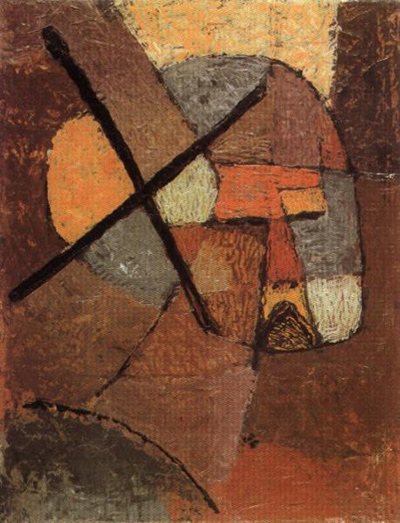
Other works from 1933 can make the difference clearer. Klee’s von der Liste gestrichen, Struck from the List, carries a title that directly evokes exclusion, and its own object history supports a more specific discussion of contemporary politics. Fire at Full Moon has a vivid title but less explicit reference. The two can be compared as works from the same threatened period without making their titles interchangeable or importing the face and marks of one into the other. The Jewish Museum’s 2026 Klee exhibition included both. Its checklist confirms the objects and their dates, while its wall-text document gives Fire at Full Moon a caption rather than a new object-specific proof of political intention.[2][8]
Later reception has also shaped what viewers expect. A French critic reviewing the 2016 Pompidou exhibition imagined an interior with a hearth and moonlight through an opening. That is a possible analogy for the combination of blocks and lights, not a documented setting. Similarly, a German press or retail claim that the work is generally a symbol of Klee’s persecution tells us something about later readings but does not replace his own records. The picture can sustain a political question and an architectural analogy because it leaves much of the represented space unresolved.[1][9]
It would be just as careless to call the work apolitical because it uses geometric colour fields. In 1933 Klee had concrete reasons to experience the national crisis, and Folkwang considers that context worth raising. The responsible conclusion is more precise: the year and suspension are facts; the probable summer date belongs to Folkwang’s assessment; a specific political meaning for moon and fire is an interpretation that remains open. The painting’s formal experiment and its historical moment can be discussed together without making either disappear.[1][3]
How did the painting reach Essen?
Folkwang publishes a relatively detailed provenance. The work remained in Klee’s studio from 1933 to 1940. After his death, it passed to Lily Klee in Bern, from 1940 until no later than 1946. Margrit and Hermann Rupf held it by 1946 and through 1957. The next stages involve Berggruen & Cie, or Heinz Berggruen and Daniel-Henry Kahnweiler, in Paris from 1957 until no later than June 1958, and Galerie Dr Werner Rusche in Cologne by June 1958. Museum Folkwang acquired it that month, supported by its named museum foundation and association. The record’s “by” and “no later than” terms are important: it does not date every handoff to an exact day.[1]
The museum reports that its 2019–20 provenance review judged this chain unbelastet, or unburdened by a problematic provenance in that review. It would overstate the record to turn that assessment into a claim that every dealer transaction and private transfer has been reconstructed in full. The public record does, however, make clear that the painting’s present Folkwang ownership is longstanding: it was purchased in 1958, rather than entering the museum through the much later exhibitions where it has appeared.[1]
Its appearance in the 2017 Fondation Beyeler exhibition and the 2026 Jewish Museum show records continuing institutional attention and loan circulation. These exhibitions also bring different interpretive frames: one groups Klee with geometric abstraction; the other situates his work in a broad account of possible worlds and the crises of his time. Neither exhibition changes what Folkwang’s object file states about the material painting, nor does a loan image by itself permit a new high-resolution reproduction on an ad-supported website.[2][6][8]
Folkwang’s own 2022 school programme used the work to explore how block-like pictorial areas can be read and even imagined in three dimensions. That educational use picks up something real about the picture: its coloured shapes suggest a space while resisting one stable construction. It should not be mistaken for a technical statement that Klee assembled physical puzzle pieces or made a model before painting.[10]
Looking again at the two lights
After following the blocks, return to the moon and red fire. The moon sits within a dark surround; the red shape meets several boundaries and seems to alter them. Each makes the other more conspicuous across the low-key field. The work is neither a simple naturalistic night view nor a colour chart. Its title offers two things to see, and its geometry prevents us from locating them confidently in one ordinary space.[1][5]
That resistance is part of the painting’s force. In 1933 Klee could set two luminous forms against an uneasy structure of colour while living through a sudden professional and political rupture. We can recognise the historical pressure, follow the museum’s political question, and still leave the picture open where the evidence does. The moon and fire remain vivid; their precise relationship is something the viewer must keep examining, not a message the sources have already settled.[1][3]
For related reading, see Struck from the List for a differently titled 1933 work, Klee’s late work for the years after his return to Bern, and the materials and techniques guide for the kinds of layered supports and media that his object records preserve.
Explore selected works from Klee’s much larger oeuvre. Titles without a link have an authenticated catalogue identity but no reviewed article yet.
Artworks directory
| Name | Date | Medium |
|---|---|---|
| A Gate | 1939 | Painting and mixed media |
| A Woman for Gods | 1938 | Watercolour and mixed media |
| Ab Ovo | 1917 | Watercolour and mixed media |
| Above Mountain Summit | 1917 | Drawing and mixed media |
| Abstract Trio | 1923 | Drawing and mixed media |
| Acrobats | 1915 | Watercolour and mixed media |
| Actor's Mask | 1924 | Painting and mixed media |
| Ad Marginem | 1930 | Drawing and mixed media |
| Ad Parnassum | 1932 | Painting and mixed media |
| Adventurer Ship | 1927 | Drawing and mixed media |
| Affected Place | 1922 | Drawing and mixed media |
| After a Sketch from Zurich | 1914 | Watercolour and mixed media |
| After Drawing | 1919 | |
| After The Floods | 1936 | Watercolour and mixed media |
| All Souls' Picture | 1921 | |
| Ancient Harmony | 1925 | Painting and mixed media |
| Angel Applicant | 1939 | Drawing and mixed media |
| Angel Serves the Desired | 1920 | |
| Angel, Still Female | 1939 | Painting and mixed media |
| Angelus Novus | 1920 | Drawing and mixed media |
| Animal Terror | 1926 | Painting and mixed media |
| Arab Song | 1932 | Painting and mixed media |
| Archangel | 1938 | Painting and mixed media |
| Architecture | 1923 | Painting and mixed media |
| Architecture of the Plain | 1923 | Drawing and mixed media |
| Around the Fish | 1926 | Painting and mixed media |
| Arrival of the Air Steamer | 1921 | Drawing and mixed media |
| Asiatic God | 1924 | Painting and mixed media |
| Astrological Fantasy Portrait | 1924 | Drawing and mixed media |
| Athlete's Head | 1932 | Watercolour and mixed media |
| Aufgehender Stern | 1931 | Painting and mixed media |
| Autumn Flower | 1922 | Painting and mixed media |
| Bad Band | 1920 | Drawing and mixed media |
| Baroque Centaur | 1939 | Painting and mixed media |
| Before the Blitz | 1923 | Drawing and mixed media |
| Before the Snow | 1929 | Drawing and mixed media |
| Besessenes Madchen | 1924 | Watercolour and mixed media |
| Bird Garden | 1924 | |
| Bird Wandering Off | 1926 | Watercolour and mixed media |
| Blossoms in the Night | 1930 | Watercolour and mixed media |
| Blue-Bird-Pumpkin | 1939 | Painting and mixed media |
| Boats in the Flood | 1937 | Painting and mixed media |
| Botanical Theatre | 1934 | Drawing and mixed media |
| Boy in Fancy Dress | 1931 | Watercolour and mixed media |
| Broken Key | 1938 | |
| Brother and Sister | 1930 | Watercolour and mixed media |
| But the Red Roof | 1935 | Painting and mixed media |
| C - C = Fisch | 1931 | Watercolour and mixed media |
| Cacti | 1912 | Painting and mixed media |
| Camel (in Rhythmic Landscape with Trees) | 1920 | Drawing and mixed media |
| Captive Pierrot | 1923 | Drawing and mixed media |
| Castle and Sun | 1928 | Drawing and mixed media |
| Cat and Bird | 1928 | Drawing and mixed media |
| Cathedrals | 1925 | Watercolour and mixed media |
| Chalice of the Heart | 1937 | Painting and mixed media |
| Characters in Yellow | 1937 | Painting and mixed media |
| Chosen Site | 1927 | Mixed media |
| Christmas Picture | 1923 | Drawing and mixed media |
| City of Towers | 1916 | Painting and mixed media |
| Clarification | 1932 | Painting and mixed media |
| Collection of Figurines | 1926 | Painting and mixed media |
| Colorful Architecture | 1917 | Painting and mixed media |
| Comedians' Handbill | 1938 | |
| Comic Opera Singer | 1927 | Painting and mixed media |
| Composition | 1939 | Painting and mixed media |
| Composition with Figures | 1915 | Drawing and mixed media |
| Composition with the Yellow Half-Moon and the Y | 1918 | Watercolour and mixed media |
| Conch–Still Life II | 1939 | Watercolour and mixed media |
| Cosmic Composition | 1919 | Painting and mixed media |
| Crystal Gradation | 1921 | Drawing and mixed media |
| Dance of the Grieving Child | 1922 | Painting and mixed media |
| Dancing Girl | 1940 | Painting and mixed media |
| Das Licht und Etliches | 1931 | Mixed media |
| Death and Fire | 1940 | Painting and mixed media |
| Death for the Idea | 1915 | |
| Demon as Pirate | 1926 | Watercolour and mixed media |
| Diana | 1931 | Painting and mixed media |
| Diavolo Player | 1923 | Drawing and mixed media |
| Die Kapelle | 1917 | Watercolour and mixed media |
| Die Vase | 1938 | Painting and mixed media |
| Doctor | 1930 | Drawing and mixed media |
| Dredger and Sailboat | 1931 | Watercolour and mixed media |
| Ein Tor | 1939 | Painting and mixed media |
| Ein Weib fur Gotter | 1938 | Mixed media |
| Embrace | 1939 | Watercolour and mixed media |
| Episode before an Arab Town | 1923 | |
| Equals Infinity | 1932 | Painting and mixed media |
| Eros | 1923 | Drawing and mixed media |
| Error on Green | 1930 | Watercolour and mixed media |
| Evening Figure | 1935 | Drawing and mixed media |
| Falling Bird | 1919 | |
| Fermata | 1932 | Watercolour and mixed media |
| Fire Clown | 1921 | Watercolour and mixed media |
| Fire Full Moon | 1933 | Watercolour and mixed media |
| Fire in the Evening | 1929 | Painting and mixed media |
| Fish in the Harbour | 1916 | Watercolour and mixed media |
| Fish Magic | 1925 | Watercolour and mixed media |
| Flock of Birds | 1917 | Drawing and mixed media |
| Flora on Sand | 1927 | Watercolour and mixed media |
| Flower Myth | 1918 | |
| Flower Stand with Watering Can and Bucket | 1910 | Watercolour and mixed media |
| Flowering Tree (Abstraction with Reference to a Flowering Tree) | 1925 | Painting and mixed media |
| Flowers in Pots | 1923 | |
| Flowers in Stone | 1939 | Painting and mixed media |
| Forest Witch | 1938 | Painting and mixed media |
| Fright of a Girl | 1922 | Drawing and mixed media |
| Fruits on Red | 1930 | Drawing and mixed media |
| Full Moon | 1919 | Mixed media |
| Föhn Wind in Franz Marc's Garden | 1915 | Watercolour and mixed media |
| Garden in St Germain, The European Quarter near Tunis | 1914 | Watercolour and mixed media |
| Ghost Chamber with the Tall Door (New Version) | 1925 | |
| Ghost of a Genius | 1922 | Drawing and mixed media |
| Girl in Mourning | 1939 | Painting and mixed media |
| Glance of a Landscape | 1926 | Watercolour and mixed media |
| Gluht Nach | 1939 | Drawing and mixed media |
| Golden Fish | 1925 | Watercolour and mixed media |
| Goldfish Wife | 1921 | Watercolour and mixed media |
| Green Plant, Blood, Louse | 1924 | Drawing and mixed media |
| Hafenbild | 1918 | Mixed media |
| Hammamet with Mosque | 1914 | Watercolour and mixed media |
| Harbour with Sailing Ships | 1937 | Painting and mixed media |
| Hauptweg und Nebenwege | 1929 | Painting and mixed media |
| Heavenly and Earthly Time | 1927 | Drawing and mixed media |
| Heroic Fiddling | 1938 | Painting and mixed media |
| Heroic Roses | 1938 | Painting and mixed media |
| Heroic Strokes of the Bow | — | Mixed media |
| Highway and Byways | 1929 | Drawing and mixed media |
| Houses near the Gravel Pit | 1913 | Watercolour and mixed media |
| Howling Dog | 1928 | Painting and mixed media |
| In the Current Six Thresholds | 1929 | Painting and mixed media |
| In the Style of Kairouan | 1914 | Drawing and mixed media |
| Individualized Altimetry of Stripes | 1930 | Painting and mixed media |
| Insula Dulcamara | 1938 | |
| Interior with the Clock | 1913 | Watercolour and mixed media |
| Irma Rossa the Animal Tamer | 1918 | Drawing and mixed media |
| Journey in Corsica | 1927 | Drawing and mixed media |
| Landscape with Bluebirds | 1919 | Watercolour and mixed media |
| Legend of the Nile | 1937 | Painting and mixed media |
| Lemon Harvest | 1937 | Watercolour and mixed media |
| Likeness in the Bower | 1930 | Watercolour and mixed media |
| Limits of Reason | 1927 | Painting and mixed media |
| Little Hope | 1938 | Watercolour and mixed media |
| Magdalena before the Conversion | 1938 | Drawing and mixed media |
| Mask of Fear | 1932 | Painting and mixed media |
| May Picture | 1925 | Painting and mixed media |
| Monument in a Cemetery | 1922 | Watercolour and mixed media |
| Monuments at G | 1929 | Watercolour and mixed media |
| Municipal Jewel | 1917 | Watercolour and mixed media |
| Mural from the Temple of Longing Thither | 1922 | |
| Nach der Uberschwemmung | 1936 | Watercolour and mixed media |
| New Harmony | 1936 | Painting and mixed media |
| New House in the Suburbs | — | Mixed media |
| Old Steamboat | 1922 | Drawing and mixed media |
| On the Edge | 1930 | Drawing and mixed media |
| Once Emerged from the Gray of Night | 1918 | Drawing and mixed media |
| One Who Understands | 1934 | Painting and mixed media |
| Oriental Pleasure Garden | 1925 | Painting and mixed media |
| Park of Idols | 1939 | Watercolour and mixed media |
| Passing by Red Pillars | 1928 | Watercolour and mixed media |
| Persian Nightingales | 1917 | Drawing and mixed media |
| Popular Wall Painting | 1922 | Painting and mixed media |
| Prestidigitator | 1927 | Watercolour and mixed media |
| Rainy Day | 1931 | Watercolour and mixed media |
| Red and White Domes | 1914 | Watercolour and mixed media |
| Red Balloon | 1922 | Drawing and mixed media |
| Redgreen and Violet-Yellow Rhythms | 1920 | Drawing and mixed media |
| Refuge | 1930 | Watercolour and mixed media |
| Rhythmic Rythmical | 1930 | Painting and mixed media |
| Saint of the Inner Light | 1921 | |
| Scaffolding of a New Building | 1930 | Painting and mixed media |
| Scholar in Dealing with Stars | 1926 | Watercolour and mixed media |
| Seated Woman | 1930 | Drawing and mixed media |
| Senecio | 1922 | Painting and mixed media |
| Separation in the Evening | 1922 | Drawing and mixed media |
| Sinbad the Sailor | 1923 | Drawing and mixed media |
| Skeptically Smiling | — | Mixed media |
| Small House in the Garden City | 1928 | Watercolour and mixed media |
| Small Portrait of a Girl in Yellow | 1925 | Painting and mixed media |
| Southern Gardens | 1919 | Watercolour and mixed media |
| Static-Dynamic Gradation | 1923 | Drawing and mixed media |
| Still Life | 1927 | Painting and mixed media |
| Still Life with Gladioli | 1932 | Watercolour and mixed media |
| Strange Garden | 1923 | Drawing and mixed media |
| Stricken City | 1936 | Painting and mixed media |
| Strong Dream | 1929 | Watercolour and mixed media |
| Struck from the List | 1933 | Drawing and mixed media |
| Structural I | 1924 | Drawing and mixed media |
| Sumpflegende | 1919 | Painting and mixed media |
| Temple Gardens | 1920 | Drawing and mixed media |
| The Arrow before the Target | 1921 | Drawing and mixed media |
| The Barbed Noose with the Mice | 1923 | Watercolour and mixed media |
| The Flora of the Heath | 1925 | Watercolour and mixed media |
| The Goldfish | 1925 | Watercolour and mixed media |
| The Hour Before One Night | 1940 | Painting and mixed media |
| The Man in Love | 1923 | |
| The Mask with the Flag | 1925 | Mixed media |
| The Pathos of Fertility | 1921 | |
| The Rhine at Duisburg | 1937 | Painting and mixed media |
| The Way to the Citadel | 1937 | Painting and mixed media |
| Three Houses and a Bridge | 1922 | Watercolour and mixed media |
| Tightrope Walker | 1923 | |
| Tomb in Three Parts | 1923 | Watercolour and mixed media |
| Tomcat's Turf | 1919 | Watercolour and mixed media |
| Tower in Orange and Green | 1922 | Drawing and mixed media |
| Tree and Architecture - Rhythms I | 1920 | Watercolour and mixed media |
| Tree and Architecture - Rhythms II | 1920 | Painting and mixed media |
| Tropical Dawn with the Owl | 1921 | Mixed media |
| Tropische Dammerung | 1921 | Painting and mixed media |
| Twittering Machine | 1922 | Drawing and mixed media |
| Variations (Progressive Motif) | 1927 | Watercolour and mixed media |
| Ventriloquist and Crier in the Moor | 1923 | |
| Viaducts Break Ranks | 1937 | Drawing and mixed media |
| Villa R | 1919 | Painting and mixed media |
| Village Carnival | 1926 | Painting and mixed media |
| Vor dem Blitz | 1923 | Drawing and mixed media |
| Wald-Hexen | 1938 | Painting and mixed media |
| Young Forest | 1925 | Drawing and mixed media |
Related artworks
Explore eight other Klee works, beginning with works close in date to this one.
Struck from the List
1933
Ad Parnassum
1932
Mask of Fear
1932
Ad Marginem
1930
Error on Green
1930
New Harmony
1936
Fire in the Evening
1929
Discussion
The moon and red fire stand out against a field of uneven, dark geometric blocks.
Folkwang raises a political question about the painting’s 1933 context without declaring one fixed explanation.
Reader Insights
Which block makes the space seem to advance or recede?
How does the red shape change the way you read its surrounding grid?
What does the title make visible that the shapes alone leave open?
Join the Conversation
Share the detail or source behind your reading.
References
- Museum Folkwang, Feuer bei Vollmond collection record, English commentary and German provenance: title, medium, dimensions, inv. G 284, probable summer 1933 date, Lily letter excerpt, political question, qualified ownership chain, 1958 acquisition and 2019–20 review, View source.
- The Jewish Museum, New York, Paul Klee: Other Possible Worlds exhibition checklist (2026), entries 35 and 36: annual numbers, English and German titles, broad medium, size, lenders and exhibition context, View source.
- Zentrum Paul Klee, archival exhibition guide on Klee’s 1933 Düsseldorf suspension, English with German archival material; used for the 21 April summary suspension and later departure sequence, not to assign a specific painted symbol, View source.
- Reisser Kunstpostkarten, German postcard technical caption, and ars mundi, reproduction listing. Their egg/wax and 44.1 × 57 cm claims are recorded as unresolved leads, not substituted for Folkwang’s object data.
- Artwork reproduction on this page, visually compared with Museum Folkwang’s owner image in reference 1. It is only 400 × 323 px, so formal observations are limited to visible large shapes; no fine material claim rests on it.
- Fondation Beyeler, German 2017 Klee exhibition press dossier and French counterpart, same institutional argument in two languages: work identity and comparative geometric-abstraction context, not a layer-level study.
- Museum Folkwang, Klee’s September 1933 letter to Lily quoted in reference 1; Ketterer Kunst, German citation of the 21 September 1933 letter, referring to Paul Klee 1933 (Munich 2003), p. 292. The auction commentary is on another 1933 work; the letter is contextual rather than an Feuer bei Vollmond statement, View source.
- The Jewish Museum, 2026 complete exhibition texts, caption for Fire at Full Moon and broader exhibition setting. The wall text does not provide a separate object-specific political decoding, View source.
- Le Goût des Expos, French review of the 2016 Centre Pompidou Klee exhibition, later critic’s imagined interior/hearth/skylight reading. This is reception, not evidence of Klee’s intended setting, View source.
- Museum Folkwang, 2022 schools programme, German educational use of the painting’s puzzle-like blocks and spatial suggestion; not a conservation source, View source.