


 by Tom Gurney
Tom Gurney BSc (Hons) is an art history expert with over 20 years experience
Published on June 19, 2020 / Updated on September 27, 2026
Email: tomgurney1@gmail.com / Phone: +44 7429 011000
Fish in the Harbour: a harbour held in a watercolour wash
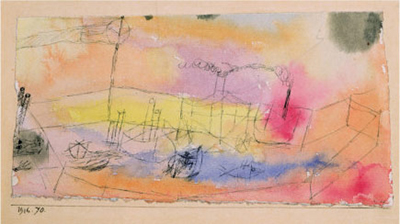
Paul Klee's Fish in the Harbour is catalogued by the Bridgeman image archive as a 1916 watercolour in a private collection. Its record carries image number CH27436 and credits the photograph to Christie's Images / Bridgeman Images. A separate private Klee title index lists the German Der Fisch im Hafen with the annual number 1916, 70. That index has not been checked against Klee's handwritten register or the printed Catalogue raisonné, and the present owner is not publicly identified in the Bridgeman record. The year and watercolour medium have stronger support than the detailed identity and provenance fields sometimes attached to reproductions.[1][2]
The work is a wide, low band of colour. A yellow horizontal passage crosses the middle; pink, orange and pale violet spread above and below it. Thin black lines rise vertically and angle across the surface, suggesting masts, rigging, hulls or harbour structures. A cooler blue-grey band runs through the centre. It can be read as water, though the boundary between water and sky is never fixed as it would be in a topographical view. The fish named by the title is difficult to isolate with certainty in available reproductions. That uncertainty matters to how the image is read.[1]
Lines that make and unmake a harbour
The visible drawing is light and exploratory. Uprights and diagonals can suggest several boats at once without enclosing any one vessel in a continuous contour. Near the left edge, darker clustered marks weight the scene. Toward the right, angled lines reach across orange and pink areas, as if a hull or quay were being assembled from a few strokes. The eye can try to connect them into familiar maritime forms, then lose the connection where a wash passes through them. This is an image of looking for a harbour in a field of marks, rather than a labelled diagram of ships and fish.[1]
Colour keeps the lines from settling into a conventional horizon. The yellow strip feels bright and open, but it does not obey a naturalistic separation of sky from water. Pink areas above and below repeat a similar temperature across the image; blue and grey intervene in the centre. The shapes have an airy, unfinished quality because much of the paper and dilute pigment remain visible. The effect comes from the relation of wash and line, not from a thickly painted seascape. The Bridgeman listing supports the watercolour description; a conservation record would be needed to identify precisely any additional drawing medium or support details.[1]
Thin linear structures evoke a harbour. A small dark form in the central band could invite a fish reading once the title has been supplied, but it is not securely legible enough to identify species, number or motion. Klee's title directs attention toward an aquatic subject while the picture resists a single visual inventory. It permits a play between recognition and abstraction without requiring every stroke to be translated into a named object.[1][2]
The watercolour within Klee's 1916 work
The Zentrum Paul Klee describes Klee's growing use of coloured watercolour after about 1910. Its technical overview explains that he often set transparent washes beside and over one another and used very dilute colour on moistened paper. It also notes the importance of his 1914 Tunisian journey for his confidence with colour. Those facts provide useful background for a 1916 sheet, but no available object record says that this particular harbour was observed in Tunisia or made to memorialise the journey.[3]
Walther J. Fuchs, a Klee specialist writing in German about the artist's 1916 work, documents drawings of boats, fish and hybrid fish-ships from that year. He identifies Fisch-Schiff-Bastarde as 1916, 42, Schiffe, ein Schiff-Fisch-Bastard as 1916, 48, and a harbour scene with a named ship as 1916, 51. These are distinct works, not preparatory studies proven for Fish in the Harbour. Their value here is comparative: Klee was testing how a few graphic signs could oscillate between a vessel, an animal and an imagined scene during the same year. The harbour page belongs within that broader visual preoccupation without being merged with any of the other objects.[4]
Fuchs's close reading also warns against treating a fish-ship form as a straightforward natural-history subject. He follows how boats, roofs, masts, flags and fish-like bodies can be broken and joined in Klee's 1916 drawings. In Fish in the Harbour, the watery colour and dispersed lines give a different emphasis: recognition depends on the viewer assembling fragments across a horizontal field. Whether the specific dark forms are fish, parts of ships or simply marks remains open in the available small image.[4]
Fish as a recurring subject
The Italian Fondazione Cerruti, in a study of its own later Klee fish picture, traces his interest in aquatic creatures to his 1902 visit to the Naples aquarium, recorded in diary entry 390. The writer, Marie Kakinuma, explains that Klee paid attention to the fish's expressive appearance and relationships. This is a documented early encounter and a useful source for the recurring fish motif, although it gives no particular source for this 1916 image.[5]
Klee returned to fish in other forms. The later Goldfish, Fish Magic and Around the Fish make it easy to see fish as a theme across decades, but they should not be allowed to dictate the appearance of this sheet. Fish in the Harbour precedes those Bauhaus-period works and uses a much lighter, more open arrangement. The title connects it to water and animal life; the marks also connect it to harbour structures and to his 1916 play with fish-ship hybrids. The comparison establishes a pattern of interest, not a single symbolic meaning shared by every fish picture.[4][5]
What remains to be verified
The original work's full dimensions, paper type, inscriptions, present ownership and detailed provenance are not supplied by the accessible Bridgeman asset entry. The private title index gives 1916, 70, and a reproduced image appears to show a notation along its lower edge, but it is too small to transcribe as primary evidence. A direct catalogue entry, auction record, owner file or high-resolution document would strengthen that identification and allow a more confident analysis of the small central forms.[1][2]
Fish in the Harbour rewards patient looking at a modest sheet. The fine lines offer possible boats, rigging and shore forms; transparent colour washes cross them; the title asks us to find a fish amid that visual traffic. What we can document is a 1916 watercolour in a private collection, with a plausible German-title crosswalk and several related 1916 works. What we can see is the lively interval between a harbour that almost takes shape and watercolour that keeps it in motion.[1][2][3][4]
Related artworks
Explore eight other Klee works from the researched artwork cluster.

Flower Myth
1918
Hammamet with Mosque
1914
Angelus Novus
1920
Crystal Gradation
1921
Red Balloon
1922
References
- Bridgeman Images, “The Fish in the Harbour, 1916 (watercolour),” CH27436: image archive record for date, medium, private collection, Christie's photograph credit and image-rights context. It gives no original object dimensions or named present owner, View source.
- PaulKlee.fr, 1916 work index (in French/German): private derivative crosswalk listing Der Fisch im Hafen as 1916, 70. The original artist register and printed catalogue entry were not directly read, so the number remains provisional, View source.
- Zentrum Paul Klee, “Paul Klee” exhibition and technique overview (in German), “Aquarelle”: institutional context for Klee's coloured watercolour practice and its development after 1910. It does not discuss this individual sheet, View source.
- Walther J. Fuchs, “Paul Klee in Landshut 1916”, Zwitscher-Maschine (in German), especially the discussion and captions for 1916, 42, 48 and 51: specialist study of contemporary fish-ship and harbour imagery. These are separate works, View source.
- Marie Kakinuma, Fondazione Cerruti, Mast= und Zier-Fische ( Fattened and Ornamental Fishes ) (in English): cites Klee's diary no. 390 on the Naples aquarium and discusses the long-running fish motif in relation to a different, later work, View source.