


 by Tom Gurney
Tom Gurney BSc (Hons) is an art history expert with over 20 years experience
Published on June 19, 2020 / Updated on September 27, 2026
Email: tomgurney1@gmail.com / Phone: +44 7429 011000
Equals Infinity: a sign within a field of painted points
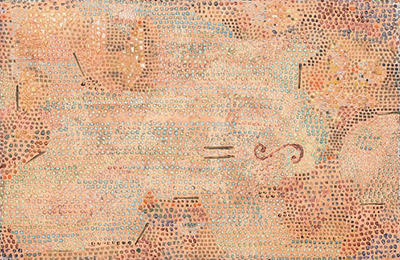
Paul Klee painted Equals Infinity in 1932. The Museum of Modern Art in New York holds the work as object 90.1950 and records its current medium as oil on canvas mounted on wood, measuring 51.4 × 68.3 cm. A MoMA checklist from the year the painting entered the collection gives the German title Gleich unendlich and describes oil on canvas in the centre and oil on wood at the margins. Those accounts are related rather than contradictory: the recent object record names the main support and mount, while the older record calls attention to painted marginal areas. The painting is more materially varied than a uniformly dotted canvas might first appear.[1][2]
Across the surface, small coloured touches form a vibrating field of peach, blue, cream and dark brown. Short dark signs interrupt it: bars, angled strokes, isolated marks and, just right of centre, a looped form that can suggest a sideways eight. The title encourages a mathematical reading of that loop as the sign for infinity. Yet its line is not simply a textbook symbol placed on a neutral ground. It shares the surface with other marks and shifts between a painted form and something we think we can read.[1][3][4]
A surface made of points
MoMA's 1950 acquisition announcement described the painting's surface as a shimmering “mosaic” of bright spots. That contemporary description is useful because the dots are not identical, mechanically repeated units. They change density, size and colour. Some passages gather into warm, nearly continuous areas; elsewhere blue and orange flecks alternate visibly. The eye moves between looking at individual touches and letting them merge into a broader colour field.[2]
The warm ground is interrupted by cooler blue-green areas and a more concentrated dark zone toward the lower right. Darker spots also collect along parts of the upper and lower edges. The result is not a flat, evenly spaced grid. Light seems to fluctuate as neighbouring colours strengthen or soften one another. A few strokes of nearly unbroken black cut across that flicker. They are conspicuous precisely because they refuse the dotted rhythm around them.[1][2]
This difference in scale is central to the work. A small dot can be one unit among hundreds; a single dark bar can halt the eye. Klee makes the surface oscillate between accumulation and interruption. The looped sign near the centre-right draws attention because it is made of a few continuous strokes in a field that otherwise asks to be scanned gradually. What the painting shows most directly is this formal relation, not a proof that particular colour spots correspond to musical notes or mathematical values.[1][3]
MoMA's early description of canvas at the centre and wood at the margins also complicates the way the image is read. The marginal area participates in the painting rather than serving only as a surrounding frame. In a small reproduction, the support boundary is difficult to establish securely; the 1950 checklist is stronger evidence for the object's construction. A direct conservation record would be needed to locate precisely where each support is exposed or painted and how the canvas is joined to the wood.[1][2]
A loop that can be read
The German title Gleich unendlich places equality and infinity side by side. It does not state a complete equation with named terms. The prominent loop invites us to see a mathematical infinity sign, but even that resemblance is unstable. Didier Semin, in a German translation of his French essay on the serpentine line, discusses Klee's 1932 painting through the difference between a closed sideways eight and an open, winding line. The former can stand for an endless return within a circuit; the latter continues outward. His argument is about the tension between visible line and coded sign, not evidence that Klee illustrated a specific theorem.[3]
Italian semiotician Paolo Fabbri points to another possible association. Summarising Hubert Damisch's earlier extended study of the painting, Fabbri describes the form as simultaneously suggestive of the infinity sign and a musical sign associated with the violin. This is a scholarly reading of how images acquire several meanings, not a documented statement by Klee that the mark depicts a violin's sound hole or that a mathematical formula is hidden in the picture. Damisch's full essay has not been directly read for this page; his interpretation is reported through Fabbri and Semin, who cite it.[3][4][5]
These readings clarify why the title matters. Without it, the loop might remain one more free shape among the bars and flecks. With it, viewers test whether the shape behaves as a sign. But the painting does not reduce to the answer “infinity.” Its form remains imperfect, coloured and embedded in a surface that changes our attention from mark to mark. The title opens a way of looking rather than closing the work with a single decoded message.[3][4]
Music without a score
Klee's long involvement with music makes it reasonable to consider the painting's rhythmic effects. Fabbri's account of Damisch invites a relation between a mathematical infinity sign and a musical form. On the surface, differently sized marks and patches do set up intervals: some are close and repeated, others sparse and emphatic. The contrast between the soft dotted ground and the hard dark strokes can be described as rhythmic without claiming that the picture transcribes a particular piece of music.[2][4]
Reading the loop as an f-shaped hole in a violin is one possible visual analogy, but the known object records do not identify an instrument. Nor do they say that every dot represents an individual note or that all human culture is made from the same elemental units. Those claims go beyond the image and its documented history. The music connection is strongest as an interpretive comparison of repetition, interval and visual movement, clearly separated from evidence of Klee's stated intention for this specific work.[1][3][4]
The painting was made in a period when Klee experimented with unusually varied ways of organising colour and form. A 1950 MoMA announcement singled out this picture as a phase of his work then absent from its collection. Its “mosaic” description catches the first impression, while the owner checklist and later scholarship help one see how the continuous signs operate across that field. The work allows dots, lines, colour and the legible hint of a mathematical mark to coexist without becoming a diagram.[1][2][3][4]
From Klee to MoMA
MoMA's published provenance begins with Klee and passes to Lily Klee in 1940. The Klee-Gesellschaft acquired the work in 1946; the museum records sales through Galerie Rosengart in Lucerne and Carstairs Gallery in New York by 1948. MoMA acquired it in 1950 through the Lillie P. Bliss Bequest. The museum bases these early stages on references to volume 6, catalogue no. 5971, of the printed Paul Klee: Catalogue Raisonné. That number is cited here through the owning museum; the printed entry itself has not been directly consulted. MoMA notes that its provenance research is ongoing.[1]
The 1950 checklist and announcement are also evidence of how the museum first presented the work: as a small oil painting with centre and margins of different supports and a lively colour surface. Later interpretations ask what the looped figure does as a sign and how mathematical, musical and pictorial readings cross. These kinds of evidence answer different questions. The institutional record establishes the object and its early display history; the scholarly essays propose ways of interpreting an image that remains visually open.[1][2][3][4]
In Equals Infinity, the smallest units and the largest idea are held in productive tension. Countless coloured touches give the work a changing texture, while a few dark lines ask to be read. The title makes the sideways loop especially charged, but no single symbol accounts for the entire painting. The image stays both an arrangement of paint and a place where seeing a mark becomes thinking through a sign.[1][3][4]
Related artworks
Explore eight other Klee works from the researched artwork cluster.
Ad Parnassum
1932
Mask of Fear
1932
Fire Full Moon
1933
Struck from the List
1933
Ad Marginem
1930
Error on Green
1930
Fire in the Evening
1929
References
- Museum of Modern Art, Equals Infinity, object 90.1950: owner record for 1932 date, oil on canvas mounted on wood, 51.4 × 68.3 cm dimensions, acquisition and provenance. Its notes cite Paul Klee: Catalogue Raisonné, vol. 6, no. 5971 indirectly; the printed entry was not directly read, View source.
- MoMA, 1950 recent-acquisitions announcement and checklist, especially pp. 2 and 5: contemporary “mosaic” description, Gleich unendlich title and medium stated as oil on canvas in the centre and on wood at the margins. The scanned text contains OCR errors in unrelated numerals; the object facts were checked against the current record, View source.
- Didier Semin, “Die Linie der Ehelosigkeit: Der Zufall, die Arabeske und die Volute”, Trivium 1 (2008), especially section 23 (in German, translated from French): directly read discussion of Gleich Unendlich, the open winding line and the closed infinity sign, View source.
- Paolo Fabbri, “La sfinge incompresa”, in Semiotiche della pittura (in Italian), pp. 75–76: directly read account of Damisch's interpretation of Uguale a infinito as a layered musical and mathematical sign. This chapter primarily analyses another Klee work; its Equals Infinity discussion is brief, View source.
- Hubert Damisch, “Égale infini,” Critique 315–16 (1973), later translated as “Equals Infinity,” 20th Century Studies (1976), 56–81. Bibliographic identity corroborated by MoMA's Klee bibliography. The full essay was not directly read; its argument is mediated through Semin and Fabbri.