


 by Tom Gurney
Tom Gurney BSc (Hons) is an art history expert with over 20 years experience
Published on June 19, 2020 / Updated on September 27, 2026
Email: tomgurney1@gmail.com / Phone: +44 7429 011000
A still life surrounded by signs
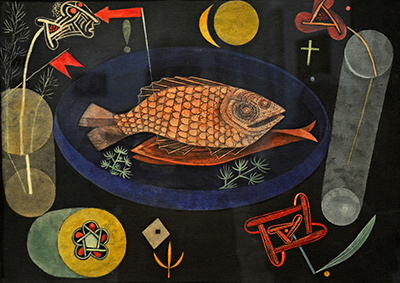
Paul Klee places a fish on a brightly edged platter, ready, it seems, to be eaten. Yet the meal has no table. Against a deep, nearly black field, a crescent, a full disk, a cross, an arrow, a flag, pale column-like forms and a small human head occupy the space around it. The central fish looks precisely worked; the surrounding signs are spare and discontinuous. Around the Fish is recognisable as a still life and resistant to the idea that a still life must show a stable room or a single moment. It asks what else might be gathered around a familiar object besides the objects one could set beside it.[1][2]
Klee made the painting in 1926 and called it Um den Fisch. It belongs to the Museum of Modern Art (MoMA), New York. A close description starts with its pictured relationships: the prepared fish versus its possible watery world, the edible object versus the moon and other signs, and an arrow whose path moves attention away from the platter. The temptation to decode each mark is strong. The sources, however, give several different readings rather than a key left by Klee.[1][2][3]
Contents
- The object and its names
- A fish served in a space without a table
- Symbols without a fixed translation
- What Klee wrote about looking beyond appearance
- From Dresden to New York
- A later artist puts the fish on a table
- Looking around it again
The object and its names
MoMA identifies the work as oil and tempera on canvas mounted on cardboard, measuring 46.7 × 63.8 cm. Its museum number is 271.1939, and its acquisition is credited to the Abby Aldrich Rockefeller Fund. Klee's own annual register number is 1926,124 (C 4), recorded in the 2026 Jewish Museum label and German scholarship. The later Catalogue raisonné Paul Klee gives continuous number 4075. These numbers serve different cataloguing systems; none is a date of acquisition.[1][2][4]
The 2026 Jewish Museum label abbreviates the medium to “oil on canvas.” An earlier scholarly German description gives oil on Nesseltuch mounted on card, a glue ground, varnish and white tempera beneath the paint. That fuller phrase may reflect catalogue or technical evidence, but it does not make the order of every layer clear. Without the conservation record, MoMA's current “oil and tempera on canvas mounted on cardboard” is the most reliable short caption. It also makes a physical distinction: the painting is mounted on a support, not a loose canvas hung only by a frame.[1][2][4]
“Around” in the English title keeps attention on the relation between centre and surround. The original German Um den Fisch likewise locates the scattered forms in relation to the fish, while leaving their connection open. The German scholar Harriet Zilch hears an echo of um den Tisch, “around the table.” The resemblance is witty, especially for a painted meal without a table, but it is her interpretation. No consulted Klee document says that he intended the pun, and the title alone does not establish a particular dinner or ritual.[4]
MoMA's online record marked the painting not on view when checked on 26 September 2026. Ownership is therefore the stable statement here; a current display claim needs a fresh museum check when this page is released.[1]
A fish served in a space without a table
The platter is a long oval with a strong blue rim. The fish lies along its horizontal axis, patterned with dark and light marks and surrounded by green sprigs. The broad dark field leaves space between the plate and the other forms. That space does not behave as a tabletop: there is no edge, leg, cloth, wall or horizon to give the objects ordinary depth. Instead, the signs appear to hover in a pictorial field. The fish can be read as food, while the rest can be seen as thoughts, forces, other places or phases of its life. Each of those further terms is an interpretation; the visible fish, plate and separation come first.[1][2]
The upper part of the painting contains a yellow disk partly met by a dark curved form, readable as a full and crescent moon. A small head near the upper left is compressed into a few features. At the right and left, taller pale forms stand like translucent tubes or vessels. There are rounded coloured forms, an emphatic cross, a mark like an exclamation point, a red forked flag and an arrow. Their unequal sizes and styles are important. The platter is a recognisable thing drawn with care; the other elements range from objects to graphic signs. Klee makes us switch ways of looking as our eyes move around the fish.[1][2][4]
MoMA's 2006 label inventories several of these features and relates the arrow to Klee's Bauhaus diagrams for force and emotion. It says the arrow points toward the stylised head and possibly alludes to human consciousness. That last word matters. The arrow's direction can be observed; a claim about consciousness is the curator's cautious proposal. The page should not turn it into an established private symbol used by Klee in every work.[1]
The Jewish Museum's 2026 label proposes another path through the image. It sees herbs on the platter as recalling seaweed, so the fish's present state as prepared food evokes the water it once inhabited. It relates lunar phases to tides, reads another form through cellular division, and describes the little head as combining frontal and profile views. These associations make a coherent account of food, nature, growth and perception, but the more specific biological language is a contemporary curatorial reading. A viewer can follow the suggested connections without being told that Klee made a scientifically exact diagram of embryology.[2]
In a separate MoMA audio account, curator Anne Umland makes the central oval itself uncertain: the fish appears over a blue-and-black plate, or perhaps a pool. She sees a form beneath it as a reflection and wonders whether a second, fainter reflection lies lower still. The Jewish Museum's 2026 audio-description script similarly notices a smaller fishlike silhouette beneath the main body, facing the other way. These are useful prompts for close looking, especially because the platter reading otherwise makes the scene seem settled too soon. They remain attributed observations and interpretations; the available small reproductions cannot verify each faint mark independently.[10][11]
Writing in a Japanese university journal, Yasuo Ishii reads the oval as a deep dish that also evokes an aquatic setting. He connects the small head, arrow, vessels and plants with the passage from living fish to human food, and notices a second fish form below the first. His emphasis on the fish's scale compared with the little head usefully shifts attention back to the animal rather than letting the orbiting signs take over. Ishii sometimes turns these visible relationships into confident claims about what Klee wanted to say; his article does not supply a Klee document that would settle such intentions. Read beside Umland's plate-or-pool question, it is a distinct, arguable account of the painted forms, not a final decoding.[10][14]
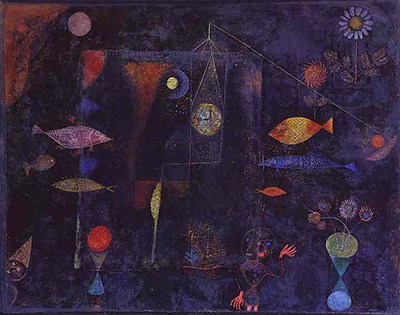
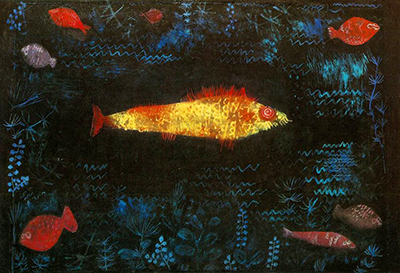
The contrast between food and environment also separates this fish from Klee's nearby aquatic pictures. In The Goldfish (1925), the fish is an illuminated presence within dark water. In Fish Magic (1925), aquatic and other images intermingle in a theatrical field. Around the Fish first looks like a fish that has been caught and served, while the oval and the form beneath it leave the water reading open. The surrounding signs keep the lost water and a wider cosmos imaginable even after the creature is on a plate. These are comparisons of visible arrangements, not evidence that Klee designed the three works as a fixed trilogy.[1][2][4]
Symbols without a fixed translation
The cross and fish have histories in Christian imagery. Zilch places both in the wider group of Klee motifs that borrow from religious iconography. Her argument is that he reshapes these motifs playfully and sometimes satirically; a conventional symbol can appear without turning the whole painting into a conventional devotional image. That is a useful restraint. The cross is visible, but it does not by itself make the platter an altar, the fish Christ or the ring of objects a congregation. Those stronger identifications require evidence this painting has not supplied.[4]
There is a different danger in claiming that none of the symbols matters. The crescent, arrow, flag and exclamation mark are purposeful choices and make the space around the fish feel active. Klee's arrangement encourages associations without settling their order. A cross can recall religion; a moon can recall time or tide; an arrow can direct the eye. The different associations can coexist. The painting's unity comes partly from a shared dark field and from the return of our gaze to the bright dish, rather than from one translated sentence hidden among the signs.[1][2][3]
In the 1987 MoMA catalogue, curator Ann Temkin treats the picture as an example of Klee's carefully rendered elements that float separately in the same field. She argues against presenting it as a rebus whose final answer solves the experience of looking. Her comparison with collage concerns how the composition works: unlike a traditional still life, the adjacent images do not have to occupy one continuous physical scene. She does not say this painting is physically made of pasted fragments. The medium remains the oil and tempera on mounted canvas recorded by MoMA.[1][3]
MoMA's 2019 label likewise stresses free-floating images, Klee's interest in apparently childlike forms and the work's resistance to a settled interpretation. It also notes that such procedures helped make Klee attractive to Surrealist artists in the 1920s. That historical relation is more precise than simply calling the painting “Surrealist.” Klee was teaching at the Bauhaus and built a deliberate visual order from recognisable and invented signs. Its open reading was a strength of the work for some contemporaries, even if it later offered hostile critics an excuse to dismiss it.[1][3]
What Klee wrote about looking beyond appearance
The 2006 MoMA label uses a sentence from Klee about an object exceeding what its outward appearance shows. Its source is his essay Wege des Naturstudiums, published in the Bauhaus book Staatliches Bauhaus in Weimar 1919–1923, at pp. 24–25, three years before this painting. The German sentence begins by saying that an object extends beyond its appearance through our knowledge of its inner nature. Klee then discusses what can be learned from examining an object's interior, as well as routes of study beyond unaided outward sight. The essay concerns his wider approach to nature and art; it is not a written explanation attached to Um den Fisch.[1][5][6]
The essay helps explain why a prepared fish might be accompanied by signs of life, environment and thought. Seeing its painted outer form is one thing. Imagining its former habitat, biological structure or relation to a person eating it is another. Yet the reasoning must run from a general idea to a question about the painting, not from a single quotation to a claim of certain intent. The moon and small head can lead the eye outward from the food precisely because Klee did not provide a diagram with labels matching his essay.[2][5]
Klee's handling of the Bauhaus arrow offers a similar balance. He taught with arrows; MoMA identifies the arrow's direction here. Neither fact proves that its red form has a single, unchanging psychological meaning. In a picture built from a dish, astronomical shapes and almost typographic punctuation, the arrow can operate as an instruction to look, a hint of force and a source of tension around the otherwise still fish.[1][3]
From Dresden to New York
The painting had a public institutional life before MoMA. According to the museum's provenance research, Dresden's Gemäldegalerie acquired it from the Internationale Kunstausstellung held at the city's Städtischer Ausstellungspalast in June–September 1926, where it was no. 528. That was the year Klee made the work. It was an acquisition by a German museum, long before the Nazi attack on modern art.[1]
Historian Christoph Zuschlag supplies an earlier step in the later suppression: Um den Fisch was removed from the Gemäldegalerie's display in March or April 1933, together with 27 other pictures. It was then displayed in the denunciatory Entartete Kunst exhibition in the Dresden town hall from 23 September to 18 October 1933. MoMA's provenance also records displays at Nürnberg, 7–21 September 1935, and Dortmund, 11 November–8 December 1935. Removal from normal display, exhibition as an object of ridicule and eventual confiscation were distinct acts, not a single event.[1][7]
The Reich Ministry confiscated the work from Dresden in 1937. MoMA's research identifies it in the confiscation inventory as EK 15982, Um den Fisch. It was shown in the infamous Munich Entartete Kunst exhibition from 19 July to 30 November 1937 and travelled to other venues. Zuschlag identifies it on a touring list and in a photograph of the Salzburg exhibition in September 1938. After that display it was among 71 works sent back to Berlin. The museum record and German archival study together make clear that the painting's route through these exhibitions extended beyond Munich.[1][7]
MoMA records the picture on consignment to Karl Buchholz in Berlin in 1939, then with Curt Valentin's Buchholz Gallery in New York, before MoMA acquired it on 13 April 1939 through the Abby Aldrich Rockefeller Fund. It appeared in MoMA's exhibition Art in Our Time from 10 May to 30 September 1939, no. 182. These dates describe what happened to the object; they do not mean the 1926 symbols forecast the later persecution.[1]
MoMA's 1987 catalogue brings the human response into view. In a 17 March 1939 letter to Lily Klee, Valentin described the Dresden picture as a favourite and reassured her about its being in New York. The letter's date precedes the museum's recorded formal acquisition date in April. It may reflect an arrangement already underway, but the sources inspected do not establish when every step of title or payment occurred. The responsible account keeps the letter and the museum date distinct. Lily's later correspondence, discussed in the same catalogue, reveals both sadness about German museum disposals and relief when Klee's art reached a safer setting.[1][3]
MoMA director Alfred H. Barr Jr. publicly framed the 1939 acquisition of displaced works in terms of the receiving country's cultural freedom, as MoMA later recalled. His statement belongs to the reception history of the painting, not its iconography. The shift is striking without being forced into the image: Dresden had purchased Um den Fisch in 1926; Nazi authorities denounced and confiscated it; by 1939 it was part of a New York museum collection. A later MoMA catalogue and the museum's installation record show that it remained visible in exhibitions over subsequent decades. None of those historical facts replaces the questions the painting posed when first made.[1][8][9]
A later artist puts the fish on a table
In 1970, Dutch conceptual artist Ger van Elk made a work titled Paul Klee – Um den Fisch, 1926. MoMA describes it as eight colour slides projected onto a cloth-covered wooden table. Its 2009 exhibition account says the slides show van Elk appearing to eat a fish dinner modelled on Klee's painting. The Dutch Art & Project collection record confirms the title, date, table-and-projector format, an Amsterdam showing in 1971 and a 2009 MoMA exhibition. This is a documented later response to Klee's specific work, not a clue to what Klee intended in 1926.[12][13]
Van Elk's performance makes a sharp visual comparison possible. Klee paints a prepared fish with no ordinary table and lets other forms float around it. Van Elk supplies an actual table, food and the time it takes to eat. What remains ambiguous in the painting becomes an event staged before a viewer, while the projected slides keep that event an image. His work shows how a later artist could take the fish's still-life promise literally and make its instability part of a new medium. That is an interpretation of the relationship between the two works, grounded in their documented forms, rather than a claim that one explains the other's private symbolism.[1][12][13]
Looking around it again
Start with the platter and then follow the objects clockwise. The signs need not form a sentence to change what the fish appears to be. The lunar shapes suggest a world outside the meal; the plants can belong to garnish and perhaps recall water; the head introduces a human observer; the arrow directs our own eyes. Return to the fish and it is still food, but it is harder to see only food. This is the productive force of the painting's title: the subject is the fish and what thought gathers around it.[1][2][3]
The securely documented object is Um den Fisch, 1926,124 (C 4), now MoMA 271.1939, in oil and tempera on canvas mounted on cardboard. Its dispersed images support several historically recorded readings; their exact private code is not documented. Its later passage from Dresden through Nazi confiscation to New York is unusually well traced and should be kept separate from interpretation of the 1926 scene. The pleasure and difficulty of looking lie in holding together the painted meal, the surrounding signs and the room the painting leaves for the viewer.[1][2][3][7]
For related forms and fish imagery, see The Goldfish, Fish Magic, the Bauhaus page and the paintings index.
Explore selected works from Klee’s much larger oeuvre. Titles without a link have an authenticated catalogue identity but no reviewed article yet.
Artworks directory
| Name | Date | Medium |
|---|---|---|
| A Gate | 1939 | Painting and mixed media |
| A Woman for Gods | 1938 | Watercolour and mixed media |
| Ab Ovo | 1917 | Watercolour and mixed media |
| Above Mountain Summit | 1917 | Drawing and mixed media |
| Abstract Trio | 1923 | Drawing and mixed media |
| Acrobats | 1915 | Watercolour and mixed media |
| Actor's Mask | 1924 | Painting and mixed media |
| Ad Marginem | 1930 | Drawing and mixed media |
| Ad Parnassum | 1932 | Painting and mixed media |
| Adventurer Ship | 1927 | Drawing and mixed media |
| Affected Place | 1922 | Drawing and mixed media |
| After a Sketch from Zurich | 1914 | Watercolour and mixed media |
| After Drawing | 1919 | |
| After The Floods | 1936 | Watercolour and mixed media |
| All Souls' Picture | 1921 | |
| Ancient Harmony | 1925 | Painting and mixed media |
| Angel Applicant | 1939 | Drawing and mixed media |
| Angel Serves the Desired | 1920 | |
| Angel, Still Female | 1939 | Painting and mixed media |
| Angelus Novus | 1920 | Drawing and mixed media |
| Animal Terror | 1926 | Painting and mixed media |
| Arab Song | 1932 | Painting and mixed media |
| Archangel | 1938 | Painting and mixed media |
| Architecture | 1923 | Painting and mixed media |
| Architecture of the Plain | 1923 | Drawing and mixed media |
| Around the Fish | 1926 | Painting and mixed media |
| Arrival of the Air Steamer | 1921 | Drawing and mixed media |
| Asiatic God | 1924 | Painting and mixed media |
| Astrological Fantasy Portrait | 1924 | Drawing and mixed media |
| Athlete's Head | 1932 | Watercolour and mixed media |
| Aufgehender Stern | 1931 | Painting and mixed media |
| Autumn Flower | 1922 | Painting and mixed media |
| Bad Band | 1920 | Drawing and mixed media |
| Baroque Centaur | 1939 | Painting and mixed media |
| Before the Blitz | 1923 | Drawing and mixed media |
| Before the Snow | 1929 | Drawing and mixed media |
| Besessenes Madchen | 1924 | Watercolour and mixed media |
| Bird Garden | 1924 | |
| Bird Wandering Off | 1926 | Watercolour and mixed media |
| Blossoms in the Night | 1930 | Watercolour and mixed media |
| Blue-Bird-Pumpkin | 1939 | Painting and mixed media |
| Boats in the Flood | 1937 | Painting and mixed media |
| Botanical Theatre | 1934 | Drawing and mixed media |
| Boy in Fancy Dress | 1931 | Watercolour and mixed media |
| Broken Key | 1938 | |
| Brother and Sister | 1930 | Watercolour and mixed media |
| But the Red Roof | 1935 | Painting and mixed media |
| C - C = Fisch | 1931 | Watercolour and mixed media |
| Cacti | 1912 | Painting and mixed media |
| Camel (in Rhythmic Landscape with Trees) | 1920 | Drawing and mixed media |
| Captive Pierrot | 1923 | Drawing and mixed media |
| Castle and Sun | 1928 | Drawing and mixed media |
| Cat and Bird | 1928 | Drawing and mixed media |
| Cathedrals | 1925 | Watercolour and mixed media |
| Chalice of the Heart | 1937 | Painting and mixed media |
| Characters in Yellow | 1937 | Painting and mixed media |
| Chosen Site | 1927 | Mixed media |
| Christmas Picture | 1923 | Drawing and mixed media |
| City of Towers | 1916 | Painting and mixed media |
| Clarification | 1932 | Painting and mixed media |
| Collection of Figurines | 1926 | Painting and mixed media |
| Colorful Architecture | 1917 | Painting and mixed media |
| Comedians' Handbill | 1938 | |
| Comic Opera Singer | 1927 | Painting and mixed media |
| Composition | 1939 | Painting and mixed media |
| Composition with Figures | 1915 | Drawing and mixed media |
| Composition with the Yellow Half-Moon and the Y | 1918 | Watercolour and mixed media |
| Conch–Still Life II | 1939 | Watercolour and mixed media |
| Cosmic Composition | 1919 | Painting and mixed media |
| Crystal Gradation | 1921 | Drawing and mixed media |
| Dance of the Grieving Child | 1922 | Painting and mixed media |
| Dancing Girl | 1940 | Painting and mixed media |
| Das Licht und Etliches | 1931 | Mixed media |
| Death and Fire | 1940 | Painting and mixed media |
| Death for the Idea | 1915 | |
| Demon as Pirate | 1926 | Watercolour and mixed media |
| Diana | 1931 | Painting and mixed media |
| Diavolo Player | 1923 | Drawing and mixed media |
| Die Kapelle | 1917 | Watercolour and mixed media |
| Die Vase | 1938 | Painting and mixed media |
| Doctor | 1930 | Drawing and mixed media |
| Dredger and Sailboat | 1931 | Watercolour and mixed media |
| Ein Tor | 1939 | Painting and mixed media |
| Ein Weib fur Gotter | 1938 | Mixed media |
| Embrace | 1939 | Watercolour and mixed media |
| Episode before an Arab Town | 1923 | |
| Equals Infinity | 1932 | Painting and mixed media |
| Eros | 1923 | Drawing and mixed media |
| Error on Green | 1930 | Watercolour and mixed media |
| Evening Figure | 1935 | Drawing and mixed media |
| Falling Bird | 1919 | |
| Fermata | 1932 | Watercolour and mixed media |
| Fire Clown | 1921 | Watercolour and mixed media |
| Fire Full Moon | 1933 | Watercolour and mixed media |
| Fire in the Evening | 1929 | Painting and mixed media |
| Fish in the Harbour | 1916 | Watercolour and mixed media |
| Fish Magic | 1925 | Watercolour and mixed media |
| Flock of Birds | 1917 | Drawing and mixed media |
| Flora on Sand | 1927 | Watercolour and mixed media |
| Flower Myth | 1918 | |
| Flower Stand with Watering Can and Bucket | 1910 | Watercolour and mixed media |
| Flowering Tree (Abstraction with Reference to a Flowering Tree) | 1925 | Painting and mixed media |
| Flowers in Pots | 1923 | |
| Flowers in Stone | 1939 | Painting and mixed media |
| Forest Witch | 1938 | Painting and mixed media |
| Fright of a Girl | 1922 | Drawing and mixed media |
| Fruits on Red | 1930 | Drawing and mixed media |
| Full Moon | 1919 | Mixed media |
| Föhn Wind in Franz Marc's Garden | 1915 | Watercolour and mixed media |
| Garden in St Germain, The European Quarter near Tunis | 1914 | Watercolour and mixed media |
| Ghost Chamber with the Tall Door (New Version) | 1925 | |
| Ghost of a Genius | 1922 | Drawing and mixed media |
| Girl in Mourning | 1939 | Painting and mixed media |
| Glance of a Landscape | 1926 | Watercolour and mixed media |
| Gluht Nach | 1939 | Drawing and mixed media |
| Golden Fish | 1925 | Watercolour and mixed media |
| Goldfish Wife | 1921 | Watercolour and mixed media |
| Green Plant, Blood, Louse | 1924 | Drawing and mixed media |
| Hafenbild | 1918 | Mixed media |
| Hammamet with Mosque | 1914 | Watercolour and mixed media |
| Harbour with Sailing Ships | 1937 | Painting and mixed media |
| Hauptweg und Nebenwege | 1929 | Painting and mixed media |
| Heavenly and Earthly Time | 1927 | Drawing and mixed media |
| Heroic Fiddling | 1938 | Painting and mixed media |
| Heroic Roses | 1938 | Painting and mixed media |
| Heroic Strokes of the Bow | — | Mixed media |
| Highway and Byways | 1929 | Drawing and mixed media |
| Houses near the Gravel Pit | 1913 | Watercolour and mixed media |
| Howling Dog | 1928 | Painting and mixed media |
| In the Current Six Thresholds | 1929 | Painting and mixed media |
| In the Style of Kairouan | 1914 | Drawing and mixed media |
| Individualized Altimetry of Stripes | 1930 | Painting and mixed media |
| Insula Dulcamara | 1938 | |
| Interior with the Clock | 1913 | Watercolour and mixed media |
| Irma Rossa the Animal Tamer | 1918 | Drawing and mixed media |
| Journey in Corsica | 1927 | Drawing and mixed media |
| Landscape with Bluebirds | 1919 | Watercolour and mixed media |
| Legend of the Nile | 1937 | Painting and mixed media |
| Lemon Harvest | 1937 | Watercolour and mixed media |
| Likeness in the Bower | 1930 | Watercolour and mixed media |
| Limits of Reason | 1927 | Painting and mixed media |
| Little Hope | 1938 | Watercolour and mixed media |
| Magdalena before the Conversion | 1938 | Drawing and mixed media |
| Mask of Fear | 1932 | Painting and mixed media |
| May Picture | 1925 | Painting and mixed media |
| Monument in a Cemetery | 1922 | Watercolour and mixed media |
| Monuments at G | 1929 | Watercolour and mixed media |
| Municipal Jewel | 1917 | Watercolour and mixed media |
| Mural from the Temple of Longing Thither | 1922 | |
| Nach der Uberschwemmung | 1936 | Watercolour and mixed media |
| New Harmony | 1936 | Painting and mixed media |
| New House in the Suburbs | — | Mixed media |
| Old Steamboat | 1922 | Drawing and mixed media |
| On the Edge | 1930 | Drawing and mixed media |
| Once Emerged from the Gray of Night | 1918 | Drawing and mixed media |
| One Who Understands | 1934 | Painting and mixed media |
| Oriental Pleasure Garden | 1925 | Painting and mixed media |
| Park of Idols | 1939 | Watercolour and mixed media |
| Passing by Red Pillars | 1928 | Watercolour and mixed media |
| Persian Nightingales | 1917 | Drawing and mixed media |
| Popular Wall Painting | 1922 | Painting and mixed media |
| Prestidigitator | 1927 | Watercolour and mixed media |
| Rainy Day | 1931 | Watercolour and mixed media |
| Red and White Domes | 1914 | Watercolour and mixed media |
| Red Balloon | 1922 | Drawing and mixed media |
| Redgreen and Violet-Yellow Rhythms | 1920 | Drawing and mixed media |
| Refuge | 1930 | Watercolour and mixed media |
| Rhythmic Rythmical | 1930 | Painting and mixed media |
| Saint of the Inner Light | 1921 | |
| Scaffolding of a New Building | 1930 | Painting and mixed media |
| Scholar in Dealing with Stars | 1926 | Watercolour and mixed media |
| Seated Woman | 1930 | Drawing and mixed media |
| Senecio | 1922 | Painting and mixed media |
| Separation in the Evening | 1922 | Drawing and mixed media |
| Sinbad the Sailor | 1923 | Drawing and mixed media |
| Skeptically Smiling | — | Mixed media |
| Small House in the Garden City | 1928 | Watercolour and mixed media |
| Small Portrait of a Girl in Yellow | 1925 | Painting and mixed media |
| Southern Gardens | 1919 | Watercolour and mixed media |
| Static-Dynamic Gradation | 1923 | Drawing and mixed media |
| Still Life | 1927 | Painting and mixed media |
| Still Life with Gladioli | 1932 | Watercolour and mixed media |
| Strange Garden | 1923 | Drawing and mixed media |
| Stricken City | 1936 | Painting and mixed media |
| Strong Dream | 1929 | Watercolour and mixed media |
| Struck from the List | 1933 | Drawing and mixed media |
| Structural I | 1924 | Drawing and mixed media |
| Sumpflegende | 1919 | Painting and mixed media |
| Temple Gardens | 1920 | Drawing and mixed media |
| The Arrow before the Target | 1921 | Drawing and mixed media |
| The Barbed Noose with the Mice | 1923 | Watercolour and mixed media |
| The Flora of the Heath | 1925 | Watercolour and mixed media |
| The Goldfish | 1925 | Watercolour and mixed media |
| The Hour Before One Night | 1940 | Painting and mixed media |
| The Man in Love | 1923 | |
| The Mask with the Flag | 1925 | Mixed media |
| The Pathos of Fertility | 1921 | |
| The Rhine at Duisburg | 1937 | Painting and mixed media |
| The Way to the Citadel | 1937 | Painting and mixed media |
| Three Houses and a Bridge | 1922 | Watercolour and mixed media |
| Tightrope Walker | 1923 | |
| Tomb in Three Parts | 1923 | Watercolour and mixed media |
| Tomcat's Turf | 1919 | Watercolour and mixed media |
| Tower in Orange and Green | 1922 | Drawing and mixed media |
| Tree and Architecture - Rhythms I | 1920 | Watercolour and mixed media |
| Tree and Architecture - Rhythms II | 1920 | Painting and mixed media |
| Tropical Dawn with the Owl | 1921 | Mixed media |
| Tropische Dammerung | 1921 | Painting and mixed media |
| Twittering Machine | 1922 | Drawing and mixed media |
| Variations (Progressive Motif) | 1927 | Watercolour and mixed media |
| Ventriloquist and Crier in the Moor | 1923 | |
| Viaducts Break Ranks | 1937 | Drawing and mixed media |
| Villa R | 1919 | Painting and mixed media |
| Village Carnival | 1926 | Painting and mixed media |
| Vor dem Blitz | 1923 | Drawing and mixed media |
| Wald-Hexen | 1938 | Painting and mixed media |
| Young Forest | 1925 | Drawing and mixed media |
Related artworks
Explore eight other Klee works, beginning with works close in date to this one.
Ancient Harmony
1925
Fish Magic
1925
Flora on Sand
1927
The Goldfish
1925
Actor's Mask
1924
Castle and Sun
1928
Cat and Bird
1928
Fire in the Evening
1929
Discussion
The prepared fish and its surrounding signs invite several paths through the painting.
The sources give different readings of the symbols and a detailed history of the object.
Reader Insights
Which surrounding sign first changes how you see the fish?
Does the painted space feel like a table, water, or neither?
Which source best helps distinguish Klee’s own words from later interpretations?
Join the Conversation
Share what you notice or a source that helps explain the work.
References
- The Museum of Modern Art, “Paul Klee, Around the Fish, 1926,” current object data, 2006 and 2019 labels, installation history and detailed provenance research (English; accessed 26 September 2026), View source.
- The Jewish Museum, New York, Paul Klee: Other Possible Worlds, written exhibition labels (2026), PDF viewer page 13, Around the Fish (Um den Fisch), 1926,124, and curatorial reading of nature, growth and perception (English), View source.
- Ann Temkin, “Klee and the Avant-Garde 1912–1940,” pp. 26–27, and Carolyn Lanchner, “Klee in America,” p. 101, in Lanchner, ed., Paul Klee (The Museum of Modern Art, 1987; English). MoMA publication record; digitized text consulted.
- Harriet Zilch, Die Engelsdarstellungen von Paul Klee (University of Bamberg dissertation, 2004), pp. 44–45 and note 146, Um den Fisch material and proposed Fisch/Tisch and Christian-iconography readings (German), View source.
- Paul Klee, “Wege des Naturstudiums,” in Staatliches Bauhaus in Weimar 1919–1923 (1923), pp. 24–25, original publication catalogued and digitized by SLUB Dresden; full digitization access challenged during this research. Quotation and context checked via source 6 and MoMA source 1, rather than a direct full-page transcription, View source.
- Fabienne Eggelhöfer, Paul Klees Lehre vom Schöpferischen (2012), discussion and transcription of Klee's 1923 Wege des Naturstudiums (German), View source.
- Christoph Zuschlag, “Paul Klee und die »Entartete Kunst«,” Zwitscher-Maschine 4 (2017), German archival study of Dresden's 1933 removal and exhibition and Salzburg's 1938 exhibition and return, View source.
- The Museum of Modern Art, “Works from Degenerate Art,” retrospective museum feature, including Barr's 1939 acquisition framing and current material description (English), View source.
- The Museum of Modern Art, Art of the Twenties (1979), catalogue entry for Around the Fish, p. 97, former Dresden ownership and historical medium description (English), View source.
- Anne Umland, MoMA audio commentary on Around the Fish, curator's plate-or-pool and reflection reading (English; German-language version also checked), View source.
- The Jewish Museum, New York, Paul Klee: Other Possible Worlds, audio-description script (2026), stop 901, visual description of Around the Fish, pp. 2–3 of the PDF (English), View source.
- The Museum of Modern Art, In & Out of Amsterdam: Travels in Conceptual Art, 1960–1976, exhibition audio entry and press release, description of Ger van Elk's Paul Klee—Um den Fisch, 1926 (1970), Object entry, Press release.
- RKD / Art & Project, Ger van Elk collection entry for Paul Klee – Um den Fisch, 1926, 1970, format and exhibition history (Dutch/English), View source.
- Yasuo Ishii, “Consideration on Expression in Paul Klee’s Primitivism: Form and Line in His Drawing of Fish,” Journal of Azabu University 28 (2016), pp. 27–36, especially pp. 32–33; original article published in Japan in English, with Japanese and other-language references (English), View source.