


 by Tom Gurney
Tom Gurney BSc (Hons) is an art history expert with over 20 years experience
Published on June 19, 2020 / Updated on September 27, 2026
Email: tomgurney1@gmail.com / Phone: +44 7429 011000
A grid of colour relations
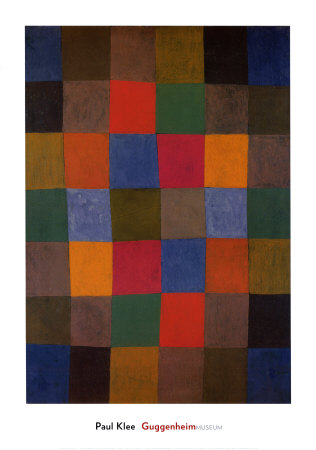
Paul Klee’s New Harmony looks orderly at first. Its tall canvas is divided into rows of coloured rectangles, most separated by narrow dark joins. Then the order starts to shift. Colours return in different places; some blocks seem related across the centre, while others interrupt the expected pattern. The painting asks what a harmony can be when its parts do not settle into an obvious, evenly repeated design. Klee painted it in 1936, and the Solomon R. Guggenheim Museum holds it as 71.1960.[1]
The Guggenheim's current record gives the original German title Neue Harmonie, identifies the medium as oil on canvas, and measures it 93.7 × 66.4 cm. Its 1984 handbook printed 93.6 × 66.3 cm. Those small differences arise from the way the same imperial dimensions were converted and rounded; they do not identify two paintings. The work is 1936,24 in Klee's annual numbering. It is one canvas, not a vague group of “New Harmony paintings.”[1][2][3]
Contents
- What is the exact painting?
- What holds the grid together?
- Is the other half an upside-down reflection?
- Where does it sit among Klee's colour squares?
- Can twelve colours make a twelve-tone composition?
- What does 1936 add to the reading?
- Why is the existing image retained?
- Looking again
What is the exact painting?
The Guggenheim's current collection page supplies the title, year, oil medium, measurements and accession. The 1984 Guggenheim handbook adds Klee's annual number 1936,24 and records a signature, “Klee,” at upper right. It says the face of the painting is undated. These details belong to an object record, and their precision matters: Alter Klang / Ancient Harmony in Basel is a different work, 1925,236, on cardboard rather than canvas.[1][2][4]
The older handbook's measurements are often repeated as 93.6 × 66.3 cm. The museum currently gives 36⅞ × 26⅛ inches, rounded metrically to 93.7 × 66.4 cm. The difference is roughly a millimetre each way, not a change in the painting's format. We use the current owner measurements in the caption and retain the historical figures when discussing the 1984 source. The German dissertation by Marianne Keller Tschirren gives approximately 93 × 66 cm, a rounded scholarly caption rather than a third competing measurement.[1][2][3]
The canvas has a documented route through collections, although the detailed chain on the public record here comes from a historical museum handbook, not a newly audited transaction file. That 1984 entry places it with Daniel-Henry Kahnweiler in Paris (1937–39), then Nierendorf Gallery in New York (1939–44), and Benjamin Baldwin in New York by 1949 until a 1971 auction. It then names Heinz Berggruen and Galerie Beyeler during 1971, before Guggenheim accession. The entry is a strong research lead and evidence of the painting's international circulation; precise transfer dates and the auction lot should be checked against the museum's current provenance file and the sale catalogue before the chain is treated as closed.[2]
The same handbook lists early exhibitions in Paris in 1938, Amsterdam and London in 1938, and a travelling American presentation of “banned” German art beginning in 1939. Those appearances show that the picture circulated while Klee was alive and before it reached the Guggenheim. It is misleading to imagine that it appeared only when the museum took its title for its 2013 exhibition New Harmony: Abstraction between the Wars, 1919–1939. The 2013 show is a later framing of the picture, not its original occasion.[2][10]
What holds the grid together?
Look first at the outer contour. The work is much taller than it is wide. Within that upright field, roughly horizontal and vertical divisions make a matrix of compartments. They are close to squares in some places and longer rectangles in others. A dark ground or dark joins keep the parts distinct without making the structure mechanically uniform. The format encourages the eye to travel down the rows, but repeated colours also pull it across and back up.[1][8]
The existing site image, a small poster reproduction with a broad white border, shows a vivid red near the upper middle and another lower down. Blues appear in several separated fields. Ochres and oranges recur, and muted greens and browns make the brighter blocks seem brighter by comparison. The darkest portions are not simply an empty backdrop: they help determine the apparent strength of adjacent colour. This is a close reading of a limited reproduction, not an exact pigment map or a conservation finding.[1][8]
Notice that a patch can be both itself and a member of a relation. A red block gains force beside deep green or blue; a paler brown may appear to recede beside a saturated orange. Small shifts in edge, hue and value prevent the matrix from becoming a printed checkerboard. It is possible to follow one colour family as if it were a recurring motif, but the recurrence is modified each time. That is why the title is more interesting as a question about relationships than as a declaration that all the blocks are alike.[1][8]
The word grid is useful, but it should not make the canvas sound like a numerical puzzle. The Guggenheim's earlier handbook places it among Klee's so-called “magic square” paintings. In this context the phrase names an art-historical family of gridded colour works. The museum does not give numbers whose rows and columns add to a common sum. Square-like forms are the visible units; their colour interactions are the subject of the analysis.[2][5]
Is the other half an upside-down reflection?
Nancy Spector's Guggenheim collection essay attributes an inverted bilateral symmetry reading to art historian Andrew Kagan. In her summary, the right half is an upside-down reflection of the left. The museum's 1984 handbook had already described the coloured fields as arranged by inverted bilateral symmetry. Keller Tschirren's German study likewise finds a central mirroring principle in this 1936 painting, connecting it to the 1927 Harmonie der nördlichen Flora.[1][2][3]
That does not require every printed patch to be a flawless duplicate of a counterpart. The grid can be read by testing correspondences: pick one colour, look across the centre and down to the opposite portion, then see where a comparable field appears. Some relations are clearer than others, especially in a small, colour-shifted poster. Describing the principle is safer than announcing an audited square-by-square map that this reproduction cannot support.[1][3][8]
Music historian Simon Shaw-Miller complicates the view productively. He accepts Kagan's bilateral inversion, but also suggests treating the canvas as four quarters: the lower right can answer the upper left in a reverse-and-inverted order, while the lower left answers the upper right. That is an account of how the viewer can traverse the painting, not a claim that Klee left a written set of instructions on it. Shaw-Miller's close comparison was published in a specialist book, and his terminology comes from musical transformations; the visible relationships remain open to testing against a high-fidelity image and the original.[5]
The dark underpainting matters in these comparisons. The 1984 handbook contrasts this later canvas's brighter fields over dark underpainting with the softer, smaller Ancient Harmony. Keller Tschirren describes how mixed or “broken” tones and a dark ground affect other square pictures. A colour repeated in two places need not look identical if its neighbours and ground differ. Exact pigment names, layer order and technical condition should await an owner examination rather than be inferred from the poster.[2][3][8]
Where does it sit among Klee's colour squares?
Klee did not invent the rectangle picture in the year of this painting. The Guggenheim traces flat coloured configurations in his art back to the 1910s; its 1984 handbook points to a developed series from 1923. Keller Tschirren supplies a more discriminating sequence across the following decade. In Ein Klang der nördlichen Flora (1924,74), she finds colour fields that recur diagonally. In Harmonie der nördlichen Flora (1927,144), related fields appear more centrally mirrored and the layout is more static, although subtle tonal variation makes some pairings difficult. Neue Harmonie takes up a comparable central-reflection principle in 1936.[1][2][3]
This is continuity of a visual problem, not a claim that the three pictures are the same design enlarged and recoloured. The 1924 sheet uses different materials and a broad horizontal format, while the 1927 work and the Guggenheim canvas have their own dimensions and supports. Keller Tschirren also discusses a 1930 colour-panel picture between these examples. Klee retained an interest in orthogonal arrangement after leaving teaching; he could return to it without copying a classroom exercise.[3]
Ancient Harmony offers a valuable comparison because the titles almost invite conflation. Basel records Alter Klang as 1925,236 (X 6), oil on cardboard nailed to a frame, about 38.3 × 38 cm. Its near-square, intimate support differs markedly from the tall 1936 canvas. The 1984 Guggenheim handbook calls the two related, then distinguishes the later work's brighter colour over dark underpainting and stricter grid. They can illuminate one another without making Ancient Harmony a preparatory study for New Harmony.[2][4]
Keller Tschirren's larger caution is essential. Her reading of Klee's German teaching documents argues that pictures and lessons can share a principle while a painting is not a one-to-one execution of theory. A gridded image can be both ordered and creatively irregular. This helps explain why a rough correspondence between fields need not be a failed theorem. Klee made an artwork, not a classroom diagram drawn to satisfy a fixed grid rule.[3]
Can twelve colours make a twelve-tone composition?
Klee was a trained and active musician, and his title encourages aural language. The Guggenheim collection essay presents Kagan's interpretation: twelve hues apart from neutral grey and black, with juxtaposed noncomplementary colours and inverted symmetry evoking Arnold Schönberg's twelve-tone music. A Spanish educational guide from Fundación Juan March repeats a twelve-colour and bilateral-inversion analogy. These are meaningful art-historical and teaching readings. Neither source publishes a work-specific statement by Klee saying that he assigned particular pitches to particular squares of this canvas.[1][6]
The difference between analogy and score matters. Schönberg's serial technique orders twelve pitch classes and transforms a chosen series. A painted field can show repetition, reflection and inversion, but it does not supply an audible sequence, rhythm or pitch designation simply by containing colours. There are visibly many more compartments than twelve. The count of twelve hues depends on decisions about mixed tones, darkened variants, grey and reproduction colour. Kagan's count is his analytical claim, transmitted by the museum; it is not something the small product image can independently prove.[1][5][6][8]
Shaw-Miller reads the coloured relations as potentially dissonant rather than as a row of twelve literal tones. He points to green and red-yellow mixtures, and sees multiple ways to describe the order: inversion, reverse ordering, and their combinations. He also notes that such structural devices exist in earlier counterpoint as well as in twentieth-century serial music. His argument widens the musical analogy: an image can make a viewer experience related positions and changes without encoding one composer. It does not settle whether Klee consciously modelled this particular work on Schönberg.[5]
A Portuguese study by R. M. S. Silva cites Kagan while analysing Leo Brouwer's guitar sonata and its relationship to Klee's “magic squares.” That is valuable evidence of the painting's later life in musical scholarship. It is not a second independent analysis of the canvas's paint. The article's figure caption gives 86 × 60 cm, inconsistent with the owner's dimensions; this page follows the Guggenheim instead. The difference shows why an object caption and a scholar's interpretive use of an image need separate checks.[1][7]
We can therefore listen metaphorically while looking precisely. Follow a blue field into its recurrence; see whether the relation is a mirror, a reversal or simply an echo. Let red-green contrast feel uneasy if it does. The painting makes formal comparisons possible. Whether one hears Schönberg, earlier counterpoint or no music at all, the canvas remains a visual arrangement with its own material, scale and colour.[1][5][8]
What does 1936 add to the reading?
Klee and Lily had returned to Bern after his removal from teaching in Düsseldorf in 1933. He became seriously ill in 1935, and the Zentrum Paul Klee records 25 works in 1936, a sharp reduction in the annual register. The 1984 Guggenheim handbook also connects this canvas with illness and reduced production. The date is historically important: a relatively large, carefully organised oil canvas was made amid changed physical and political circumstances.[2][9]
The circumstances cannot diagnose the grid. No cited object record establishes that a particular red square expresses a symptom or that the strict arrangement was a therapeutic attempt at control. Nor was this one of Klee's very last works. He continued to make art through 1940, and his 1939 register contains far more entries. The museum's description of New Harmony as the last such composition concerns its line of flat gridded canvases, not the end of Klee's creative life. The older site's “among his last compositions” phrasing blurred that distinction.[1][9]
The picture also had a public history in those years. The 1984 exhibition list places it in 1938 European shows and in an American travelling presentation of banned German art beginning in 1939. This does not prove the painting itself was created as a direct protest image. It does show that a work made in Bern could move across borders and acquire new contexts while the political conditions around its maker grew harsher.[2]
Why is the existing image retained?
The small poster image includes a white product surround and does not provide a close view of the oil surface. Its broad arrangement can be read, but paint texture cannot be judged from it.[1][8]
Looking again
Start with one strong red and search for its counterpart. Then follow a blue through several separated blocks. Check whether the central division acts like a mirror or whether a reverse ordering better describes what you see. The dark joins hold these questions together without forcing one answer. Klee's painting is structured enough to invite comparison and varied enough to resist the first simple rule.[1][3][5][8]
Neue Harmonie is the 1936,24 Guggenheim canvas, oil on canvas, 93.7 × 66.4 cm in the current owner record. The museum and scholars agree that mirrored colour relations matter; they differ in how much musical theory those relations can bear. Its 1920s predecessors, its 1936 circumstances, and its later musical reception each illuminate part of the work. None replaces the experience of examining its coloured fields. See Ancient Harmony, Klee and music, colour theory and late work for the separate threads.[1][2][3][4][5]
Explore selected works from Klee’s much larger oeuvre. Titles without a link have an authenticated catalogue identity but no reviewed article yet.
Artworks directory
| Name | Date | Medium |
|---|---|---|
| A Gate | 1939 | Painting and mixed media |
| A Woman for Gods | 1938 | Watercolour and mixed media |
| Ab Ovo | 1917 | Watercolour and mixed media |
| Above Mountain Summit | 1917 | Drawing and mixed media |
| Abstract Trio | 1923 | Drawing and mixed media |
| Acrobats | 1915 | Watercolour and mixed media |
| Actor's Mask | 1924 | Painting and mixed media |
| Ad Marginem | 1930 | Drawing and mixed media |
| Ad Parnassum | 1932 | Painting and mixed media |
| Adventurer Ship | 1927 | Drawing and mixed media |
| Affected Place | 1922 | Drawing and mixed media |
| After a Sketch from Zurich | 1914 | Watercolour and mixed media |
| After Drawing | 1919 | |
| After The Floods | 1936 | Watercolour and mixed media |
| All Souls' Picture | 1921 | |
| Ancient Harmony | 1925 | Painting and mixed media |
| Angel Applicant | 1939 | Drawing and mixed media |
| Angel Serves the Desired | 1920 | |
| Angel, Still Female | 1939 | Painting and mixed media |
| Angelus Novus | 1920 | Drawing and mixed media |
| Animal Terror | 1926 | Painting and mixed media |
| Arab Song | 1932 | Painting and mixed media |
| Archangel | 1938 | Painting and mixed media |
| Architecture | 1923 | Painting and mixed media |
| Architecture of the Plain | 1923 | Drawing and mixed media |
| Around the Fish | 1926 | Painting and mixed media |
| Arrival of the Air Steamer | 1921 | Drawing and mixed media |
| Asiatic God | 1924 | Painting and mixed media |
| Astrological Fantasy Portrait | 1924 | Drawing and mixed media |
| Athlete's Head | 1932 | Watercolour and mixed media |
| Aufgehender Stern | 1931 | Painting and mixed media |
| Autumn Flower | 1922 | Painting and mixed media |
| Bad Band | 1920 | Drawing and mixed media |
| Baroque Centaur | 1939 | Painting and mixed media |
| Before the Blitz | 1923 | Drawing and mixed media |
| Before the Snow | 1929 | Drawing and mixed media |
| Besessenes Madchen | 1924 | Watercolour and mixed media |
| Bird Garden | 1924 | |
| Bird Wandering Off | 1926 | Watercolour and mixed media |
| Blossoms in the Night | 1930 | Watercolour and mixed media |
| Blue-Bird-Pumpkin | 1939 | Painting and mixed media |
| Boats in the Flood | 1937 | Painting and mixed media |
| Botanical Theatre | 1934 | Drawing and mixed media |
| Boy in Fancy Dress | 1931 | Watercolour and mixed media |
| Broken Key | 1938 | |
| Brother and Sister | 1930 | Watercolour and mixed media |
| But the Red Roof | 1935 | Painting and mixed media |
| C - C = Fisch | 1931 | Watercolour and mixed media |
| Cacti | 1912 | Painting and mixed media |
| Camel (in Rhythmic Landscape with Trees) | 1920 | Drawing and mixed media |
| Captive Pierrot | 1923 | Drawing and mixed media |
| Castle and Sun | 1928 | Drawing and mixed media |
| Cat and Bird | 1928 | Drawing and mixed media |
| Cathedrals | 1925 | Watercolour and mixed media |
| Chalice of the Heart | 1937 | Painting and mixed media |
| Characters in Yellow | 1937 | Painting and mixed media |
| Chosen Site | 1927 | Mixed media |
| Christmas Picture | 1923 | Drawing and mixed media |
| City of Towers | 1916 | Painting and mixed media |
| Clarification | 1932 | Painting and mixed media |
| Collection of Figurines | 1926 | Painting and mixed media |
| Colorful Architecture | 1917 | Painting and mixed media |
| Comedians' Handbill | 1938 | |
| Comic Opera Singer | 1927 | Painting and mixed media |
| Composition | 1939 | Painting and mixed media |
| Composition with Figures | 1915 | Drawing and mixed media |
| Composition with the Yellow Half-Moon and the Y | 1918 | Watercolour and mixed media |
| Conch–Still Life II | 1939 | Watercolour and mixed media |
| Cosmic Composition | 1919 | Painting and mixed media |
| Crystal Gradation | 1921 | Drawing and mixed media |
| Dance of the Grieving Child | 1922 | Painting and mixed media |
| Dancing Girl | 1940 | Painting and mixed media |
| Das Licht und Etliches | 1931 | Mixed media |
| Death and Fire | 1940 | Painting and mixed media |
| Death for the Idea | 1915 | |
| Demon as Pirate | 1926 | Watercolour and mixed media |
| Diana | 1931 | Painting and mixed media |
| Diavolo Player | 1923 | Drawing and mixed media |
| Die Kapelle | 1917 | Watercolour and mixed media |
| Die Vase | 1938 | Painting and mixed media |
| Doctor | 1930 | Drawing and mixed media |
| Dredger and Sailboat | 1931 | Watercolour and mixed media |
| Ein Tor | 1939 | Painting and mixed media |
| Ein Weib fur Gotter | 1938 | Mixed media |
| Embrace | 1939 | Watercolour and mixed media |
| Episode before an Arab Town | 1923 | |
| Equals Infinity | 1932 | Painting and mixed media |
| Eros | 1923 | Drawing and mixed media |
| Error on Green | 1930 | Watercolour and mixed media |
| Evening Figure | 1935 | Drawing and mixed media |
| Falling Bird | 1919 | |
| Fermata | 1932 | Watercolour and mixed media |
| Fire Clown | 1921 | Watercolour and mixed media |
| Fire Full Moon | 1933 | Watercolour and mixed media |
| Fire in the Evening | 1929 | Painting and mixed media |
| Fish in the Harbour | 1916 | Watercolour and mixed media |
| Fish Magic | 1925 | Watercolour and mixed media |
| Flock of Birds | 1917 | Drawing and mixed media |
| Flora on Sand | 1927 | Watercolour and mixed media |
| Flower Myth | 1918 | |
| Flower Stand with Watering Can and Bucket | 1910 | Watercolour and mixed media |
| Flowering Tree (Abstraction with Reference to a Flowering Tree) | 1925 | Painting and mixed media |
| Flowers in Pots | 1923 | |
| Flowers in Stone | 1939 | Painting and mixed media |
| Forest Witch | 1938 | Painting and mixed media |
| Fright of a Girl | 1922 | Drawing and mixed media |
| Fruits on Red | 1930 | Drawing and mixed media |
| Full Moon | 1919 | Mixed media |
| Föhn Wind in Franz Marc's Garden | 1915 | Watercolour and mixed media |
| Garden in St Germain, The European Quarter near Tunis | 1914 | Watercolour and mixed media |
| Ghost Chamber with the Tall Door (New Version) | 1925 | |
| Ghost of a Genius | 1922 | Drawing and mixed media |
| Girl in Mourning | 1939 | Painting and mixed media |
| Glance of a Landscape | 1926 | Watercolour and mixed media |
| Gluht Nach | 1939 | Drawing and mixed media |
| Golden Fish | 1925 | Watercolour and mixed media |
| Goldfish Wife | 1921 | Watercolour and mixed media |
| Green Plant, Blood, Louse | 1924 | Drawing and mixed media |
| Hafenbild | 1918 | Mixed media |
| Hammamet with Mosque | 1914 | Watercolour and mixed media |
| Harbour with Sailing Ships | 1937 | Painting and mixed media |
| Hauptweg und Nebenwege | 1929 | Painting and mixed media |
| Heavenly and Earthly Time | 1927 | Drawing and mixed media |
| Heroic Fiddling | 1938 | Painting and mixed media |
| Heroic Roses | 1938 | Painting and mixed media |
| Heroic Strokes of the Bow | — | Mixed media |
| Highway and Byways | 1929 | Drawing and mixed media |
| Houses near the Gravel Pit | 1913 | Watercolour and mixed media |
| Howling Dog | 1928 | Painting and mixed media |
| In the Current Six Thresholds | 1929 | Painting and mixed media |
| In the Style of Kairouan | 1914 | Drawing and mixed media |
| Individualized Altimetry of Stripes | 1930 | Painting and mixed media |
| Insula Dulcamara | 1938 | |
| Interior with the Clock | 1913 | Watercolour and mixed media |
| Irma Rossa the Animal Tamer | 1918 | Drawing and mixed media |
| Journey in Corsica | 1927 | Drawing and mixed media |
| Landscape with Bluebirds | 1919 | Watercolour and mixed media |
| Legend of the Nile | 1937 | Painting and mixed media |
| Lemon Harvest | 1937 | Watercolour and mixed media |
| Likeness in the Bower | 1930 | Watercolour and mixed media |
| Limits of Reason | 1927 | Painting and mixed media |
| Little Hope | 1938 | Watercolour and mixed media |
| Magdalena before the Conversion | 1938 | Drawing and mixed media |
| Mask of Fear | 1932 | Painting and mixed media |
| May Picture | 1925 | Painting and mixed media |
| Monument in a Cemetery | 1922 | Watercolour and mixed media |
| Monuments at G | 1929 | Watercolour and mixed media |
| Municipal Jewel | 1917 | Watercolour and mixed media |
| Mural from the Temple of Longing Thither | 1922 | |
| Nach der Uberschwemmung | 1936 | Watercolour and mixed media |
| New Harmony | 1936 | Painting and mixed media |
| New House in the Suburbs | — | Mixed media |
| Old Steamboat | 1922 | Drawing and mixed media |
| On the Edge | 1930 | Drawing and mixed media |
| Once Emerged from the Gray of Night | 1918 | Drawing and mixed media |
| One Who Understands | 1934 | Painting and mixed media |
| Oriental Pleasure Garden | 1925 | Painting and mixed media |
| Park of Idols | 1939 | Watercolour and mixed media |
| Passing by Red Pillars | 1928 | Watercolour and mixed media |
| Persian Nightingales | 1917 | Drawing and mixed media |
| Popular Wall Painting | 1922 | Painting and mixed media |
| Prestidigitator | 1927 | Watercolour and mixed media |
| Rainy Day | 1931 | Watercolour and mixed media |
| Red and White Domes | 1914 | Watercolour and mixed media |
| Red Balloon | 1922 | Drawing and mixed media |
| Redgreen and Violet-Yellow Rhythms | 1920 | Drawing and mixed media |
| Refuge | 1930 | Watercolour and mixed media |
| Rhythmic Rythmical | 1930 | Painting and mixed media |
| Saint of the Inner Light | 1921 | |
| Scaffolding of a New Building | 1930 | Painting and mixed media |
| Scholar in Dealing with Stars | 1926 | Watercolour and mixed media |
| Seated Woman | 1930 | Drawing and mixed media |
| Senecio | 1922 | Painting and mixed media |
| Separation in the Evening | 1922 | Drawing and mixed media |
| Sinbad the Sailor | 1923 | Drawing and mixed media |
| Skeptically Smiling | — | Mixed media |
| Small House in the Garden City | 1928 | Watercolour and mixed media |
| Small Portrait of a Girl in Yellow | 1925 | Painting and mixed media |
| Southern Gardens | 1919 | Watercolour and mixed media |
| Static-Dynamic Gradation | 1923 | Drawing and mixed media |
| Still Life | 1927 | Painting and mixed media |
| Still Life with Gladioli | 1932 | Watercolour and mixed media |
| Strange Garden | 1923 | Drawing and mixed media |
| Stricken City | 1936 | Painting and mixed media |
| Strong Dream | 1929 | Watercolour and mixed media |
| Struck from the List | 1933 | Drawing and mixed media |
| Structural I | 1924 | Drawing and mixed media |
| Sumpflegende | 1919 | Painting and mixed media |
| Temple Gardens | 1920 | Drawing and mixed media |
| The Arrow before the Target | 1921 | Drawing and mixed media |
| The Barbed Noose with the Mice | 1923 | Watercolour and mixed media |
| The Flora of the Heath | 1925 | Watercolour and mixed media |
| The Goldfish | 1925 | Watercolour and mixed media |
| The Hour Before One Night | 1940 | Painting and mixed media |
| The Man in Love | 1923 | |
| The Mask with the Flag | 1925 | Mixed media |
| The Pathos of Fertility | 1921 | |
| The Rhine at Duisburg | 1937 | Painting and mixed media |
| The Way to the Citadel | 1937 | Painting and mixed media |
| Three Houses and a Bridge | 1922 | Watercolour and mixed media |
| Tightrope Walker | 1923 | |
| Tomb in Three Parts | 1923 | Watercolour and mixed media |
| Tomcat's Turf | 1919 | Watercolour and mixed media |
| Tower in Orange and Green | 1922 | Drawing and mixed media |
| Tree and Architecture - Rhythms I | 1920 | Watercolour and mixed media |
| Tree and Architecture - Rhythms II | 1920 | Painting and mixed media |
| Tropical Dawn with the Owl | 1921 | Mixed media |
| Tropische Dammerung | 1921 | Painting and mixed media |
| Twittering Machine | 1922 | Drawing and mixed media |
| Variations (Progressive Motif) | 1927 | Watercolour and mixed media |
| Ventriloquist and Crier in the Moor | 1923 | |
| Viaducts Break Ranks | 1937 | Drawing and mixed media |
| Villa R | 1919 | Painting and mixed media |
| Village Carnival | 1926 | Painting and mixed media |
| Vor dem Blitz | 1923 | Drawing and mixed media |
| Wald-Hexen | 1938 | Painting and mixed media |
| Young Forest | 1925 | Drawing and mixed media |
Related artworks
Explore eight other Klee works, beginning with works close in date to this one.
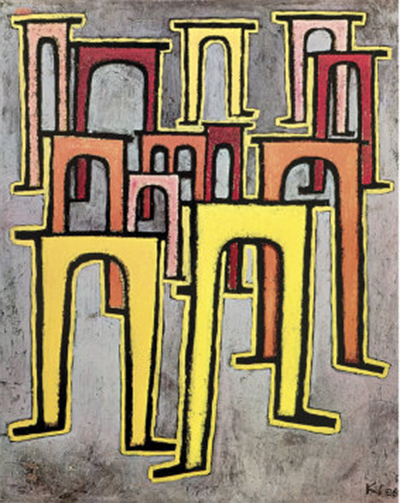
Viaducts Break Ranks
1937
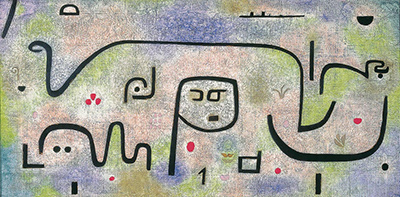
Insula Dulcamara
1938
Fire Full Moon
1933
Struck from the List
1933
Ad Parnassum
1932
Death and Fire
1940
Mask of Fear
1932
Discussion
Klee arranges coloured rectangles in a tall, dark grid.
Symmetry and musical analogy invite different ways of reading it.
Reader Insights
Which colour do you follow first across the grid?
Where do you see repetition, inversion or a changed counterpart?
What can the small reproduction show, and what requires the original?
Join the Conversation
Share the detail or source behind your reading.
References
- Solomon R. Guggenheim Museum, New Harmony (Neue Harmonie), accession 71.1960, current object record and Nancy Spector's collection essay: title, 1936 date, oil on canvas, 36⅞ × 26⅛ in / 93.7 × 66.4 cm, Kagan's attributed symmetry and twelve-hue reading, and ARS/VG Bild-Kunst notice, View source.
- Vivian Endicott Barnett, Handbook, The Guggenheim Museum Collection 1900–1980 (Solomon R. Guggenheim Foundation, 1984), entry 82, pp. 181–83, edition record and digitised text access. The entry was read in digitised text with OCR noise: 1936,24, signature, older dimensions, historical provenance and exhibitions; original print and transactions still warrant verification, View source.
- Marianne Keller Tschirren, Dreieck, Kreis, Kugel dissertation, German National Library PDF, pp. 153–56: the 1924/1927 square pictures, central mirroring in Neue Harmonie, mixed tones, dark grounds, and the nonliteral relation of teaching to painting, View source.
- Kunstmuseum Basel, accession list for Alter Klang, G 1960.25, and Spanish state loan record transcribing its Basel object data: distinct 1925,236 work, medium and scale.
- Simon Shaw-Miller, Visible Deeds of Music: Art and Music from Wagner to Cage (Yale University Press, 2002), chapter 4, pp. 153–58, publisher edition record. Text directly checked in a digitised copy; the four-quarter/retrograde proposal and caveat about earlier counterpoint are his interpretation. His incidental 1927 date for Basel's Alter Klang conflicts with the owner's 1925 record and is not adopted here, View source.
- Fundación Juan March, “Paul Klee, el pintor violinista,” teaching guide, Spanish, 2013–14, section on Schönberg: institutional educational analogy of twelve colour tones and inverted bilateral symmetry, View source.
- R. M. S. Silva, “Ekphrasis em música: os Quadrados Mágicos de Paul Klee na Sonata para violão solo de Leo Brouwer,” Per Musi 19 (2009), Portuguese, p. 56: Kagan received in music analysis; conflicting figure measurement is not used as object data, View source.
- Existing local poster splash, visually inspected. Small retail reproduction with white surround; usable only for broad composition, not pigment analysis, faithful hue counting or new detail derivatives. The project's internal image-rights ledger records the exact-work master as unresolved.
- Zentrum Paul Klee, “Klee in Bern”, German exhibition research, and illness research with the University of Bern medical faculty: Bern chronology, low 1936 register total and later work.
- Solomon R. Guggenheim Museum, New Harmony: Abstraction between the Wars, 1919–1939, 2013 exhibition; Guggenheim's 2013 institutional filing confirms exhibition dates 10 May–8 September 2013.