


 by Tom Gurney
Tom Gurney BSc (Hons) is an art history expert with over 20 years experience
Published on June 19, 2020 / Updated on September 27, 2026
Email: tomgurney1@gmail.com / Phone: +44 7429 011000
Paul Klee’s The Arrow before the Target
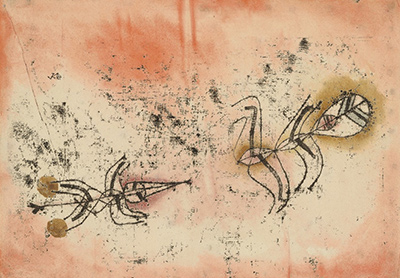
Paul Klee made The Arrow before the Target (Der Pfeil vor dem Ziel) in 1921. The Museum of Modern Art, New York, identifies it as an oil transfer drawing and watercolour on paper on board, measuring 23.8 × 31.8 cm, in the John S. Newberry Collection (object 376.1960). These are the secure starting points for the work. The old page called it a painting and described two insects, a rocky landscape and a response to approaching war. The image and the museum records do not establish those narrative claims.[1]
The image and its direction
Across a pale pink and cream field, two dark, intricate forms occupy the left and right sides. Delicate lines loop and cross; small patches of darker colour and granular marks interrupt the field. The right-hand form extends toward a pointed, enclosed shape. The left-hand cluster seems to face it, but the relation between the forms remains ambiguous. The English and German titles introduce an arrow and a target, inviting us to seek direction and arrival in a composition whose outlines do not make either one simple.[1][2]
Looking closely, the eye moves between a few strong linear gestures and the mottled surface around them. Some contours suggest wings, antennae or a device, which may explain the inherited page's insect description. None identifies a species or proves that Klee intended a literal scene of two flying creatures. The title is a more reliable guide to the work's tension: motion is suggested before its destination is reached. Even that is an interpretation of title and visible form, not a reported statement of Klee's intent.[1]
The sheet's compact size matters. Its image is made of light, scattered marks and wiry contours rather than a single massive figure. A small reproduction can make the image seem simpler than its surface actually is.[1]
Oil transfer and watercolour
Klee's transfer method helps explain the difference between the fine dark tracery and the field of colour. In MoMA's 1979 exhibition catalogue, curator Howardena Pindell describes the method he developed in 1919: he coated one side of a sheet with printer's ink or oil paint, set a drawing above it and traced its lines, allowing pressure to transfer them to a receiving sheet. The hand's pressure could also leave an impression of paper texture. Watercolour could then interact with the transferred drawing. This is a general account of Klee's method, not a technical reconstruction of every mark in this particular sheet.[2]
MoMA's current object entry names the work oil transfer drawing and watercolour. Its 1979 checklist calls it watercolour on transfer drawing, while a 1999 museum checklist describes watercolour and oil transfer drawing on paper mounted on cardboard. The wording differs in emphasis, and the historical publications report slightly different measurements. The present page follows MoMA's current 23.8 × 31.8 cm entry for the displayed dimensions, while retaining the older records as evidence of how the museum has catalogued the work.[1][2][3]
The irregularity of the dark marks is part of the experience. The line can be followed as drawing, but it also looks pressed or deposited. Pink watercolour unifies the surface without turning it into a continuous landscape. Nothing in MoMA's entry specifies a desert, rock formation or cosmic setting. A reader can notice an atmospheric effect while leaving those proposed locations open.[1][2]
Reading the arrow
The title makes the sheet a study of anticipation. “Before” describes an interval: the arrow has a destination in the language of the title, yet that destination is not straightforwardly pinned down by the image. The left and right clusters create a loose directional relationship, but their unstable outlines complicate a literal story. This is one way to read the work's formal structure rather than a key that decodes it completely.[1]
Pindell's 1979 MoMA essay explicitly associates The Arrow before the Target with Klee's combination of humour and eroticism. Her observation is a curator's historical interpretation, valuable because it is specific to this artwork and published by its owning museum. It does not turn each line into a fixed symbol or prove a single private meaning. The former article's claim that the forms are realistic insects has no comparable support in the museum account.[2]
The image belongs to Klee's early Bauhaus period, but that broad context should not become an invented causal story. In 1921 Klee began teaching at the school; the museum's transfer catalogue explains his development of the oil tracing process from 1919. Neither fact shows that this individual sheet comments on a particular battle or on war drawing nearer in 1921. The former page's war explanation confused chronology and lacked object evidence.[2]
Collection and image record
MoMA identifies the work as object 376.1960 and records its Newberry Collection credit. Its 1960–61 Recent Acquisitions display and 1979 transfer-drawing exhibition document later museum presentation. These records establish collection and exhibition points; they do not by themselves supply a complete ownership history from Klee's studio to the museum.[1][2]
Related artworks
Explore eight other Klee works from the researched artwork cluster.
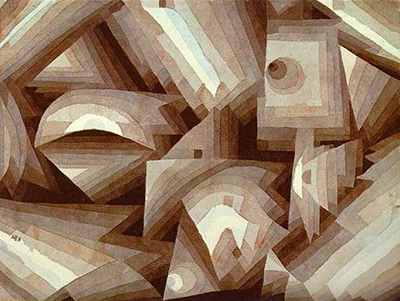
Crystal Gradation
1921
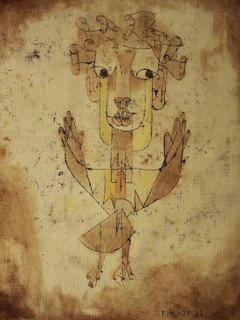
Angelus Novus
1920
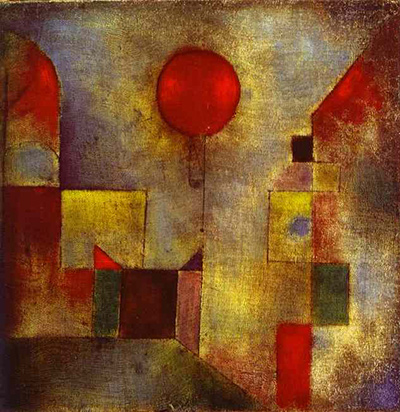
Red Balloon
1922
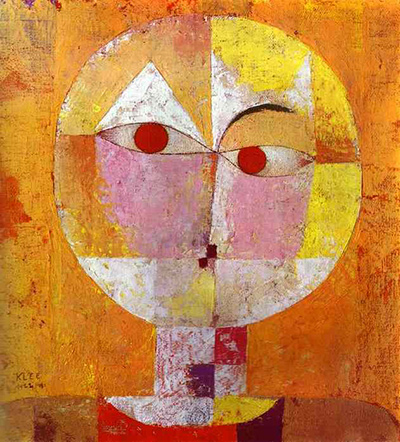
Senecio
1922
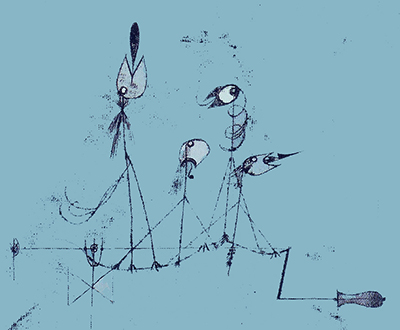
Twittering Machine
1922
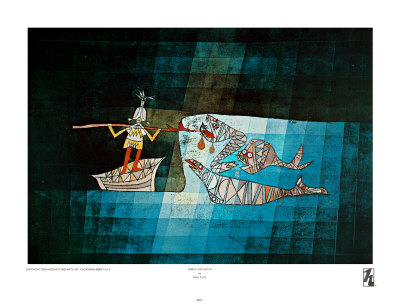
Sinbad the Sailor
1923
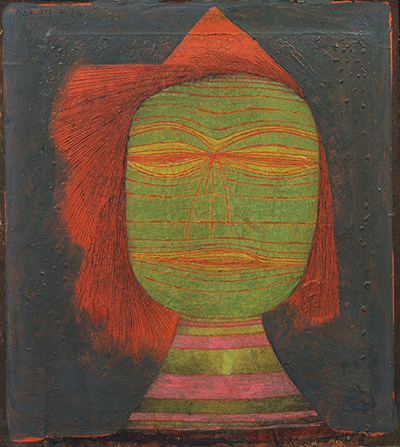
Actor's Mask
1924
Flower Myth
1918
References
- Museum of Modern Art, The Arrow before the Target (Der Pfeil vor dem Ziel), current collection record: title, date, medium, dimensions, credit, object number and image notice, View source.
- Howardena Pindell, Paul Klee Centennial: Prints and Transfer Drawings, Museum of Modern Art exhibition catalogue, 1979, pp. 6–9 and checklist item 39. General transfer method and curator's artwork-specific interpretation, View source.
- Museum of Modern Art, Collecting in Depth: Drawings by Grosz, Schwitters, Ernst, and Klee, 1999, checklist entry for The Arrow Before the Target. The listed measurements differ slightly from the current object record, View source.