


 by Tom Gurney
Tom Gurney BSc (Hons) is an art history expert with over 20 years experience
Published on June 19, 2020 / Updated on September 27, 2026
Email: tomgurney1@gmail.com / Phone: +44 7429 011000
Four birds and an uncertain machine
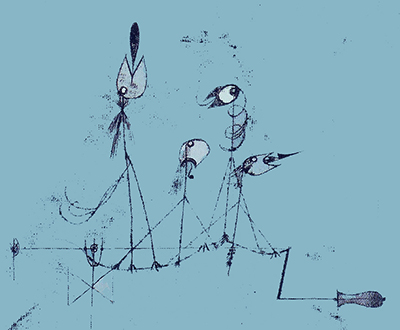
Four improbable birds stand on a line that leads to a hand crank. They open their beaks, but the picture makes no sound. Beneath them is a structure that could support the device or threaten to catch something falling into it. Around this thin black construction, blue watercolour seems to open a wide space; pink at the edges presses it closed again. Paul Klee’s Die Zwitscher-Maschine (Twittering Machine) gives viewers enough parts to imagine a machine working, then withholds the mechanical explanation. Is the turning handle making birds sing, copying their voices or luring other birds into danger? A picture made in 1922 cannot answer by running. Its uneasy relation between living creatures and a device is what keeps us looking.[1]
The distinction between seeing and inferring matters here. Klee supplied a title and a set of drawn and painted forms, not an operating manual or a statement of one fixed meaning. Museum writers, art historians and composers have since imagined several machines from those forms. Their accounts illuminate the work when we identify who is speaking and what each can actually establish. Its subsequent history also matters: a Berlin museum acquired the sheet, the Nazi state confiscated and publicly derided it, and MoMA eventually bought it in New York. Those events belong to the life of the artwork after 1922; they should not be projected back as an explanation of Klee’s original intentions.[1]
Contents
- What kind of work is it?
- Look before turning the crank
- The earlier bird drawing and related machines
- Berlin, New York and a changing public life
- When composers hear the drawing
- Looking again
What kind of work is it?
The Museum of Modern Art identifies the object as a 1922 oil transfer drawing, watercolour and ink on paper, with gouache and ink borders on board. It belongs to the museum’s Department of Drawings and Prints, has accession number 564.1939, and measures 64.1 × 48.3 cm overall in the current collection record. MoMA cites Paul Klee: Catalogue raisonné no. 2975 in its provenance note; the separate annual work designation 1922,151 appears in specialist Klee research. These identifiers distinguish it from other birds, machines and Klee oil transfers. The drawing is unique. Its transfer process does not mean that it was one impression in a published edition, and its watercolour does not turn the support into an oil-painted canvas.[1][2]
Oil transfer created the black line by an indirect route. In MoMA’s 1979 technical account, Klee placed a prepared sheet carrying an ink or oil layer between a model drawing and the receiving paper. He traced the model with a needle, pressing dark material onto the paper underneath. Changes in pressure and incidental contact could leave uneven or seemingly accidental marks. Watercolour and pen-and-ink work then added other kinds of line and colour. The process is more complicated than a pen sketch copied mechanically, because Klee chose what to trace and how to work the transferred surface. It also differs from a printing plate designed to produce a run of identical images. MoMA’s current object entry gives the same broad principle, while identifying the artist’s board as part of the finished object.[1][2]
The black contours, blue field and pink surround therefore do different jobs. A thin dark line makes the birds and apparatus seem diagrammatic; colour gives them a space that does not behave like an engineering diagram’s neutral page. MoMA’s 2019 account stresses the tension between transfer smudges, which keep the surface visible, and the blue wash, which suggests depth. The gouache and ink borders identified on the board mean that the surrounding edge is not merely a modern museum mat to be ignored. The current public record does not establish the precise order of every wash, line and border, or explain how the board was attached. Those details need object-level conservation evidence.[1][2]
Published dimensions need equal care. MoMA now gives 64.1 × 48.3 cm, while its 1979 transfer-drawing catalogue recorded 63.8 × 48.1 cm. A 2018 music-theory article captions the image 41.3 × 30.5 cm. The smaller pair probably refers to the image or sheet rather than the mounted whole, but the public sources do not define the measuring boundaries well enough to settle that confidently. For an unqualified object caption, the present owning museum record is the soundest choice. The different measurements remain useful clues for anyone examining the paper, borders and board in person.[1][2][3]
Look before turning the crank
The four creatures do not stand like realistic birds on a natural branch. Their heads, necks and beaks are reduced to wiry curves and pointed marks. Their shapes and attitudes differ. One rises, another droops, and the beaks seem to issue little notes or tongues. The line beneath their feet continues toward a handle at the right, prompting the mind to give the still image motion. Yet no hand appears to turn the crank. We supply the operator and the imagined sound ourselves.[1][3]
Below the perch is a framed opening. It can be read as a base, a pit, a trap or some combination of those things, depending on how the lines are followed. The drawing does not show gears that would explain how turning the handle moves a bird’s body or voice. The birds may be bound to the line, or they may be parts of the contraption. A viewer can see how a handle and wire are arranged without claiming to know how this impossible device would work. That gap between a recognisable machine part and an unworkable mechanism gives the picture much of its wit and discomfort.[1][3]
MoMA’s Highlights interpretation calls the relation a violent joining of nature and industry. Its writer sees most birds tethered above a possible trap, their tongues alternating between musical notes and fishhooks. The blue field opens into distance while the pink wash encloses the group. This is a forceful, source-backed reading, but the claims about a trap, captivity and what the tongues resemble are interpretations of ambiguous forms. MoMA does not cite a Klee statement assigning those features fixed meanings. A reader can test the reading by asking whether the birds look like performers, prisoners or lures, and whether the opening below seems designed to receive them or other arrivals.[1]
The music theorist Orit Hilewicz places that uncertainty at the centre of her close description. She sees four birdlike figures, a crank and an apparatus whose engineering is left indefinite. Her discussion follows an earlier article by Maurice L. Shapiro, who proposed a bird-trap reading: a decoy chorus might draw living birds toward a pit. The publisher’s abstract of Shapiro’s 1968 article confirms his authorship and his concern with Klee’s darker comedy, but the full pages have not yet been checked here; details of his three proposed trapping mechanisms reach this account through Hilewicz. Her alternative of a musical automaton is likewise an argued analogy, not a documented machine that Klee built.[3][4]
Notice how each reading makes a different imagined event. If the apparatus is an automaton, the crank makes an artificial chorus and the birds merge with its moving parts. If it is a trap, their noise attracts a victim. If it is a parody of forcing nature to perform, the visible instability of the birds matters more than the practical function of the handle. None of these requires treating the picture as a literal musical score. No sequence of pitches or durations is specified by the drawing. Open beaks invite us to think about sound, while the lack of audible sound keeps that thought provisional.[1][3]
The earlier bird drawing and related machines
There is a more direct predecessor than a general resemblance between machines. Konzert auf dem Zweig (Concert on the Branch), 1921,188, is a pen drawing held by the Zentrum Paul Klee, Bern. The specialist journal Zwitscher-Maschine describes its contours as scratched with a needle on paper mounted on cardboard and gives its size as 28.2 × 22 cm. The work also appears, under the French title Concert sur la branche, in the Philharmonie de Paris’s Klee exhibition checklist. These independent institutional records identify an actual surviving bird drawing, not merely a proposed lost model.[14][15]
In his 1983 MoMA study, John Elderfield calls this drawing the preliminary sketch from which Klee transferred the later image. Comparing the two makes a particular change visible: the thin birds and branchlike line acquire a crank, a lower structure and a large coloured field in Twittering Machine. The title also changes from a concert on a branch to a machine that produces, or perhaps compels, twittering. Elderfield reads the result as nature bound by technology and relates its diagrammatic line to machine drawings by Francis Picabia. These are Elderfield’s formal and historical interpretations. The documented link between the sheets is more specific: MoMA’s account identifies a preliminary drawing and an oil-transfer process, while the two museums’ records establish distinct works from 1921 and 1922.[2][13][14]
The change matters to the object’s appearance. In the earlier title, a bird concert can still sound like an event in nature. In the later work, a handle asks who controls the performers, while the blue and pink watercolour places the same thin forms in an uncertain atmosphere. This comparison offers a way to see how Klee revised an idea without assuming that one version tells us the definitive meaning of the other. Neither title supplies the missing mechanism or a literal sequence of notes.[1][13]
Klee was already experimenting with the meeting of drawn mechanisms and transfer technique before Twittering Machine. In a German-language study, Elke Seibert describes his separate Kleine Experimentier Maschine (Little Experimental Machine), 1921,11: an oil-transfer and watercolour drawing on paper mounted on cardboard. Its crank and thin horizontal wires or strings provide a close comparison, but its small devices include discs, crescent shapes and flaglike forms rather than the four birds of the 1922 MoMA sheet. Its reported location is unknown. It cannot simply be treated as another title for the New York work.[5]
Seibert also discusses a related 1921 drawing, 1921,44, with “Zwitsch” written beside a small rotating propeller. The word suggests chirping and makes a connection to the later Zwitscher-Maschine tempting. Seibert presents that link as a proposal. These two other 1921 sheets show that Klee explored crank-operated forms and soundlike words in the preceding year; unlike Concert on the Branch, neither is identified by MoMA as the preliminary drawing for the New York work. Nor should their exhibition histories be merged: Little Experimental Machine appeared in a 1937 MoMA presentation discussed by Seibert, while Twittering Machine was at that time caught in the Nazi campaign against modern art.[5][13]
The comparison also reveals a shared visual idea without forcing a single symbol. A transfer drawing makes marks through pressure on an intermediate layer. The imagined apparatus likewise promises that a human action at one point—the turning of a handle—will cause a result elsewhere. Seibert links those two kinds of mediation. It is a perceptive formal analogy; it does not prove that Klee intended the actual oil-transfer method to stand for mechanised birdsong. The later work is distinctive because living forms have become entangled with the device and because colour makes their thin stage feel both airy and confined.[1][2][5]
Berlin, New York and a changing public life
The Nationalgalerie in Berlin acquired the drawing directly from Klee in 1923. MoMA’s provenance research says it was included in the Nationalgalerie’s Klee exhibition at the Kronprinzenpalais that February and remained on view there until 1933. The work crossed the Atlantic as a loan before it became a New York museum purchase. In MoMA’s German Painting and Sculpture exhibition of 1931, the original printed checklist lists Twittering Machine as no. 43, a watercolour lent by the National Gallery, Berlin. It lists Angler as no. 42. MoMA’s present provenance note mistakenly assigns no. 42 to Twittering Machine, but the scanned 1931 catalogue settles the printed number.[1][6]
The 1931 catalogue also shows an early way of presenting Klee to a New York audience. Alfred H. Barr Jr. associated this picture and Angler with “exquisite absurdity.” He wrote in the language of fantasy and the unconscious familiar to early twentieth-century museum criticism. This is evidence of a curator’s reception in 1931, not evidence that Klee supplied those precise categories when he made the drawing in 1922. The work already supported a reading that combined elegance with something disquieting, before later writers elaborated the trap or automaton accounts.[6]
Under the Nazi regime, its institutional life changed violently. MoMA records its inclusion in the propaganda show Der Bolschewismus in Munich in 1936–37. Officials removed it from the Nationalgalerie in 1937 under the state’s campaign against art it condemned as “degenerate”; it appeared in the Munich Entartete Kunst exhibition and later versions of that travelling display. The derogatory word was the regime’s label, not an art-historical category that the painting accepts. Nor does the 1922 drawing become an illustration of 1937 politics just because it was later seized. The confiscation shows what authorities did to modern works and institutions, not what the artist had secretly meant fifteen years earlier.[1]
The German scholar Christoph Zuschlag identifies the drawing by its annual number, 1922,151, in photographic evidence of the Munich display. He traces it among works removed from the Nationalgalerie and then routed through dealers. The object is absent from one surviving Nazi confiscation list, the “Harry Fischer list”; Zuschlag explains that a later database gives it a supplemental entry because the original inventory apparently missed it. The photograph, propaganda postcard and later custody chain supply positive evidence of seizure and exhibition. An omission from one list should not be turned into a claim that confiscation is doubtful.[1][7]
One contemporary response survives in a postcard. Lily Klee sent an official postcard showing the confiscated drawing to Hermann and Margrit Rupf on 23 June 1938. A specialist journal reproduces and transcribes it. Her message on the reverse discusses an auction, Klee prices, visitors and Paul’s health rather than offering an interpretation of the picture. The journal reads the use of a Nazi propaganda image as sardonic; that is plausible, but the postcard itself does not explain the 1922 machine’s symbolism. It is strongest as evidence that the seized image circulated publicly and that Klee’s family handled this hostile reproduction in the midst of a difficult period.[8]
In 1939 the confiscated sheet was assigned to Karl Buchholz in Berlin, then passed through his New York gallery operated by Curt Valentin. MoMA records its purchase on 14 October 1939. Its arrival in the United States was therefore the end of a coercive state removal and dealer route, not a straightforward voluntary sale by Klee to a sympathetic collector. The museum’s provenance project labels its work ongoing. That is compatible with the documented 1923 acquisition, 1937 confiscation and dated 1939 MoMA purchase; it simply leaves room for future archival clarification of intermediate handling.[1][7]
When composers hear the drawing
The object’s title and open beaks invite an imaginary soundtrack. Musicians have answered that invitation in strikingly different ways. Hilewicz counted at least 22 compositions associated with this image in her 2018 study and analysed three orchestral responses closely. An earlier orchestral work by Giselher Klebe adds a revealing contrast. These compositions belong to the drawing’s later reception, decades after Klee made it. They can make a viewer notice different possible actions in the fixed scene, but cannot reveal an unheard score encoded by the artist.[3][16]
Giselher Klebe’s Die Zwitschermaschine, op. 7, was composed in 1950 and premiered at Donaueschingen on 10 September that year. His publisher supplies both the dated programme and Klebe’s own account: he took the picture’s formal arrangement as a starting point for an orchestral transformation, deliberately placing literal illustration in the background. The roughly thirteen-minute work unfolds in four linked sections. Klebe describes how a restless rhythmic idea moves through them, slows and stiffens, then returns in altered form. Musicologist Siglind Bruhn hears the four sections as responses to four differently posed birds. That bird-to-section mapping is her listening interpretation; Klebe’s note supports the four-part form and the stated compositional approach, not a fixed pictorial key.[16][17]
Gunther Schuller’s Seven Studies on Themes of Paul Klee was composed in 1959. Schuller later recalled translating Klee paintings into musical form. Hilewicz hears his Zwitschermaschine movement beginning with a buzzing, winding quality and developing varied birdlike calls. Their apparent spontaneity yields to exact repetition, so an orchestra can start to sound like a device replaying its own programme. That is Hilewicz’s close hearing of Schuller’s notes; Schuller’s general account confirms his stated visual-to-musical approach, without turning his version into the only sound the 1922 drawing could make.[3][9]
Peter Maxwell Davies composed Five Klee Pictures in 1959 and revised it in 1976. His publisher identifies the suite as an orchestral work conceived for school, amateur or professional players, and The Twittering Machine is its middle movement. Hilewicz argues that this version does not imitate natural birdsong in the way Schuller’s can seem to do. Its movement, accelerating pattern and unusual orchestral colour instead make the device’s drive a subject for listening. The publisher’s account anchors the work and dates; the suggestion that particular sounds represent particular birds is Hilewicz’s interpretive mapping, not an explanation supplied by Klee.[3][10]
Tan Dun’s Death and Fire: Dialogue with Paul Klee, written in 1992, includes a section labelled “Insert 4: Twittering Machine.” Tan Dun’s own published programme note says he was moved by a Klee exhibition at MoMA and imagined a dialogue with the paintings. He explicitly resists calling the symphony a musical description of particular works. Hilewicz hears a more exaggerated and parodic bird chorus than in Schuller; that is a valid way to listen to a later composition, while Tan Dun’s note defines his broader aim differently. The work’s recorded premiere was in Glasgow on 27 March 1993. None of these dates or sonic responses belongs to the drawing’s original 1922 context.[3][11][12]
These four composers give the viewer a useful experiment. Klebe’s changing four-part form can draw attention to the birds as separate characters. Hear Schuller’s apparent winding and repeating calls, and they may resemble a manufactured chorus. Hear Davies’s changing drive, and the unseen operator comes to the fore. Hear Tan Dun’s more unruly sound world, and the picture’s comedy may feel more abrasive. The sheet itself remains silent. Its ability to support different but argued sound worlds is stronger evidence of an open image than of a single concealed musical programme.[1][3][16][17]
Looking again
Return to the handle, then to the feet on the line, then to the opening below. Can you tell where the force of a turned crank would travel? What part of the picture lets a bird be an animal, and what part makes it seem attached to a device? The answers may shift as you move between the black line and the blue and pink washes. Klee’s transfer method helps make the line both deliberate and irregular, while the title supplies a sound the object cannot literally produce. This is more specific than saying that the work simply “visualises music.”[1][2][3]
The documented drawing, its 1921 comparisons, its Berlin-to-New York provenance and its later musical responses each answer a different question. The image does not need one master key. It asks us to notice how quickly a machine becomes imaginable from a few marks—and how uneasy that imagined machine becomes when the marks look like living birds.[1][3][5]
For the process behind the black line, see Klee’s materials and techniques and the drawings overview. The music page follows his broader musical life and later musical reception; Angelus Novus offers another, very different use of oil transfer and a powerful history of later interpretation.
Explore selected works from Klee’s much larger oeuvre. Titles without a link have an authenticated catalogue identity but no reviewed article yet.
Artworks directory
| Name | Date | Medium |
|---|---|---|
| A Gate | 1939 | Painting and mixed media |
| A Woman for Gods | 1938 | Watercolour and mixed media |
| Ab Ovo | 1917 | Watercolour and mixed media |
| Above Mountain Summit | 1917 | Drawing and mixed media |
| Abstract Trio | 1923 | Drawing and mixed media |
| Acrobats | 1915 | Watercolour and mixed media |
| Actor's Mask | 1924 | Painting and mixed media |
| Ad Marginem | 1930 | Drawing and mixed media |
| Ad Parnassum | 1932 | Painting and mixed media |
| Adventurer Ship | 1927 | Drawing and mixed media |
| Affected Place | 1922 | Drawing and mixed media |
| After a Sketch from Zurich | 1914 | Watercolour and mixed media |
| After Drawing | 1919 | |
| After The Floods | 1936 | Watercolour and mixed media |
| All Souls' Picture | 1921 | |
| Ancient Harmony | 1925 | Painting and mixed media |
| Angel Applicant | 1939 | Drawing and mixed media |
| Angel Serves the Desired | 1920 | |
| Angel, Still Female | 1939 | Painting and mixed media |
| Angelus Novus | 1920 | Drawing and mixed media |
| Animal Terror | 1926 | Painting and mixed media |
| Arab Song | 1932 | Painting and mixed media |
| Archangel | 1938 | Painting and mixed media |
| Architecture | 1923 | Painting and mixed media |
| Architecture of the Plain | 1923 | Drawing and mixed media |
| Around the Fish | 1926 | Painting and mixed media |
| Arrival of the Air Steamer | 1921 | Drawing and mixed media |
| Asiatic God | 1924 | Painting and mixed media |
| Astrological Fantasy Portrait | 1924 | Drawing and mixed media |
| Athlete's Head | 1932 | Watercolour and mixed media |
| Aufgehender Stern | 1931 | Painting and mixed media |
| Autumn Flower | 1922 | Painting and mixed media |
| Bad Band | 1920 | Drawing and mixed media |
| Baroque Centaur | 1939 | Painting and mixed media |
| Before the Blitz | 1923 | Drawing and mixed media |
| Before the Snow | 1929 | Drawing and mixed media |
| Besessenes Madchen | 1924 | Watercolour and mixed media |
| Bird Garden | 1924 | |
| Bird Wandering Off | 1926 | Watercolour and mixed media |
| Blossoms in the Night | 1930 | Watercolour and mixed media |
| Blue-Bird-Pumpkin | 1939 | Painting and mixed media |
| Boats in the Flood | 1937 | Painting and mixed media |
| Botanical Theatre | 1934 | Drawing and mixed media |
| Boy in Fancy Dress | 1931 | Watercolour and mixed media |
| Broken Key | 1938 | |
| Brother and Sister | 1930 | Watercolour and mixed media |
| But the Red Roof | 1935 | Painting and mixed media |
| C - C = Fisch | 1931 | Watercolour and mixed media |
| Cacti | 1912 | Painting and mixed media |
| Camel (in Rhythmic Landscape with Trees) | 1920 | Drawing and mixed media |
| Captive Pierrot | 1923 | Drawing and mixed media |
| Castle and Sun | 1928 | Drawing and mixed media |
| Cat and Bird | 1928 | Drawing and mixed media |
| Cathedrals | 1925 | Watercolour and mixed media |
| Chalice of the Heart | 1937 | Painting and mixed media |
| Characters in Yellow | 1937 | Painting and mixed media |
| Chosen Site | 1927 | Mixed media |
| Christmas Picture | 1923 | Drawing and mixed media |
| City of Towers | 1916 | Painting and mixed media |
| Clarification | 1932 | Painting and mixed media |
| Collection of Figurines | 1926 | Painting and mixed media |
| Colorful Architecture | 1917 | Painting and mixed media |
| Comedians' Handbill | 1938 | |
| Comic Opera Singer | 1927 | Painting and mixed media |
| Composition | 1939 | Painting and mixed media |
| Composition with Figures | 1915 | Drawing and mixed media |
| Composition with the Yellow Half-Moon and the Y | 1918 | Watercolour and mixed media |
| Conch–Still Life II | 1939 | Watercolour and mixed media |
| Cosmic Composition | 1919 | Painting and mixed media |
| Crystal Gradation | 1921 | Drawing and mixed media |
| Dance of the Grieving Child | 1922 | Painting and mixed media |
| Dancing Girl | 1940 | Painting and mixed media |
| Das Licht und Etliches | 1931 | Mixed media |
| Death and Fire | 1940 | Painting and mixed media |
| Death for the Idea | 1915 | |
| Demon as Pirate | 1926 | Watercolour and mixed media |
| Diana | 1931 | Painting and mixed media |
| Diavolo Player | 1923 | Drawing and mixed media |
| Die Kapelle | 1917 | Watercolour and mixed media |
| Die Vase | 1938 | Painting and mixed media |
| Doctor | 1930 | Drawing and mixed media |
| Dredger and Sailboat | 1931 | Watercolour and mixed media |
| Ein Tor | 1939 | Painting and mixed media |
| Ein Weib fur Gotter | 1938 | Mixed media |
| Embrace | 1939 | Watercolour and mixed media |
| Episode before an Arab Town | 1923 | |
| Equals Infinity | 1932 | Painting and mixed media |
| Eros | 1923 | Drawing and mixed media |
| Error on Green | 1930 | Watercolour and mixed media |
| Evening Figure | 1935 | Drawing and mixed media |
| Falling Bird | 1919 | |
| Fermata | 1932 | Watercolour and mixed media |
| Fire Clown | 1921 | Watercolour and mixed media |
| Fire Full Moon | 1933 | Watercolour and mixed media |
| Fire in the Evening | 1929 | Painting and mixed media |
| Fish in the Harbour | 1916 | Watercolour and mixed media |
| Fish Magic | 1925 | Watercolour and mixed media |
| Flock of Birds | 1917 | Drawing and mixed media |
| Flora on Sand | 1927 | Watercolour and mixed media |
| Flower Myth | 1918 | |
| Flower Stand with Watering Can and Bucket | 1910 | Watercolour and mixed media |
| Flowering Tree (Abstraction with Reference to a Flowering Tree) | 1925 | Painting and mixed media |
| Flowers in Pots | 1923 | |
| Flowers in Stone | 1939 | Painting and mixed media |
| Forest Witch | 1938 | Painting and mixed media |
| Fright of a Girl | 1922 | Drawing and mixed media |
| Fruits on Red | 1930 | Drawing and mixed media |
| Full Moon | 1919 | Mixed media |
| Föhn Wind in Franz Marc's Garden | 1915 | Watercolour and mixed media |
| Garden in St Germain, The European Quarter near Tunis | 1914 | Watercolour and mixed media |
| Ghost Chamber with the Tall Door (New Version) | 1925 | |
| Ghost of a Genius | 1922 | Drawing and mixed media |
| Girl in Mourning | 1939 | Painting and mixed media |
| Glance of a Landscape | 1926 | Watercolour and mixed media |
| Gluht Nach | 1939 | Drawing and mixed media |
| Golden Fish | 1925 | Watercolour and mixed media |
| Goldfish Wife | 1921 | Watercolour and mixed media |
| Green Plant, Blood, Louse | 1924 | Drawing and mixed media |
| Hafenbild | 1918 | Mixed media |
| Hammamet with Mosque | 1914 | Watercolour and mixed media |
| Harbour with Sailing Ships | 1937 | Painting and mixed media |
| Hauptweg und Nebenwege | 1929 | Painting and mixed media |
| Heavenly and Earthly Time | 1927 | Drawing and mixed media |
| Heroic Fiddling | 1938 | Painting and mixed media |
| Heroic Roses | 1938 | Painting and mixed media |
| Heroic Strokes of the Bow | — | Mixed media |
| Highway and Byways | 1929 | Drawing and mixed media |
| Houses near the Gravel Pit | 1913 | Watercolour and mixed media |
| Howling Dog | 1928 | Painting and mixed media |
| In the Current Six Thresholds | 1929 | Painting and mixed media |
| In the Style of Kairouan | 1914 | Drawing and mixed media |
| Individualized Altimetry of Stripes | 1930 | Painting and mixed media |
| Insula Dulcamara | 1938 | |
| Interior with the Clock | 1913 | Watercolour and mixed media |
| Irma Rossa the Animal Tamer | 1918 | Drawing and mixed media |
| Journey in Corsica | 1927 | Drawing and mixed media |
| Landscape with Bluebirds | 1919 | Watercolour and mixed media |
| Legend of the Nile | 1937 | Painting and mixed media |
| Lemon Harvest | 1937 | Watercolour and mixed media |
| Likeness in the Bower | 1930 | Watercolour and mixed media |
| Limits of Reason | 1927 | Painting and mixed media |
| Little Hope | 1938 | Watercolour and mixed media |
| Magdalena before the Conversion | 1938 | Drawing and mixed media |
| Mask of Fear | 1932 | Painting and mixed media |
| May Picture | 1925 | Painting and mixed media |
| Monument in a Cemetery | 1922 | Watercolour and mixed media |
| Monuments at G | 1929 | Watercolour and mixed media |
| Municipal Jewel | 1917 | Watercolour and mixed media |
| Mural from the Temple of Longing Thither | 1922 | |
| Nach der Uberschwemmung | 1936 | Watercolour and mixed media |
| New Harmony | 1936 | Painting and mixed media |
| New House in the Suburbs | — | Mixed media |
| Old Steamboat | 1922 | Drawing and mixed media |
| On the Edge | 1930 | Drawing and mixed media |
| Once Emerged from the Gray of Night | 1918 | Drawing and mixed media |
| One Who Understands | 1934 | Painting and mixed media |
| Oriental Pleasure Garden | 1925 | Painting and mixed media |
| Park of Idols | 1939 | Watercolour and mixed media |
| Passing by Red Pillars | 1928 | Watercolour and mixed media |
| Persian Nightingales | 1917 | Drawing and mixed media |
| Popular Wall Painting | 1922 | Painting and mixed media |
| Prestidigitator | 1927 | Watercolour and mixed media |
| Rainy Day | 1931 | Watercolour and mixed media |
| Red and White Domes | 1914 | Watercolour and mixed media |
| Red Balloon | 1922 | Drawing and mixed media |
| Redgreen and Violet-Yellow Rhythms | 1920 | Drawing and mixed media |
| Refuge | 1930 | Watercolour and mixed media |
| Rhythmic Rythmical | 1930 | Painting and mixed media |
| Saint of the Inner Light | 1921 | |
| Scaffolding of a New Building | 1930 | Painting and mixed media |
| Scholar in Dealing with Stars | 1926 | Watercolour and mixed media |
| Seated Woman | 1930 | Drawing and mixed media |
| Senecio | 1922 | Painting and mixed media |
| Separation in the Evening | 1922 | Drawing and mixed media |
| Sinbad the Sailor | 1923 | Drawing and mixed media |
| Skeptically Smiling | — | Mixed media |
| Small House in the Garden City | 1928 | Watercolour and mixed media |
| Small Portrait of a Girl in Yellow | 1925 | Painting and mixed media |
| Southern Gardens | 1919 | Watercolour and mixed media |
| Static-Dynamic Gradation | 1923 | Drawing and mixed media |
| Still Life | 1927 | Painting and mixed media |
| Still Life with Gladioli | 1932 | Watercolour and mixed media |
| Strange Garden | 1923 | Drawing and mixed media |
| Stricken City | 1936 | Painting and mixed media |
| Strong Dream | 1929 | Watercolour and mixed media |
| Struck from the List | 1933 | Drawing and mixed media |
| Structural I | 1924 | Drawing and mixed media |
| Sumpflegende | 1919 | Painting and mixed media |
| Temple Gardens | 1920 | Drawing and mixed media |
| The Arrow before the Target | 1921 | Drawing and mixed media |
| The Barbed Noose with the Mice | 1923 | Watercolour and mixed media |
| The Flora of the Heath | 1925 | Watercolour and mixed media |
| The Goldfish | 1925 | Watercolour and mixed media |
| The Hour Before One Night | 1940 | Painting and mixed media |
| The Man in Love | 1923 | |
| The Mask with the Flag | 1925 | Mixed media |
| The Pathos of Fertility | 1921 | |
| The Rhine at Duisburg | 1937 | Painting and mixed media |
| The Way to the Citadel | 1937 | Painting and mixed media |
| Three Houses and a Bridge | 1922 | Watercolour and mixed media |
| Tightrope Walker | 1923 | |
| Tomb in Three Parts | 1923 | Watercolour and mixed media |
| Tomcat's Turf | 1919 | Watercolour and mixed media |
| Tower in Orange and Green | 1922 | Drawing and mixed media |
| Tree and Architecture - Rhythms I | 1920 | Watercolour and mixed media |
| Tree and Architecture - Rhythms II | 1920 | Painting and mixed media |
| Tropical Dawn with the Owl | 1921 | Mixed media |
| Tropische Dammerung | 1921 | Painting and mixed media |
| Twittering Machine | 1922 | Drawing and mixed media |
| Variations (Progressive Motif) | 1927 | Watercolour and mixed media |
| Ventriloquist and Crier in the Moor | 1923 | |
| Viaducts Break Ranks | 1937 | Drawing and mixed media |
| Villa R | 1919 | Painting and mixed media |
| Village Carnival | 1926 | Painting and mixed media |
| Vor dem Blitz | 1923 | Drawing and mixed media |
| Wald-Hexen | 1938 | Painting and mixed media |
| Young Forest | 1925 | Drawing and mixed media |
Related artworks
Explore eight other Klee works, beginning with works close in date to this one.
Red Balloon
1922
Senecio
1922
Crystal Gradation
1921
Sinbad the Sailor
1923
Actor's Mask
1924
Angelus Novus
1920
Ancient Harmony
1925
Fish Magic
1925
Discussion
Klee gives the birds a handle and a perch, yet leaves the machine's action uncertain.
Its later interpretations, confiscation history and musical responses raise different questions.
Reader Insights
What do you think the crank would move, based on the lines actually shown?
Does the opening below the birds look more like a base or a trap to you?
Which later musical response changes the way you see the silent drawing?
Join the Conversation
Share the marks or sources behind your reading of the work.
References
- Museum of Modern Art, “Paul Klee. Twittering Machine (Die Zwitscher-Maschine). 1922,” current collection, copyright and provenance record, 564.1939 (English), View source.
- Museum of Modern Art, Paul Klee Centennial: Prints and Transfer Drawings (New York, 1979), pp. 8–9 and cat. no. 48 (English), View source.
- Orit Hilewicz, “Reciprocal Interpretations of Music and Painting: Representation Types in Schuller, Tan, and Davies after Paul Klee,” Music Theory Online 24.3 (2018), DOI 10.30535/mto.24.3.3 (English), View source.
- Maurice L. Shapiro, “Klee’s Twittering Machine,” The Art Bulletin 50.1 (1968), 67–69; publisher abstract and bibliographic details consulted, full article not yet read (English), View source.
- Elke Seibert, “Klees Kleine Experimentier Maschine und prähistorische Malereien im Museum of Modern Art (1937) in New York,” Zwitscher-Maschine 2 (2016), related-work section (German), View source.
- Museum of Modern Art, German Painting and Sculpture (New York, 1931), printed pp. 25–26 / PDF viewer pp. 29–30, original checklist no. 43 and A. H. Barr Jr. text (English), View source.
- Christoph Zuschlag, “Paul Klee und die ‘Entartete Kunst’,” Zwitscher-Maschine 4 (2017), sections on Munich display and Nationalgalerie confiscations (German), View source.
- Zwitscher-Maschine editors, “«Die Zwitscher-Maschine» als «entarte Kunst»” (2015), reproduction and transcription of Lily Klee’s 23 June 1938 Rupf postcard (German), View source.
- Gunther Schuller, interview in National Endowment for the Arts, “Gunther Schuller,” composer’s retrospective account (English), View source.
- Boosey & Hawkes, “Peter Maxwell Davies: Five Klee Pictures,” publisher’s work record and youth-orchestra catalogue (English), Work record, Youth-orchestra guide.
- Tan Dun, programme note for Death and Fire: Dialogue with Paul Klee, in Wise Music Classical publisher’s work record (English), View source.
- IRCAM, “Death and Fire: Dialogue with Paul Klee,” composition and premiere record (English), View source.
- John Elderfield, The Modern Drawing: 100 Works on Paper from The Museum of Modern Art (New York: MoMA, 1983), p. 134 / PDF p. 139, Twittering Machine essay and identification of Concert on the Branch as preliminary drawing (English), View source.
- Zwitscher-Maschine / Zentrum Paul Klee, journal object caption for Konzert auf dem Zweig, 1921,188, with medium, size and owner (German/English), View source.
- Philharmonie de Paris, Paul Klee: Polyphonies, exhibition worklist, Konzert auf dem Zweig / Concert sur la branche, 1921, attributed to Zentrum Paul Klee (French), View source.
- Giselher Klebe, composer’s note and Bote & Bock / Boosey & Hawkes work record for Die Zwitschermaschine, op. 7, including 1950 premiere and four-part design (German), View source.
- Siglind Bruhn, “A Concert of Paintings: ‘Musical Ekphrasis’ in the Twentieth Century,” sections on Klee and Giselher Klebe (English), View source.