


 by Tom Gurney
Tom Gurney BSc (Hons) is an art history expert with over 20 years experience
Published on June 19, 2020 / Updated on September 27, 2026
Email: tomgurney1@gmail.com / Phone: +44 7429 011000
Explore the details of Harbour with Sailing Ships
Select a numbered area to examine its detail at high resolution.
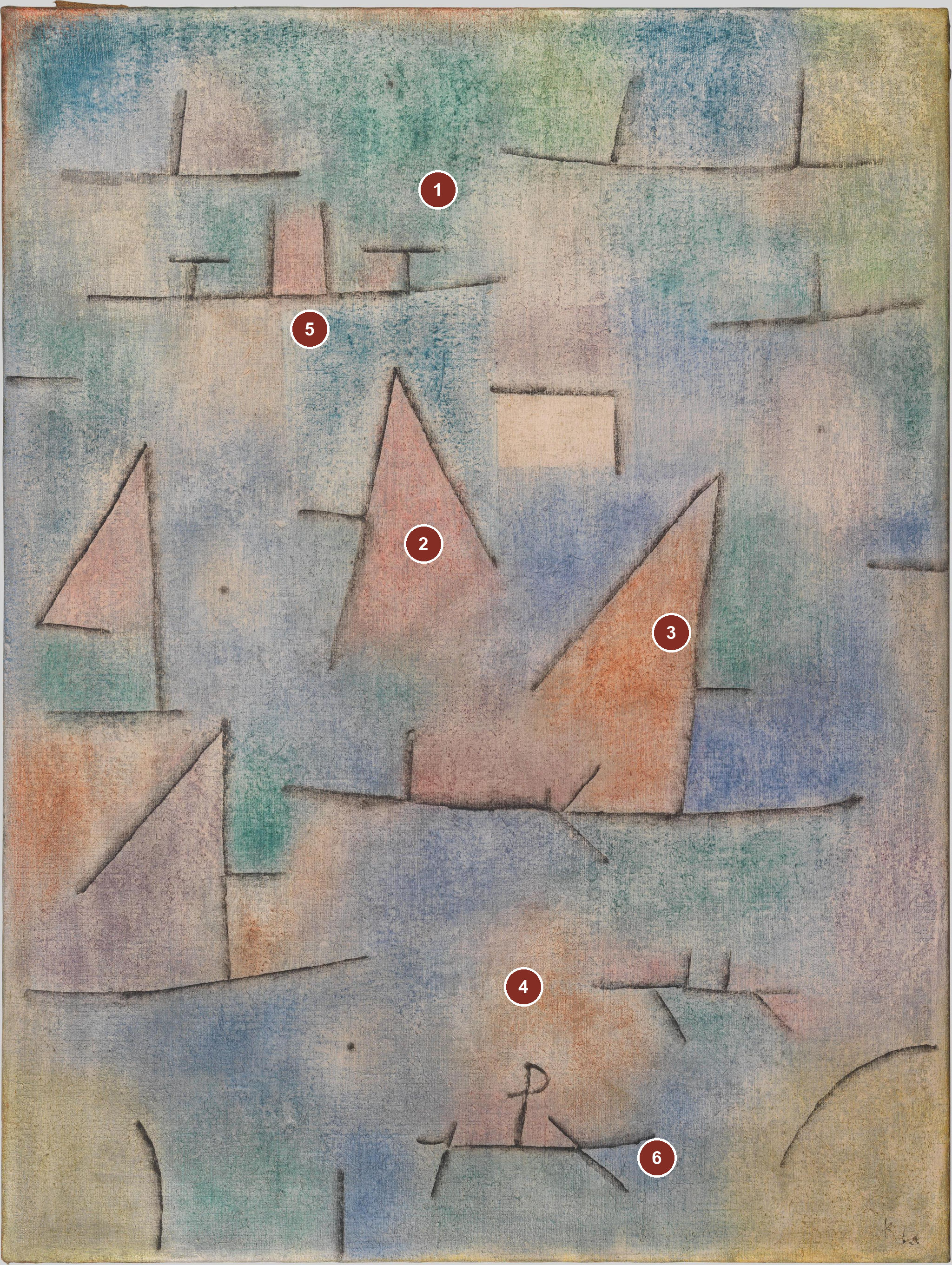
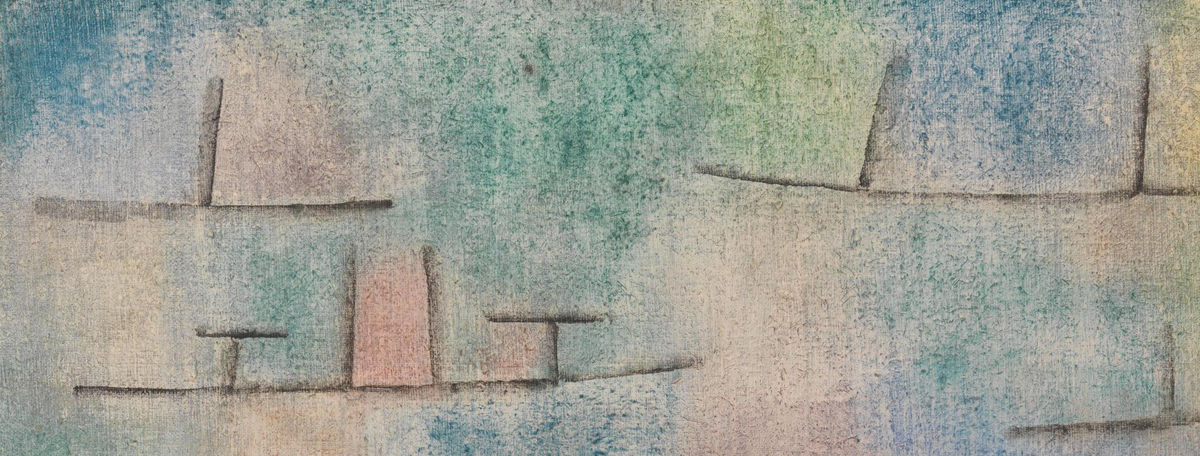
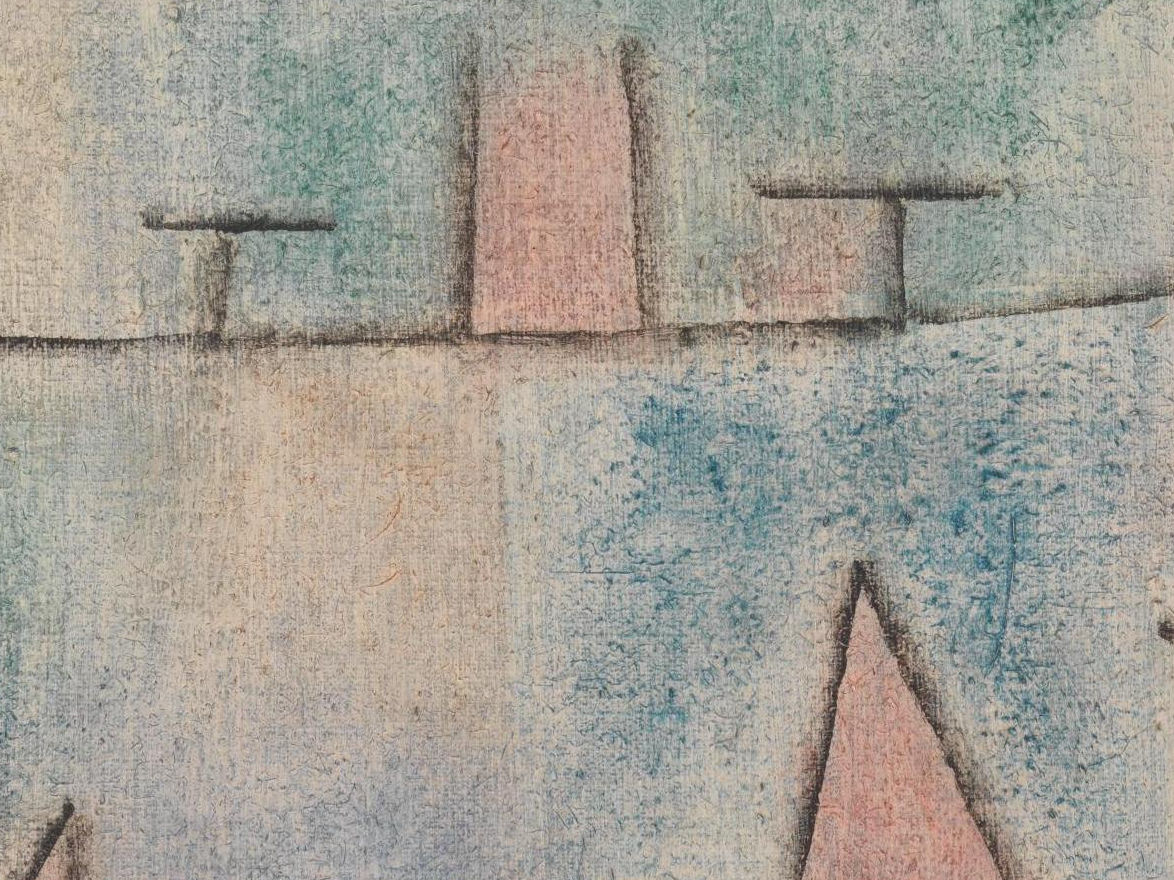
Abbreviated boats along the upper edge
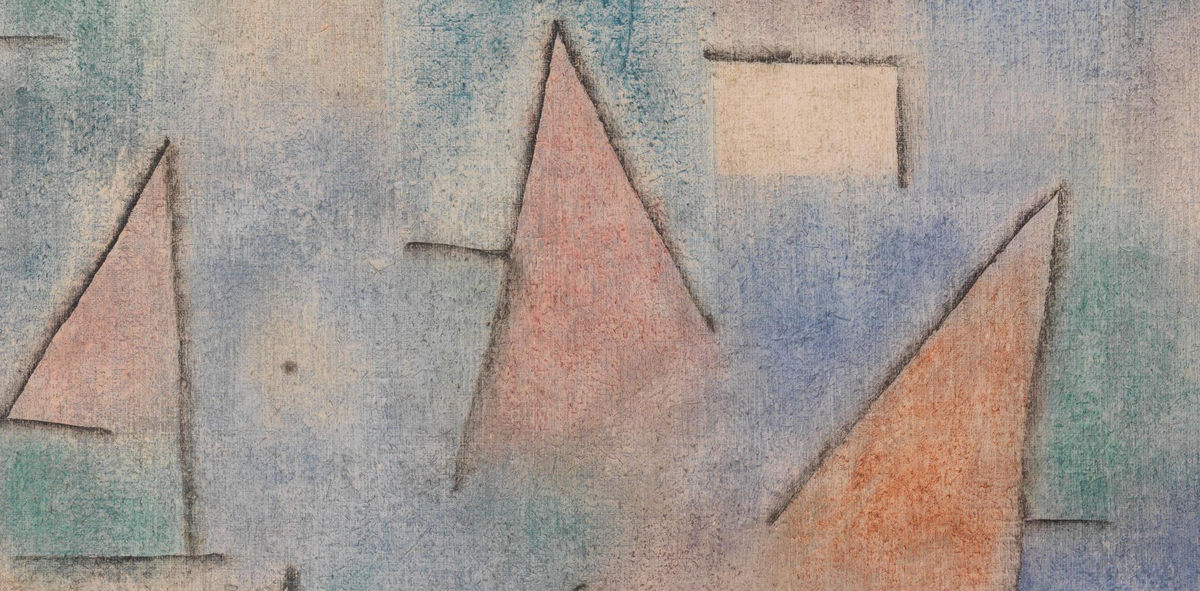
Three sail-like triangles in the middle
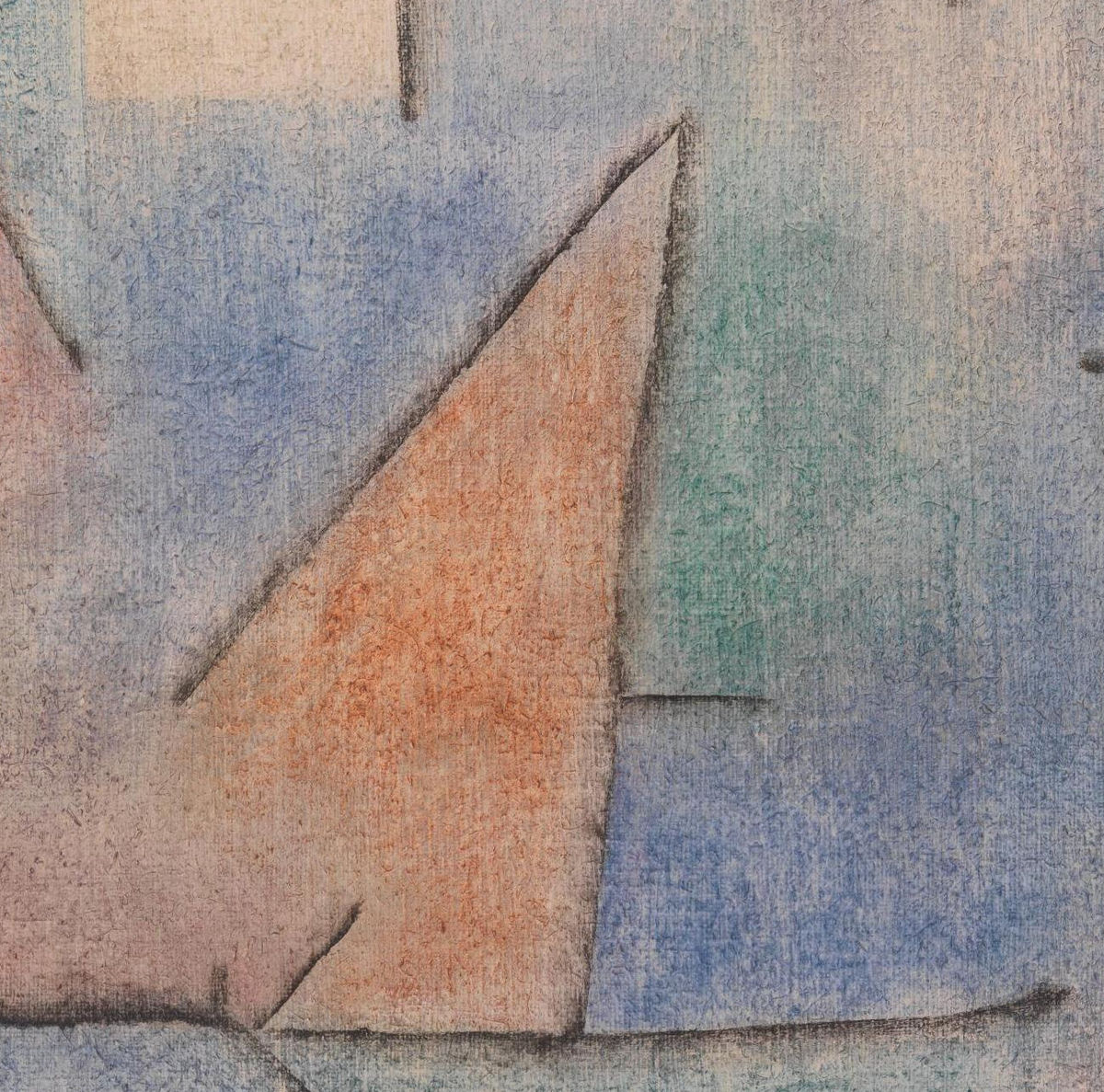
Orange sail and extended dark hull line
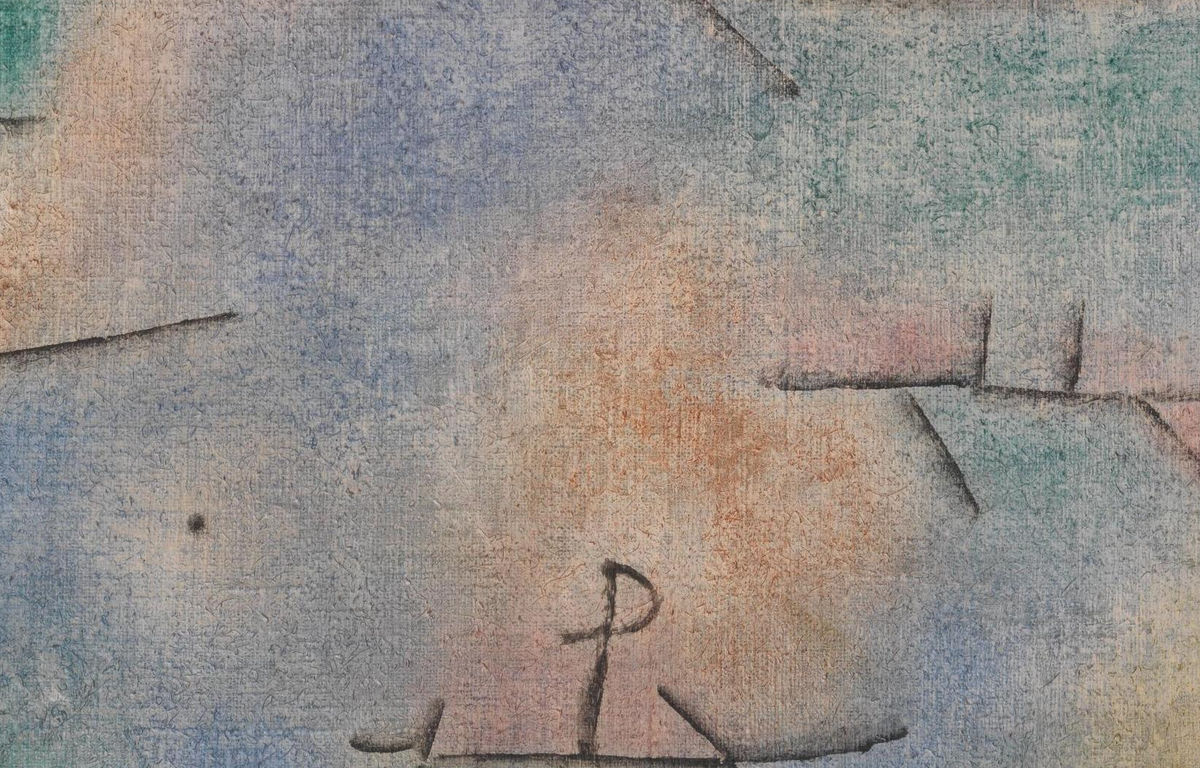
Smaller hull and mast marks below
Mottled blue-green and mauve paint
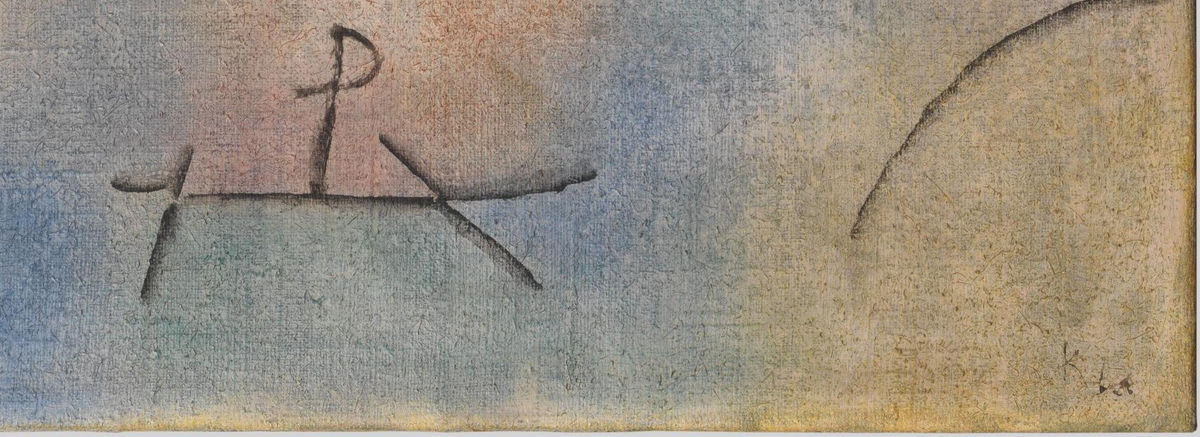
Lower-edge signs and Klee signature
Harbour with Sailing Ships: Klee’s maritime signs
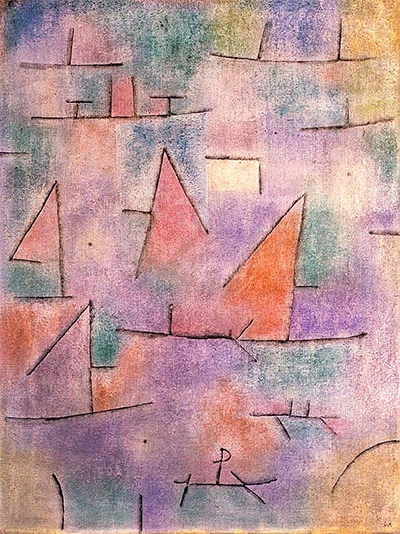
Paul Klee's Hafen mit Segelschiffen (Harbour with Sailing Ships) is a 1937 oil painting on canvas in the Musée national d'art moderne, Centre Pompidou, Paris. The museum gives its size as 80 × 60.5 cm, inventory AM 3969 P, and records a 1952 donation by Mr and Mrs André Lefèvre. Its French title is Port et voiliers. The English wording on this page is a translation of Klee's German title rather than a different artwork.[1]
Triangles, short horizontal strokes and upright lines evoke sails, hulls and masts. Yet the picture offers no conventional quay, shoreline or horizon. Small boat-like marks hover near the top and bottom as well as among the larger coloured triangles. A field of mauve, grey, green, blue and pink holds them together. The result is recognizable as a harbour through a spare visual vocabulary, even while the painting resists being mapped as one view of an actual port.[1][2]
How do these signs become boats?
Three large triangular forms carry much of the central movement. A pale triangle at left, a pink one near the middle and an orange one at right can each be read as a sail because of an adjacent line that behaves like a mast or hull. Smaller strokes above and below echo the same combination at different scales. Some are only a horizontal bar crossed by a vertical mark. Others have a sail-like area of colour. The eye connects these fragments through the title and the repeated geometry.[1][2]
The central forms are not isolated silhouettes. Lines continue beyond them, intersect them or stop just short. A horizontal dark stroke beneath the orange triangle extends across much of the composition, but it does not become a fixed waterline for every vessel. A little lower, another line holds a shape with a peaked upper edge. At the top, abbreviated forms float in open colour. This uneven distribution keeps the viewer moving through the painting rather than settling into a single foreground and background.[1][2]
The Centre Pompidou's analysis, written by Christian Derouet, calls attention to Klee's pictogram-like manner in this work: boats, shores and waves are reduced to simple lines. The museum explicitly notes the lack of a horizon and names the soft mauve, grey, green and pink tones. Those observations fit the owner photograph better than the intensely purple and orange colouring of the small reproduction formerly used on this page.[1]
The painterly field matters as much as the signs. The colours mingle and vary within each passage rather than filling neat geometric compartments. Dark strokes sit over that cloudy ground. In a high-resolution photograph, the mottled surface and subtle changes between blue-green and pink can be studied, though a photograph cannot tell us exactly how thickly Klee worked the oil paint or in what order every layer was applied. The museum's medium record establishes oil on canvas; the image supports visual description, not technical analysis of the object's construction.[1][2]
A harbour without a story of leisure
The former page imagined occupants of the boats, a relaxed day and a festive mood. The visible painting gives us no identifiable people and no weather report. Its forms do not establish whether the vessels are arriving, leaving or resting. The title anchors the scene as a harbour with sailing ships, but it does not turn the geometry into an account of a particular outing.[1]
Nor does the absence of a painted storm make the harbour a documented symbol of safety. The sparse lines may feel quiet to one viewer and unsettled to another. Some sail-like forms point in different directions, and the lack of a horizon leaves the spatial relationships uncertain. It is more accurate to describe that visual openness than to assign all imagined boat occupants the same emotion.[1][2]
One can compare Hafen mit Segelschiffen with Klee's other ship pictures, but similar subject matter is not enough to make them chapters in a single narrative. In Boats in the Flood (boote in der Überflutung), the Fondation Beyeler identifies a distinct 1937 work with its own annual number and material. The two titles invite different expectations, and each image needs to be read on its own terms. This page therefore does not use the other painting as proof of danger, safety or a change in Klee's mood.[3]
Date, inscription and museum history
The Centre Pompidou records “Klee” as the signature at the lower right. It also transcribes “1937.2.II Hafen mit Segelschiffen” on the reverse. The museum's analysis identifies this painting as no. 7087 in volume VII of the printed Paul Klee: Catalogue raisonné. That is a museum-supplied cross-reference; the printed entry has not been independently read for this page. The annual designation visible in the reverse inscription and the published catalogue number are different kinds of numbering and should not be confused.[1]
Klee had returned to Bern after his dismissal from a Düsseldorf teaching post in 1933. The Centre Pompidou's contextual essay describes the pressure on his work in Nazi Germany, the disruption of dealer Alfred Flechtheim, and support from Daniel-Henry Kahnweiler through Galerie Simon in Paris. It also records Klee's representation by ten works lent by Paris collectors to a 1937 exhibition at the Jeu de Paume. These facts show that the artist's work continued to circulate in France at the time this harbour picture was made. They do not establish that its boats encode exile or a particular political event.[1]
The museum received the painting in 1952 through the Lefèvre donation. Its bibliography lists the 1964 exhibition of the donated collection, where the picture was reproduced, as well as later Klee and collection catalogues. The accessible owner record does not give every earlier transfer from Klee's studio to the Lefèvre collection. A complete provenance would require those documents and the printed catalogue entry, not an invented chain based on the donation date alone.[1]
Seeing a place through marks
The painting's economy lets a few repeated signs carry a maritime subject. A triangle can be a sail, a short dark line can become a hull or shore, and a soft colour field can hold air and water without separating them. The title directs that recognition; the lack of a fixed horizon keeps it provisional. Klee makes the harbour legible while leaving its viewpoint, movement and human story unsettled.[1][2]
Related artworks
Explore eight other Klee works from the researched artwork cluster.
Viaducts Break Ranks
1937
Insula Dulcamara
1938
New Harmony
1936
Death and Fire
1940
Fire Full Moon
1933
Struck from the List
1933
Ad Parnassum
1932
References
- Centre Pompidou, Hafen mit Segelschiffen (Port et voiliers) (French object record and Christian Derouet's analysis, published in the museum's 2007 modern collection catalogue): current owner source for title, date, oil/canvas medium, dimensions, reverse inscription, acquisition, bibliography, catalogue raisonné no. 7087 and French historical context. The printed catalogue entry itself was not directly read, View source.
- Wikimedia Commons, high-resolution Hafen mit Segelschiffen reproduction: 3,010 × 4,000 photograph sourced from the Centre Pompidou, marked as a faithful public-domain reproduction; used to inspect colour and composition. The source file is tagged 72 dpi, View source.
- Fondation Beyeler, boote in der Überflutung: separate 1937 work used only to distinguish related boat imagery; not a key to the Paris painting, View source.
