


 by Tom Gurney
Tom Gurney BSc (Hons) is an art history expert with over 20 years experience
Published on June 19, 2020 / Updated on September 27, 2026
Email: tomgurney1@gmail.com / Phone: +44 7429 011000
A face out of balance
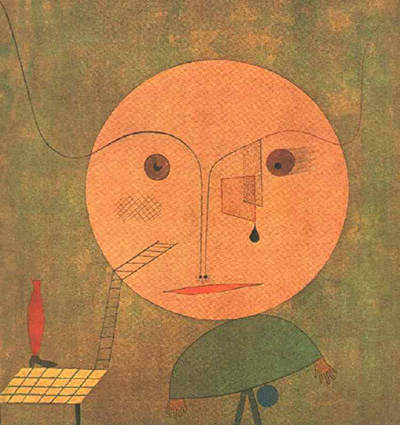
A huge orange face hovers over a small green body. One eye seems to have slipped into a different system of lines from the other; a dark drop hangs beneath it. A red, upright shape stands on a checked platform at the left, while a tiny blue disc appears near the lower right. The parts of Paul Klee’s Irrung auf Grün are recognisable enough to invite a story, but they refuse to settle into one. The painting was made in 1930, and the English title Error on Green is only one way of rendering its German name.[1][2]
The most recent institutional loan record identifies it as watercolour on cotton on a stretcher frame, 15¾ × 15 inches (about 40 × 38.1 cm), in a private collection. The Jordan Schnitzer Museum of Art in Oregon displayed it from 8 April to 12 July 2026 under the English title Errancy on Green. That record anchors the object much more securely than the old story on this page, which dated it to 1939 and claimed it was on display in Paris.[1]
Contents
- Which work is Error on Green?
- What can we see in the face?
- Why does the picture feel unsteady?
- Was it made in Klee’s late period?
- How has the work been received?
- Looking again
Which work is Error on Green?
Klee’s German title is Irrung auf Grün. Irrung can suggest an error, a mistaken course or an errancy. Neither Error on Green nor Errancy on Green is an English title written by Klee. The preposition auf places this disturbance on green, a colour field that supports, surrounds and seems to absorb the more solid shapes. The title does not identify the supposed error. It may refer to the strange figure, the unstable arrangement, or the act of looking for a correct reading at all. Those are interpretive possibilities, not translations of a hidden caption.[1][2]
The Oregon museum lists the work as a loan from a private collection, L2026:18.4, and describes the cotton as stretched over a frame. Cotton is part of the object’s construction, not merely a neutral background for an image. The present small reproduction cannot show how much of its weave is visible in the original, whether a given brown fleck comes from paint or support, or how its water-based colour sits on the fabric. Those questions require a close technical image or examination record.[1][2]
The image agency Artothek gives a slightly larger 40.6 × 38.7 cm and also says the work is privately owned. Its record appends “(3404)” to the title, without identifying what that number denotes. It should not be presented as Klee’s catalogue number. Stefania Caliandro’s 2019 scholarly chapter, as indexed, gives 1930,182, apparently an annual Klee work number, and rounds the dimensions to 40 × 38 cm. The original handlist and catalogue raisonné entry still need checking, so the painting’s institutional loan identity is the firm starting point here. The small measurement difference remains unresolved; it may reflect different measuring conventions, but no published technical finding located for this page proves which.[1][3][4]
This was a relatively small work, close to square. Its face is not a large canvas portrait: it occupies much of a support roughly forty centimetres across. Within that limited space, Klee gives disproportionate importance to a circle, then asks several much smaller elements to steady or complicate it. The object’s scale is important when imagining the encounter. A web image can make the head feel monumental; the painting’s actual dimensions make its play of delicacy and imbalance more striking.[1][2]
What can we see in the face?
The orange-pink roundel almost touches the left and right limits of the composition. It sits above the lower green form with little apparent neck. Its upper edge is smooth, while the green-brown field behind it is mottled. This contrast sets up an apparently simple portrait: a round face against a ground. Looking longer breaks that simplicity. A thin curving line enters from the upper left and arcs across the face. Near the centre it turns down and stops at two dark points. A second, angular set of lines near the right eye makes the two halves of the head unlike each other.[2]
The left eye is a dark circular mark inside a ring. The right has its own dark circular centre but is caught among straight line segments. A lightly crosshatched patch below the left eye suggests a cheek, a blush, a shadow or simply a texture. A small dark drop descends from the right eye. It can be seen as a tear, but the painting does not name grief or its cause. Near the bottom of the face, a red stroke forms a plausible mouth, angled slightly against the perfect geometry implied by the head’s outline. The line beside the left cheek can be followed toward the checked platform below, so it belongs at once to a possible face and to a larger path through the picture.[2]
At the lower left, a red vertical form stands on a pale grid. It might bring to mind a bottle, marker, boot or game piece, but the present image does not decide among them. The grid gives it a different kind of space from the green field: a little measured platform within a painting that otherwise resists stable measurement. A narrow, dark, ladder-like band climbs diagonally from that platform toward the large face. The two areas look connected even if their narrative roles remain unclear.[2]
The rounded green form below the face could serve as a body. It rests on thin supports that look frail beside the head. At the lower right, the small blue circle is remarkably distinct from the surrounding greens and browns. A diagonal dark line and a short reddish fringe complicate the edge of the green form. The head, platform, body and blue dot create a field of separated focal points. The eye moves among them to work out which belongs to which; the picture continually makes that work interesting.[2]
These are observations from the existing 400 × 425-pixel local splash. It is adequate for broad relations but not for deciding whether a fine mark crosses, ends at, or lies beneath another. An interpretation that depends on such a detail needs an authenticated larger reproduction. The page therefore treats the visible forms as evidence and keeps imagined identities open.[2]
Why does the picture feel unsteady?
The largest mass is high and somewhat left of the composition’s implied centre. The thin lower shapes cannot literally carry it as an ordinary body would carry a head. Yet the painting does not simply topple to the left. The blue disc, the red upright and the checked platform pull attention outward in different directions. The curved line entering the upper left returns the gaze toward the face; the lower diagonal leads away again. This is a reading of visual weight, not a claim that Klee drew an engineering diagram.[2]
Stefania Caliandro makes this tension central to her analysis of Klee. In Paul Klee’s Grey Point, she discusses the emergence of a figurative face within a structure of colour, geometric parts and dynamic relations. Search-accessible passages associate the oversized face, displaced from an implied balance point, with a small blue disc that acts as a visual counterweight. This is an illuminating way to look, especially because it does not require every coloured shape to be translated into an object. The chapter’s complete authorised text remains to be read before adopting its more detailed argument or suggesting that Klee consciously used Caliandro’s later theoretical vocabulary.[4]
The French scholar Nathalie Roelens reproduces the work in a University of Luxembourg lecture on the spiral and dynamic systems. Her slide draws on Caliandro to discuss gravity and impetus, rest and movement, and a precarious equilibrium. She calls attention to the relation between figurative elements and purely visual ones: the picture feels animated even though its forms do not depict an ordinary action. Her slide offers an attributed interpretive comparison, not a technical proof about the artwork. It also calls the medium gouache on cotton, while the current lending museum calls it watercolour on cotton. A conservation or catalogue record is needed before explaining that difference.[1][5]
Klee’s wider teaching and practice give a reason to take line, movement, colour and balance seriously. The Zentrum Paul Klee records that he taught formal and design theory at the Bauhaus between 1921 and 1931, leaving a substantial body of teaching notes. But a general concern in that teaching is not an instruction sheet for this painting. We can compare the viewer’s experience of opposed pulls with Klee’s interests without claiming that a specific lesson produced the face, blue disc or green body. That distinction keeps the painting more particular than a demonstration of an abstract principle.[6]
Was it made in Klee’s late period?
No. The work belongs to 1930, during Klee’s final Bauhaus year in Dessau. A Zentrum Paul Klee chronology dates his formal departure from the Bauhaus to 1 April 1931 and his Düsseldorf Academy appointment to 1 July 1931. His forced removal from that academy, return to Bern and later illness belong to subsequent years. The old page collapsed those stages, placing this image in 1939 and reading it as a premonition of the Second World War and the atomic bomb. Neither its date nor its documented interpretation supports that story.[1][6][7]
This correction does not forbid a response to the image’s unease. The dark drop and precarious body can feel melancholy, fragile or comic, depending on how one follows the marks. A viewer today may bring knowledge of later events to the painting. Historical explanation, however, must distinguish that later response from evidence of what Klee meant in 1930. The same discipline applies to proposed artistic influences. Nothing in the consulted object record identifies Joan Miró as a direct source for this particular face, and similarity to other modernist portraits alone does not prove a borrowing.[1][2][7]
Klee’s 1930 position was also more public than the old page implies. Zentrum Paul Klee’s research guide records responses to his work in Germany, including a 1930 discussion of children looking at his images, and notes his first monographic exhibition at New York’s Museum of Modern Art that year. Such facts place the painting amid active exhibition and critical exchange. They do not tell us when within 1930 it was painted, whom he showed it to first, or how its private ownership began. Those are questions for catalogues and archival records, not for a romantic account of isolation.[7]
How has the work been received?
Its appearance in a 1963 Basel exhibition review shows how viewers could value its resistance to easy charm. An indexed Werk-Chronik review of a Galerie Beyeler Klee exhibition contrasts the rich painted Kiosk-Architektur of 1920 with the harder linear grotesque of Irrung auf Grün of 1930. That is a historically situated critic’s comparison: the work’s strange line and bodily distortion mattered to the reviewer alongside Klee’s more lyrical painting. The archive currently blocks inspection of the complete original page, so the page does not quote the review or infer a detailed loan history from it.[8]
“Galerie Beyeler” in that Basel report is not the same as saying the painting is now in the Fondation Beyeler collection, still less that it is on view in Paris. The current Oregon loan record gives private collection and a specific, now finished, 2026 display. A listing in the contents of a Will Grohmann Klee publication also identifies the work as colour plate 24, page 97, paired in sequence with other paintings from around 1930. The contents prove reproduction in that book; the plate and any adjacent commentary require direct inspection before their account can be used.[1][8][9]
This limited but real reception history is preferable to inventing an origin story. The image circulated enough to be reproduced and exhibited, yet the readily available records leave its chain of owners, exact exhibition loans and changes in title or medium incomplete. A privately held painting can have a public interpretive history without being permanently housed in a museum.[1][3][8][9]
Looking again
The face becomes less self-evident as its lines are followed. One curved path crosses its orange field; the two eyes belong to different local geometries; a dark drop hangs without an agreed narrative. The red upright, grid, thin supports and tiny blue disc make the surrounding green a place of relationships rather than a passive backdrop. Irrung leaves open whether the straying belongs to a figure, the picture’s equilibrium or our attempt to see it correctly.[1][2][4][5]
The secure anchors are modest and useful: Irrung auf Grün, 1930, watercolour on stretched cotton according to its current museum loan record, roughly 40 × 38 cm, now privately held. Its visual instability has a documented scholarly reading, and its 1963 reception suggests that the contrast between hard line and painted richness was noticed well before the web repeated it. The more elaborate personal and wartime stories previously attached to this page exceed the evidence. For related context, see Klee at the Bauhaus, his paintings and materials and techniques.[1][4][5][6][8]
Explore selected works from Klee’s much larger oeuvre. Titles without a link have an authenticated catalogue identity but no reviewed article yet.
Artworks directory
| Name | Date | Medium |
|---|---|---|
| A Gate | 1939 | Painting and mixed media |
| A Woman for Gods | 1938 | Watercolour and mixed media |
| Ab Ovo | 1917 | Watercolour and mixed media |
| Above Mountain Summit | 1917 | Drawing and mixed media |
| Abstract Trio | 1923 | Drawing and mixed media |
| Acrobats | 1915 | Watercolour and mixed media |
| Actor's Mask | 1924 | Painting and mixed media |
| Ad Marginem | 1930 | Drawing and mixed media |
| Ad Parnassum | 1932 | Painting and mixed media |
| Adventurer Ship | 1927 | Drawing and mixed media |
| Affected Place | 1922 | Drawing and mixed media |
| After a Sketch from Zurich | 1914 | Watercolour and mixed media |
| After Drawing | 1919 | |
| After The Floods | 1936 | Watercolour and mixed media |
| All Souls' Picture | 1921 | |
| Ancient Harmony | 1925 | Painting and mixed media |
| Angel Applicant | 1939 | Drawing and mixed media |
| Angel Serves the Desired | 1920 | |
| Angel, Still Female | 1939 | Painting and mixed media |
| Angelus Novus | 1920 | Drawing and mixed media |
| Animal Terror | 1926 | Painting and mixed media |
| Arab Song | 1932 | Painting and mixed media |
| Archangel | 1938 | Painting and mixed media |
| Architecture | 1923 | Painting and mixed media |
| Architecture of the Plain | 1923 | Drawing and mixed media |
| Around the Fish | 1926 | Painting and mixed media |
| Arrival of the Air Steamer | 1921 | Drawing and mixed media |
| Asiatic God | 1924 | Painting and mixed media |
| Astrological Fantasy Portrait | 1924 | Drawing and mixed media |
| Athlete's Head | 1932 | Watercolour and mixed media |
| Aufgehender Stern | 1931 | Painting and mixed media |
| Autumn Flower | 1922 | Painting and mixed media |
| Bad Band | 1920 | Drawing and mixed media |
| Baroque Centaur | 1939 | Painting and mixed media |
| Before the Blitz | 1923 | Drawing and mixed media |
| Before the Snow | 1929 | Drawing and mixed media |
| Besessenes Madchen | 1924 | Watercolour and mixed media |
| Bird Garden | 1924 | |
| Bird Wandering Off | 1926 | Watercolour and mixed media |
| Blossoms in the Night | 1930 | Watercolour and mixed media |
| Blue-Bird-Pumpkin | 1939 | Painting and mixed media |
| Boats in the Flood | 1937 | Painting and mixed media |
| Botanical Theatre | 1934 | Drawing and mixed media |
| Boy in Fancy Dress | 1931 | Watercolour and mixed media |
| Broken Key | 1938 | |
| Brother and Sister | 1930 | Watercolour and mixed media |
| But the Red Roof | 1935 | Painting and mixed media |
| C - C = Fisch | 1931 | Watercolour and mixed media |
| Cacti | 1912 | Painting and mixed media |
| Camel (in Rhythmic Landscape with Trees) | 1920 | Drawing and mixed media |
| Captive Pierrot | 1923 | Drawing and mixed media |
| Castle and Sun | 1928 | Drawing and mixed media |
| Cat and Bird | 1928 | Drawing and mixed media |
| Cathedrals | 1925 | Watercolour and mixed media |
| Chalice of the Heart | 1937 | Painting and mixed media |
| Characters in Yellow | 1937 | Painting and mixed media |
| Chosen Site | 1927 | Mixed media |
| Christmas Picture | 1923 | Drawing and mixed media |
| City of Towers | 1916 | Painting and mixed media |
| Clarification | 1932 | Painting and mixed media |
| Collection of Figurines | 1926 | Painting and mixed media |
| Colorful Architecture | 1917 | Painting and mixed media |
| Comedians' Handbill | 1938 | |
| Comic Opera Singer | 1927 | Painting and mixed media |
| Composition | 1939 | Painting and mixed media |
| Composition with Figures | 1915 | Drawing and mixed media |
| Composition with the Yellow Half-Moon and the Y | 1918 | Watercolour and mixed media |
| Conch–Still Life II | 1939 | Watercolour and mixed media |
| Cosmic Composition | 1919 | Painting and mixed media |
| Crystal Gradation | 1921 | Drawing and mixed media |
| Dance of the Grieving Child | 1922 | Painting and mixed media |
| Dancing Girl | 1940 | Painting and mixed media |
| Das Licht und Etliches | 1931 | Mixed media |
| Death and Fire | 1940 | Painting and mixed media |
| Death for the Idea | 1915 | |
| Demon as Pirate | 1926 | Watercolour and mixed media |
| Diana | 1931 | Painting and mixed media |
| Diavolo Player | 1923 | Drawing and mixed media |
| Die Kapelle | 1917 | Watercolour and mixed media |
| Die Vase | 1938 | Painting and mixed media |
| Doctor | 1930 | Drawing and mixed media |
| Dredger and Sailboat | 1931 | Watercolour and mixed media |
| Ein Tor | 1939 | Painting and mixed media |
| Ein Weib fur Gotter | 1938 | Mixed media |
| Embrace | 1939 | Watercolour and mixed media |
| Episode before an Arab Town | 1923 | |
| Equals Infinity | 1932 | Painting and mixed media |
| Eros | 1923 | Drawing and mixed media |
| Error on Green | 1930 | Watercolour and mixed media |
| Evening Figure | 1935 | Drawing and mixed media |
| Falling Bird | 1919 | |
| Fermata | 1932 | Watercolour and mixed media |
| Fire Clown | 1921 | Watercolour and mixed media |
| Fire Full Moon | 1933 | Watercolour and mixed media |
| Fire in the Evening | 1929 | Painting and mixed media |
| Fish in the Harbour | 1916 | Watercolour and mixed media |
| Fish Magic | 1925 | Watercolour and mixed media |
| Flock of Birds | 1917 | Drawing and mixed media |
| Flora on Sand | 1927 | Watercolour and mixed media |
| Flower Myth | 1918 | |
| Flower Stand with Watering Can and Bucket | 1910 | Watercolour and mixed media |
| Flowering Tree (Abstraction with Reference to a Flowering Tree) | 1925 | Painting and mixed media |
| Flowers in Pots | 1923 | |
| Flowers in Stone | 1939 | Painting and mixed media |
| Forest Witch | 1938 | Painting and mixed media |
| Fright of a Girl | 1922 | Drawing and mixed media |
| Fruits on Red | 1930 | Drawing and mixed media |
| Full Moon | 1919 | Mixed media |
| Föhn Wind in Franz Marc's Garden | 1915 | Watercolour and mixed media |
| Garden in St Germain, The European Quarter near Tunis | 1914 | Watercolour and mixed media |
| Ghost Chamber with the Tall Door (New Version) | 1925 | |
| Ghost of a Genius | 1922 | Drawing and mixed media |
| Girl in Mourning | 1939 | Painting and mixed media |
| Glance of a Landscape | 1926 | Watercolour and mixed media |
| Gluht Nach | 1939 | Drawing and mixed media |
| Golden Fish | 1925 | Watercolour and mixed media |
| Goldfish Wife | 1921 | Watercolour and mixed media |
| Green Plant, Blood, Louse | 1924 | Drawing and mixed media |
| Hafenbild | 1918 | Mixed media |
| Hammamet with Mosque | 1914 | Watercolour and mixed media |
| Harbour with Sailing Ships | 1937 | Painting and mixed media |
| Hauptweg und Nebenwege | 1929 | Painting and mixed media |
| Heavenly and Earthly Time | 1927 | Drawing and mixed media |
| Heroic Fiddling | 1938 | Painting and mixed media |
| Heroic Roses | 1938 | Painting and mixed media |
| Heroic Strokes of the Bow | — | Mixed media |
| Highway and Byways | 1929 | Drawing and mixed media |
| Houses near the Gravel Pit | 1913 | Watercolour and mixed media |
| Howling Dog | 1928 | Painting and mixed media |
| In the Current Six Thresholds | 1929 | Painting and mixed media |
| In the Style of Kairouan | 1914 | Drawing and mixed media |
| Individualized Altimetry of Stripes | 1930 | Painting and mixed media |
| Insula Dulcamara | 1938 | |
| Interior with the Clock | 1913 | Watercolour and mixed media |
| Irma Rossa the Animal Tamer | 1918 | Drawing and mixed media |
| Journey in Corsica | 1927 | Drawing and mixed media |
| Landscape with Bluebirds | 1919 | Watercolour and mixed media |
| Legend of the Nile | 1937 | Painting and mixed media |
| Lemon Harvest | 1937 | Watercolour and mixed media |
| Likeness in the Bower | 1930 | Watercolour and mixed media |
| Limits of Reason | 1927 | Painting and mixed media |
| Little Hope | 1938 | Watercolour and mixed media |
| Magdalena before the Conversion | 1938 | Drawing and mixed media |
| Mask of Fear | 1932 | Painting and mixed media |
| May Picture | 1925 | Painting and mixed media |
| Monument in a Cemetery | 1922 | Watercolour and mixed media |
| Monuments at G | 1929 | Watercolour and mixed media |
| Municipal Jewel | 1917 | Watercolour and mixed media |
| Mural from the Temple of Longing Thither | 1922 | |
| Nach der Uberschwemmung | 1936 | Watercolour and mixed media |
| New Harmony | 1936 | Painting and mixed media |
| New House in the Suburbs | — | Mixed media |
| Old Steamboat | 1922 | Drawing and mixed media |
| On the Edge | 1930 | Drawing and mixed media |
| Once Emerged from the Gray of Night | 1918 | Drawing and mixed media |
| One Who Understands | 1934 | Painting and mixed media |
| Oriental Pleasure Garden | 1925 | Painting and mixed media |
| Park of Idols | 1939 | Watercolour and mixed media |
| Passing by Red Pillars | 1928 | Watercolour and mixed media |
| Persian Nightingales | 1917 | Drawing and mixed media |
| Popular Wall Painting | 1922 | Painting and mixed media |
| Prestidigitator | 1927 | Watercolour and mixed media |
| Rainy Day | 1931 | Watercolour and mixed media |
| Red and White Domes | 1914 | Watercolour and mixed media |
| Red Balloon | 1922 | Drawing and mixed media |
| Redgreen and Violet-Yellow Rhythms | 1920 | Drawing and mixed media |
| Refuge | 1930 | Watercolour and mixed media |
| Rhythmic Rythmical | 1930 | Painting and mixed media |
| Saint of the Inner Light | 1921 | |
| Scaffolding of a New Building | 1930 | Painting and mixed media |
| Scholar in Dealing with Stars | 1926 | Watercolour and mixed media |
| Seated Woman | 1930 | Drawing and mixed media |
| Senecio | 1922 | Painting and mixed media |
| Separation in the Evening | 1922 | Drawing and mixed media |
| Sinbad the Sailor | 1923 | Drawing and mixed media |
| Skeptically Smiling | — | Mixed media |
| Small House in the Garden City | 1928 | Watercolour and mixed media |
| Small Portrait of a Girl in Yellow | 1925 | Painting and mixed media |
| Southern Gardens | 1919 | Watercolour and mixed media |
| Static-Dynamic Gradation | 1923 | Drawing and mixed media |
| Still Life | 1927 | Painting and mixed media |
| Still Life with Gladioli | 1932 | Watercolour and mixed media |
| Strange Garden | 1923 | Drawing and mixed media |
| Stricken City | 1936 | Painting and mixed media |
| Strong Dream | 1929 | Watercolour and mixed media |
| Struck from the List | 1933 | Drawing and mixed media |
| Structural I | 1924 | Drawing and mixed media |
| Sumpflegende | 1919 | Painting and mixed media |
| Temple Gardens | 1920 | Drawing and mixed media |
| The Arrow before the Target | 1921 | Drawing and mixed media |
| The Barbed Noose with the Mice | 1923 | Watercolour and mixed media |
| The Flora of the Heath | 1925 | Watercolour and mixed media |
| The Goldfish | 1925 | Watercolour and mixed media |
| The Hour Before One Night | 1940 | Painting and mixed media |
| The Man in Love | 1923 | |
| The Mask with the Flag | 1925 | Mixed media |
| The Pathos of Fertility | 1921 | |
| The Rhine at Duisburg | 1937 | Painting and mixed media |
| The Way to the Citadel | 1937 | Painting and mixed media |
| Three Houses and a Bridge | 1922 | Watercolour and mixed media |
| Tightrope Walker | 1923 | |
| Tomb in Three Parts | 1923 | Watercolour and mixed media |
| Tomcat's Turf | 1919 | Watercolour and mixed media |
| Tower in Orange and Green | 1922 | Drawing and mixed media |
| Tree and Architecture - Rhythms I | 1920 | Watercolour and mixed media |
| Tree and Architecture - Rhythms II | 1920 | Painting and mixed media |
| Tropical Dawn with the Owl | 1921 | Mixed media |
| Tropische Dammerung | 1921 | Painting and mixed media |
| Twittering Machine | 1922 | Drawing and mixed media |
| Variations (Progressive Motif) | 1927 | Watercolour and mixed media |
| Ventriloquist and Crier in the Moor | 1923 | |
| Viaducts Break Ranks | 1937 | Drawing and mixed media |
| Villa R | 1919 | Painting and mixed media |
| Village Carnival | 1926 | Painting and mixed media |
| Vor dem Blitz | 1923 | Drawing and mixed media |
| Wald-Hexen | 1938 | Painting and mixed media |
| Young Forest | 1925 | Drawing and mixed media |
Related artworks
Explore eight other Klee works, beginning with works close in date to this one.
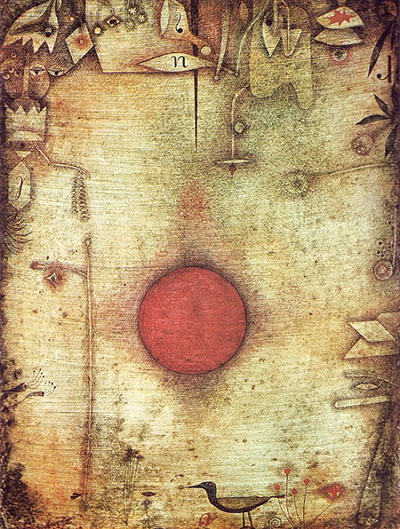
Ad Marginem
1930
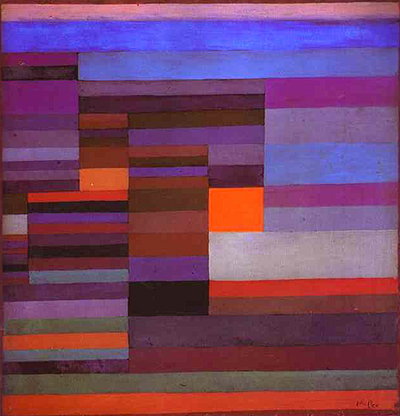
Fire in the Evening
1929
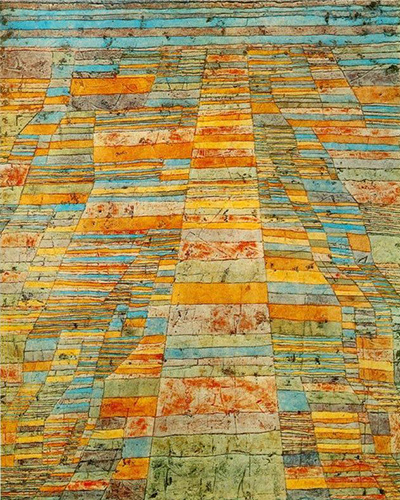
Highway and Byways
1929
Ad Parnassum
1932
Castle and Sun
1928
Cat and Bird
1928
Mask of Fear
1932
Discussion
One large face and several small shapes pull the eye across Klee's green field.
Its title leaves open what has gone astray.
Reader Insights
How does the small blue circle change the picture's balance?
Where does the curving line entering at the upper left lead your eye?
Which detail supports your reading of the dark drop?
Join the Conversation
Share the detail or source behind your reading.
References
- Jordan Schnitzer Museum of Art, Shared Visions loan listing, Irrung auf Grün (Errancy on Green), 1930, private loan L2026:18.4, material, size and 2026 display dates; museum research guide, p. 2. The loan record is the current institutional object anchor, not a permanent-collection entry.
- Existing local splash, Error on Green Paul Klee.jpg, visually inspected at 400 × 425 pixels. Observations about forms are independent visual readings at that resolution, not technical or iconographic findings.
- Artothek, German image record 11589, Irrung auf Grün. 1930. (3404), private ownership, 40.6 × 38.7 cm, Hans Hinz photograph and high-resolution rights-managed file. The parenthetical number is unidentified and the material is not established by this record, View source.
- Stefania Caliandro, “Paul Klee’s Grey Point”, in Morphodynamics in Aesthetics (Springer, 2019), pp. 13–47. Work-specific title, 1930,182 identifier, approximate dimensions and off-centre face/blue-disc reading are accessible through publisher/indexed extracts; the full authorised chapter has not been read and must be checked before more specific paraphrase, View source.
- Nathalie Roelens, Le motif de la spirale: entre science et art, University of Luxembourg lecture slides, slide 18. French comparative reading of balance, motion and figuration, citing Caliandro; calls the medium gouache, unlike the museum’s watercolour, View source.
- Zentrum Paul Klee, research and archive description and biography, Bauhaus teaching and move to Düsseldorf; general context, not a statement about this individual picture.
- Zentrum Paul Klee, German exhibition guide and dated chronology, pp. 36–37, for 1930 reception and 1931 job dates. Later exile and illness are not causes established for a 1930 picture, View source.
- Werk-Chronik, issue 5 (1963), p. 111, indexed German review of a Galerie Beyeler exhibition in Basel. Search-readable excerpt only; original page remains behind an access interstitial and is not quoted, View source.
- Will Grohmann, Klee publication contents preview, lists Irrung auf Grün as colour plate 24, p. 97. Plate and prose are not yet directly read, View source.