


 by Tom Gurney
Tom Gurney BSc (Hons) is an art history expert with over 20 years experience
Published on June 19, 2020 / Updated on September 27, 2026
Email: tomgurney1@gmail.com / Phone: +44 7429 011000
Arab Song: a face, a landscape and a remembered place
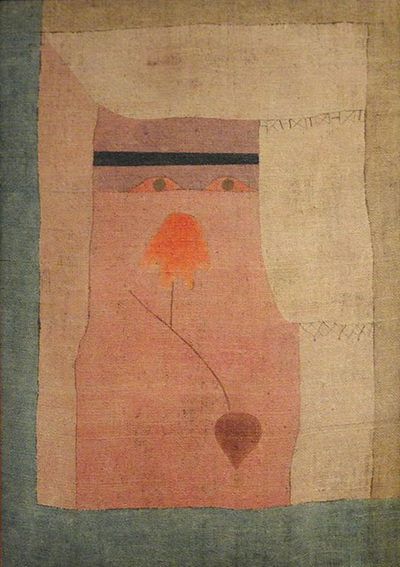
Paul Klee's Arabisches Lied—Arab Song—is a large, vertical work of 1932, entered in his annual list as 1932, 283. The Phillips Collection in Washington, DC, records oil on burlap canvas, 91.1 × 64.5 cm (35⅞ × 25⅜ in.), collection number 0990, acquired in 1940. Its coarse, open support is part of the painting's appearance. The sparse forms make an image that can change as one looks: a veiled face, a landscape, a hanging textile and a small tree may occupy the same broad, dusty field.[1][2]
The composition is immediately more ambiguous than a literal view of North Africa. A broad, pale upper band covers much of the top. Below it, two small dark marks read as eyes under a heavy horizontal strip. A warm vertical form can become a nose or trunk. Lower down, a thin stem reaches a heart-shaped leaf. At the right, a light, nearly blank hanging shape looks like a veil or curtain. Greenish fabric frames the sides and bottom. Klee gives enough cues to make a face appear, then lets the same marks turn into plants, dunes, cloth and colour intervals.[1][3]
A title that can be heard as well as seen
The Phillips interprets the work through Klee's search for a visual analogy to music. It cites his 1927 comment about travel and colour: he wished to awaken inner “sounds” through an adventure in colour. The museum sees this painting as a particularly spare melody compared with earlier, more complex arrangements of shifting horizontal bands and overlapping squares. Those are the collection's curatorial terms, not evidence that Arab Song transcribes an identifiable tune.[1]
The title joins an evocation of cultural place to a musical form. Lied means “song”; the work contains no notation or named performer. The short bars, separated marks and broad rests of untreated or thinly stained fabric may invite a sense of measured interval. The picture does not demand that every colour have a corresponding note. Its musical quality can be experienced in pacing: two small eyes, one central accent, the long downward pull of a stem, and the larger quiet areas around them.[1][3]
This economy differs from a crowded travel illustration. Klee had visited Tunisia in 1914 and Egypt in 1928–29. The Phillips relates the palette, open horizons and geometry to remembered impressions of both places. The painting was made years later. It should be called an evocation or recollection, rather than a view recorded on site in 1932. The museum reproduces collector Duncan Phillips's response as a “romantic interpretation of North Africa”; the wording identifies his historical reception of the painting, not an objective description of the region.[1]
Face, landscape or curtain?
One way to read the center is as a face partly covered by a veil. The eyes sit under a strong dark band, while the broad pale area at the right screens part of what might be a body. Yet the head is not enclosed in an ordinary outline. The eye marks can also be read as two points on a far horizon. A red-orange form may be a nose, a little tree or another patch of colour. What looks like a veil can become cloth hanging before a window or an unpainted interval. Klee allows recognition to start, pause and restart.[1][3]
The Jewish Museum's 2026 exhibition label emphasizes that ambiguity. It describes pale desert tones, a coloured tree and heart-shaped leaf, but also eyes emerging from a veil. The label suggests an alert, uneasy gaze amid the recollection of travel. This is one curatorial reading of a painting made as National Socialism was gaining power. Its political and emotional connection should be presented as the exhibition's interpretation; neither the owner record nor an object-specific statement by Klee supplies a single coded meaning for the eyes.[2][3]
The tree and leaf provide an especially gentle counterweight to the face. A slender line reaches down to a dark, pointed heart shape. The painted sign is small relative to the empty field, but it becomes a visual anchor because the eye follows the line toward it. The centre's warm forms and green edges make a modest colour rhythm. They do not turn the work into a botanically exact scene. Instead, the same economical shape can be a plant in a landscape and part of a figure remembered through that landscape.[1][3]
The surface itself complicates the imagery. The Phillips describes pale tones on raw burlap. In the Jewish Museum's account, pink and green stains and visible fabric contribute a sensation of dust and plaster. That sensation comes from pigment and weave working together, not from actual desert dust embedded in the picture. Burlap is a rough textile support, and here it remains conspicuous rather than hidden beneath a smooth paint film. The relative emptiness of the upper and right sections therefore has texture even where there are few marks.[1][3]
The burlap and its later treatment
The material history is unusually well documented for a short account of this work. Swiss conservator and scholar Nathalie Bäschlin, in her German study of restoration practices, records that Gustav Berger treated Arabisches Lied in 1976. According to her reading of Berger's report, he judged the weakened support to need lining and chose a method using a synthetic adhesive associated with his work on BEVA. He aimed to retain the mesh-like character of Klee's loosely woven jute while improving control and reversibility. These are reported intentions and treatment decisions from 1976, not claims drawn from a current technical examination of the painting.[4]
Bäschlin then describes later criticism by Wolfgang Kersten and others. They argued that a wax-like adhesive across the structure could alter the experience of the work's fragility and material authenticity. Her study presents this disagreement as part of a wider change in conservation ethics: how to stabilize a vulnerable object while changing as little as possible. It would be misleading either to celebrate the lining as unquestionably successful or to declare that it destroyed the work. The available source documents a treatment and a debate; it does not provide the Phillips's present-day condition assessment.[4]
The historical study gives an approximate 90 × 60 cm in a note, which does not match the Phillips's current 91.1 × 64.5 cm dimensions. The basis for the difference is not established in these records. For the object's present catalogue size, the owning museum's measurements are used. The contrast is a reminder that a published conservation discussion and a current collection label serve different purposes.[1][4]
Ownership and reception
The Phillips acquired Arab Song in 1940. A 1949 Museum of Modern Art exhibition catalogue already lists it as lent by the Phillips Gallery and captions it as oil on burlap. That record establishes its early public life in the United States without supplying a full pre-1940 chain of ownership. The Phillips has repeatedly returned to the work in presentations about Klee, including its later program on American artists responding to him. An exhibition reference documents display or use at a particular time, not continuous exhibition today.[1][5]
The painting's later interpretations show how much it withholds. Duncan Phillips saw desert light and veiled figures; the Phillips curatorial text hears an exceptionally simple visual melody. The Jewish Museum reads calm memory alongside apprehension. All attend to actual features—the pale tones, raw textile, veil-like form, eyes and small plant—but each puts them into a different relation. The painting is not a comprehensive account of an Arab culture or a realistic record of any one place. Its title and forms belong to Klee's imagined, historically situated response to travel.[1][3]
Arab Song can be approached as a slow alternation between what is seen and what is supplied by memory. A pair of marks becomes eyes, a strip becomes a horizon, and cloth may be both support and subject. The musical title gives those sparse changes a rhythm. The open burlap makes the pauses visible.[1][3][4]
Related artworks
Explore eight other Klee works from the researched artwork cluster.
Ad Parnassum
1932
Mask of Fear
1932
Fire Full Moon
1933
Struck from the List
1933
Ad Marginem
1930
Error on Green
1930
Fire in the Evening
1929
References
- The Phillips Collection, Arab Song collection record, English: current title, materials, dimensions, accession 0990, 1940 acquisition, Duncan Phillips's historical reception and the museum's music/travel interpretation, View source.
- The Jewish Museum, Paul Klee: Other Possible Worlds, exhibition checklist, English, 2026: Arab Song (Arabisches Lied), 1932, 283, oil on burlap canvas, Phillips Collection. This confirms the annual number absent from the Phillips web caption, View source.
- The Jewish Museum, Paul Klee and Fascism, complete exhibition texts, English, 2026, p. 38: attributed curatorial reading of the veiled face, tree, leaf, stained burlap, memory and apprehension, View source.
- Nathalie Bäschlin, Fragile Werte: Diskurs und Praxis der Restaurierungswissenschaften 1913–2014, German, transcript Verlag, 2020, pp. 142–44: directly read account of Gustav Berger's 1976 lining treatment of Arabisches Lied and later criticism of its material effects. The book cites Berger's 1976 report; that report and a current Phillips condition file have not been inspected, View source.
- Museum of Modern Art, Paintings, Drawings, and Prints by Paul Klee, English, 1949 exhibition catalogue, illustrated caption and checklist: Arab Song, oil on burlap, lent by the Phillips Gallery. The historical size is approximate and is not substituted for the current owner measurement, View source.