


 by Tom Gurney
Tom Gurney BSc (Hons) is an art history expert with over 20 years experience
Published on June 19, 2020 / Updated on September 27, 2026
Email: tomgurney1@gmail.com / Phone: +44 7429 011000
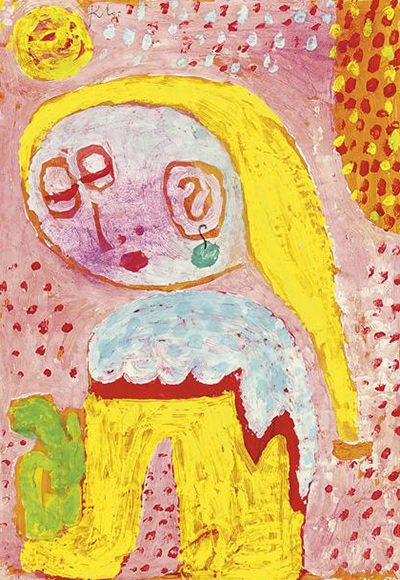
Magdalena before the Conversion: a figure held in colour
Paul Klee's Magdalena vor der Bekehrung (Magdalena before the Conversion) dates from 1938. The artist's mount bears the inscription “1938 A 15 Magdalena vor der Bekehrung”; the picture is signed at upper left. Christie's identifies it as gouache over pencil on paper, laid down by Klee on board, with a painted image of 29.5 × 20.6 cm and a mount of 47.3 × 34.6 cm. The later printed Paul Klee, Catalogue raisonné lists the work in volume 7, page 505, number 7657, according to Christie's citation. That catalogue entry has not been directly examined for this article.[1]
The title asks us to meet a named figure at a particular point in a story: before a change of life. Yet the picture contains no narrative event. A pale, almost mask-like face faces outward amid long yellow hair, a bright earring and a blue drape. Small red marks pepper the pink ground. The scene is immediate and theatrical, but what the woman thinks or will do next remains unstated. Klee gives a temporal title to an image that holds its subject still.[1][2]
A face assembled from unequal parts
The figure occupies nearly the full painted rectangle. Yellow hair arches over the head and falls in a long sweep down the right side, while pale violet and cream shapes make a face that is recognizable without being anatomically regular. One eye is a dark angular mark; the other seems wider and more open. The nose descends as a short central form, and the mouth is a compact red accent. These parts do not join into a smooth illusion of skin. They let the construction of a face remain visible.[2]
Green at the ear draws attention to the large dangling ornament. Below, a blue shape sweeps across the neck and shoulders. A yellow passage at the bottom suggests a garment, but its boundaries are deliberately loose. The figure appears to sit before the pink field, while the repeated dots and curved patches bring that field forward again. Rather than offering a stable foreground and background, Klee lets colour trade places with contour.[2]
At upper left, a round yellow and red form hovers near the hair. Another warm patch touches the upper right. Their exact identity is uncertain: they could be read as decorative elements, lights or simply balancing shapes. The painting supplies no setting that would settle the matter. Its narrow vertical format compresses figure and surroundings into a single zone, with the hair and blue drape carrying the eye from top to bottom.[2]
This closeness makes the title especially active. If vor der Bekehrung means “before the conversion,” the image does not show that conversion taking place. The viewer is asked to read a future into the present figure. The jewellery, conspicuous hair and bright face may recall older depictions of a worldly Magdalene. They do not, by themselves, prove what Klee thought about her moral status, and no statement by him explaining this particular composition has been established here.[1][3]
Which Magdalene does the title invoke?
Mary Magdalene's biblical role and her later artistic image are different histories. The Städel Museum's German-language research project explains that the biblical accounts present her as a follower of Jesus and a witness to the crucifixion and empty tomb. In the sixth century, Gregory the Great identified her with Mary of Bethany and an unnamed woman described as a sinner. That merger helped establish the widely pictured “penitent Magdalene.” The Catholic Church formally reversed the identification in 1969.[3]
Klee's title belongs to a world in which that later tradition was familiar. “Before conversion” makes sense as a reference to the narrative of the formerly sinful woman. It should not be presented as a biblical episode that identifies Mary Magdalene as a prostitute. Christie's 2008 lot essay does call her one and reads the earring and painted face as signs of vice. That is the auction house's interpretation, not a secure fact about the historical woman or a documented statement of Klee's intention. The Städel's account gives the necessary context for reading this inherited iconography critically.[1][3]
The image can therefore be approached without assigning guilt to its sitter. Its pleasure in colour and ornament is plain to see; whether those qualities are meant as criticism, sympathy, irony or theatrical display remains open. Klee often gave suggestive titles to figures whose marks resist a single literal story. Here the gap between a moralizing title tradition and an elusive painted face is part of the work's force.[1][2][3]
Paper, mount and numbering
The artwork's material description matters. Gouache can produce the dense, opaque yellow, blue and pink passages seen in the reproduction; the pencil beneath offers an initial drawing structure. Christie's specifies that Klee himself laid the paper down on board. The board is therefore part of the artist's presentation, not merely a later frame. The signed, dated and titled mount also preserves evidence that a cropped reproduction of the painted area alone cannot show.[1][2]
The inscription's “A 15” and the work-register number 455 belong to Klee's own ordering system. An earlier Christie's catalogue entry records the work in his Werkkatalog as 455 (A15), while its heading uses the variant Magdalena kurz vor der Bekehrung. The same entry transcribes the mount as Magdalena vor der Bekehrung. The later, fuller 2008 catalogue likewise uses the inscription's wording. This page follows the wording on the mount, while recording the catalogue variant rather than treating it as a separate artwork.[1][4]
The 1996 and 2008 auction descriptions differ slightly in their measurements: the former gives approximately 29.2 × 20.6 cm for the subject and 47.2 × 34.5 cm for the mount. They also phrase the materials somewhat differently. Such small differences can reflect measuring and catalogue practice; no conservation record was available here to resolve them. The consistent facts are a 1938 gouache and pencil work on paper, attached to Klee's mount, with its identifying inscription.[1][4]
Exhibitions and ownership
Christie's 2008 provenance places the picture with Daniel-Henry Kahnweiler in Paris until 1939, then with Karl Nierendorf in New York and Galka Scheyer. It subsequently passed to Ruth McClymonds Maitland and by descent to Walter McClymonds Maitland, before a New York auction in 1985. The later chain includes Achim Moeller Fine Art, Helen Serger, Robert M. Light & Co., a London auction in 1989 and a Christie's London sale in 1996. The 2008 record says the then owner acquired it at that last sale; it does not establish the current owner.[1]
The exhibition list begins with Nierendorf Gallery's 1940 New York show marking Klee's sixtieth birthday, then a Beverly Hills exhibition in 1948. It records a Venice exhibition at Ca' Pesaro, continuing to Milan's Palazzo Reale, in 1986, and an Achim Moeller show in New York in 1987. These appearances show how a small work on paper circulated through both private collections and public displays. They do not reveal how contemporary viewers understood its title.[1]
Klee had returned to Bern from Germany in 1933 and made the work during his late Swiss years. The Zentrum Paul Klee chronology confirms the return and the period of illness that followed. A bright palette is not, on its own, evidence that he felt optimistic in 1938; the previous version of this page made that leap. The documented date and personal history provide context, while the painting itself asks for a more precise account of what can be seen.[1][5]
The work's tension lies in its combination of clear naming and elusive expression. We know the title because Klee wrote it on the mount; we know the medium, size and much of its later journey from catalogues. In the picture, however, the large eyes, ornament and colour remain open to more than one emotional reading. The figure faces us before a promised turning point, with the event still outside the painted frame.[1][2][3]
Related artworks
Explore eight other Klee works from the researched artwork cluster.
Insula Dulcamara
1938
Viaducts Break Ranks
1937

Death and Fire
1940
New Harmony
1936
Fire Full Moon
1933
Struck from the List
1933

Ad Parnassum
1932
References
- Christie's, Magdalena vor der Bekehrung, 7 May 2008, lot 138 (English): inscription, materials, dimensions, provenance, exhibitions and citation to Paul Klee, Catalogue raisonné, vol. 7 (2003), p. 505, no. 7657. Its iconographic reading is attributed in the text. The printed catalogue itself was not directly read, View source.
- Wikimedia Commons, Paul Klee Magdalena vor der Bekehrung 1938 A15: 1,664 × 2,740-pixel public-domain-marked reproduction sourced to Christie's, used for close visual study and the local splash. Source and exact-file identity are kept in the image ledger; the file has no verified 300dpi metadata, so annotation details were not derived from it, View source.
- Städel Museum, Maria Magdalena (German): biblical accounts, Gregory the Great's conflation of three women, subsequent artistic tradition and the 1969 reversal, View source.
- Christie's, Magdalena kurz vor der Bekehrung, 3 December 1996, lot 298 (English): variant catalogue heading, mount transcription, slightly different measurements and citation to Klee's Werkkatalog number 455 (A15), View source.
- Zentrum Paul Klee, biographical chronology (English): return to Bern and chronology of the artist's late years, View source.
