


 by Tom Gurney
Tom Gurney BSc (Hons) is an art history expert with over 20 years experience
Published on June 19, 2020 / Updated on September 27, 2026
Email: tomgurney1@gmail.com / Phone: +44 7429 011000
Strong Dream: the image above the sleeper
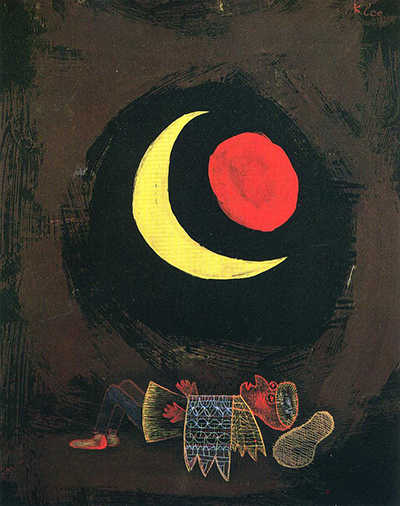
A yellow crescent and a red disc shine inside a black circular field. Far below, a small, loosely drawn figure reclines. In Paul Klee's Starker Traum, usually translated Strong Dream, the brilliant shapes overhead dwarf the sleeper without telling us whether they belong to the outside sky or to an inner vision. The title names the experience as a dream; the painting gives the dream a surprisingly concrete visual weight.[1]
This is a securely identifiable work, not merely a popular image with a generic English title. The artist's mount carries the inscription “1929 3.H.33 Starker Traum V,” as recorded by Christie's when it offered the sheet in 2026. The image measures 26.3 × 21 cm and is gouache and watercolour on paper laid down on Klee's own mount. The auction catalogue cites Paul Klee: Catalogue Raisonné, volume 5, page 403, number 5089. That citation is useful as an identity crosscheck, though the printed catalogue entry itself has not been read for this page.[1]
Two scales of experience
The work's immediate contrast is one of size. A broad dark disc dominates the upper part; the person below is a narrow tangle of coloured lines. The crescent is so bright that it holds the eye before the figure is noticed. Red then answers yellow: the smaller circular form sits in the same dark zone, almost touching the inward curve of the crescent. Their relation can evoke moon and sun, moon and star, or a pair of celestial signs. Christie's calls the red shape a star in its essay, but the image alone does not require that identification. It is safer to describe its shape and position before naming its astronomical role.[1][2]
The sleeper is both delicate and active as a drawing. Bent limbs and a lifted face are made with fine, differently coloured lines; a small pillow-like form lies near the head. The figure's body is far less filled in than the red and yellow forms overhead. This does not make the person less important. The title makes that small figure the possible source of the vast scene. Klee has arranged an enormous image above the tiny dreamer, so the dream can feel larger than the body that produces it.[1]
Around the central black field, brown and grey strokes remain visible against the dark ground. They give the night area a worked, unsettled edge rather than a mechanically perfect circle. Klee's handling of gouache and watercolour creates several kinds of darkness: solid black behind the celestial forms, rubbed or brushed tonal variation around it, and a dim field around the sleeper. The contrast is therefore built with texture as well as with colour. The inherited page's description of a hasty sketch should not be reversed into the equally unsupported claim that every mark has a known symbolic purpose. The physical marks can be described without pretending to recover a complete private code.[1]
The object and its long passage through collections
Christie's records that Klee entrusted the work to Alfred Flechtheim in December 1930, then to Daniel-Henry Kahnweiler around 1934, and that it was with London's Mayor Gallery by 1935. These are consignments, not necessarily changes of ownership. It appeared at the Mayor Gallery's Klee exhibition in June 1935, then at the Leicester Galleries in March 1941. Edward Le Bas acquired it from the latter in 1941. His collection was shown at the Royal Academy in 1963; the work was sold at Christie's Geneva in 1969 and passed through later private and gallery hands. The auction record says the consigning owners acquired it in 2012.[1]
That sequence matters because it explains why the painting is associated with a private collection in modern image catalogues and why reproductions have circulated under several names. It also shows that the work entered British exhibitions well before Klee's late twentieth-century popularity. The 1946 Arts Council touring exhibition carried it through several British cities, while a 1999–2001 exhibition about dreams placed it in a different interpretive setting. These documented displays support a history of changing reception without proving that any one exhibition's theme expresses Klee's own intention.[1]
The year of the Egyptian journey
Klee made Starker Traum during his Bauhaus period, after his 1928–29 Egyptian journey. Zentrum Paul Klee's chronology confirms the travel, while its Mapping Klee project explains that Egyptian landscape and hieroglyphic forms informed works he later developed in the studio. The auction essay reads the crescent and red disc in relation to Middle Eastern and Islamic imagery and calls the reclining figure an angel. Those are the auction house's readings, not facts supplied by the artist's inscription. The sheet does not depict an identifiable Egyptian place, and the chronology alone cannot prove that a particular sight on the journey generated this painting.[1][3][4]
Klee's own title leaves the relationship between inner image and outer world unresolved. Even Christie's essay asks whether the celestial scene is the sky above the sleeper or the content of the dream. That question is more productive than assigning the disc and crescent a fixed religious meaning. A viewer can follow the powerful formal contrast—open and filled shapes, fine line and opaque colour, small body and immense circle—without settling the symbolic question. The painting remains specific in its materials and layout while generous in its possible readings.[1]
The German word starker suggests force or intensity. It need not mean that the dream is frightening. The dark ground gives the image drama, but the sleeper is not visibly struggling. Nor does the scene provide evidence for a clinical theory of the unconscious. The work's force lies in a visual inversion: a fragile person occupies very little space, yet the image associated with that person commands the page. Such a relation can be felt directly even when one refuses to assign the red disc a single celestial identity.[1]
A precise title, a cautious image decision
The dated artist’s mount, material description, dimensions and catalogue number distinguish Starker Traum from other dream and moon pictures by Klee. Its visible features agree with the published auction image.[1][5]
Klee's picture asks the eye to travel repeatedly between the small sleeper and the enormous disc. The movement makes scale part of the subject. It can feel like a night sky pressing down or like an inner image expanding outward. The formal facts remain observable: a reclining lined figure, a yellow crescent, a red round form, a black field and dark worked edges. The title holds them together as Strong Dream while leaving the actual contents of that dream open.[1]
Related artworks
Explore eight other Klee works from the researched artwork cluster.
Fire in the Evening
1929
Highway and Byways
1929
Ad Marginem
1930
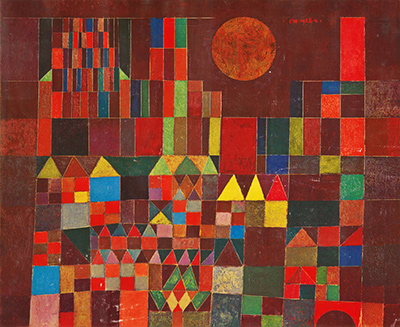
Castle and Sun
1928
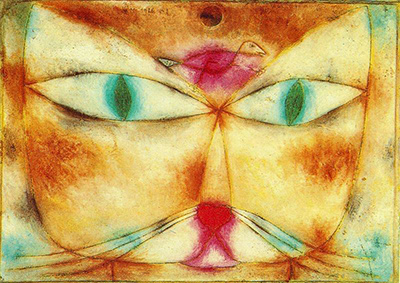
Cat and Bird
1928
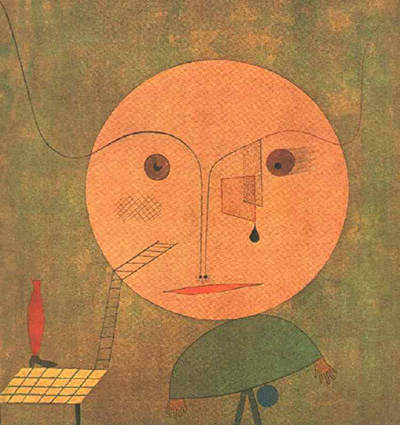
Error on Green
1930
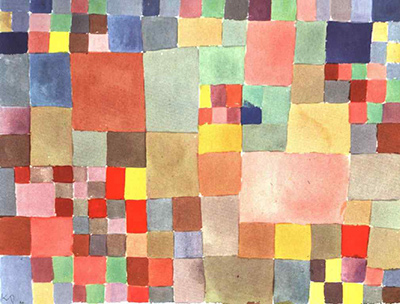
Flora on Sand
1927
Ad Parnassum
1932
References
- Christie's, Paul Klee (1879–1940), Starker Traum, lot 5, artist's inscription, medium, dimensions, provenance, exhibition history and catalogue raisonné citation; accessed 27 September 2026, View source.
- Bridgeman Education, Paul Klee assets, lists Strong Dream, 1929, no. 333, as watercolour and gouache on primed paper on cardboard; accessed 27 September 2026, View source.
- Zentrum Paul Klee, Kosmos Klee guide, chronology, records Klee's 1928 Egypt journey and Bauhaus years; accessed 27 September 2026, View source.
- Zentrum Paul Klee, Mapping Klee, “Ägypten 1928” and landscape-composition sections; accessed 27 September 2026, View source.
- SuperStock/Bridgeman, Sun and Moon (Subtitled Starker Traum), licensed-image listing and use restrictions; accessed 27 September 2026, View source.
- Deutscher Musikwettbewerb, “Bilder und Texte zu Painted Music”, contemporary German programme identifying Starker Traum and its WikiArt image claim; accessed 27 September 2026, View source.