


 by Tom Gurney
Tom Gurney BSc (Hons) is an art history expert with over 20 years experience
Published on June 19, 2020 / Updated on September 27, 2026
Email: tomgurney1@gmail.com / Phone: +44 7429 011000
Heroic Strokes of the Bow: Klee’s painted gesture
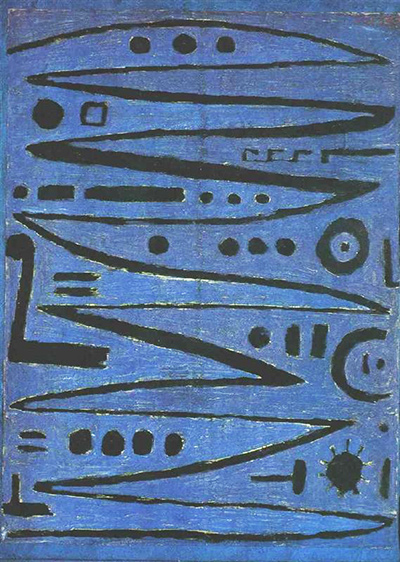
Paul Klee’s Heroische Bogenstriche was made in 1938. The Museum of Modern Art, New York, translates its title as Heroic Strokes of the Bow. This page has long called the same work Heroic Fiddling, a looser English rendering that preserves its familiar address but is not the museum’s preferred title. MoMA identifies the work as object 958.1979, measuring 73 × 53 cm, and credits the Nelson A. Rockefeller Bequest. Its older online catalogue gives “Klee 7202” as a reference to the published catalogue raisonné; that printed entry has not been checked directly here.[1][2]
The painting’s broad black paths cross a blue field from side to side. They change direction sharply, taper, swell and sometimes run nearly parallel. Small circles, bars and other signs fill the spaces between them. No violin or player is pictured. The title directs attention to the movement of a bow across strings, while the arrangement makes that motion visible through the weight and direction of marks. MoMA’s gallery account treats the zigzags as a suggested rhythm, not as an illustration of a particular performance.[1]
The support beneath the blue
The older description of this work as paint “on canvas” misses its unusual physical construction. MoMA’s current record specifies pigmented paste on newspaper on dyed cloth on board in the artist’s frame. Its older record describes the textile more specifically as dyed cotton fabric. Newspaper, cloth, board and frame are parts of a made object, not incidental backing for an image that could be transferred unchanged to any smooth surface.[1][2]
The newspaper can be easy to miss in a reduced reproduction. MoMA points out that fine printed type remains barely visible beneath the coloured paste and runs vertically against the much larger black marks. Those fragments bring an ordinary, dated material into the picture, even though the text cannot reliably be read here. They also set up a striking change of scale: tiny repeated letters and big hand-drawn gestures occupy the same plane.[1]
The paste has a denser presence than a transparent wash. Blue covers much of the ground but varies across the surface, while black lines seem to ride over it. The frame makes a visible boundary around the compressed composition. From a screen image one can describe those relationships, but not determine the exact order in which Klee attached, dyed or coated every layer. MoMA’s material record supplies the firmer account of the support.[1]
A MoMA exhibition checklist and catalogue from the 1950s described the medium instead as tempera and oil on paper and used the English title Heroic Bowing. These are valuable records of how the work was presented then; their shorter material formula should not replace MoMA’s present object description. The changes in English wording also show why the German title matters. Bogenstriche points to strokes of the bow, both a violinist’s movement and, here, an invitation to look at Klee’s marked surface.[1][3]
Marks with rhythm, without a score
The longest black line near the top bends broadly before it meets the edge. Below, other lines swing out and turn back, so that the eye repeatedly travels across the width and then reverses. Some marks are thick and blunt; others narrow to a fine end. The scattered discs and short bars interrupt those journeys. The result can feel measured in pulses, but it does not display a staff, clef or sequence of notes from which a melody could be reconstructed.[1]
MoMA likens the field of dashes, circles and hard-to-read signs to a tablet of hieroglyphs. That comparison describes the viewer’s experience of looking at marks that suggest a system without yielding a literal translation. A circle might resemble a peg or a note head, yet the painting does not require one symbol-to-object key. Its motion comes from changes in interval, direction, thickness and repetition.[1]
Music theorist Leonard Probst connects this work to discussions of line and embodied movement in Bauhaus-era art and music. Following art historian Régine Bonnefoit, he reads the strokes as transferring the bodily action of bowing into painterly gesture. His article offers an interpretation of how the lines work, not proof that Klee encoded a particular piece of music. Probst calls the surface a canvas in passing; MoMA’s object record is the source for the actual newspaper-and-cloth construction.[1][4]
A German-language essay from Museumsdienst Köln likewise points to the blue on newspaper and the work’s musical cues. Its broad claim that the picture contains signs of composition is most useful as evidence of reception; it does not identify a score. The safest reading keeps both aspects together: Klee’s violin title and deliberate visual rhythm make music relevant, while the forms remain open to more than a single musical decoding.[5]
A late work and a related picture
Klee produced Heroische Bogenstriche after leaving Germany for Switzerland in 1933. MoMA places his late works in a period of intense production and increasingly direct mark making. That context helps explain why the large black lines command this picture. It does not make the blue ground a coded political statement or the black marks a record of a particular symptom; neither claim follows from this object record.[1]
MoMA’s historical exhibition catalogue notes another 1938 composition, The Grey One and the Coastline, in relation to this painting. It reports that the second picture was first called Bowing II before Klee changed it toward a coastal subject. The catalogue attributes a possible dedication to violinist Adolf Busch to Will Grohmann’s 1955 study. Since Grohmann’s page and Klee’s own documentation have not been read for this manuscript, the dedication remains a reported possibility rather than an established intention for Heroische Bogenstriche itself.[3]
That comparison is useful without collapsing two works into one. A pattern of bow-like lines could be taken toward a different image by changing a few elements and its title. In Heroische Bogenstriche, the German name holds the musical possibility in the foreground; in the related picture, the shore became the principal way to see the marks. The same sort of line can therefore invite more than one visual subject.[3]
From picture to music
Composer Judith Weir made an orchestral piece titled Heroic Strokes of the Bow in 1992 in response to Klee’s painting. In her own programme note she says the work answers the title more directly than it depicts the image: energetic violins dominate the piece, whose restless opening gives way to a broader close. Weir’s distinction is helpful. The painting inspired a new composition, but the composition is not a recovered sound track hidden in Klee’s marks.[6]
Weir describes the picture as blue and black over pink newspaper and repeats a tradition that it was a tribute to Busch. The material observation agrees broadly with MoMA’s account, while the tribute should retain her cautious “said to be” status until the historical evidence is checked. Her music shows how a later artist could take Klee’s title and gestures seriously while making a work with its own form and decisions.[1][3][6]
MoMA acquired the painting through Nelson A. Rockefeller’s bequest under accession 958.1979. A MoMA 1969 announcement of his intended bequest already named Heroische Bogenstriche among the proposed Klee works. The museum’s present title, material description and object number should therefore guide identification; older English labels and this site’s Heroic Fiddling remain useful as aliases, not separate artworks.[1][7]
The picture’s force lies in this meeting of material and motion. Newspaper type remains underneath; blue paste creates a field; sweeping black marks make the hand’s action prominent. Its title brings violin playing into the act of looking, but leaves the viewer to follow the strokes rather than to translate them into a tune.[1][4]
Related artworks
Explore eight other Klee works from the researched artwork cluster.
Insula Dulcamara
1938
Viaducts Break Ranks
1937
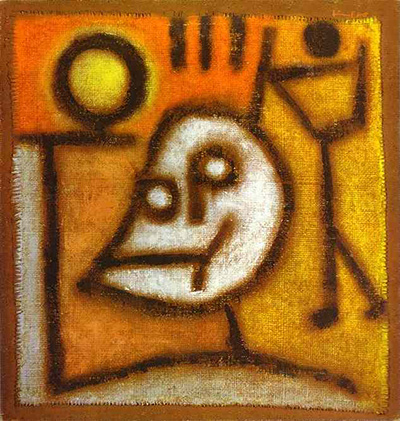
Death and Fire
1940
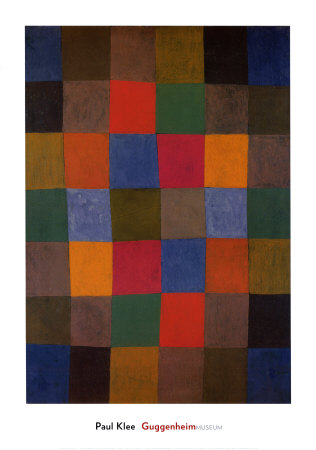
New Harmony
1936
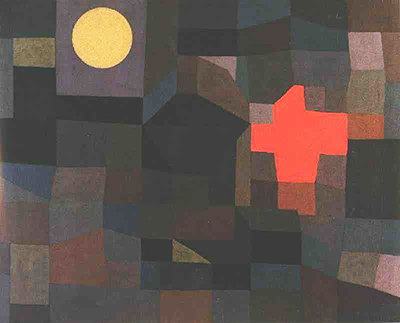
Fire Full Moon
1933
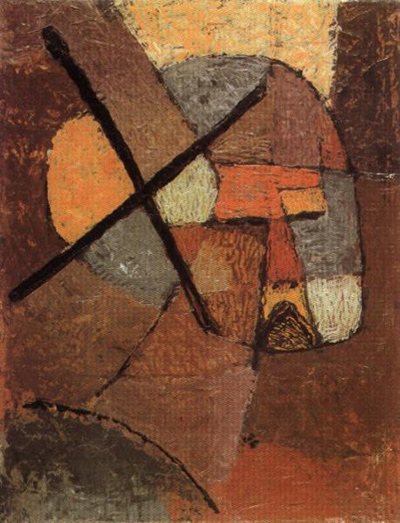
Struck from the List
1933
Ad Parnassum
1932
References
- Museum of Modern Art, Heroic Strokes of the Bow (Heroische Bogenstriche), object 958.1979 (English): current owner title, date, material, dimensions, bequest, image-rights notice and 2006 gallery interpretation, View source.
- MoMA, older online object record for Heroic Strokes of the Bow (English): dyed cotton specification and “Klee 7202” reference. This is an indirect catalogue pointer, not direct inspection of the printed entry, View source.
- MoMA, Two Exhibitions: Works of Art, Given or Promised (English), p. 25: historical Heroic Bowing title and medium, comparison with The Grey One and the Coastline, and an attributed pointer to Grohmann 1955, View source.
- Leonard Probst, “Visualizing Bach’s Polyphony at the Bauhaus,” Music Theory Online 26, no. 4 (2020) (English), §2.5 and note 14: scholarly interpretation of Klee’s bow gestures following Régine Bonnefoit, View source.
- Anke von Heyl, “Blue Note (Blau 19),” Museumsdienst Köln (German, 2012): museum-education reception of the newspaper ground and musical hints, View source.
- Judith Weir, programme note for Heroic Strokes of the Bow (English): composer’s first-hand explanation of her 1992 response to Klee and its performance history, View source.
- MoMA, 27 May 1969 press announcement of the Rockefeller intended bequest (English): lists Heroische Bogenstriche among the proposed works, View source.