


 by Tom Gurney
Tom Gurney BSc (Hons) is an art history expert with over 20 years experience
Published on June 19, 2020 / Updated on September 27, 2026
Email: tomgurney1@gmail.com / Phone: +44 7429 011000
Following Klee’s line
Paul Klee’s line can be a darting creature, a wire, a path across paper or a broken sign that seems almost readable. It is tempting to set his drawings apart from his colourful paintings. The objects resist that division: he drew through wet and dry media, used painted colour with graphic marks, transferred lines from one sheet to another, and sometimes made the paper or mount part of the work’s meaning. A drawing is often a finished Klee work, rather than a preparatory step toward a canvas.[1][2][4]
The Zentrum Paul Klee calls him primarily a draughtsman and says roughly 80% of his oeuvre consists of works on paper. That figure covers more than black-and-white drawings: watercolours and mixed-media sheets belong to the larger category. The Bern museum says its own collection is also about 80% drawings and watercolours, with about 20% paintings. These are two related descriptions, not a licence to say that exactly 80% of all Klee works are pencil drawings. This guide follows particular objects and methods to show how his graphic practice changed.[1]
Contents
- What counts as a Klee drawing?
- Why did Klee keep his childhood drawings?
- How did line become an image?
- What is oil-transfer drawing?
- What does a reed pen do in Gemischt?
- How did the late drawings change?
- A painted drawing on newspaper
- How should a drawing be identified?
- Follow the line onward
What counts as a Klee drawing?
The answer depends on whether we mean a way of making marks, a physical object, or a museum collection category. Gemischt (Mixed) of 1927 is straightforwardly made with reed pen and black ink over traces of graphite. Twittering Machine of 1922 begins from a transferred drawing but includes watercolour, ink and gouache borders on a board. God of War of 1937 is classified as a drawing by its owner, although it is made with gouache and tempera on newspaper fixed to an artist’s mount. Those three works would be poorly described by one sentence about “pencil sketches.”[3][4][5]
The support matters too. Paper can be translucent, rough, trimmed, stained or mounted. Klee’s own prepared or attached mount may contain an inscription that belongs to the work’s identity. A current museum record may measure the image sheet and the larger support separately. A database class can tell us where a museum files the object; its material field tells us more about how Klee made it. The materials and techniques guide explores those constructions in greater depth, while the watercolours guide treats the specific possibilities of water-based colour.[3][5]
Conservators Elizabeth Kaiser Schulte, Margaret Holben Ellis and Antoinette King examined Klee’s compound drawings in a 1986 study. Their central point is physical: the image sheet and the secondary support are parts of one constructed object. They found that Klee commonly mounted sheets himself, chose support proportions for individual images, and sometimes added black or coloured borders. Dates, titles and work numbers could be written on the mount. Their conversations with Felix Klee supplied family recollections of his father cooking flour paste; those memories complement, but are distinct from, what the conservators saw on the objects. The authors argue that cropping a reproduction to the inner image removes evidence of how Klee presented the work.[16]
Their treatment of Bauchtanz (Belly Dance) shows why construction cannot simply be flattened into a neat label. This ink, watercolour and graphite drawing was attached at eighteen spots. Tension around those points produced severe distortions and damage; the conservators released and repaired it, retaining signs of Klee’s attachment while reducing the worst strain. They did not conclude that all artist mounts should be removed. Their broader survey found no evidence that the typical mount routinely damaged the image sheet through acid migration, so they urged case-by-case treatment rather than automatic disassembly.[16]
A 2016 account by Tora Hederus and Alison Norton, conservators at Moderna Museet, shows the same issue in another collection. They found some artist mounts cut or folded to suit later frames, as well as tape and glue added during remounting. On one 1938 newspaper-supported work, Will weg, muss weinen, treatment exposed a different title variant written on the secondary support and previously hidden by the frame. That discovery does not tell us which title should govern every catalogue; it shows how an apparently peripheral strip of card can preserve object evidence. A full view of sheet and mount is therefore an aid to attribution and interpretation, not merely a decorative preference.[17]
Nor should drawing automatically mean something unfinished. Klee registered works, titled many of them, mounted sheets and presented drawings in exhibitions. In 1912, for example, he showed 17 works in the second Blue Rider exhibition in Munich, an exhibition devoted to graphic work. A paper object could be a public, catalogued endpoint, not a studio note awaiting a more prestigious painting.[1][9]
Why did Klee keep his childhood drawings?
The museum’s account of Familie bei Tisch (Family at Table), dated 1885, supplies an unusually concrete starting point. Klee rediscovered some of his childhood drawings in 1902. In 1911 he put childhood sheets at the beginning of the catalogue in which he listed his works. That editorial act gave them a place inside the story he constructed of his own practice. It did not mean that every adult drawing was made by attempting to forget what he had learned.[6]
The Family at Table sheet arranges adults and a small child at different scales. The museum suggests the figures represent Klee’s parents and himself and reads the father as an authority. That is an institutional interpretation of the picture, not a direct transcript of what the six-year-old thought. The more secure point for this page is the later, documented act of preservation and catalogue placement. Klee chose to treat these early lines as art worth retaining and numbering.[6]
Childhood art also entered a larger debate. The Zentrum Paul Klee’s chronology records that Klee began collecting drawings and watercolours by his son Felix in January 1913. In a January 1912 review of the first Blue Rider exhibition, published in the Swiss journal Die Alpen, Klee had argued that beginnings of art could be found in children’s work and in objects then discussed under ethnographic and medical categories. The original issue and page 302 are identifiable in the Swiss digital journal archive, although its PDF currently requests verification. German academic studies reproduce the relevant passage, but its full original setting should be checked before using a direct quotation or treating the ideas as a fixed recipe for Klee’s later work.[7][8]
These histories must stay distinct. There are Klee’s own childhood sheets, Felix’s drawings, Klee’s 1912 criticism, and adult works that viewers later called childlike. They do not prove one simple line of imitation. The old page here spoke of an untrained freedom Klee copied. That description misses the deliberate decisions in his adult work: where a line begins, whether it is transferred or drawn directly, how a figure is distorted, and how the whole sheet is mounted or titled. A 1907 group of figure drawings, described by the Zentrum Paul Klee as anatomically grounded in places and grotesquely or ornamentally transformed in others, already shows choice rather than mere inability.[6][7][10]
How did line become an image?
In the early graphic work Klee could start from a recognisable body, then pull it toward caricature or ornamental arrangement. The 1907 halbakt, archaisierender weibl. ensemble at Bern brings multiple drawings onto a shared mount. Its forms alternate between studied anatomy and deliberate distortion. Their relationship on that mount is part of what a small isolated reproduction can hide. The exact medium and work number still need confirmation before this page can use it as a full object caption, but the museum’s description establishes the formal range.[10]
Line later became both a shape and a route for looking. The Zentrum Paul Klee’s digital tour describes it as a continuing expressive and structural concern even after Klee’s stronger turn toward colour. A contour can suggest a bird or a machine; it can also cross an area to set direction and tempo. One does not have to choose between line depicting something and line organising the surface. The strongest examples permit both ways of seeing at once.[2][4]
That double role explains why a generic label such as “hieroglyphic signs” is insufficient. A sign-like stroke can evoke writing without belonging to an alphabet we can translate. On any given sheet, the reader must ask what the mark does beside its neighbours, whether it encloses a figure, and what a museum or scholar can actually document about it. A resemblance to a letter is an observation; a fixed message attributed to Klee needs more evidence.[2][11]
What is oil-transfer drawing?
Twittering Machine (Die Zwitscher-Maschine), 1922, is an especially useful test. MoMA identifies it as oil-transfer drawing, watercolour and ink on paper, with gouache and ink borders on board. Its object number is 564.1939. The drawing presents bird-like creatures joined to a mechanical perch, but the dark strokes did not all arise from pen meeting this final sheet directly.[4]
MoMA describes a sheet bearing an earlier drawing placed over a surface covered in dried oil paint, itself laid face down against the receiving paper. Klee pressed along the earlier lines with a needle; pressure transferred the image and could leave irregular smudges. A 1978 MoMA publication dates his development of this method to 1919. It produced a drawn image with some of the unpredictable texture of an impression. That does not make each result a conventional multiple or editioned print. The source line, transfer sheet, pressure, receiving sheet and later colour all matter.[4][12]
In Twittering Machine, wiry black lines articulate birds, crank and perch, while colour gives the image a very different atmospheric reach. MoMA’s 2019 account reads it as a disturbing collision of living birdsong and human machinery. That is the museum’s interpretation, useful because it follows both the actual marks and the title. Other readers may first notice the creatures’ comic gestures. The medium itself supports the tension: a mechanically mediated line depicts a device that seems to mechanise nature.[4]
An oil-transfer drawing can be recognisably drawn even though its line arrived indirectly. It complicates the division between original drawing and print, just as a watercolour and ink addition complicates the division between drawing and painting.[4]
What does a reed pen do in Gemischt?
The National Gallery of Art in Washington identifies Gemischt (Mixed), 1927, as reed pen and black ink over traces of graphite, 29.5 × 41.8 cm, accession 1988.7.1. The museum’s description shows an interlocking play of lines that can suggest animated, creature-like forms, but that automatically generated description should not be promoted into Klee’s own identification of particular animals. The recorded materials tell a more precise story: the graphite traces and black ink are different stages of mark-making, and the reed pen’s line is not the same as a pencil contour.[3]
The NGA record also shows why labels and numbers need care. It gives the published catalogue raisonné number 4372, while the inscription on a separate sheet reads “1927 F.8 gemischt.” The latter belongs to Klee’s annual notation and title evidence; it is not another accession number. A photo cropped to the principal drawing could omit the lower title sheet, hiding the physical basis for the name. The museum says its image is not available for download, so this page links to the owner’s record rather than importing the image.[3]
The title Gemischt invites more than one meaning of mixture. Its marks overlap, and its object combines at least ink and graphite. But the title alone does not say Klee intended a theory of mixed media or that a specific creature appears. The page can show readers how to look for successive lines and how to read a collection label without turning either into a closed allegory.[3]
How did the late drawings change?
Klee’s late graphic output is substantial. A Zentrum Paul Klee exhibition on the late sheets cites his 2 January 1940 letter to Will Grohmann: he described 1939 as unusually rich and intense for drawing and noted 1,200 work numbers that year. The exhibition concentrated on pencil, ink and paste-colour sheets, some organised in sequences traceable through annual numbers. This is more exact than saying that illness made every late line bold, dark or despairing.[13]
The same exhibition points to Klee’s 1938 annotation beside work number 365, Süchtig, recalling the old maxim about not letting a day pass without a line. It raises a question about his final 1940 annual number and that leap year’s 366 days. The museum explicitly frames the possible relationship as a question. It must not be turned into a proven daily schedule or evidence that he completed one drawing each day. Work numbers record registered works, not a diary of every hand movement.[13]
The Zentrum Paul Klee’s Ohne Titel (Zweierlei Augenmass), made around 1938, offers a quieter late example. The museum describes spare, free curves that produce a figure, face and differently read eyes. Klee himself gave it no title; the parenthetical Zweierlei Augenmass came from Felix after Klee’s death. The distinction affects interpretation. A viewer may find the two eyes compelling, but cannot cite that later phrase as evidence that Klee chose the subject in 1938.[14]
A more broken graphic language appears in Bedrohliche Zeichen (Threatening Signs), 1938, at the Centre Pompidou. The French collection essay by Guitemie Maldonado describes segments and intervals as means of structuring the space, rather than treating broken signs as mere collapse. She relates drawing to colour and proposes a borderland between visible forms and suggestive, unreadable writing. Her larger account brings in illness, death and political crisis; those are an attributed interpretive frame, not a diagnosis encoded in every stroke. The object is in a graphic collection while its material record includes paste colour, graphite, wrapping paper and card. Once again, the physical sheet refuses a narrow idea of drawing.[11]
A painted drawing on newspaper
The Cleveland Museum of Art calls God of War a drawing, although its medium is gouache and tempera. Klee painted on newspaper, then tipped that sheet onto a larger cream-coloured artist’s mount. The image sheet measures 35.2 × 29 cm; the secondary support is 64.6 × 49.3 cm. The record identifies catalogue number 6961 and the museum’s own accession 1992.278. These are different identifiers for one object.[5]
The painting’s large face, small figures and red border coexist with fragments of print still visible through or beside the colour. Cleveland identifies a visible article as concerning the Spanish Civil War and interprets the painting in the anxiety of the late 1930s. That context is more specific than calling the sheet vaguely “political,” yet it does not prove that every sign is a literal cipher for a particular event. The newspaper is a material and a contemporary document inside the work; the exact printed words and their relationship to Klee’s intention deserve fuller study.[5]
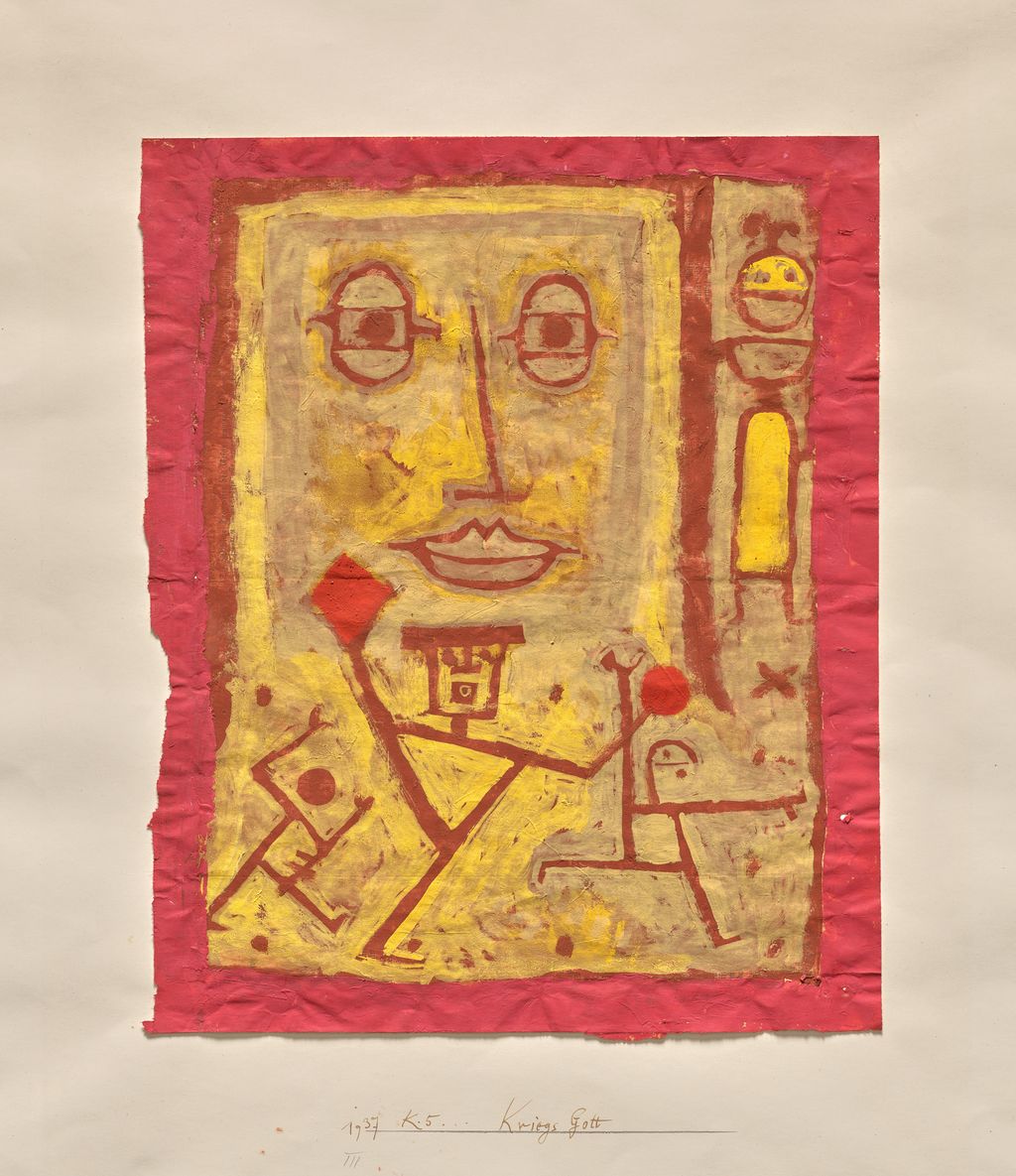
The reproduction is a useful reminder of both the reach and the limit of a category. The work uses painted blocks of strong yellow and red, yet its network of signs and its registration as a drawing matter. If a visitor arrived here expecting only thin black pencil lines, this object gives a more accurate sense of Klee’s graphic range.[5]
How should a drawing be identified?
Start with the owning museum’s title, date, support, medium, dimensions and inventory number. Then distinguish Klee’s annual entry from the published catalogue raisonné number and from the museum accession. Ask whether the title is Klee’s, on a separate strip or mount, a translation, or supplied after his death. Gemischt and Ohne Titel (Zweierlei Augenmass) show two different reasons to ask. A drawing’s identity is not exhausted by the picture area alone.[3][14]
Next look at the physical construction. An oil-transfer mark differs from direct ink; a newspaper sheet differs from a plain drawing paper; a mount may carry a title and change proportions. Finally separate what can be seen from what has been proposed. The bird-machine reading in MoMA’s account, Maldonado’s fragmented-space interpretation and Cleveland’s political context are informed readings by named institutions or authors. None licenses a universal key for all Klee lines.[3][4][5][11]
Follow the line onward
Klee’s drawings range from childhood sheets that he later admitted into his catalogue to direct ink, transferred oil lines, painted newspaper and late fragments that hover between image and writing. The difference between them is as meaningful as the continuity. Line could carry humour, satire, movement, colour or a disturbing incompleteness without having to serve as a sketch for a future painting.[2][3][4][5][6][11]
The broad claim that Klee was chiefly a draughtsman becomes convincing only when these particular works are kept in view. His roughly 80% works-on-paper share is a measure of scale; the material records show variety within it. Follow the artwork directory for individual objects, the watercolour guide for the coloured sheet, the prints guide for editioned processes and the materials guide for supports and transfer.[1][3][4][5]
Discussion
Klee used drawn lines across direct ink, oil transfer and painted sheets.
Object records help distinguish a visible mark from its material and later interpretation.
Reader Insights
Which drawing changed when you learned how its line was made?
Where does a mount or inscription change the way you read a sheet?
Which source would you check before assigning a meaning to a sign?
Join the Conversation
Share the work and the evidence behind your reading.
References
- Zentrum Paul Klee, English collection overview, with German and Italian versions, on Klee as draughtsman, the approximately 80% works-on-paper share and the collection’s 80/20 distribution. The translations are one institutional source family, not three independent counts.
- Zentrum Paul Klee, Kosmos Klee digital tour, German, and English tour, on continuing roles of line and colour; general curatorial context rather than an object-specific technical record.
- National Gallery of Art, Gemischt (Mixed), 1988.7.1, medium, dimensions, inscriptions, separate lower-title sheet, published catalogue raisonné no. 4372 and image-download restriction. The page’s automated visual description is not treated as the artist’s iconography, View source.
- Museum of Modern Art, Twittering Machine, 564.1939, object data and excerpt from MoMA Highlights (2019) on oil transfer, colour and interpretation; current ARS/VG Bild-Kunst image notice, View source.
- Cleveland Museum of Art, God of War, 1992.278, object, support, dimensions, catalogue number and museum interpretation; official image/metadata API records CC0 status and 2,938 × 3,400-pixel print image. The museum’s general 1937-exile timing phrase is not used.
- Zentrum Paul Klee, Familie bei Tisch, German, with French version, on the 1885 childhood work, 1902 rediscovery and 1911 catalogue placement; family-psychology reading is attributed to the museum.
- Zentrum Paul Klee, German chronology and archival exhibition guide, pp. 27–28, dates the 1912 review/graphic exhibition and 1913 Felix collection; Cobra exhibition for later reception.
- Paul Klee, January 1912 review in Die Alpen, vol. 6, issue 5, p. 302, original issue entry. Original PDF currently returns verification; context and wording checked against Evelin Priebe, German academic study, p. 159. No direct quotation is used.
- Lenbachhaus, Der Blaue Reiter history, German, on the second exhibition as paper-only; Zentrum Paul Klee, biography, records Klee’s 17 exhibited works.
- Zentrum Paul Klee, halbakt, archaisierender weibl., German, on the 1907 drawing ensemble and its mixture of anatomical, grotesque and ornamental treatment; full physical catalogue data remains to check, View source.
- Centre Pompidou, Bedrohliche Zeichen, French owner record and Guitemie Maldonado essay from the 2008 graphic-collection catalogue, on fragmented lines, intervals and ambiguous writing; the political and medical frame is attributed to the essayist, View source.
- Museum of Modern Art, 1978 exhibition release on Klee prints and transfer, p. 2, dates his development of oil-transfer drawing to 1919. The process is read with MoMA’s Twittering Machine object account, View source.
- Zentrum Paul Klee, Kein Tag ohne Linie exhibition account, German text on a French-locale route, on late drawing, the 2 January 1940 Grohmann letter, Süchtig and the explicitly tentative leap-year hypothesis, View source.
- Zentrum Paul Klee, Ohne Titel (Zweierlei Augenmass), German, circa 1938; Felix’s parenthetical posthumous title and institutional formal description, View source.
- Existing local drawings page, saved before manuscript replacement; the five inherited embedded work reproductions were inspected in the HTML but are not treated as newly cleared supplementary images. The splash and affiliate subtree are retained verbatim.
- Elizabeth Kaiser Schulte, Margaret Holben Ellis and Antoinette King, “An Approach to the Conservation Treatment of Paul Klee Drawings,” The Book and Paper Group Annual 5 (1986), direct conservation study of compound drawings, artist mounts, inscriptions, adhesives, Bauchtanz and wachsendegras. Felix Klee’s recollections are identified separately from direct material observation, View source.
- Tora Hederus and Alison Norton, “The conservation and re-framing of Paul Klee’s works of art on paper from the Moderna Museet collection”, 20 January 2016, first-hand treatment account on trimmed mounts, hidden title evidence, tape, glue and framing decisions. Its reference to the 1986 paper is not counted as independent confirmation of that paper’s entire survey, View source.