


 by Tom Gurney
Tom Gurney BSc (Hons) is an art history expert with over 20 years experience
Published on June 19, 2020 / Updated on September 27, 2026
Email: tomgurney1@gmail.com / Phone: +44 7429 011000
A journey in colour and place
In April 1914 Paul Klee travelled through Tunisia with fellow artists August Macke and Louis Moilliet. Within roughly two weeks he made watercolours and drawings of streets, gardens, buildings and coast. The journey became one of the best-known episodes of his career, largely because of a diary declaration dated 16 April: “Die Farbe hat mich … ich und die Farbe sind eins. Ich bin Maler” — colour has taken hold of him; he and colour are one; he is a painter. The sentence is compelling, but it is neither a description of every picture made there nor proof that Klee first discovered colour on that day. The diary was subsequently edited by its author, and he had been investigating colour before he left Europe.[1][2][3]
The works make a more interesting story than a single instant of conversion. In one sheet a Tunis café remains populated by quick figures; in another, buildings near St. Germain resolve into a loose grid of colour. At Hammamet, a recognisable mosque and a modern military tower occupy the same skyline, while translucent areas below loosen the view from ordinary perspective. These are distinct responses to places Klee visited, sometimes transformed further by cutting and mounting. Their later reception has also transformed the journey itself.[2][4][5]
Contents
- Who travelled, and what did they make?
- What did Klee mean by “I am a painter”?
- Looking at the Tunis street café
- St. Germain: a landscape organised as colour
- Hammamet: what a watercolour leaves in and out
- Kairouan, the diary and later return
- A journey within French colonial Tunisia
- What changed after Tunisia?
Who travelled, and what did they make?
Klee, Macke and Moilliet crossed from Marseille to Tunis in April 1914. Their route included the capital, St. Germain near Tunis, Hammamet and Kairouan. Moilliet knew Tunisia from an earlier visit, and the three did not arrive with the same experience of the country or make identical kinds of work there. The Zentrum Paul Klee's 2014 exhibition account counts 35 watercolours and 13 drawings by Klee during the stay, alongside 33 watercolours and 79 drawings in three sketchbooks by Macke. Those are the institution's counts for work made on the journey; they do not include all subsequent works inspired by it and should not be treated as an item-by-item catalogue of surviving sheets.[1][5]
The transfer from Hammamet to Kairouan was itself part of what Klee recorded. Roger Benjamin reconstructs the 15 April journey from the published diary: the three artists walked roughly ten kilometres inland through sand to Bir Bou Regba station, travelled by rail through Kalâa Sghira, and reached Kairouan that afternoon. Benjamin compares Klee's self-conscious account of their European appearance on the road with his less generous descriptions of people they encountered. The itinerary places the celebrated 16 April colour declaration after a concrete day of travel and social encounters; it does not explain that declaration away or make it a direct caption for any one watercolour.[5]
The comparison matters. This was a shared expedition in which the artists looked, travelled and worked together, yet their pictures need not be read as a single collective style. Macke's photographs also form part of the visual record. Roger Benjamin's detailed study of Hammamet identifies Moilliet's drawing of a beached boat, Macke's scene of harbour activity and three very different Klee watercolours connected with the town. Each selected a different part of its architecture or daily activity. The journey produced collaboration and exchange, not one uniform “Tunisian look.”[1][5]
Klee's own record is uneven. He assigned annual numbers to works, but a numbered 1914 sheet is not automatically evidence that its present appearance was completed outdoors in Tunisia. Paper could be painted in front of a motif, carried away, mounted, trimmed or revisited. The question of when a work took its present form has to be asked for each object. The Centre Pompidou reports Wolfgang Kersten's view that St. Germain near Tunis (Inland) was painted before the motif, while its own analysis notes white bands made by the rubber bands holding Klee's paper. In that sheet he kept some of those reserves as active vertical elements instead of removing them. This is a documented process for a named work, not a licence to say that every Tunisia watercolour was made or cut in the same way.[4]
What did Klee mean by “I am a painter”?
The famous diary passage is attached to 16 April 1914, when Klee was in Kairouan. Its textual anchor is entry 926o in Wolfgang Kersten's critical edition of the Tagebücher, page 350. The short German declaration is reproduced by the Berlin State Museums and by the Zentrum Paul Klee. Both its date and its later publication history matter. The Berlin museum explicitly notes that Klee re-edited the diary near the end of 1921; research on the diaries places his larger retrospective revision between 1916 and 1921. We can securely say that the declaration is part of Klee's account of his experience. We cannot simply treat the published text as an untouched notebook entry penned at the very instant of revelation.[2][3][6]
Nor does the sentence erase what came earlier. A Zentrum Paul Klee guide says plainly that Klee may have exaggerated the suddenness of his “discovery”: he had begun studying colour about four years before the trip. A separate ZPK exhibition draws on a diary note from 1900 about painting as a possible vocation and another from 1918 about mastering it. In 1912, Klee met Robert Delaunay in Paris; he translated Delaunay's essay Sur la lumière into German for publication in Der Sturm in 1913. The Fondation Beyeler's French guide notes that Klee worked some of his own ideas into that translation. Tunisia provided particular subjects and conditions for an inquiry already underway.[3][4][7]
The first-person claim still has force. It records how Klee wanted to articulate a decisive feeling about colour. But there is a difference between an artist's meaningful self-description and a complete causal explanation of the art. In 1914 he remained a skilled draughtsman, and the Tunis sheets do not abandon drawing: pencil edges, abbreviated figures and bands of line coexist with colour washes. His later Bauhaus colour teaching and many differently organised pictures cannot be reduced to one afternoon in Kairouan.[2][3][4]
Looking at the Tunis street café
The Berlin State Museums hold Strassenkaffee in Tunis (Street Café in Tunis), dated 1914, a watercolour and pencil sheet mounted on card. Their record gives the present size as 9.5 × 21.5 cm and notes that Klee gave the work to his mother. It also says he cut the sheet down horizontally and at the sides. The narrow, frieze-like format therefore belongs to the work's history: the view we encounter is not necessarily the whole sheet as first painted.[2]
Across its upper half, awnings, arches and walls differ in weight and hue. Some pencil or brush contours identify architecture; elsewhere colour and paper take over. People at the left café tables are compressed into energetic strokes. A lone figure crosses the open sandy ground. The blue-grey area to the right could suggest a cast shadow or a roof seen from above; the Berlin account leaves that identity open. At the far right, dense blue, orange and yellow blocks still suggest things seen in a city, but their relation to the other buildings is less like conventional depth than a strip of adjacent colour events. The title anchors the place without making each patch a solved object.[2]
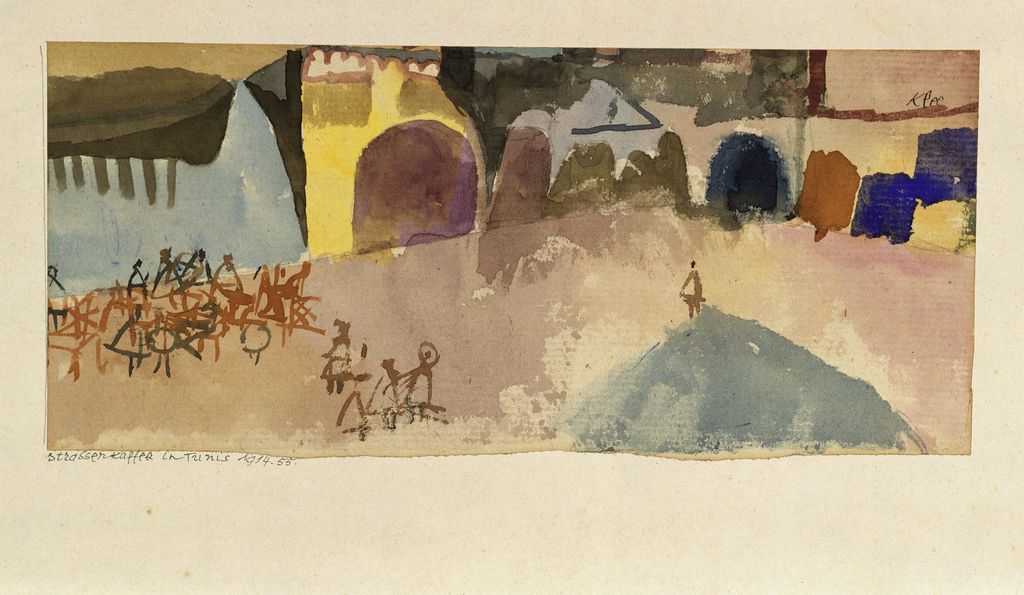
The sheet demonstrates how misleading a simple division between “figurative before Tunisia” and “abstract after Tunisia” would be. Abbreviated figures and coloured squares inhabit the same object. It also makes the process visible: an observed place became a carefully selected, physically shortened image. That is more precise than saying Klee abandoned reality. He changed which relations in a scene carried the picture.[2]
St. Germain: a landscape organised as colour
The Centre Pompidou's St. Germain b. Tunis. Landeinwärts (St. Germain near Tunis: Inland) is Klee's 1914,217, now AM 81-65-876. The museum describes it as watercolour on paper glued to card, 21.8 × 31.5 cm, and records its 1981 bequest from Nina Kandinsky. A handwritten inscription at the lower edge includes year, number and title. These details identify a specific sheet rather than a generic picture of the journey.[4]
Here coloured fields meet like an irregular checkerboard. Blues and blue-greens oppose reddish orange and violet; darker divisions stop one plane and let another begin. Angela Lampe's French catalogue account still sees shorthand for a shrub, mound and habitation within the grid. The land has not disappeared. It has been reorganised so that colour, spacing and rhythm carry more of the account than descriptive outlines do. Lampe, following Kersten, treats the painting as work done before the motif. Her observation about the unpainted vertical bands made by holding the sheet in place is especially useful: a practical condition of painting outdoors becomes part of its composition.[4]
The Delaunay connection clarifies one possible source for this handling of simultaneous contrasts, but it should not turn Klee into a passive follower. He had seen Delaunay's work and translated his theory before the trip; the Tunisian landscape offered new material for Klee's own experiment. Equally, the resulting grid does not prove that the city itself was simply a ready-made abstract picture waiting to be copied. Klee chose, painted, left blank and perhaps adjusted. The work is a sequence of decisions made in relation to a place.[4][7]
Hammamet: what a watercolour leaves in and out
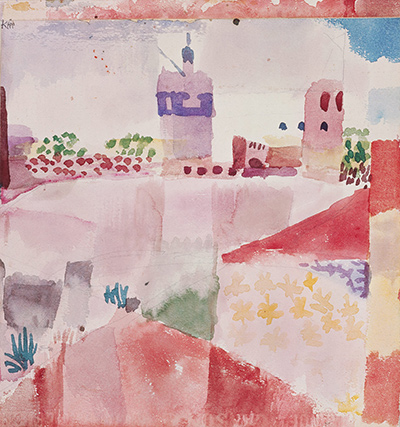
The splash image above reproduces Hammamet with Its Mosque, Klee's 1914,199, held by the Metropolitan Museum of Art as 1984.315.4. The Met says Klee visited Hammamet on 14 April 1914 and made the watercolour from outside the city walls. Its current record describes watercolour and graphite on paper mounted on cardboard and gives overall dimensions 23.8 × 22.2 cm. Roger Benjamin's chapter prints smaller dimensions, 20.6 × 19.4 cm, as have older descriptions; these may reflect different measured components, but the accessible records do not explain the discrepancy. This page uses the current owning museum record while preserving the question for object-level study.[5][8]
The upper part of the painting still gives a recognisable skyline: mosque minaret, another tower and low forms or planting. Below, the view opens into soft pink, red, blue and pale washed areas. Benjamin identifies the second tower as the Poste Optique, a French military communications structure on the fort, and compares historical photographs and postcards to reconstruct the view. The French protectorate is thus visible in the townscape. It is easy to overlook when the scene is discussed only as an encounter with ancient architecture or brilliant light.[5][8]
A locally authored account by Tunisia's Institut National du Patrimoine places Hammamet at the southern end of Cap Bon and describes its walled medina, fort and Great Mosque near the edge of the street network. That urban history makes the town more specific than a set of forms in Klee's watercolour. It also corrects the Met label's geographical error: Hammamet is south, not northwest, of Tunis. Museum expertise about the object and Tunisian heritage expertise about the place each have a distinct role in this account.[8][11]
Benjamin also reports a more interventionist choice: Klee cut a painted strip from the original sheet, reversed it and attached it to the mount. The diagonal and rectangular relations below the skyline are therefore not merely the result of looking at a street from one fixed point. His chapter situates Hammamet within a specific town of fishing, trade, religious life, agriculture and colonial administration. The watercolour selects from that complex place. It should neither be taken as an objective topographic document nor emptied of the mosque, military tower and living setting that gave its forms a starting point.[5]
Another Hammamet watercolour, Hammamet (1914,33), raises a different identification. Klee's diary mentions painting from a small terrace on the way to the Hôtel de la Plage. Benjamin compares an early postcard of that beachfront hotel, which opened in 1899, with the watercolour and proposes that its one small building is the hotel. The painted building is shifted and simplified, so the postcard and diary make a reasoned case rather than a proven exact viewpoint. View toward the Harbor of Hammamet is sparser still, with fragments of beach, vessels, vegetation and architecture reduced to delicate colour and discontinuous contour. These distinct works show that “the Hammamet style” is no more single than “the Tunisian style.” Klee's choices changed from sheet to sheet.[5]
Kairouan, the diary and later return
Kairouan is the city attached to the 16 April diary declaration, and it supplied material for both 1914 watercolours and subsequent recollection. Two separate 1914 pictures share a form of the title In the Style of Kairouan, Transposed in a Moderate Way. Klee's 1914,210 is now at LACMA; 1914,211 is associated with the Zentrum Paul Klee in Bern. Their related titles must not cause their dimensions, ownership or details to be merged. The planned dedicated artwork page in this cluster treats the Bern work, whereas the LACMA record concerns its own distinct sheet.[9]
Klee did not stop working with Kairouan when he came home. The Fondation Beyeler's French guide discusses Kairuan, vor den Thoren (nach einer Scizze von 1914), 1921,4 — Kairouan, Before the Gates (after a 1914 sketch). The title itself specifies a later work made after an earlier sketch. Its crystalline architecture belongs to 1921, seven years after the journey, even if its motivating observation belongs to 1914. The museum sees Tunisia as continuing to matter into the 1930s. That longer afterlife is a stronger claim than declaring every later grid or garden an undocumented memory of Tunis.[7]
The diary's vivid language and these later pictures have often been read together as if the 1914 trip already contained a finished theory of Klee's mature art. They are better kept in chronological relation: experience, on-site and near-site works, later editing of a diary, revisiting sketches and still later interpretation by museums and historians. This allows the journey to be important without making it an origin myth that explains everything after it.[2][3][7]
A journey within French colonial Tunisia
The three travellers entered a French protectorate, established in 1881. The setting is not incidental background. Benjamin's chapter traces Hammamet's resistance to the French invasion, land purchases by settlers, the military communications tower and a local economy involving fishing and exchange across the Mediterranean. Some of that history can be checked against the visual objects Klee drew; other parts come from later memoirs and photographs that Benjamin evaluates. These specifics complicate a travel narrative in which Tunisia appears only as colour, heat or anonymous “Eastern” architecture.[5]
Klee's published diary also shows the limits of his viewpoint. Benjamin quotes passages in which the travellers describe people they met through racial and sensory prejudices, even while noticing their own European appearance on a country road. A responsible reading does not need to repeat every slur to acknowledge that the visitor's gaze was historically situated. Nor should the page speak as though Tunisian inhabitants existed chiefly to awaken a European artist. His work is art made in encounter with a place inhabited and governed by others, under unequal political conditions.[5]
The journey's reception raises another question: who gets to describe what Tunisia contributed? Dominique Jarrassé's French-language study argues in its published abstract that the 1914 journey has been mythologised, partly by Klee himself, and asks how later commemorations and claims of a “Mediterranean modernism” can repeat northern European dominance. That abstract establishes the article's question; its full argument still needs reading before more particular conclusions are attributed to it. Placed beside Benjamin's close reconstruction, it is a reason to avoid calling the country merely a source of “exotic” motifs.[5][10]
What changed after Tunisia?
The 1914 sheets make a convincing case for intensified experiment with coloured planes, watercolour transparency, rhythmic architecture and the relation between observation and transformation. They do not support a single date at which Klee ceased to draw or became abstract. The café, St. Germain and Hammamet works demonstrate three different solutions within the same trip. Some incorporate clear topography and figures; some emphasise the constructed field; some combine both. Their physical histories add another layer to what we see today.[2][4][5][8]
Klee's “I am a painter” is best read beside those objects rather than above them as a verdict. It captures the excitement of a meeting between prior artistic study and a new set of encounters. Its edited form and later fame explain why the trip became a story of revelation. Looking closely at the works, their material evidence and their setting lets the journey remain significant without asking one sentence to carry an entire career.[1][2][3][4][5]
For closer study, see Hammamet with Mosque, In the Style of Kairouan, Klee's materials and techniques and the later Bauhaus years.
Explore selected works from Klee’s much larger oeuvre. Titles without a link have an authenticated catalogue identity but no reviewed article yet.
Artworks directory
| Name | Date | Medium |
|---|---|---|
| A Gate | 1939 | Painting and mixed media |
| A Woman for Gods | 1938 | Watercolour and mixed media |
| Ab Ovo | 1917 | Watercolour and mixed media |
| Above Mountain Summit | 1917 | Drawing and mixed media |
| Abstract Trio | 1923 | Drawing and mixed media |
| Acrobats | 1915 | Watercolour and mixed media |
| Actor's Mask | 1924 | Painting and mixed media |
| Ad Marginem | 1930 | Drawing and mixed media |
| Ad Parnassum | 1932 | Painting and mixed media |
| Adventurer Ship | 1927 | Drawing and mixed media |
| Affected Place | 1922 | Drawing and mixed media |
| After a Sketch from Zurich | 1914 | Watercolour and mixed media |
| After Drawing | 1919 | |
| After The Floods | 1936 | Watercolour and mixed media |
| All Souls' Picture | 1921 | |
| Ancient Harmony | 1925 | Painting and mixed media |
| Angel Applicant | 1939 | Drawing and mixed media |
| Angel Serves the Desired | 1920 | |
| Angel, Still Female | 1939 | Painting and mixed media |
| Angelus Novus | 1920 | Drawing and mixed media |
| Animal Terror | 1926 | Painting and mixed media |
| Arab Song | 1932 | Painting and mixed media |
| Archangel | 1938 | Painting and mixed media |
| Architecture | 1923 | Painting and mixed media |
| Architecture of the Plain | 1923 | Drawing and mixed media |
| Around the Fish | 1926 | Painting and mixed media |
| Arrival of the Air Steamer | 1921 | Drawing and mixed media |
| Asiatic God | 1924 | Painting and mixed media |
| Astrological Fantasy Portrait | 1924 | Drawing and mixed media |
| Athlete's Head | 1932 | Watercolour and mixed media |
| Aufgehender Stern | 1931 | Painting and mixed media |
| Autumn Flower | 1922 | Painting and mixed media |
| Bad Band | 1920 | Drawing and mixed media |
| Baroque Centaur | 1939 | Painting and mixed media |
| Before the Blitz | 1923 | Drawing and mixed media |
| Before the Snow | 1929 | Drawing and mixed media |
| Besessenes Madchen | 1924 | Watercolour and mixed media |
| Bird Garden | 1924 | |
| Bird Wandering Off | 1926 | Watercolour and mixed media |
| Blossoms in the Night | 1930 | Watercolour and mixed media |
| Blue-Bird-Pumpkin | 1939 | Painting and mixed media |
| Boats in the Flood | 1937 | Painting and mixed media |
| Botanical Theatre | 1934 | Drawing and mixed media |
| Boy in Fancy Dress | 1931 | Watercolour and mixed media |
| Broken Key | 1938 | |
| Brother and Sister | 1930 | Watercolour and mixed media |
| But the Red Roof | 1935 | Painting and mixed media |
| C - C = Fisch | 1931 | Watercolour and mixed media |
| Cacti | 1912 | Painting and mixed media |
| Camel (in Rhythmic Landscape with Trees) | 1920 | Drawing and mixed media |
| Captive Pierrot | 1923 | Drawing and mixed media |
| Castle and Sun | 1928 | Drawing and mixed media |
| Cat and Bird | 1928 | Drawing and mixed media |
| Cathedrals | 1925 | Watercolour and mixed media |
| Chalice of the Heart | 1937 | Painting and mixed media |
| Characters in Yellow | 1937 | Painting and mixed media |
| Chosen Site | 1927 | Mixed media |
| Christmas Picture | 1923 | Drawing and mixed media |
| City of Towers | 1916 | Painting and mixed media |
| Clarification | 1932 | Painting and mixed media |
| Collection of Figurines | 1926 | Painting and mixed media |
| Colorful Architecture | 1917 | Painting and mixed media |
| Comedians' Handbill | 1938 | |
| Comic Opera Singer | 1927 | Painting and mixed media |
| Composition | 1939 | Painting and mixed media |
| Composition with Figures | 1915 | Drawing and mixed media |
| Composition with the Yellow Half-Moon and the Y | 1918 | Watercolour and mixed media |
| Conch–Still Life II | 1939 | Watercolour and mixed media |
| Cosmic Composition | 1919 | Painting and mixed media |
| Crystal Gradation | 1921 | Drawing and mixed media |
| Dance of the Grieving Child | 1922 | Painting and mixed media |
| Dancing Girl | 1940 | Painting and mixed media |
| Das Licht und Etliches | 1931 | Mixed media |
| Death and Fire | 1940 | Painting and mixed media |
| Death for the Idea | 1915 | |
| Demon as Pirate | 1926 | Watercolour and mixed media |
| Diana | 1931 | Painting and mixed media |
| Diavolo Player | 1923 | Drawing and mixed media |
| Die Kapelle | 1917 | Watercolour and mixed media |
| Die Vase | 1938 | Painting and mixed media |
| Doctor | 1930 | Drawing and mixed media |
| Dredger and Sailboat | 1931 | Watercolour and mixed media |
| Ein Tor | 1939 | Painting and mixed media |
| Ein Weib fur Gotter | 1938 | Mixed media |
| Embrace | 1939 | Watercolour and mixed media |
| Episode before an Arab Town | 1923 | |
| Equals Infinity | 1932 | Painting and mixed media |
| Eros | 1923 | Drawing and mixed media |
| Error on Green | 1930 | Watercolour and mixed media |
| Evening Figure | 1935 | Drawing and mixed media |
| Falling Bird | 1919 | |
| Fermata | 1932 | Watercolour and mixed media |
| Fire Clown | 1921 | Watercolour and mixed media |
| Fire Full Moon | 1933 | Watercolour and mixed media |
| Fire in the Evening | 1929 | Painting and mixed media |
| Fish in the Harbour | 1916 | Watercolour and mixed media |
| Fish Magic | 1925 | Watercolour and mixed media |
| Flock of Birds | 1917 | Drawing and mixed media |
| Flora on Sand | 1927 | Watercolour and mixed media |
| Flower Myth | 1918 | |
| Flower Stand with Watering Can and Bucket | 1910 | Watercolour and mixed media |
| Flowering Tree (Abstraction with Reference to a Flowering Tree) | 1925 | Painting and mixed media |
| Flowers in Pots | 1923 | |
| Flowers in Stone | 1939 | Painting and mixed media |
| Forest Witch | 1938 | Painting and mixed media |
| Fright of a Girl | 1922 | Drawing and mixed media |
| Fruits on Red | 1930 | Drawing and mixed media |
| Full Moon | 1919 | Mixed media |
| Föhn Wind in Franz Marc's Garden | 1915 | Watercolour and mixed media |
| Garden in St Germain, The European Quarter near Tunis | 1914 | Watercolour and mixed media |
| Ghost Chamber with the Tall Door (New Version) | 1925 | |
| Ghost of a Genius | 1922 | Drawing and mixed media |
| Girl in Mourning | 1939 | Painting and mixed media |
| Glance of a Landscape | 1926 | Watercolour and mixed media |
| Gluht Nach | 1939 | Drawing and mixed media |
| Golden Fish | 1925 | Watercolour and mixed media |
| Goldfish Wife | 1921 | Watercolour and mixed media |
| Green Plant, Blood, Louse | 1924 | Drawing and mixed media |
| Hafenbild | 1918 | Mixed media |
| Hammamet with Mosque | 1914 | Watercolour and mixed media |
| Harbour with Sailing Ships | 1937 | Painting and mixed media |
| Hauptweg und Nebenwege | 1929 | Painting and mixed media |
| Heavenly and Earthly Time | 1927 | Drawing and mixed media |
| Heroic Fiddling | 1938 | Painting and mixed media |
| Heroic Roses | 1938 | Painting and mixed media |
| Heroic Strokes of the Bow | — | Mixed media |
| Highway and Byways | 1929 | Drawing and mixed media |
| Houses near the Gravel Pit | 1913 | Watercolour and mixed media |
| Howling Dog | 1928 | Painting and mixed media |
| In the Current Six Thresholds | 1929 | Painting and mixed media |
| In the Style of Kairouan | 1914 | Drawing and mixed media |
| Individualized Altimetry of Stripes | 1930 | Painting and mixed media |
| Insula Dulcamara | 1938 | |
| Interior with the Clock | 1913 | Watercolour and mixed media |
| Irma Rossa the Animal Tamer | 1918 | Drawing and mixed media |
| Journey in Corsica | 1927 | Drawing and mixed media |
| Landscape with Bluebirds | 1919 | Watercolour and mixed media |
| Legend of the Nile | 1937 | Painting and mixed media |
| Lemon Harvest | 1937 | Watercolour and mixed media |
| Likeness in the Bower | 1930 | Watercolour and mixed media |
| Limits of Reason | 1927 | Painting and mixed media |
| Little Hope | 1938 | Watercolour and mixed media |
| Magdalena before the Conversion | 1938 | Drawing and mixed media |
| Mask of Fear | 1932 | Painting and mixed media |
| May Picture | 1925 | Painting and mixed media |
| Monument in a Cemetery | 1922 | Watercolour and mixed media |
| Monuments at G | 1929 | Watercolour and mixed media |
| Municipal Jewel | 1917 | Watercolour and mixed media |
| Mural from the Temple of Longing Thither | 1922 | |
| Nach der Uberschwemmung | 1936 | Watercolour and mixed media |
| New Harmony | 1936 | Painting and mixed media |
| New House in the Suburbs | — | Mixed media |
| Old Steamboat | 1922 | Drawing and mixed media |
| On the Edge | 1930 | Drawing and mixed media |
| Once Emerged from the Gray of Night | 1918 | Drawing and mixed media |
| One Who Understands | 1934 | Painting and mixed media |
| Oriental Pleasure Garden | 1925 | Painting and mixed media |
| Park of Idols | 1939 | Watercolour and mixed media |
| Passing by Red Pillars | 1928 | Watercolour and mixed media |
| Persian Nightingales | 1917 | Drawing and mixed media |
| Popular Wall Painting | 1922 | Painting and mixed media |
| Prestidigitator | 1927 | Watercolour and mixed media |
| Rainy Day | 1931 | Watercolour and mixed media |
| Red and White Domes | 1914 | Watercolour and mixed media |
| Red Balloon | 1922 | Drawing and mixed media |
| Redgreen and Violet-Yellow Rhythms | 1920 | Drawing and mixed media |
| Refuge | 1930 | Watercolour and mixed media |
| Rhythmic Rythmical | 1930 | Painting and mixed media |
| Saint of the Inner Light | 1921 | |
| Scaffolding of a New Building | 1930 | Painting and mixed media |
| Scholar in Dealing with Stars | 1926 | Watercolour and mixed media |
| Seated Woman | 1930 | Drawing and mixed media |
| Senecio | 1922 | Painting and mixed media |
| Separation in the Evening | 1922 | Drawing and mixed media |
| Sinbad the Sailor | 1923 | Drawing and mixed media |
| Skeptically Smiling | — | Mixed media |
| Small House in the Garden City | 1928 | Watercolour and mixed media |
| Small Portrait of a Girl in Yellow | 1925 | Painting and mixed media |
| Southern Gardens | 1919 | Watercolour and mixed media |
| Static-Dynamic Gradation | 1923 | Drawing and mixed media |
| Still Life | 1927 | Painting and mixed media |
| Still Life with Gladioli | 1932 | Watercolour and mixed media |
| Strange Garden | 1923 | Drawing and mixed media |
| Stricken City | 1936 | Painting and mixed media |
| Strong Dream | 1929 | Watercolour and mixed media |
| Struck from the List | 1933 | Drawing and mixed media |
| Structural I | 1924 | Drawing and mixed media |
| Sumpflegende | 1919 | Painting and mixed media |
| Temple Gardens | 1920 | Drawing and mixed media |
| The Arrow before the Target | 1921 | Drawing and mixed media |
| The Barbed Noose with the Mice | 1923 | Watercolour and mixed media |
| The Flora of the Heath | 1925 | Watercolour and mixed media |
| The Goldfish | 1925 | Watercolour and mixed media |
| The Hour Before One Night | 1940 | Painting and mixed media |
| The Man in Love | 1923 | |
| The Mask with the Flag | 1925 | Mixed media |
| The Pathos of Fertility | 1921 | |
| The Rhine at Duisburg | 1937 | Painting and mixed media |
| The Way to the Citadel | 1937 | Painting and mixed media |
| Three Houses and a Bridge | 1922 | Watercolour and mixed media |
| Tightrope Walker | 1923 | |
| Tomb in Three Parts | 1923 | Watercolour and mixed media |
| Tomcat's Turf | 1919 | Watercolour and mixed media |
| Tower in Orange and Green | 1922 | Drawing and mixed media |
| Tree and Architecture - Rhythms I | 1920 | Watercolour and mixed media |
| Tree and Architecture - Rhythms II | 1920 | Painting and mixed media |
| Tropical Dawn with the Owl | 1921 | Mixed media |
| Tropische Dammerung | 1921 | Painting and mixed media |
| Twittering Machine | 1922 | Drawing and mixed media |
| Variations (Progressive Motif) | 1927 | Watercolour and mixed media |
| Ventriloquist and Crier in the Moor | 1923 | |
| Viaducts Break Ranks | 1937 | Drawing and mixed media |
| Villa R | 1919 | Painting and mixed media |
| Village Carnival | 1926 | Painting and mixed media |
| Vor dem Blitz | 1923 | Drawing and mixed media |
| Wald-Hexen | 1938 | Painting and mixed media |
| Young Forest | 1925 | Drawing and mixed media |
Discussion
Klee's Tunisia watercolours vary from populated streets to broad fields of colour.
His later-edited diary shaped the way the journey has been remembered.
Reader Insights
What is still recognisable in the St. Germain or Hammamet sheets?
How does knowing about a cut or mounted sheet change your reading?
Which part of the journey's setting deserves a closer source?
Join the Conversation
Share the work and evidence behind your reading.
References
- Zentrum Paul Klee, Die Tunisreise. Klee, Macke, Moilliet, 2014 exhibition page (German). It supplies the institution's scoped counts of works made on the journey and identifies the three travellers and later inspired works, View source.
- Staatliche Museen zu Berlin, Strassenkaffee in Tunis, catalogue record and Dieter Scholz's German object essay, updated 28 August 2026. Source for medium, dimensions, gift to Klee's mother, cutting, scene analysis, diary re-editing and the image's Public Domain Mark 1.0; image asset 2538215, photo credit Jörg P. Anders, View source.
- Zentrum Paul Klee, Landhäuser am Strand digital guide and Paul Klee. Ich bin Maler exhibition account, both German. The first explicitly cautions against a sudden discovery of colour; the second documents a longer development through dated diary notes.
- Centre Pompidou, St. Germain b. Tunis. Landeinwärts, object record and Angela Lampe's French analysis from Collection art graphique (2008). Source for 1914,217, medium, dimensions, accession, Kersten's on-site attribution, bands left by rubber bands, visual analysis and Delaunay context, View source.
- Roger Benjamin, “A Crystalline Hammamet,” chapter 14 of Kandinsky and Klee in Tunisia (University of California Press, 2015), pp. 126–139, author-hosted chapter PDF. Full chapter read; English-language specialist analysis of town, colonial infrastructure, 1914 sheets, comparative sources, diary and later intervention. The linked online PDF is image-only; details were checked against its rendered pages. The chapter's own footnotes and wider book remain to inspect directly, View source.
- Marianne Keller Tschirren, Dreieck, Kreis, Kugel, German dissertation, pp. 62 and 141–42, citing Wolfgang Kersten's text-critical edition of Klee's Tagebücher 1898–1918, entry 926o, p. 350. Source for citation anchor and discussion of the 1916–21 diary revision; the critical edition itself remains to inspect, View source.
- Fondation Beyeler, Paul Klee. La dimension abstraite, French room guide (2017), pp. 4–5. Discusses pre-1914 Delaunay encounter and translation, 1914 work In the Desert, and Klee's 1921 Kairouan painting after a 1914 sketch. Its rhetoric about a mysterious land is not adopted as the narrator's voice, View source.
- Metropolitan Museum of Art, Hammamet with Its Mosque, current object record: visit on 14 April, medium, overall dimensions, collection number and rights notice. The Met does not offer this image as an Open Access download; the legacy splash is preserved, not replaced from the Met page, View source.
- Los Angeles County Museum of Art, In the Style of Kairouan, Transposed in a Moderate Way, distinct LACMA object M.2005.70.51; ZPK Mapping Klee and the Fondation Beyeler checklist identify Bern's separate 1914,211. The 2014 Tunis colloquium paper discusses both numbered variants. Printed catalogue entries remain to read directly.
- Dominique Jarrassé, “Un modernisme méditerranéen? Usages du voyage de Klee en Tunisie”, Artl@s Bulletin 10, no. 2 (2021), French. Only the abstract was accessible for this manuscript; use is limited to its stated research question and broad myth-making premise, View source.
- Hanen Werteni, Institut National du Patrimoine, Tunisia, “La ville de Hammamet” (2023), French. Direct local heritage research on position, medina plan, fort, peripheral Great Mosque and the town's continuing built history; source for correction of the Met's “northwest of Tunis” direction, View source.