


 by Tom Gurney
Tom Gurney BSc (Hons) is an art history expert with over 20 years experience
Published on June 19, 2020 / Updated on September 27, 2026
Email: tomgurney1@gmail.com / Phone: +44 7429 011000
A bridge divided into moving arches
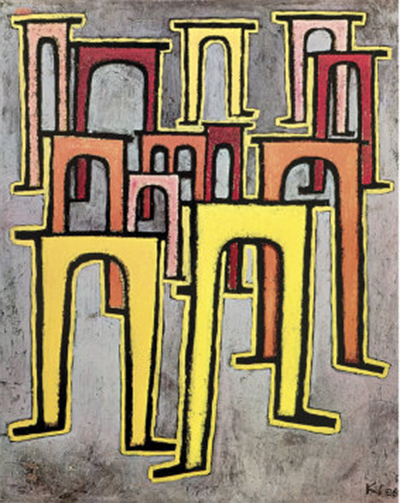
The arches in Paul Klee’s Revolution des Viaductes no longer hold up a single roadway. They stand at different heights and angles against a mottled grey ground. Some seem to have feet. Their red, pink, orange and yellow interiors vary, while black outlines give them a shared form. The group can look like architecture, a crowd or a procession. Klee made this oil painting in 1937, when a word such as “revolution” carried urgent political weight. The image invites such a reading without depicting a named army, place or event.[1][2]
This site’s longstanding English title, Viaducts Break Ranks, describes the action of the arches. A closer translation of Klee’s title is Revolution of the Viaduct. The contrast between the two is useful: one stresses what can be seen, the other the artist’s provocative naming. The painting is held by the Hamburger Kunsthalle, whose record establishes its identity and later route into the collection.[1]
Explore the details of Viaducts Break Ranks
Select a numbered area to examine its detail at high resolution.
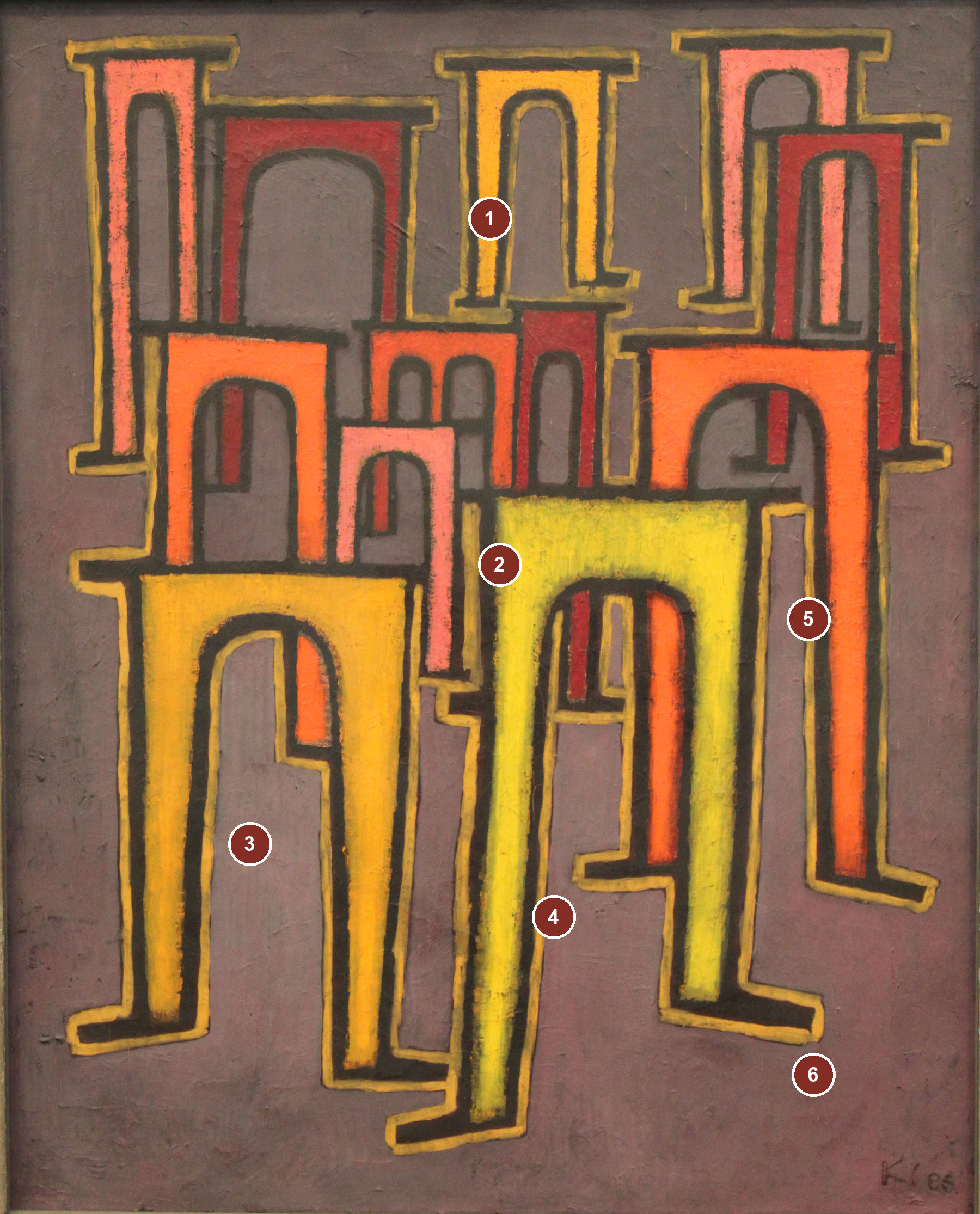
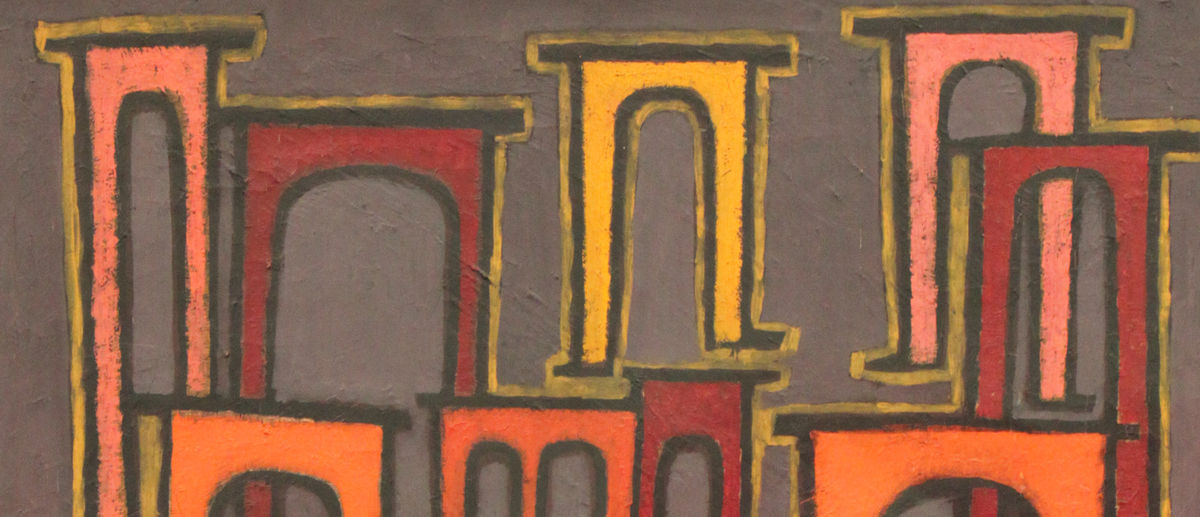
Small arches overlap near the top of the group
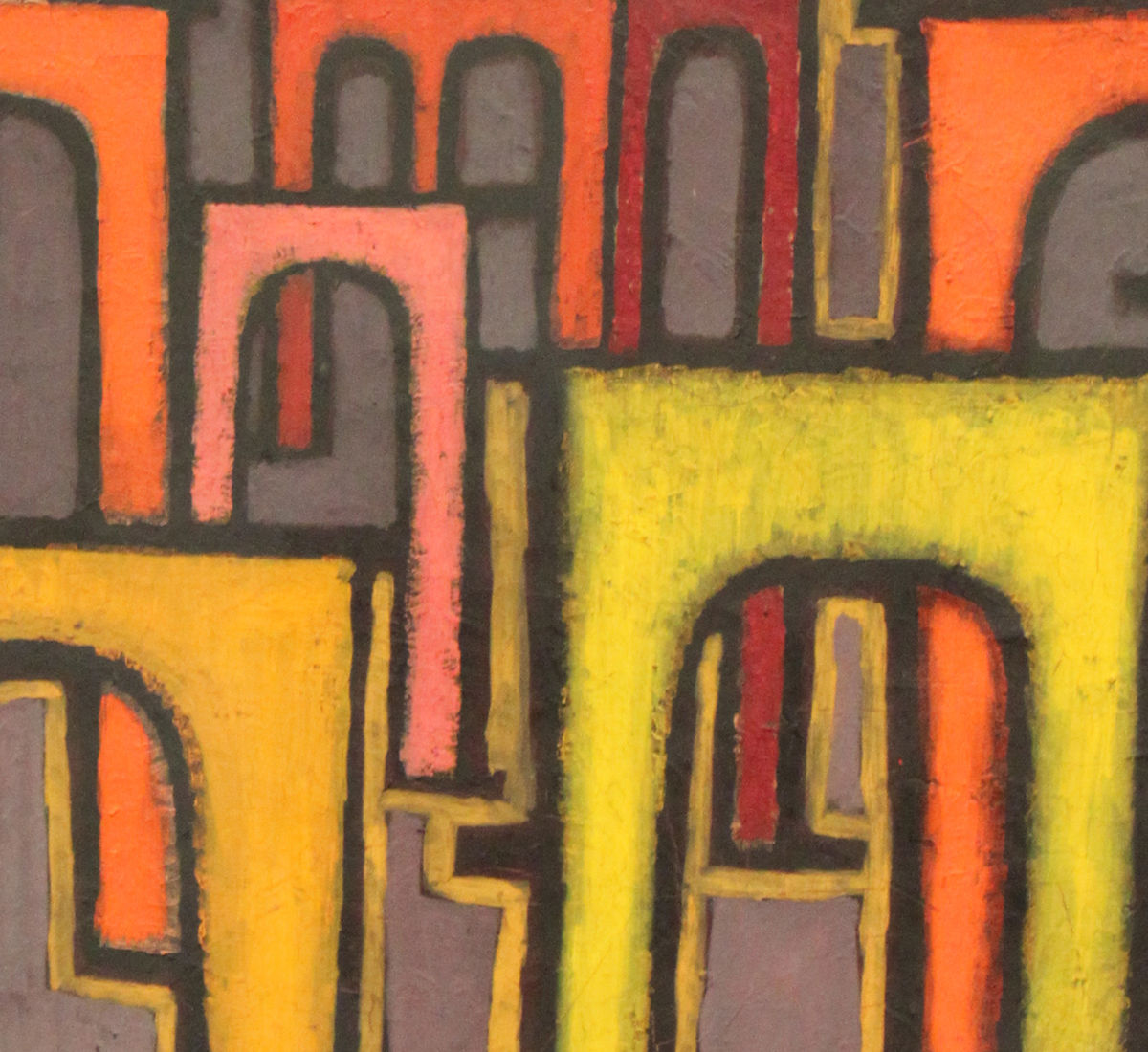
Openings at different levels interrupt the bridge rhythm
The left arches bend outward at their feet
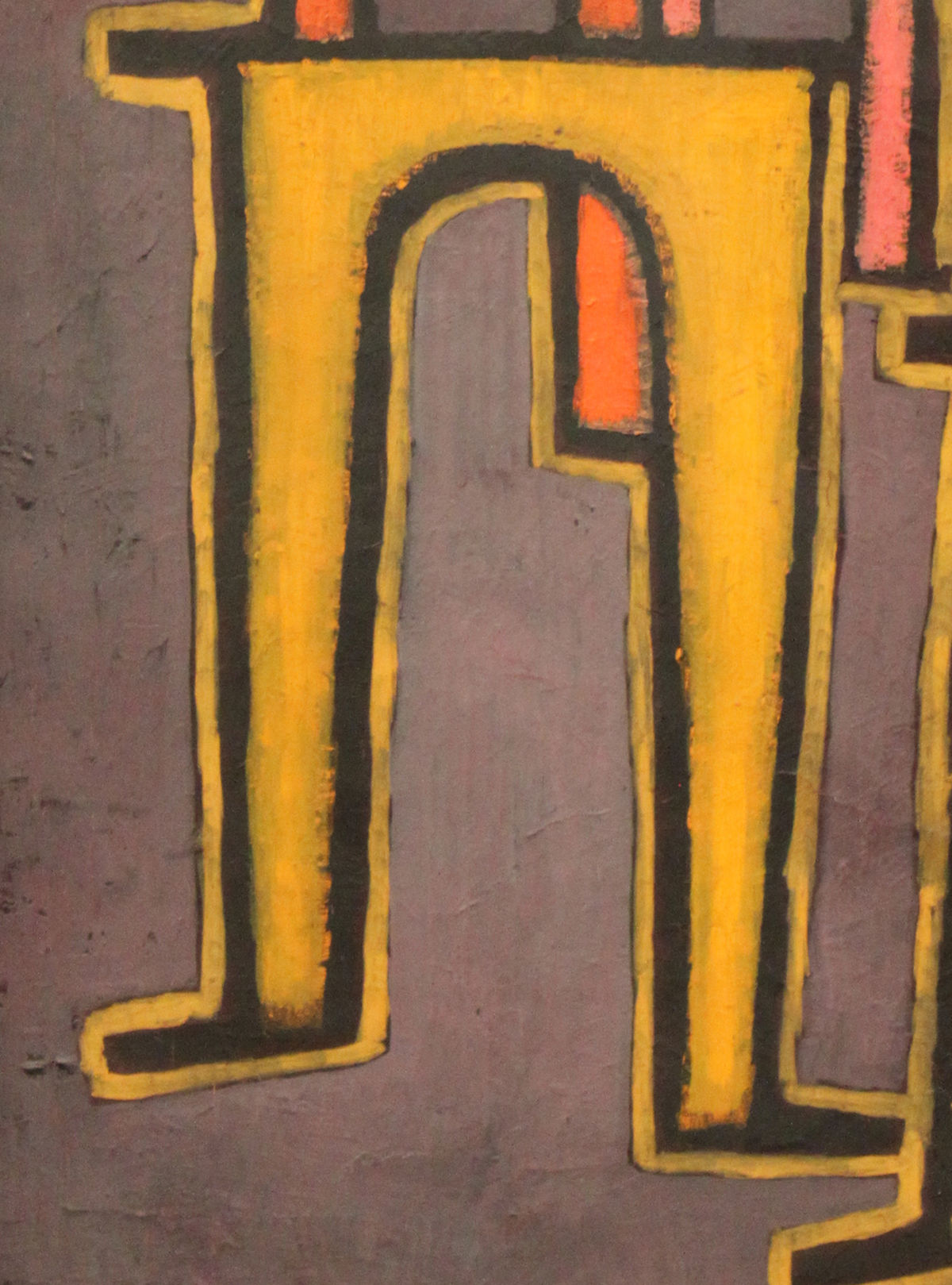
The large foreground arch has no roadway above it
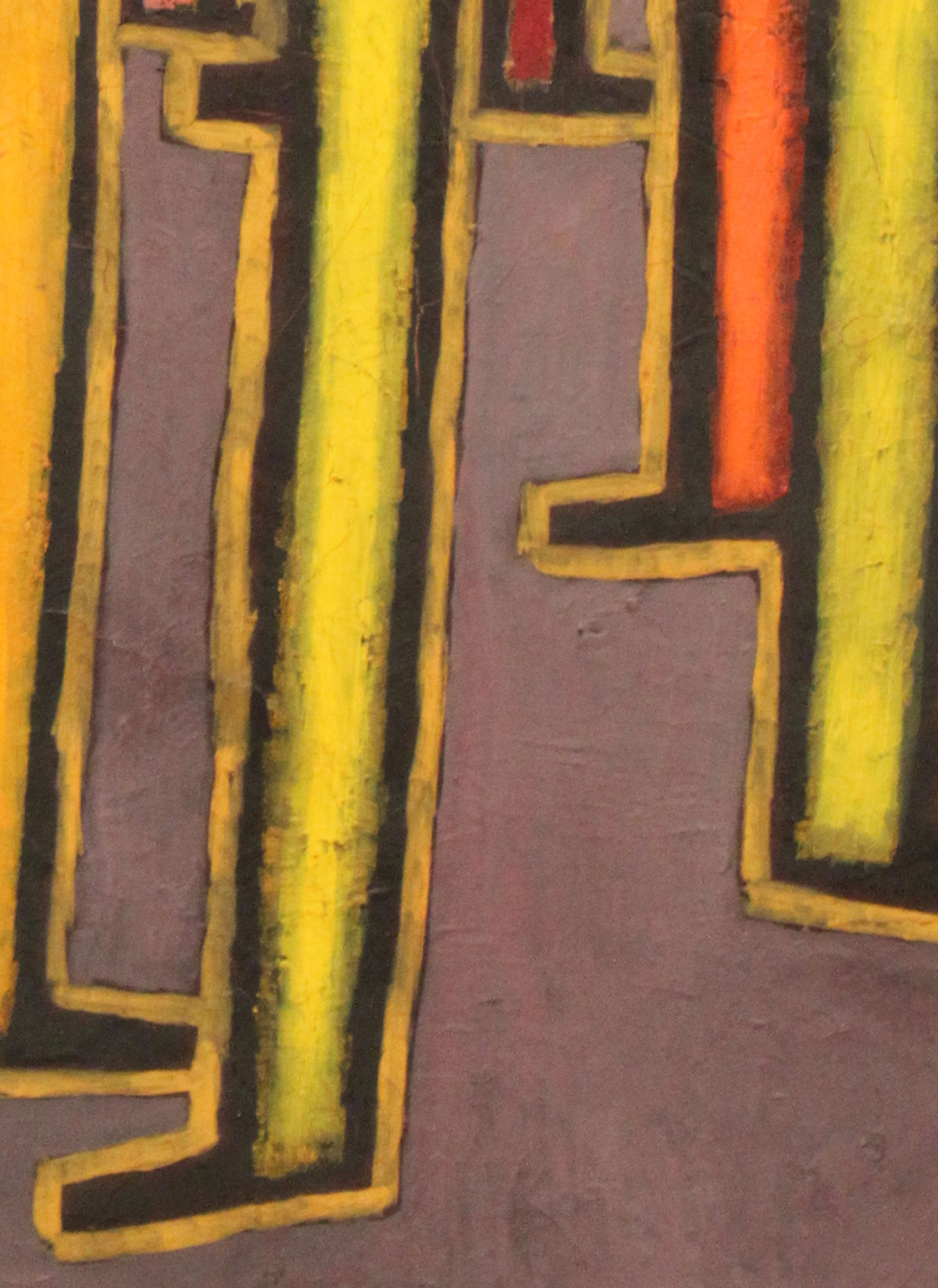
Warm red and orange forms crowd the right side
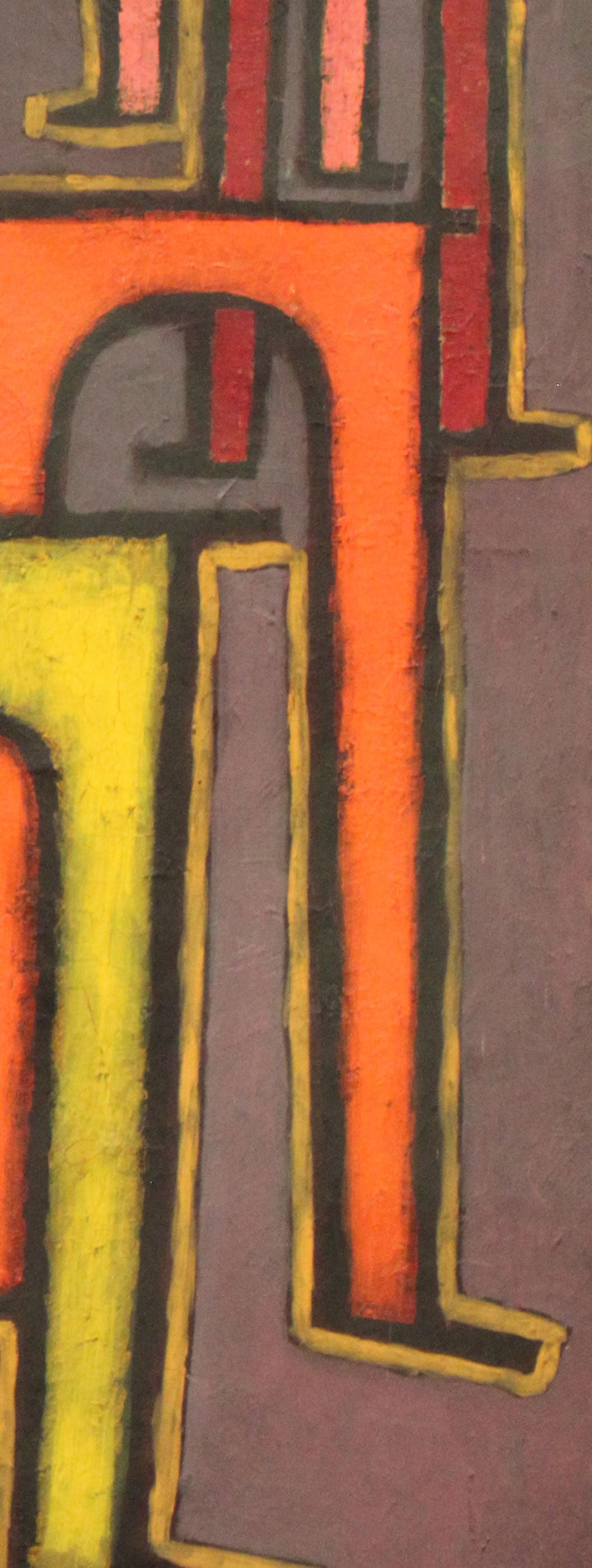
Signature and mottled grey field at lower right
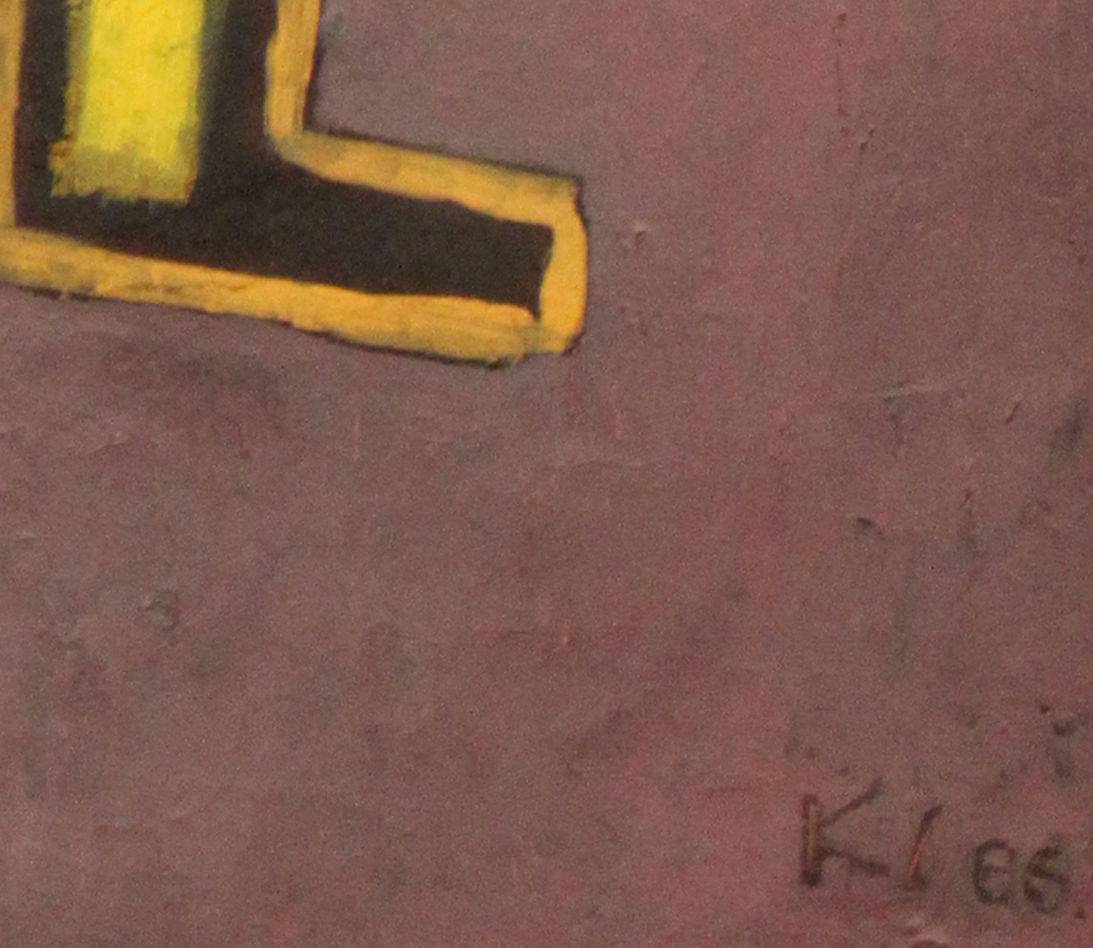
Contents
- Identifying the Hamburg painting
- How an arch learns to move
- Explore the details of Viaducts Break Ranks
- A 1937 work in a hostile climate
- Related works and the danger of a neat sequence
- From Klee to the Hamburger Kunsthalle
- Looking again
Identifying the Hamburg painting
The museum transcribes Klee’s title as Revolution des Viaductes, retaining its French-derived spelling. Other catalogues use Viaduktes or Viadukts. Those variants should not be taken as different paintings. Klee’s own annual number is 1937,153, with code R 13; the later catalogue raisonné gives continuous number 7089. The Hamburger Kunsthalle’s inventory number is HK-2899. The museum records a Klee signature at lower right and the title with his name on the stretcher reverse.[1]
The current museum object record describes oil on cotton, an image measuring 60 × 50 cm, with an 80 × 70 cm frame. The Jewish Museum’s written label for its 2026 New York exhibition specifies primed cotton. Its audio description instead says linen and gives a larger size, so the institution’s two explanations conflict; the owning museum’s object record is the sounder caption. Neither short description establishes the exact chemistry or application sequence of the ground. The visible dark contours and coloured areas should be discussed as painting, while a conservation file is sought for technical detail.[1][2]
The “Guggenheim Bridge” mentioned in some older accounts of this picture is not a documented bridge that Klee painted. The confusion appears to arise from a different Klee work in the Guggenheim collection: Brückenbogen treten aus der Reihe, an earlier 1937,111 composition of bridge arches in charcoal on cloth mounted on paper. The Guggenheim is the holding museum for that related work, not the name of a structure in the Hamburg picture. A relationship between studies and final painting is worth researching, but distinct supports, numbers and collections must remain distinct.[1][3]
How an arch learns to move
A viaduct works by repetition. One span follows another, carrying a continuous route across ground that might otherwise interrupt travel. Klee takes away the route. Each support now stands separately, and several bend at the base as if stepping away. The repeated inverted U shape keeps the group related; changes of height, width, position and colour give each member a different presence. The bridge has become an assembly of parts capable of movement.[1][4]
Painting: Hamburger Kunsthalle, HK-2899. Image: Anagoria's photograph via Wikimedia Commons, marked public domain there. The splash, numbered overview and details were resized or cropped from this photograph. Its colour and lighting are those of the photograph, not a calibrated record of the painting.
At first, the painting can still look solid. Thick dark lines enclose many of the forms, and the arches retain upright piers and flat tops. But they overlap in an irregular cluster rather than lining up to bear a load. A larger arch near the front competes with smaller ones behind it; openings at different levels pull the eye into and out of the group. Narrow yellow edging makes some black contours seem more emphatic. The grey background supplies no river, bank or road that could put the structure back to work. That absence is part of the animation: the arches no longer have to perform the task for which viaducts are built.[1][2]
Karin Schick, writing for the Hamburger Kunsthalle, begins with this reversal of architectural function. She leaves a productive question open: are the segments marching in ominous lockstep, or have differently coloured individuals joined in a revolt? Their similar shapes can suggest both conformity and collective action. The bends that look like feet sharpen the double possibility. A viewer can see a procession before deciding whether it is a threatening column, an exuberant departure or something between the two.[1]
Schick also notes that an earlier study included people and animals around the bridge. The final oil painting concentrates on the arches themselves. Art historian O. K. Werckmeister traces a group of five related 1937 works, including Tiere spielen Komödie (Animals Play Comedy) and Seltsame Jagd (Strange Hunt), which complicates a simple drawing-to-canvas story. What the finished painting shows plainly is a shift from a supported route to animated supports. Klee gives the bridge the energy of bodies without painting individual human faces or uniforms onto its members.[1][10]
Colour contributes to the change. Warm interiors vary from one arch to the next, while black outlines bind them as a recognisable type. That repeated difference is visible in the existing reproduction, though a small, colour-shifted JPG cannot establish exact pigments or all surface effects. It is enough to see that the group is not one flat-coloured mass. The visual tension between type and variation helps explain why its politics have been read in different ways.[1][2]
A 1937 work in a hostile climate
Klee’s historical circumstances make a political interpretation reasonable. The National Socialists removed him from his professorship at the Düsseldorf Academy in 1933, and he returned to Bern that December. He did not leave Germany in 1937 while making this painting. In the years that followed, the regime attacked and confiscated modern artworks, including Klee’s. The painting belongs to this time of displacement and repression, but a dated context alone cannot identify every arch as a specific soldier or prove that Klee pictured a particular Nazi spectacle.[5]
The Jewish Museum’s 2026 label presents a strong anti-fascist reading. It sees the individual, human-footed arches breaking out of line against the ordered displays of military parades. It relates their bright warm colours to nonconformity and contrasts them with Nazi uniform colours. This is a recent curator’s argument about Klee’s wit and the painting’s historical setting. It should be understood as an interpretation, not as an inscription by Klee saying that a red arch stands for one group and a yellow arch for another.[2]
Schick’s Hamburg account makes the ambiguity especially valuable. The same cluster can resemble soldiers keeping step or figures refusing to remain a fixed part of the bridge. The arches’ common shape allows the first thought; the differences among them and their apparent release from a single structure allow the second. A political account need not flatten the image into a poster with a key. Its refusal of a single visual command is one reason it could become a symbol of dissent.[1]
Art historian Frank Zöllner notes that since the 1950s this picture has often been understood as a confrontation with fascism. He suggests thinking more precisely about artistic and individual resistance. His remark is a later scholarly framing of the painting’s reception, not direct testimony to Klee’s 1937 private intention. A 1999 German collection of essays on art against war and fascism summarises Hans-Ernst Mittig’s contribution as moving beyond a simple direct-protest formula: in that reading, an effort to find footing again in Switzerland could itself provide a basis for resistance. The full Mittig chapter has not yet been accessible for close quotation, so its editors’ summary is the appropriate limit.[6][7]
Jürgen Glaesemer, in a recorded 1986 Guggenheim lecture, describes the arches as a caricature of mass movements. He connects the painting to Klee’s humour and irony as ways to consider reality without heroic pathos. The surviving transcript contains obvious speech-to-text mistakes, including a wrong reference to the First World War. Its object-specific interpretive point is useful when attributed, but its erroneous chronology should not be repeated. Glaesemer’s view broadens the question: the arches can be at once comical in their apparent feet and serious in what a crowd might do.[4]
Werckmeister’s 1987 analysis offers a sharper disagreement with the earlier view of an advancing totalitarian mob. He compares the repeated arches with monumental bridge and stadium architecture promoted under National Socialism. Such structures bind similar units into one permanent, collective form. In Klee’s picture, the top route is broken, the supports differ in size and colour, and they move through depth rather than holding a fixed line. Werckmeister therefore reads their individuality as a formal challenge to the idea of a homogeneous “people’s community.” This comparison is his historical interpretation; it does not identify one specific highway bridge as Klee’s model.[10]
His argument also connects the picture to Klee’s teaching about pictorial architecture. In the account Werckmeister cites, physical architecture tends toward static stability, while a painting can make the viewer’s position and the forms themselves seem to move. The arches turn that distinction into a joke with political force: components engineered to stand still walk away from their assignment. For Werckmeister, the title “revolution” is deliberately unsettled. In the Europe of 1937, the word was claimed by different political movements; he reads Klee’s image as a more cautious assertion of artistic independence than a declaration for a named party. Other viewers, including the Hamburg curator, still find a more ominous march plausible. The difference is part of the work’s documented reception.[1][10]
The painting has been compared with Picasso’s Guernica because both were made in 1937 and both have figured in accounts of art facing fascist violence. That comparison can clarify differences as well as similarities. Klee does not show a bombed town or a documented battle. His architectural fragments behave like figures, allowing satire and metaphor where Guernica stages bodily catastrophe. A shared year and broad political context do not make the works illustrations of the same event or prove a direct exchange of methods.[2][7]
Related works and the danger of a neat sequence
The Guggenheim-held Brückenbogen treten aus der Reihe, usually translated Bridge Arches Break Ranks, is an important neighbour to the Hamburg painting. Its annual number 1937,111 places it earlier in Klee’s 1937 register than the oil painting 1937,153. It is a charcoal work on cloth mounted on paper, not the 60 × 50 cm oil on cotton. The titles both animate bridge arches, and the repeated motif makes comparison natural.[1][3]
Werckmeister’s documented sequence names Unter dem Viaduct (1937,77), the Guggenheim drawing (1937,111), Tiere spielen Komödie (1937,112), Seltsame Jagd (1937,152), and the Hamburg painting (1937,153). The two intervening titles warn against treating every member as a literal viaduct sketch. His note also reports a photograph Felix Klee took of an earlier state of the Hamburg painting. That state has been described as Abwanderung der Brückenbogen or Abwandernde Brückenbogen (“Departure of the Bridge Arches”), but Werckmeister says the available evidence does not establish whether Paul Klee first gave it that title and then changed it. The secure point is sustained work on the motif and a documented change within the final painting, not a perfectly settled chain of titles and intentions.[10]
This distinction also guards against a familiar mistake in art writing. The final canvas does not depict an actual bridge that was celebrated by Germans, and the museum name “Guggenheim” supplies no evidence for such a structure. A title about a viaduct can name a pictorial invention. Klee’s arches need only retain enough of a bridge’s shape to make their departure striking.[1][3]
From Klee to the Hamburger Kunsthalle
The Hamburger Kunsthalle’s researched provenance follows the painting from Klee, who held it from 1937 to 1940, to Lily Klee by inheritance. It then passed to the Paul-Klee-Gesellschaft in Bern in 1946. In April 1950, Oskar Reinhart of Winterthur held it, and the Hamburger Kunsthalle acquired it from him that month through a documented exchange involving nine paintings and one drawing. This chain matters because the picture did not enter Hamburg directly from Klee or remain at one institution since its creation.[1]
The museum marks its provenance as clarified and unproblematic while continuing object research. That assessment is part of its current record; it should not be padded with unrecorded motives or intermediate owners. Werckmeister’s 1987 catalogue reports that the picture was first publicly shown at Klee’s memorial exhibition in Bern, 9 November–8 December 1940, where it was offered for 1,500 Swiss francs. This is a documented historical asking price, not evidence of a sale. A 1957 MoMA catalogue already reproduced the Hamburg work under an English form of its title, showing its postwar international visibility. The Jewish Museum borrowed it for Paul Klee: Other Possible Worlds in New York from 20 March to 26 July 2026. That dated loan does not establish where it is hanging today; present display needs a fresh check at the time of release.[1][2][8][9][10]
Looking again
Begin with the outline of one arch and imagine reconnecting it to the next. The gaps, overlaps and footlike ends quickly defeat that repair. Look across the group by colour, then by size. The arches share a template but refuse identical placement. Finally ask what “revolution” changes: the position of bridge parts, the behaviour of a crowd, or the terms by which an image can be political. The painting supports these questions without turning a painting of moving architecture into a map of a real bridge or a documented parade.[1][2][4]
The Hamburg object is securely Revolution des Viaductes, 1937,153, oil on cotton, 60 × 50 cm, inventory HK-2899. Its related Guggenheim work is a separate charcoal composition. Klee’s forced departure from Düsseldorf and the Nazi attack on his art form essential context. The exact political target of each arch remains a matter of interpretation, best approached through the museum’s open question and the later, clearly dated readings. The arches are most alive where they seem both a group and individuals: parts of a common structure taking different steps.[1][2][3]
For related work, see Struck from the List for another object whose title invites political reading, the late-work overview for Klee’s circumstances after 1933, and the paintings index for the wider selection.
Explore selected works from Klee’s much larger oeuvre. Titles without a link have an authenticated catalogue identity but no reviewed article yet.
Artworks directory
| Name | Date | Medium |
|---|---|---|
| A Gate | 1939 | Painting and mixed media |
| A Woman for Gods | 1938 | Watercolour and mixed media |
| Ab Ovo | 1917 | Watercolour and mixed media |
| Above Mountain Summit | 1917 | Drawing and mixed media |
| Abstract Trio | 1923 | Drawing and mixed media |
| Acrobats | 1915 | Watercolour and mixed media |
| Actor's Mask | 1924 | Painting and mixed media |
| Ad Marginem | 1930 | Drawing and mixed media |
| Ad Parnassum | 1932 | Painting and mixed media |
| Adventurer Ship | 1927 | Drawing and mixed media |
| Affected Place | 1922 | Drawing and mixed media |
| After a Sketch from Zurich | 1914 | Watercolour and mixed media |
| After Drawing | 1919 | |
| After The Floods | 1936 | Watercolour and mixed media |
| All Souls' Picture | 1921 | |
| Ancient Harmony | 1925 | Painting and mixed media |
| Angel Applicant | 1939 | Drawing and mixed media |
| Angel Serves the Desired | 1920 | |
| Angel, Still Female | 1939 | Painting and mixed media |
| Angelus Novus | 1920 | Drawing and mixed media |
| Animal Terror | 1926 | Painting and mixed media |
| Arab Song | 1932 | Painting and mixed media |
| Archangel | 1938 | Painting and mixed media |
| Architecture | 1923 | Painting and mixed media |
| Architecture of the Plain | 1923 | Drawing and mixed media |
| Around the Fish | 1926 | Painting and mixed media |
| Arrival of the Air Steamer | 1921 | Drawing and mixed media |
| Asiatic God | 1924 | Painting and mixed media |
| Astrological Fantasy Portrait | 1924 | Drawing and mixed media |
| Athlete's Head | 1932 | Watercolour and mixed media |
| Aufgehender Stern | 1931 | Painting and mixed media |
| Autumn Flower | 1922 | Painting and mixed media |
| Bad Band | 1920 | Drawing and mixed media |
| Baroque Centaur | 1939 | Painting and mixed media |
| Before the Blitz | 1923 | Drawing and mixed media |
| Before the Snow | 1929 | Drawing and mixed media |
| Besessenes Madchen | 1924 | Watercolour and mixed media |
| Bird Garden | 1924 | |
| Bird Wandering Off | 1926 | Watercolour and mixed media |
| Blossoms in the Night | 1930 | Watercolour and mixed media |
| Blue-Bird-Pumpkin | 1939 | Painting and mixed media |
| Boats in the Flood | 1937 | Painting and mixed media |
| Botanical Theatre | 1934 | Drawing and mixed media |
| Boy in Fancy Dress | 1931 | Watercolour and mixed media |
| Broken Key | 1938 | |
| Brother and Sister | 1930 | Watercolour and mixed media |
| But the Red Roof | 1935 | Painting and mixed media |
| C - C = Fisch | 1931 | Watercolour and mixed media |
| Cacti | 1912 | Painting and mixed media |
| Camel (in Rhythmic Landscape with Trees) | 1920 | Drawing and mixed media |
| Captive Pierrot | 1923 | Drawing and mixed media |
| Castle and Sun | 1928 | Drawing and mixed media |
| Cat and Bird | 1928 | Drawing and mixed media |
| Cathedrals | 1925 | Watercolour and mixed media |
| Chalice of the Heart | 1937 | Painting and mixed media |
| Characters in Yellow | 1937 | Painting and mixed media |
| Chosen Site | 1927 | Mixed media |
| Christmas Picture | 1923 | Drawing and mixed media |
| City of Towers | 1916 | Painting and mixed media |
| Clarification | 1932 | Painting and mixed media |
| Collection of Figurines | 1926 | Painting and mixed media |
| Colorful Architecture | 1917 | Painting and mixed media |
| Comedians' Handbill | 1938 | |
| Comic Opera Singer | 1927 | Painting and mixed media |
| Composition | 1939 | Painting and mixed media |
| Composition with Figures | 1915 | Drawing and mixed media |
| Composition with the Yellow Half-Moon and the Y | 1918 | Watercolour and mixed media |
| Conch–Still Life II | 1939 | Watercolour and mixed media |
| Cosmic Composition | 1919 | Painting and mixed media |
| Crystal Gradation | 1921 | Drawing and mixed media |
| Dance of the Grieving Child | 1922 | Painting and mixed media |
| Dancing Girl | 1940 | Painting and mixed media |
| Das Licht und Etliches | 1931 | Mixed media |
| Death and Fire | 1940 | Painting and mixed media |
| Death for the Idea | 1915 | |
| Demon as Pirate | 1926 | Watercolour and mixed media |
| Diana | 1931 | Painting and mixed media |
| Diavolo Player | 1923 | Drawing and mixed media |
| Die Kapelle | 1917 | Watercolour and mixed media |
| Die Vase | 1938 | Painting and mixed media |
| Doctor | 1930 | Drawing and mixed media |
| Dredger and Sailboat | 1931 | Watercolour and mixed media |
| Ein Tor | 1939 | Painting and mixed media |
| Ein Weib fur Gotter | 1938 | Mixed media |
| Embrace | 1939 | Watercolour and mixed media |
| Episode before an Arab Town | 1923 | |
| Equals Infinity | 1932 | Painting and mixed media |
| Eros | 1923 | Drawing and mixed media |
| Error on Green | 1930 | Watercolour and mixed media |
| Evening Figure | 1935 | Drawing and mixed media |
| Falling Bird | 1919 | |
| Fermata | 1932 | Watercolour and mixed media |
| Fire Clown | 1921 | Watercolour and mixed media |
| Fire Full Moon | 1933 | Watercolour and mixed media |
| Fire in the Evening | 1929 | Painting and mixed media |
| Fish in the Harbour | 1916 | Watercolour and mixed media |
| Fish Magic | 1925 | Watercolour and mixed media |
| Flock of Birds | 1917 | Drawing and mixed media |
| Flora on Sand | 1927 | Watercolour and mixed media |
| Flower Myth | 1918 | |
| Flower Stand with Watering Can and Bucket | 1910 | Watercolour and mixed media |
| Flowering Tree (Abstraction with Reference to a Flowering Tree) | 1925 | Painting and mixed media |
| Flowers in Pots | 1923 | |
| Flowers in Stone | 1939 | Painting and mixed media |
| Forest Witch | 1938 | Painting and mixed media |
| Fright of a Girl | 1922 | Drawing and mixed media |
| Fruits on Red | 1930 | Drawing and mixed media |
| Full Moon | 1919 | Mixed media |
| Föhn Wind in Franz Marc's Garden | 1915 | Watercolour and mixed media |
| Garden in St Germain, The European Quarter near Tunis | 1914 | Watercolour and mixed media |
| Ghost Chamber with the Tall Door (New Version) | 1925 | |
| Ghost of a Genius | 1922 | Drawing and mixed media |
| Girl in Mourning | 1939 | Painting and mixed media |
| Glance of a Landscape | 1926 | Watercolour and mixed media |
| Gluht Nach | 1939 | Drawing and mixed media |
| Golden Fish | 1925 | Watercolour and mixed media |
| Goldfish Wife | 1921 | Watercolour and mixed media |
| Green Plant, Blood, Louse | 1924 | Drawing and mixed media |
| Hafenbild | 1918 | Mixed media |
| Hammamet with Mosque | 1914 | Watercolour and mixed media |
| Harbour with Sailing Ships | 1937 | Painting and mixed media |
| Hauptweg und Nebenwege | 1929 | Painting and mixed media |
| Heavenly and Earthly Time | 1927 | Drawing and mixed media |
| Heroic Fiddling | 1938 | Painting and mixed media |
| Heroic Roses | 1938 | Painting and mixed media |
| Heroic Strokes of the Bow | — | Mixed media |
| Highway and Byways | 1929 | Drawing and mixed media |
| Houses near the Gravel Pit | 1913 | Watercolour and mixed media |
| Howling Dog | 1928 | Painting and mixed media |
| In the Current Six Thresholds | 1929 | Painting and mixed media |
| In the Style of Kairouan | 1914 | Drawing and mixed media |
| Individualized Altimetry of Stripes | 1930 | Painting and mixed media |
| Insula Dulcamara | 1938 | |
| Interior with the Clock | 1913 | Watercolour and mixed media |
| Irma Rossa the Animal Tamer | 1918 | Drawing and mixed media |
| Journey in Corsica | 1927 | Drawing and mixed media |
| Landscape with Bluebirds | 1919 | Watercolour and mixed media |
| Legend of the Nile | 1937 | Painting and mixed media |
| Lemon Harvest | 1937 | Watercolour and mixed media |
| Likeness in the Bower | 1930 | Watercolour and mixed media |
| Limits of Reason | 1927 | Painting and mixed media |
| Little Hope | 1938 | Watercolour and mixed media |
| Magdalena before the Conversion | 1938 | Drawing and mixed media |
| Mask of Fear | 1932 | Painting and mixed media |
| May Picture | 1925 | Painting and mixed media |
| Monument in a Cemetery | 1922 | Watercolour and mixed media |
| Monuments at G | 1929 | Watercolour and mixed media |
| Municipal Jewel | 1917 | Watercolour and mixed media |
| Mural from the Temple of Longing Thither | 1922 | |
| Nach der Uberschwemmung | 1936 | Watercolour and mixed media |
| New Harmony | 1936 | Painting and mixed media |
| New House in the Suburbs | — | Mixed media |
| Old Steamboat | 1922 | Drawing and mixed media |
| On the Edge | 1930 | Drawing and mixed media |
| Once Emerged from the Gray of Night | 1918 | Drawing and mixed media |
| One Who Understands | 1934 | Painting and mixed media |
| Oriental Pleasure Garden | 1925 | Painting and mixed media |
| Park of Idols | 1939 | Watercolour and mixed media |
| Passing by Red Pillars | 1928 | Watercolour and mixed media |
| Persian Nightingales | 1917 | Drawing and mixed media |
| Popular Wall Painting | 1922 | Painting and mixed media |
| Prestidigitator | 1927 | Watercolour and mixed media |
| Rainy Day | 1931 | Watercolour and mixed media |
| Red and White Domes | 1914 | Watercolour and mixed media |
| Red Balloon | 1922 | Drawing and mixed media |
| Redgreen and Violet-Yellow Rhythms | 1920 | Drawing and mixed media |
| Refuge | 1930 | Watercolour and mixed media |
| Rhythmic Rythmical | 1930 | Painting and mixed media |
| Saint of the Inner Light | 1921 | |
| Scaffolding of a New Building | 1930 | Painting and mixed media |
| Scholar in Dealing with Stars | 1926 | Watercolour and mixed media |
| Seated Woman | 1930 | Drawing and mixed media |
| Senecio | 1922 | Painting and mixed media |
| Separation in the Evening | 1922 | Drawing and mixed media |
| Sinbad the Sailor | 1923 | Drawing and mixed media |
| Skeptically Smiling | — | Mixed media |
| Small House in the Garden City | 1928 | Watercolour and mixed media |
| Small Portrait of a Girl in Yellow | 1925 | Painting and mixed media |
| Southern Gardens | 1919 | Watercolour and mixed media |
| Static-Dynamic Gradation | 1923 | Drawing and mixed media |
| Still Life | 1927 | Painting and mixed media |
| Still Life with Gladioli | 1932 | Watercolour and mixed media |
| Strange Garden | 1923 | Drawing and mixed media |
| Stricken City | 1936 | Painting and mixed media |
| Strong Dream | 1929 | Watercolour and mixed media |
| Struck from the List | 1933 | Drawing and mixed media |
| Structural I | 1924 | Drawing and mixed media |
| Sumpflegende | 1919 | Painting and mixed media |
| Temple Gardens | 1920 | Drawing and mixed media |
| The Arrow before the Target | 1921 | Drawing and mixed media |
| The Barbed Noose with the Mice | 1923 | Watercolour and mixed media |
| The Flora of the Heath | 1925 | Watercolour and mixed media |
| The Goldfish | 1925 | Watercolour and mixed media |
| The Hour Before One Night | 1940 | Painting and mixed media |
| The Man in Love | 1923 | |
| The Mask with the Flag | 1925 | Mixed media |
| The Pathos of Fertility | 1921 | |
| The Rhine at Duisburg | 1937 | Painting and mixed media |
| The Way to the Citadel | 1937 | Painting and mixed media |
| Three Houses and a Bridge | 1922 | Watercolour and mixed media |
| Tightrope Walker | 1923 | |
| Tomb in Three Parts | 1923 | Watercolour and mixed media |
| Tomcat's Turf | 1919 | Watercolour and mixed media |
| Tower in Orange and Green | 1922 | Drawing and mixed media |
| Tree and Architecture - Rhythms I | 1920 | Watercolour and mixed media |
| Tree and Architecture - Rhythms II | 1920 | Painting and mixed media |
| Tropical Dawn with the Owl | 1921 | Mixed media |
| Tropische Dammerung | 1921 | Painting and mixed media |
| Twittering Machine | 1922 | Drawing and mixed media |
| Variations (Progressive Motif) | 1927 | Watercolour and mixed media |
| Ventriloquist and Crier in the Moor | 1923 | |
| Viaducts Break Ranks | 1937 | Drawing and mixed media |
| Villa R | 1919 | Painting and mixed media |
| Village Carnival | 1926 | Painting and mixed media |
| Vor dem Blitz | 1923 | Drawing and mixed media |
| Wald-Hexen | 1938 | Painting and mixed media |
| Young Forest | 1925 | Drawing and mixed media |
Related artworks
Explore eight other Klee works, beginning with works close in date to this one.

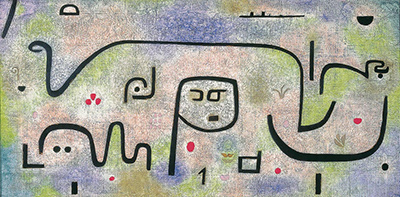
Insula Dulcamara
1938
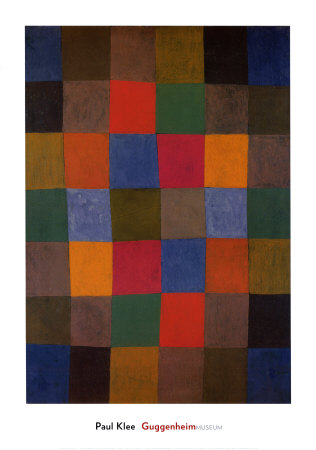
New Harmony
1936
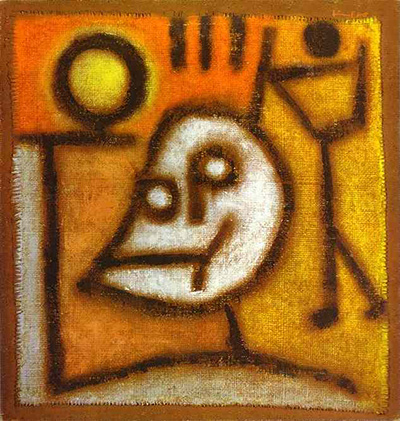
Death and Fire
1940
Fire Full Moon
1933
Struck from the List
1933
Ad Parnassum
1932
Mask of Fear
1932
Discussion
The separate arches keep a bridge’s shared shape while moving at different angles and sizes.
The sources leave room to test both collective dissent and the unsettling image of a marching crowd.
Reader Insights
Which arch first looks as if it has taken a step?
Does the group seem to move together or in different directions?
Which original study could clarify the sequence of Klee’s bridge pictures?
Join the Conversation
Share what you see or a source that helps explain the work.
References
- Hamburger Kunsthalle, “Revolution des Viaductes,” object HK-2899, current indexed object, provenance and bibliography record (German; direct object view presented a challenge on 26 September 2026), View source.
- The Jewish Museum, New York, Paul Klee: Other Possible Worlds, written exhibition labels (2026), p. 57 of PDF, “Revolution of the Viaduct,” oil on primed cotton and curatorial political interpretation (English), View source.
- Solomon R. Guggenheim Museum, Arches of the Bridge Stepping Out of Line, separate collection object. Its 2008 exhibition caption, reproduced in contemporary coverage, gives charcoal on cloth mounted on paper and accession 48.1172.59; a published German work-register index gives Brückenbögen treten aus der Reihe, 1937,111 (P 11).
- Jürgen Glaesemer, “Paul Klee and German Romanticism,” 1986 Hilla Rebay lecture, Guggenheim Museum Archives transcript (English transcript published 2018; pp. 7–8 discuss the Hamburg painting as caricature; transcript contains errors), View source.
- Zentrum Paul Klee, biographical chronology and 1933 dismissal/return to Bern (English; German original cross-check), View source.
- Frank Zöllner, “Paul Klee, Hauptweg und Nebenwege, 1929,” Wallraf-Richartz-Jahrbuch 61 (2000), opening comparison with Revolution des Viaductes and its postwar readings (German; author-uploaded full text), View source.
- Gabriele Saure and Gisela Schirmer, introduction to Kunst gegen Krieg und Faschismus: 37 Werkmonografien (1999), p. 11 of publisher preview summarising Hans-Ernst Mittig’s chapter on this work (German; chapter itself remains unread), View source.
- The Museum of Modern Art, German Art of the Twentieth Century (1957), p. 127, entry/reproduction of the Hamburg painting under “Revolution of the Viaduct” (English; medium in this historical caption differs from the owning museum’s current record), View source.
- The Jewish Museum, “Paul Klee: Other Possible Worlds,” exhibition dates 20 March–26 July 2026 (English), View source.
- O. K. Werckmeister, “From Revolution to Exile,” in Carolyn Lanchner, ed., Paul Klee (The Museum of Modern Art, 1987), pp. 56–58 and notes 125–27 (English), discussion of the sequence, pictorial architecture, political readings and first exhibition. MoMA publication record; digitized text consulted.