


 by Tom Gurney
Tom Gurney BSc (Hons) is an art history expert with over 20 years experience
Published on June 19, 2020 / Updated on September 27, 2026
Email: tomgurney1@gmail.com / Phone: +44 7429 011000
Death for the Idea: a small print in a wartime journal
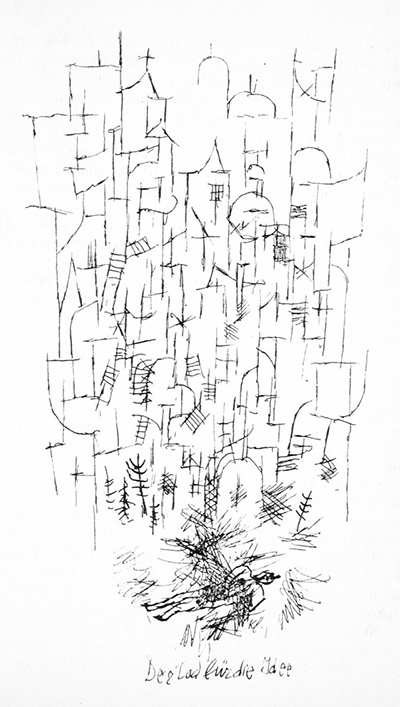
Paul Klee's Der Tod für die Idee is a lithograph published in January 1915 in the seventh number of Zeit-Echo. Ein Kriegs-Tagebuch der Künstler, a journal whose subtitle means “A wartime diary of artists.” The Museum of Modern Art holds the impression printed on page 93 of that issue and calls it Death for an Idea. SFMOMA records another impression under the English title Dying for a Cause. This site's established title, Death for the Idea, is a third translation of the same German words. The work is a print made for circulation on paper.[1][2]
Its printed composition is narrow and small: MoMA measures it at about 16.2 × 8.6 cm. A figure lies across the lower part of the image. Above it, close-set lines grow into a steep construction of pointed roofs, spires, stairs and tree-like forms. The dark, heavily worked body and the upward rush of the architecture compete for attention. The title places death and an “idea” in relation, but it does not tell us whose idea, whether the death is noble or futile, or whether the figure stands for a soldier, an artist or both.[1][3]
How the image is built
The print's long vertical format makes the lower figure feel pressed beneath what rises over it. Crosshatching and repeated diagonal strokes darken the body; several lines cut through or across it. The figure is recognisable as human, yet too abbreviated to serve as a portrait. German scholar Manfred Clemenz sees a possible spiked helmet, or Pickelhaube, on its head. That is an interpretive observation, not an identification supplied by either museum's object record. If the shape is a military helmet, it strengthens the print's wartime association without establishing a named casualty.[1][3]
Above this compressed body, Klee has assembled a space that is at once town, landscape and abstract structure. It contains shapes that resemble church spires and trees, but their edges splinter into an angular mesh. One can trace individual architectural features only briefly before they merge with neighbouring marks. The contrast gives the viewer two different ways to read the same sheet: as a scene with a fallen figure before a settlement, and as an arrangement of dense strokes below a widening, upward pattern. Neither reading cancels the other.[1][3]
The small dimensions matter. A journal reader would have encountered the image on a page rather than across a gallery wall. The fine lines invite close inspection; the stark division between prone body and rising construction makes the basic contrast visible at a glance. MoMA identifies the publisher as Graphik Verlag München and lists both a regular issue and a special issue on Japanese paper, while leaving the full edition size unknown. “Lithograph” names a printing process and the surviving work exists in multiple impressions. The journal plate's page number and publishing context are therefore part of its history, not incidental captions.[1][2]
The journal and the neighbouring poem
Literary scholar Peter Sprengel records that the January 1915 Zeit-Echo placed Klee's print with Georg Trakl's poem Die Nacht (“The Night”). MoMA's page-93 identification locates the impression precisely in that issue. Sprengel asks, without asserting, whether the graphic was made as a companion to the poem. His abstract describes their relation to one another and to the First World War as shifting or ambiguous; he singles out crystalline imagery as a significant parallel. A shared page opening is evidence of an editorial encounter, but not proof that Klee illustrated each line of Trakl's poem or that the poet and artist coordinated their works.[1][4]
Clemenz also discusses this pairing. He sees only a limited direct link between the poem's imagery and Klee's pictured town, trees and steps. The disagreement is useful: the publication creates a context in which a reader might connect poem and print, while the lithograph retains its own title and visual argument. The journal's wartime framing gives the word Tod (“death”) immediate force, but the image is not a literal battlefield report.[3][4]
Whose death, and what idea?
Klee's friend August Macke died in the war in 1914, before the print appeared. Franz Marc died in 1916, after this January 1915 publication. The Zentrum Paul Klee gives that sequence in its account of Klee's artist friendships. Macke's death may have informed Klee's thinking; the print cannot have been a response to Marc's death. These dates make it necessary to distinguish the print's contemporary wartime setting from later losses in Klee's circle.[5]
Clemenz proposes that Macke's death may be one reference and rejects a straightforward celebration of patriotic sacrifice. To him the crossed-through or diminished figure looks too abject to glorify a heroic death. He also acknowledges that a helmet and the title might bring the wartime phrase “death for the fatherland” into view. These are reasoned readings of a deliberately equivocal image, not facts about Klee's private intention. The work neither names Macke nor labels the body as a soldier.[3]
There is another question inside the title. The German Idee need not mean a national cause alone; it can also suggest an artistic or spiritual conception. As Manfred Clemenz explains, Regine Prange read the upward, crystalline architecture in relation to Klee's early-1915 thoughts about abstraction and an artist's movement beyond ordinary visible reality. Clemenz challenges her argument: for him, the fallen figure and crystalline rise hold together bodily death, war rhetoric and a possible spiritual transformation, without collapsing into one symbol. This account of Prange's position comes through Clemenz; her full 1993 article has not been directly examined here.[3][6]
That debate helps explain why the image resists an easy “anti-war” or “pro-war” label. The body could be a casualty, a caricature of heroic sacrifice, or a sign for leaving the earthly self behind. The structures above it could be the built world that survives, a visionary destination or an abstraction made from visible motifs. Clemenz argues for ambivalence; Sprengel finds the relationship between print, poem and war similarly unsettled. The surviving publication and the forms on the sheet support those possibilities, but none identifies a single intended message.[3][4]
A print with several lives
Different collections preserve different impressions. MoMA's example is the page-93 plate transferred from its library, object 549.1951. SFMOMA records an impression in the Carl Djerassi Trust I extended loan and promised gift, with a printed area of 16.3 × 8.6 cm. Clemenz illustrates a Bern impression and supplies another size for that object. These numbers describe particular records or measured components; their slight differences should not be smoothed into one universal size for every sheet. The German title and the lithographic design connect them.[1][2][3]
The reproduction shown here makes the figure, vertical architecture and written title recognisable, but does not identify the particular impression from which it was photographed. A closer study of a verified high-resolution impression could refine the description of the lower figure and the marks around its head. The printed Catalogue raisonné Paul Klee entry and the original journal issue have not been examined directly for this account. Those limits matter most where a claim depends on tiny marks, a particular print state or the exact editorial layout.[1][2]
What can be said securely is already substantial. In January 1915, Klee's small lithograph appeared in a wartime artists' journal under a title linking death to an idea. It sets a crossed or fallen human form beneath an urgent growth of architecture and nature. The contrast gives the print its tension: an individual body seems to end while a constructed pattern presses upward. Its force lies in that unresolved relation, sharpened by the war around its first publication and by the different meanings the word “idea” could carry.[1][3][4]
Related artworks
Explore eight other Klee works from the researched artwork cluster.
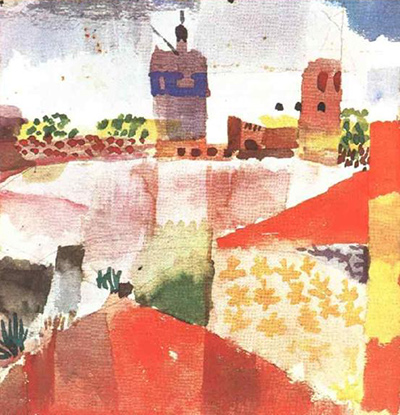
Hammamet with Mosque
1914
Flower Myth
1918
Angelus Novus
1920
Crystal Gradation
1921
Red Balloon
1922
References
- Museum of Modern Art, Death for an Idea (Der Tod für die Idee), object 549.1951: journal volume, issue and January 1915 date; page 93; lithographic medium; composition and sheet measurements; publisher and edition notes; collection history and image-rights notice, View source.
- San Francisco Museum of Modern Art, Der Tod für die Idee (Dying for a Cause): title variant, 1915 date, medium, printed dimensions and collection status, View source.
- Manfred Clemenz, Der Mythos “Paul Klee”: Eine biographische und kulturgeschichtliche Studie (Böhlau, 2016), pp. 121–23 and 131–32; searchable text consulted. German-language scholarly interpretations of the figure, helmet, architecture, Macke connection, Prange's thesis and Trakl pairing. Clemenz identifies Bern's illustration as 1915,1; this is not direct inspection of Klee's handwritten catalogue.
- Peter Sprengel, “Kristallisierung: Trakl, Klee und der Krieg: Zur Frage des Bild-Text-Bezugs im Zeit-Echo”, Deutsche Vierteljahrsschrift für Literaturwissenschaft und Geistesgeschichte 68, no. 3 (1994), 549–61; abstract consulted. Abstract in German; full article not directly inspected.
- Zentrum Paul Klee, “Kandinsky, Arp, Picasso …” (in German): institutional account of Klee's artist friendships, the 1914 death of August Macke and the 1916 death of Franz Marc, View source.
- Regine Prange, “Hinüberbauen in eine jenseitige Gegend: Paul Klees Lithographie ‘Der Tod für die Idee’ und die Genese der Abstraktion”, Wallraf-Richartz-Jahrbuch 54 (1993), 281–314 (in German). Bibliographic record and indexed excerpt located; full PDF access was blocked. Its argument is reported through Clemenz rather than claimed as directly read, View source.