


 by Tom Gurney
Tom Gurney BSc (Hons) is an art history expert with over 20 years experience
Published on June 19, 2020 / Updated on September 27, 2026
Email: tomgurney1@gmail.com / Phone: +44 7429 011000
Eros: colour, arrows and opposing triangles
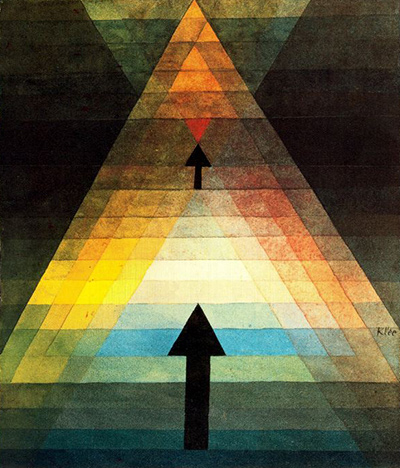
Paul Klee made Eros in 1923. The work is in the Museum Sammlung Rosengart in Lucerne, whose account places it among his 1920s Farbabstufungen, or colour gradations. The museum pairs it with Doppelzelt (Double Tent) as an example of a geometric language in which colour changes are part of the structure of the image. Reproduction records identify the work as 1923, 115 and describe watercolour, gouache and pencil on paper, with pieces cut and recombined, mounted on cardboard. They give an overall size of approximately 33.3 × 24.5 cm (height × width). The museum's own online artist overview confirms the work and collection but does not publish those detailed material and measurement fields; the latter are therefore reported from reproduction catalogues, not presented as a directly checked museum object record.[1][2][3]
Against a nearly black, blue-green ground, a large, pointed structure rises from the base of the picture. Within it, horizontal passages shift through orange, yellow, pale green and blue. Another triangular form points down into the first. Two black arrows point upwards toward a small red triangle near the top. The forms are simple enough to name, but their overlap makes the space difficult to settle. Does the eye follow the arrows, move along the strips of colour, or return to the light area near the middle? The painting makes these directions compete.[1][4]
How the picture is built
The large triangle has a broad base and an apex high in the image. It seems to advance from the dark surround because its inner colours are brighter. The smaller, inverted triangle crosses it and changes the apparent direction of the composition: one pointed form rises while another descends. Their intersection creates a complex centre without conventional perspective or a depicted setting. The two arrows bring a third kind of shape into play. They are strong, dark directional signs in a field of softly changing hues.[4]
Manfred Clemenz, writing in German about Klee's Bauhaus work, identifies Eros as one of the Streifenbilder, or stripe pictures, though its horizontal bands are combined with triangles rather than left as a uniform set of strips. He stresses the different sizes of the black arrows, the small red downward-pointing triangle, and the way the eye can travel from the centre through the colour gradations and back. His account is helpful because it begins with the work's visible organisation before asking what the arrows might mean.[4]
The surface should not be mistaken for a printed colour diagram. The bands vary in width and tone; boundaries are sometimes firm and sometimes softened by neighbouring colour. The image moves between dark and light, between warm orange and cooler green or blue. Its order is neither a single smooth rainbow nor a row of isolated swatches. The triangular contours gather the bands into an upward thrust, while the arrows make that movement explicit. At the same time, the down-pointing shape interrupts it. The result is a visual tension rather than a simple instruction to look in one direction.[1][4]
The account of cut and recombined paper matters here. Klee did not necessarily arrive at the final relationships only by filling in a pre-planned outline. The reported construction allows for physical rearrangement as part of making the image. The small inherited website photograph cannot show the seams or layers securely enough for us to map each cut. A technical examination or detailed museum record would be needed to say precisely which visible boundaries are paper joins and which are drawn or painted edges.[2][3]
What does Eros mean here?
The title names desire or attraction, but the picture does not depict a couple, a figure, or a narrative from classical myth. Its first language is made of colour, directions and intersecting geometry. Clemenz suggests that Klee's arrows may stand for a thought or impulse directed toward an object of erotic desire. He makes that reading tentatively. It should not be turned into a confirmed account of a particular sexual scene or of Klee's private life.[4]
Clemenz also cites Klee's own discussion of a triangle arising when a point enters into tension with a line and follows the law of its Eros. In that formulation, desire is a generative relation between elementary forms. Read beside the 1923 painting, it offers a way to understand why a title associated with love might belong to an abstract composition: tension, approach and combination can be pictorial events. The verbal formulation is transmitted in Clemenz's scholarly account and is not evidence that Klee supplied a fixed explanation for every mark in this particular work.[4]
This distinction keeps the image open. The arrows are visibly arrows, and the red point is visibly near the upper end of their path. What that destination symbolises is an interpretation. The opposing triangles may suggest union, encounter or resistance, but none of those associations is an object fact. They are proposals tested against the painting's structure and its title. The most secure observation is that several directions operate at once: rising, descending, crossing, returning to the centre.[1][4]
Colour as a moving relation
The Rosengart museum's term Farbabstufungen is more precise than calling the work merely “colourful”. A gradation depends on relationships between adjacent tones. In Eros, change takes place through bands that pass from one hue or value toward another, while arrows and triangular edges cut across those passages. Clemenz relates the work and Doppelzelt to Klee's Bauhaus experiments with primary and complementary colours and their transitions. That is a contextual reading of his practice; it does not mean this individual image can be reduced to a classroom exercise or a complete colour wheel.[1][4]
The dark outer field is crucial to those transitions. It makes the warm colours appear luminous and gives the pale central passage a focal weight. The left and right sides of the broad triangle do not simply mirror each other. Small shifts in hue and width affect how quickly the eye moves through them. The arrows, by contrast, have clear silhouettes and an unambiguous upward orientation. One can therefore experience the work in two tempos: gradual comparison across colour strips, then a quick leap along the arrows. Their coexistence helps explain the energy of an otherwise still, compact image.[4]
Clemenz calls the space produced by the overlapping triangles non-illusionistic. The image does not pretend there is a deep room behind the surface. Yet its layers and light centre still produce a sense that something passes behind, in front of, or through something else. That is an effect of pictorial relations, not of a naturalistic setting. The interpretation is strongest when linked to the visible construction: two differently oriented triangles cross; the tonal centre pulls attention; dark arrows repeatedly redirect it.[4]
Within Klee's Bauhaus years
Klee taught at the Bauhaus during the 1920s, when his work explored multiple ways of organising colour and form. Clemenz places Eros beside Doppelzelt and Scheidung. Abends (Separation. Evening) as works where constructed shape and colour transition are closely related. The Rosengart museum independently places Eros and Doppelzelt together within its group of colour gradations. These comparisons locate the painting within a cluster of experiments, without implying that the three works carry the same story or that one is merely a study for another.[1][4]
There is a useful restraint in keeping the date 1923 attached to the object. Klee continued to make stripe-based pictures later, including after his journey to Egypt in 1928–29, but Eros predates that trip. It should not be explained as a direct response to the Egyptian landscape. The later work can illuminate his sustained interest in bands, divisions and movement, while the earlier date prevents a false origin story.[4]
The Rosengart collection now provides the painting's institutional home, and its description gives the clearest public-facing classification found for this page. Reproduction catalogues add a detailed, plausible account of media and construction, with a minor discrepancy in one dealer's width field (24.8 versus 24.5 cm). The more complete German postcard listing and the other width field give 24.5 cm; the page treats the measurement as approximate pending a direct object entry. No acquisition history or provenance chain has been asserted where the available owner overview does not supply one.[1][2][3]
Eros turns an abstract vocabulary into a charged encounter. A field of gradually changing colour is compressed within rising and falling triangles. The arrows insist on an upward path, but the centre and the downward point interrupt any easy conclusion. Klee's title invites thought about attraction and generative tension; the painting sustains that idea through its visible construction without becoming a diagram of a single, settled meaning.[1][4]
Related artworks
Explore eight other Klee works from the researched artwork cluster.
Sinbad the Sailor
1923
Actor's Mask
1924
Red Balloon
1922
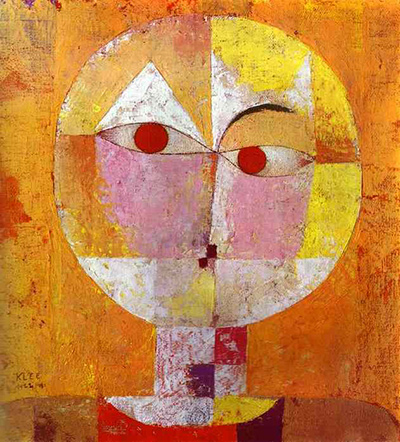
Senecio
1922
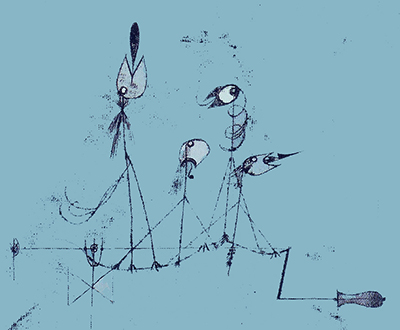
Twittering Machine
1922
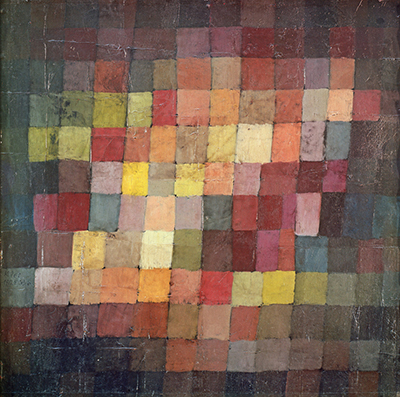
Ancient Harmony
1925
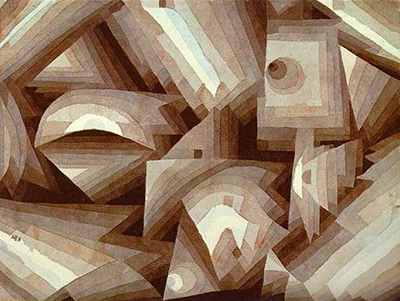
Crystal Gradation
1921
Fish Magic
1925
References
- Museum Sammlung Rosengart, “Die Künstler: Paul Klee” (German): owner overview identifying Eros and Doppelzelt as 1920s colour gradations and noting the collection's Klee holdings. It does not provide an object-level medium, dimensions or provenance for Eros, View source.
- Reisser Kunstpostkarten, Eros, 1923.115 (German): reproduction listing for the work number, cut and recombined watercolour, gouache and pencil on paper, mount, and 33.3 × 24.5 cm size. This is a commercial secondary record, not a direct museum entry, View source.
- The Fine Art Gallery, Eros, Rosengart reproduction SR048 (German): lists medium, Rosengart image copyright and original size; the page contains both 24.8 and 24.5 cm width fields, so the exact width is not independently resolved by this listing, View source.
- Manfred Clemenz, Der Mythos “Paul Klee”: Eine biographische und kulturgeschichtliche Studie (2016), especially pp. 212–13 and 219–21 (German): directly read discussion of Klee's Bauhaus colour work, Eros, its arrows and triangles, relation to Doppelzelt, and the author's attributed and tentative interpretation of the title, View source.