



 by Tom Gurney
Tom Gurney BSc (Hons) is an art history expert with over 20 years experience
Published on June 19, 2020 / Updated on October 30, 2026
Email: tomgurney1@gmail.com / Phone: +44 7429 011000
Tarring the Boat by Édouard Manet: Introduction
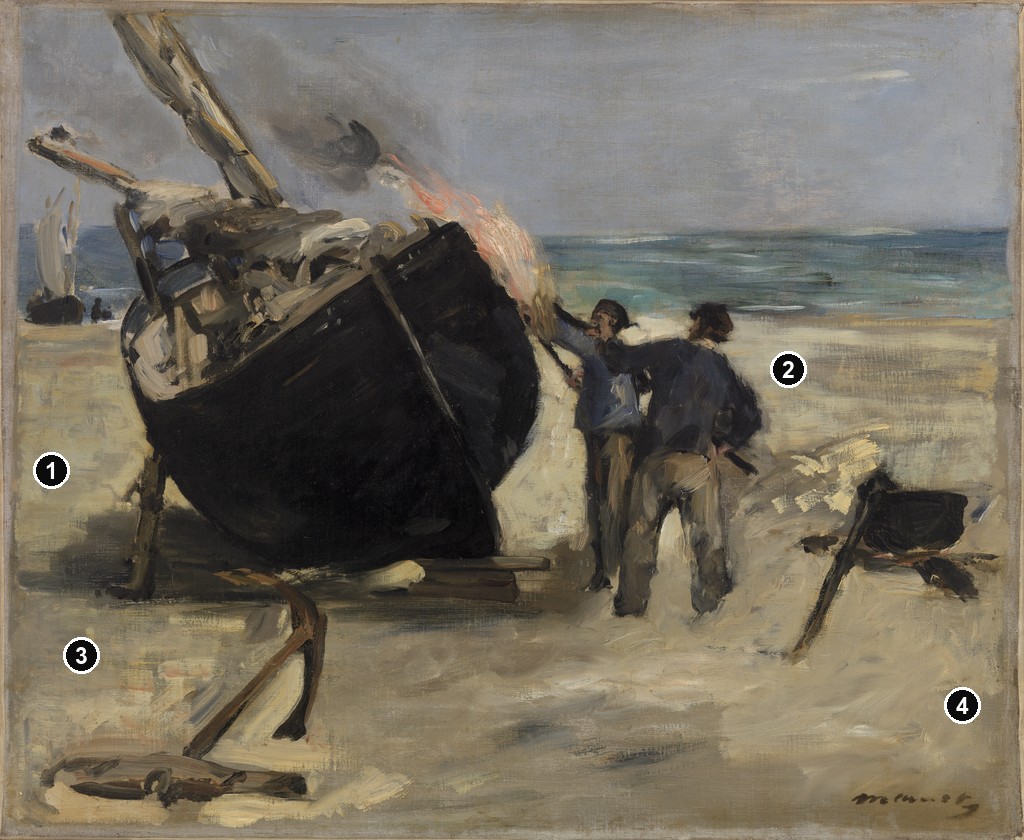
A dark fishing boat tilts towards the viewer, its tall mast passing beyond the picture's upper edge. Beside the hull, two men work beneath a rising flame. Édouard Manet painted Tarring the Boat at Berck-sur-Mer in July–August 1873.[1] The black hull, bright fire and workers' outstretched arms bring the coastal maintenance task close to the viewer. Beyond them, a narrow band of blue-green sea extends beneath the grey sky.
At a Glance
- ArtistÉdouard Manet
- TitleTarring the Boat / Le Bateau goudronné
- DateJuly–August 1873
- MediumOil on canvas
- Dimensions50 × 61.2 cm
- CollectionBarnes Foundation, Philadelphia
- Accession numberBF166
- Catalogue numberRW I193.[1]
This work across Édouard Manet’s career
Olympia
1863The Fifer
1866The Balcony
1868–69The Railway
1873Tarring the Boat by Édouard Manet (current article)
July–August 1873Asparagus
1880Contents
- The Hull at Close Range
- The Workers and the Flame
- An Anchor and a Tar Kettle
- The Sea Beyond the Boat
- Boats Afloat at Berck
- From French Collections to the Barnes
- Annotated details
The Hull at Close Range
The Barnes Foundation explains that Berck's fishermen brought their boats onto the beach because the village lacked a sheltered port. Here, two men apply flaming tar to protect the wooden hull from dampness.[1]
The vessel occupies most of the left side. Its near-black body widens towards the middle before curving down to the sand, where a pale supporting length emerges beneath it. At the right, a sharply rising edge leads towards the flame and the men's extended arms. The hull's uneven position gives the whole structure a pronounced tilt.
Against the pale beach, its dark shape appears substantial. The surface is interrupted by thin brown strokes and scattered grey touches, while narrow highlights pick out parts of the upper edge. These variations keep the black from becoming uniform. Some marks follow the boat's slant; others break across it, revealing a change of plane.
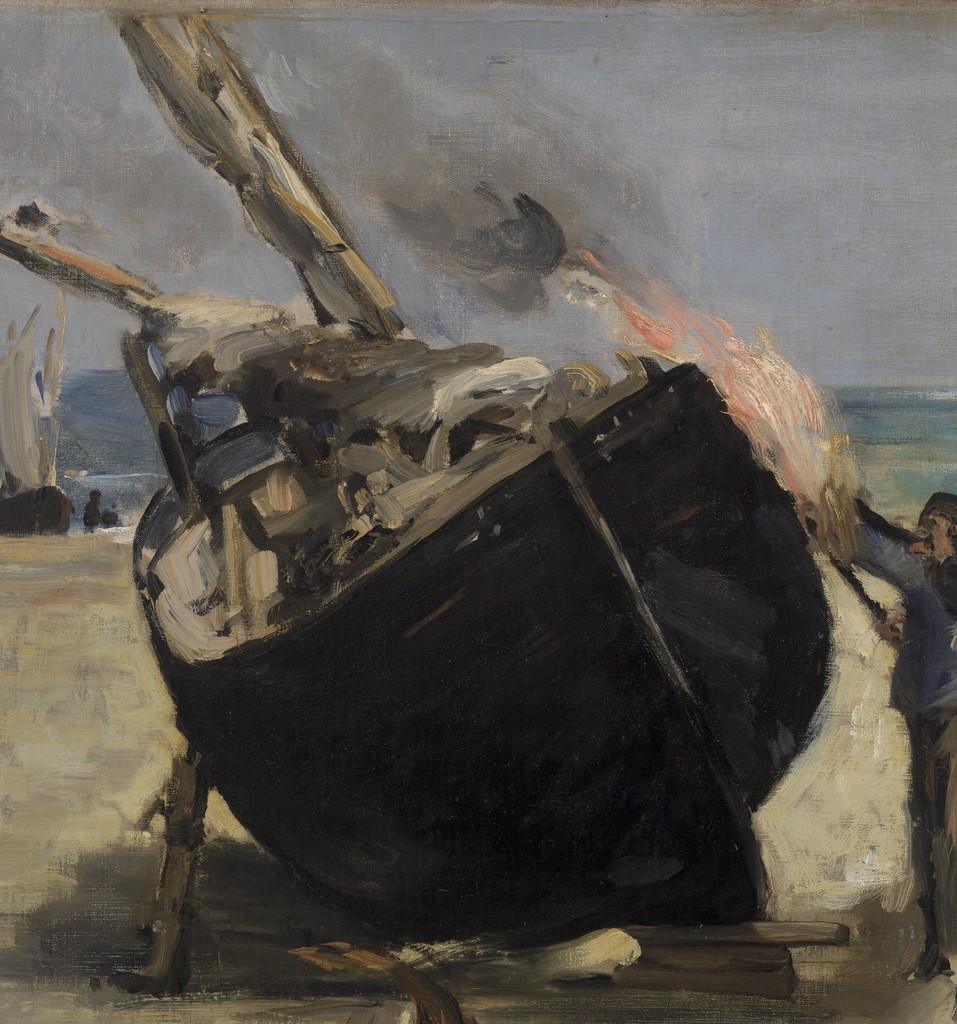
Above the hull, the arrangement becomes open. Pale lengths of timber, dark gaps and folded fabric form an irregular pattern around the mast. A light curved edge returns towards the left, bringing the eye back around the vessel. Here, Manet uses changes between pale and dark to distinguish structures that overlap.
The tall spar is cut by the upper border. Another projecting member extends diagonally towards the left, almost reaching the side of the picture. These interrupted forms make the boat seem too large to fit comfortably inside the canvas. They also connect its heavy lower body with the comparatively empty sky above.
Looking between the upper structure and the broad hull reveals how differently Manet handles the two areas. The upper part is broken into angular pieces and gaps. Below, the dark body holds together across a wide surface. The contrast gives the boat both weight and complexity.
The Workers and the Flame
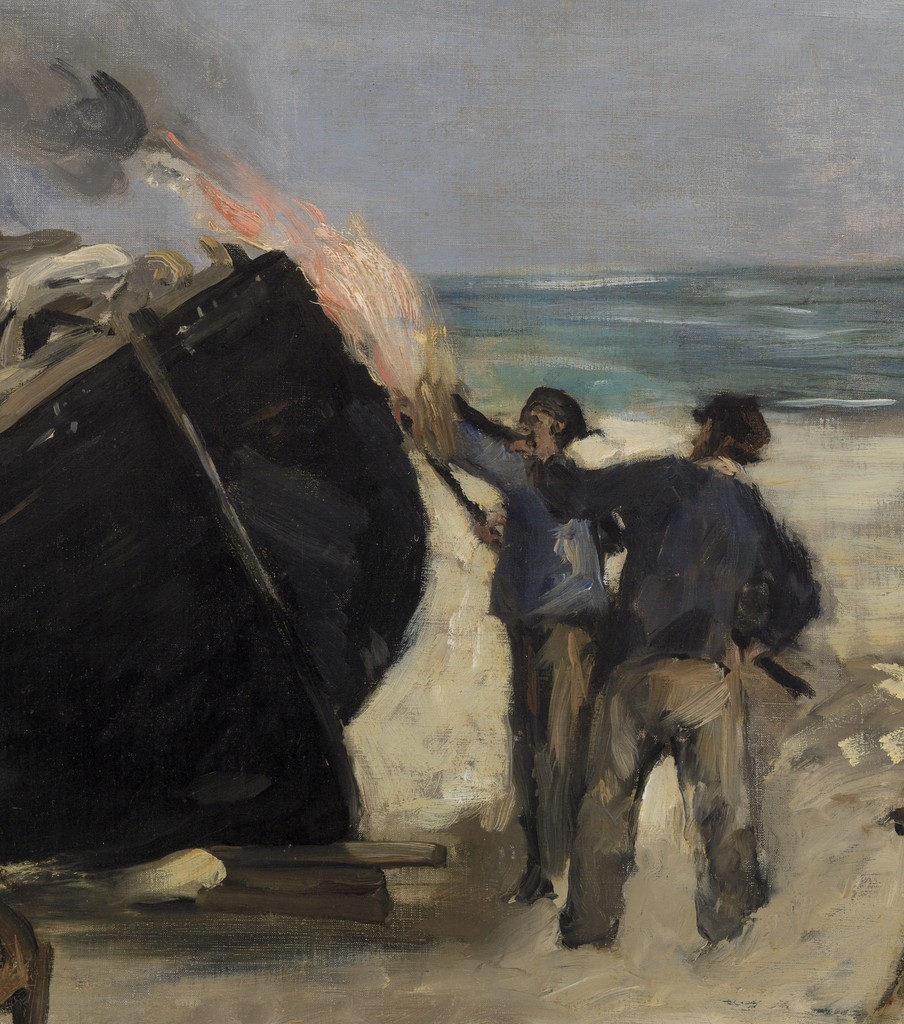
The nearer man stands with his back largely turned towards us. His dark blue upper garment spreads across the shoulders, with broad grey strokes running through the sleeves and back. Light trousers divide into two uneven legs planted on the sand. His stance has enough breadth to remain clear against the pale ground around his feet.
One arm reaches sideways towards the boat. The other bends near his hip, where a short dark implement extends to the right. The hand and tool are described economically, leaving the broader direction of his action more conspicuous than any small mechanical detail.
The second man is partly obscured between his companion and the hull. A light patch describes his face beneath a dark hat, and his arm rises towards the working area. His body appears narrower, with darker passages gathering around his legs. The two men overlap enough for their actions to form a single concentrated group beside the much larger vessel.
At the boat's edge, the flame rises through a cluster of pink, orange, yellow and pale cream strokes. Some marks curve outward; others descend in thinner streaks towards the men. Their brightness becomes more intense beside the dense black hull. The small area of warm colour gathers attention at the point where people and boat meet.
Smoke curls upwards and to the left. Its darker upper shape stands out against the grey sky, while lower passages spread more softly around the flame. The smoke and fire introduce another set of directions beside the boat's firmer diagonals. Where the mast cuts a long path through the sky, the smoke bends into a much shorter, irregular movement.
The figures, hull and flame remain closely connected. The men's arms reach into the narrow interval between the dark vessel and the bright rising marks. Their blue clothing mediates between the near-black boat and the lighter sea behind. The working group is small in relation to the hull, but its actions organise the busiest part of the picture.
An Anchor and a Tar Kettle
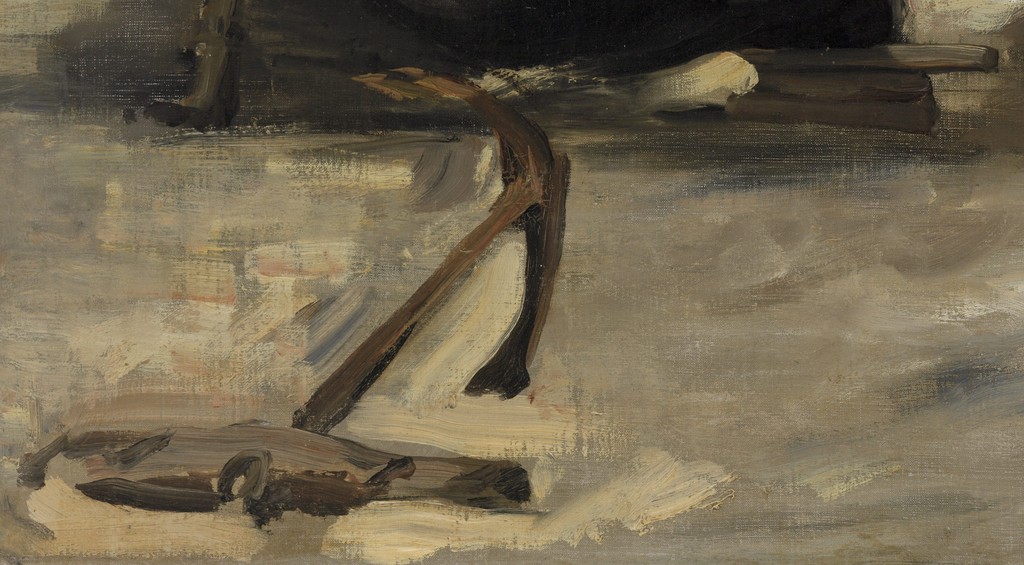
The anchor occupies a large area of the lower foreground. Its long brown shaft cuts diagonally across the sand, with a dark curving form beside it and a broad horizontal piece close to the bottom edge. A small loop interrupts the lower shape. Pale marks catch along some edges, separating the metal-looking forms from the cooler shadows around them.
Its slant helps connect the nearest part of the beach with the boat farther back. The anchor also gives the foreground a strong shape of its own. Dark curved edges stand beside warmer brown surfaces and loose pale strokes on the ground.
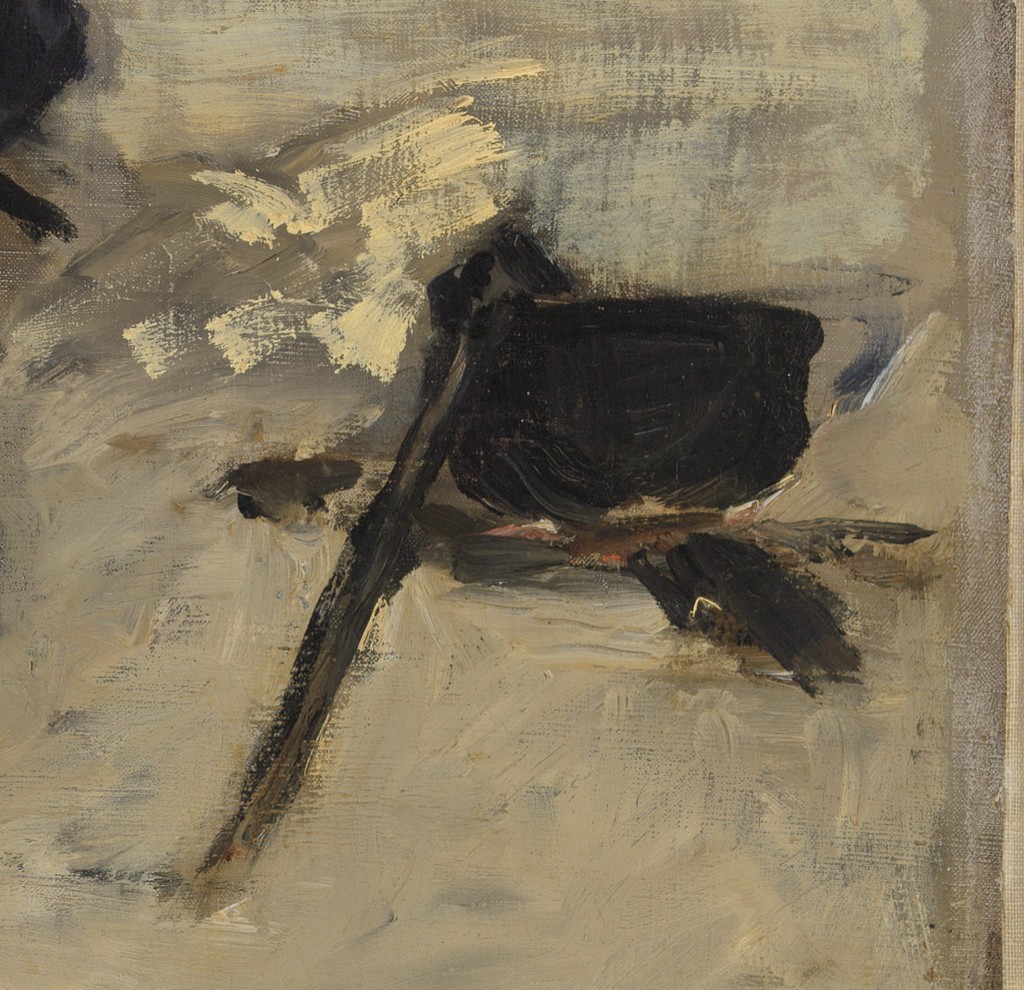
At the right, a black kettle rests above low supports. Its rounded body has a different outline from the boat's enormous curved side, although both depend on dark paint against the sand. Small warm touches appear underneath it, and pale lengths lie nearby. Théodore Duret's 1902 catalogue description identifies the tar kettle at the right and the anchor before the boat, alongside the two men, flames and smoke.[2]
The kettle and anchor spread the activity beyond the men themselves. Equipment occupies the spaces on either side, making the pale foreground part of the working scene. Between these objects, the sand is built from broad strokes of cream, grey and muted yellow. Darker horizontal passages gather underneath the hull and around the workers' feet.
The Sea Beyond the Boat
The beach opens widely to the right of the figures. Its loosely painted surface becomes a setting for the kettle, scattered objects and small dark marks. Near the water, lighter bands stretch across the picture and give the shore a more horizontal direction.
The sea occupies a narrower strip behind the work. Short white strokes interrupt blue-green passages, with darker marks gathering farther out. A small pale sail appears at the far left, partly screened by the large vessel. Its distance is especially apparent beside the close boat's extensive upper structure.
Above the water, the sky is largely grey. It offers enough open space for the smoke, spars and flame to remain distinct. The broad divisions of sky, sea and sand establish the setting, while the boat and figures repeatedly cut across them. The scene's energy comes from these interruptions as well as from the tarring activity itself.
Boats Afloat at Berck
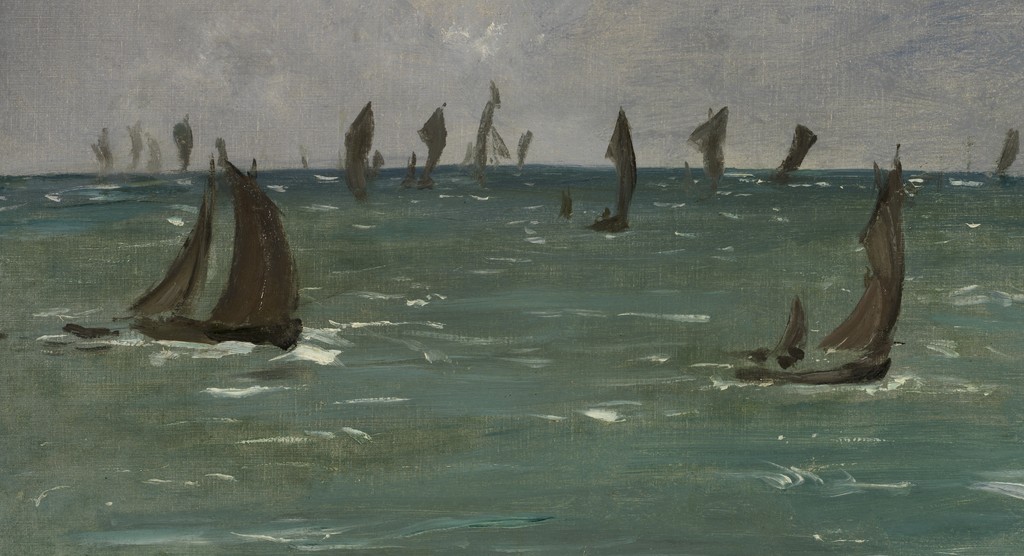
Manet's Boats at Berck-sur-Mer, also painted in 1873, belongs to the Cleveland Museum of Art. Measuring 34 × 55.8 cm, it is a smaller, wider canvas.[3] Dark sails rise above green-blue water beneath a grey sky, with two larger vessels separated across the nearer part of the scene.
The left-hand boat carries a broad brown sail beside a narrower, paler one. On the opposite side, another large sail bends into a curved outline above a low dark hull. Smaller silhouettes recede towards the horizon between and behind these vessels. Their differences of size make the water seem to extend over a considerable distance.
White marks break across the surface in uneven lengths and curves. They surround the nearer boats, then become smaller and more scattered towards the horizon. The repeated interruptions give the water a lively pattern across most of the canvas.
Seen beside Tarring the Boat, the Cleveland painting shows another way to distribute darkness through a coastal view. One close hull gathers the Barnes picture into a powerful mass, while the seascape spreads dark sails across a much broader expanse of water. The ashore scene makes room for people and equipment on pale sand; the boats afloat depend on the changing spaces between their silhouettes and the waves. The comparison makes the closeness of the tarring operation especially evident.
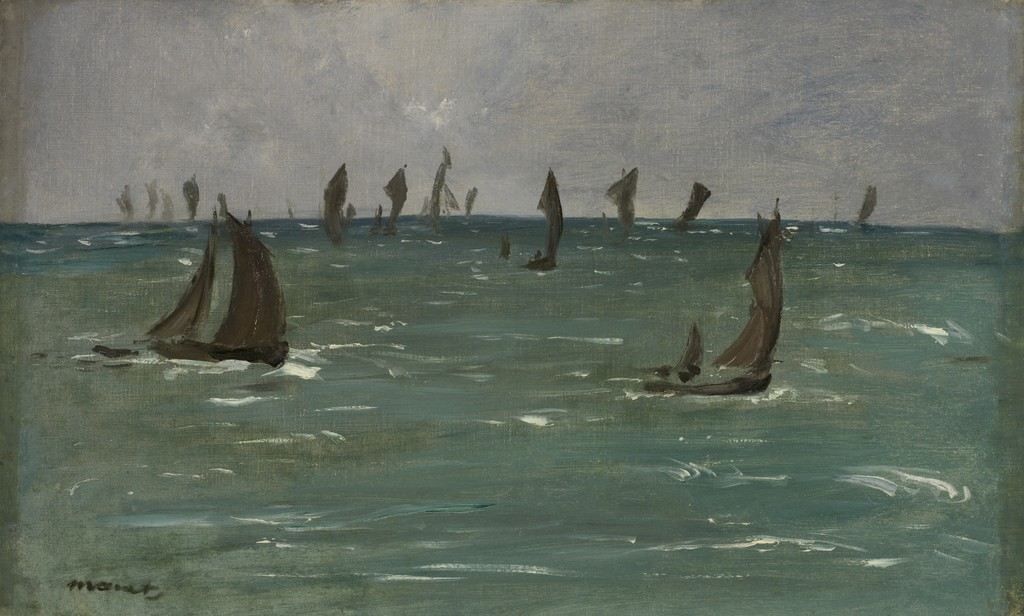
Édouard Manet, Boats at Berck-sur-Mer, 1873. Cleveland Museum of Art, Purchase from the J. H. Wade Fund, 1940.534. Cleveland Museum of Art; CC0 1.0. Image source. CC0 / Public domain. Whole supplied reproduction resized for web display. No enlargement or retouching.
Annotated Details from Tarring the Boat
The numbered points identify visible features discussed in this article. Return from each detail to the whole composition. Each caption identifies the work shown.
Tarring the Boat
Édouard Manet, Tarring the Boat, July–August 1873. Barnes Foundation, Philadelphia, BF166. Faithful public-domain reproduction via Wikimedia Commons; PD-Art / Public Domain Mark. Image source. Public domain. Numbers added to a separate resized overview. Detail crops from the supplied public-domain reproduction; no enlargement or retouching.
Boats at Berck-sur-Mer
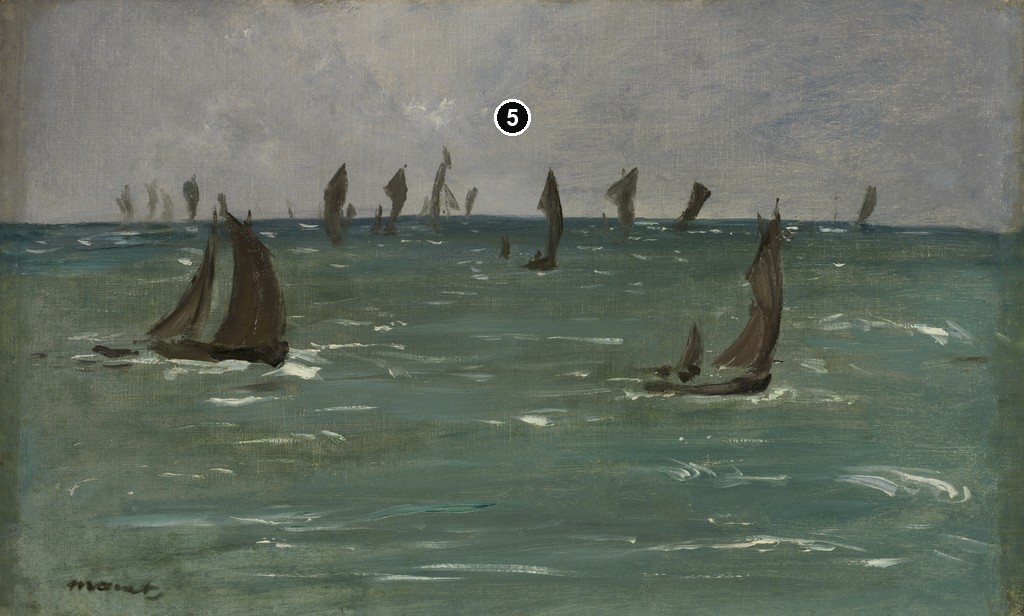
Édouard Manet, Boats at Berck-sur-Mer, 1873. Cleveland Museum of Art, Purchase from the J. H. Wade Fund, 1940.534. Cleveland Museum of Art; CC0 1.0. Image source. CC0 / Public domain. Numbers added to a separate resized overview. Detail crops from the supplied public-domain reproduction; no enlargement or retouching.
Details from TARRING THE BOAT
Explore the hull, workers, anchor and tar kettle, then compare boats sailing off Berck.
Tarring the Boat
Tilting Hull and Upper Structure
The tall upper structure rises above the dark hull. Long sloping edges carry the eye down towards the beach.
Workers Flame and Smoke
Two standing men work beside the boat. Pale smoke rises above the small bright flame, while the dark hull provides a dense background.
Anchor in the Foreground
The anchor lies across the pale foreground. Its long shaft and curved arms extend the boat’s working space towards the viewer.
Tar Kettle and Working Area
A dark kettle sits to the right of the workers. Upright supports and scattered lengths of equipment occupy the beach around it.
Boats at Berck-sur-Mer
Brown Sails and Broken Water
Brown sails stand out against the grey sky and green-blue water. Short white marks break around the boats and continue across the open sea.
From French Collections to the Barnes
Duret listed Mme Besnard in Paris as the painting's owner in 1902.[2] Rouart and Wildenstein's later catalogue traces it through French collections and Wilhelm Hansen in Copenhagen before Dr Barnes.[4] The Barnes Foundation's exhibition history records it in a Paul Guillaume exhibition of recent acquisitions in 1923.[1]
Artworks directory
Explore selected paintings, drawings and prints by Édouard Manet. Search by title or another recorded name.
Frequently Asked Questions
Applying flaming tar to protect the boat's hull from dampness.[1]
At Berck-sur-Mer in July–August 1873.[1]
At the Barnes Foundation in Philadelphia, accession BF166.[1]
Discussion
Look again at the images and ideas explored in Tarring the Boat by Édouard Manet. These editorial prompts invite your observations.
Reader Insights
Follow the small area of pink and orange beside the much larger dark hull, then look at the arms reaching towards it.
Trace its diagonal shaft from the lower part of the picture towards the vessel.
Compare the concentrated dark hull with the scattered brown sail shapes in the Cleveland seascape.
Join the Conversation
Share a detail, comparison or question about Tarring the Boat by Édouard Manet below.
References
- Barnes Foundation, Tarring the Boat (Le Bateau goudronné), July–August 1873, BF166, collection record and exhibition history; long description by Judith Dolkart, reprinted from The Barnes Foundation: Masterworks, 2012, p. 132. View source.
- Théodore Duret, Histoire d'Édouard Manet et de son œuvre, 1902, catalogue no. 160, p. 232. In French. View source.
- Cleveland Museum of Art, Boats at Berck-sur-Mer, 1873, accession 1940.534, collection record. View source.
- Denis Rouart and Daniel Wildenstein, Édouard Manet: Catalogue raisonné, volume I, Peintures, Bibliothèque des Arts, 1975, no. 193, pp. 168–169; no. 197, pp. 170–171. In French. View source.
- Splash image, Édouard Manet, Tarring the Boat, July–August 1873. Barnes Foundation, Philadelphia, BF166. Faithful public-domain reproduction via Wikimedia Commons; PD-Art / Public Domain Mark. Image source. Public domain. Whole supplied reproduction resized for web display. No enlargement or retouching.


