



 by Tom Gurney
Tom Gurney BSc (Hons) is an art history expert with over 20 years experience
Published on June 19, 2020 / Updated on October 30, 2026
Email: tomgurney1@gmail.com / Phone: +44 7429 011000
Head of Christ by Édouard Manet: Introduction
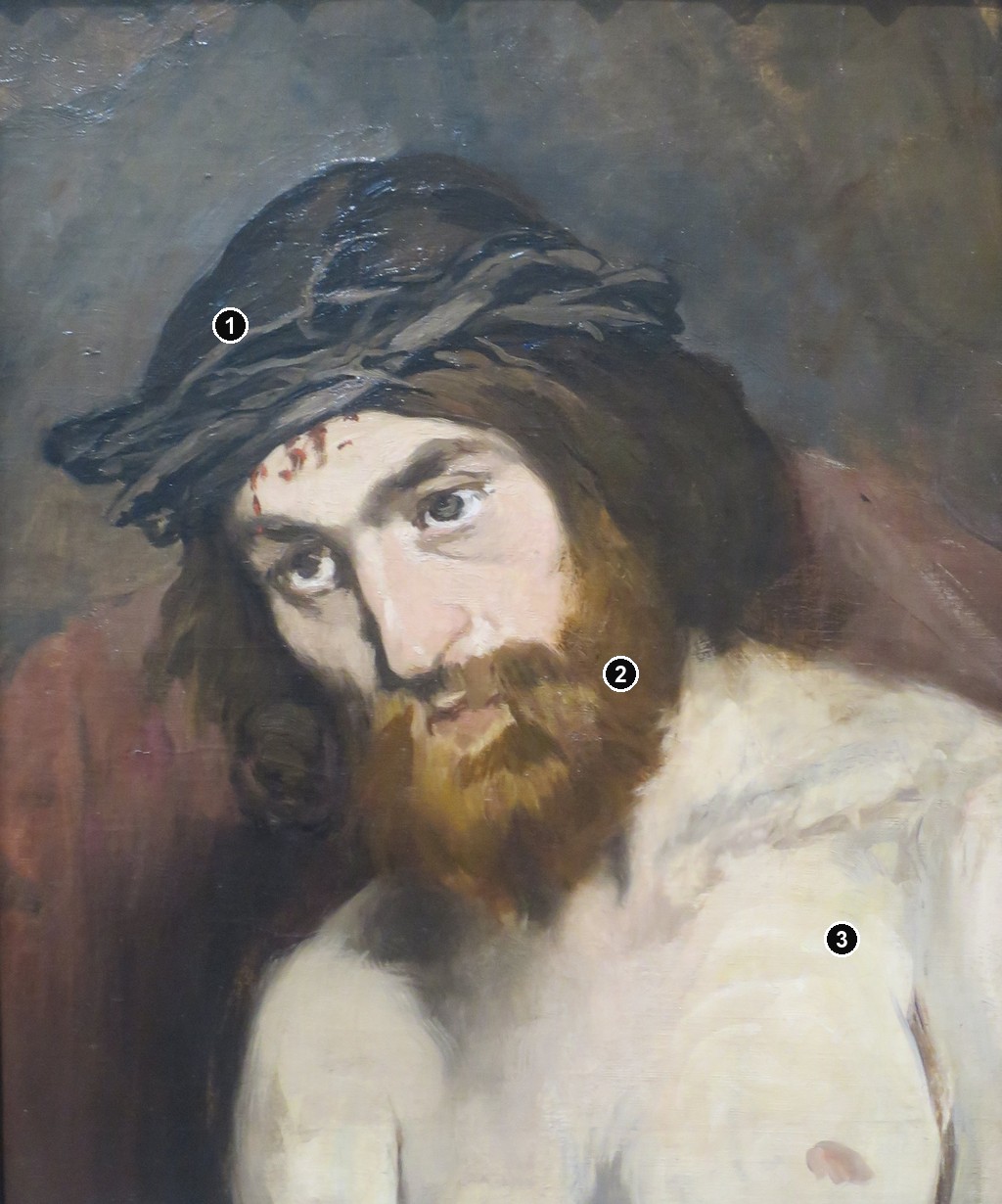
A crown of thorns crosses dark hair above a pale forehead marked with red. Below it, Christ’s head bends towards the left of the picture while his eyes look out beneath strongly drawn brows. Édouard Manet brings the face and bare upper body close, surrounding them with dark and reddish-brown passages. The Fine Arts Museums of San Francisco dates this small oil painting to about 1864–65.[1]
At a Glance
- ArtistÉdouard Manet
- TitleHead of Christ; Tête de Christ
- DateAbout 1864–65.[1]
- MediumOil on canvas
- Dimensions46.7 × 38.7 cm.[1]
- CollectionFine Arts Museums of San Francisco, 69.30.131
- CreditMemorial gift from Dr. T. Edward and Tullah Hanley, Bradford, Pennsylvania.[1]
This work across Édouard Manet’s career
Olympia
1863Head of Christ by Édouard Manet (current article)
About 1864–65The Fifer
1866The Balcony
1868–69The Railway
1873Asparagus
1880Contents
- The Tilt of the Head
- Crown and Forehead
- Eyes and the Pale Face
- Hair and Beard
- Shoulder and Dark Surroundings
- A Fragment from an Earlier Study
- The Larger Composition
- From the Hanley Collection to San Francisco
- Annotated details
The Tilt of the Head
The head’s angle gives the figure an uneven outline. The crown projects towards the left, while the hair on the opposite side forms a rounded mass above the shoulder. The nose descends diagonally across the face, and the beard continues the movement below the mouth. These slanting forms contrast with the upright sides of the canvas.
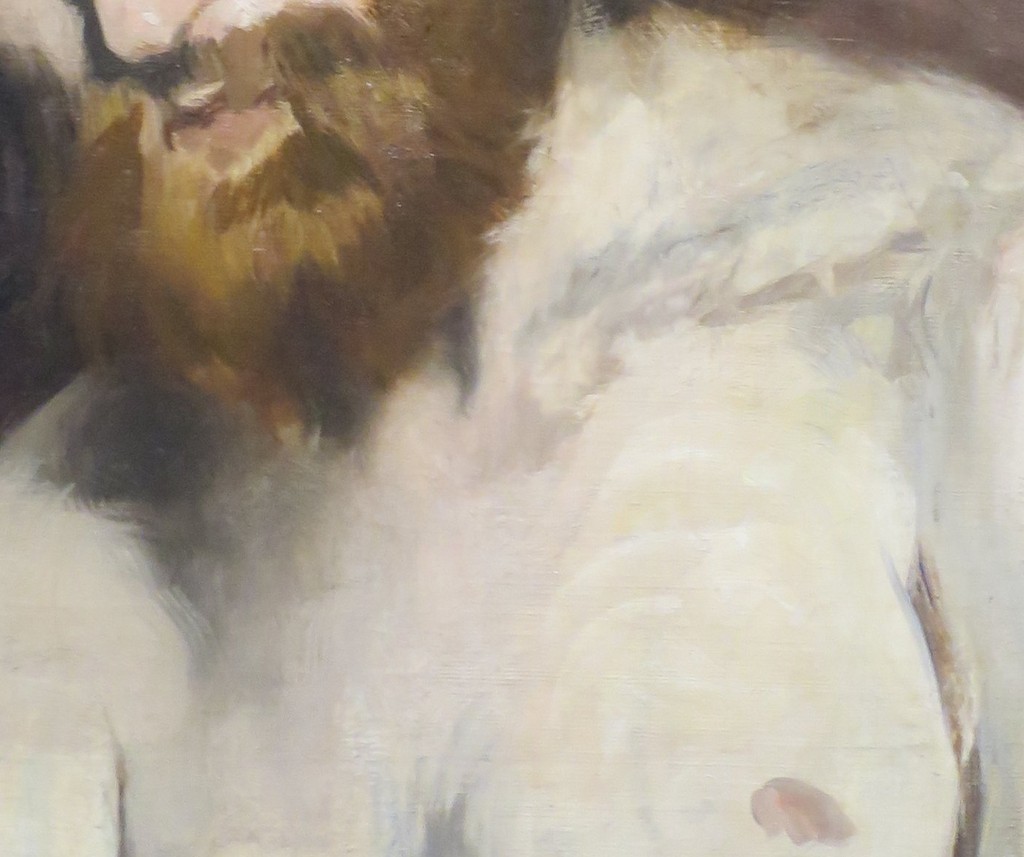
The shoulders follow a different direction. One rises towards the right edge, where it extends beyond the head’s dark outline. The other falls into a narrower pale area at the lower left. Between them, the neck is partly concealed by the beard. Head and torso therefore turn against one another rather than forming a single, straight axis.
The close boundaries make these changes of direction especially clear. The body continues beyond the lower edge, leaving its full posture unresolved. Neither hands nor arms provide a gesture that would explain the figure’s position.
Crown and Forehead
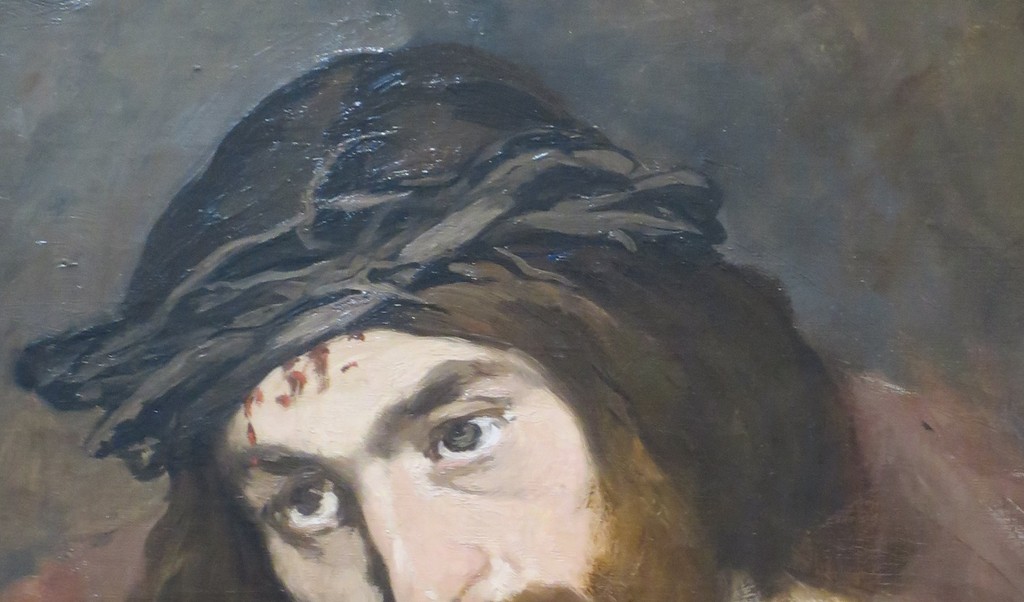
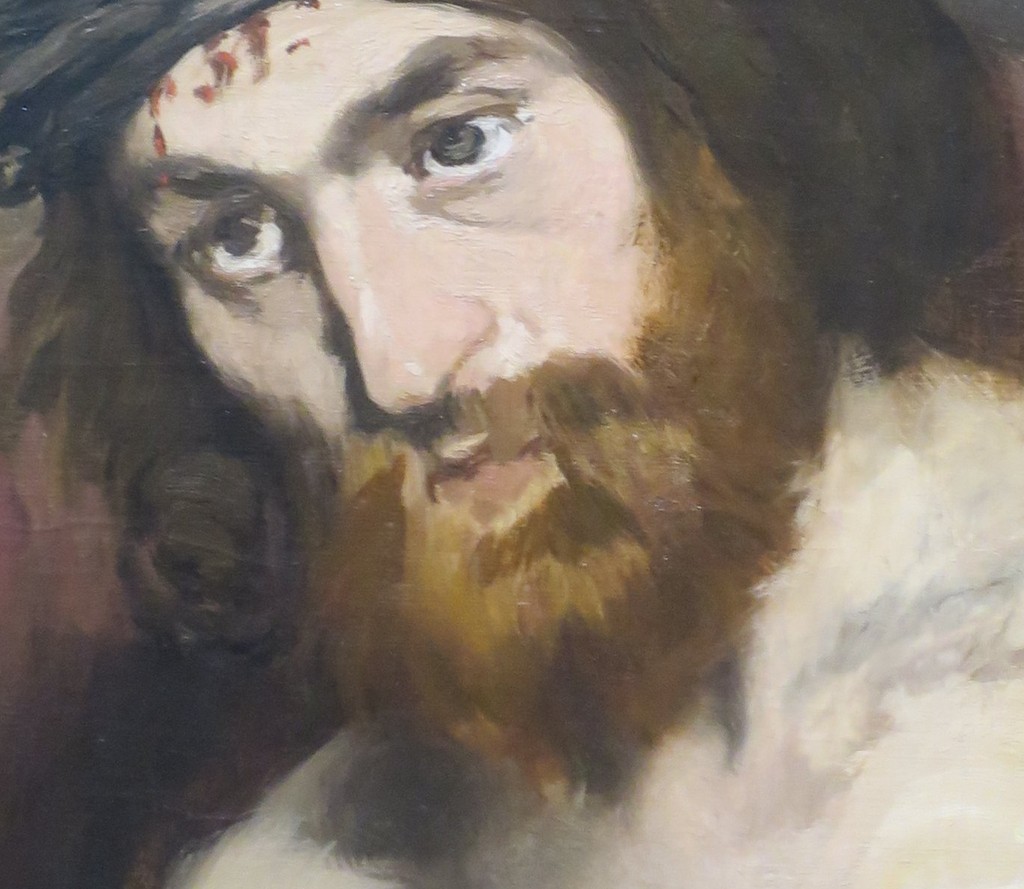
The crown consists of overlapping dark and lighter brown bands. Long, irregular shapes stretch across the hair, with pointed ends projecting into the surrounding space. Some run almost horizontally; others rise towards the right before disappearing against the dark upper part of the head.
A narrow light area separates parts of the crown from the forehead. Beneath the lower band, small red marks descend onto the skin. Their uneven placement interrupts the broad pale surface above the brows. The crown and these marks identify the suffering Christ before the viewer considers the rest of the figure.
Above the crown, dark hair rounds towards the top of the head. Its boundary is less sharply drawn than the projecting bands below. This difference lets the crown remain distinct even though both occupy the darkest part of the figure.
Eyes and the Pale Face
The eyes sit at different heights because of the head’s tilt. The eye on the image’s right is larger and more exposed, with a pale rim around its dark centre. The opposite eye lies nearer the shadowed side of the face. Thick brows accentuate their unequal positions without making them mirror images.
Across the forehead and nose, light cream and pinkish passages meet darker areas around the eyes. The nose forms a long, comparatively simple plane between these more intricate shapes. A warmer patch beside it leads towards the moustache, where the light face meets the darker hair around the mouth.
The lips part slightly beneath the moustache. They are small in relation to the surrounding beard, yet their warmer colour makes them distinguishable.
Hair and Beard
Long dark hair falls beside the face, widening into rounded areas at either side. On the left, it merges with a deep shadow below the crown. On the right, it spreads behind the cheek before turning towards the neck and shoulder. Its darker outline separates the head from the warmer background.
The beard has a different colour and structure. Brown, reddish and ochre passages broaden below the mouth, while darker marks divide the central area from the sides. Its lower edge breaks into several uneven points above the chest. The moustache links the beard to the upper lip without producing a continuous dark border around the mouth.
These changes distinguish several kinds of hair within a compact space. The crown’s long crossing bands, the larger dark masses beside the face and the warmer beard each have a different direction.
Shoulder and Dark Surroundings
The exposed shoulder on the right is built from broad, angular pale strokes. Grey and brown passages break up the lighter surface. A darker curve descends at the far right, while the chest spreads towards the lower edge. The light body occupies a large part of the foreground.
At the left, a nearly black vertical area stands beside the figure. Reddish-brown passages rise behind the hair and continue on the opposite side of the head. They suggest a warmer surrounding field, but provide few clues to a particular place. No other person is identifiable within this close view.
The dark area beside the chest differs from the more varied space above the crown. That contrast gives the pale torso a clear boundary on one side, while the upper outline of the hair remains softer.
A Fragment from an Earlier Study
Denis Rouart and Daniel Wildenstein catalogued the work as Tête de Christ in 1975, identifying it as a fragment cut from a study for Jesus Mocked by the Soldiers.[2] It is therefore distinct from the complete painting now in Chicago.
Their catalogue transcribes an inscription on a stretcher crossbar, signed A. Hurel, stating that Manet cut the study for him from one of his canvases.[2] This recorded inscription connects the fragment with Abbé Hurel. The catalogue’s account concerns an earlier study, rather than a piece removed from the surviving exhibition canvas.
The Larger Composition
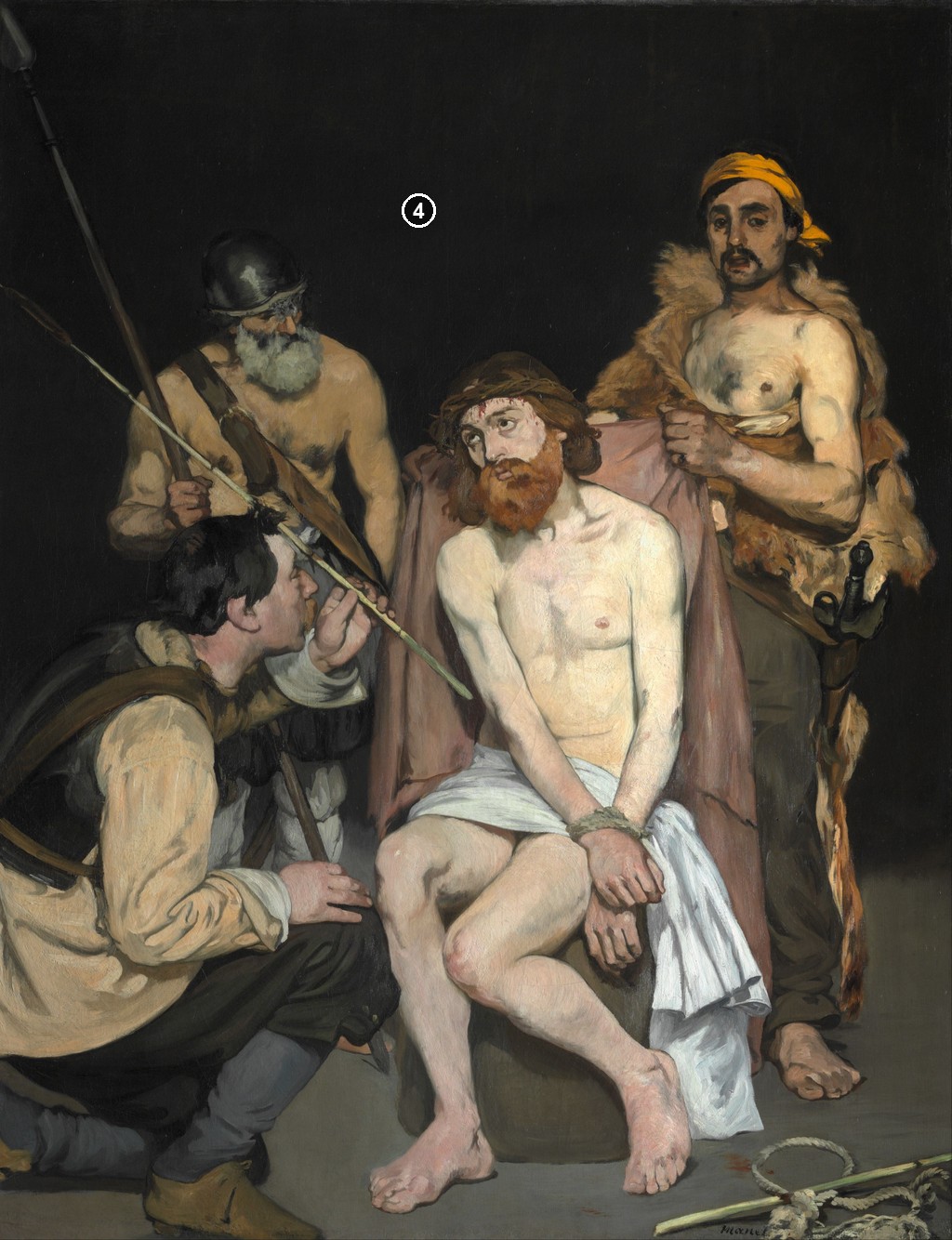
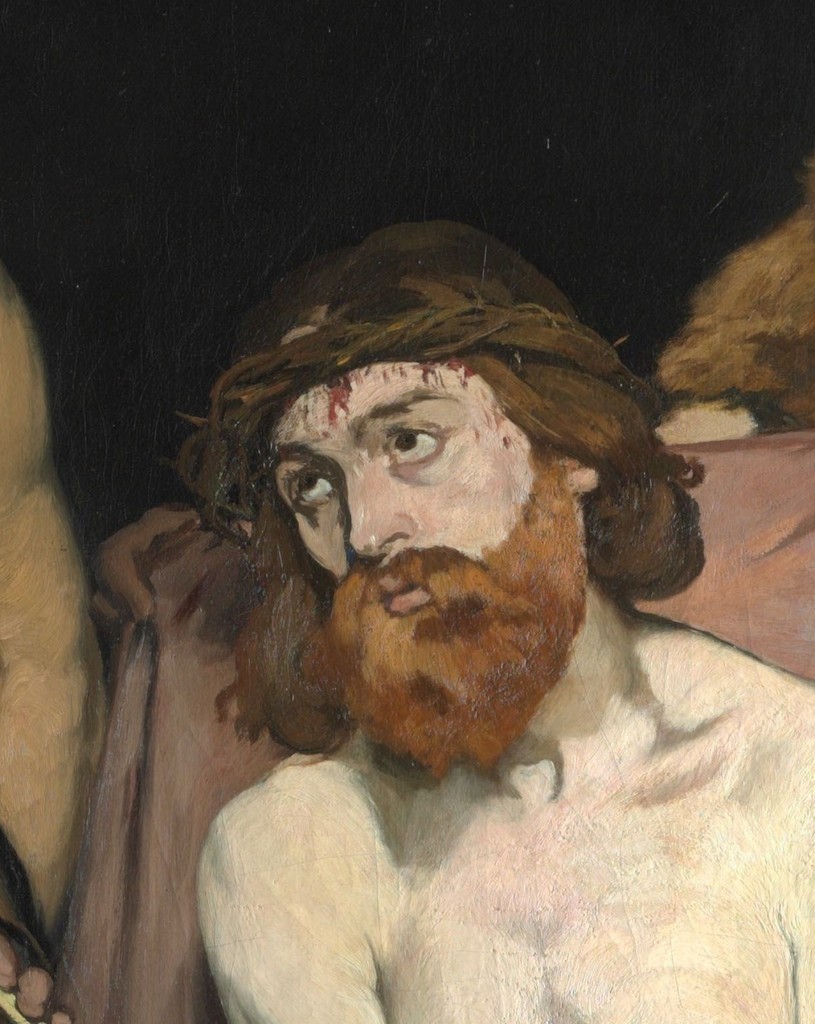
In Jesus Mocked by the Soldiers, dated 1865 and now at the Art Institute of Chicago, the crowned figure appears among three men.[3] The larger canvas sets a related treatment of Christ’s head within a narrative scene.
The seated Christ’s bound hands rest in front of his body, with pale drapery crossing the knees. A kneeling man occupies the lower left, and two standing figures rise behind him. Long poles cross the composition diagonally. The body’s position can be followed through the arms, hands, legs and feet, unlike the small head study’s abbreviated view.
The head also changes. In the complete painting it sits more upright, with the eyes turned upwards. In the fragment, the downward tilt and outward-looking eyes create a different relationship with the viewer. Comparing them shows how a related face can operate within two different arrangements of bodies and space.
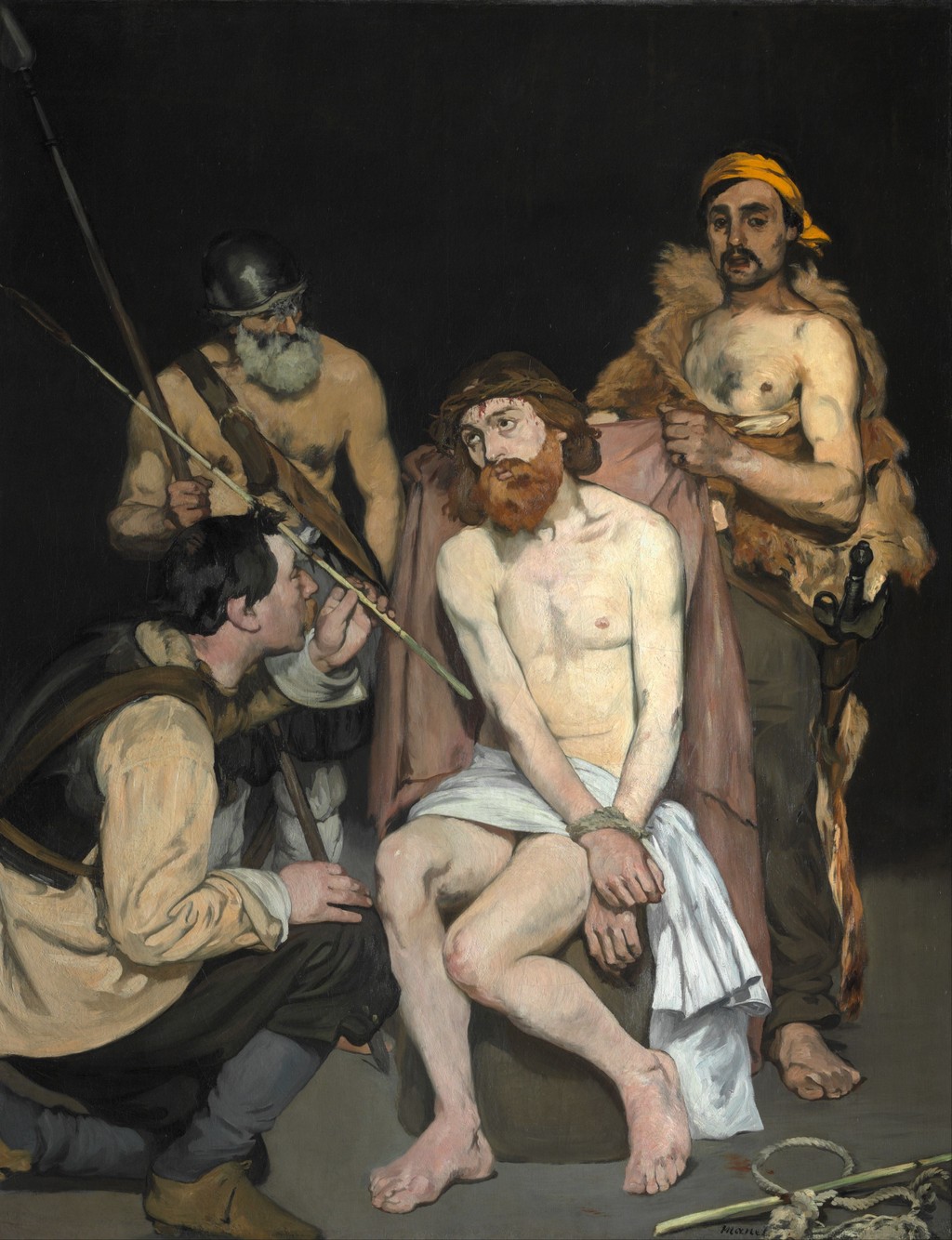
Édouard Manet, Jesus Mocked by the Soldiers, 1865. Oil on canvas. Art Institute of Chicago, gift of James Deering, 1925.703. The complete painting is separate from the earlier study represented by the head fragment. Art Institute of Chicago / Google Art Project / Wikimedia Commons. Image source. Public domain. Resized without cropping or enlargement from the supplied reproduction.
From the Hanley Collection to San Francisco
Rouart and Wildenstein’s published history traces the head through Hurel, the Marquis de Narbonne-Lara, Mme Besnard and Goldschmidt before the Hanleys. It records the museum gift in 1969.[2]
The museum’s exhibition history includes the Philadelphia and Chicago Manet exhibition of 1966–67 and the Musée d’Orsay exhibition of 2011.[1] The small fragment thus continued to be presented alongside Manet’s wider work, while retaining its own identity as a separately collected painting.
Annotated Details from Head of Christ
The numbered points identify visible features discussed in this article. Return from each detail to the whole composition. Each caption identifies the work shown.
Head of Christ
Édouard Manet, Head of Christ, about 1864–65. Oil on canvas, 46.7 × 38.7 cm. Fine Arts Museums of San Francisco, 69.30.131. Memorial gift from Dr. T. Edward and Tullah Hanley, Bradford, Pennsylvania. Édouard Manet / Fine Arts Museums of San Francisco, via Wikimedia Commons. Image source. Public domain. Numbers added to a separate overview. Three detail crops from the supplied photograph; no enlargement, recolouring or retouching.
Jesus Mocked by the Soldiers — Chicago Painting
Édouard Manet, Jesus Mocked by the Soldiers, 1865. Oil on canvas. Art Institute of Chicago, gift of James Deering, 1925.703. The complete painting is separate from the earlier study represented by the head fragment. Art Institute of Chicago / Google Art Project / Wikimedia Commons. Image source. Public domain. Numbers added to a separate resized whole supplied overview. Detail crops from the unchanged original; no enlargement, retouching or colour alteration.
Details from HEAD OF CHRIST
Follow the numbered details back to the complete images above. Each caption identifies the work shown.
Head of Christ
The crown and red marks
Long dark and lighter brown bands overlap above the forehead. Small red marks descend onto the pale area beneath the lower band.
Eyes above the beard
The open eyes sit at unequal heights beneath the brows. The pale nose leads down towards the moustache and the warmer, broader beard.
The slope of the shoulder
Broad angular marks cross the pale shoulder, which rises towards the right edge. Its direction differs from the downward tilt of the head.
Jesus Mocked by the Soldiers — Chicago Painting
The Turned Head and Crown
The pale turned face sits beneath a dark crown of thorns and above the reddish beard in the separate Chicago painting.
Artworks directory
Explore selected paintings, drawings and prints by Édouard Manet. Search by title or another recorded name.
Frequently Asked Questions
The Fine Arts Museums of San Francisco dates it to about 1864–65.[1]
Rouart and Wildenstein identify it as a fragment from an earlier study for Jesus Mocked by the Soldiers, rather than from the surviving Chicago canvas.[2]
It belongs to the Fine Arts Museums of San Francisco, accession 69.30.131, as a memorial gift from Dr. T. Edward and Tullah Hanley.[1]
Discussion
Look again at the images and ideas explored in Head of Christ by Édouard Manet. These editorial prompts invite your observations.
Reader Insights
Follow the angle of the forehead and nose, then compare it with the slope of the shoulders. Where do the two movements meet?
Trace the long bands above the forehead. Which projecting points remain clearest against the dark hair?
Compare the fragment with the Chicago painting. How do bound hands and surrounding figures change your reading of the face?
Join the Conversation
Share a detail, comparison or question about Head of Christ by Édouard Manet below.
References
- Fine Arts Museums of San Francisco, Head of Christ, about 1864–1865, 69.30.131, object details and exhibition history. View source.
- Denis Rouart and Daniel Wildenstein, Édouard Manet: Catalogue raisonné, tome I, 1975, no. 101, pp. 102–103, Tête de Christ. Digitised catalogue, Wildenstein Plattner Institute. French. View source.
- Art Institute of Chicago, Jesus Mocked by the Soldiers, 1865, 1925.703, museum-authored record on Google Arts & Culture. View source.
- Splash image, Édouard Manet, Head of Christ, about 1864–65. Oil on canvas, 46.7 × 38.7 cm. Fine Arts Museums of San Francisco, 69.30.131. Memorial gift from Dr. T. Edward and Tullah Hanley, Bradford, Pennsylvania. Édouard Manet / Fine Arts Museums of San Francisco, via Wikimedia Commons. Image source. Public domain. Resized without cropping or enlargement from the supplied photograph.


