



 by Tom Gurney
Tom Gurney BSc (Hons) is an art history expert with over 20 years experience
Published on June 19, 2020 / Updated on October 30, 2026
Email: tomgurney1@gmail.com / Phone: +44 7429 011000
The Monet Family in Their Garden at Argenteuil by Édouard Manet: Introduction
A large white dress spreads across the grass. A boy in blue reclines against it, while a man bends towards the flowers at the left. In The Monet Family in Their Garden at Argenteuil, Manet brings a family portrait into the ordinary activity of a garden. Resting, tending plants and posing for a painter occupy the same small patch of ground.
The people are Claude Monet, his wife Camille and their son Jean. Painted in 1874, the canvas belongs to the Metropolitan Museum of Art in New York.[1] Its wider story also includes Renoir, whose painting of Camille and Jean offers a remarkably close comparison: the same family and occasion, rearranged by another painter’s eye.
At a Glance
- ArtistÉdouard Manet
- Date1874
- MediumOil on canvas
- Dimensions61 × 99.7 cm, height × width
- CollectionThe Metropolitan Museum of Art, New York
- Accession number1976.201.14
- CreditBequest of Joan Whitney Payson, 1975.[1]
This work across Édouard Manet’s career
Contents
- A Summer of Painting at Argenteuil
- Camille and Jean on the Lawn
- Claude Monet as a Gardener
- Making Space with Greens and Reds
- White Fabric and Visible Paint
- Renoir’s Companion Painting
- A Shared Occasion, Different Results
- From Gardening to the Floating Studio
- A Gift Returned and a Public Collection
- Annotated details
A Summer of Painting at Argenteuil
During the summer of 1874, Manet visited Monet at Argenteuil while staying across the Seine at his own family’s house in Gennevilliers. The garden shown here was at Monet’s first rented house in the town, before his move to another property later that year.[1]
The setting allows Manet to paint his friend in a different capacity from the one we might expect. There is no easel beside Claude. His attention is directed downwards, towards the plants. Camille and Jean, meanwhile, form the principal seated group. The garden makes room for the father’s activity and for their repose without bringing all three into a conventional portrait pose.
A letter from Émile Zola provides a contemporary glimpse of this painting campaign. On 23 July 1874, writing to the painter Antoine Guillemet, Zola said that Manet was making a study at Monet’s in Argenteuil and was hard to find.[2] The remark places Manet at work there, although it does not securely identify this canvas or date its sitting to that particular day.
That distinction leaves the painting’s summer setting intact. We can understand the friends working in close contact without turning a dated mention of a study into a complete account of an afternoon. Much of what makes this canvas distinctive is already available in the poses, clothes and garden around the family.
Camille and Jean on the Lawn
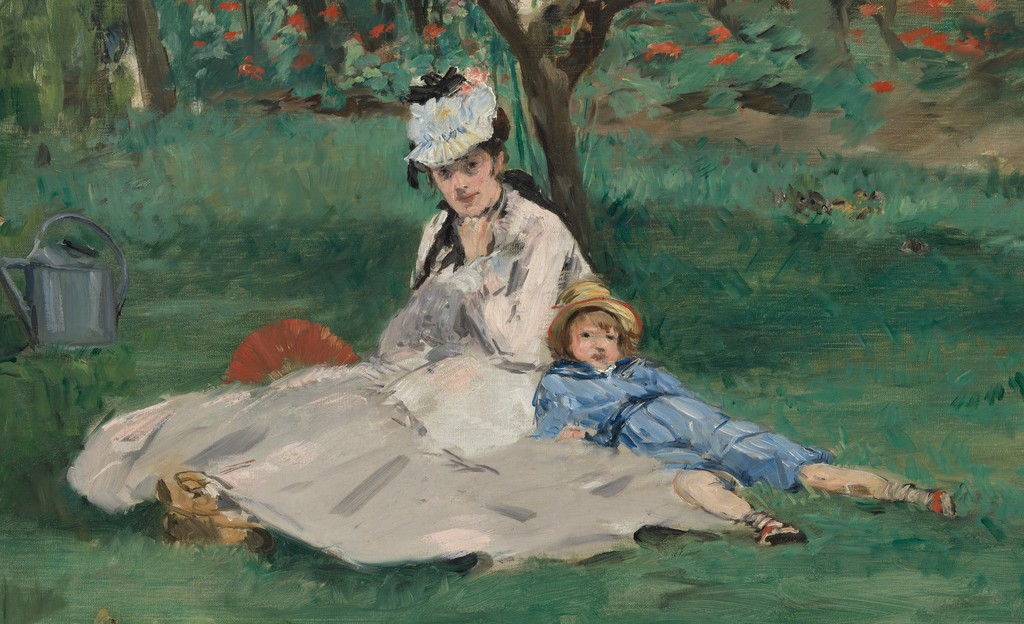
Camille sits near the centre-right, with the breadth of her dress reaching towards the left. Its pale fabric supplies the largest light shape in the painting. The skirt gives her seated body a substantial base, while the smaller forms of her shoulders, head and hat rise above it.
Her face turns towards us beneath the brim of an elaborate pale hat. Dark trim and ribbon interrupt the light clothing near her neck. The angle of her head and the hand close to her chin give the pose a supported, settled quality. Yet the directness of her face keeps her from being absorbed entirely into the surrounding greenery.
Jean leans back beside her in blue sailor clothes, his straw hat edged with a reddish band. His legs extend across the lawn towards the right, opening at different angles. The dark trim of his collar, waist and sleeves gives the loose blue shapes a clearer structure. Small red accents in the footwear answer the warmer colours elsewhere in the scene.
The two figures are joined by overlapping shapes. Jean’s blue sleeve meets the white dress; his body follows its broad outward spread; the brim of his hat sits close to his mother’s shoulder. Their physical closeness is established through these contacts, while each retains a separate face and posture.
Neither figure has been isolated against a neutral background. Grass comes up around the skirt and legs, and the tree rises directly behind Camille. The family seems to belong to this particular place through the way bodies, clothes and plants occupy it together.
Claude Monet as a Gardener
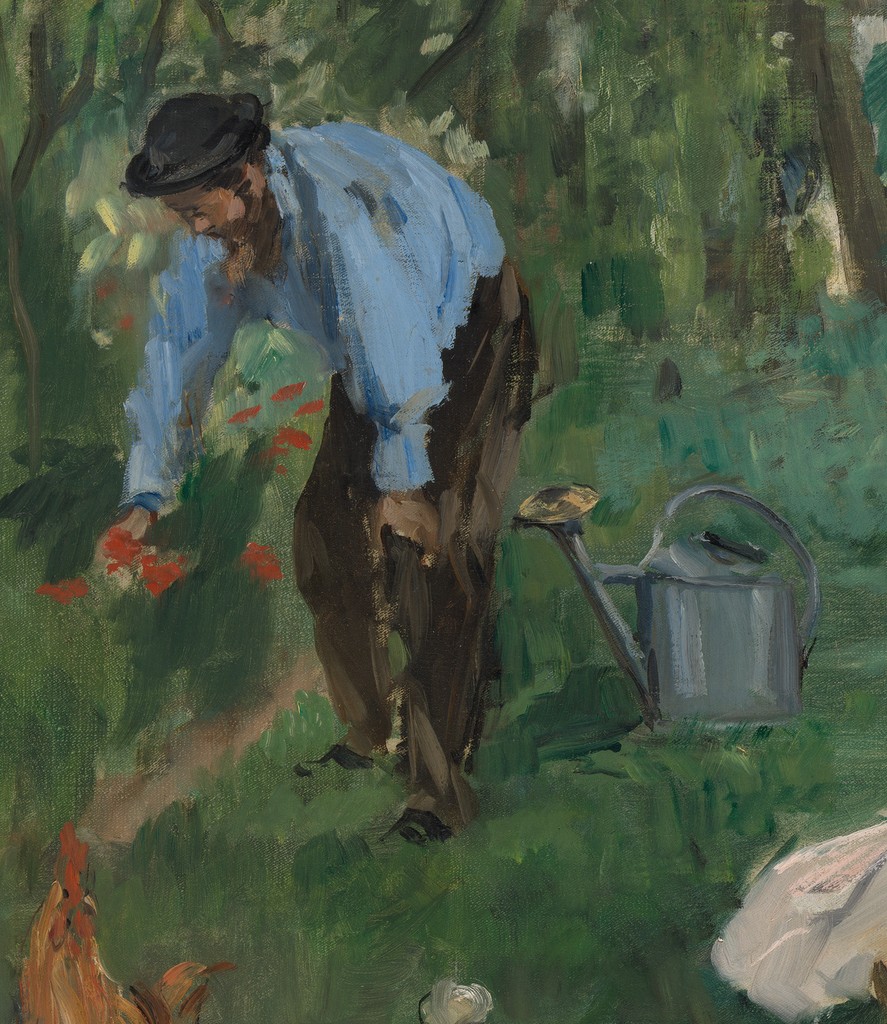
At the left, Claude’s blue shirt forms another conspicuous patch of colour. His dark trousers and bowler hat give the bent figure a different outline from Camille’s broad white skirt. With his head lowered and one arm reaching towards the flowers, he directs attention to a small area of planting.
A watering can rests beside him. Its upright body, long spout and curved handle make a recognisable object among the less sharply defined leaves. Because it is set on the ground, the can also helps locate Claude’s feet and the patch of lawn on which he works.
His position balances the family group without repeating its pose. Camille and Jean stretch across the lower middle and right; Claude occupies a more upright area at the left, even while bending forward. Between them, the grass and watering can provide a small interval. The family is connected across the width of the canvas rather than gathered into a compact triangle of faces.
Monet’s blue shirt also answers his son’s blue clothes. Against the extensive greens, the two patches help the eye move from one side of the picture to the other. Their shared colour can be appreciated without making it into a fixed symbolic code.
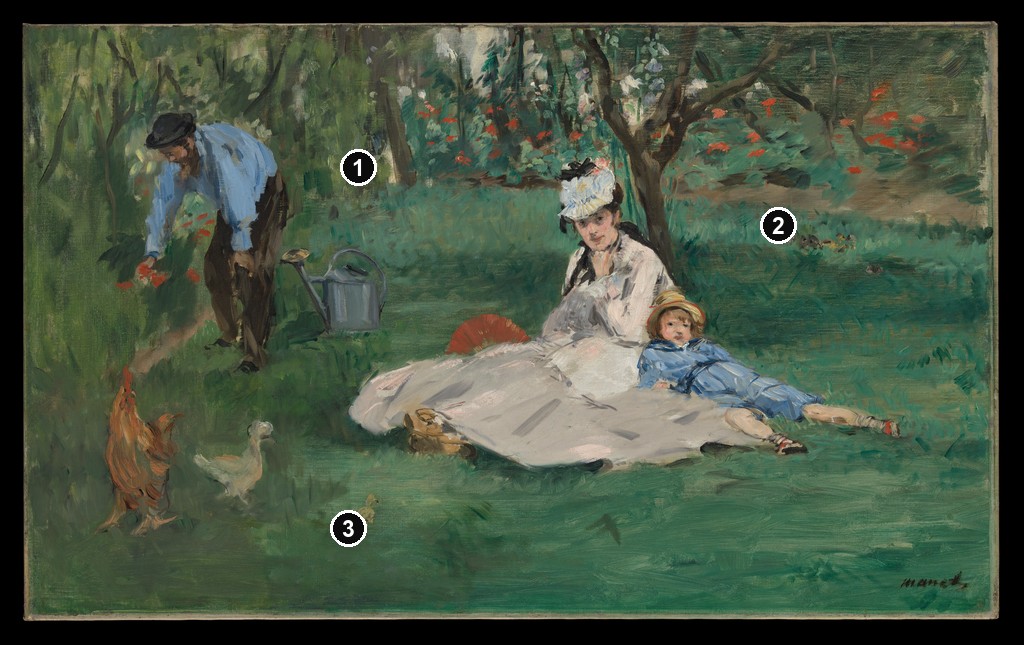
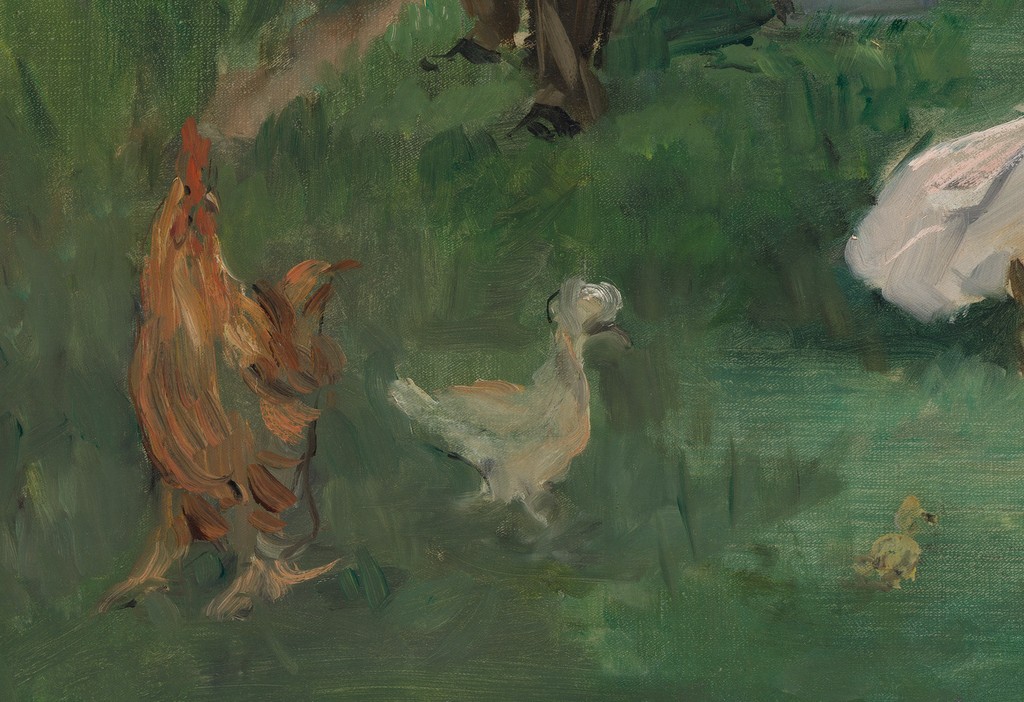
In the foreground, a reddish rooster, a pale hen and a small chick introduce a second little gathering. The Met’s catalogue entry, following Colin Bailey, reads the birds as an echo of the family trio.[1] It is an appealing interpretation of their placement, though the picture does not establish a declared animal fable.
The birds have a practical compositional role as well. Their different sizes and colours bring variety to the darker left foreground. They also occupy the space between us and Claude, giving the garden an inhabited depth before the eye reaches the flowers at the back.
Making Space with Greens and Reds
The garden fills almost the entire canvas. Its lawn provides a broad green field around the figures, while flowers and darker foliage gather above and behind them. A pale curving strip separates parts of the lawn from the more distant planting, making a route through the picture even where individual plants remain loosely described.
The tree behind Camille is especially useful to the composition. Its dark trunk helps separate her light hat and shoulders from the background. Higher branches extend to the right, giving structure to an area that might otherwise remain an undifferentiated spread of green. The tree connects the seated group to the taller garden around it.
Red flowers appear in scattered touches across the upper part of the painting and near Claude’s reaching hand. They are small compared with the dress, yet their warmth makes them forceful. The red fan beside Camille’s skirt brings that colour into the foreground, where it becomes easier to recognise as a distinct object.
Manet varies the greens considerably. Some passages are cool and blue, others warmer or darker, and the direction of the brushwork changes from one area to the next. A broad mark can describe the lawn, while a short upright stroke suggests a leaf or stem. These differences allow the garden to feel abundant without requiring every plant to be carefully outlined.
The resulting space remains legible. Claude stands beyond the foreground birds, Camille and Jean sit within the lawn, and the flowerbeds run behind them. This order gives the small domestic scene room to breathe. The viewer can move between its separate activities while remaining within the enclosure of the garden.
White Fabric and Visible Paint
Camille’s dress is particularly rewarding to examine closely. What reads from a distance as white contains grey, pale pink and darker strokes. Some follow the long spread of the skirt; others interrupt it, suggesting folds or the changing direction of the fabric. The light shape holds together even where its individual marks are conspicuous.
Near the lower edge, the outline becomes uneven. Pale paint meets grass in broad passages, and the small tan shoes are only briefly indicated. The contrast between such economical details and the dress’s large area gives the eye different kinds of work: first recognising the whole, then discovering how little paint may establish a particular object.
Jean’s clothes have a similar freedom. Bands of blue and white describe folds without giving every seam equal attention. His exposed knees, socks and shoes break the body into smaller changes of colour as the legs extend towards the right.
The faces receive enough distinction to make the family recognisable, but they share the surrounding picture’s visible handling. They are part of the same painted surface as the foliage and clothing. Manet lets a portrait remain alert to colour and touch across the whole canvas.
Such handling contributes to the feeling of an outdoor encounter. It does not, by itself, measure how quickly the work was completed. A freely placed stroke may be the result of considerable choice, just as a relaxed pose can be arranged for a painter.
Renoir’s Companion Painting
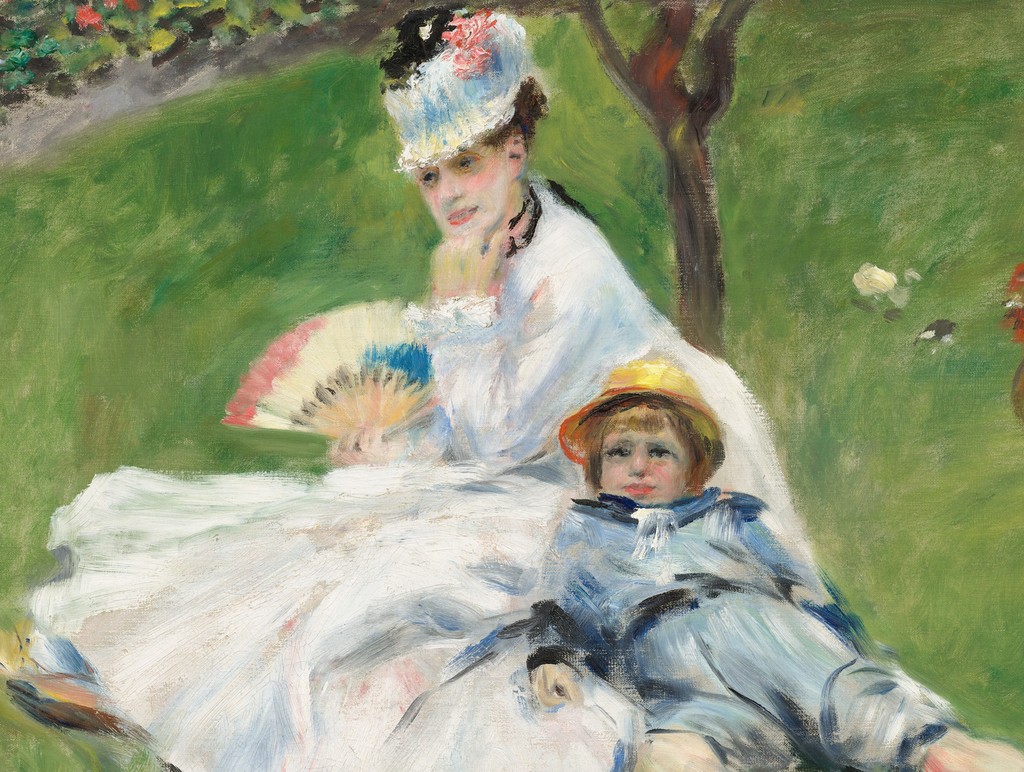
Renoir’s Madame Monet and Her Son, also dated 1874, is now in the National Gallery of Art in Washington.[3] Comparing the two paintings makes the decisions of each artist unusually visible.
According to Monet’s much later recollection, Renoir arrived while Manet was working, borrowed painting materials and began beside him.[4] The account explains why the mother, child, clothes and garden are so closely related in the two pictures. It also lets us see how much could change even when painters shared a subject.
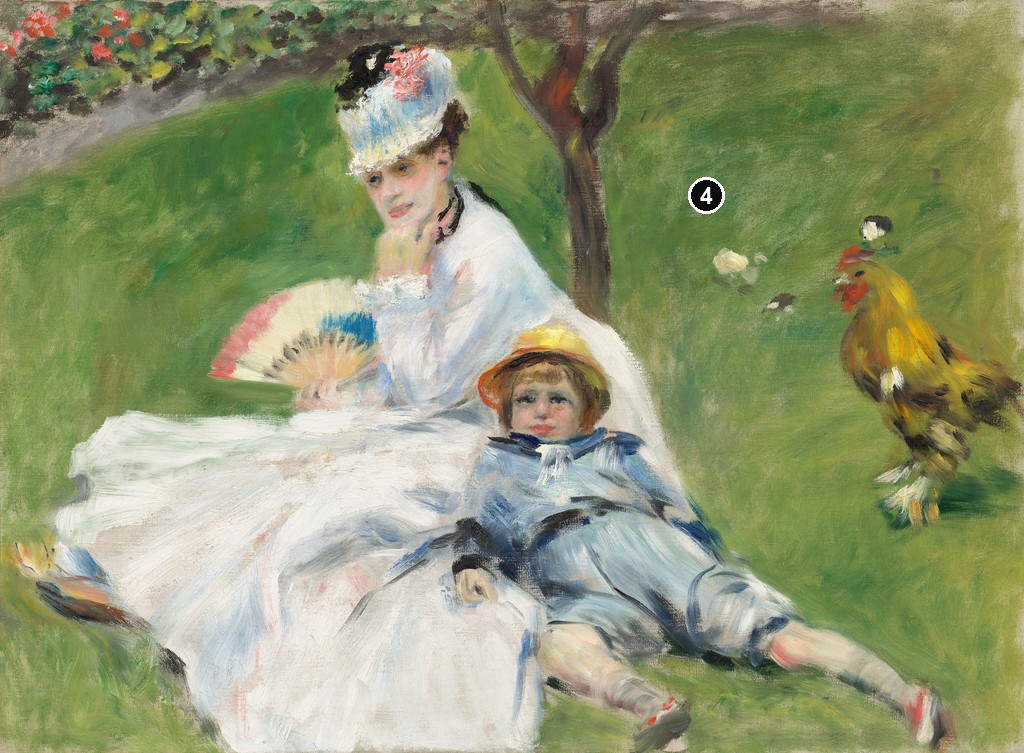
Renoir comes nearer to Camille and Jean. Claude disappears from his composition, and the mother’s skirt and boy’s legs continue beyond the lower border. The family occupies much more of the available space. We are brought close to faces, fabric and the open fan, while the wider activity of gardening falls away.
The fan is a striking difference. In Manet it appears as a relatively small red shape beside the skirt. Renoir makes its spread of red, white and blue conspicuous against Camille’s dress. Its radiating structure offers a clear pattern within the freer strokes of her clothes.
The tree remains behind her, but its relationship to the figures changes with the closer viewpoint. Grass fills the space to the right, where a rooster stands in profile facing towards the seated pair. A few small birds are suggested beyond it. The flowerbed is compressed into a narrow area at the upper left.
Camille’s gaze also changes. Manet brings her face more directly towards the viewer; Renoir turns her attention aside. Jean’s face is more prominent in Renoir’s closer arrangement. These differences affect our relationship to the group even before we consider their brushwork.
Paul Hayes Tucker describes Manet’s space as more measured, with successive light and dark areas suggesting recession, while Renoir compresses the garden more strongly.[5] The distinction helps explain why the Manet can seem more spacious despite containing the additional figure of Claude.
In Renoir, white fabric almost fills the lower-left quarter; in Manet, the skirt sits within a larger surrounding lawn. Renoir’s rooster is prominent at the right; Manet’s birds are smaller elements at the left. One painter draws us into the mother-and-child group, while the other lets us survey a family’s place in its garden.
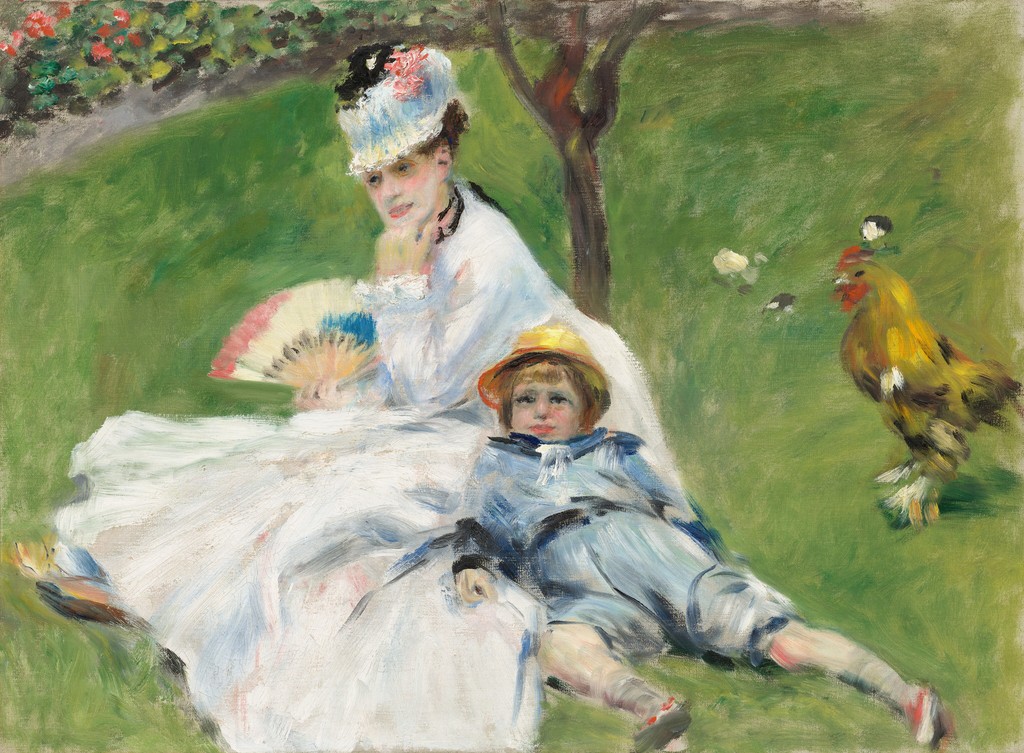
Auguste Renoir, Madame Monet and Her Son, 1874. National Gallery of Art, Washington, 1970.17.60. Ailsa Mellon Bruce Collection. Image source. CC0 / Public domain. Whole supplied reproduction resized within native dimensions; no enlargement or retouching.
Annotated Details from The Monet Family: Garden, Clothes and Birds
The numbered points identify visible features discussed in this article. Return from each detail to the whole composition. Each caption identifies the work shown.
The Monet Family in Their Garden
Édouard Manet, The Monet Family in Their Garden at Argenteuil, 1874. The Metropolitan Museum of Art, New York, 1976.201.14. Bequest of Joan Whitney Payson, 1975. Image source. CC0 / Public domain. Numbers added to a separate resized overview retaining the complete supplied view and existing margins. Detail crops from the immutable original; no enlargement or retouching.
Renoir’s Madame Monet and Her Son
Auguste Renoir, Madame Monet and Her Son, 1874. National Gallery of Art, Washington, 1970.17.60. Ailsa Mellon Bruce Collection. Image source. CC0 / Public domain. Numbers added to a separate resized overview retaining the complete supplied view and existing margins. Detail crops from the immutable original; no enlargement or retouching.
Details from THE MONET FAMILY: GARDEN, CLOTHES AND BIRDS
Move from Claude and his watering can to Camille, Jean and the foreground birds. Then compare Renoir’s closer arrangement of the mother, child and fan.
The Monet Family in Their Garden
Claude and the Watering Can
Claude bends towards red flowers beside the long-spouted watering can. His blue shirt stands out among the greens.
Camille and Jean on the Lawn
Camille’s broad pale skirt meets Jean’s blue clothes. Her upright head contrasts with his reclining body and outward-reaching legs.
Birds in the Foreground
A reddish rooster, pale hen and small chick occupy the darker lawn below the gardener.
Renoir’s Madame Monet and Her Son
Renoir’s Fan and Closer Figures
The closely grouped faces rise above a radiating fan. White fabric and blue sailor clothes fill the foreground.
A Shared Occasion, Different Results
Manet and Renoir chose different distances, colours and emphases while responding to the same people and setting. Their friendship made the shared occasion possible; their pictures retain the differences between them.
Tucker stresses the deliberate arrangement behind the apparently casual scenes.[5] Camille and Jean were posing, and the painters were constructing images. The ease of their bodies should not make us imagine that either artist merely copied an accidental glimpse without decisions about placement and emphasis.
Later stories gave the occasion a competitive edge. Monet recalled Manet making a disparaging remark about Renoir’s talent, an anecdote whose wording and seriousness have been debated.[5] It is an uncertain basis for declaring hostility between them. The two surviving pictures offer firmer evidence of what each painter chose to do.
This garden subject also belongs beside Monet’s own paintings of family life among plants, including Springtime (The Reader). Such pictures make a cultivated garden a setting for sustained observation: a dress against foliage, a figure partly in shade, or a patch of colour that can hold attention without an elaborate action.
From Gardening to the Floating Studio
Manet portrayed another aspect of his friend in Monet Painting in His Studio Boat, the 1874 canvas known in Munich as Die Barke.[6] There, Monet sits at an easel aboard a small boat, with Camille further back under its canopy.
The contrast with the garden is revealing. The bending gardener has become an upright seated painter, concentrating on a canvas. A watering can is replaced by the equipment of painting. Blue water and the boat’s dark hull surround the pair instead of lawn, flowers and birds.
Yet both works connect people to an environment through what they do within it. Claude’s work among the plants and his work at the easel each give Manet an activity to observe. Camille’s presence gives both scenes a domestic relationship alongside the portrait of an artist friend.
Together, the pictures show how broad the subject of friendship could become. It could include the family’s rest, the cultivation of a garden and the practical arrangements of painting outdoors, with each activity leading to a different distribution of bodies, objects and light.
A Gift Returned and a Public Collection
Manet gave the garden painting to Monet in 1874. It returned to Manet in an exchange in 1876 and was sold in 1878. Much later, Joan Whitney Payson owned it; her 1975 bequest brought it to the Met.[1]
That history adds a personal beginning to the canvas’s public life. Its first recipient was the friend shown working at the left, surrounded by the garden and family that made the subject possible. The picture now lets other viewers enter that arrangement, noticing the broad dress first, then the gardener, the watering can, the birds and the scattered red flowers.
Artworks directory
Explore selected paintings, drawings and prints by Édouard Manet. Search by title or another recorded name.
Frequently Asked Questions
Claude Monet, his wife Camille and their son Jean.[1]
No. The setting is his earlier garden at Argenteuil.[1]
Discussion
Look again at the images and ideas explored in The Monet Family in Their Garden at Argenteuil by Édouard Manet. These editorial prompts invite your observations.
Reader Insights
Compare the red fan, Jean’s blue clothes and the tree behind Camille in the two paintings.
Then look for the edges of the white dress.
The amount of lawn around it gives each family group a different relationship to the viewer.
Join the Conversation
Share a detail, comparison or question about The Monet Family in Their Garden at Argenteuil by Édouard Manet below.
References
- The Metropolitan Museum of Art; Jane R. Becker. “The Monet Family in Their Garden at Argenteuil,” 1874, 1976.201.14. Object record, provenance and 2018 catalogue entry. View source.
- Émile Zola. Letter to Antoine Guillemet, Paris, 23 July 1874, in Correspondance—Les lettres et les arts, 1908, pp.96–97. French transcription. View source. (in French).
- National Gallery of Art. Auguste Renoir, “Madame Monet and Her Son,” 1874, 1970.17.60. Object record and collection image. View source.
- National Gallery of Art. Picturing France 1830–1900, p.55. Manet–Renoir comparison and Monet’s later recollection. View source.
- Paul Hayes Tucker. The Impressionists at Argenteuil, National Gallery of Art, 2000, catalogue 21, p.96; related discussion pp.27–28. View source.
- Bayerische Staatsgemäldesammlungen. Édouard Manet, “Die Barke,” 1874, 8759. Current object record and commentary. View source. (in German).
- Splash image, Édouard Manet, The Monet Family in Their Garden at Argenteuil, 1874. The Metropolitan Museum of Art, New York, 1976.201.14. Bequest of Joan Whitney Payson, 1975. Image source. CC0 / Public domain. Remove photographed black surround and narrow outer rim before resize. Main figures, birds, watering can and signature retained; small outer fringe excluded, no claim to preserve every physical canvas edge.


