



 by Tom Gurney
Tom Gurney BSc (Hons) is an art history expert with over 20 years experience
Published on June 19, 2020 / Updated on October 30, 2026
Email: tomgurney1@gmail.com / Phone: +44 7429 011000
The Fifer by Édouard Manet: Introduction
A young musician stands with his feet apart, holding a dark fife across his lips. Red trousers, a nearly black jacket and bright white fabric give his small body a striking presence. Behind him, a grey field offers almost no information about where he stands. The instrument and uniform identify an activity, while the empty setting concentrates attention on the person performing it.
Édouard Manet painted The Fifer, or Le Fifre, in 1866. Now in the Musée d’Orsay, it was rejected by that year’s Paris Salon.[1] Its apparent simplicity became central to the argument over Manet’s art. A child, a uniform and a bare background could produce an unusually forceful encounter, provided the viewer accepted the painter’s way of putting them together.
At a Glance
- ArtistÉdouard Manet
- Date1866
- French titleLe Fifre
- MediumOil on canvas
- Dimensions160.5 × 97 cm
- CollectionMusée d’Orsay, Paris
- Object numberRF 1992
- SubjectA young military musician
- Salon historyRejected in 1866
- Museum acquisitionCount Isaac de Camondo bequest, accepted in 1911[1]
This work across Édouard Manet’s career
Contents
- A Figure That Holds the Canvas
- Red, Black, White and Gold
- The Instrument and the Hands
- The Space around His Feet
- A French Musician after a Spanish Journey
- Looking beside Pablo de Valladolid
- Who Was the Model?
- Rejection and Zola’s Defence
- Two Dark Jackets, Two Different Effects
- From Private Collections to the Musée d’Orsay
A Figure That Holds the Canvas
The boy faces almost directly towards us. His head sits beneath a tall cap, and his eyes look out above the instrument. His torso turns slightly within the dark jacket, while his raised arms spread across the upper part of the figure. Below them, the red trousers widen the body before the legs separate towards the ground.
The stance is firm but uneven. The feet point in different directions, and the knees do not make a perfectly symmetrical pair. One side of the body seems more extended; the other gathers into a slight bend. These differences keep the figure from becoming a rigid emblem. A few changes of angle give the standing pose a sense of adjustment and balance.
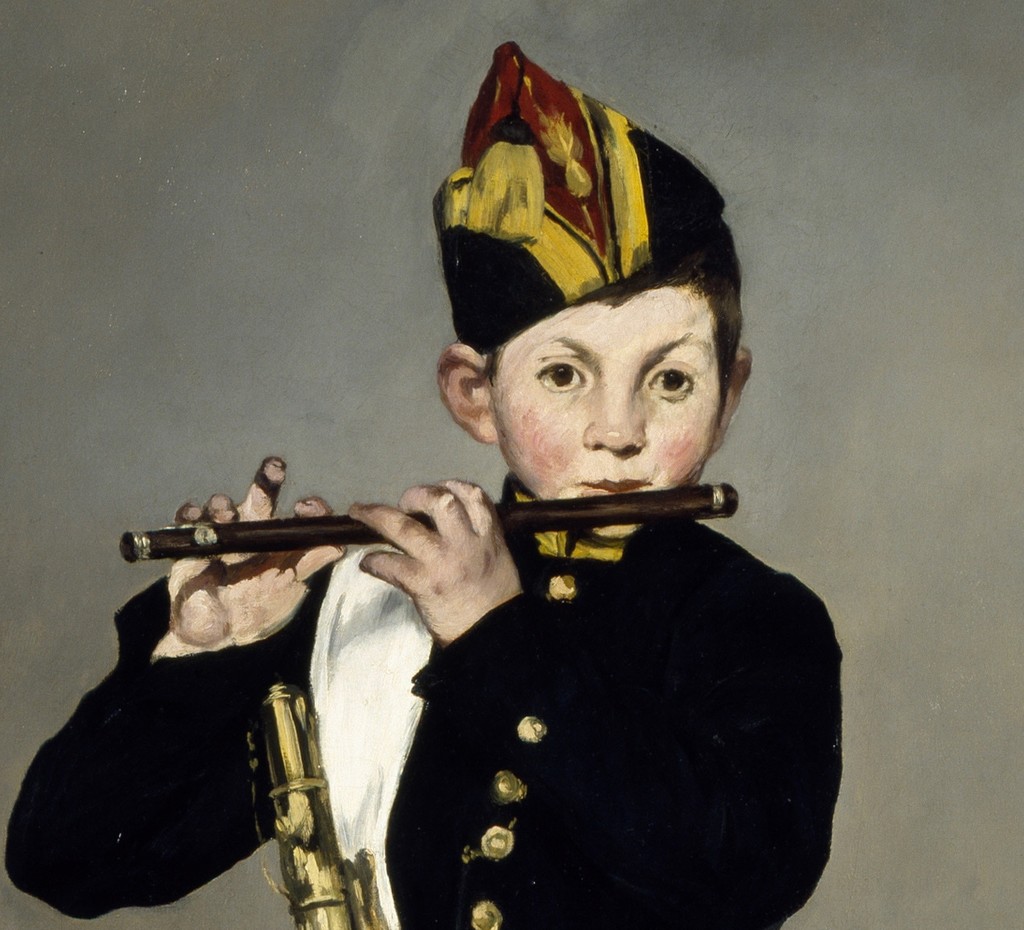
The face is particularly direct. Large eyes, warm cheeks and dark brows establish a presence that can be recognised from some distance. The fife passes across the lower face, drawing attention towards the mouth while concealing part of it. We meet the boy’s eyes at the same moment that his hands and instrument direct our attention sideways.
There is little surrounding action to explain the encounter. No fellow musicians, commanding officer or spectator enters the scene. The figure is occupied in playing, yet he is presented with the concentration usually associated with a portrait. His activity gives the hands a purpose and gives the body a pose that can be held before the viewer.
The tall canvas contributes to that concentration. The boy is shown from cap to shoes, with enough space around him for the silhouette to remain clear. His relatively ordinary role receives the attention of a full-length figure painting. The scale asks us to spend time with someone whose name the picture does not supply.
Red, Black, White and Gold
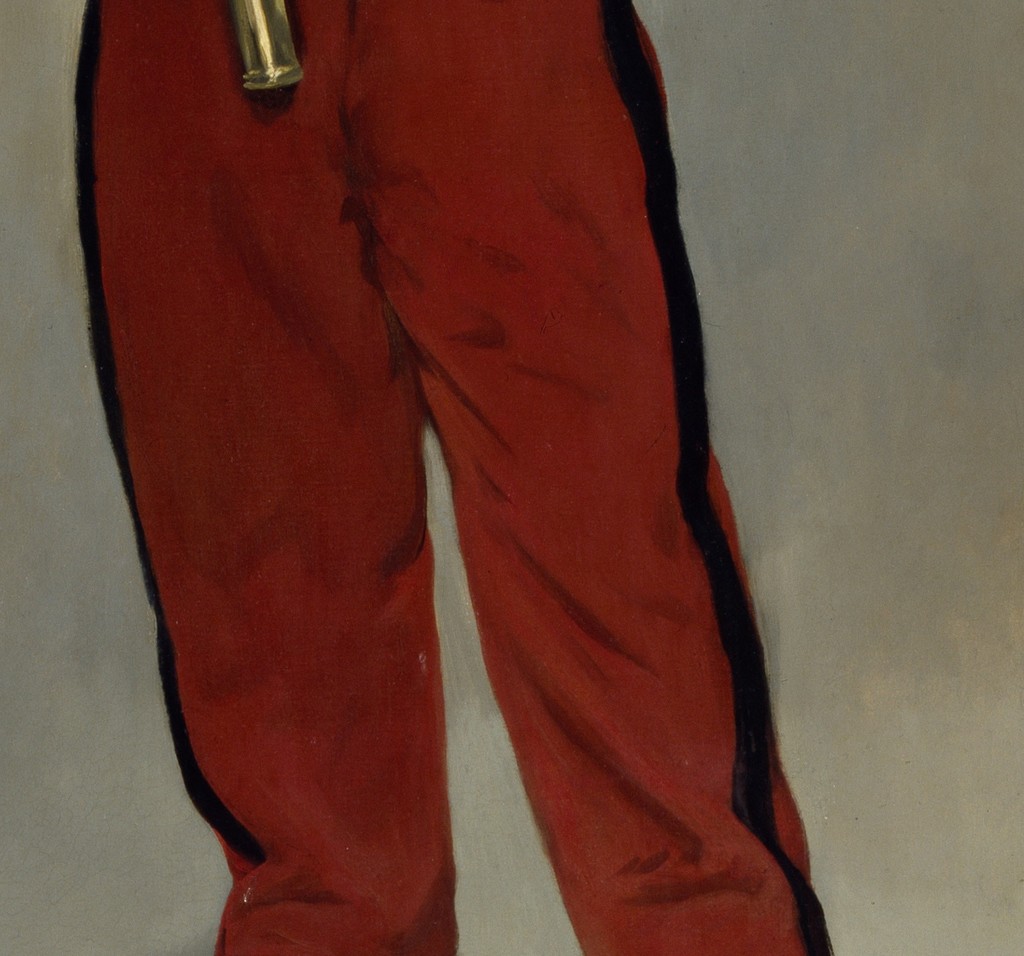
The trousers provide the largest area of strong colour. Their red spreads across the lower half of the body, interrupted by dark bands along the sides and by a few marks suggesting folds. The colour gives the legs weight and breadth even where the modelling is economical. Small changes of tone help distinguish one leg from the other without dissolving the red into a complicated pattern of shadow.
Above them, the jacket gathers into a broad, dark shape. Its edges are emphatic against the grey background. The sleeves change direction sharply around the elbows, and the front narrows towards the waist. Manet makes the garment legible through this outer contour, the placement of the hands and the bright details that cross its surface.
A line of gold-coloured buttons descends along the front. Each small spot has considerable force against the dark cloth. The buttons help lead the eye from the instrument towards the waist, while their spacing suggests the garment’s closure. They are descriptive details that also organise the otherwise uninterrupted area of dark paint.
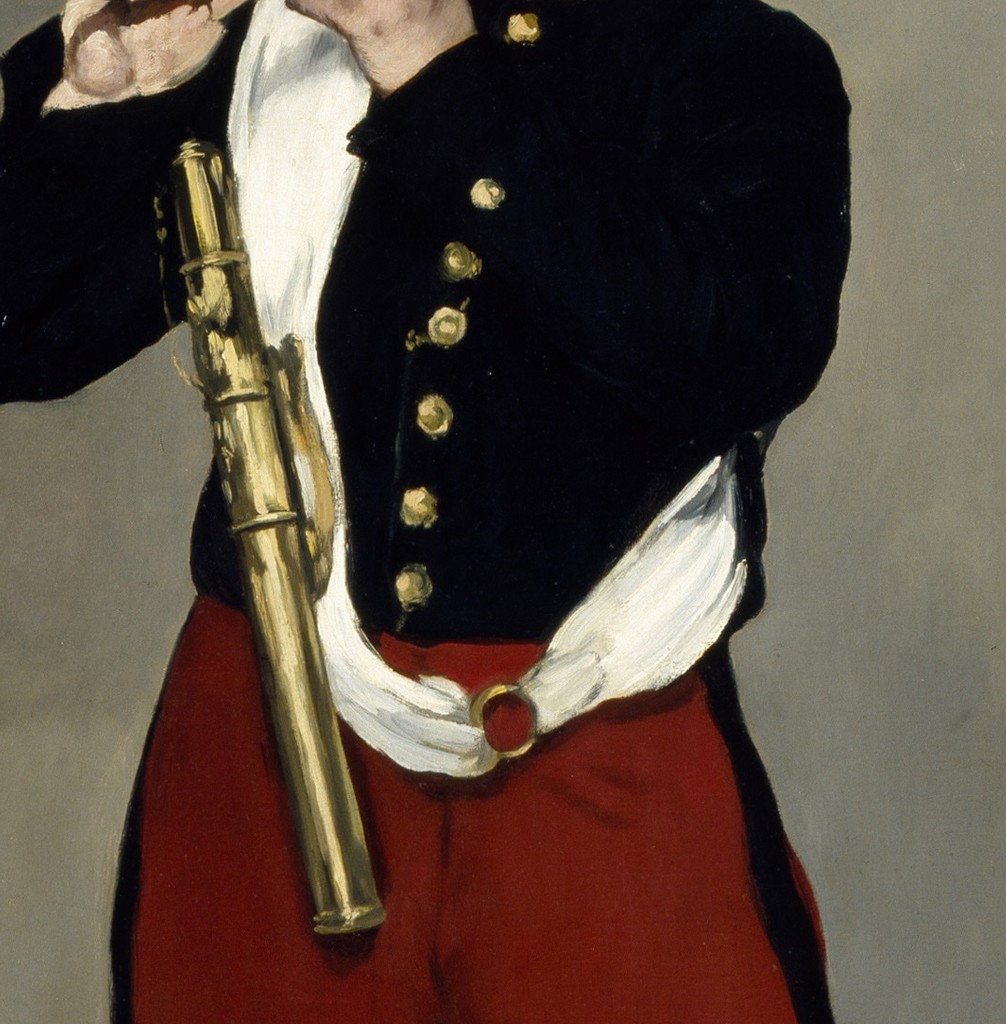
White fabric supplies a different rhythm. It appears across the upper body and gathers around the waist, where its folds make a pale, irregular band. More white emerges above the shoes. These passages separate major areas of colour and clarify the body’s construction. The eye moves from face and hands to the waist, then down towards the feet.
The cap repeats colours found elsewhere in the uniform. Red and yellow ornament rises from its dark base, adding height above the face. Its relatively elaborate shape contrasts with the plain field behind it. At the top of the figure, a small arrangement of bright marks gives the silhouette a distinctive finish.
Looking at the uniform in this way reveals how much variety Manet obtains from a restricted set of colours. Broad areas establish the body; small accents locate its details. The painting can be grasped quickly across a room, then examined more slowly as a set of carefully related shapes.
The Instrument and the Hands
The fife is held transversely, extending towards the left side of the picture from the boy’s mouth. Its narrow, dark form makes a strong horizontal across the upper body. Against the larger curves of head, sleeves and cap, it introduces a compact, straight direction.
Both hands gather around the instrument. Their fingers overlap it at different points, and their pale flesh stands out against the jacket. The hands are small but active. They give the pose a specific task and keep the arms from reading simply as a broad shape spread across the chest.
The contrast of scale is striking. Much of the lower body can be followed through the large red masses of the trousers. At the instrument, attention has to become more exact, separating fingers, dark tube and small reflected accents. The musician’s activity is concentrated in a narrow area close to the face.
A long, bright instrument case hangs down beside the torso. Its gold-coloured surface differs from the matte-looking dark cloth and the softer white fabric. Light marks along its length suggest a rounded, reflective object. The case also introduces a diagonal that carries the eye down from the raised hands towards the lower body.
These two objects establish different directions within the figure. The fife stretches sideways; the case descends. Their relation helps animate a person whose feet remain planted. Manet gives the musician enough equipment to make his role clear while keeping the surrounding space free of additional props.
The pose encourages us to imagine a note, but the painting offers no particular tune or musical programme. Its precision concerns the visible act: the fingers arranged around the instrument, the mouth meeting it and the arms holding it in place. Sound remains an experience the viewer supplies.
The Space around His Feet
The background is often the first feature mentioned in discussions of The Fifer. It gives us a grey expanse with little indication of a room, landscape or horizon. A conventional division between floor and wall is difficult to locate. The boy seems to occupy a continuous field that becomes meaningful chiefly through his presence within it.
That field is not completely uniform. Subtle variations of tone can be seen around the body and lower down near the shoes. These changes give the painted surface some movement without establishing a detailed setting. They allow the figure to remain distinct while keeping our understanding of its surroundings open.
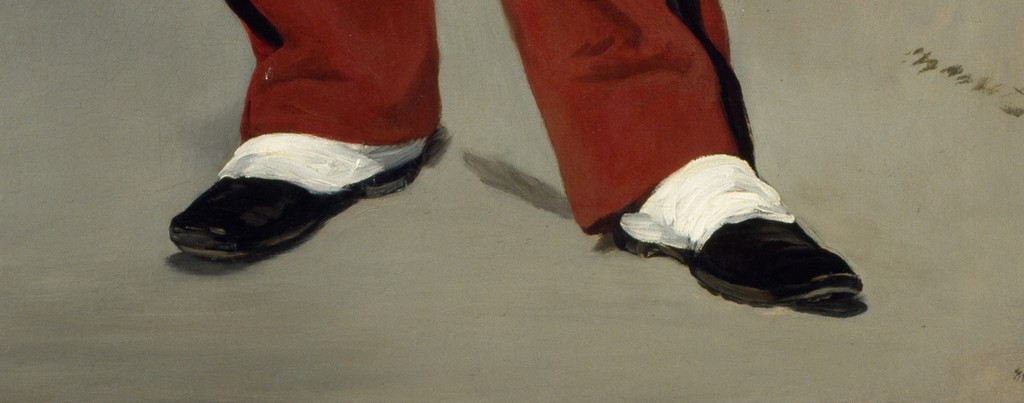
The feet are therefore especially important. Their separation establishes the body’s stance, and small shadows near them suggest contact with a supporting surface. The white fabric at the ankles makes the transition from red trousers to black shoes unusually clear. The body reaches the ground through a sequence of contrasting shapes.
The dark outlines of the clothes can make the figure appear flat against the background. The face, fingers and bright case offer a different kind of information, suggesting rounded surfaces and material depth. The painting moves between these effects. We can see a bold arrangement of colour and still encounter a body that seems able to breathe and shift its weight.
The spare setting also changes the significance of the uniform. In a parade or barracks scene it would belong to a larger military arrangement. Here it is attached to one particular face and body. The removal of surrounding activity makes the musician more available to individual attention, even as the clothes identify a public role.
Annotated Details from The Fifer
The numbered points identify visible features discussed in this article. Return from each detail to the whole composition. Édouard Manet, The Fifer, 1866. Musée d’Orsay, Paris, RF 1992. The Yorck Project / DIRECTMEDIA, via Wikimedia Commons. Image source. Public domain. Numbers added to a separate resized whole overview retaining the supplied edges and margins. Detail crops from the immutable original; no enlargement or retouching.
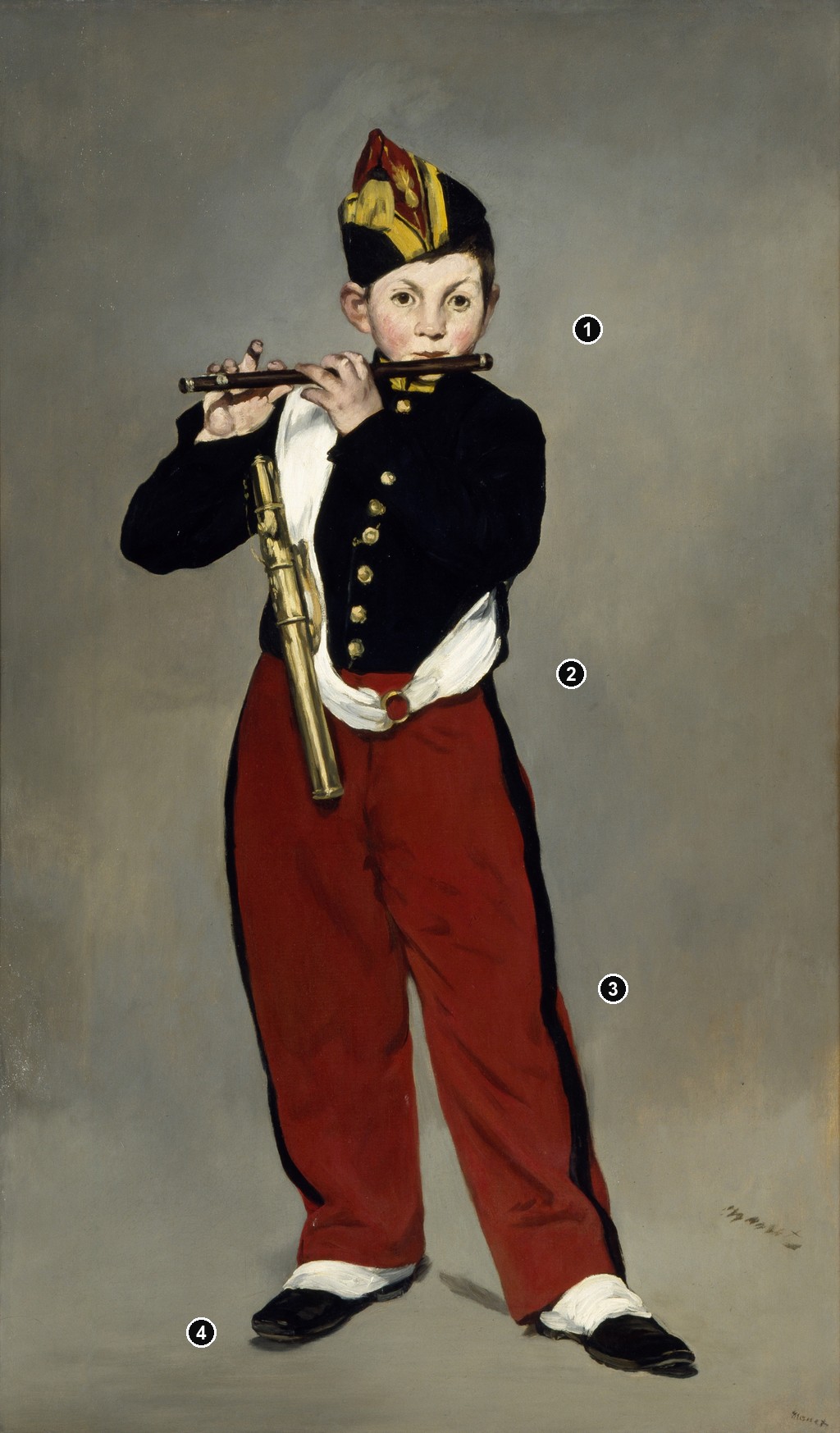
Details from THE FIFER
Move from the cap, face and fife to the bright case, red trousers and separated feet. Small changes of direction give the standing figure its balance.
The Cap, Face and Fife
The decorated cap rises above the direct gaze. Pale fingers gather around the dark fife crossing the lower face.
The Bright Case and White Waist
A long bright case descends beside the dark jacket, meeting the broad white fabric gathered at the waist.
Red Trousers and Dark Side Bands
The trousers form two large red shapes, divided by folds and bordered by darker strips.
The Separated Shoes and Slight Shadows
The shoes turn in different directions beneath white ankle fabric. Small grey shadows suggest contact with the spare ground.
A French Musician after a Spanish Journey
The uniform belongs to a French military context. In a letter to Charles Baudelaire dated 27 March 1866, Manet described his subject as a fifer from the Guard’s light infantry. The French phrase is reproduced in Juliet Wilson-Bareau’s study of Manet and Spain.[2] This is a useful distinction: the painting’s Spanish connection concerns the artist’s study of earlier art, while the subject belongs to his own time in France.
Manet had visited Madrid in September 1865, where Velázquez’s work at the Prado made a powerful impression on him. His correspondence singles out the portrait now known as Pablo de Valladolid. What excited him was the way the background seemed to disappear, leaving the black-clad figure surrounded by air.[2]
That response identifies a problem of painting as much as an admired subject. How could an artist give a person weight and presence while describing so little of the place around him? The earlier portrait offered a persuasive example. Manet brought that problem into contact with a young musician, strong colours and a sharply simplified silhouette.
His interest in Spanish art had already shaped works such as The Spanish Singer. The journey gave him direct experience of paintings he had previously encountered through other works, copies and reproductions. In The Fifer, the knowledge becomes visible in the relation between a solitary figure and an almost unlocated space.
The result has its own character. Bright red trousers and a decorated cap make the boy immediately conspicuous. The raised hands concentrate his activity near the face. A military instrument replaces the broader gesture of the older portrait. Manet finds a contemporary subject through which to pursue the pictorial effect that had impressed him in Madrid.
Looking beside Pablo de Valladolid
Velázquez’s portrait, generally dated around 1635, represents a performer associated with the Spanish court. The Prado’s account emphasises the economy of its setting and the expressive force of the figure’s gesture.[3] A man in dark clothing stands with one arm extended, his feet separated across a scarcely specified ground.
In Velázquez’s portrait, the outward-reaching arm opens a broad space beside the body. The other hand rests nearer the torso. The long dark costume gives the man a strong silhouette, while the gesture makes him seem engaged in an address. A shadow helps establish his position in the otherwise spare field.
Manet gives his musician a more compact action. The elbows spread, but the hands return towards the instrument and mouth. The figure’s attention is gathered around something small. Red trousers and white accents divide the body more sharply than the largely dark clothing of the Velázquez portrait.
The comparison shows how a useful pictorial idea can generate different encounters. Both figures command attention with little surrounding scenery. One expands into the space through a declamatory gesture; the other holds a concentrated activity close to his face. Their presence depends on the relation between pose, silhouette, painted flesh and the air-like field around them.
The boy’s eyes make the exchange more intimate. The body performs a task while the face remains available to us. We have little else to inspect beyond the musician and his equipment. The older portrait helps explain the ambition of that arrangement, while the new subject gives it a different scale and mood.
Who Was the Model?
The Musée d’Orsay describes the figure as an anonymous young troop musician.[1] That leaves a distinction between the role represented and the personal identity of whoever posed. The uniform and instrument tell us what the boy is shown doing; they do not, by themselves, establish his name or family history.
The face has enough individuality to encourage curiosity. Its open eyes, rounded cheeks and small mouth seem more particular than a generic uniform illustration. Yet resemblance alone is a fragile basis for identification, especially when several different models have been suggested over time. The painting can be approached closely without settling that separate biographical question.
What Manet makes unusually clear is the encounter itself. The musician is shown whole, facing out, absorbed in an activity whose physical requirements can be followed. The scale of the canvas and the clarity of the silhouette give him considerable authority within the frame. His anonymity does not diminish that visible presence.
Rejection and Zola’s Defence
The Salon jury rejected The Fifer in 1866. Manet’s other submission, The Tragic Actor, was also refused. Émile Zola discussed the pair in his 1867 study of the artist, contrasting their rejection with the acceptance of Olympia the previous year.[4] The exhibition record places The Fifer in Manet’s own pavilion in 1867.[1]
Zola preferred the musician. He reported that an unnamed landscape painter had compared the work to a costumer’s sign, then accepted the comparison in a carefully defined sense. If it meant that Manet had treated the costume with the clarity of an image, Zola considered that a strength. Yellow trim, blue-black tunic and red trousers became broad areas of colour through which the painter could achieve a direct effect.[4]
The exchange helps explain why the picture’s modest subject could provoke a substantial argument. A uniform illustration or shop sign might be expected to communicate quickly through outline and colour. A major oil painting could be judged by different expectations of modelling, finish and depth. Manet brought the force of the simpler image into a format where those expectations carried considerable weight.
The comparison also gives us a practical way to look. At a distance, the cap, dark torso, white accents and red legs are immediately legible. Moving closer reveals differences among face, hands, cloth and metal. The picture combines graphic clarity with enough variation to keep those materials and body parts distinct.
Zola’s defence gave artistic value to that combination. He saw the simplification as the work of a painter responding through his own eyes and temperament.[4] His language is advocacy, but it addresses something we can examine directly: the strong effect produced by relatively few large colour relationships.
The precise reasoning of an exhibition jury should be separated from the arguments that later gathered around its decision. The rejection is documented. The painting’s apparent flatness and unusual handling help us understand the critical dispute, without supplying a complete account of every juror’s response.
Two Dark Jackets, Two Different Effects
The Tragic Actor makes a revealing companion to the musician. It represents Philibert Rouvière in the role of Hamlet. Dark costume, hands gathered in front and a lowered sword create a concentrated theatrical figure. Its shadow and restrained colour give the setting a different weight from the bright red and white accents of The Fifer.
Théodore Duret’s retrospective account of 1906 treats the two rejections together. He praises the fifer’s strong colour relationships and the actor portrait’s handling of dark clothing. His defence suggests that Manet could challenge expectations through contrasting effects: bright juxtapositions in one painting and forceful treatment of a largely dark figure in the other.[5]
The comparison is useful because it prevents the Salon dispute from becoming a single complaint about one colour or one subject. Manet was testing how a full-length person could be made present through a restricted arrangement. The particular balance of contour, tone, gesture and space changed from one work to the next.
For the musician, the dark jacket creates a broad central shape from which the pale hands emerge. The actor’s gathered hands and long costume keep more of the gesture close to his torso. Looking between the two brings attention back to the choices within each painting, beyond the shared fact of rejection.
From Private Collections to the Musée d’Orsay
Durand-Ruel acquired The Fifer from Manet in 1872. It passed to Jean-Baptiste Faure in 1873, returned to Durand-Ruel in 1893 and entered Count Isaac de Camondo’s collection in 1894. Camondo’s bequest was accepted in 1911 for the Louvre. The painting was assigned to the Musée d’Orsay in 1986.[1]
That history carried the once-rejected work into a national collection, where its simplicity became one of its most recognisable qualities. The painting still asks the viewer to negotiate the same visual relations: a body strongly outlined against grey, colour organised into broad areas, and small details that make an apparently plain image feel alive.
Begin with the whole silhouette, then return to the hands and face. Follow the bright case down towards the red trousers and the separated feet. The figure gains its presence through those connections. Manet gives the young musician a clear activity and an unusually spare setting, then allows the act of looking to fill the space between them.
Artworks directory
Explore selected paintings, drawings and prints by Édouard Manet. Search by title or another recorded name.
Frequently Asked Questions
The painting belongs to the Musée d’Orsay, Paris, under inventory number RF 1992.[1]
It is French. Manet described the subject as a fifer from the Guard’s light infantry in his March 1866 letter to Baudelaire.[2]
The current Orsay record describes an anonymous young troop musician. A personal identity should be distinguished from the role represented.[1]
The spare field concentrates attention on the figure. Manet’s admiration for Velázquez’s Pablo de Valladolid, particularly its air-like space, provides an important context.[2]
It was rejected in 1866 and shown in Manet’s own exhibition pavilion the following year.[2]
Discussion
Look again at the images and ideas explored in The Fifer by Édouard Manet. These editorial prompts invite your observations.
Reader Insights
Look first at the large red, dark and white areas.
Then notice how the fingers, cheeks and reflective case introduce smaller changes of tone.
Finally, inspect the feet: their uneven angles and the slight shadows help give a solid stance to a figure surrounded by so little scenery.
Join the Conversation
Share a detail, comparison or question about The Fifer by Édouard Manet below.
References
- Musée d’Orsay. “Le Fifre,” 1866, RF 1992. Collection commentary, current dimensions, provenance and exhibition history. View source. (in French).
- Juliet Wilson-Bareau. “Manet and Spain,” in Manet/Velázquez: The French Taste for Spanish Painting, edited by Gary Tinterow and Geneviève Lacambre, 2003, especially pp. 234–239 and notes 90–92, 107–108. Includes excerpts from Manet’s letters. View source.
- Museo Nacional del Prado. “Pablo de Valladolid,” around 1635. Collection commentary on the sitter, pose and restricted setting. View source.
- Émile Zola. Édouard Manet: étude biographique et critique. 1867. Discussion of The Fifer and The Tragic Actor. View source. (in French).
- Théodore Duret. Histoire d’Édouard Manet et de son œuvre. 1906, pp. 69–71. Retrospective discussion of the two Salon submissions of 1866. View source. (in French).
- Splash image, Édouard Manet, The Fifer, 1866. Musée d’Orsay, Paris, RF 1992. The Yorck Project / DIRECTMEDIA, via Wikimedia Commons. Image source. Public domain. Whole supplied reproduction resized within native dimensions; no enlargement or retouching.


