



 by Tom Gurney
Tom Gurney BSc (Hons) is an art history expert with over 20 years experience
Published on June 19, 2020 / Updated on October 30, 2026
Email: tomgurney1@gmail.com / Phone: +44 7429 011000
Monet Painting in His Studio Boat by Édouard Manet: Introduction
Claude Monet sits beneath a striped awning, facing a small canvas. His palette rests across his lap, his legs extend into the narrow working space, and his wife Camille sits behind him in the cabin. Water surrounds the dark hull. Manet has brought the familiar equipment of a painter’s studio onto the Seine.
Painted in 1874, Monet Painting in His Studio Boat belongs to Munich’s Neue Pinakothek, where its title is Die Barke.[1] The picture combines a portrait of an artist friend with a close view of the practical setting in which he worked. Its blue cabin, pale clothes and broken reflections give that working arrangement a vivid painted form.
At a Glance
- ArtistÉdouard Manet
- Date1874
- Alternate titleDie Barke
- MediumOil on canvas
- Dimensions82.7 × 105 cm, height × width
- CollectionNeue Pinakothek, Munich
- Inventory number8759.[1]
This work across Édouard Manet’s career
Contents
- A Studio Arranged on the Water
- Monet in Profile, Camille in the Cabin
- Curved Hull, Flat Cabin and Striped Shade
- The River Around the Portrait
- What Is Monet Painting on the Easel?
- The Larger Stuttgart Version
- Monet’s Own Portrait of the Boat
- An Artist Friend at Work
- Annotated details
A Studio Arranged on the Water
Manet visited Monet at Argenteuil during the summer of 1874, coming from Gennevilliers on the opposite bank of the Seine.[1]
The boat offered Monet a way to work from the river itself. A small cabin provided an enclosed space, while the area in front of it could accommodate the painter and his easel. The awning extended that arrangement into the open air, giving shade without separating the artist from the surrounding view.
Théodore Duret described these practical features in his 1906 account of Manet. He recalled a cabin at the back where Monet could shelter in bad weather, with a tent-like covering in front under which he could work in sunshine. He also described Camille seated behind her husband, within the cabin.[2]
Duret’s account helps explain the compactness of the picture. The people, canvas and equipment have to share a small platform. Monet’s body is turned towards his work, and the easel stands close to his knees. The cabin becomes a background to the portrait as well as part of the boat’s working structure.
The arrangement had a precedent. As the Kröller-Müller Museum explains, Monet followed the example of the landscape painter Charles-François Daubigny in having a boat built from which to paint.[3] A floating studio allowed an artist to choose viewpoints on the water and to remain near them with some protection from the weather.
The cabin and awning made that movable viewpoint a practical working space. In Manet’s picture, its sheltered foreground opens onto the wider river beyond.
Monet in Profile, Camille in the Cabin
Monet is the larger and nearer figure. His straw hat has a warm reddish band, and his beard gives the profile a firm outline against the blue behind him. Pale shirt and light trousers spread across the lower centre, interrupted by a dark tie and the black shapes of his footwear.
The line of his head directs attention towards the easel. His face has a clearer side view than Camille’s, while his torso and arms are described in broader passages of pale paint. The palette across his lap connects the seated figure to the canvas immediately in front of him. We can recognise the painter’s activity without needing every implement to be sharply distinguished.
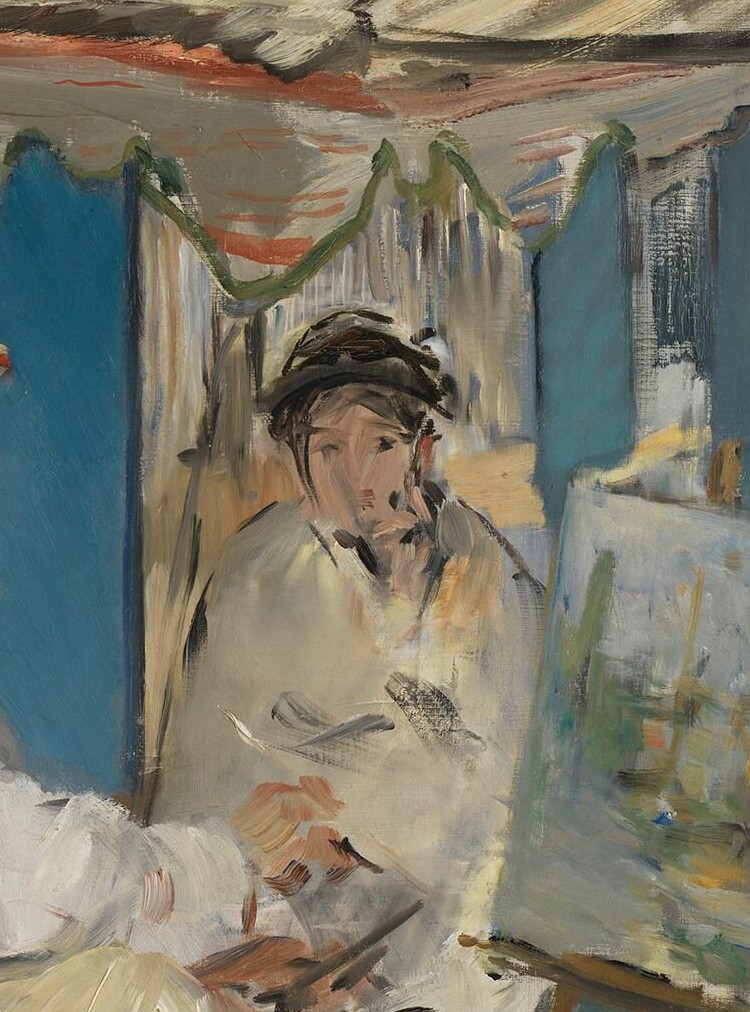
Camille sits further back, her pale clothes and dark bonnet framed by the cabin opening. Her face turns more towards us. This difference gives the two figures separate directions: Monet’s profile leads into the act of painting, while Camille’s face remains available to a viewer looking into the boat.
The blue surfaces help hold them together. The colour behind Monet separates his pale shirt and warm face from the cabin; nearby blue areas surround Camille’s lighter silhouette. The structure provides distinct spaces for the two people while enclosing them within a shared setting.
Her presence also changes the portrait’s character. A solitary painter at an easel would make the activity almost self-contained. With Camille seated behind, the boat accommodates companionship as well as work. The picture gives little evidence of what she is thinking, but it makes her physical place within this small environment clear.
Curved Hull, Flat Cabin and Striped Shade
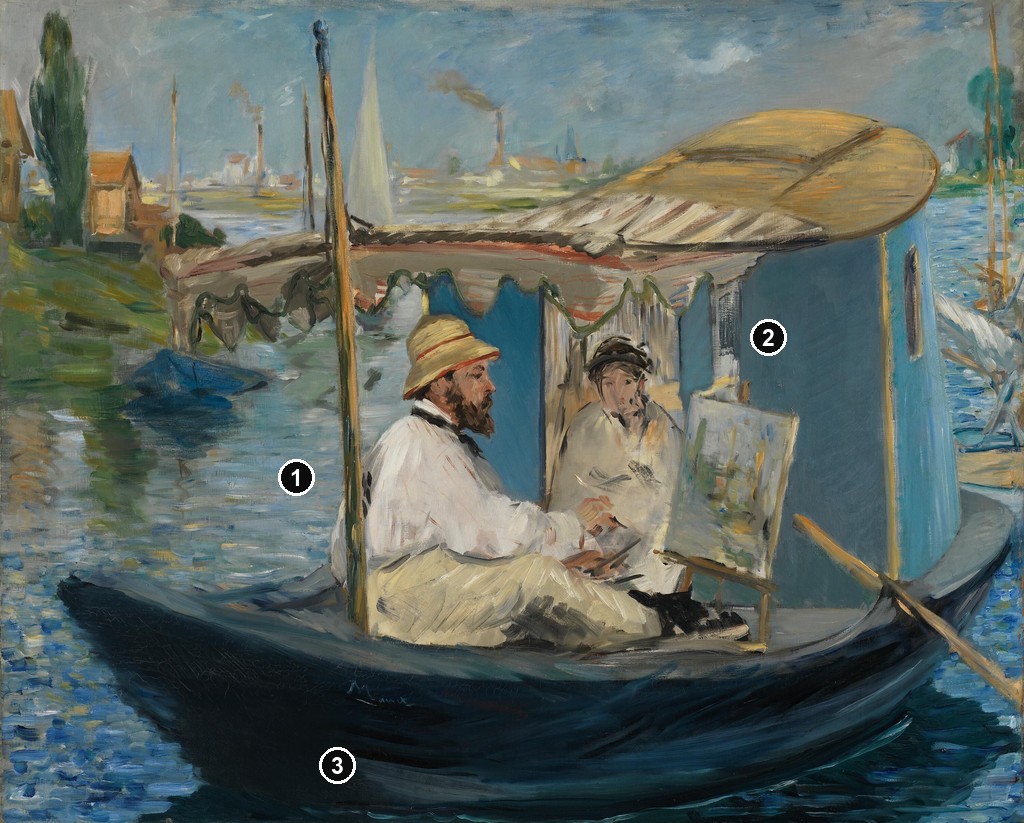
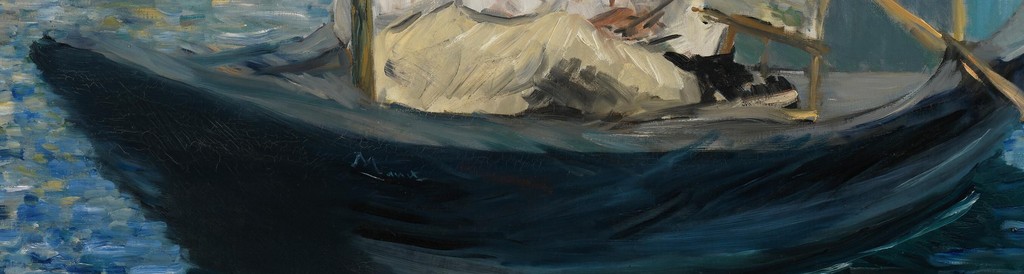
The boat’s dark hull sweeps across the bottom of the canvas. Its long curve supports the more upright shapes above, gathering the seated figures and cabin into a single form. The foreground edge comes close to us, so that the boat feels immediately present rather than remote on the river.
Above it, the blue cabin has broad, relatively flat sides. These planes give the picture a firm structure amid the loose marks of water and clothing. A pale upright near the easel, the edge of a door and the vertical pole behind Monet each introduce narrower divisions into that larger arrangement.
The canopy offers a different kind of shape. Stripes run across its projecting surface, while pale fabric hangs in shallow curves around the front of the cabin. The long tan roof behind it has a rounded end. Together, these forms make the shelter seem light enough to belong to a small craft, yet substantial enough to organise the space beneath it.
A diagonal oar reaches across the right side. Its direction leads beyond the enclosure of the cabin towards the surrounding water. The vertical pole at the left of Monet, the sloping easel and the curve of the hull give the eye several different routes through a confined area.
Colour makes the parts easier to read. The cabin’s blue is stronger and more continuous than many of the blues in the river. Warm tan and red touches distinguish the roof, hat and canopy from the pale clothes. The hull supplies a dark base, allowing the figures to remain conspicuous without sharply outlining every fold.
The River Around the Portrait
Water fills the space beside the boat, especially at the left. Short strokes of blue, pale grey, green and white suggest a surface broken by light and movement. Some marks lie almost horizontally; others turn or overlap, preventing the reflections from becoming a smooth mirror.
The dark hull casts a broad presence into this lighter field. Near it, stronger blue passages suggest the depth and shadow around the craft. Further away, the water becomes paler and less emphatic, helping separate the close foreground from the more distant bank.
Behind the studio are buildings, trees, masts and other boats. A tall narrow tree and an orange-roofed building stand towards the left. Smokestacks and smoke appear further across the river. These details place the small floating studio within a landscape of work and recreation, rather than an empty stretch of countryside.
The background is economical. A mast can be a slender upright, a sail a pale triangle, and a roof a compact patch of warmth. Manet gives these distant objects enough definition to establish the river’s activity while keeping the two people and their boat dominant.
The difference between water and cabin is especially telling. The cabin is a broad painted surface with edges; the water is built from repeated, separate touches. Each treatment answers a different visual problem. One establishes an enclosure, the other suggests a changing surface around it.
That surrounding activity also makes Monet’s position distinctive. His canvas is close and steady enough to work on, while the view beyond his shelter contains boats, reflections and smoke. The little studio brings a concentrated task into a larger scene of movement.
What Is Monet Painting on the Easel?
The small canvas faces partly towards us, creating a painting within Manet’s painting. Its marks are abbreviated, but its presence invites a particular question: whether the subject can be connected to a surviving work by Monet.
Paul Hayes Tucker, following Robert Herbert, identifies it with Monet’s Sailboats on the Seine, now titled Sailboats on the Seine at Petit-Gennevilliers.[4] The 1874 work belongs to the Fine Arts Museums of San Francisco and was given by Bruno and Sadie Adriani.[5]
Tucker points to correspondences between a tree and projecting bank at the left and a group of boats at the right. He also compares the scene around Manet’s studio boat with the houses, shoreline and vessels in Monet’s painting.[4] This is a scholarly reconstruction from the two images; the small easel picture does not provide a readable title of its own.
The proposed connection adds another relationship to the portrait. Manet watches Monet working, while Monet’s canvas translates a river view into its own arrangement of coloured marks. The viewer can consider the artist, his equipment, the small painted surface and the larger setting together.
It also raises the question of where Manet stood. Tucker suggests a nearby position, probably on a dock.[4] The viewpoint makes the front and side of the studio boat available to us, while giving a good view of Monet’s profile and the face of his canvas. That arrangement is persuasive as a way of observing the working painter, even though the precise location is not securely fixed.
The Larger Stuttgart Version
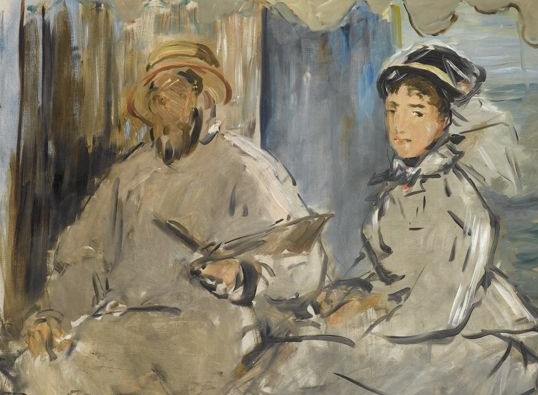
Manet made another painting of the couple aboard the floating studio. Der Maler Monet in seinem Atelier, also dated 1874, belongs to the Staatsgalerie Stuttgart and measures 106.5 × 135 cm.[6] The larger canvas is a separate work with a substantially different composition.
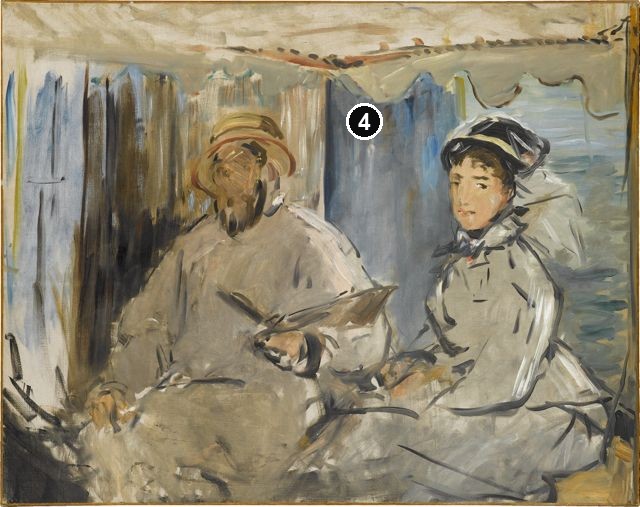
The Stuttgart picture draws much closer to the two figures. Monet and Camille sit side by side, filling most of the available space. The wide river setting is largely lost, and the cabin walls and low sweep of the awning surround them more tightly.
Monet turns towards us rather than remaining in the clear profile of the Munich painting. His palette is prominent in front of his body, while the face and much of the clothing remain loosely indicated. Camille’s bonnet and jacket have stronger dark divisions, making her silhouette particularly noticeable at the right.
The difference changes how we enter the scene. In Munich, we approach an artist absorbed in work, with his companion further inside the cabin. In Stuttgart, both people are brought into a closer relationship with our position. The studio becomes a compact enclosure around a paired portrait.
Tucker treats the Stuttgart canvas as an incomplete sketch.[4] Its broad, thin-looking passages and uneven degree of definition make that description understandable. The two paintings need not be forced into a simple sequence in which a preliminary idea automatically becomes a finished version. Their different viewpoints and groupings are substantial choices in their own right.
Their ownership histories also differ. The Staatsgalerie records that Monet valued the Stuttgart painting and kept it for a long time at Giverny. The museum acquired it with lottery funds in 1966.[6] That history belongs to the larger, closely framed painting, not to the Munich canvas discussed here.
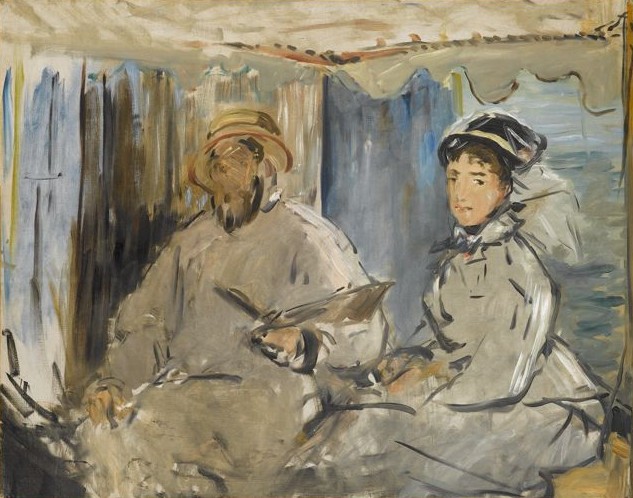
Édouard Manet, Der Maler Monet in seinem Atelier, 1874. Staatsgalerie Stuttgart, 2750. Acquired with lottery funds, 1966. A separate painting from the Munich work. Image source. Public domain. Trim the narrow photographed outer rim directly from the owner PDF’s original embedded JPEG; no enlargement or physical-canvas-edge claim.
Annotated Details from Monet’s Floating Studio in Munich and Stuttgart
The numbered points identify visible features discussed in this article. Return from each detail to the whole composition. Each caption identifies the work shown.
Monet’s Studio Boat — Munich
Édouard Manet, Monet Painting in His Studio Boat (Die Barke), 1874. Neue Pinakothek, Munich, 8759. Bayerische Staatsgemäldesammlungen – Neue Pinakothek München. Image source. CC BY-SA 4.0. Bayerische Staatsgemäldesammlungen – Neue Pinakothek München, CC BY-SA 4.0. Numbers added to a separate resized whole overview; detail crops from the museum download, without enlargement or retouching. These image adaptations are licensed under CC BY-SA 4.0.
Monet in His Studio — Stuttgart
Édouard Manet, Der Maler Monet in seinem Atelier, 1874. Staatsgalerie Stuttgart, 2750. Acquired with lottery funds, 1966. A separate painting from the Munich work. Image source. Public domain. Numbers added to a separate resized overview retaining the complete supplied view and existing margins. Detail crops from the immutable original; no enlargement or retouching.
Details from MONET’S FLOATING STUDIO IN MUNICH AND STUTTGART
Follow Monet’s profile towards his palette and easel, look into Camille’s cabin, and trace the hull above the water. The Stuttgart detail offers a broader view of the closer pair.
Monet’s Studio Boat — Munich
Monet’s Profile, Palette and Easel
The straw hat and bearded profile lead towards the small canvas. Pale clothes surround the palette across Monet’s lap.
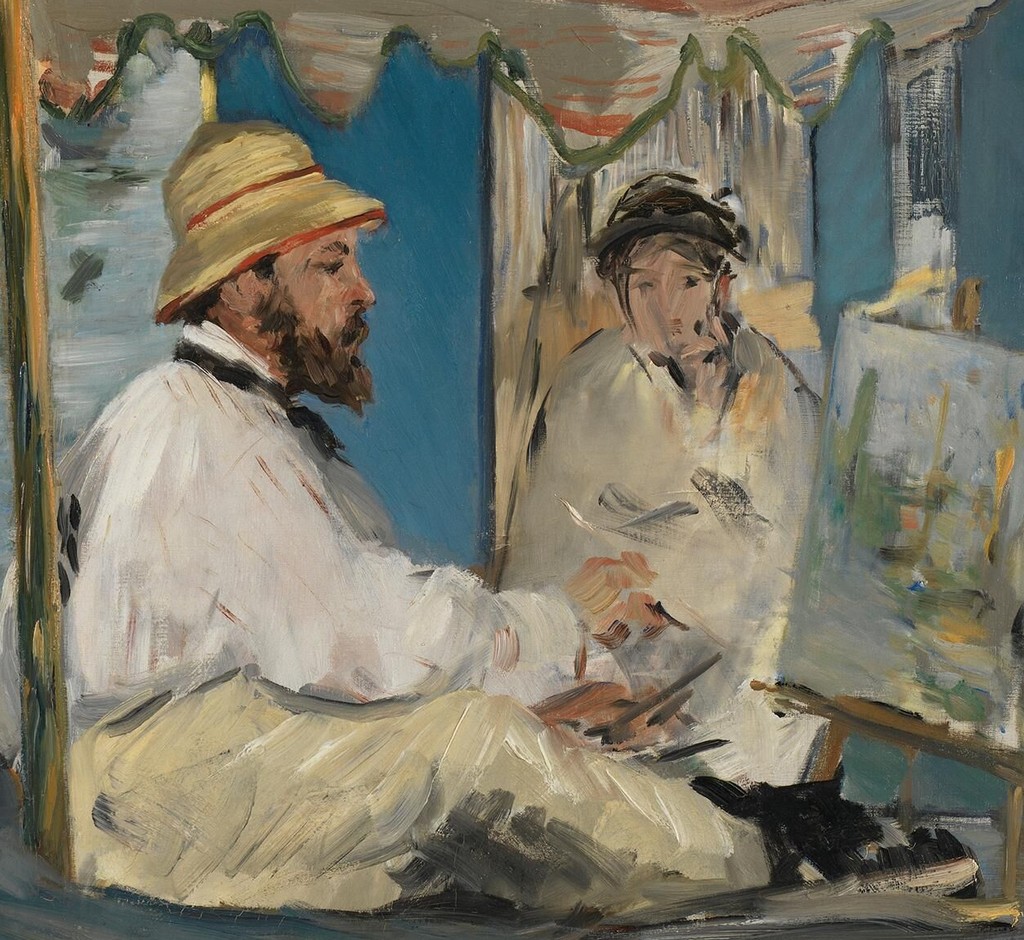
Camille within the Blue Cabin
Camille faces out from the cabin opening. Pale clothing and a dark bonnet separate her figure from the blue surrounding planes.
The Curved Hull and Broken Reflections
The long dark hull curves beneath the figures. Short blue and pale strokes break across the surrounding water.
Monet in His Studio — Stuttgart
The Closer Stuttgart Pair
Both figures occupy the cabin closely beneath its low covering. The palette crosses the painter’s body beside Camille’s darker bonnet and trim.
Monet’s Own Portrait of the Boat
Monet also painted the studio boat itself. His 1874 Le bateau-atelier, in the Kröller-Müller Museum, shows the craft moored between two poles on calm water. The museum identifies an indistinct figure in the cabin as probably Monet.[3]
Here the boat is seen from further away. Its dark hull and pale green cabin sit within a much larger surrounding field of water and reflection. Trees and buildings on the opposite bank help establish the setting, while the cabin opening remains a small dark area.
The comparison shows what Manet gains by coming close. The working painter, his wife, their clothes and the easel become the subject’s immediate human interest. In Monet’s own view, the craft can be considered as a shape on the river, with its reflection giving it a second, shifting form below.
The shelter is both equipment and a subject for painting. It enables views from the water and can itself be viewed from outside. Each position gives the painter a different relationship to the river.
An Artist Friend at Work
Duret recalled Manet treating the boat as Monet’s studio and joking about that identification.[2] The recollection suits the picture’s combination of familiar activity and unusual setting. Palette, canvas and painter are recognisable; their place on a small floating platform gives them a new relationship to the world outside.
Manet also painted The Monet Family in Their Garden at Argenteuil, showing Claude tending plants while Camille and Jean rested nearby.[2] The two subjects give his friend different activities and surroundings: a family garden and a working space arranged on the water.
The Munich boat picture entered the collection through the Tschudi-Spende in 1914.[1] Its close view still makes the arrangement easy to explore: the hat and profile first, then the palette and small canvas, the blue cabin, Camille’s face and the water beyond the hull.
Artworks directory
Explore selected paintings, drawings and prints by Édouard Manet. Search by title or another recorded name.
Frequently Asked Questions
He followed the example of the earlier landscape painter Charles-François Daubigny.[3]
Discussion
Look again at the images and ideas explored in Monet Painting in His Studio Boat by Édouard Manet. These editorial prompts invite your observations.
Reader Insights
Compare the broad blue cabin with the short blue strokes on the water.
Then follow the hull’s curve around the figures.
These different kinds of shape give the small working space its solidity while keeping it visibly afloat within the river.
Join the Conversation
Share a detail, comparison or question about Monet Painting in His Studio Boat by Édouard Manet below.
References
- Bayerische Staatsgemäldesammlungen. Édouard Manet, “Die Barke,” 1874, 8759. Current object record and commentary. View source. (in German).
- Théodore Duret. Histoire d’Édouard Manet et de son œuvre, 1906, pp.160–162, selected passage. Monet’s boat, shelter and studio title. View source. (in French).
- Kröller-Müller Museum. Claude Monet, “Le bateau-atelier / Monet’s Studio-Boat,” 1874, KM111.222. Object record and commentary. View source.
- Paul Hayes Tucker. The Impressionists at Argenteuil, National Gallery of Art, 2000, p.28 and catalogue 38–39, pp.138–141. Easel comparison and the different studio-boat paintings. View source.
- Legion of Honor, Fine Arts Museums of San Francisco. Claude Monet, “Sailboats on the Seine at Petit-Gennevilliers,” 1874. Owner-supplied record on Google Arts & Culture. View source.
- Staatsgalerie Stuttgart. Édouard Manet, “Der Maler Monet in seinem Atelier,” 1874, 2750. Current owner record, PDF. View source. (in German).
- Splash image, Édouard Manet, Monet Painting in His Studio Boat (Die Barke), 1874. Neue Pinakothek, Munich, 8759. Bayerische Staatsgemäldesammlungen – Neue Pinakothek München. Image source. CC BY-SA 4.0. Resized and re-encoded from the museum download. This image adaptation is licensed under CC BY-SA 4.0. (in German).


