



 by Tom Gurney
Tom Gurney BSc (Hons) is an art history expert with over 20 years experience
Published on June 19, 2020 / Updated on October 30, 2026
Email: tomgurney1@gmail.com / Phone: +44 7429 011000
Jesus Mocked by the Soldiers by Édouard Manet: Introduction
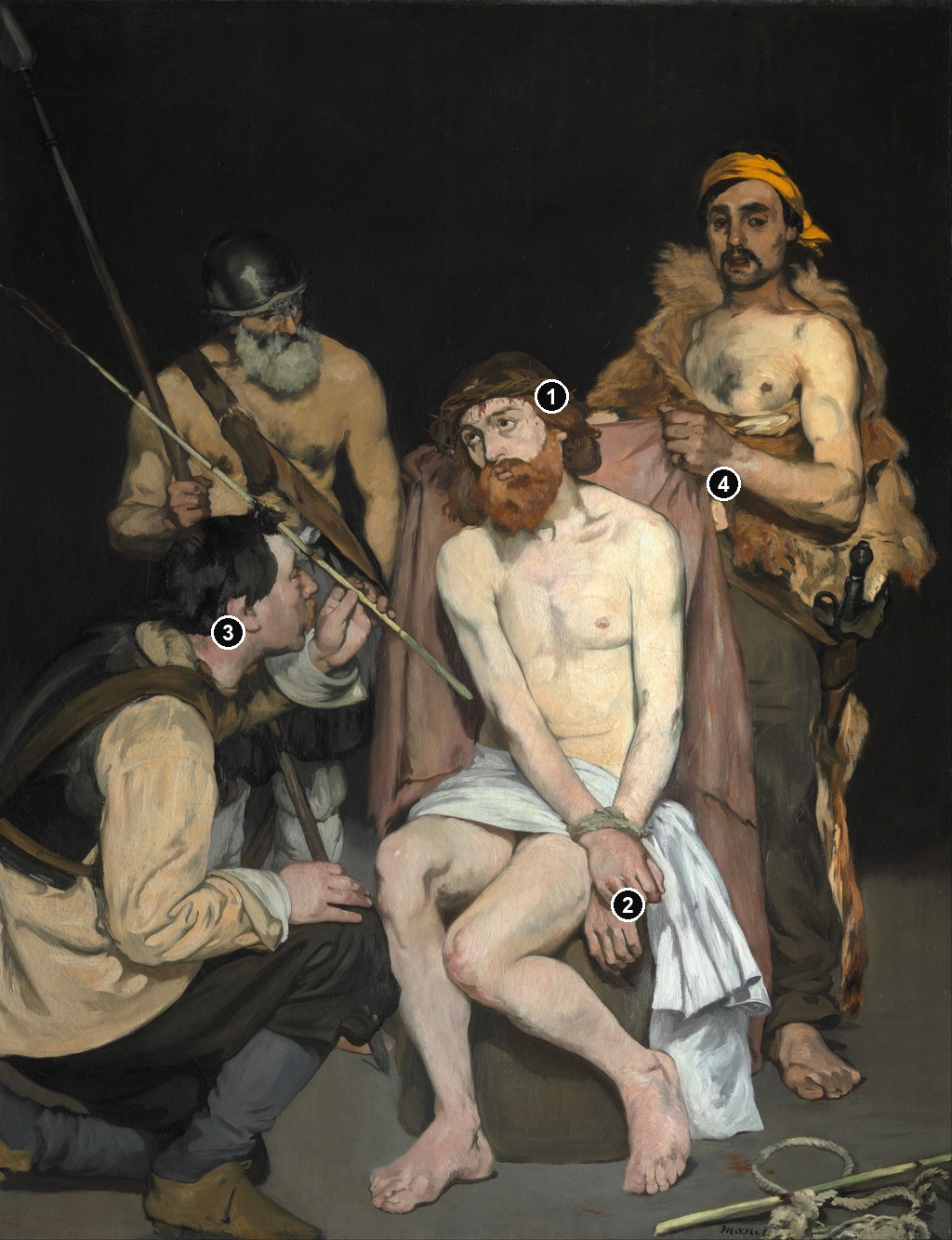
A pale, bound body occupies the centre of a dark painting. Three men crowd around it, but their different poses make the encounter difficult to settle into a single action. One kneels close to the seated figure; another stands behind with a spear; the third holds a rose-purple cloth. The physical presence of these four bodies is immediate. Their relationships take longer to read.
Édouard Manet painted Jesus Mocked by the Soldiers in 1865. It belongs to the Art Institute of Chicago. [1]
The picture rewards attention to small differences: the direction of a gaze, the angle of a wrist, the interval between two hands. Its religious subject is recognisable, yet the people do not combine into a neatly explained demonstration. Manet places the viewer close to a scene whose gestures remain troublingly open.
At a Glance
- ArtistÉdouard Manet
- Date1865
- MediumOil on canvas
- Dimensions190.8 × 148.3 cm
- CollectionArt Institute of Chicago
- CreditGift of James Deering
- Accession1925.703
This work across Édouard Manet’s career
Contents
- The Bound Body
- Three Different Encounters
- Cloth, Colour and Close Space
- A Subject from the Passion
- An Old Master Subject Recast
- At the Salon of 1865
- Beside The Dead Christ with Angels
- Annotated details
The Bound Body
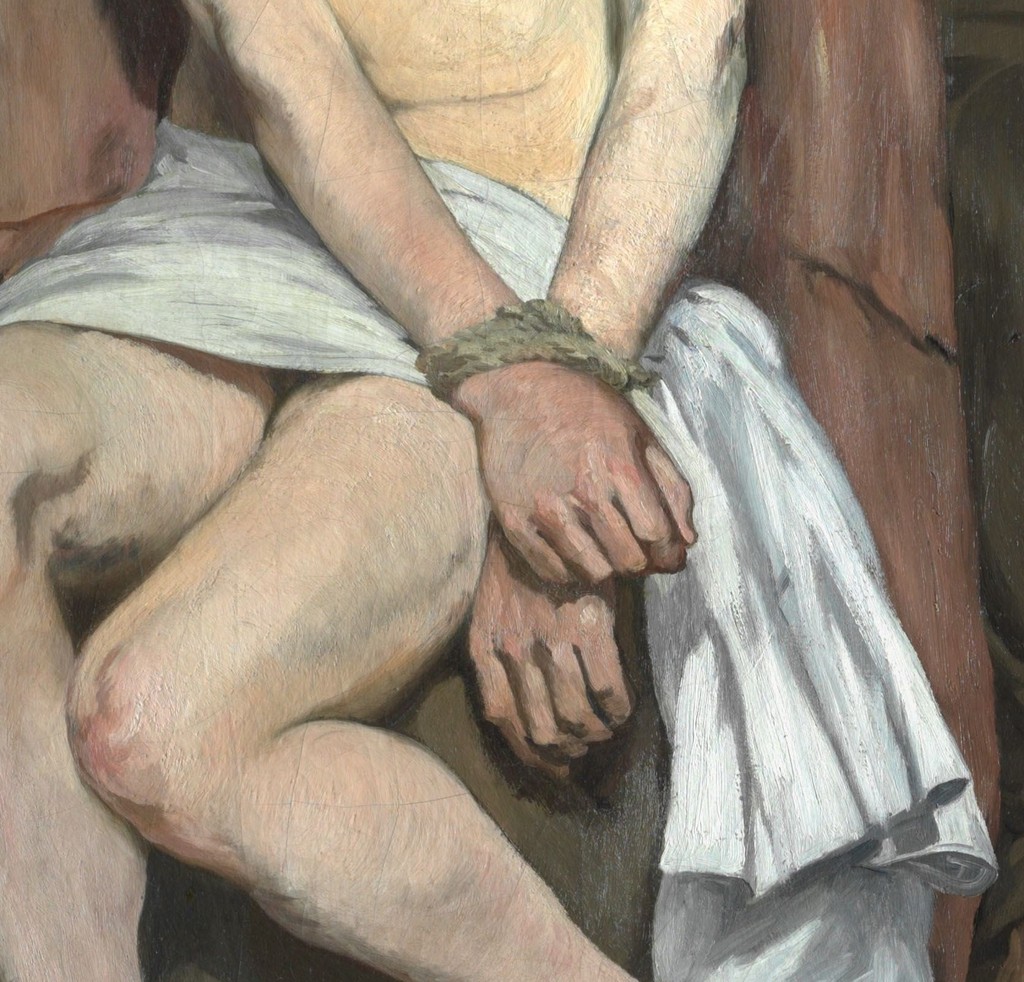
Christ sits on a low, block-like support, with his hands crossed together in front of his lap. A rope binds the wrists. The arms descend from the shoulders to this compact knot of hands, giving the upper body a long, enclosed shape. A white cloth passes around the hips and falls down beside the legs. Its broad pale folds extend the light of the torso towards the lower edge.
The body is neither squarely upright nor completely collapsed. The shoulders slope, the head turns, and the legs angle across one another. These departures from a rigid frontal pose create an uneasy balance. The figure seems to occupy the seat with real weight, while the binding limits what its hands can do.
The feet bring that bodily presence especially close. They lie near the bottom of the picture, separated from the dark upper field by a long passage of exposed skin and white fabric. The nearer knee makes a broad diagonal across the lower body. Such changes of direction keep the figure from reading as a simple vertical column of light.
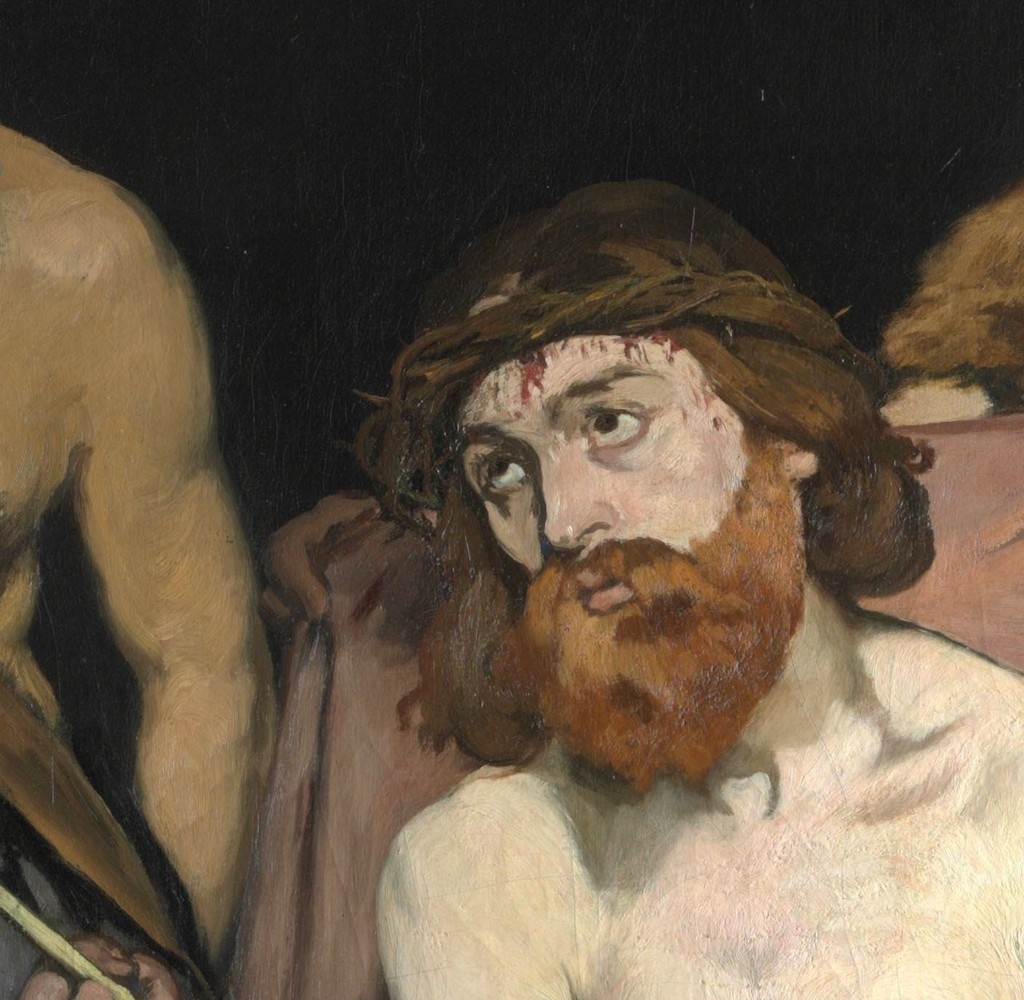
Above the reddish beard, Christ's eyes turn towards the left side of the image. The crown of thorns presses into the hair. Small reddish marks interrupt the forehead, but the expression does not supply a complete account of pain or resignation. The turned head opens a line of attention that the surrounding figures do not straightforwardly return.
Three Different Encounters
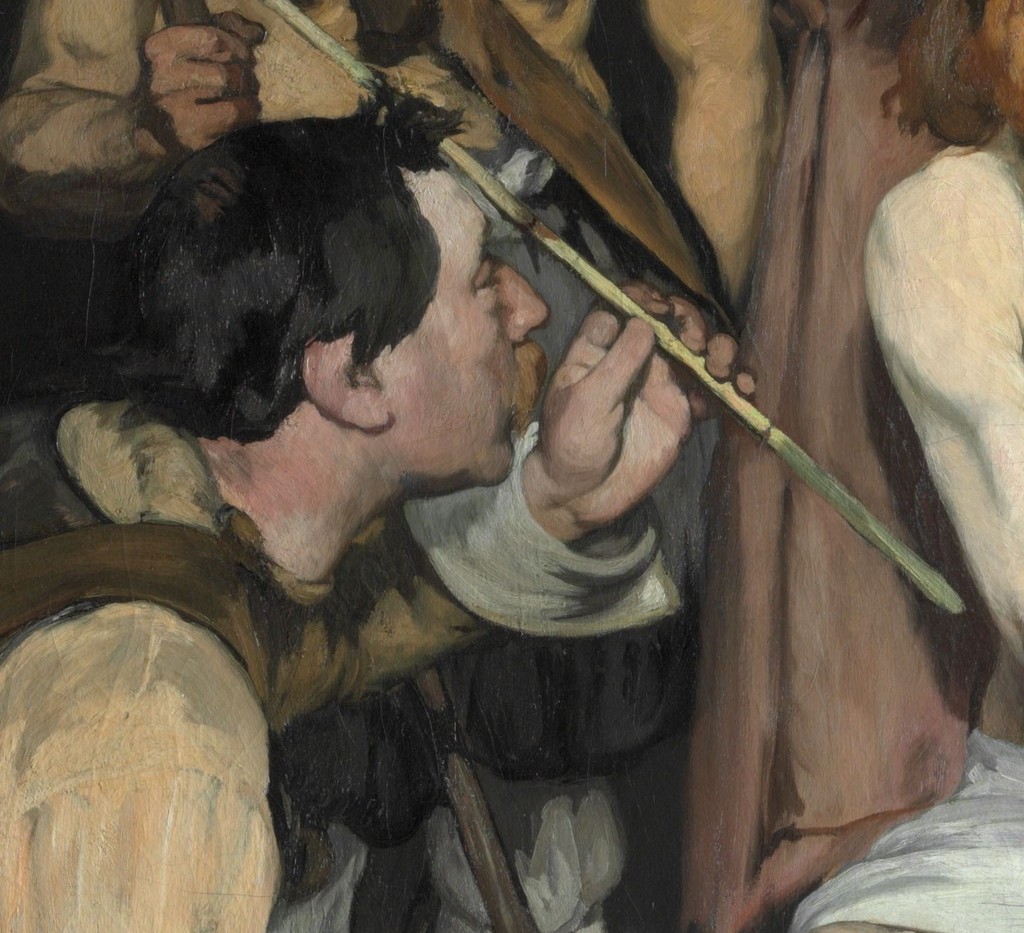
The kneeling man at the left brings his face close to Christ's body. His head is seen in profile, and one hand rises beneath the long diagonal reed. His other hand rests near his knee. The pale shirt, dark vest and bent leg make him a substantial foreground figure. He occupies space that might otherwise separate the viewer from the prisoner.
Behind him stands an older, grey-bearded man in a dark helmet. A spear rises towards the upper-left corner. The bare chest and the strap across it give this figure a different silhouette from the kneeling man's layered clothing. His head inclines towards the centre, but the weapon carries the eye away from the faces into the nearly black field above them.
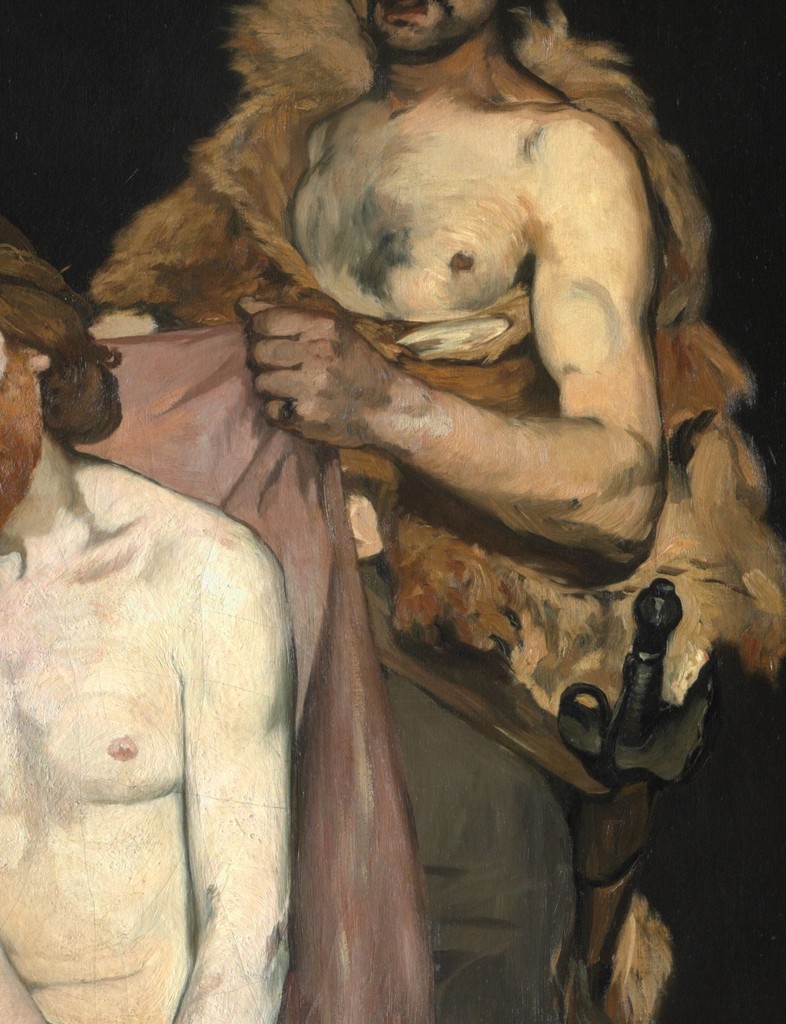
At the right, the standing man wears a yellow head covering and a fur-like garment around his shoulders and waist. His hands hold the purple cloth behind Christ. Their placement can be followed more readily than the purpose of the gesture. The fabric stretches between his fingers and the central body without resolving exactly what is happening to it.
The Art Institute reads the captors' behaviour as ambivalent. It suggests that the standing man may be covering Christ rather than stripping him. This is an interpretation of the gesture, rather than an action conclusively explained by the image. [1]
The contrast between the men matters as much as their shared position around Christ. The kneeling head is close and low; the helmeted head inclines from behind; the standing face at the right turns more towards the viewer's side of the encounter. Their gazes do not form one continuous circuit. The scene holds several kinds of attention together.
Cloth, Colour and Close Space
The white cloth has a structural role beyond identifying a garment. It divides the lower body from the darker clothing around it, then carries a sequence of sharp folds towards the floor. Its edges move between the hands, thigh and seat. Looking along them makes the bound figure feel both strongly outlined and physically entangled with its surroundings.
The purple cloth works differently. Its broad, comparatively quiet surface stretches behind the pale torso and provides a coloured interval between the people. It also connects Christ to the standing man's hands. The viewer can read it as a shape within the composition before deciding what its movement might mean.
Warm yellow, brown and reddish passages gather around the central body. The standing man's head covering is particularly conspicuous against the dark background. The kneeling man's shirt and the older man's skin create related patches of warmth at the opposite side. These colours keep the surrounding figures active, even when the pale torso first commands attention.
The setting offers little relief from this concentration. There is no distant landscape, crowd or clearly furnished room into which the eye can escape. A narrow floor supports the feet, ropes and rods near the lower edge. Above the heads, darkness occupies a large part of the canvas. It makes the bodies feel gathered into a restricted space without giving that space an easily measurable depth.
A Subject from the Passion
The crown, reed and purple cloth identify the mocking of Christ before the Crucifixion. Mark 15:16–20 describes soldiers dressing Jesus in purple, placing a thorn crown on him, striking him with a reed and kneeling in mock homage. The passage then describes the removal of the purple clothing before he is led away. [2]
Manet's picture does not arrange these elements into a sequence that can be read from one side to the other. The reed crosses the composition, but no blow is visibly completed. The kneeling posture is clear, while the man's expression is harder to assign. The cloth is held, yet the direction and purpose of its movement remain uncertain.
This suspension gives the subject its particular pressure. A viewer familiar with the story knows what will follow, but the painted encounter demands attention to a moment before that outcome. The rope constrains the hands, the figures surround the body, and the weapons remain present. The uncertainty of the gestures does not remove the unequal power between the people.
The religious meaning also depends on how the body is presented. Christ is exposed, bound and placed close to the front of the picture. His face and feet occupy the same tangible world as the soldiers' clothing and hands. The painting makes that bodily proximity available to viewers before they settle on an explanation of any individual expression.
An Old Master Subject Recast
The 2013 Venice exhibition guide identifies Titian's treatment of the subject in the Louvre as one of Manet's sources. It places the picture within an account of his engagement with Italian religious painting. That is a proposed artistic relationship, rather than proof that Manet copied a particular passage directly. [3]
The Louvre work is Titian's The Crowning with Thorns, painted on poplar and dated in its collection history to about 1540–1543. [4]
The connection helps explain why an established religious subject could remain a demanding pictorial choice. Manet had to organise several bodies, several directions of attention and a scene of violence whose outcome his audience already knew. In his own painting, the close grouping and interrupted gestures give those problems a force that can be followed through the visible arrangement.
The soldiers' different clothing also prevents the group from becoming a uniform surround. Helmet, shirt, head covering and fur-like material create separate textures and outlines. The pale central figure is exposed against this accumulation of things worn, held and carried. Colour and material differences do part of the work that a more emphatic sequence of actions might otherwise perform.
At the Salon of 1865
Jesus Mocked by the Soldiers appeared at the Paris Salon of 1865 alongside Olympia. The Venice guide discusses the hostile reception of both paintings, placing the religious work beside the much more familiar controversy over its companion. [3]
The pairing matters when reading later criticism. In his 1867 essay, Émile Zola names both pictures but directs his extended praise towards Olympia. His discussion of the earlier Dead Christ with Angels belongs to the preceding year's Salon. Those passages should not be combined into a single tribute to Jesus Mocked by the Soldiers. [5]
Writing retrospectively in 1906, Théodore Duret recalls the two 1865 submissions together and describes the public's renewed mockery of Manet. His account helps recover the pairing's importance in the artist's reputation, although it is a later assessment by a supporter rather than a transcript of every response at the exhibition. [6]
Kathryn Kremnitzer's published study adds another view of Manet's public presence that year. For L'Autographe au Salon et dans les ateliers, he supplied a drawing recalling The Gypsies, The Spanish Ballet and Lola de Valence, rather than either of his Salon paintings. The drawing appeared in the July 8 issue. His representation in print therefore reached beyond the two controversial canvases on the exhibition walls. [7]
Beside The Dead Christ with Angels
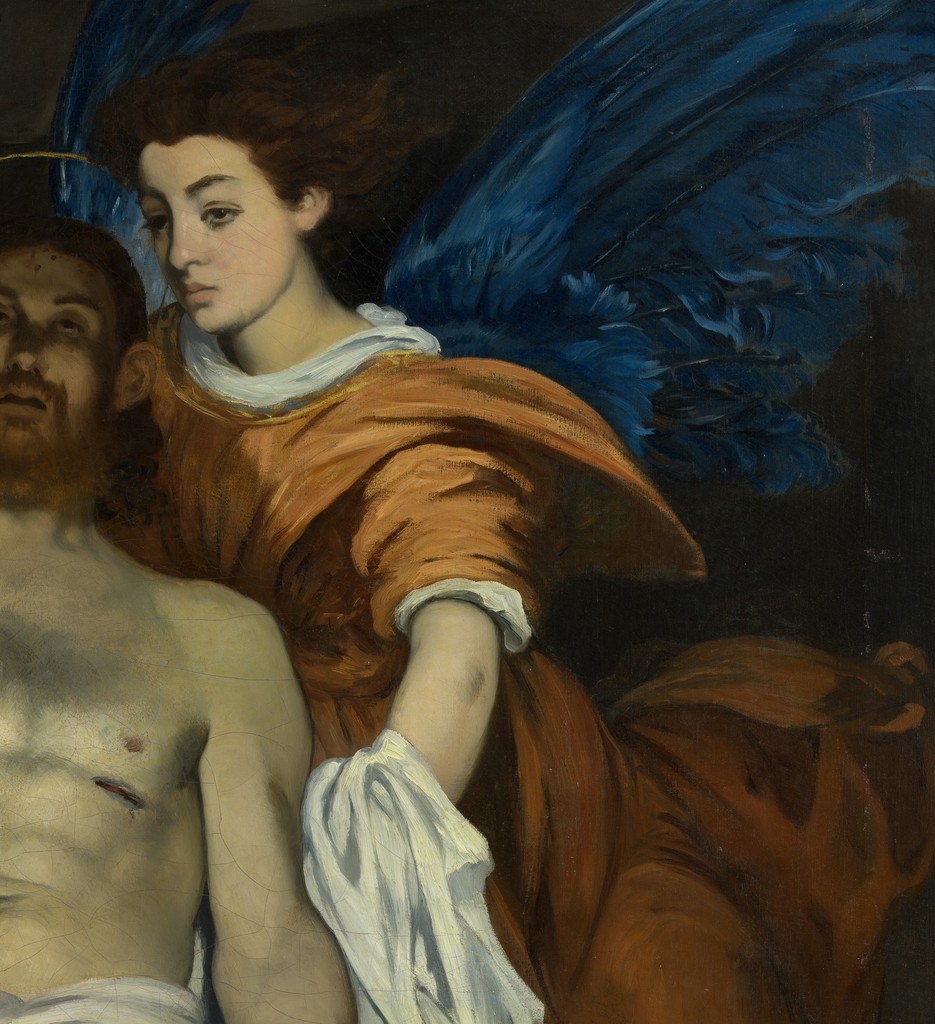
The closest comparison within Manet's work is The Dead Christ with Angels, painted in 1864 and now in the Metropolitan Museum of Art. [8]
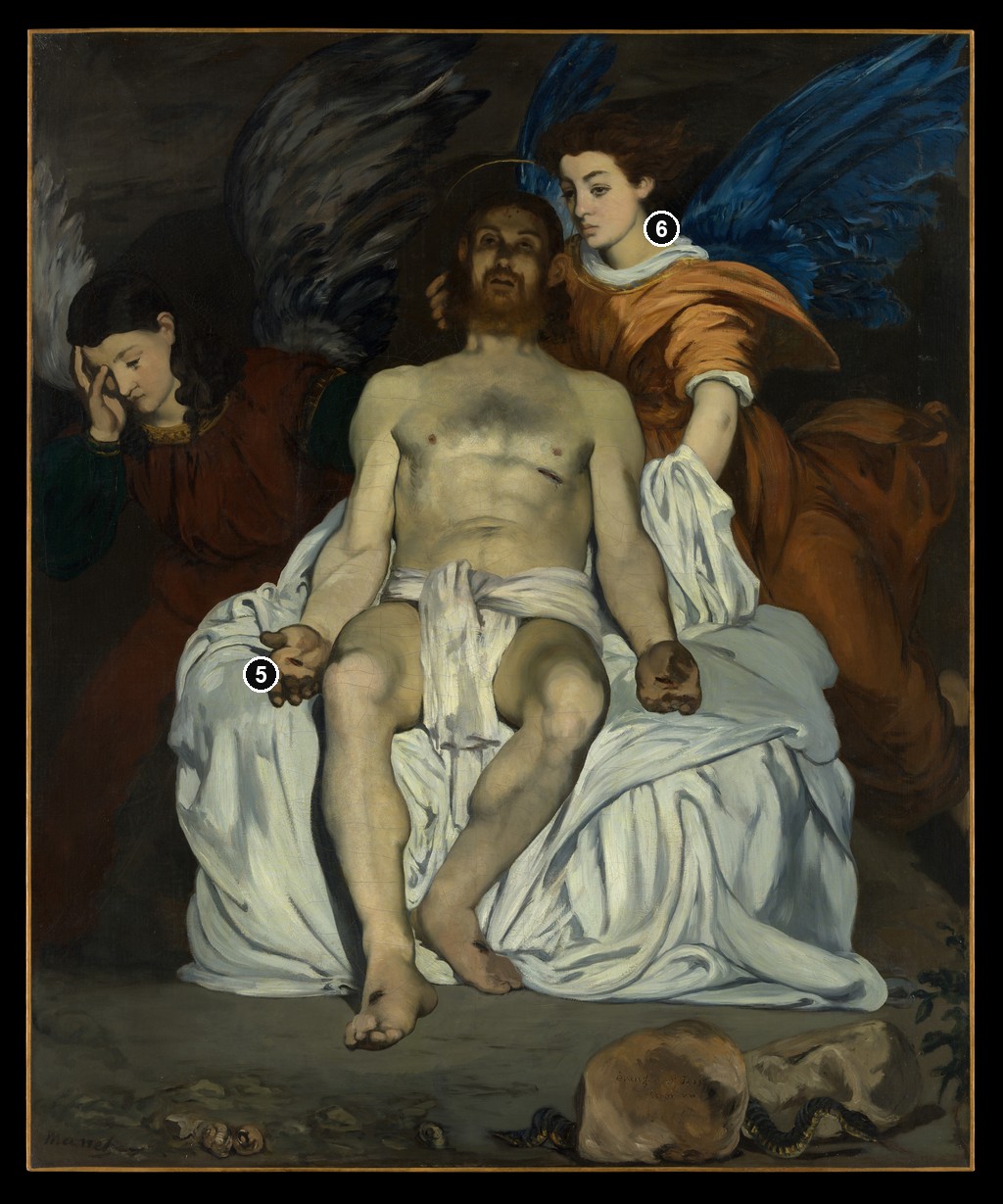
Both compositions place a pale body near the front of a dark setting, surrounded by figures whose gestures direct attention towards it. In the earlier painting, two winged figures attend the dead Christ. One hand supports his upper arm; the other angel bends a head towards a hand raised beside the face. Broad white fabric gathers around the body and seat.
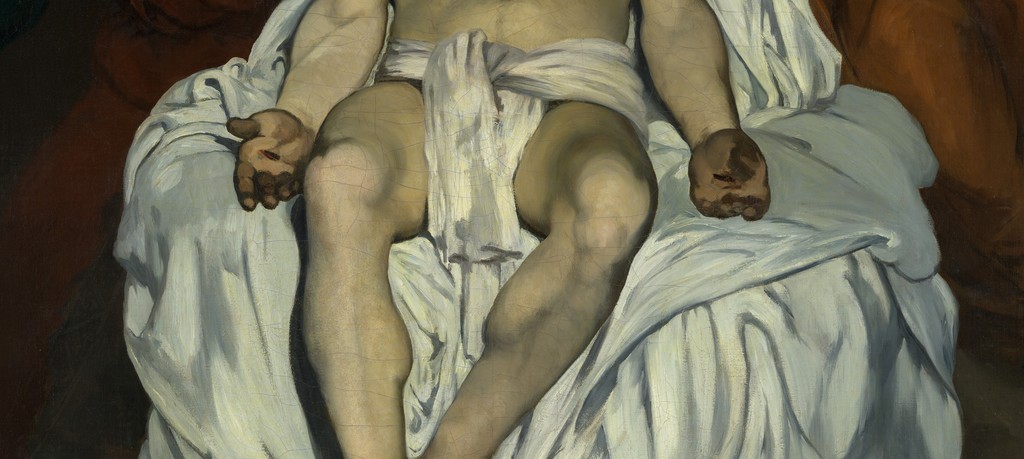
The hands produce an especially revealing difference. In the earlier picture, Christ's palms open towards the viewer, with wounds visible. In Jesus Mocked, the hands are crossed, bound and gathered together. One figure is being supported after death; the other remains alive within an enclosing group. The difference can be read through what the arms and hands are physically able to do.
The earlier picture also spreads the attending figures' wings through the background. The blue and grey feathered forms establish a surrounding presence distinct from the exposed human body. In the later work, the men bring weapons, clothing and a held cloth into the same close space. The figures on either side become harder to read as a single, clearly defined kind of attendance.
Returning to Jesus Mocked by the Soldiers, the central hands remain a useful point of entry. The rope is explicit; the gestures around it are less so. Light makes the body strongly visible, while the differences between the surrounding faces resist a simple collective expression. The painting holds those unequal certainties together, making a familiar subject demand a fresh act of looking.
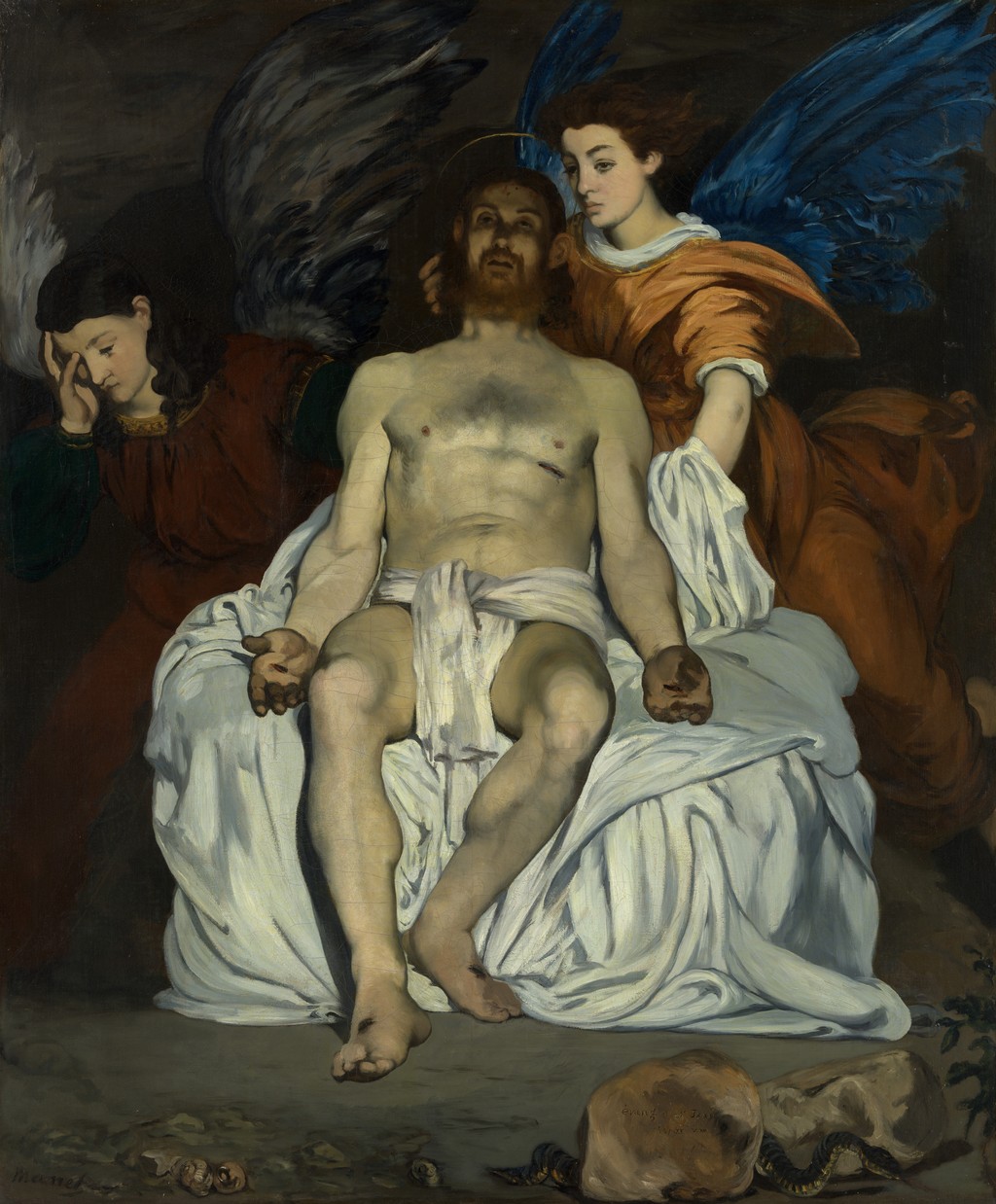
Édouard Manet, The Dead Christ with Angels, 1864. Metropolitan Museum of Art, 29.100.51. The Metropolitan Museum of Art. Image source. CC0 / Public domain. Photographic surround trimmed from the native image before proportional resizing; no enlargement or retouching.
Annotated Details from Jesus Mocked by the Soldiers and The Dead Christ with Angels
The numbered points identify visible features discussed in this article. Return from each detail to the whole composition. Each caption identifies the work shown.
Jesus Mocked by the Soldiers
Édouard Manet, Jesus Mocked by the Soldiers, 1865. Art Institute of Chicago. Art Institute of Chicago / Google Art Project. Image source. Public domain. Numbers added to a separate resized whole supplied overview. Detail crops from the unchanged original; no enlargement or retouching.
The Dead Christ with Angels — 1864
Édouard Manet, The Dead Christ with Angels, 1864. Metropolitan Museum of Art, 29.100.51. The Metropolitan Museum of Art. Image source. CC0 / Public domain. Numbers added to a separate resized whole supplied overview, retaining its photographic border. Detail crops from the unchanged original; no enlargement or retouching.
Details from JESUS MOCKED BY THE SOLDIERS AND THE DEAD CHRIST WITH ANGELS
Compare the turned face, bound hands, kneeling profile and purple cloth with the earlier painting’s open palms and attending angel.
Jesus Mocked by the Soldiers
The Face and Crown
The turned face, reddish beard and crown of thorns sit above the pale shoulders.
The Bound Wrists and White Cloth
The rope gathers the wrists together above the white cloth; the two hands occupy different angles.
The Kneeling Profile and Raised Hand
The kneeling profile and raised hand turn towards the seated figure, beside the long diagonal reed.
Holding the Purple Cloth
The fingers grip the purple cloth beside the pale shoulder, above a fur-like garment.
The Dead Christ with Angels — 1864
Earlier Painting: Two Open Palms
The open palms spread to either side of the body in The Dead Christ with Angels; compare them with the bound hands in Jesus Mocked.
Earlier Painting: The Angel’s Face and Blue Wing
The angel’s head and blue wing rise above orange drapery and a pale sleeve, beside Christ’s upper body.
Artworks directory
Explore selected paintings, drawings and prints by Édouard Manet. Search by title or another recorded name.
Frequently Asked Questions
It belongs to the Art Institute of Chicago. [1]
Yes. Both paintings appeared at the Paris Salon of 1865. [3]
The gesture is ambiguous; the Art Institute suggests it may instead be covering Christ. [1]
Discussion
Look again at the images and ideas explored in Jesus Mocked by the Soldiers by Édouard Manet. These editorial prompts invite your observations.
Reader Insights
Compare the bound wrists with the hands holding the reed and cloth. Notice which actions are clear and which remain difficult to settle.
Follow the direction of each gaze. Consider whether the four figures appear to share one encounter or to occupy different kinds of attention.
Look at the palms, white cloth and surrounding figures in the two religious paintings. Describe their differences before proposing an emotional or biographical explanation.
Join the Conversation
Share a detail, comparison or question about Jesus Mocked by the Soldiers by Édouard Manet below.
References
- Art Institute of Chicago, Jesus Mocked by the Soldiers, museum-authored record on Google Arts & Culture. View source.
- United States Conference of Catholic Bishops, Mark 15:16–20, the mocking of Jesus. View source.
- Fondazione Musei Civici di Venezia, Manet: Ritorno a Venezia, 2013 Italian exhibition guide, section IV and cat. 30, printed pp. 13–14. In Italian. View source. (in Italian).
- Musée du Louvre, Titian, Le Couronnement d'épines, INV 748 / MR 515, collection record. In French. View source. (in French).
- Émile Zola, Édouard Manet: étude biographique et critique, 1867, passages on the 1864 and 1865 Salons. In French. View source. (in French).
- Théodore Duret, Histoire d'Édouard Manet et de son œuvre, 1906, pp. 50–51. In French. View source. (in French).
- Kathryn Kremnitzer, “Manet Across Media: Looking at Lola de Valence”, Materia, issue 2, 2022, “L'Autographe au Salon.” View source.
- The Metropolitan Museum of Art, The Dead Christ with Angels, 1864, collection record. View source.
- Splash image, Édouard Manet, Jesus Mocked by the Soldiers, 1865. Art Institute of Chicago. Art Institute of Chicago / Google Art Project. Image source. Public domain. Whole supplied public-domain reproduction resized without enlargement or retouching.


