



 by Tom Gurney
Tom Gurney BSc (Hons) is an art history expert with over 20 years experience
Published on June 19, 2020 / Updated on October 30, 2026
Email: tomgurney1@gmail.com / Phone: +44 7429 011000
Rue Mosnier Decorated with Flags by Édouard Manet: Introduction
Flags break into red, white and blue above a remarkably open street. A carriage waits beside the right pavement; near the opposite edge, a man on crutches makes his way past a wooden fence. The buildings are dressed for a public celebration, but the people below them remain separate, each occupying a small part of the afternoon.
Manet's The Rue Mosnier with Flags, also known as Rue Mosnier Decorated with Flags, depicts the holiday of 30 June 1878. Now in the J. Paul Getty Museum, it brings national colours into contact with the unfinished fabric and varied lives of a Parisian street.[1]
At a Glance
- ArtistÉdouard Manet
- Date1878
- Occasion depictedThe national celebration of 30 June 1878
- MediumOil on canvas
- Dimensions65.4 × 80 cm, height × width
- CollectionJ. Paul Getty Museum, Los Angeles
- Accession number89.PA.71
- Signature and dateLower left, “Manet / 1878.”[1]
This work across Édouard Manet’s career
Contents
- A Celebration of Peace in June
- The View from Manet's Studio
- An Open Road between Two Pavements
- The Man on Crutches
- Carriages, Passengers and a Ladder
- Flags and the Touch of the Brush
- A Related Drawing of the Figure
- Other Views of the Rue Mosnier
- Monet's View of the Same Holiday
- The Painting at the Getty
A Celebration of Peace in June
The occasion was the Fête de la Paix, or Celebration of Peace. Paris was hosting the Exposition Universelle, and the festivities presented an image of recovery after France's defeat in the Franco-Prussian War of 1870–1871 and the violence of the Paris Commune. The Musée d'Orsay describes the June celebration as an affirmation of peace and work that also helped consolidate the still-fragile Republic.[1][2]
The date matters. Although flags filling a French street readily suggest Bastille Day, the event represented here took place on 30 June. The adoption of 14 July as France's national holiday followed in 1880.[2] The world's fair was still open during the June festivities, giving the public celebration a setting of international display and confidence in the country's future.
A contemporary printed programme, now in the Mucem collection, bears the title Fête nationale du 30 juin 1878. Its surviving inscription record includes a programme and songs.[3] Such material helps place the flags within a deliberately organised occasion. They were visible declarations shared across the city, bringing a common set of colours to otherwise different streets and households.
Manet's street offers a relatively quiet view of that public display. The flags are numerous, but the figures do not merge into a dense crowd. The space between them lets the eye distinguish a person walking, people beside a carriage and work continuing close to the foreground. The national occasion holds these activities together without making them identical.
The View from Manet's Studio
Manet looked along the rue Mosnier from his studio at 4 rue de Saint-Pétersbourg. Juliet Wilson-Bareau's reconstruction of the neighbourhood identifies the former fencing hall he rented there in July 1872. Its windows opened onto a district shaped by the expansion of the railway and surrounding property development.[4]
The position gives the painting its unusual intimacy with the street. We can look down onto the man's back, the carriage and the pavement, yet the nearest figures remain substantial enough to be distinguished individually. The viewpoint has height without turning all human activity into distant specks.
It also limits the composition. There is no broad strip of sky above the houses. Buildings and flags continue out of the top of the picture, while the roadway extends towards its lower edge. The scene feels like a portion of the city caught within a window's field of vision, with more architecture, traffic and activity beyond the frame.
The rue Mosnier, now the rue de Berne, lay beside the railway cutting. Wilson-Bareau relates the fence and unfinished area at the left to that developing site.[4] The pale broken material behind the fence therefore belongs to the street's construction history. Its roughness introduces a very different surface from the orderly façades opposite.
The contrast is immediately visible. On the right, repeated openings and long horizontal divisions give the buildings a continuous frontage. On the left, the fence interrupts the pavement and conceals an uneven accumulation of material. The picture contains a finished-looking residential street and a place still being made.
An Open Road between Two Pavements
The roadway occupies much of the lower half. Its pale cream and grey surface widens towards us, then narrows as it reaches the shaded distance. The right curb supplies the strongest diagonal, running from near the lower corner towards the far end of the street. Its dark edge makes a clear guide through the lighter paint.
The left boundary is less regular. Fence posts, shadows and the man on crutches break up its course. This gives the two sides different rhythms: a relatively continuous sweep at the right, a succession of interruptions at the left. The open space between them becomes more noticeable because its borders behave differently.
A wide band of shade crosses the road farther up. Beyond it, the surface cools towards blue-grey; nearer us, warmer light spreads across the foreground. The change gives a sense of the sun falling between buildings without requiring a precisely described view of the sky or a carefully outlined shadow at every point.
Short marks interrupt broader, more horizontal strokes across the road. Cooler patches lie beside warmer ones, and the direction of the brush remains apparent. Its lightness becomes the field against which darker figures, wheels and crutches register.
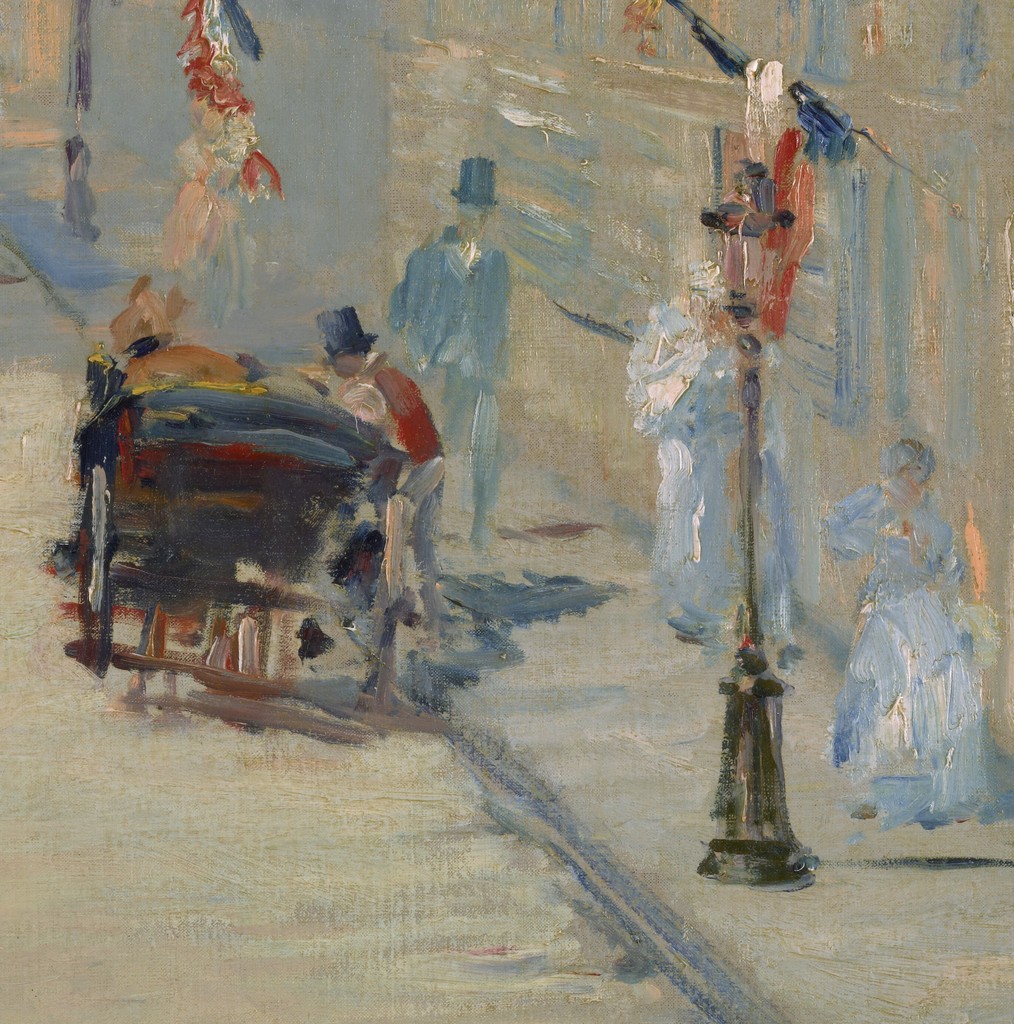
The nearest lamppost stands on the right pavement. Its dark base and slender shaft make a firm upright against the curb's diagonal. Smaller posts farther away repeat that vertical at diminishing sizes. Together with the repeated doors and windows, they help turn a flat expanse of paint into a street extending through space.
The Man on Crutches
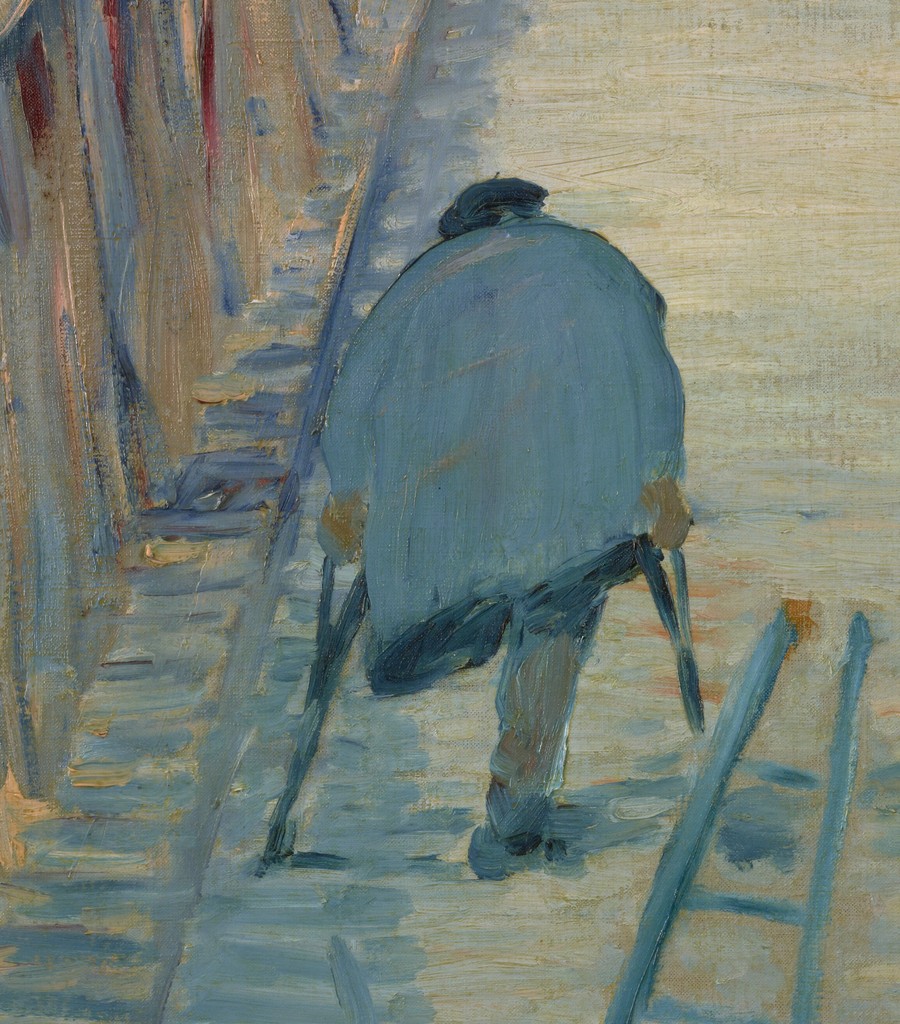
The man in blue occupies the lower left, close to the fence. Seen from behind, his rounded back forms one of the painting's clearest areas of colour. A dark cap sits above it. Below, one lower leg and foot are visible between the long supports of his crutches.
His position draws attention partly because he is near, partly because so much pale road surrounds him. The blue garment forms a compact shape against the cream surface. The crutches continue downwards into darker, narrower lines, making the act of supporting and advancing the body visible even at this small scale.
We cannot read his face. The head is lowered, and his direction carries him away from our viewpoint. Manet gives enough to show how he moves, while leaving his private response to the occasion inaccessible. His presence can hold the eye without an invented account of what he is thinking.
The Getty describes him as an amputee, perhaps a veteran or beggar.[1] Theodore Reff reads the figure more strongly as a reminder of war's consequences introduced into a celebration of peace.[5] That interpretation gives the painting a powerful historical tension, while the man's actual military service and the cause of his limb loss remain uncertain.
The possible connection to war changes the experience of the flags. Their colours can announce collective recovery, while the body beneath them may suggest a cost that public celebration cannot remove. The effect arises from sharing the same space: the man proceeds along the very pavement above which the decorations hang.
Placed close to the left edge, the man slows the eye before it follows the street into the distance. His broad blue back answers the larger dark carriage across the road, establishing a sequence of human presences through the open space.
Carriages, Passengers and a Ladder
The nearer carriage presents its dark rear towards us. Warm brown and reddish accents cross its body, while small wheels and the undercarriage touch the road below. People cluster beside it on the right, their pale clothing interrupted by darker hats and shadows.
The figures remain loosely described. A few strokes give the suggestion of a light dress, a head turned or a body standing beside the vehicle. The lack of facial detail directs attention towards their positions and their relations to the carriage and pavement. We see the social activity of arrival, departure or waiting without being given a complete episode.
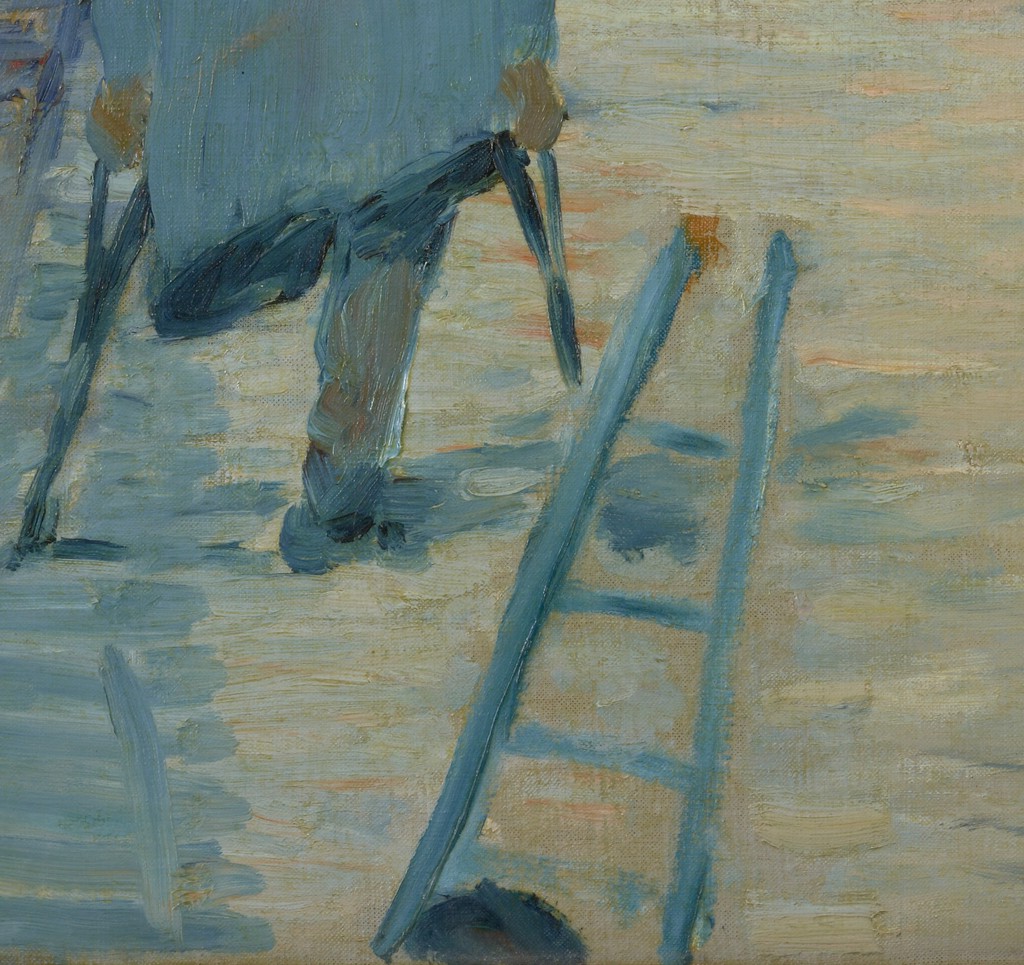
At the lower edge, a ladder enters the picture on a steep diagonal. Its blue-grey rails and pale crosspieces are large beside the more distant objects. The Getty identifies a worker carrying it in the foreground; much of this activity is cut off by the frame.[1]
Wilson-Bareau suggests that the ladder could be connected with putting up further decorations.[4] That is a plausible reading within the occasion. Visually, it also brings the work of handling and arranging things into the same field as the finished display. The flags have been attached somewhere; the street is inhabited by people whose actions make such public appearances possible.
Flags and the Touch of the Brush
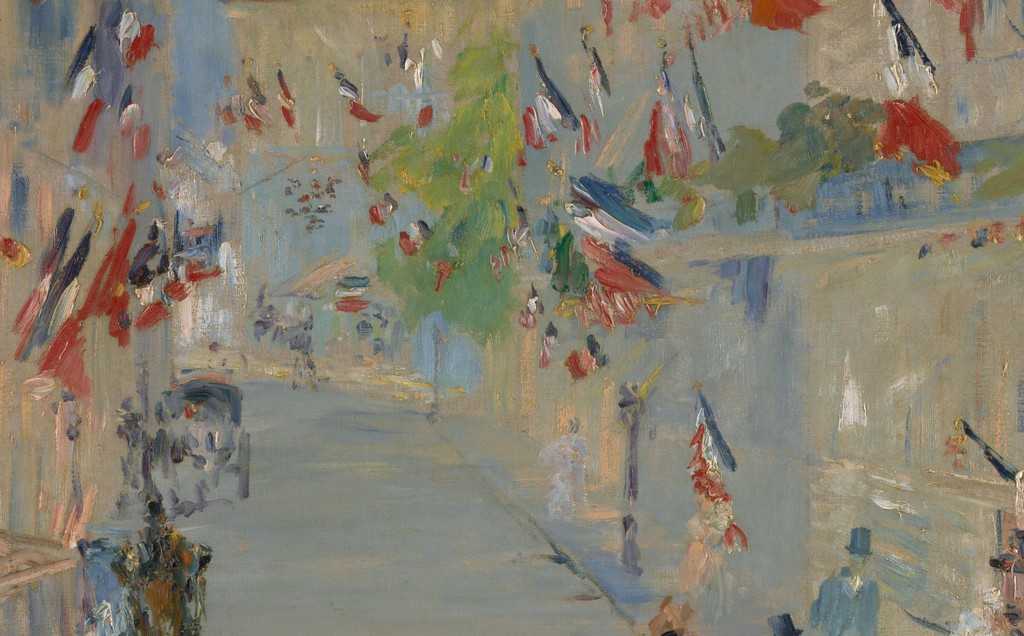
The decorations vary enormously in size. The near flag at the right almost leaves the painting, its red lower section turning into an irregular edge against the building. Across the street, other flags project on diagonal poles or bunch into overlapping patches of red, pale white and dark blue.
Their folds are conveyed through changes in the paint's direction. A red stroke turns down; a pale band widens; a blue passage narrows into the shadow beside it. The fabric can seem to flutter even where its precise contour is difficult to follow. Farther away, a few coloured touches are enough to suggest another hanging flag.
The colours also connect different distances. Red appears prominently near the right edge, then returns in smaller marks along both sides of the street. Blue joins the flags to shadows, the foreground garment and touches in the buildings. White belongs both to the national emblem and to the broader light that fills the scene.
The buildings are painted more quietly. Pale vertical strokes describe walls and openings, while blue-grey marks establish ledges, shadows and recesses. At points, those architectural forms loosen into the same visible touches that animate the flags. Elsewhere, a door frame or the curb becomes much firmer.
A Related Drawing of the Figure
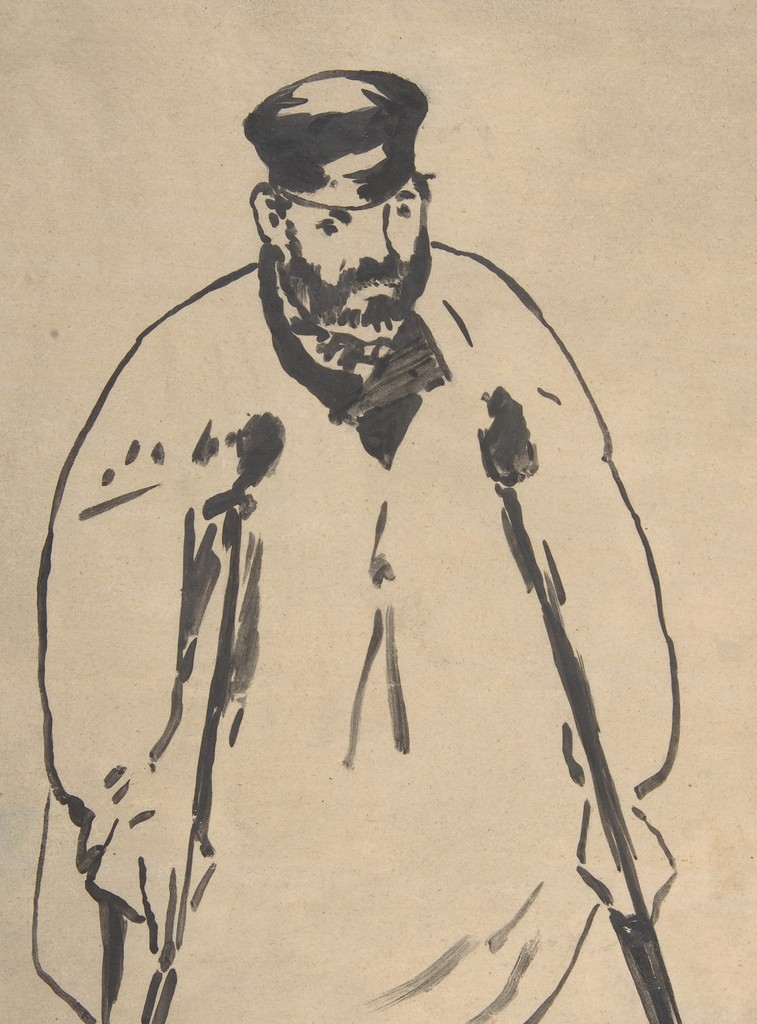
Manet's A Man on Crutches, dated 1878, belongs to the Metropolitan Museum of Art. It is drawn with brush and lithographic ink on transfer paper, on a sheet measuring 27.1 × 19.7 cm.[6] Reff connects its subject with the man seen from behind in the Getty painting.[5]
The change of viewpoint is striking. In the drawing, the man turns more towards us, allowing dark strokes to suggest eyes, beard and the shape of his cap. A long curved outline encloses his broad garment. The crutches extend down either side, with the black ink varying between narrow lines and heavier patches.
Much of the paper remains untouched within the figure. The artist does not need a continuous field of shadow to make the garment feel substantial. A few folds, the surrounding contour and the supports beneath the arms allow the body to emerge from the pale sheet.
In the painting, that same general bulk becomes a blue shape seen from behind. The change brings the figure into the street's pattern of colour, distance and movement, turning his attention away from us and towards the road ahead.
The material of the drawing has another significance. Wilson-Bareau discusses the rue Mosnier drawings in relation to an unfulfilled print project, alongside a projected songsheet design connected with the composer Cabaner and poems by Jean Richepin.[4] Such a project offered the possibility of circulating the street images more widely. The exact sequence and eventual use of individual sheets remain open; the Met work is a drawing, rather than a published lithograph.
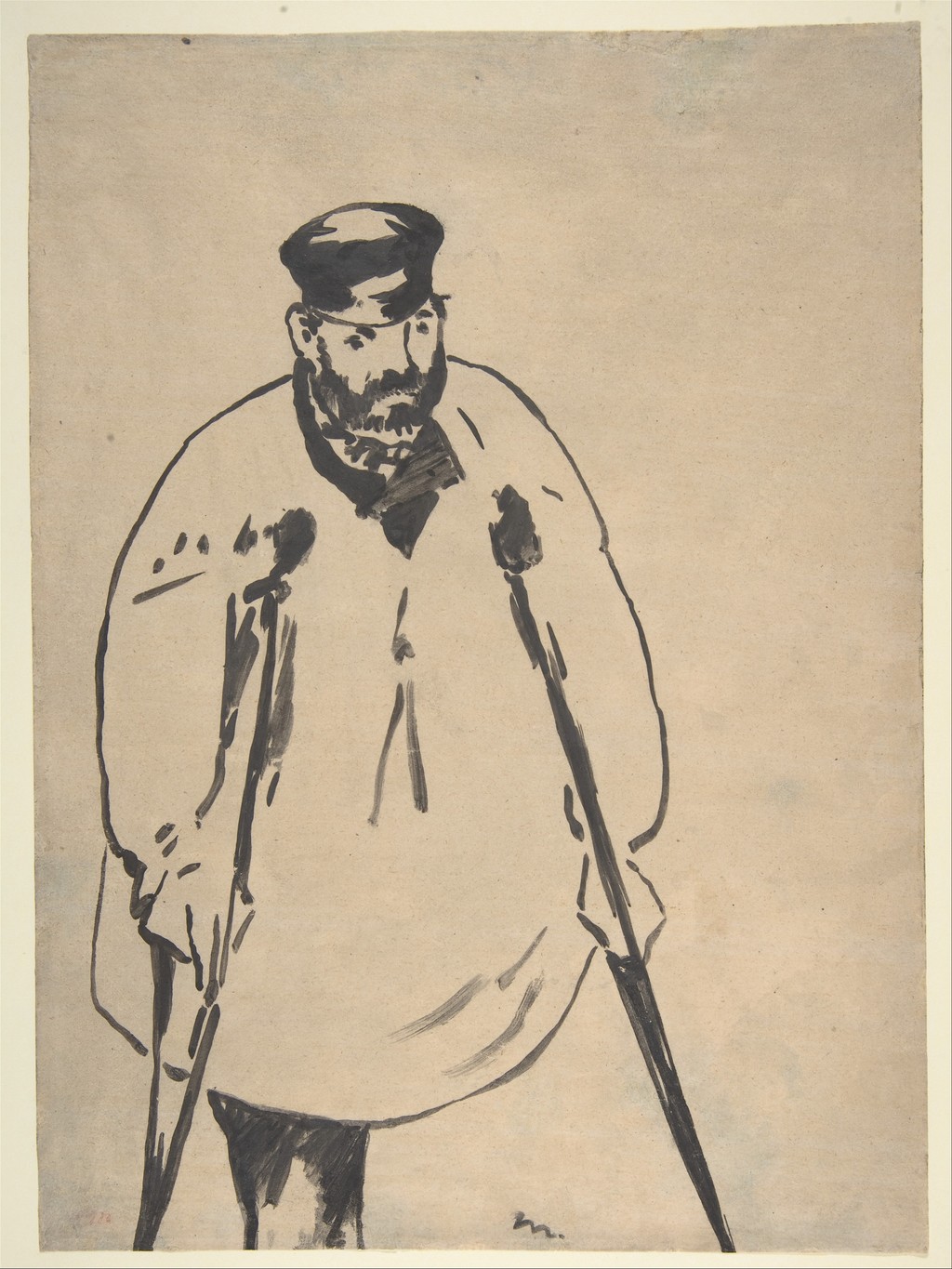
Édouard Manet, A Man on Crutches, 1878. Brush and lithographic ink on transfer paper. The Metropolitan Museum of Art, New York, 48.10.2. Harris Brisbane Dick Fund, 1948. Image source. CC0 / Public domain. Whole supplied drawing view resized, retaining paper colour and provided edges, including the lower cut through the crutch shafts; no enlargement, whitening or retouching.
Annotated Details from Rue Mosnier: Flags, Figures and the Open Road
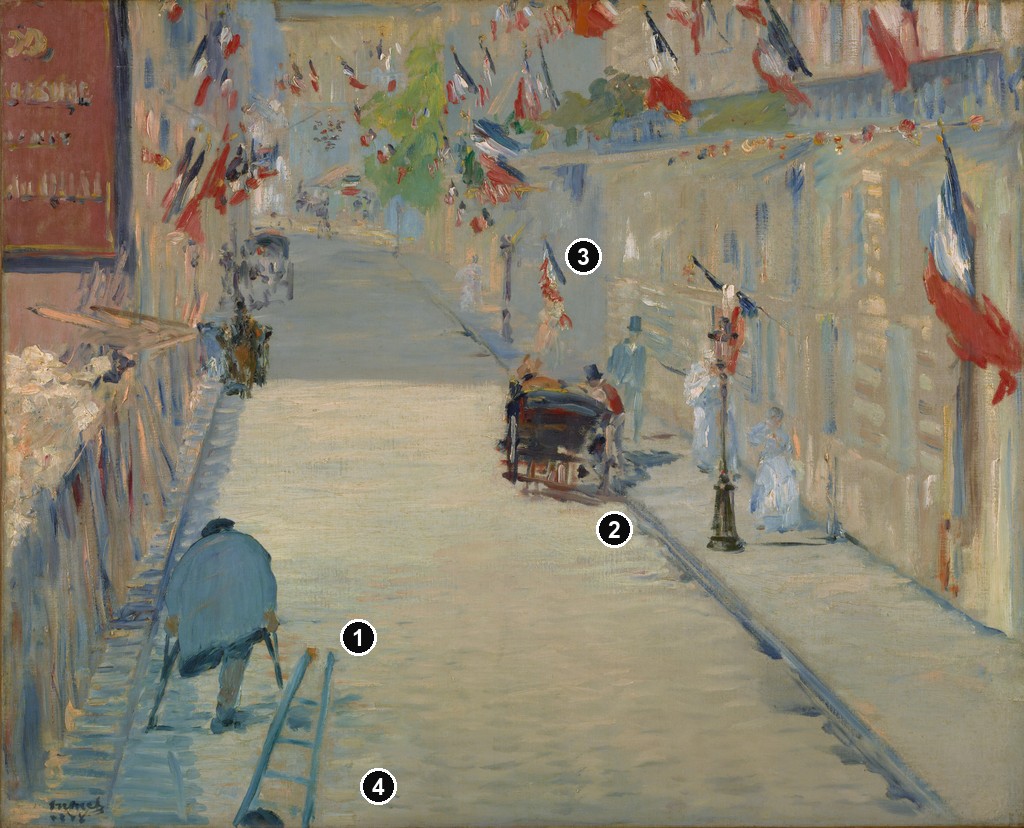
The numbered points identify visible features discussed in this article. Return from each detail to the whole composition. Each caption identifies the work shown.
The Rue Mosnier with Flags
Édouard Manet, The Rue Mosnier with Flags, 1878. J. Paul Getty Museum, Los Angeles, 89.PA.71. Image source. CC0 / Public domain. Numbers added to a separate resized whole provided overview. Detail crops from the immutable original; no enlargement, retouching or colour alteration.
A Man on Crutches — Met Drawing
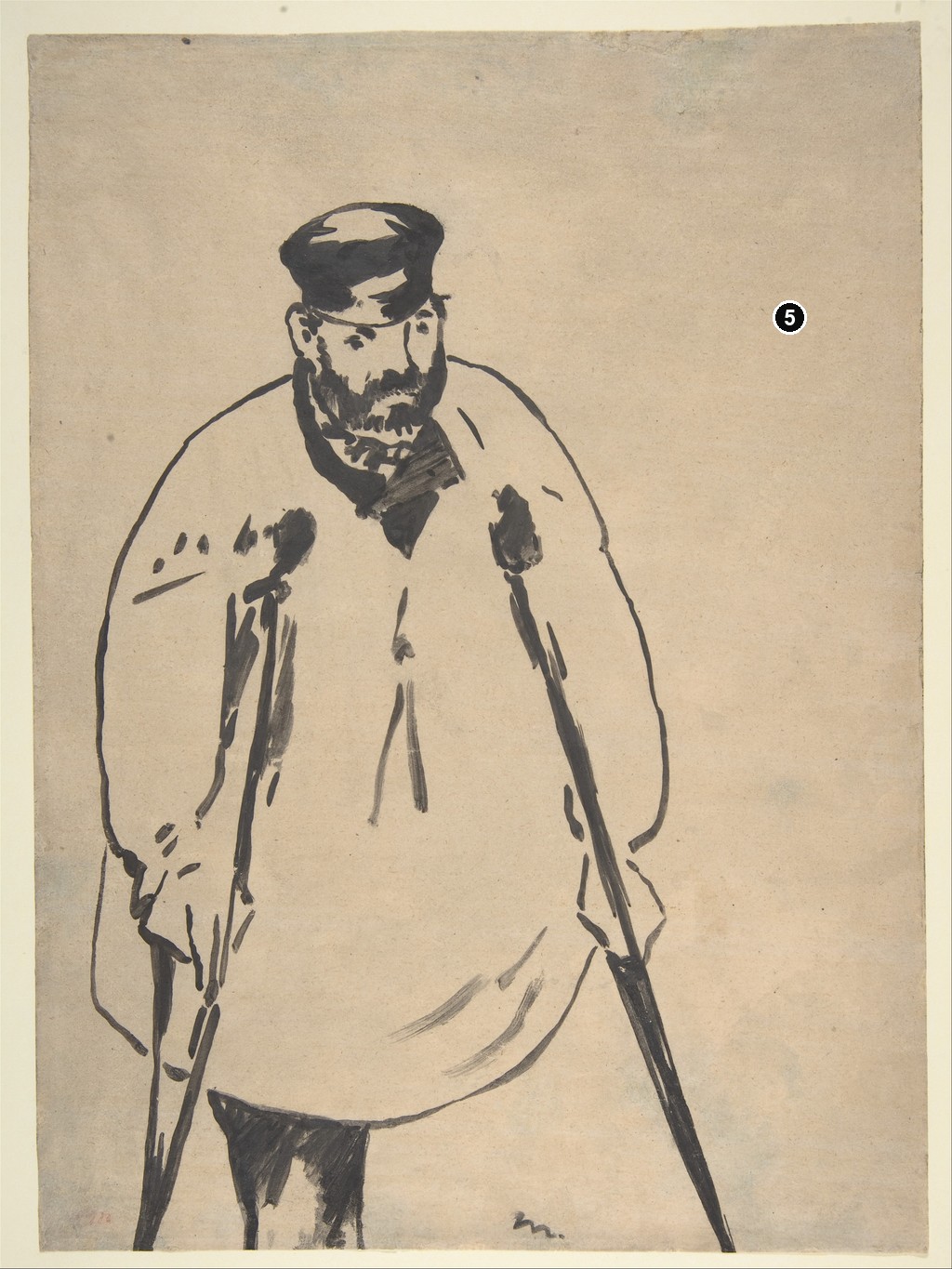
Édouard Manet, A Man on Crutches, 1878. Brush and lithographic ink on transfer paper. The Metropolitan Museum of Art, New York, 48.10.2. Harris Brisbane Dick Fund, 1948. Image source. CC0 / Public domain. Number added to a separate resized whole supplied drawing overview retaining paper colour and the provided lower cut through the crutch shafts. One upper-body detail crop from the immutable original; no enlargement, whitening, retouching or reconstruction.
Details from RUE MOSNIER: FLAGS, FIGURES AND THE OPEN ROAD
Follow the blue figure and crutches beside the ladder, then look across to the carriage and up to the flags. The related drawing provides a closer view of the cap, beard and hands at the crutch grips.
The Rue Mosnier with Flags
Blue Figure and Two Crutches
The blue-clad figure moves away along the left pavement, with two long crutches beside the body.
Carriage and Figures on the Right Pavement
The dark carriage and small figures gather along the right pavement, leaving the centre of the road open.
Flags above the Receding Street
Red, white and blue flags interrupt the pale façades as the street narrows into the distance.
Ladder beside the Lower Edge
The ladder angles across the lower foreground, where the original bottom edge cuts through its rails.
A Man on Crutches — Met Drawing
Cap, Beard and the Two Crutch Grips
A dark cap and beard sit above the spare coat outline. Both hands meet the long crutches in the supplied drawing.
Other Views of the Rue Mosnier
The decorated street also appears in another oil with a large red portion of a flag cutting across the near left. In The Rue Mosnier with Pavers, workers occupy the foreground. Reff and Wilson-Bareau discuss these related canvases as different treatments of the same familiar surroundings.[4][5]
They bring different activities forward. A large near flag can interrupt the street view and make the festive fabric dominate. Pavers can turn attention towards the labour that shapes the road itself. In the Getty painting, the open road leaves room for both the national display above and the man moving along its edge.
The relationship between these views is more secure than a precise account of their order. Wilson-Bareau notes uncertainty about how the paving activity relates to the stage of construction shown beside the fence.[4] It is useful to look at them as repeated investigations of a place whose appearance and uses kept changing.
Monet's View of the Same Holiday
Claude Monet painted La Rue Montorgueil, à Paris. Fête du 30 juin 1878, now in the Musée d'Orsay, for the same occasion. His tall canvas measures 81 × 50 cm and looks down a different Parisian street.[2] It provides a revealing comparison with Manet's broader, more open arrangement.
In Monet's painting, flags crowd both sides of a deep urban passage. Their red, white and blue forms overlap the buildings, while a mass of small dark figures fills much of the road below. Above, pale sky opens between the façades and makes room for still more fluttering fabric.
The eye experiences the crowd as a gathering before it can separate many individuals. Numerous little dark strokes collect into a moving stream. The flags have a similarly cumulative effect: their repetitions become a dense rhythm extending along the street and beyond the edge of the picture.
Manet allows larger intervals between his people. The foreground man, the ladder and the nearer carriage can each become a distinct point of attention. His road is broad enough for the viewer to feel the space between them, while the absence of open sky concentrates the view on façades and pavement.
The comparison brings out two ways of organising a shared public occasion. Monet makes the accumulation of flags and people the central visual experience. Manet gives more room to encounters with particular bodies and objects. Both pictures find possibilities in the national colours, but the different balance of space and figures changes how we move through the celebration.
The Painting at the Getty
The Getty acquired The Rue Mosnier with Flags in 1989, at the sale of Paul Mellon's collection in New York.[1] Its familiar scene remains open to more than one emphasis: the colour of a holiday, the building of a modern city, the movement of people and the possible memory of war.
The man on crutches shares the afternoon with the carriage passengers and the worker near the frame. Around them, a decorated city remains a place of individual actions: carrying, waiting, walking and finding a way forward.
Artworks directory
Explore selected paintings, drawings and prints by Édouard Manet. Search by title or another recorded name.
Frequently Asked Questions
He looked along the rue Mosnier from his studio at 4 rue de Saint-Pétersbourg.[4]
It belongs to the J. Paul Getty Museum in Los Angeles, accession 89.PA.71.[1]
Discussion
Look again at the images and ideas explored in Rue Mosnier Decorated with Flags by Édouard Manet. These editorial prompts invite your observations.
Reader Insights
Follow the red, white and blue flags between the buildings. Compare their short, moving-looking marks with the longer lines of the facades.
Look between the blue figure on crutches and the carriage farther along the street. Notice how each becomes distinct against the pale road.
Trace the curbs and repeated lampposts towards the distance. Where do the separate objects begin to merge into smaller touches of paint?
Join the Conversation
Share a detail, comparison or question about Rue Mosnier Decorated with Flags by Édouard Manet below.
References
- J. Paul Getty Museum, The Rue Mosnier with Flags, 89.PA.71, collection record, commentary and provenance. View source.
- Musée d'Orsay, La Rue Montorgueil, à Paris. Fête du 30 juin 1878, French collection record and commentary. View source. (in French).
- Ministère de la Culture, Fête nationale du 30 juin 1878, Joconde record 5002E009066, Mucem collection, inventory 50.39.1258 D. View source. (in French).
- Juliet Wilson-Bareau, Manet, Monet, and the Gare Saint-Lazare, National Gallery of Art, 1998, pp. 131–143 and notes 99–111, p. 189. View source.
- Theodore Reff, Manet and Modern Paris, National Gallery of Art, 1982, catalogue entries 86–88. View source.
- Metropolitan Museum of Art, A Man on Crutches, 48.10.2, collection record. View source.
- Splash image, Édouard Manet, The Rue Mosnier with Flags, 1878. J. Paul Getty Museum, Los Angeles, 89.PA.71. Image source. CC0 / Public domain. Whole supplied reproduction resized within native dimensions; no enlargement, retouching or colour alteration.


