



 by Tom Gurney
Tom Gurney BSc (Hons) is an art history expert with over 20 years experience
Published on June 19, 2020 / Updated on October 30, 2026
Email: tomgurney1@gmail.com / Phone: +44 7429 011000
The Horsewoman by Édouard Manet: Introduction
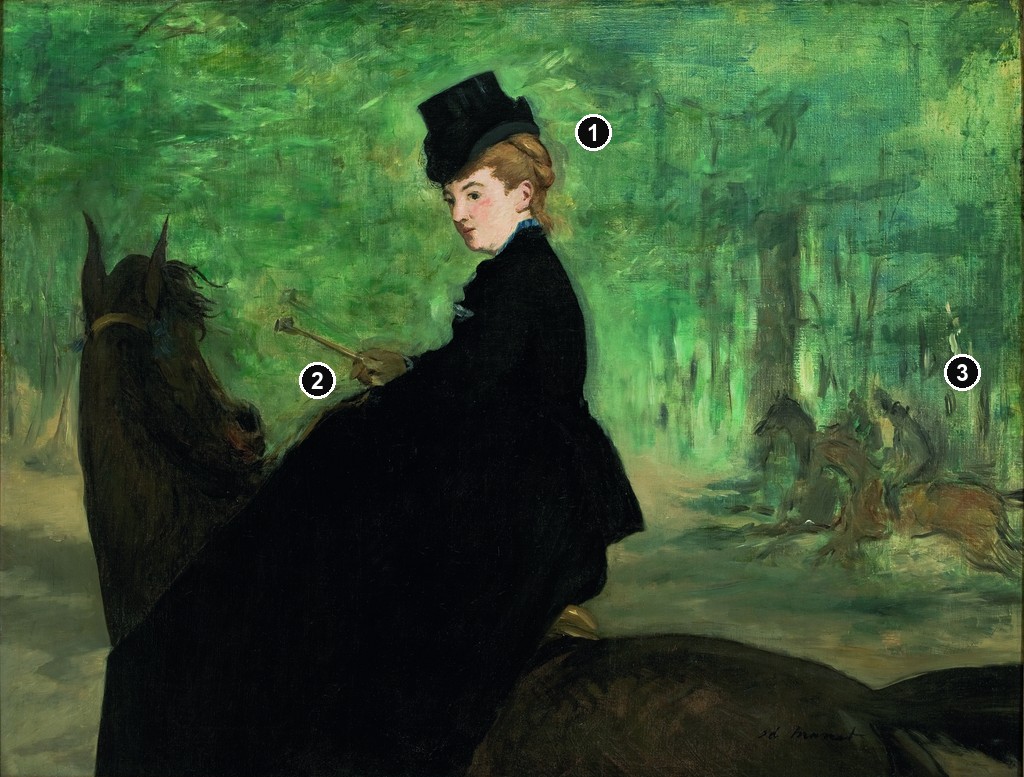
A woman in a tall black hat turns back above the dark body of her horse. Her pale face stands out against green trees, while two much smaller mounted figures occupy the path behind her. Édouard Manet brings the rider close without showing the horse’s full body. MASP identifies her as Marie Lefébure and dates the painting to 1870–75.[1]
At a Glance
- ArtistÉdouard Manet
- TitleThe Horsewoman; The Amazon — Portrait of Marie Lefébure on Horseback
- Date1870–75.[1]
- MediumOil on canvas
- Dimensions89.5 × 116 cm.[1]
- CollectionMuseu de Arte de São Paulo Assis Chateaubriand, MASP.00076
- AcquisitionPurchase, 1958.[1]
This work across Édouard Manet’s career
Contents
- A Turned Face beneath a Tall Hat
- The Black Riding Clothes
- The Gloved Hand and Riding Crop
- The Horse Seen from Behind
- Trees and a Path beyond the Rider
- Marie Lefébure and a Related Portrait
- The Inscription and Collecting History
- A Later Horsewoman in Madrid
- Annotated details
A Turned Face beneath a Tall Hat
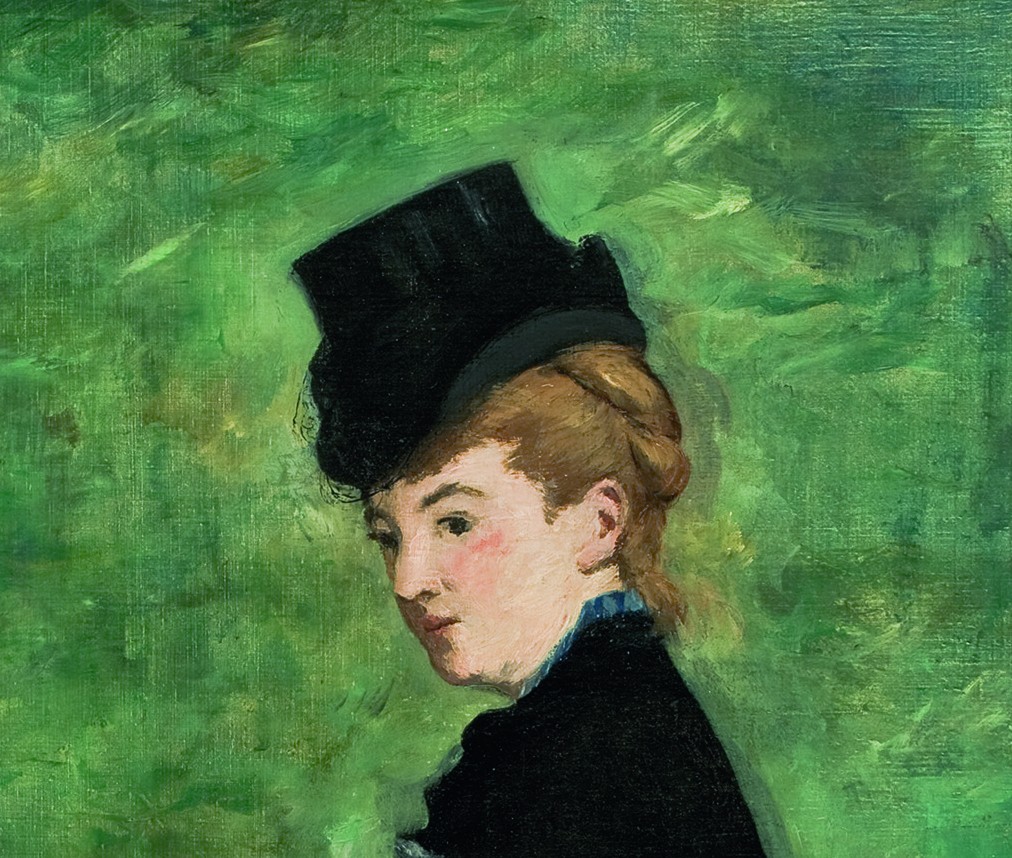
The woman’s body faces away, but her head turns towards the left and back into view. One eye is clearly visible beneath the dark brim. The nose projects beyond the warm cheek, and a small pink mouth sits above the pale chin. Her features occupy a small area above the dark costume.
The black hat rises at an angle, its upper edge slanting upwards towards the right. A broad curved brim crosses the forehead, casting a darker border above the face. The tall crown has straighter sides, which stand against the irregular patches of green behind it.
Reddish-brown hair rounds behind the ear and gathers at the back of the head. A few lighter passages distinguish its outer edge from the surrounding green. Below it, a narrow blue collar separates the warm skin from the black clothing. These colour changes contrast with the larger dark costume.
The Black Riding Clothes
The clothing descends from the neck in a long, nearly continuous dark shape. A broad curve follows the back on the right before reaching a projecting lower edge. Towards the left, the front of the figure slopes diagonally down across the horse. The costume widens towards the bottom.
Small grey-blue marks interrupt the dark area near the chest, while narrow changes of tone indicate the bent arm. Elsewhere, the black passages merge so closely that separate folds are difficult to follow. The outline describes the body more clearly than many of the marks within it.
The projecting edge behind the sitter stands against a lighter strip of ground. Below it, a small warm shape appears above the horse’s back. These interruptions keep the rider and horse distinguishable where the broad dark forms otherwise meet.
The Gloved Hand and Riding Crop
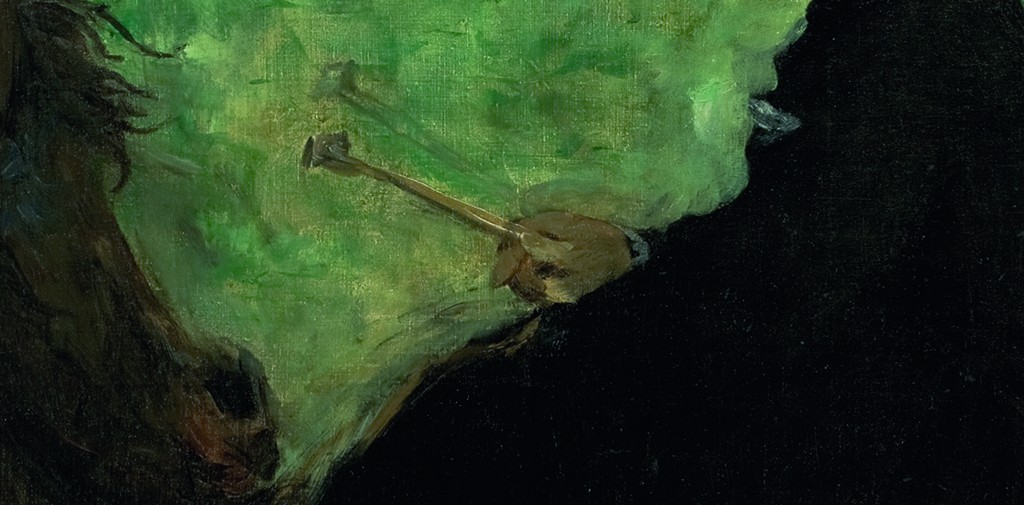
A tan glove occupies the space between the dark sleeve and the horse’s mane. The hand encloses a slender brown riding crop which points diagonally towards the left. A slightly widened end makes it distinct from the thinner lines below, which run towards the horse’s head.
The glove is much warmer than the surrounding greens. Its light upper edge, darker lower area and bent fingers create a small articulated form within the large sweep of black clothing. The crop carries that interruption farther across the picture, bridging the gap between the sitter’s hand and the horse’s ears.
Above the stronger brown diagonal, lighter angled traces suggest another position for the crop. MASP’s commentary identifies revisions here and along the sitter’s back. Such revisions are called pentimenti, meaning changes of mind visible in a painting.[1] The museum’s curatorial team interprets the repeated crop as contributing to the sensation of movement.
The stronger crop remains clear, while the paler traces partly merge with the trees behind.
The Horse Seen from Behind
Two pointed ears rise at the left, separated by the rounded top of the horse’s head. A narrow warm band crosses below them. On the right side of the head, the mane breaks into several dark strands that project against the lighter background.
The neck broadens downwards before meeting the diagonal edge of the woman’s clothing. Warmer brown passages near its far side separate it from the black costume. Their different outlines separate the horse’s head from the rider’s body.
Across the lower part of the canvas, the horse’s back makes a long curved shape. Dark and reddish-brown areas spread beneath the sitter and continue towards the right edge. Its legs fall outside the view. The close framing relates the rider to the animal’s head, neck and back without describing a complete stride.
Trees and a Path beyond the Rider
The surrounding green varies from broad light patches to darker vertical marks. Near the top, short slanting strokes cross one another without describing individual leaves. Farther down, longer pale and brown shapes suggest trunks and the gaps between them. The woodland becomes more open around the figures on the right.
A large upright trunk rises behind the smaller riders. Beside it, narrow light passages lead the eye down towards the ground. The repeated verticals contrast with the foreground horse’s broad curve and the diagonal fall of the woman’s costume.
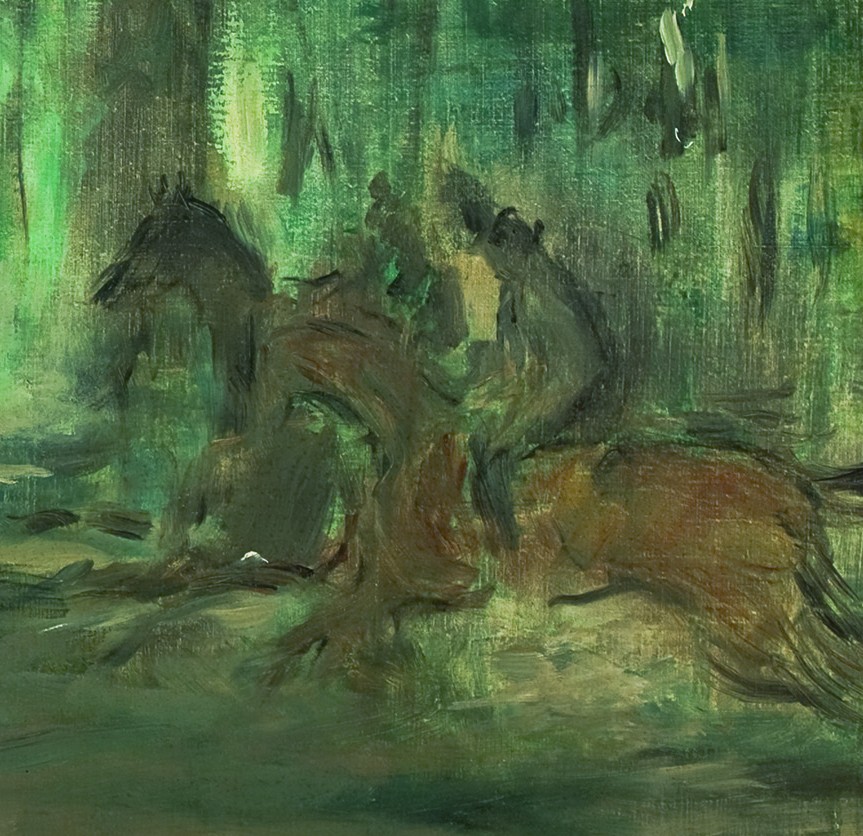
The path provides another contrast. Its warmer, paler surface opens along the left edge, then continues behind the large horse and rider. On the right, broken grey and brown marks spread beneath the smaller horses. The broad foreground forms and scattered distant marks give different degrees of definition to near and far.
The two smaller mounted figures appear to move across this opening. Their bodies consist of a few dark and lighter shapes above the horses’ backs. One horse’s head points towards the left, while another occupies the far right. Their reduced scale establishes distance without offering the same facial detail as Marie’s portrait.
Marie Lefébure and a Related Portrait
Denis Rouart and Daniel Wildenstein catalogued this painting as L’Amazone in 1975, identifying its sitter as Mlle Marie Lefébure and dating it to about 1870.[2] MASP currently dates it to 1870–75.[1]
The museum relates the work to a similarly sized equestrian portrait of the painter Émile Guillaumin.[1] In the French catalogue’s illustration, the male rider wears pale clothes and faces towards the right, with a hat held beside him.[2] The opposing directions and contrasting light and dark costumes make the two mounted portraits useful to compare.
Marie’s turned head gives the present canvas a more direct encounter between sitter and viewer. The nearby horse remains largely turned away, while her visible face interrupts the direction established by the animal.
The Inscription and Collecting History
Dark lettering appears on the horse’s body near the lower right. MASP identifies this inscription as an addition made by Mme Manet after the painter’s death.[1] Its position places it within the large foreground animal rather than on the open path.
Rouart and Wildenstein’s published history traces the painting through Linde in Lübeck, Alfred Cassirer in Berlin and Wildenstein in New York. Their exhibition list includes Berlin in 1928, London and Düsseldorf in 1954, and New York and Toledo in 1957.[2] MASP records its purchase in 1958.[1]
A Later Horsewoman in Madrid
Manet returned to riding dress in the later Horsewoman, Full-Face, also called The Amazon. The Museo Nacional Thyssen-Bornemisza dates that separate oil painting to about 1882.[3]
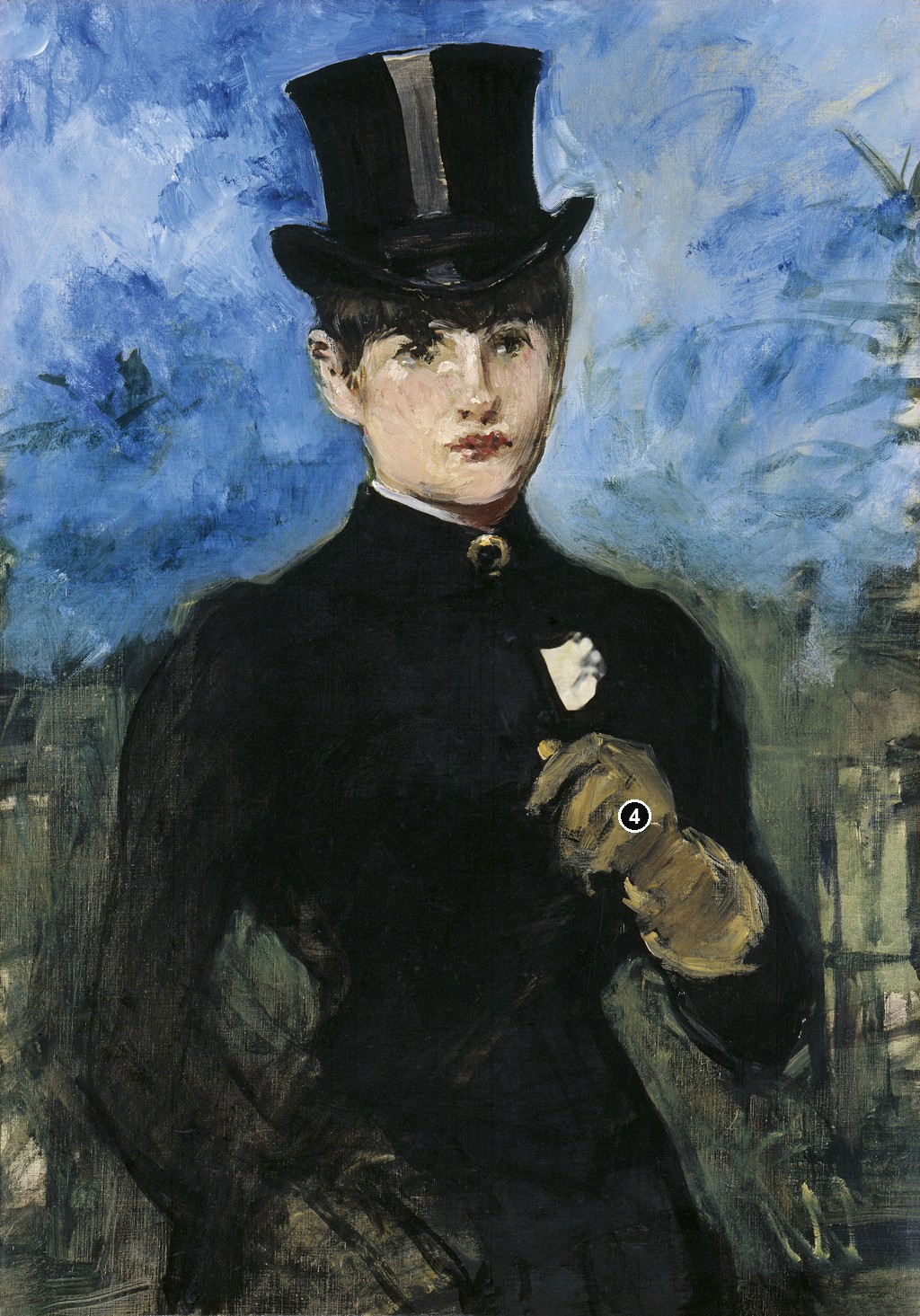
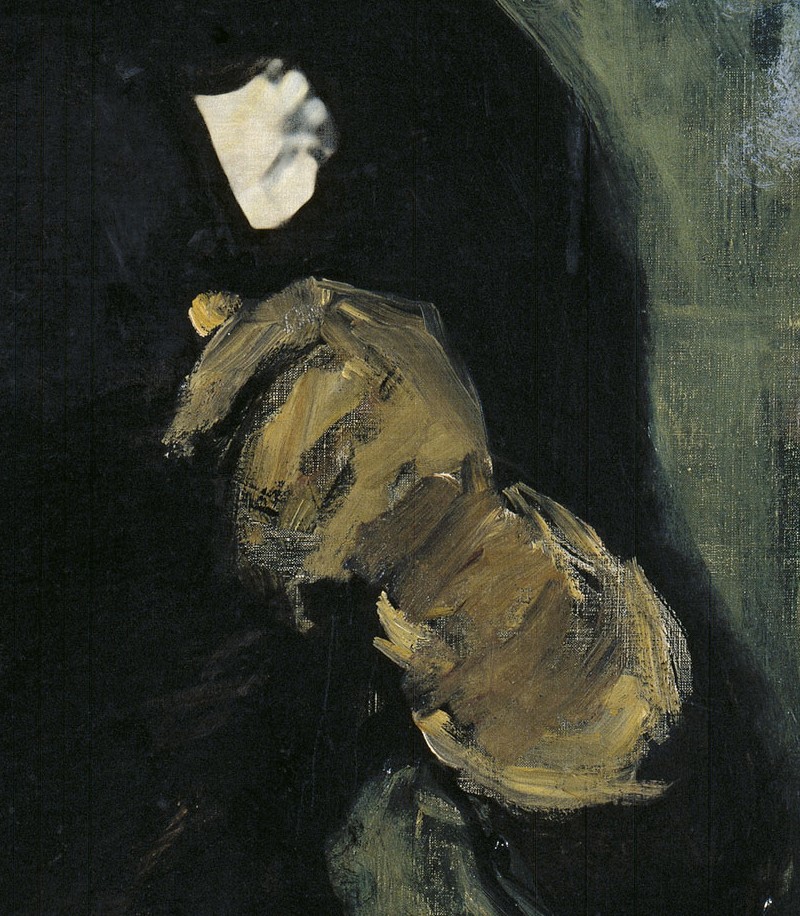
Its upright composition places a woman’s face below an even taller black hat, with a gloved hand raised against the dark bodice. Blue passages surround the figure. No horse appears, and the lower body extends beyond the view. The clothes alone establish the riding theme.
The São Paulo canvas gives the costume a different role. Its long dark shape connects the woman with the animal beneath her, while the path and small riders situate her within an outdoor scene. In Madrid, the closer framing brings the hat, face and glove together. Manet develops the riding subject through a mounted portrait in one case and fashionable clothes in the other.
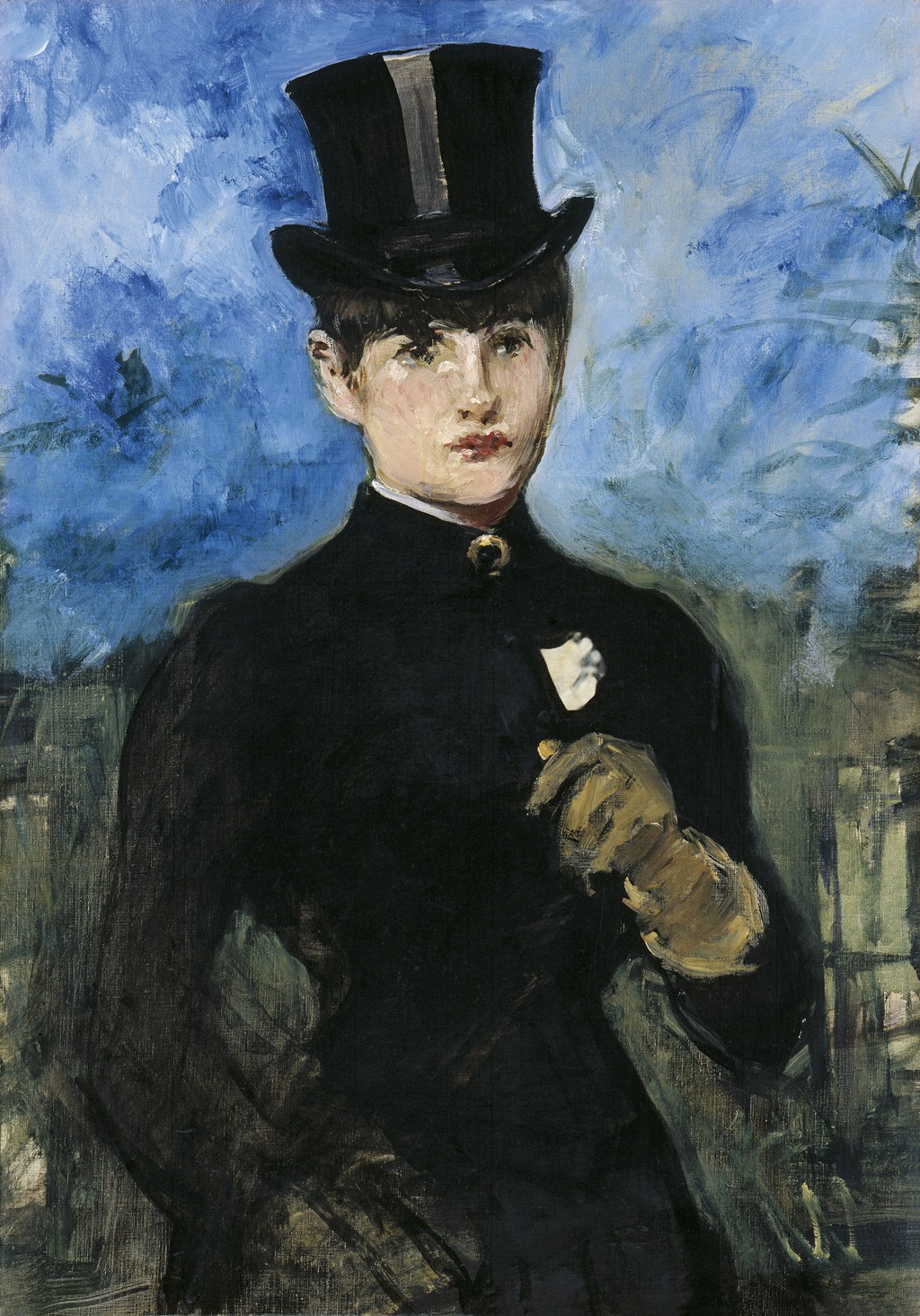
Édouard Manet, Horsewoman, Full-Face (The Amazon), about 1882. Oil on canvas, 73 × 52 cm. Museo Nacional Thyssen-Bornemisza, Madrid, 659 (1980.5). A separate portrait without a horse. Museo Nacional Thyssen-Bornemisza, Madrid; faithful reproduction via Wikimedia Commons. Image source. Public domain. Resized without cropping or enlargement from the supplied reproduction.
Annotated Details from The Horsewoman
The numbered points identify visible features discussed in this article. Return from each detail to the whole composition. Each caption identifies the work shown.
The Horsewoman
Édouard Manet, The Horsewoman — Portrait of Marie Lefébure on Horseback, 1870–75. Oil on canvas, 89.5 × 116 cm. Museu de Arte de São Paulo Assis Chateaubriand, MASP.00076. Purchase, 1958. Édouard Manet / Museu de Arte de São Paulo, via Wikimedia Commons. Image source. Public domain. Numbers added to a separate overview. Three detail crops from the supplied reproduction; no enlargement, recolouring or retouching.
The Amazon
Édouard Manet, Horsewoman, Full-Face (The Amazon), about 1882. Oil on canvas, 73 × 52 cm. Museo Nacional Thyssen-Bornemisza, Madrid, 659 (1980.5). A separate portrait without a horse. Museo Nacional Thyssen-Bornemisza, Madrid; faithful reproduction via Wikimedia Commons. Image source. Public domain. Numbers added to a separate resized whole supplied overview. Detail crops from the unchanged original; no enlargement, retouching or colour alteration.
Details from THE HORSEWOMAN
Follow the numbered details back to the complete images above. Each caption identifies the work shown.
The Horsewoman
The tilted hat and turned face
The tilted black hat rises above reddish-brown hair. A pale face turns back over the shoulder, with a narrow blue collar below.
A glove and two crop positions
The tan glove holds a brown crop pointing left. Lighter angled traces above it are discussed by MASP as a revision.
The distant mounted figures
Two smaller mounted figures occupy the path at the right. Broken brown, grey and green marks distinguish them from the broad dark foreground forms.
The Amazon
The raised glove
Ochre, brown and pale strokes describe the bent fingers and broad cuff. The warm hand stands before the much darker bodice beside a small white shape on the chest.
Artworks directory
Explore selected paintings, drawings and prints by Édouard Manet. Search by title or another recorded name.
Frequently Asked Questions
MASP identifies her as Marie Lefébure in its title, The Amazon — Portrait of Marie Lefébure on Horseback.[1]
Discussion
Look again at the images and ideas explored in The Horsewoman by Édouard Manet. These editorial prompts invite your observations.
Reader Insights
Compare the horse’s turned head with Marie’s face. Which outlines guide your eye back towards the viewer?
Find the tan glove among the dark clothes and green background. How far does the crop extend its diagonal movement?
Compare the large foreground horse with the smaller riders on the right. Where do separate forms become harder to distinguish?
Join the Conversation
Share a detail, comparison or question about The Horsewoman by Édouard Manet below.
References
- Museu de Arte de São Paulo Assis Chateaubriand, A amazona — Retrato de Marie Lefébure, 1870–75, MASP.00076, object facts and commentaries by the MASP curatorial team (2015) and an unnamed author (1998). Portuguese. View source. (in Portuguese).
- Denis Rouart and Daniel Wildenstein, Édouard Manet: Catalogue raisonné, tome I, 1975, nos. 160–161, pp. 146–147, L’Amazone and Portrait de Guillaudin à cheval. Digitised catalogue, Wildenstein Plattner Institute. French. View source.
- Clara Marcellán, Museo Nacional Thyssen-Bornemisza, Amazona de frente, about 1882, 659 (1980.5), object facts and essay. Spanish. View source. (in Spanish).
- Splash image, Édouard Manet, The Horsewoman — Portrait of Marie Lefébure on Horseback, 1870–75. Oil on canvas, 89.5 × 116 cm. Museu de Arte de São Paulo Assis Chateaubriand, MASP.00076. Purchase, 1958. Édouard Manet / Museu de Arte de São Paulo, via Wikimedia Commons. Image source. Public domain. Resized without cropping or enlargement from the supplied reproduction.


