



 by Tom Gurney
Tom Gurney BSc (Hons) is an art history expert with over 20 years experience
Published on June 19, 2020 / Updated on October 30, 2026
Email: tomgurney1@gmail.com / Phone: +44 7429 011000
The Absinthe Drinker by Édouard Manet: Introduction
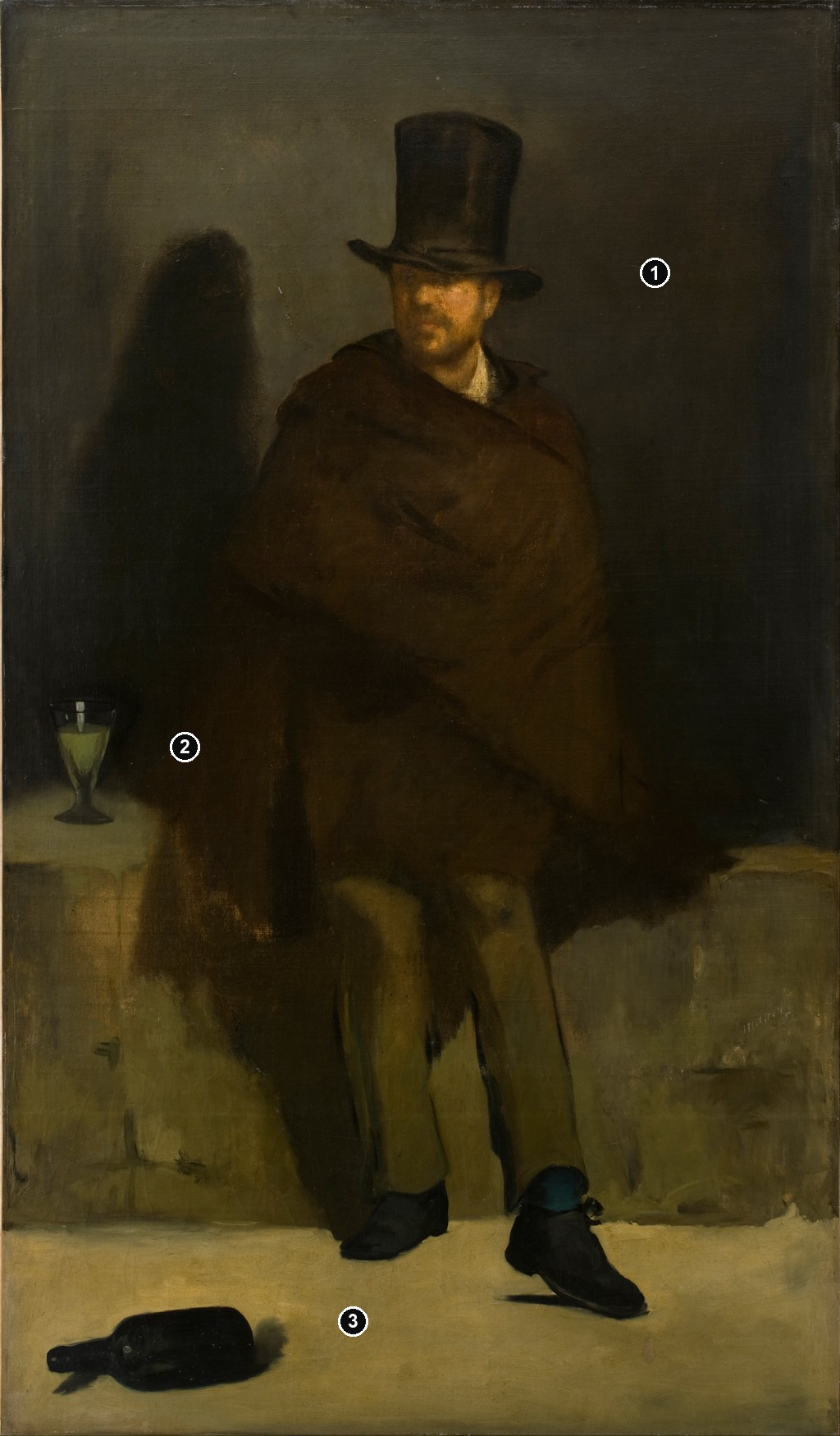
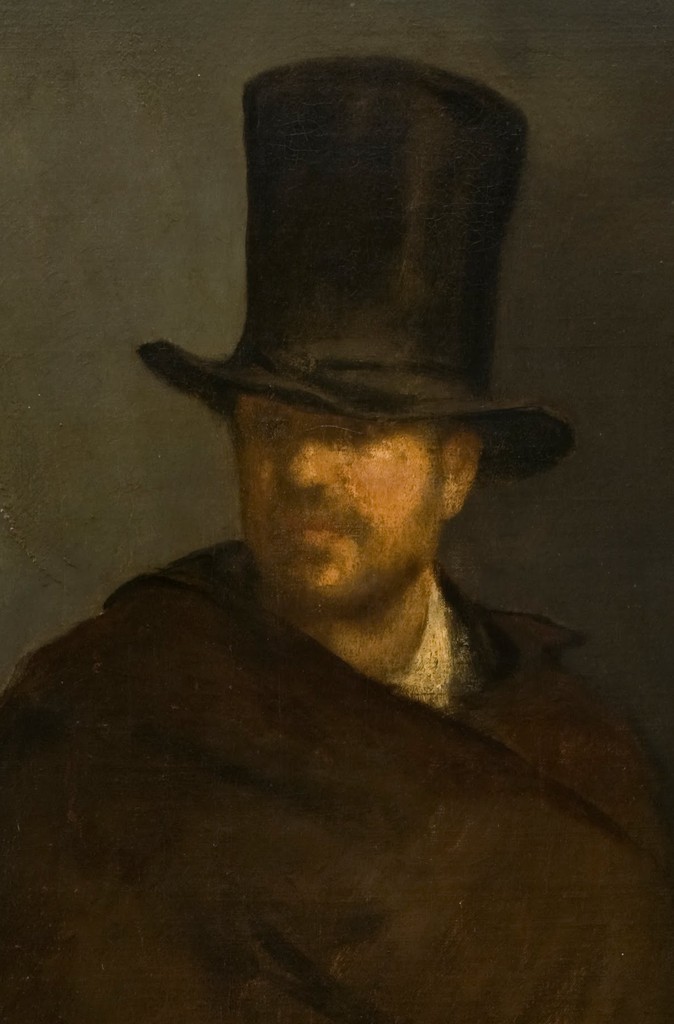
A tall hat gives the man an imposing outline, but its brim shades his eyes. His brown cloak gathers his body into a broad, dark mass. Below it, two legs emerge at different angles, with one black shoe turned out across the pale ground. A bottle lies nearby, separated from the stemmed glass on the ledge behind him.
Édouard Manet began The Absinthe Drinker, or Le Buveur d’absinthe, in 1858–59 and submitted it to the Salon of 1859. It was refused.[1][2] The picture became a significant early statement of his ambition: a contemporary figure given the scale and concentration of a major portrait. Manet continued to alter it, so the painting now in Copenhagen contains decisions made well after that first submission.
At a Glance
- ArtistÉdouard Manet
- French titleLe Buveur d’absinthe
- Date1858–59, subsequently reworked around 1868–72[1]
- MediumOil on canvas
- Dimensions180.5 × 105.6 cm
- CollectionNy Carlsberg Glyptotek, Copenhagen
- Object numberM.IN 1778
- In the museum’s collectionSince 1917[3]
- First Salon submissionRefused in 1859[2]
This work across Édouard Manet’s career
Contents
- A Figure Balanced against the Wall
- The Hat, Cloak and Hidden Hands
- Colardet and the Role of the Drinker
- A Bottle on the Ground, a Glass on the Ledge
- A Painting Changed over Time
- The Salon of 1859 and Later Judgements
- Baudelaire and the Beggar-Philosophers
- The Related Watercolour
- A Figure Manet Returned To
- Annotated details
A Figure Balanced against the Wall
The man occupies almost the whole height of the canvas. His hat rises into the dark upper area, while his shoes approach the lower edge. The setting gives him little company: a wall, a low ledge and enough ground to establish the position of his feet. The restricted surroundings make small adjustments of posture unusually important.
His upper body seems to rest against the ledge, yet his legs do not settle into an entirely comfortable arrangement. One descends more directly, while the other moves forward and outwards. The long cloak conceals the points at which the legs join the body. We have to imagine the stance through a combination of visible shoes, trouser legs and the weight of the cloth above them.
This slight uncertainty keeps the pose alive. The head and hat suggest an upright figure, but the lower body introduces a looser, less ceremonious rhythm. The man can appear to be pausing, leaning or partly sitting. The image offers enough support for each impression without fixing the instant into a clearly described action.
His face turns towards our left. Light catches parts of the cheek, nose and mouth, while the brim holds the upper face in shadow. The difference gives the head both presence and reserve. We can recognise a particular person, but the eyes provide little direct contact with the viewer.
A larger shadow rises on the wall to his left. Its broad shape repeats the figure’s upright form without reproducing every detail. It makes the body feel close to a surface and supplies a second dark presence beside it. The man remains alone, accompanied by an enlarged, less definite version of his own outline.
The ledge runs behind him and returns into view on either side. Its pale stone helps separate the dark cloak from the ground. It also gives the glass a place to stand. A modest architectural feature therefore supports both the body and one of the objects through which the subject becomes legible.
The Hat, Cloak and Hidden Hands
The hat commands attention before the face becomes distinct. Its tall crown increases the figure’s height, while the projecting brim introduces a firm horizontal line near the top. Against the muted background, the shape is easier to read than the eyes beneath it. An item of clothing takes on some of the work normally performed by an expressive face.
The cloak has a different kind of authority. It spreads across the shoulders, wraps the torso and drops unevenly towards the knees. Broad brown passages establish its weight. Changes within the brown suggest folds, but the garment retains a strong overall shape even where individual creases are difficult to follow.
The hands disappear into this enveloping mass. Their concealment removes a familiar source of explanation. A hand lifting a glass, gripping a bottle or reaching towards a pocket would give the figure a specific task. Here, the pose remains largely self-contained. The head turns, the legs shift and the cloth hangs; there is no clear exchange with another person.
Light and dark divide the picture into a few large areas. The face and trousers draw attention out of the cloak, while the black shoes become distinct against the pale foreground. A small glimpse of blue above one shoe adds a sharper colour note. These changes bring the eye down through the body without making every part equally clear.
The clothes can suggest a degree of ceremony. The top hat and enveloping cloak give the man a substantial silhouette, although the pose and uneven garment complicate its dignity. Appearance becomes something to examine closely. The image allows impressive bearing and material vulnerability to occupy the same body.
Colardet and the Role of the Drinker
The model is usually identified as a ragpicker named Colardet, whom Manet encountered in or around the Louvre. Theodore Reff discusses that identification in relation to the painter’s interest in contemporary street figures.[4] Knowing the model’s reported occupation changes the social associations of the large portrait, but it does not explain every feature of the represented person.
No bundle of collected material appears beside him. His occupation is supplied by the history attached to the picture; the glass and bottle give more immediate clues to the role named in its title. Manet brings a particular model into an arrangement whose meaning depends on clothing, posture, scale and a few carefully placed objects.
The distinction leaves room for an individual presence. A ragpicker could be known through the materials he collected, the neighbourhood he worked in or the encounters of a particular day. The painting concentrates instead on the body at rest. Its narrow setting gives us little access to the wider circumstances of his life.
The title directs us towards drinking, but the man is not shown taking a drink. His hidden hands and shaded eyes leave his immediate condition uncertain. The looseness of the stance may encourage an impression of intoxication; it cannot by itself establish the model’s health, habits or feelings.
That tension is part of the picture’s interest. We recognise a social role quickly, then find that the person’s visible behaviour provides less of a story than expected. The face, the shifting feet and the quiet weight of the cloak continue to attract attention after the identifying objects have been noticed.
A Bottle on the Ground, a Glass on the Ledge
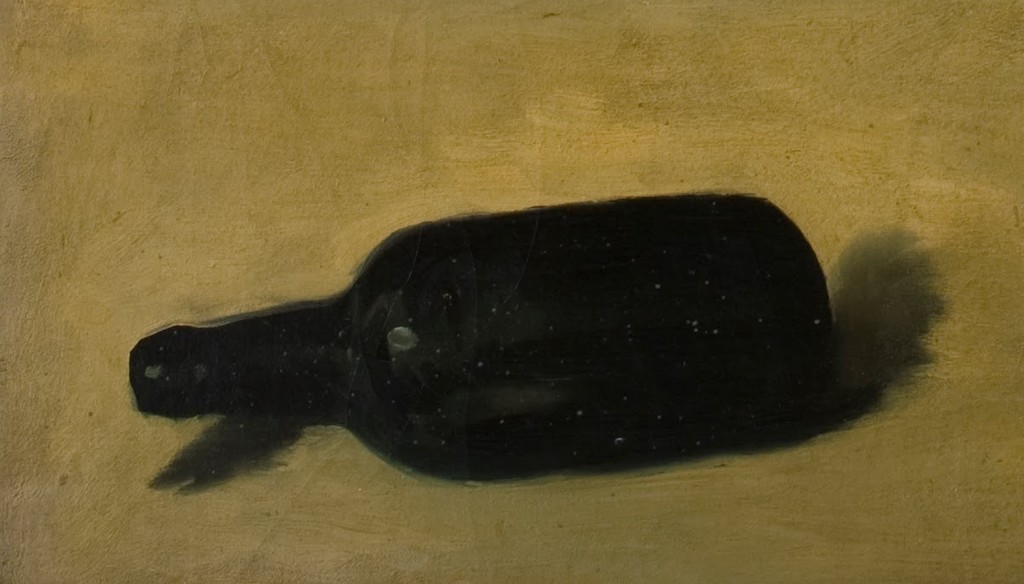
The bottle lies in the lower left foreground, its neck pointing towards the edge. It is dark, compact and almost horizontal. The man’s legs rise behind it, so the small object helps establish a difference between the ground near us and the figure farther back.
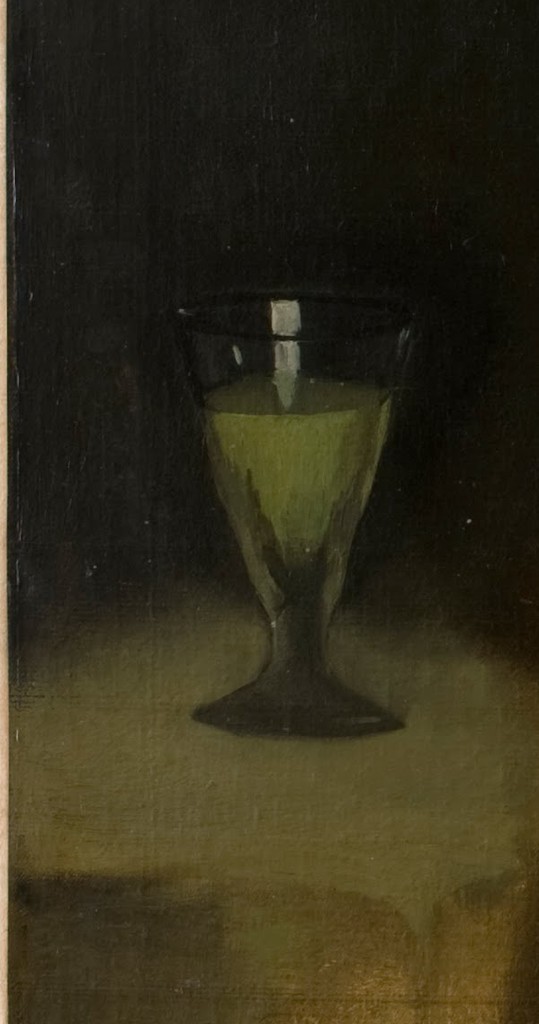
The glass occupies a higher position at the left, resting on the ledge. Its stem and bowl give it a more delicate outline than the bottle. Pale green liquid catches attention within the surrounding brown and grey. Where the bottle appears weighty and discarded, the glass stands upright and available.
Together, the objects make an uneven pair. Their separation leads the eye between two heights and two kinds of support. The glass rests on a constructed surface; the bottle has reached the ground. Between them, the body rises as the principal dark shape in the composition.
The contrast also complicates the picture’s stillness. A horizontal bottle invites a possible account of how it came to lie there, while the glass suggests a drink that could be resumed. Neither event occurs before us. The painting keeps their relationship open, offering the results or possibilities of actions rather than illustrating them.
The small glass is particularly consequential because its colour is so different from the cloak’s subdued mass. It can pull attention away from the person whose presence dominates the canvas. The eye moves from face to glass, down towards the bottle and back to the shoes. A few objects organise a surprisingly sustained circuit of looking.
A Painting Changed over Time
The familiar image does not preserve every feature of its first presentation. Manet altered its format and repainted it over the following years. When it appeared in his independent exhibition of 1867, the lower part was out of view and the glass had not yet been added. The canvas subsequently returned to a full-length presentation, with the glass appearing before its sale in 1872.[1]
The Ny Carlsberg Foundation records an increase to the lower canvas during 1867–72, together with work around the upper and side areas.[3] The history of the picture therefore asks us to think about the extent of the surface as well as the objects painted upon it. Its present proportions belong to that continuing process.
The glass’s absence in 1867 prompted a joke by the caricaturist Randon. As reported by Juliet Wilson-Bareau, he questioned how viewers could know the man preferred absinthe and suggested supplying him with a glass.[1] The joke identifies a practical problem of representation: a title names a particular drink, but a cloaked man alone cannot make its identity certain.
The later glass gives the subject an additional point of recognition. Its green colour and conspicuous position help the title attach itself to an object within the scene. It also changes the balance of the composition, setting a small luminous form against the much larger dark figure.
Those pictorial effects can be observed without assuming the joke caused the change. The sequence shows that Manet reconsidered how the drinker should appear, how much of his body should be visible and what should accompany him. The work remained available for revision as his career developed.
The Salon of 1859 and Later Judgements
The Salon refusal gave the painting an important place in accounts of Manet’s beginnings. Duret’s 1906 history identifies it as the work with which he first sought admission in 1859. Duret then contrasts that refusal with the acceptance of The Spanish Singer and the portrait of Manet’s parents in 1861.[2]
That sequence records a changing reception. The painter continued to seek recognition through the Salon, and his next submission brought a different result. It is difficult to turn the first refusal into a complete explanation of what every juror thought, especially when the submitted picture was subsequently altered.
Early supporters did not all regard the painting as an entirely successful declaration of independence. In his 1867 essay, Zola thought the subject retained something melodramatic and found Manet still searching for the broad, direct manner he would later achieve. His praise of the artist allowed room for dissatisfaction with this particular work.[5]
Duret also saw traces of Couture’s influence. He described the sombre figure through the moral language of drink’s destructive effects, while treating the painting as a stage in the emergence of Manet’s individual art.[2] That description tells us about Duret’s interpretation; it does not establish the condition of the person who posed.
These judgements make the work’s early position more interesting. Its importance has never depended on universal agreement about its achievement. The same dark cloak and uncertain stance can be approached as remnants of an earlier manner, as forceful devices in their own right, or as parts of a painting that Manet continued to reconsider.
Baudelaire and the Beggar-Philosophers
Reff connects the figure with Baudelaire’s poem Le Vin des chiffonniers, often translated as Ragpickers’ Wine. He presents the poem as a literary parallel and possible source for Manet’s treatment of a socially marginal person.[4] The connection offers a way to think about the meeting of ordinary urban life and imaginative transformation.
The picture gives its model the kind of sustained attention a viewer might expect from a portrait of someone with public authority. Height, isolation and the large cloak help make his presence substantial. The reported occupation and the drinking objects bring different social associations into that commanding format.
Spanish painting supplied an important precedent. Wilson-Bareau relates Manet’s figure to Velázquez’s representations of the ancient philosophers Aesop and Menippus.[1] In those pictures, plain clothing and a restricted setting coexist with the intellectual identities supplied by their titles. Status is carried by the relationship between image and name as much as by outward splendour.
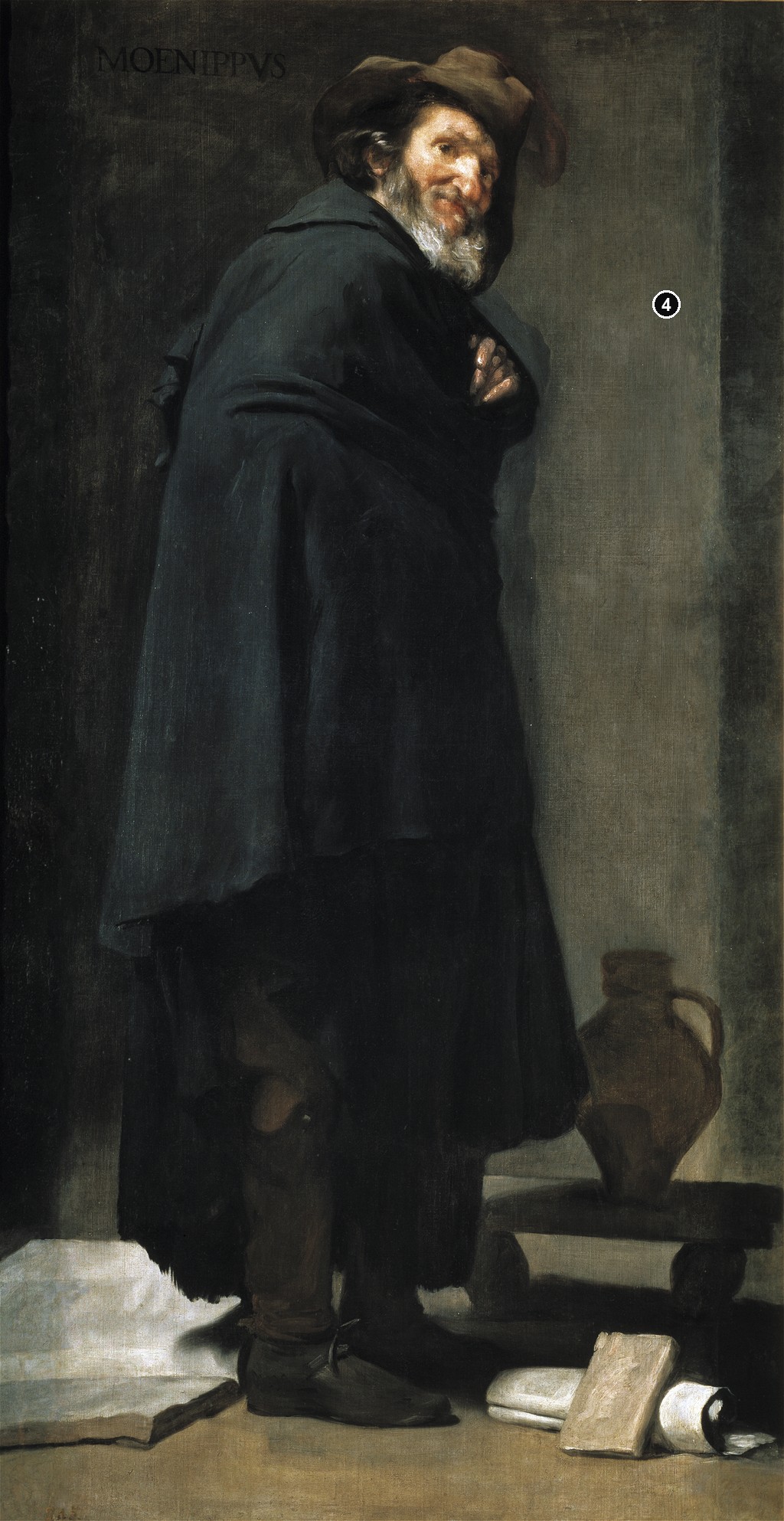
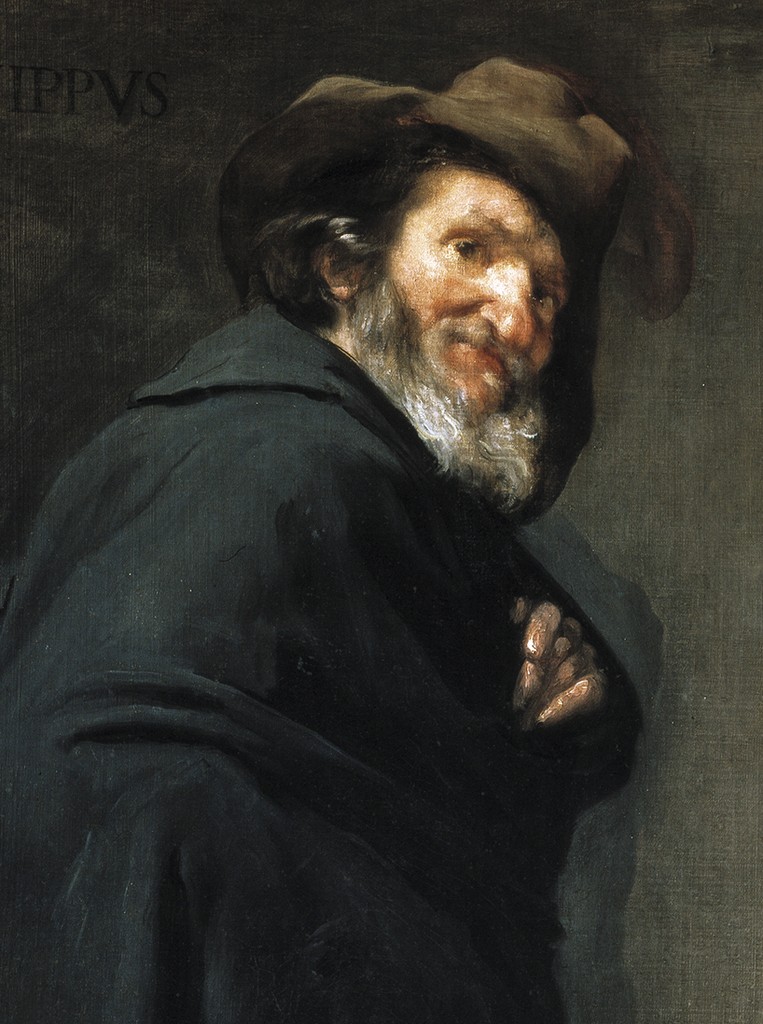
Velázquez’s Menippus offers a particularly suggestive comparison. The philosopher turns his head beneath a hat and gathers a dark cloak around his body. Books and a jug occupy the ground near his feet. Large areas of clothing establish his presence, while a few separate objects extend the implications of the figure.
Manet gives those relationships a contemporary form. His top hat has a more emphatic vertical shape, his cloak encloses the hands, and his objects direct attention towards drinking. The comparison helps show how a borrowed dignity could be redistributed among people encountered in modern Paris.
Reff notes that Manet later grouped The Absinthe Drinker with other figures under the description of four philosophers.[4] That association enlarges the role available to the man in the cloak. He can belong to an artistic tradition of thoughtful outsiders while remaining attached to the particular world suggested by his clothes and title.
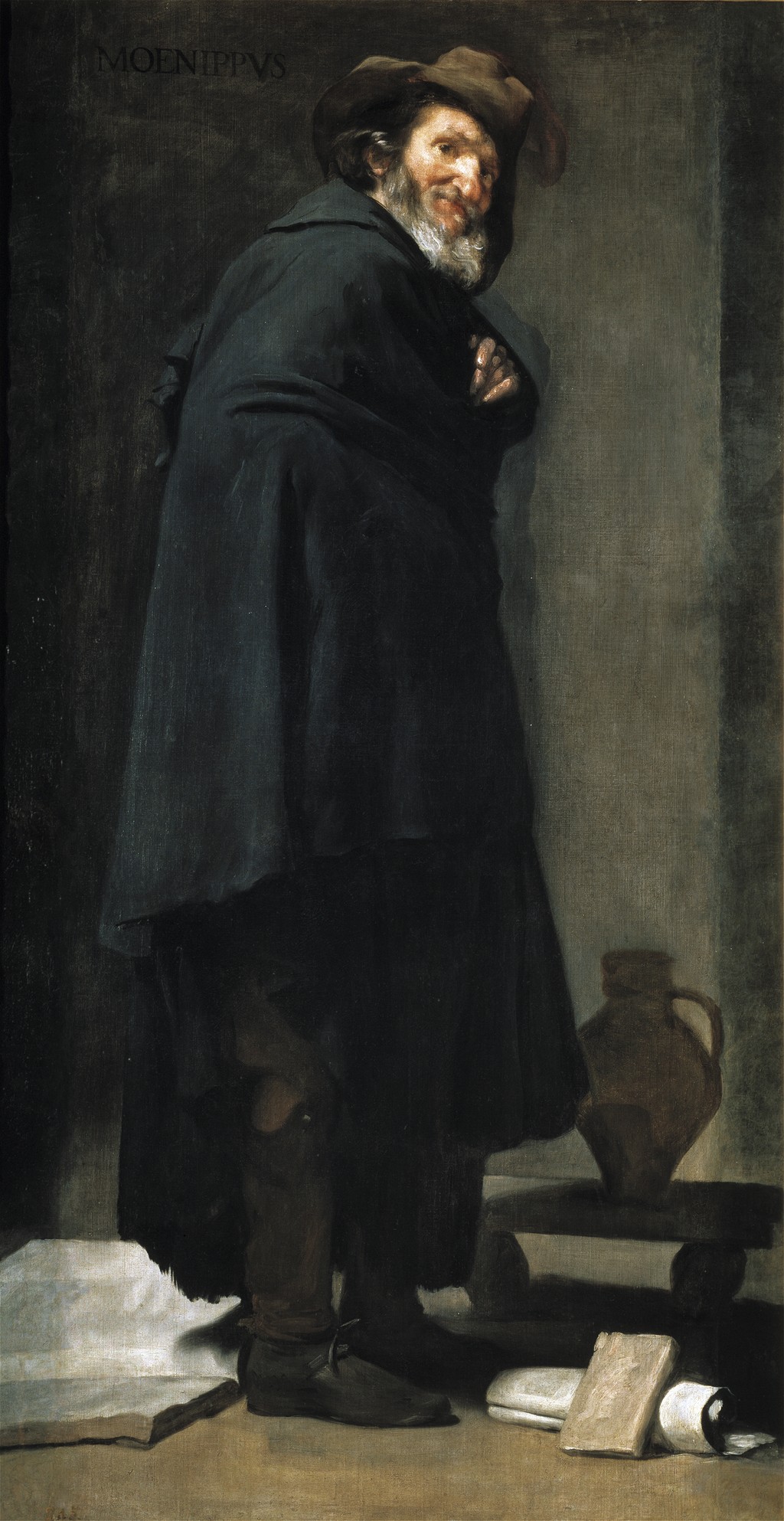
Diego Velázquez, Menippus, about 1638. Museo Nacional del Prado, Madrid, P001207. Museo Nacional del Prado, Madrid; faithful reproduction via The Yorck Project/Wikimedia Commons. Image source. Public domain. Whole supplied faithful public-domain reproduction resized within native dimensions. No enlargement, retouching or colour alteration.
The Related Watercolour
The National Gallery of Art holds The Man in the Tall Hat, dated 1858/1859, a watercolour and graphite work on a sheet measuring 35.7 × 25.7 cm.[6] It offers a lighter, more abbreviated encounter with the familiar arrangement.
The figure occupies a relatively small area within the paper. A brown wash establishes the cloak, grey passages indicate the hat and shadow, and sparse darker marks articulate the trousers and shoes. The face remains especially open, described through a few areas of tone surrounded by lighter paper.
The ledge is indicated economically. Parts of its edge appear as short horizontal marks; broader washes suggest the stone beneath. Against these lightly described surroundings, the hat remains an exceptionally clear sign. Its height makes the figure recognisable even where the body is only broadly established.
Comparing the sheet with the oil brings the cloak’s role into focus. In watercolour, its broad shape is transparent and relatively light; in the painting, the garment holds the figure within a much denser field of darkness. Similar shapes generate different experiences because the surfaces and surrounding tones differ.
The watercolour also makes looking feel less continuous. Marks stop, paper remains visible and some edges are barely indicated. The viewer completes the body across these intervals. The oil gives more substantial forms, yet it too depends on concealment and interruption, especially where the cloak hides the hands and upper legs.
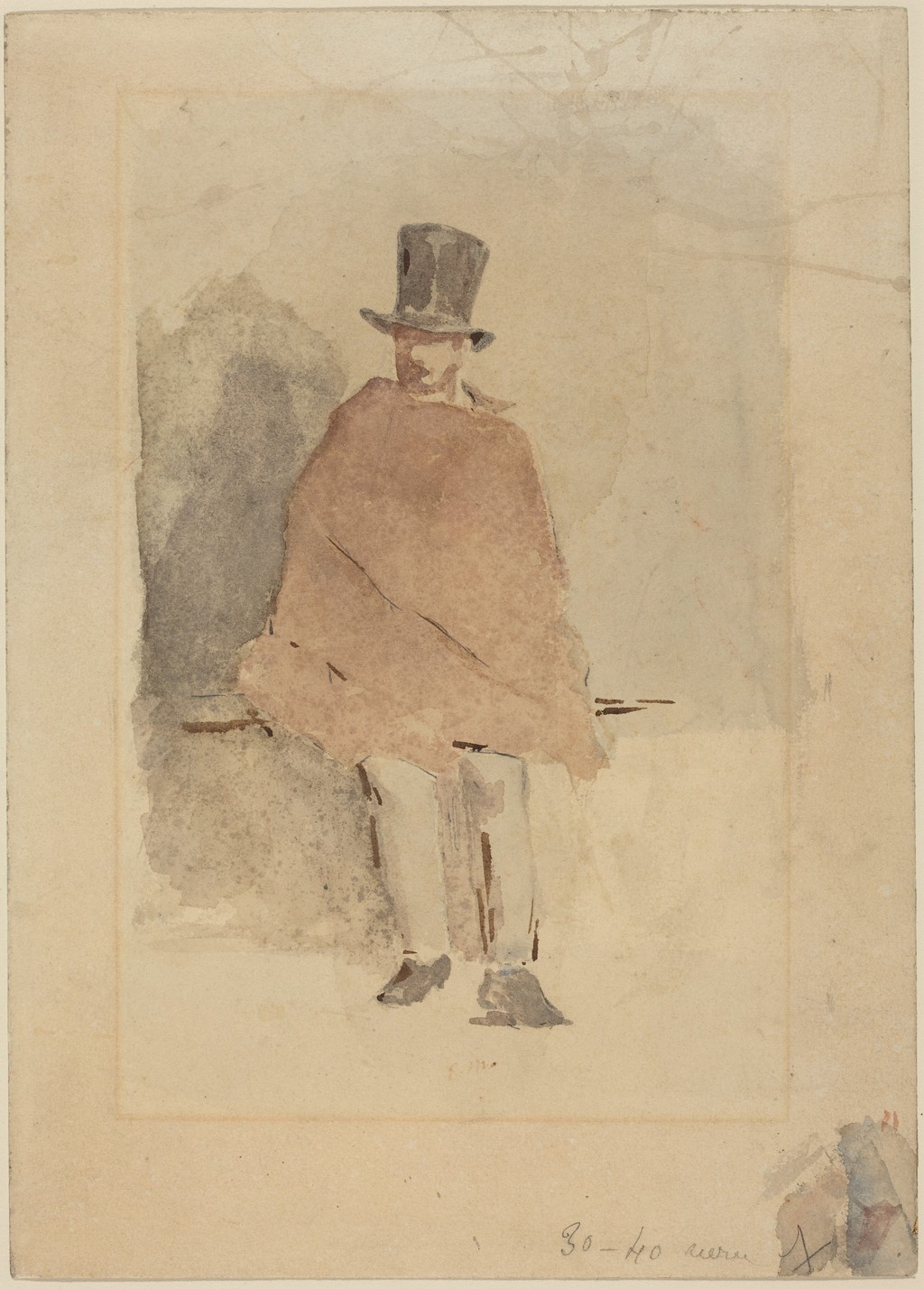
Édouard Manet, The Man in the Tall Hat, 1858/1859. Watercolour and graphite. National Gallery of Art, Washington, 1943.3.5753. National Gallery of Art, Washington, Rosenwald Collection. Image source. CC0 / Public domain. Whole supplied sheet resized within native dimensions, retaining paper margins and the separate colour mark. No whitening, reconstruction, enlargement or retouching.
A Figure Manet Returned To
Manet explored the subject in print as well. The National Gallery of Art catalogues an etching with aquatint of The Absinthe Drinker as 1862.[7] Returning to the figure in another medium shows how readily its hat, cloak and pose could become the basis of further work.
The cloaked man also reappears in The Old Musician, painted in 1862 and now in the National Gallery of Art.[4][8] There he stands towards the right of a larger gathering. The solitary figure has entered a scene with other bodies, different ages and a seated musician at its centre.
That change gives his posture another function. Beside the lower, seated figure, the tall hat helps establish a high point within the group. The cloak joins a broader rhythm of clothing, and the head becomes one among several faces turned in different directions. A pose developed for a single person can help organise a more complicated assembly.
The Ny Carlsberg Foundation bought the painting in 1914 and gave it to the Glyptotek in 1917.[1] The repeatedly revised figure had found a public home, where its different stages could be considered together.
The image itself keeps a less settled balance. The hat rises firmly, the cloak conceals, the feet move apart, and the glass draws attention from the shaded face. Following these differences makes the drinker’s presence more specific, even as the painting leaves his immediate thoughts and circumstances beyond our reach.
Annotated Details from The Absinthe Drinker
The numbered points identify visible features discussed in this article. Return from each detail to the whole composition. Each caption identifies the work shown.
The Absinthe Drinker
Édouard Manet, The Absinthe Drinker, 1858–59. Ny Carlsberg Glyptotek, Copenhagen, MIN 1778. Ny Carlsberg Glyptotek / Google Art Project, faithful reproduction via Wikimedia Commons. Image source. Public domain. Numbers added to a separate resized whole supplied overview. Detail crops from the unchanged original; no enlargement, retouching or colour alteration.
Menippus — Velázquez
Diego Velázquez, Menippus, about 1638. Museo Nacional del Prado, Madrid, P001207. Museo Nacional del Prado, Madrid; faithful reproduction via The Yorck Project/Wikimedia Commons. Image source. Public domain. Numbers added to a separate resized whole supplied overview. Detail crops from the unchanged original; no enlargement, retouching or colour alteration.
Details from THE ABSINTHE DRINKER
Look from the tall hat and shaded face to the glass and foreground bottle, then compare the turned head and emerging hand in Velázquez’s Menippus.
The Absinthe Drinker
The Tall Hat and Shaded Face
The high black hat shades the eyes above the lit cheek and dark beard. The brown cloak closes beneath the pale collar.
The Stemmed Glass on the Ledge
A small pale-green glass stands at the far left of the stone ledge, apart from the wrapped figure.
The Bottle across the Foreground
The dark bottle lies across the pale ground, its neck pointing towards the left edge.
Menippus — Velázquez
Turned Head and Hand in the Cloak
The bearded face looks outward beneath a brown hat while one hand emerges from the dark clothing.
Artworks directory
Explore selected paintings, drawings and prints by Édouard Manet. Search by title or another recorded name.
Frequently Asked Questions
He is usually identified as a ragpicker named Colardet, encountered by Manet in or around the Louvre.[4]
It was refused in 1859, when Manet first submitted a painting to the Salon.[2]
It was absent when the picture appeared in Manet’s 1867 exhibition and was added during the subsequent reworking before the 1872 sale.[1]
It belongs to the Ny Carlsberg Glyptotek in Copenhagen, inventory M.IN 1778.[3]
Discussion
Look again at the images and ideas explored in The Absinthe Drinker by Édouard Manet. These editorial prompts invite your observations.
Reader Insights
Begin with the hat and shaded face, then follow the cloak down to the two shoes.
Compare the man’s large shadow with his solid outline.
Finally, move between the upright glass and the bottle lying on the ground, noticing how these small objects change the balance of the whole figure.
Join the Conversation
Share a detail, comparison or question about The Absinthe Drinker by Édouard Manet below.
References
- Juliet Wilson-Bareau. “Manet and Spain,” especially pp.209–213, and catalogue no.128, p.483, in Gary Tinterow and Geneviève Lacambre, eds., Manet/Velázquez: The French Taste for Spanish Painting. Metropolitan Museum of Art, 2003. View source.
- Théodore Duret. Histoire d’Édouard Manet et de son œuvre. 1906, pp.24–29. Retrospective discussion of the early work and Salon submissions. View source. (in French).
- Ny Carlsberg Foundation. “Absinthdrikkeren.” Danish collection record: dimensions, medium, later work on the canvas and placement at the Ny Carlsberg Glyptotek. View source.
- Theodore Reff. Manet and Modern Paris. National Gallery of Art, 1982, especially pp.19–20 and entries63–64, pp.182–184. Model, literary and pictorial associations, and the figure’s return in other works. View source.
- Émile Zola. Édouard Manet: étude biographique et critique. 1867. Critical paragraph on Le Buveur d’absinthe and transition to The Spanish Singer and Boy with a Sword. View source. (in French).
- National Gallery of Art, Washington. “The Man in the Tall Hat,” 1858/1859, 1943.3.5753. Current object record: watercolour and graphite, overall sheet dimensions and collection. View source.
- National Gallery of Art, Washington. “The Absinthe Drinker (Le buveur d’absinthe),” 1862, 2009.19.1. Etching with aquatint on laid paper. View source.
- National Gallery of Art, Washington. “The Old Musician,” 1862, 1963.10.162. Collection record and commentary. View source.
- Splash image, Édouard Manet, The Absinthe Drinker, 1858–59. Ny Carlsberg Glyptotek, Copenhagen, MIN 1778. Ny Carlsberg Glyptotek / Google Art Project, faithful reproduction via Wikimedia Commons. Image source. Public domain. Whole supplied faithful public-domain reproduction resized within native dimensions. No enlargement, retouching or colour alteration.


