



 by Tom Gurney
Tom Gurney BSc (Hons) is an art history expert with over 20 years experience
Published on June 19, 2020 / Updated on October 30, 2026
Email: tomgurney1@gmail.com / Phone: +44 7429 011000
Head of Jean-Baptiste Faure by Édouard Manet: Introduction
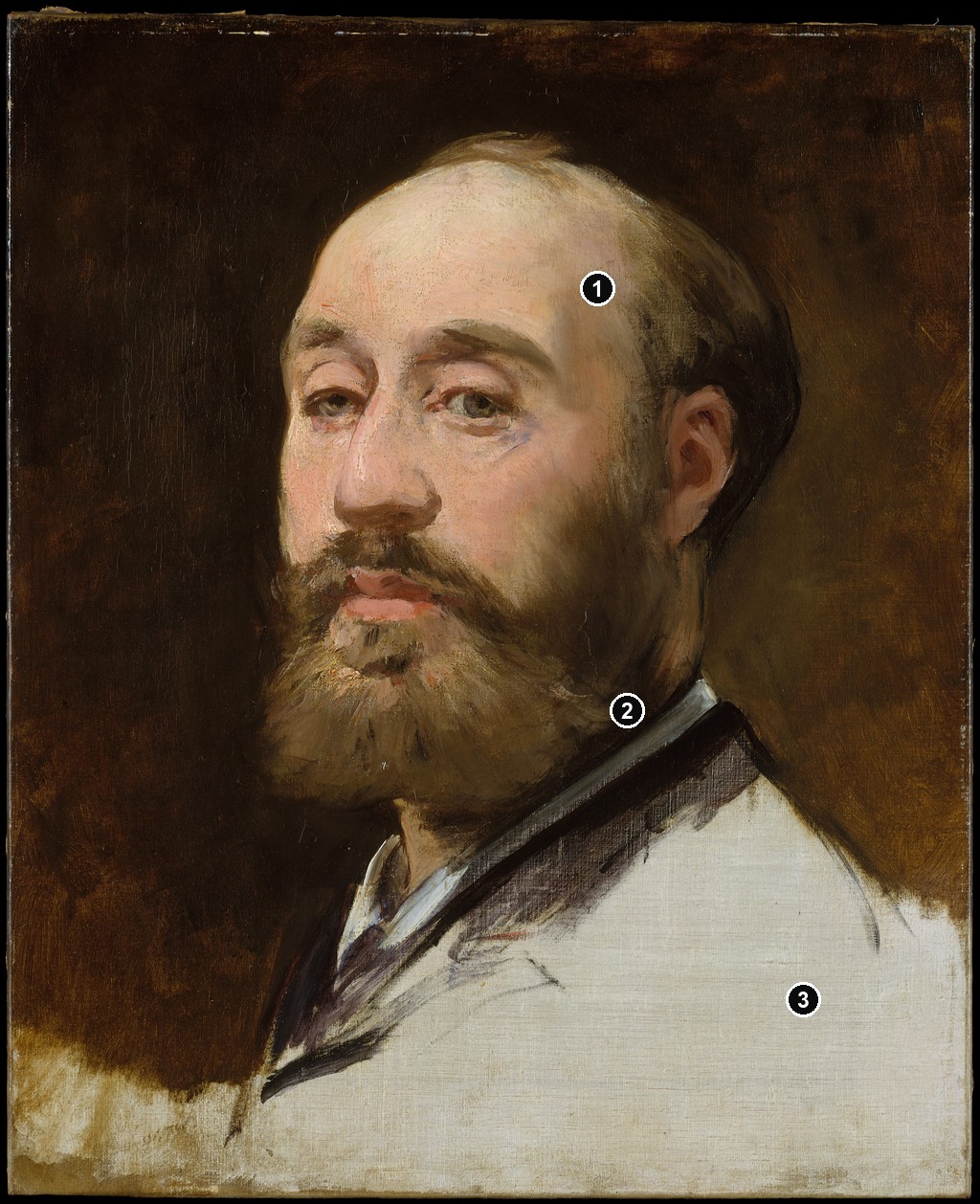
A high, pale forehead rises above open eyes and a spreading brown-grey beard. Below the carefully described face, the clothing gives way to a broad light area crossed by a few dark outlines. Édouard Manet painted this study of the baritone Jean-Baptiste Faure in the winter of 1882–83. It belongs to a group of three studies for a portrait left unfinished at his death.[1]
At a Glance
- ArtistÉdouard Manet
- TitleHead of Jean-Baptiste Faure; Tête de Jean-Baptiste Faure
- Date1882–83.[1]
- MediumOil on canvas
- Dimensions46 × 37.8 cm.[1]
- CollectionThe Metropolitan Museum of Art, New York, 59.129
- CreditGift of Mrs. Ralph J. Hines, 1959.[1]
This work across Édouard Manet’s career
Contents
- The Turn of the Head
- Open Eyes and Heavy Lids
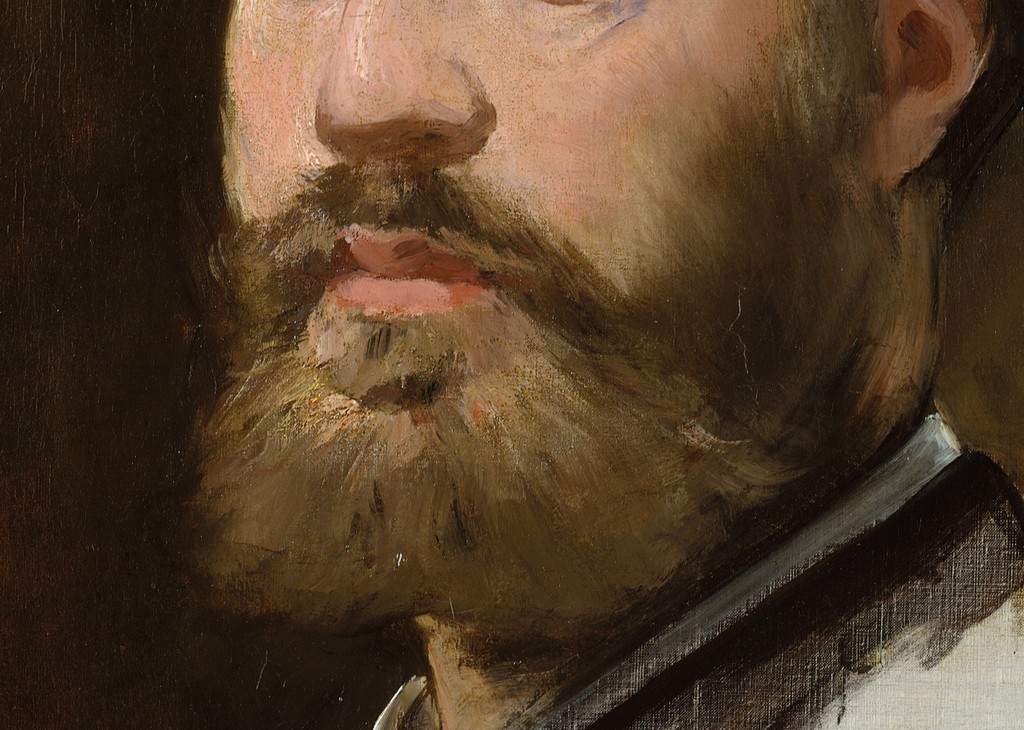
- Moustache and Beard
- Ear and Pale Collar
- A Lightly Painted Shoulder
- The Brown Background
- Faure and the Unfinished Portrait
- Another Study at the Met
- A Separately Collected Study
- Annotated details
The Turn of the Head
Faure turns towards the left of the picture, presenting most of his face while leaving the ear on the right visible. The bridge of the nose lies to the left of the head’s centre. The forehead, cheek and beard spread further across the opposite side.
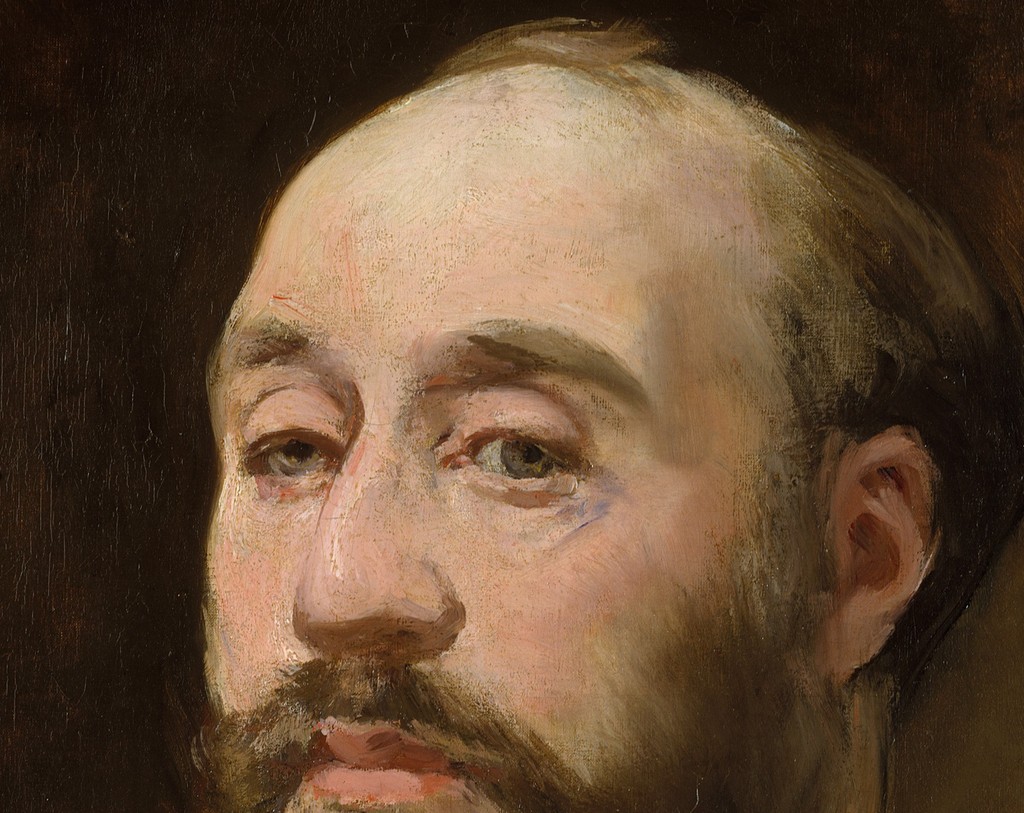
The high forehead forms the largest continuous light area. Pink and cream passages follow its rounded surface, becoming greyer near the hair on the right. A thin sweep of brown-grey hair crosses the top before joining the darker mass behind the ear. Its sparse edge leaves the head’s curve visible.
The turning head and sloping shoulder lead in different directions. The face draws attention leftwards, while the shoulder extends down and out towards the right. The visible ear marks the turn from the broad face to the side of the head.
Open Eyes and Heavy Lids
Dark brows arch above two open eyes. The eye nearer the image’s right has a broad pale lower rim, while the other sits closer to the edge of the face. Small dark centres remain distinct within the warmer, lighter passages around them.
Pink areas above the lids separate the eyes from the brows. Beneath them, short grey and blue marks interrupt the warmer cheeks. Under the eye on the right, an angled blue mark points out towards the side of the face.
The nose provides a longer, simpler form between the eyes and mouth. Light runs down its bridge, then meets a broad brown shadow underneath. This dark underside gives the nose a firm lower boundary before the moustache begins.
Moustache and Beard
The moustache spreads sideways from beneath the nose. On the left it projects beyond the cheek’s pale edge; on the right it curves down and out towards the beard. Its two sides therefore make a wider shape than the small pink mouth enclosed between them.
The upper lip is partly shaded, while the lower lip presents a broader warm band. Dark marks at the corners join the mouth to the surrounding hair. Just below, a small light patch breaks the beard before its larger brown-grey mass descends towards the collar.
Across the beard, lighter strokes separate several locks from the darker areas around them. Some fall downwards; others curve towards the right, following the jaw. Its lower edge spreads into an irregular line, with small changes of direction that contrast with the smooth curve of the forehead above.
The beard also conceals much of the neck. A narrow warm passage remains visible underneath it, leading down to the opening of the collar. These grouped features make this area more intricate than the forehead or cheek.
Ear and Pale Collar
The ear on the right is a compact arrangement of pink, red and brown shapes. Its lighter outer rim stands beside the deep brown hair behind it. A reddish hollow lies near the top, while the lower part joins the warmer side of the neck.
Behind the ear, the hair forms a rounded dark boundary against the background. The distinction becomes less obvious lower down, where brown passages around the jaw approach the colour of the surrounding field. The pale collar restores a clearer separation beneath the head.
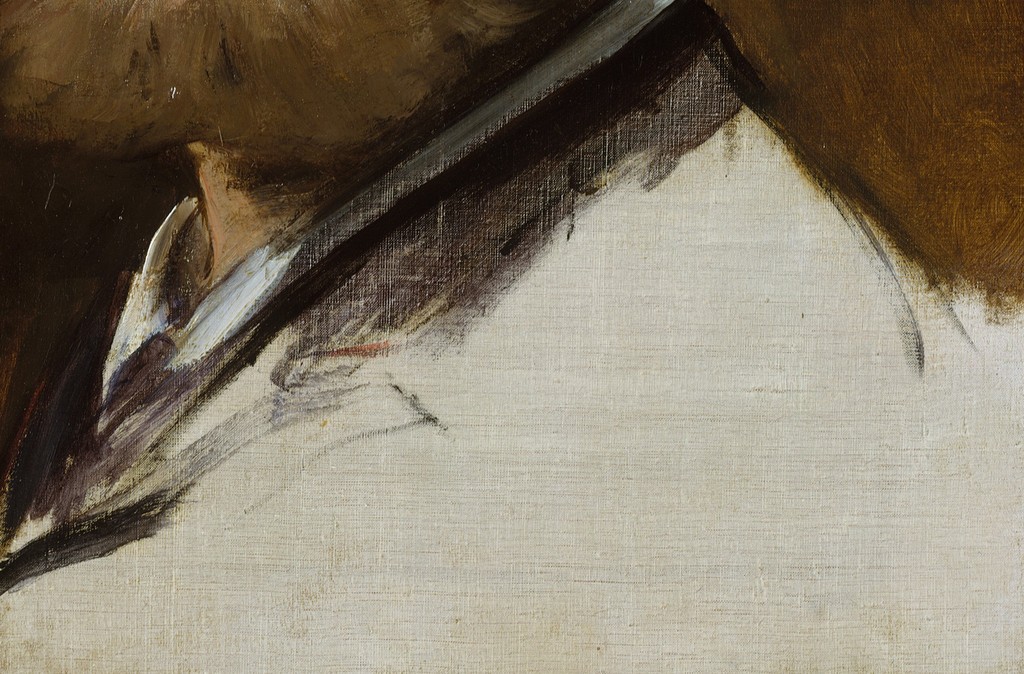
The collar runs diagonally from the right side of the neck towards the lower centre. Blue-grey marks cross its light surface. At the opening below the beard, a second pale point rises beside a dark patch of neckwear. These angular forms establish the clothing around the face.
A Lightly Painted Shoulder
A long dark diagonal follows the collar towards the lower left. Beside it, a wider dark band spreads over the shoulder. Farther down, thin, uneven lines indicate the opening and lapel of a coat, leaving much of the surrounding light area scarcely described.
The shoulder’s outer curve is especially clear at the right, where the brown background meets the pale lower field. Inside that boundary, there is little to match the modelling of the forehead, nose or ear. The head has a rounded presence, while the clothing opens into a flatter expanse crossed by isolated marks.
Near the bottom, the dark lines converge into a pointed shape. A separate thin mark descends below it, stopping before the edge. These scattered indications allow the eye to follow the coat’s arrangement without supplying a fully developed torso. No hands or furniture explain the rest of Faure’s posture.
The Brown Background
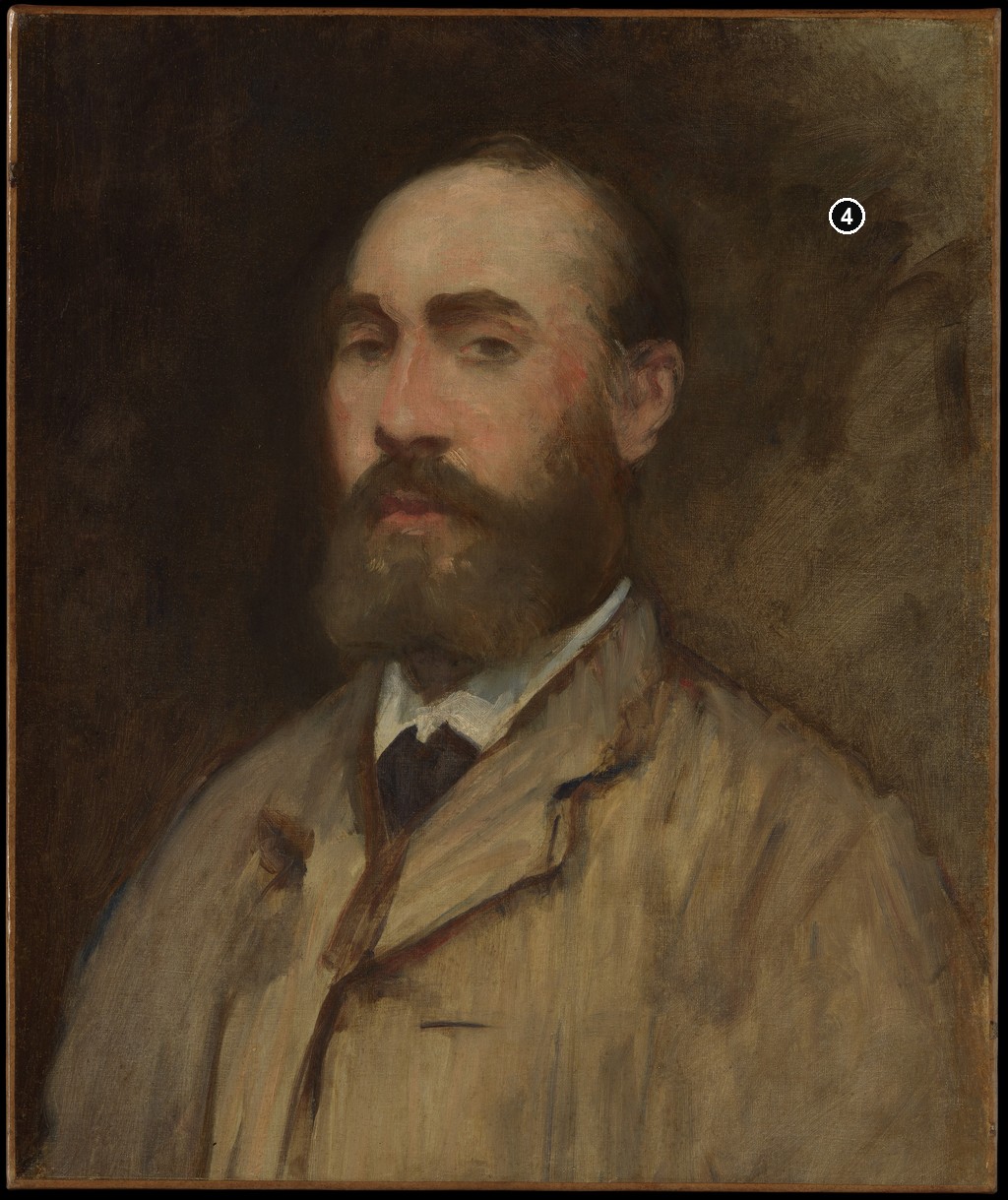
The background surrounds the head with brown and near-black passages. It is darker beside the cheek on the left and warmer near the shoulder on the right. This variation prevents the surrounding field from reading as a single uniform colour.
At the lower left, its boundary breaks into an uneven edge above the light area. Along the opposite side, it follows the shoulder before meeting the same pale field. Their different edges repeat the contrast between developed head and abbreviated clothing.
The setting provides no identifiable stage prop or room furnishing. Faure’s face, hair and collar carry the portrait’s detail, with the darker surroundings keeping their outlines distinct.
Faure and the Unfinished Portrait
Faure was both a singer and an early collector of Manet’s work. Rouart and Wildenstein’s French catalogue describes a commissioned portrait begun again on several canvases but never completed.[2] The separate studies preserve different approaches to this continuing project.
Manet had previously portrayed Faure at full length as Hamlet. According to the Met, that earlier portrait received adverse criticism at the Salon of 1877, and Faure refused to accept it.[1] The later head study presents the sitter without an identifiable theatrical role or surrounding dramatic action.
Another Study at the Met
The Met also owns Jean-Baptiste Faure, a larger study from 1882–83, measuring 59.1 × 49.5 cm. It entered the collection through the gift of Mr. and Mrs. William B. Jaffe in 1950.[3]
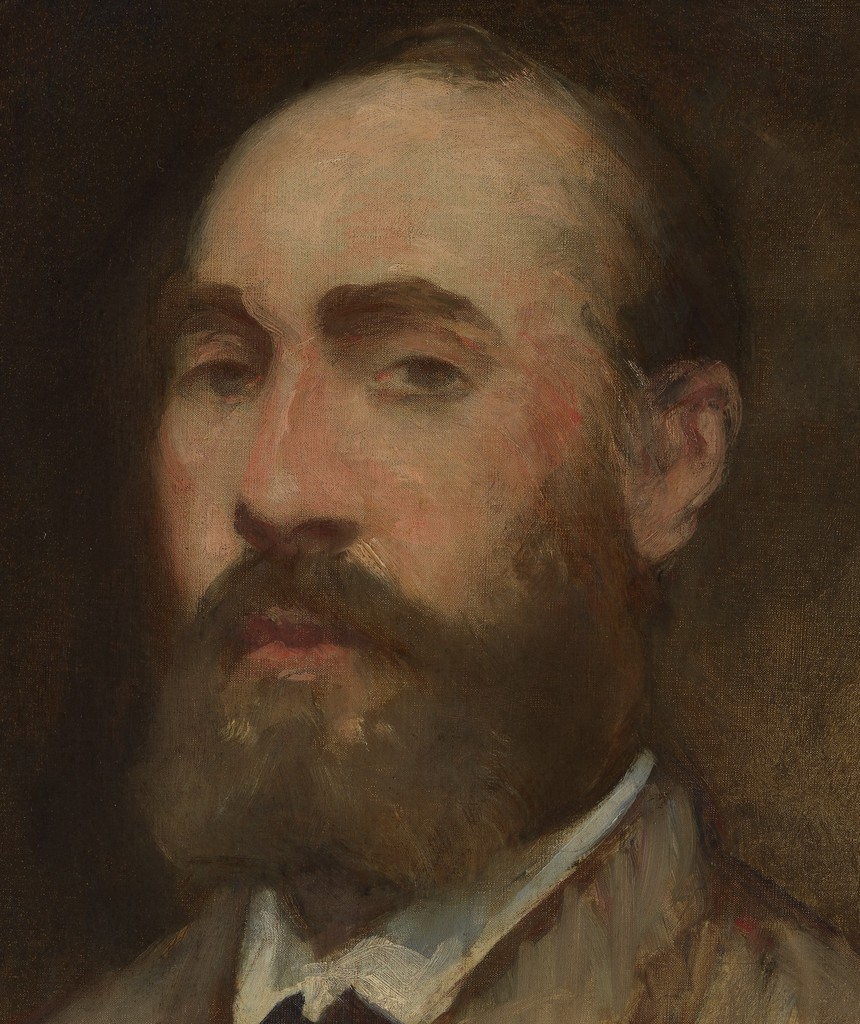
That canvas shows more of the torso. A grey-brown coat spreads across both shoulders, with a white collar and dark neckwear beneath the beard. Stronger lapel outlines extend down the chest, and broad pale and darker passages describe the clothing within them.
The face turns in a similar direction, but the eyes appear less open. The forehead and cheek also meet the surrounding hair in a different arrangement. The comparison reveals changes in both the face and clothing.
In the smaller head study, the face occupies more of the picture’s height, and the light lower area makes the dark collar particularly conspicuous. In the larger canvas, the coat gives the body a more continuous shape.
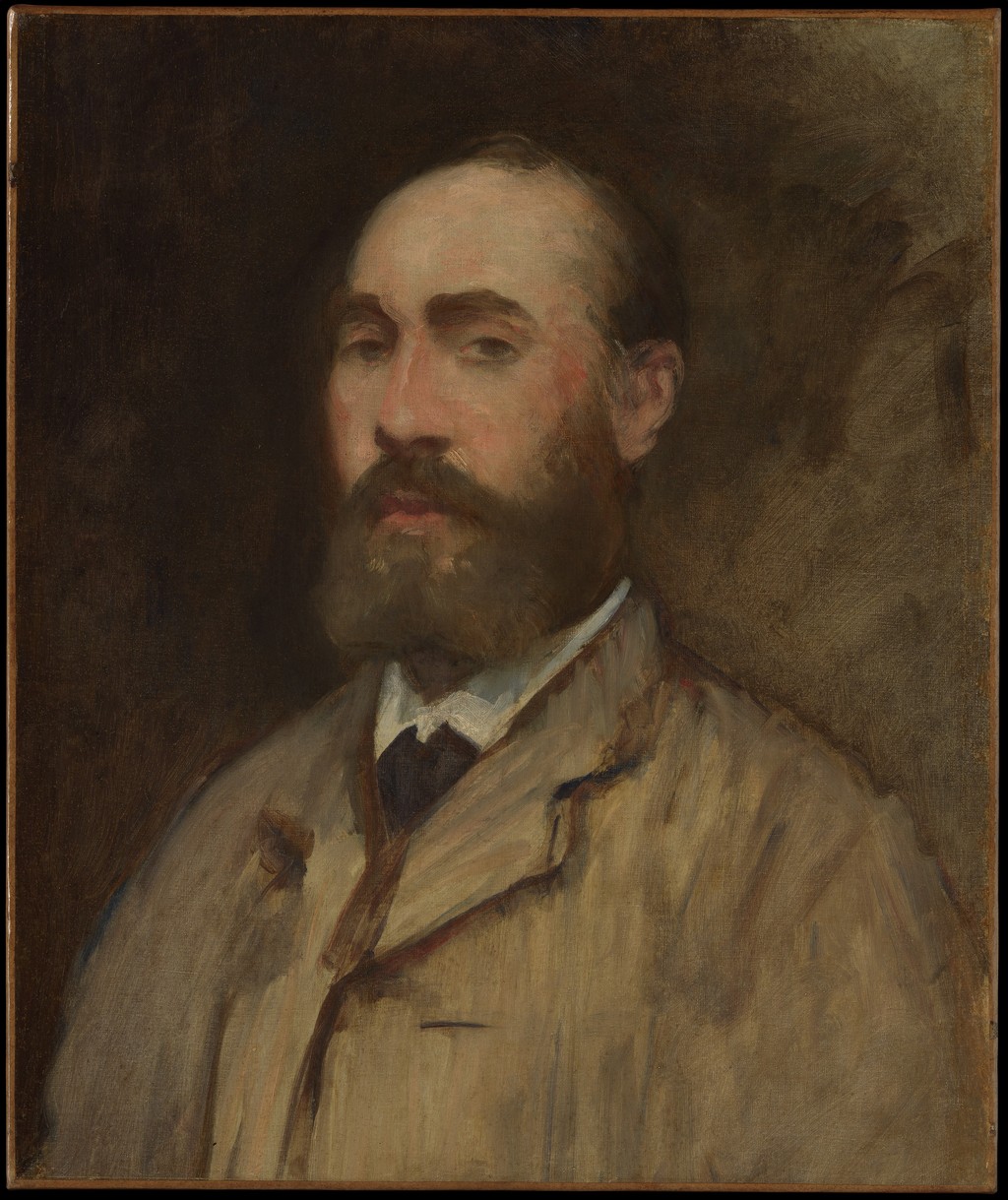
Édouard Manet, Jean-Baptiste Faure, 1882–83. Oil on canvas, 59.1 × 49.5 cm. The Metropolitan Museum of Art, New York, gift of Mr. and Mrs. William B. Jaffe, 1950, 50.71.1. A separate study for the unfinished portrait. The Metropolitan Museum of Art, New York, Gift of Mr. and Mrs. William B. Jaffe, 1950. Image source. CC0 / Public domain. Resized without cropping or enlargement from the supplied Met reproduction.
A Separately Collected Study
Rouart and Wildenstein’s published history traces the head through the Faure family, Georges Bernheim, Sacha Guitry and Van Diemen-Lilienfeld before Mrs. Ralph J. Hines. Their entry also records exhibitions in Paris in 1912, 1928 and 1936.[2]
The Met identifies the painting as Mrs. Hines’s gift of 1959.[1] Its own collection number, 59.129, distinguishes this small head from the larger Faure study held by the same museum.
Annotated Details from Head of Jean-Baptiste Faure
The numbered points identify visible features discussed in this article. Return from each detail to the whole composition. Each caption identifies the work shown.
Head of Jean-Baptiste Faure
Édouard Manet, Head of Jean-Baptiste Faure, 1882–83. Oil on canvas, 46 × 37.8 cm. The Metropolitan Museum of Art, New York, gift of Mrs. Ralph J. Hines, 1959, 59.129. The Metropolitan Museum of Art, New York, Gift of Mrs. Ralph J. Hines, 1959. Image source. CC0 / Public domain. Numbers added to a separate overview. Three detail crops from the supplied Met reproduction; no enlargement, recolouring or retouching.
Jean-Baptiste Faure — Met Study
Édouard Manet, Jean-Baptiste Faure, 1882–83. Oil on canvas, 59.1 × 49.5 cm. The Metropolitan Museum of Art, New York, gift of Mr. and Mrs. William B. Jaffe, 1950, 50.71.1. A separate study for the unfinished portrait. The Metropolitan Museum of Art, New York, Gift of Mr. and Mrs. William B. Jaffe, 1950. Image source. CC0 / Public domain. Numbers added to a separate resized whole supplied overview. Detail crops from the unchanged original; no enlargement, retouching or colour alteration.
Details from HEAD OF JEAN-BAPTISTE FAURE
Follow the numbered details back to the complete images above. Each caption identifies the work shown.
Head of Jean-Baptiste Faure
Forehead and open eyes
The broad pale forehead curves above two open eyes. Pink areas above the lids meet short grey and blue marks below them.
Moustache and beard
The moustache spreads sideways around the small pink mouth. Lighter locks divide the broader brown-grey beard below.
Collar and sketched clothing
A pale diagonal collar meets a broad dark band. Thin angular lines below indicate the coat within a much lighter field.
Jean-Baptiste Faure — Met Study
Face and Broad Beard
Brown and grey passages connect the beard with the pale collar beneath the face.
Artworks directory
Explore selected paintings, drawings and prints by Édouard Manet. Search by title or another recorded name.
Frequently Asked Questions
The Met dates it to 1882–83 and identifies the winter of those years as its period of execution.[1]
The face is extensively described, while much of the clothing consists of thin outlines across a light field. The Met identifies the painting as a preparatory study.[1]
Discussion
Look again at the images and ideas explored in Head of Jean-Baptiste Faure by Édouard Manet. These editorial prompts invite your observations.
Reader Insights
Follow the nose towards the left, then the shoulder towards the right. How does the pale collar connect these directions?
Compare the forehead’s curve with the beard’s lower edge. Where do lighter marks break the darker mass of hair?
Compare the amount of clothing in the two Met canvases. How does each arrangement affect the prominence of the face?
Join the Conversation
Share a detail, comparison or question about Head of Jean-Baptiste Faure by Édouard Manet below.
References
- The Metropolitan Museum of Art, Head of Jean-Baptiste Faure (1830–1914), 1882–83, 59.129, object details and introductory commentary. View source.
- Denis Rouart and Daniel Wildenstein, Édouard Manet: Catalogue raisonné, tome I, 1975, no. 391, pp. 288–289, Tête de Jean-Baptiste Faure. Digitised catalogue, Wildenstein Plattner Institute. French. View source.
- The Metropolitan Museum of Art, Jean-Baptiste Faure (1830–1914), 1882–83, 50.71.1, object details and relationship to the head study. View source.
- Splash image, Édouard Manet, Head of Jean-Baptiste Faure, 1882–83. Oil on canvas, 46 × 37.8 cm. The Metropolitan Museum of Art, New York, gift of Mrs. Ralph J. Hines, 1959, 59.129. The Metropolitan Museum of Art, New York, Gift of Mrs. Ralph J. Hines, 1959. Image source. CC0 / Public domain. Resized without cropping or enlargement from the supplied Met reproduction.


