



 by Tom Gurney
Tom Gurney BSc (Hons) is an art history expert with over 20 years experience
Published on June 19, 2020 / Updated on October 30, 2026
Email: tomgurney1@gmail.com / Phone: +44 7429 011000
Music in the Tuileries by Édouard Manet: Introduction
Black top hats, blue bonnets and pale dresses gather beneath a dense roof of trees. Faces emerge from the crowd, then disappear into small strokes of paint. At the front, children occupy the space between seated adults and a tangle of curved metal chairs. The scene offers plenty to look at before its title reminds us to imagine music.
Édouard Manet painted Music in the Tuileries Gardens in 1862.[1] Its fashionable Parisian gathering includes the artist himself, along with people from his family and circle of friends. The picture combines the recognition offered by a group portrait with the less orderly experience of encountering a crowd. Knowing who appears in it helps, but its effect also depends on the people and activities that remain only partly distinct.
At a Glance
- ArtistÉdouard Manet
- Date1862
- MediumOil on canvas
- Dimensions76.2 × 118.1 cm
- Full English titleMusic in the Tuileries Gardens
- French titleLa Musique aux Tuileries
- Object numberNG3260
- Collection creditSir Hugh Lane Bequest, 1917, The National Gallery, London. In partnership with Hugh Lane Gallery, Dublin.
- Early exhibitionLouis Martinet’s gallery, Paris, March 1863[1]
This work across Édouard Manet’s career
Contents
- Entering the Crowd
- Chairs, Children and a Parasol
- Manet and His Circle
- Fashion as Form
- Music beyond the Frame
- Baudelaire and the Beauty of the Present
- A Modern Gathering with an Older Artistic Model
- Marks That Become People
- Martinet’s Exhibition and Zola’s Defence
- From a Parisian Gathering to London and Dublin
Entering the Crowd
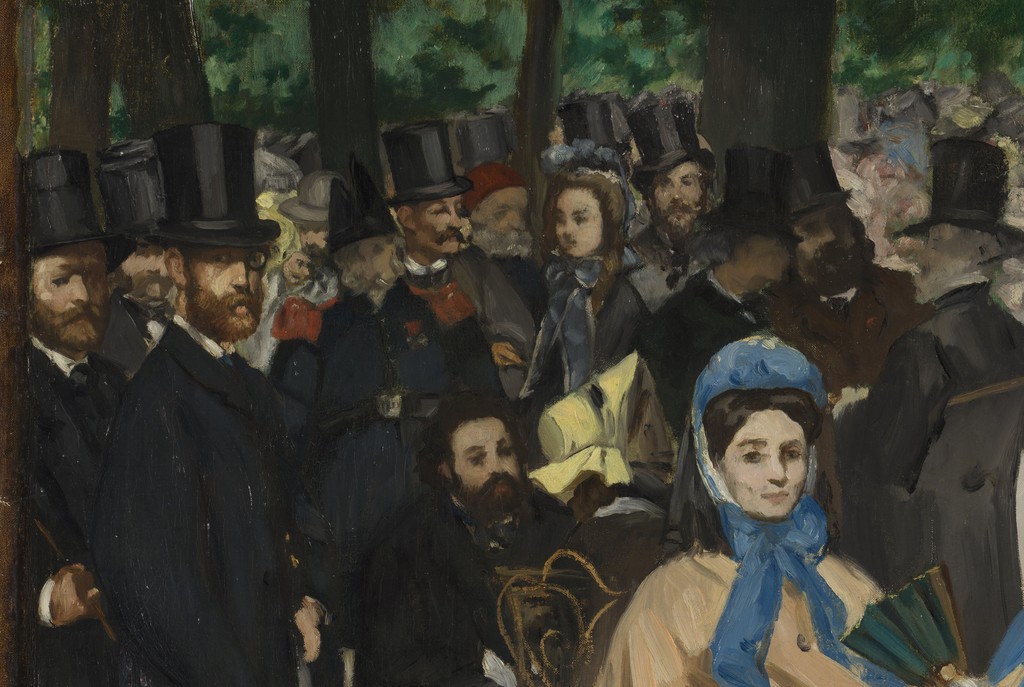
The first impression is of people spreading across a broad horizontal canvas. Dark coats and hats form a repeated band beneath the foliage. Larger, lighter figures interrupt it near the front. There is no single person whose action explains the gathering, and no obvious route through which the eye must travel. Attention moves between faces, clothes and small openings in the mass.
Manet gives the foreground several different points of entry. At the left, standing men turn partly towards us. Near the centre-left, two seated women occupy a wide area with their pale dresses. Farther right, a man in light trousers bends towards the people around him. At the opposite edge, bright blue and red accents draw attention to another group. Each offers a temporary resting place before some neighbouring detail takes over.
The figures overlap so closely that a head can be easier to find than the body belonging to it. A hat rises above a shoulder; a face appears beside a trunk; a pale sleeve marks a person partly hidden by someone else. Looking becomes a process of joining fragments. That experience resembles being among people whose gestures and expressions can be noticed only in passing.
The lower part of the painting is more open, but it is hardly empty. Chairs, a parasol, clothing and children occupy the ground in front of the adults. These objects bring us close to the gathering. We seem to have reached its edge at a point where a chair might be moved or someone might step into view. The picture offers proximity without giving us an unobstructed place to stand.
Above the heads, tree trunks establish a larger rhythm. Some rise straight, while others lean across the view. They divide the crowd into uneven groups and connect the figures to the dark canopy. A small opening of pale sky near the top gives a glimpse of air beyond this enclosed social world.
Chairs, Children and a Parasol
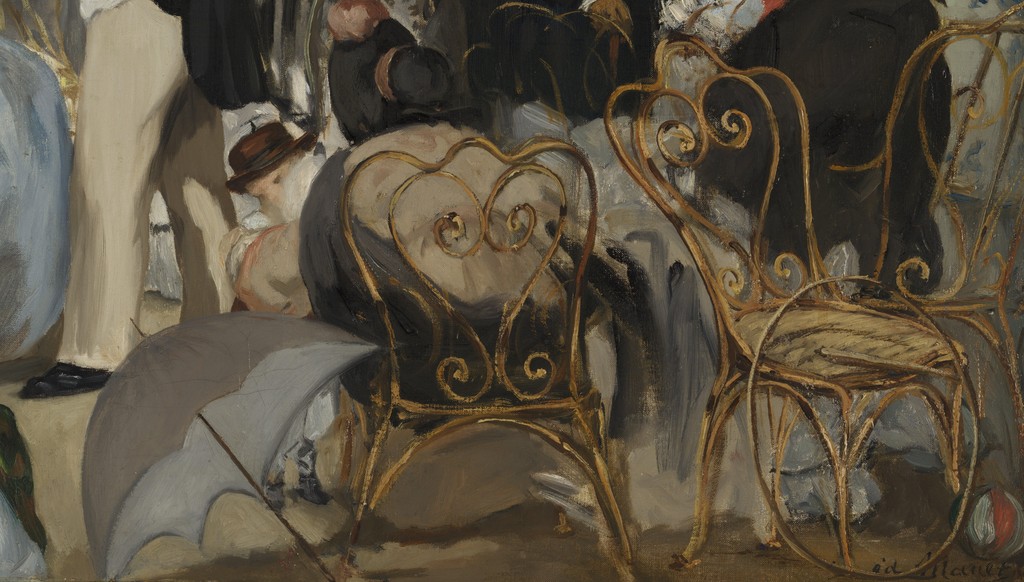
The chairs are among the painting’s most distinctive objects. Their thin metal frames curl into loops that stand out against dark clothes and pale ground. At the right, several backs and legs overlap, creating an intricate pattern near the surface of the canvas. Their open construction lets us see through them even as their curves complicate the view.
Those curves provide a counter-rhythm to the trees. The trunks make broad, comparatively simple uprights; the chairs produce small, repeated turns. One pattern belongs to the garden’s natural structure, the other to the furniture through which people occupy it. Manet places both in clear relation to the bodies between them. Sitting, standing and moving all require negotiations with these objects.
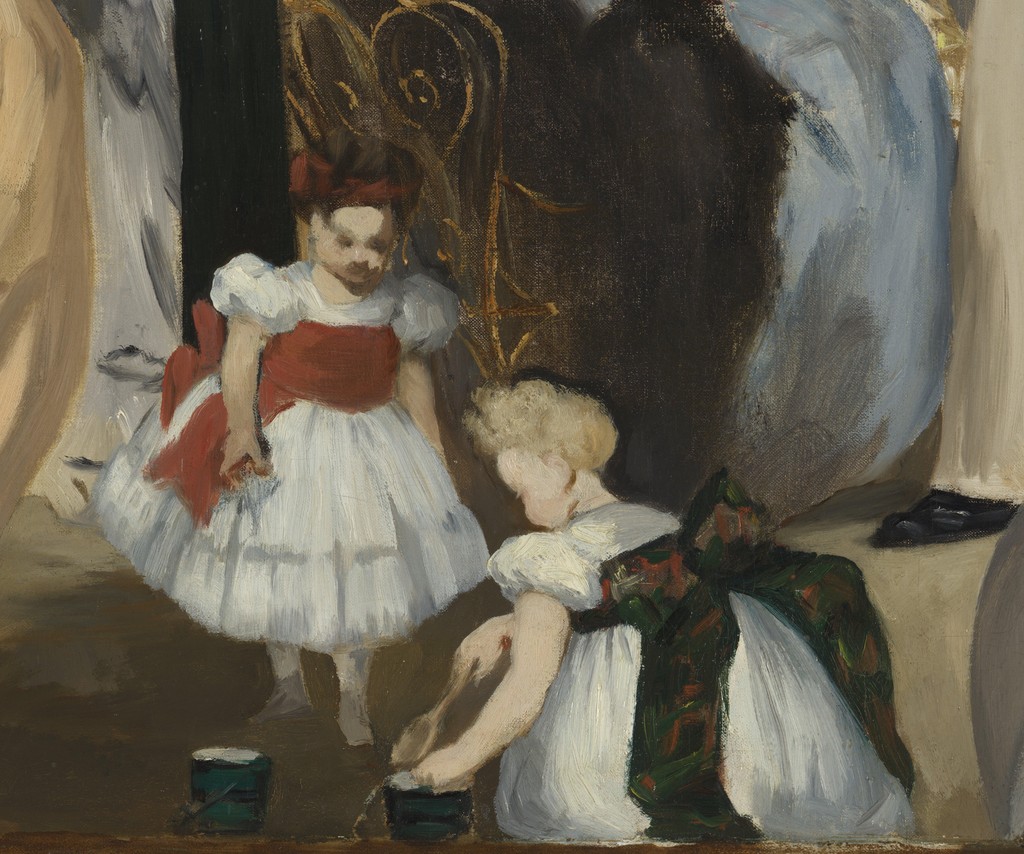
The children near the lower centre bring a different scale to the scene. Their light clothing and coloured ribbons distinguish them from the adults above. One stands close to a tree, while another bends lower towards the ground. Their heads fall beneath the level at which most of the social exchanges appear to occur. The picture accommodates their smaller world within the larger gathering.
An open parasol spreads across the lower right. Its broad panels create a rounded area of grey and muted lilac beside the narrow chair frames. The juxtaposition makes both objects more legible: the parasol offers a continuous surface, while the chairs break into fine lines. Together they give the foreground a material variety that can be overlooked when the painting is approached only as a collection of portraits.
These details also affect the imagined pace of the scene. A crowd might suggest constant movement, but chairs and a resting parasol imply that people stay, settle and spend time here. Children bend and stand among adults who are seated or occupied in conversation. The gathering contains many small rhythms, held together by the shared space under the trees.
Annotated Details from Music in the Tuileries: Faces, Clothes and Chairs
The numbered points identify visible features discussed in this article. Return from each detail to the whole composition. Édouard Manet, Music in the Tuileries Gardens, 1862. Sir Hugh Lane Bequest, 1917, The National Gallery, London. In partnership with Hugh Lane Gallery, Dublin. National Gallery, London, via Wikimedia Commons. Image source. Public domain. Numbers added to a separate resized whole overview retaining the supplied edges and margins. Detail crops from the immutable original; no enlargement or retouching.
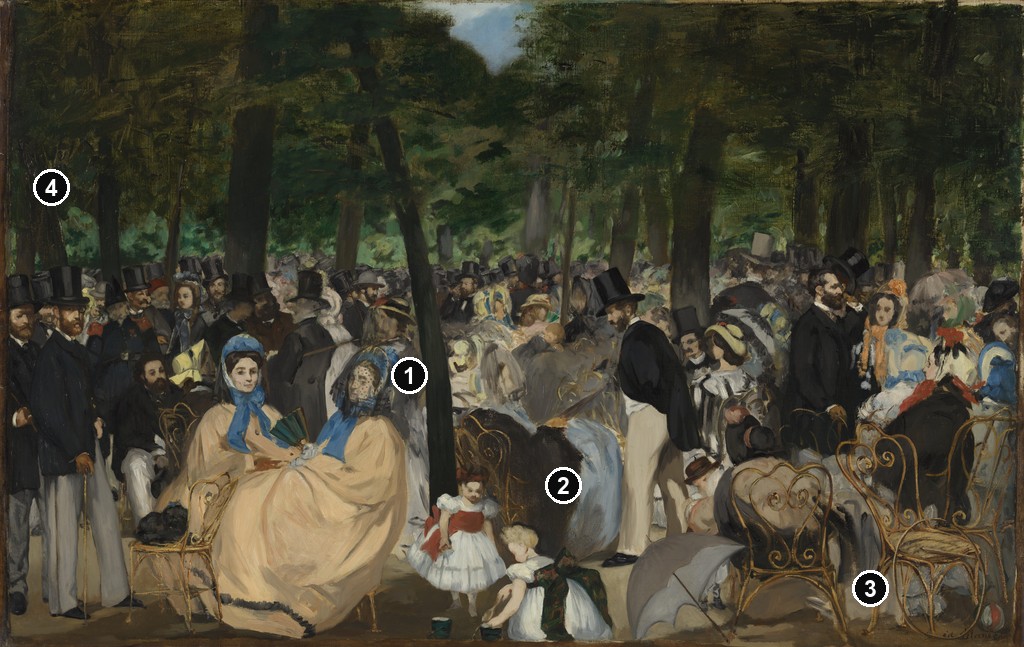
Details from MUSIC IN THE TUILERIES: FACES, CLOTHES AND CHAIRS
Compare the blue bonnets and broad pale dresses with the children’s smaller world below. Follow the curling chairs beside the parasol, then return to the faces beneath the left-hand hats.
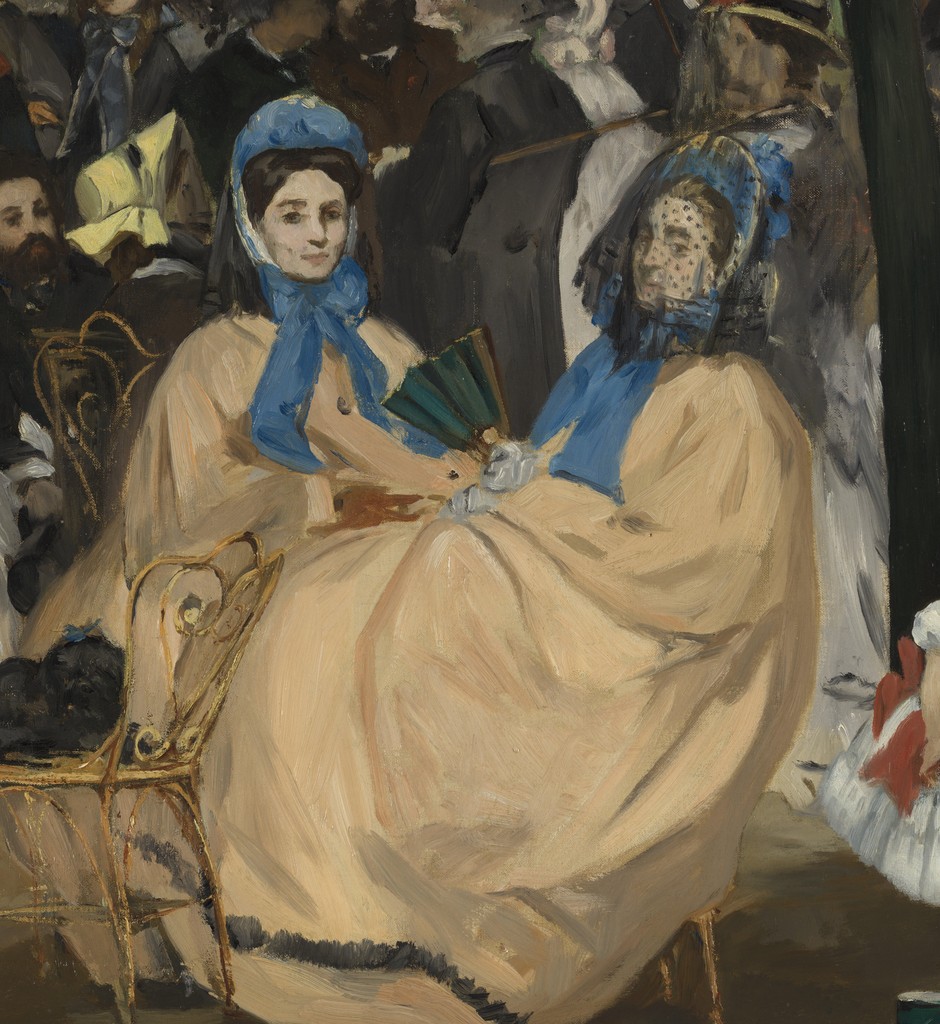
Two Pale Dresses and Blue Bonnets
Blue bonnets and ribbons distinguish the seated women above the broad folds of their pale dresses.
Children at the Front
The children occupy the lower space beneath the adults, with pale clothing, coloured ribbons and small objects near the ground.
Curved Chairs and the Open Parasol
Looping metal chair frames cross beside the broad grey panels of the open parasol.
Faces beneath the Left-hand Hats
Dark top hats repeat above differently turned faces. Pale collars and small warm marks separate heads within the crowd.
Manet and His Circle
Manet includes himself at the far left, where the edge cuts into his figure. The painter Albert de Balleroy stands beside him.[2] Their position makes the artist a member of the gathering whose own place remains peripheral. Theodore Reff’s study of Manet’s Paris relates this self-presentation to the painter’s participation in the city’s artistic and literary society.[3]
The placement has a practical visual effect. We encounter Manet as one of several upright figures in dark clothing, then discover that this is the person responsible for the scene. Recognition changes the figure’s significance without changing his scale. He has not been enlarged or placed on a central platform; he has entered the same system of partial views as his companions.
The National Gallery identifies the seated, bearded man nearby as Zacharie Astruc. Just right of centre stands Manet’s brother Eugène, recognisable by his light trousers and forward inclination. The composer Jacques Offenbach is seated farther right, wearing glasses and a moustache.[1] These names give the crowd a particular social character: the gathering brings family, music, criticism and painting into the same public setting.
Charles Baudelaire also appears among the smaller heads, in the group above the seated women at the left.[3] His presence matters because his writings provide an unusually suggestive context for Manet’s attention to contemporary life. Yet the face occupies only a small part of the canvas. A viewer can miss a celebrated writer while immediately noticing a bonnet, a chair or a patch of bright fabric.
That uneven distribution of attention is central to the group portrait. People who carry considerable historical importance do not always receive the most visual emphasis. The artist makes room for recognisable individuals while preserving the crowd’s capacity to absorb them. A name can help us return to a small head, but it does not turn every surrounding mark into a fully explained person.
The picture also leaves much of the company anonymous. We can follow a turned profile or a lifted hat without identifying its owner. That balance between recognition and anonymity allows the scene to operate on two levels: as an image of Manet’s circle and as an encounter with a gathering larger than any one participant’s experience.
Fashion as Form
The men’s dark clothes create a strong repeated structure. Top hats rise above faces at slightly different heights and angles. Pale trousers, collars and glimpses of shirt interrupt the darker bodies. With relatively few colours, Manet differentiates standing poses and turns of the head while retaining the massed effect of the group.
The seated women’s clothing produces broader shapes. Their skirts spread across the foreground, making folds and rounded edges that occupy much more space than the narrow upright figures behind them. Blue bonnets and ribbons frame the faces and lead the eye down towards the pale fabric. The clothes help determine how the bodies sit within the composition.
The bright blues are particularly effective because they recur in separate parts of the gathering. At the left they concentrate around the seated women’s heads and shoulders; at the right they appear among more strongly contrasting red and white passages. The eye can move between these accents across intervening dark areas. Colour connects people whose individual activities remain separate.
The dresses also modify the spaces around them. Their width limits the apparent room between chairs and neighbouring figures. A pale sleeve can merge briefly with a skirt before a darker line separates the forms. Clothing becomes part of the architecture of the gathering, governing where bodies seem able to sit or pass.
This is one reason the painting’s fashions matter beyond their value as historical costume. They provide the actual shapes through which the scene is organised. Replace the wide skirts, tall hats and close-fitting coats with different garments, and much of the painting’s pattern would change. Manet gives the clothes enough specificity to make the crowd belong to a particular moment, while using their contrasts to hold the canvas together.
The result rewards looking at whole areas as well as details. A bonnet can be read as something worn by an individual woman, then as a blue shape against a dark background. A coat can describe a person’s posture and contribute to a much larger black band. The picture continually moves between those scales of attention.
Music beyond the Frame
The Tuileries Gardens hosted concerts twice a week, attracting the kind of fashionable company represented here.[3] The title locates the scene within that activity, but Manet leaves the musicians outside the picture. There is no visible conductor, score or line of instruments around which to organise the crowd.
The omission directs attention towards the social life of an audience. People face different ways, turn towards companions or look out of the picture. Their arrangement does not establish that everyone is listening to the same musical passage. We cannot tell from the canvas whether a performance is already underway or about to begin.
Sound remains something the viewer supplies imaginatively. A concert offers one reason for the gathering, while conversation and the observation of other people seem equally plausible activities within it. The title can make us hear the scene inwardly, even though its visible drama concerns glances, clothing, proximity and movement.
The people looking towards us create another possibility. We can imagine occupying part of the space that a performance would address. That is an invitation produced by the direction of their faces, rather than a reliable plan of where the orchestra stood. The painting gives the viewer a social position without supplying a complete map of the event.
This choice also makes looking reciprocal. We inspect the crowd, and several figures appear to inspect our position. The audience has become a spectacle in its own right. Manet’s attention rests on the experience of being among other spectators, with the music helping to bring them together while remaining beyond sight.
Baudelaire and the Beauty of the Present
Baudelaire’s The Painter of Modern Life offers a way to think about this attention to people, fashion and passing appearances. In its third chapter, the poet describes an observer who takes pleasure in entering the crowd and finding images in its changing forms. The artist’s curiosity reaches towards gestures, fabrics, vehicles and the myriad visible details of urban life.[4]
The essay’s central artistic figure is Constantin Guys. Its argument can illuminate Manet’s painting through shared concerns, while retaining that distinction. Baudelaire gives the observation of contemporary society an ambition beyond the collection of amusing incidents. The observer must find forms capable of preserving something of the life passing before him.
In the fourth chapter, Baudelaire turns specifically to modernity and dress. He argues that the beauty belonging to an age is carried by its clothes, gestures and expressions. Studying older masters cannot, by itself, reveal how a contemporary fabric falls over a contemporary skirt or how a person’s manner gives that garment its character.[4]
Manet’s crowd provides a compelling visual companion to those ideas. The clothes determine the bodies’ shapes; the bodies establish their positions among other people; those positions give rise to fleeting encounters. A raised hat, a broad skirt or a partially hidden face can carry the particularity of the present without developing into a formal narrative.
According to the Bibliothèque nationale de France, Baudelaire wrote the essay between November 1859 and February 1860, and it appeared in Le Figaro in late 1863.[5] The published text therefore followed Manet’s 1862 painting. The dates place the picture and essay within a shared period of inquiry, with the friendship connecting poet and painter.
The essay also helps us understand why the painting’s social specificity matters. The gathering does not have to represent everyone in Paris to become a significant image of the city. Its force comes from making this particular company, with these clothes and these habits of attention, available to sustained looking.
A Modern Gathering with an Older Artistic Model
Manet’s interest in the present developed alongside his admiration for older painting. Reff relates the placement of Manet and de Balleroy at the left to The Little Cavaliers, a painting then attributed to Velázquez. The figures in that work were believed to include Spanish artists, giving Manet a precedent for presenting a contemporary artistic circle.[3]
The historical attribution is part of the comparison: it describes what the earlier picture meant to Manet’s generation. The link suggests that a new subject could be shaped through knowledge of an older pictorial tradition. Manet could look at his own companions with the ambition and self-awareness that such a model encouraged.
His place in the crowd consequently carries several possible meanings. He is a person attending a fashionable gathering, an artist among other cultural figures and a painter showing how he has chosen to represent that society. These roles coexist in the small figure at the edge. The painting invites us to recognise an author inside the world he depicts.
Readers familiar with The Spanish Singer will recognise how readily Manet’s early career moved between admired artistic traditions and subjects close to his own experience. In Music in the Tuileries, the field of attention expands from an isolated performer towards a company of spectators. Clothing, pose and painted surface remain essential, but their relations become more numerous and less easily contained.
Marks That Become People
The brushwork makes those relations unusually visible. Some faces have enough separate features to be recognised; others consist of a few pale or dark touches beneath a hat. The degree of definition changes as the eye moves across the canvas. A detailed head may sit beside an area where several people seem to merge into one another.
The distinction follows neither distance nor importance with complete regularity. A foreground garment can be broadly treated while a small head farther back attracts attention through a carefully placed accent. This variability prevents the painting from behaving like a uniform inventory. Looking involves repeatedly deciding which marks belong together and what kind of presence they describe.
The foliage works in a related way. Dark and green passages gather into a canopy, broken by trunks and small intervals of light. Individual leaves seldom need to be identified for the trees to feel substantial. Their broad masses establish shade over a crowd whose own surfaces are similarly assembled from selected indications.
At close range, a face can seem unexpectedly slight. From farther away, its position among hats, collars and shoulders helps it become legible. The painting relies on relations across the surface to complete what individual marks leave open. This is an economy of representation with a strong physical effect: the crowd seems to form as the viewer finds an appropriate distance.
The varied finish cannot establish the number or duration of sittings. What we can follow is the movement between paint as marks and paint as people, sustained across a densely occupied canvas.
Martinet’s Exhibition and Zola’s Defence
Manet showed the painting at Louis Martinet’s gallery on the boulevard des Italiens in March 1863, alongside thirteen other pictures. It appeared again in his own exhibition pavilion in 1867.[1] Its early reception belongs to these independent presentations of his work. It should be distinguished from the three paintings he exhibited at the Salon des Refusés in 1863, among them Le Déjeuner sur l’herbe.[6]
Émile Zola’s 1867 defence of Manet returns to the response at Martinet’s. He reports that an angry visitor threatened violence if Music in the Tuileries remained on view. Zola then imagines what he would have said had he been present: the dissatisfied spectator should step back and let the apparently disconnected patches become a living crowd.[6]
The distinction between report and imagined intervention is revealing. Zola is constructing a defence, using an anecdote to expose a difficulty in the act of looking. A visitor who expects every person to be fully modelled at close range may find the surface frustrating. Distance changes the relation between small marks and the gathering they collectively represent.
For Zola, the abbreviated figures demonstrate the painter’s fidelity to his own eyes and temperament. Their vitality comes from the way they are seen together. The marks do not need to reproduce every detail separately to convey people talking and moving under trees.[6] His account makes the viewer’s adjustment part of the painting’s success.
We can test the usefulness of that defence without accepting every flourish of his advocacy. Begin close enough to notice how little paint describes some faces. Then stand farther back, or view a reproduction at a smaller scale, and watch the groups become more coherent. Return to a distinctive chair, bonnet or pair of trousers and notice how it helps organise the adjacent figures.
Zola’s argument also explains why the picture could seem more disruptive than its pleasant subject suggests. Nothing overtly scandalous is required within the gathering. The challenge lies in the expectations brought to its representation: how finished a person should appear, how much a viewer must contribute and what kind of subject can sustain an ambitious painting.
From a Parisian Gathering to London and Dublin
The National Gallery records that Jean-Baptiste Faure probably acquired the painting in 1882. He sold it to Durand-Ruel in 1898, and Hugh Lane bought it from the dealer in 1906.[1] Its later history became part of the much-debated fate of Lane’s collection, linking the picture with both London and Dublin.
The Hugh Lane Gallery’s account describes the dispute over Lane’s intentions and the successive arrangements that allowed the public in both cities to see the works. A partnership signed in 2021 continued that collaboration over their care and display.[7] The current collection credit acknowledges the National Gallery and its partnership with the Hugh Lane Gallery. It is more informative than assigning the painting a permanent display location that may change with loans and rotations.
Its movement into public collections has changed the conditions of looking. Faces that belonged to Manet’s immediate circle now often require identification, and fashions that were contemporary have become historical. The painting’s visual activity remains readily accessible: dark hats gathering into a band, a child beneath the adults, pale fabric spreading across a chair and small marks becoming a crowd.
That activity gives the work its continuing freshness. Manet shows people enjoying a familiar urban setting while making the viewer newly attentive to how such a scene is perceived. Recognition arrives unevenly, through fragments and relations. The gathering holds together, but looking at it remains an active experience.
Artworks directory
Explore selected paintings, drawings and prints by Édouard Manet. Search by title or another recorded name.
Frequently Asked Questions
The signed and dated painting was made in 1862.[1]
It belongs to the Lane Bequest, whose display is shared between London and Dublin under a partnership. Consult the galleries’ current information before visiting.[7]
He appears at the far left, partly cut by the edge, beside the painter Albert de Balleroy.[2]
The musicians remain outside the picture. The title identifies a concert setting, while the painting concentrates on the gathered people.
Zola discusses its Martinet exhibition separately from Manet’s three Salon des Refusés paintings.[6]
Discussion
Look again at the images and ideas explored in Music in the Tuileries by Édouard Manet. These editorial prompts invite your observations.
Reader Insights
Try viewing the painting at two distances. Close up, find a face made from very few marks.
From farther away, notice how the surrounding hats, collars and shoulders help that face become legible.
Then follow the curling chair frames across the foreground: they create a lively pattern beneath the crowd.
Join the Conversation
Share a detail, comparison or question about Music in the Tuileries by Édouard Manet below.
References
- The National Gallery, London. “Music in the Tuileries Gardens,” 1862, NG3260. Collection record, commentary, provenance and exhibition history. View source.
- Utpictura18, Université Aix-Marseille. “La musique aux Tuileries — Édouard Manet,” notice 19543. Catalogue notice and selected figure identifications. View source. (in French).
- Theodore Reff. Manet and Modern Paris. National Gallery of Art, 1982, introductory essay, especially pp. 13–16. View source.
- Charles Baudelaire. Le Peintre de la vie moderne, chapters III–IV, “L’artiste, homme du monde, homme des foules et enfant” and “La modernité.” French text in the collected edition of L’Art romantique, 1885. View source. (in French).
- Bibliothèque nationale de France. “Le peintre de la vie moderne.” Work authority record, including composition and publication dates. View source. (in French).
- Émile Zola. Édouard Manet: étude biographique et critique. 1867. Discussion of the Martinet exhibition, Music in the Tuileries and the Salon des Refusés. View source. (in French).
- Hugh Lane Gallery. “Partnership agreed between Hugh Lane Gallery and The National Gallery,” 12 April 2022. View source.
- Splash image, Édouard Manet, Music in the Tuileries Gardens, 1862. Sir Hugh Lane Bequest, 1917, The National Gallery, London. In partnership with Hugh Lane Gallery, Dublin. National Gallery, London, via Wikimedia Commons. Image source. Public domain. Whole supplied reproduction resized within native dimensions; no enlargement or retouching.


