



 by Tom Gurney
Tom Gurney BSc (Hons) is an art history expert with over 20 years experience
Published on June 19, 2020 / Updated on October 30, 2026
Email: tomgurney1@gmail.com / Phone: +44 7429 011000
Mademoiselle Victorine in the Costume of a Matador by Édouard Manet: Introduction
Victorine Meurent stands with a sword raised and a pink cape extended, turning her face towards the viewer while a bullfight unfolds behind her. Édouard Manet painted this large canvas in 1862. Now in the Metropolitan Museum of Art, it is catalogued as Mademoiselle V. . . in the Costume of an Espada.[1] Its familiar alternative title, Mademoiselle Victorine in the Costume of a Matador, describes the role assumed by the model.
At a Glance
- ArtistÉdouard Manet
- TitleMademoiselle V. . . in the Costume of an Espada
- Alternative titleMademoiselle Victorine in the Costume of a Matador
- French catalogue titleVictorine Meurent en costume d'espada
- ModelVictorine Meurent
- Date1862
- MediumOil on canvas
- Dimensions165.1 × 127.6 cm
- CollectionThe Metropolitan Museum of Art, New York
- Accession number29.100.53.[1][2]
This work across Édouard Manet’s career
Contents
- A Pose Turning in Several Directions
- A Face Beneath the Black Hat
- The Sword and the Hanging Cape
- Dark Clothing, Pale Stockings
- A Bullfight at Another Scale
- Goya and a Renaissance Figure
- From Painting to Print
- A Nude Beneath the Bullfighter
- Exhibition and Collecting
- Annotated details
A Pose Turning in Several Directions
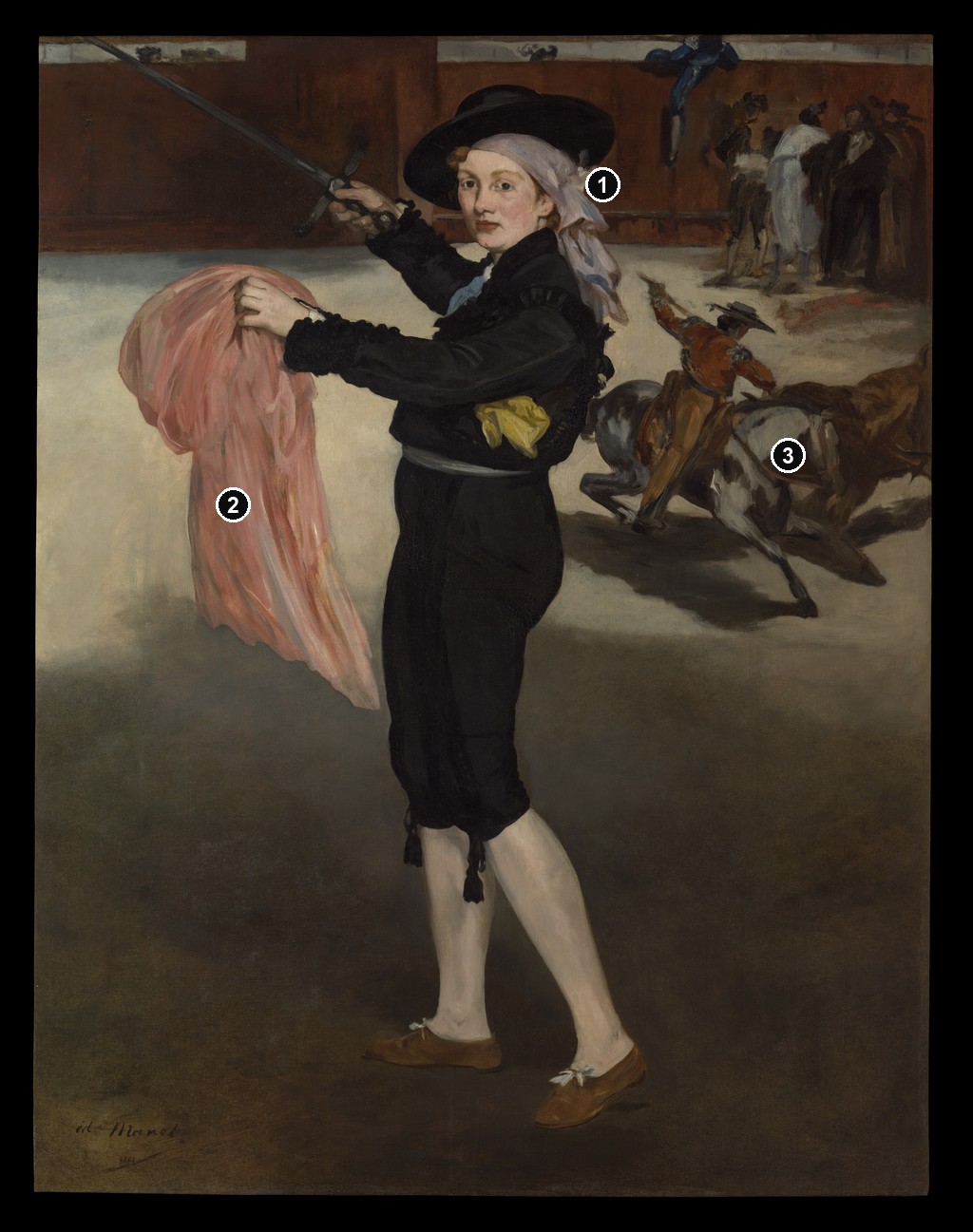
The figure occupies almost the entire height of the painting. Her torso turns towards the left, both arms extend in that direction, and her head turns back towards us. Below, the legs cross into a narrower arrangement, with the two shoes pointing along different lines. Several turns coexist within one held position.
The figure is difficult to place within the surrounding action. Her arms suggest movement, but her face directs attention out of the bullring. The small figures behind her remain occupied with their own activities. She is much closer to the viewer, and her outline separates clearly from the pale ground across the upper half of the canvas.
A Face Beneath the Black Hat
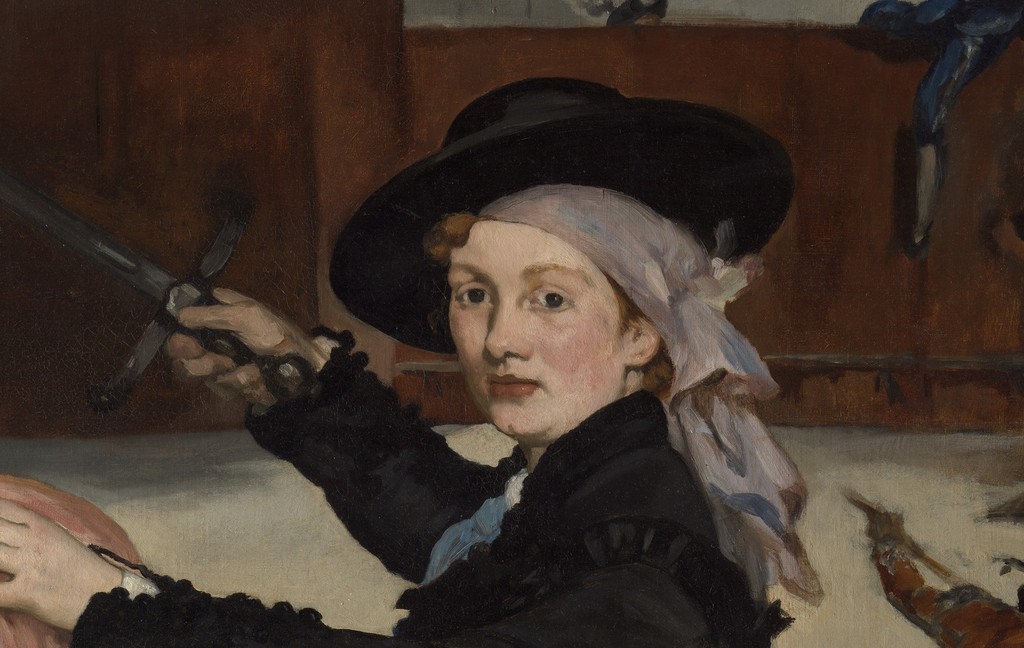
The broad black hat forms a dark, tilted shape above Victorine's forehead. Beneath it, a pale scarf passes around the head and falls behind the neck. Its loose ends introduce smaller folds and changes of direction beside the much larger curve of the hat.
Warm pink and cream passages describe the face. Shorter dark marks establish the eyes, nose and closed mouth, while the cheek forms a more continuous area of light. Brown hair appears between the scarf and forehead. The features remain legible against the reddish-brown barrier, while the hat partly merges with its darker surroundings.
The contrast between head and clothing matters. The face contains several small shifts of colour within a compact area; the black jacket below presents broader masses. As attention moves downwards, the description changes from features to folds, edges and intervals of light.
The Sword and the Hanging Cape
The sword runs diagonally from the raised hand towards the upper-left corner. Its blade passes across the darker wall, where its direction can be followed without confusing it with the horizontal rail. The hand and guard form a cluster of smaller shapes at the point where this diagonal meets the figure.
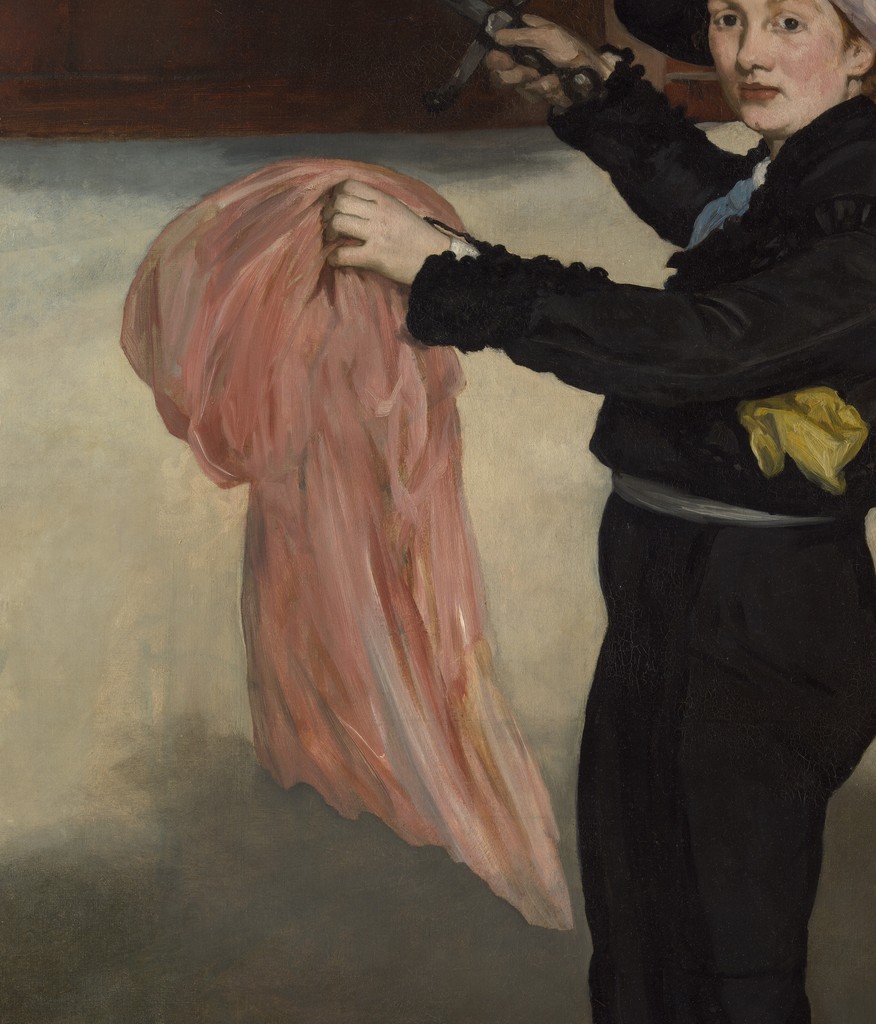
The other hand gathers the pink cape farther down and to the left. Here a few pale fingers interrupt the rounded folds. Long strokes carry the fabric towards its lower point, while shorter, curving marks bunch it near the hand. The cape occupies a broad area beside the dark body, introducing a softer and more irregular boundary.
The objects extend the arms differently. The sword projects in a thin, relatively straight line; the cape descends in a large, yielding mass. Their contrasting shapes make the gesture easier to follow across the surface.
Dark Clothing, Pale Stockings
Victorine's jacket and knee breeches form a nearly continuous dark silhouette. Small changes within the black describe seams, sleeves and gathered fabric. A gray band marks the waist, and a bright yellow accent interrupts the jacket at the side. That small patch becomes particularly noticeable because so much of the surrounding costume is dark.
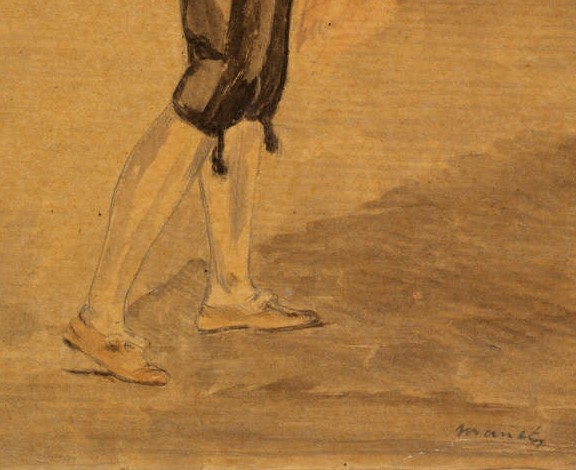
Below the knees, pale stockings change the balance of the figure. The legs emerge as two long light forms against the brown foreground. Dark ties and hanging ends mark the transition from breeches to stockings. At the bottom, small brown shoes with light accents rest within a comparatively open area of ground.
The Met notes that the shoes are unsuitable for bullfighting and the cape has the wrong hue.[1] The title identifies a model assuming a part.
A Bullfight at Another Scale
The background is divided by a warm, reddish barrier. Above it, a few small spectators lean or sit along the edge. A larger group gathers at the upper right, their bodies described through patches of dark clothing, pale fabric and warm faces. They occupy a shallow-looking strip between the wall and the foreground action.
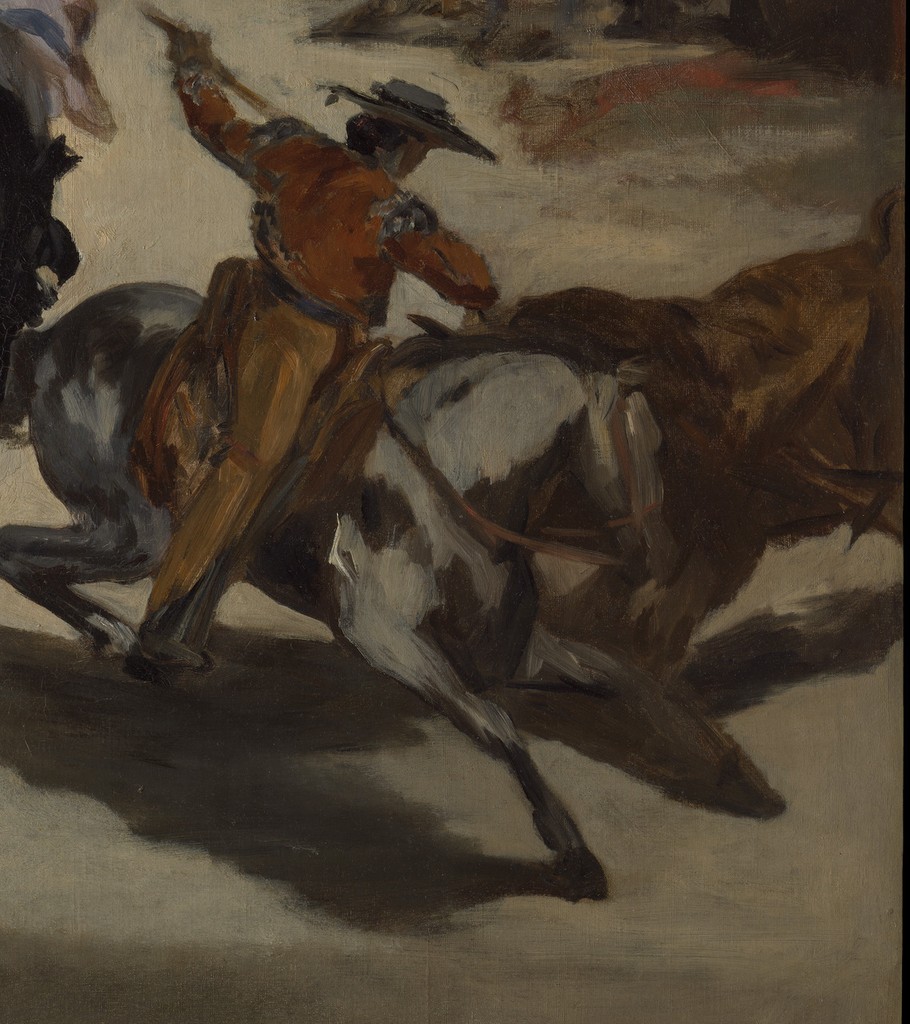
Below them, horse, rider and bull overlap closely. Their angled forms introduce a sudden concentration of movement behind Victorine's right side. The horse's body and legs spread across a relatively small part of the canvas, while the foreground model rises through almost its whole height.
There is little gradual transition between the large figure and the compressed incident behind her. Nor does Victorine turn her face towards that incident. The painting lets us recognize the separate activities while keeping their spatial relationship unsettled. Its open lower ground gives the model room, but the action behind appears pushed close to her outline.
Goya and a Renaissance Figure
Art historian Beatrice Farwell connected the mounted bullfighting group with plate 5 of Francisco de Goya's Tauromaquia, and the barrier imagery more freely with plates 19 and 28. She also identified a source for Victorine's twisting pose in Marcantonio Raimondi's engraving of Temperance, after Raphael.[3]
Farwell's comparison brings together different kinds of borrowing. Goya supplies an episode of action, while Raimondi offers a figure whose body and head turn in different directions. In Manet's painting, a recognizable model and Spanish costume give that older pose a new setting. The identification does not require us to treat Victorine as an allegory of Temperance; it helps explain how a seemingly immediate encounter can also depend on earlier images.
From Painting to Print
A related work at the RISD Museum makes the composition's passage between media unusually clear. Dated 1862, it is a drawing in graphite, pen and ink, and watercolor on tracing paper, with incised lines for transfer. The museum describes it as an intermediary made after the oil painting to prepare an etching. It suggests that a photograph may have helped with tracing, while leaving that possibility uncertain.[4]
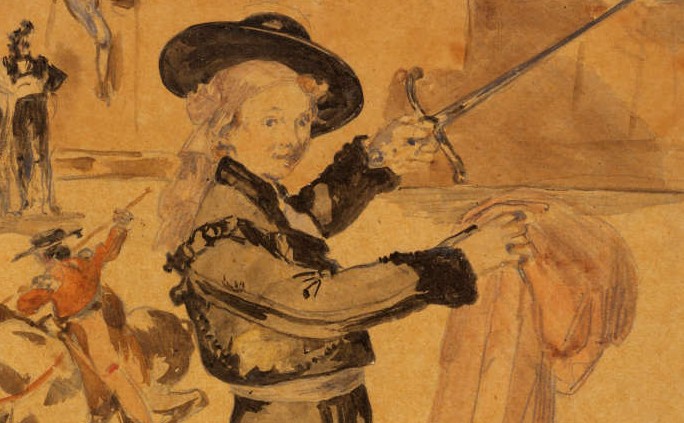
The drawing reverses the composition: the cape extends towards the right, and the mounted action appears on the left. Printing reverses a plate's image again. The sheet therefore belongs to the process of translating the painting into a print, rather than simply serving as a preliminary sketch for the oil.
Its outlines and washes also change how the costume reads. More of the warm paper remains apparent between dark marks, and the folds become linear patterns. Comparing the two works shows that transferring a composition involves more than retaining the same figures: colour, line and open areas take on different functions.
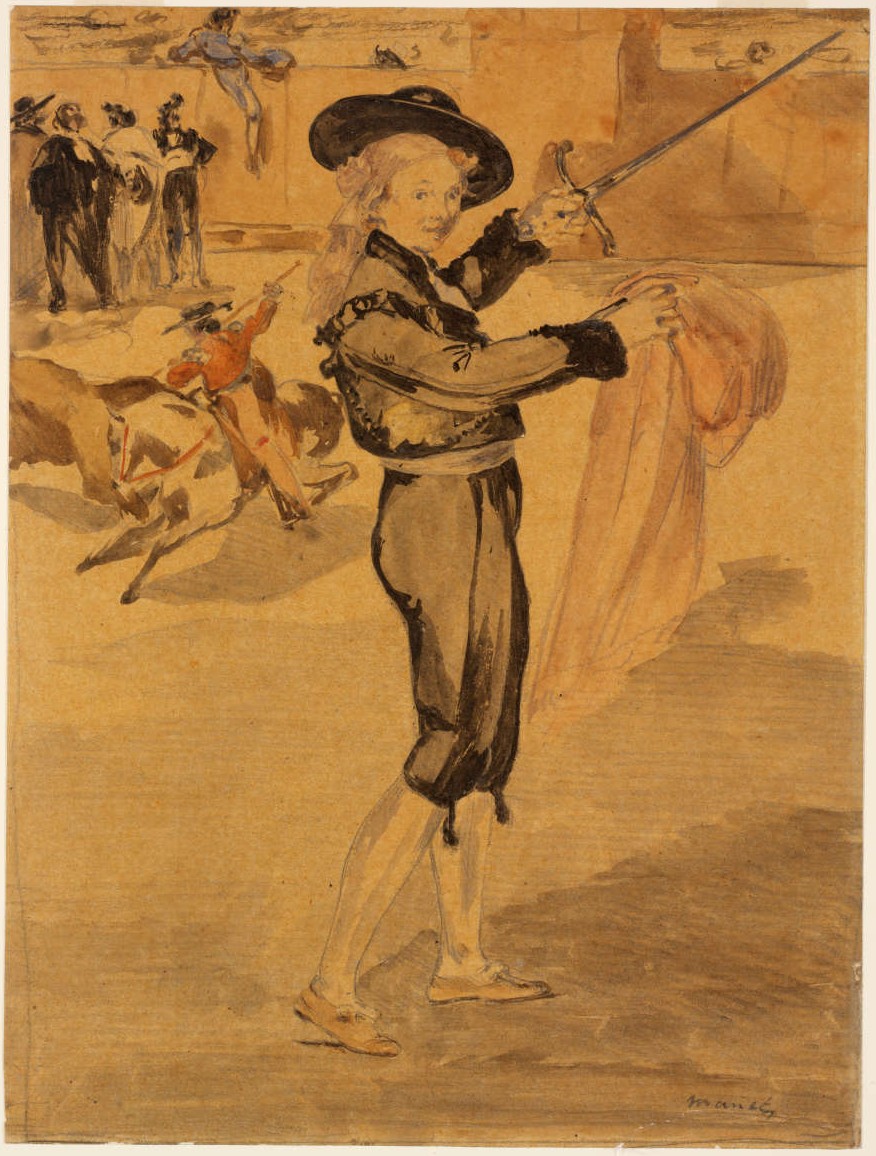
Édouard Manet, Mlle. Victorine in the Costume of an Espada (Victorine Meurent), 1862. Graphite, pen and ink, watercolor on tracing paper, incised for transfer; 30.5 × 22.9 cm. RISD Museum, 21.483. RISD Museum, Gift of Mrs. Gustav Radeke. Image source. CC0 / Public domain. Outside photographic margins reduced; retained at source size without enlargement.
Annotated Details from Mademoiselle Victorine in the Costume of an Espada
The numbered points identify visible features discussed in this article. Return from each detail to the whole composition. Each caption identifies the work shown.
Mademoiselle Victorine in the Costume of an Espada
Édouard Manet, Mademoiselle V. . . in the Costume of an Espada, 1862. Oil on canvas, 165.1 × 127.6 cm. The Metropolitan Museum of Art, 29.100.53. The Metropolitan Museum of Art, H. O. Havemeyer Collection, Bequest of Mrs. H. O. Havemeyer, 1929. Image source. CC0 / Public domain. Numbers added to a separate resized overview. Detail crops from the museum source image; no enlargement, recolouring or retouching.
Victorine Espada RISD Drawing
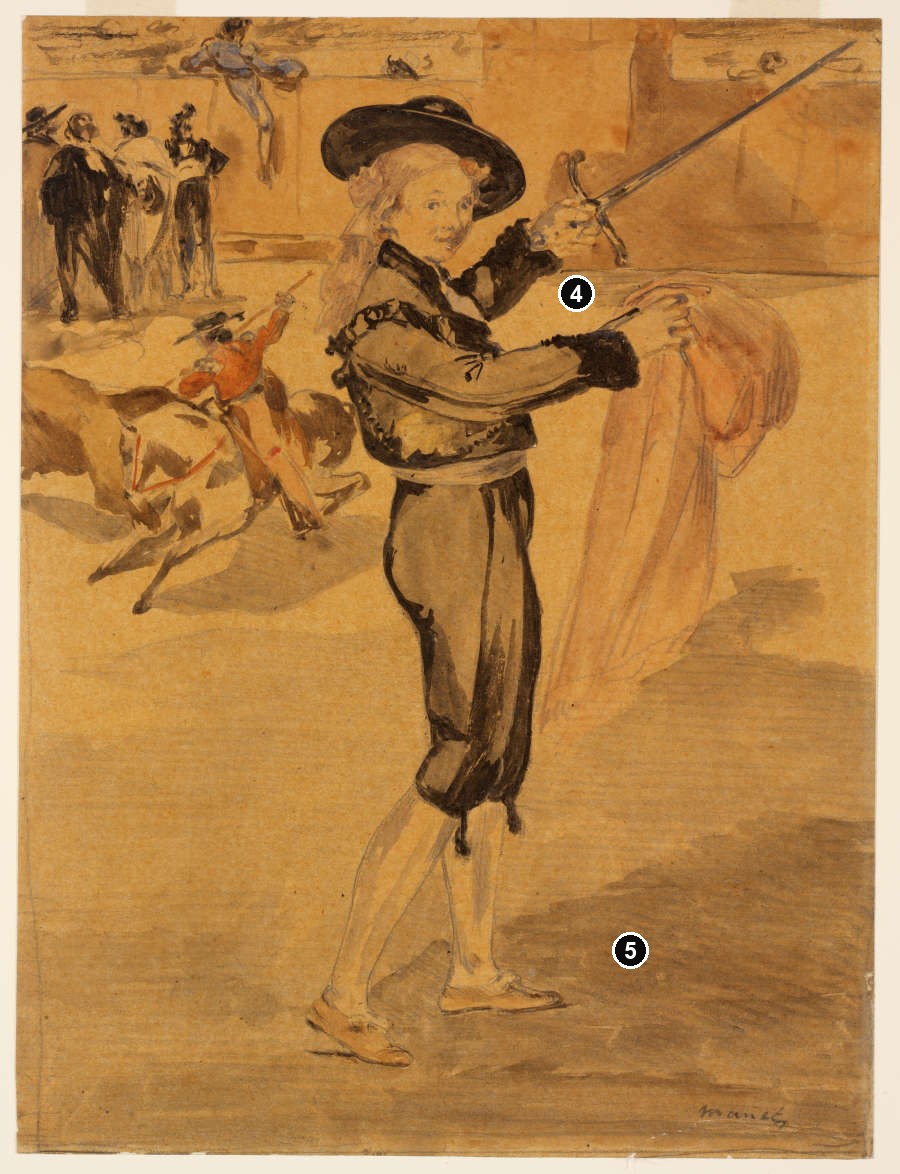
Édouard Manet, Mlle. Victorine in the Costume of an Espada (Victorine Meurent), 1862. Graphite, pen and ink, watercolor on tracing paper, incised for transfer; 30.5 × 22.9 cm. RISD Museum, 21.483. RISD Museum, Gift of Mrs. Gustav Radeke. Image source. CC0 / Public domain. Numbers added to a separate resized overview. Detail crops from the museum source image; no enlargement, recolouring or retouching.
Details from MADEMOISELLE VICTORINE IN THE COSTUME OF AN ESPADA
Follow the costume and background action in the oil, then compare the drawing’s outlines and reversed arrangement.
Mademoiselle Victorine in the Costume of an Espada
Hat Scarf and Sword Hand
The broad black hat frames the pale scarf and warm face. The raised hand meets the sword guard beside the darker sleeve.
Pink Cape and Extended Arm
The hand gathers short folds at the top of the cape. Longer pink passages carry the fabric down beside the dark extended sleeve.
Rider Horse and Bull
Small angled bodies overlap behind the foreground model. The horse and bull occupy a compressed area between pale ground and the warm barrier.
Victorine Espada RISD Drawing
Head Arms and Linear Folds
Dark outlines and washes describe the turned head and extended arms. Areas of warm paper remain visible between the marks.
Legs Shoes and Signature
Linear contours and a broad shadow distinguish the legs from the paper. The lower-right signature remains visible within the sheet.
A Nude Beneath the Bullfighter
Published X-radiography reveals a seated female nude beneath the present painting, oriented upside down relative to Victorine. In her 2018 study, Emily A. Beeny proposed a relationship with François Boucher's Diana Leaving Her Bath, alongside an earlier comparison with Bathsheba imagery after Giulio Romano. She distinguishes the concealed figure from Manet's lost copy of Boucher's painting. The exact dates when he began, abandoned and covered the nude remain unknown.[5] The physical reuse of the canvas is clearer than the reasons for it.
Exhibition and Collecting
Rouart and Wildenstein's French catalogue records the painting's rejection from the 1863 Salon and its appearance at the Salon des Refusés as number 365.[2] Its named model in Spanish costume belonged to the same period as Le Déjeuner sur l'herbe, another work shown there. Victorine's presence across different subjects makes it useful to compare this elaborate full-length role with her separate portrait.
The Espada remained with Manet until 1872, when it passed to Durand-Ruel. Jean-Baptiste Faure subsequently owned it, and the Havemeyers acquired it through Durand-Ruel in 1898. It entered the Met through Mrs. H. O. Havemeyer's 1929 bequest.[2]
Artworks directory
Explore selected paintings, drawings and prints by Édouard Manet. Search by title or another recorded name.
Frequently Asked Questions
She is Victorine Meurent, posing in the male role of an espada, or bullfighter.[1]
The RISD Museum holds the drawing, accession 21.483, in graphite, pen and ink, and watercolor on tracing paper. It helped translate the oil composition into an etching.[4]
Discussion
Look again at the images and ideas explored in Mademoiselle Victorine in the Costume of a Matador by Édouard Manet. These editorial prompts invite your observations.
Reader Insights
Follow the turn of the head, the extended arms and the crossed legs. Which direction first draws your eye, and where does it move next?
Compare the thin sword with the hanging cape. How do their different shapes extend the gesture of the hands?
Compare the oil with the RISD drawing. Look for the cape, mounted figure and spectators before considering how outlines replace areas of colour.
Join the Conversation
Share a detail, comparison or question about Mademoiselle Victorine in the Costume of a Matador by Édouard Manet below.
References
- The Metropolitan Museum of Art, Mademoiselle V. . . in the Costume of an Espada, 1862, 29.100.53, collection record, notes, provenance and markings. View source.
- Denis Rouart and Daniel Wildenstein, Édouard Manet: Catalogue raisonné, tome I, 1975, no.58, p.66 and illustration p.67. French. View source.
- Beatrice Farwell, “Manet's ‘Espada’ and Marcantonio”, Metropolitan Museum Journal 2, 1969, pp.197–207. View source.
- RISD Museum, Mlle. Victorine in the Costume of an Espada (Victorine Meurent), 1862, 21.483, collection record and exhibition labels. View source.
- Emily A. Beeny, “Manet's Boucher”, Metropolitan Museum Journal 53, 2018, pp.69–77 and relevant notes. View source.
- Splash image, Édouard Manet, Mademoiselle V. . . in the Costume of an Espada, 1862. Oil on canvas, 165.1 × 127.6 cm. The Metropolitan Museum of Art, 29.100.53. The Metropolitan Museum of Art, H. O. Havemeyer Collection, Bequest of Mrs. H. O. Havemeyer, 1929. Image source. CC0 / Public domain. Outside photographic margins reduced; no enlargement, recolouring or retouching.


