



 by Tom Gurney
Tom Gurney BSc (Hons) is an art history expert with over 20 years experience
Published on June 19, 2020 / Updated on October 30, 2026
Email: tomgurney1@gmail.com / Phone: +44 7429 011000
Monsieur Pertuiset the Lion Hunter by Édouard Manet: Introduction
A man in a dark hat kneels with a gun held diagonally across his body. Beside him, a thick tree trunk divides the head of a lion skin from its long ochre body. Édouard Manet painted Mr. Eugène Pertuiset, the Lion Hunter in 1881. The canvas belongs to the Museu de Arte de São Paulo Assis Chateaubriand, known as MASP.[1] The sitter faces the viewer with a stillness that makes the surrounding patches of blue, violet and green especially noticeable.
At a Glance
- ArtistÉdouard Manet
- TitleMr. Eugène Pertuiset, the Lion Hunter
- Also known asMonsieur Pertuiset Lion Hunter; Portrait de Pertuiset en chasseur de lions
- Date1881
- MediumOil on canvas
- Dimensions150.5 × 171.5 cm, unframed
- CollectionMuseu de Arte de São Paulo Assis Chateaubriand, São Paulo
- Accession numberMASP.00079
- CreditGift of Gastão Vidigal and Geremia Lunardelli, 1950.[2]
This work across Édouard Manet’s career
Contents
- The Face and Dark Hat
- Hands around the Gun
- The Tree and Lion Skin
- Blue and Violet beneath the Trees
- A Portrait in the Role of a Hunter
- Comparing Delacroix’s Lion Hunt
- Criticism at the Salon of 1881
- Annotated details
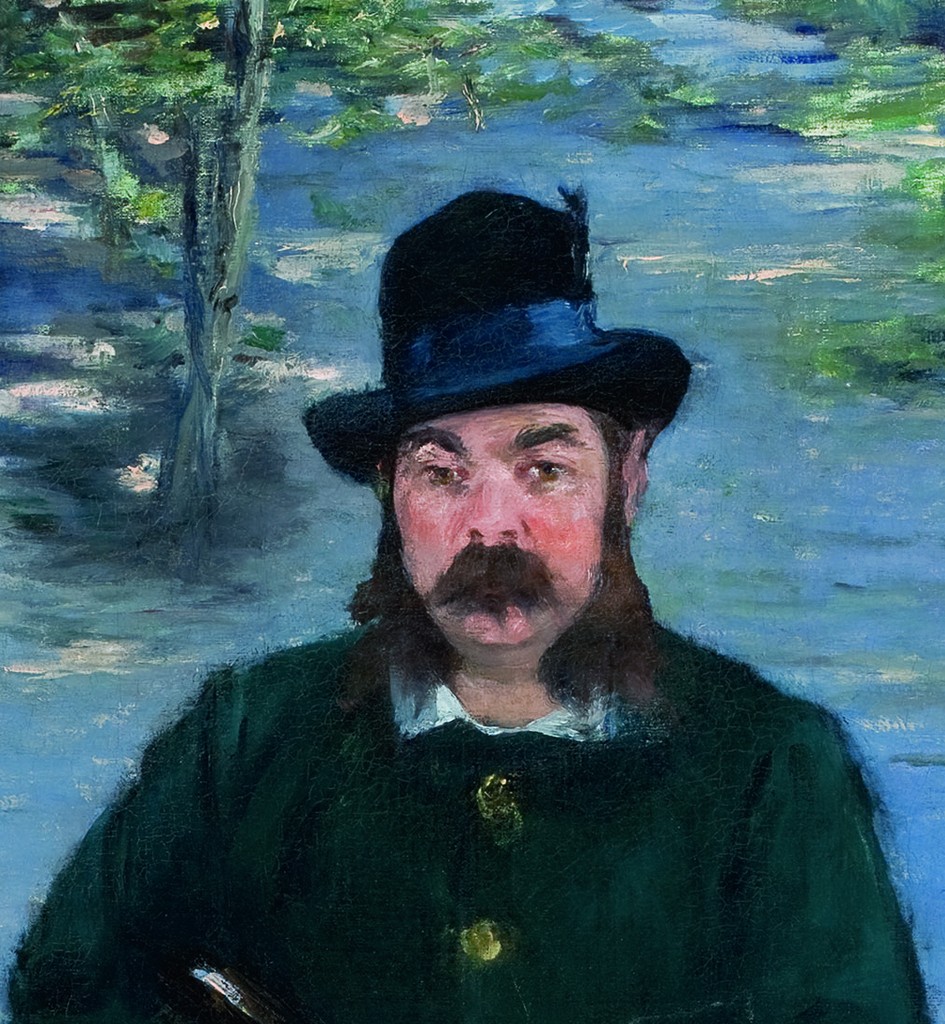
The Face and Dark Hat
Pertuiset’s broad hat rises above a face turned almost directly towards us. A blue band crosses its lower part, and the brim makes an uneven dark shape around the forehead. Below it, strong eyebrows frame the eyes. Pinker passages on the cheeks and nose stand out beside the dark moustache and long side whiskers.
The face occupies a small area of the canvas, but its position gives it considerable force. It is held above the broad shoulders, clear of the tree trunk and the gun. A narrow pale collar marks the transition between skin and clothing, while dark hair connects the sides of the face with the coat below.
Manet varies the clarity of the edges. The brim has a firm silhouette against the lighter background. Across the cheek and chin, shorter patches suggest changes in surface and light. The eyes remain distinct enough to establish the sitter’s outward gaze within this broken handling of the face.
Hands around the Gun
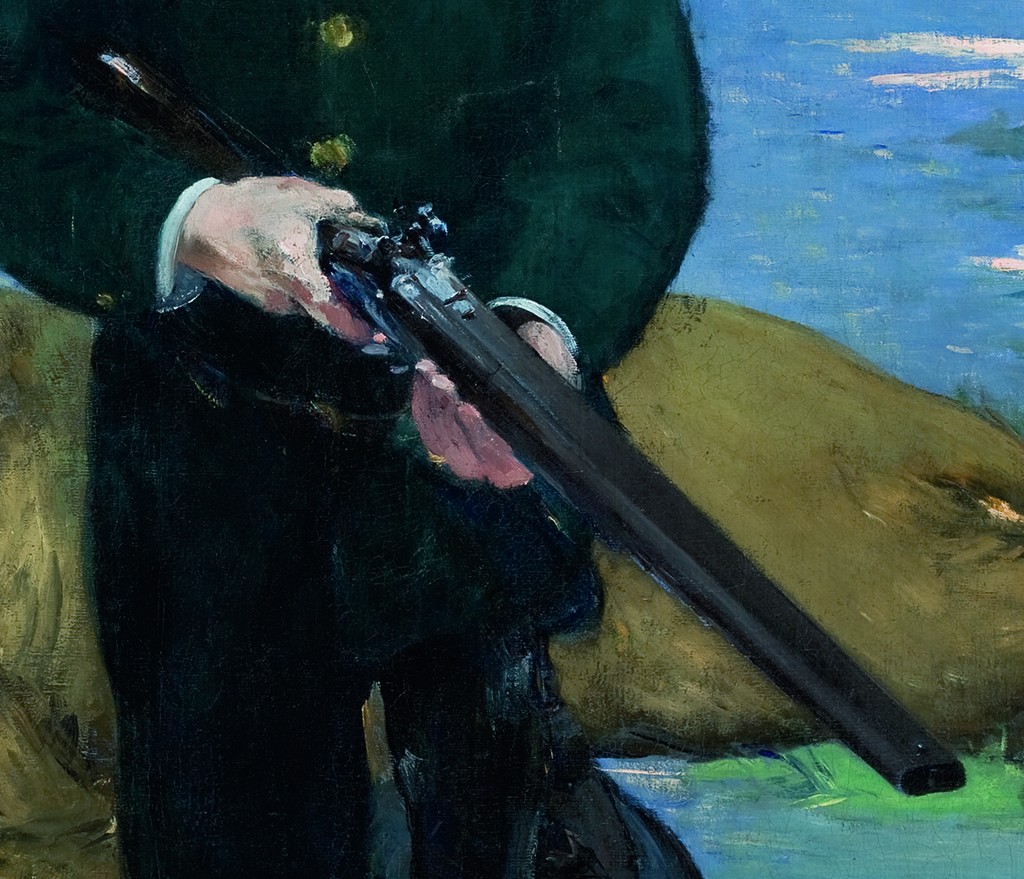
Both hands gather around the gun near the middle of the body. One pale hand lies above the other, with the fingers meeting dark and bright metal passages. The light cuffs provide additional breaks between skin and coat.
From this compact junction, two long barrels extend down towards the right. Their nearly parallel edges form a strong diagonal across the lower half of the picture. The gun’s direction differs from the upright torso and the vertical tree, bringing an oblique line into an arrangement otherwise dominated by standing forms.
The coat spreads around the waist and bent knee. Small gold-coloured buttons descend along its front, making a sequence of light accents above the hands. Lower down, one boot projects towards the viewer. Its rounded toe catches pale reflections against the coloured ground. The other leg is largely concealed by the pose and dark clothing.
Hands, gun and boot make the kneeling posture readable. Each occupies a different plane: the hands sit close to the torso, the barrels project sideways, and the forward foot approaches the lower edge.
The Tree and Lion Skin
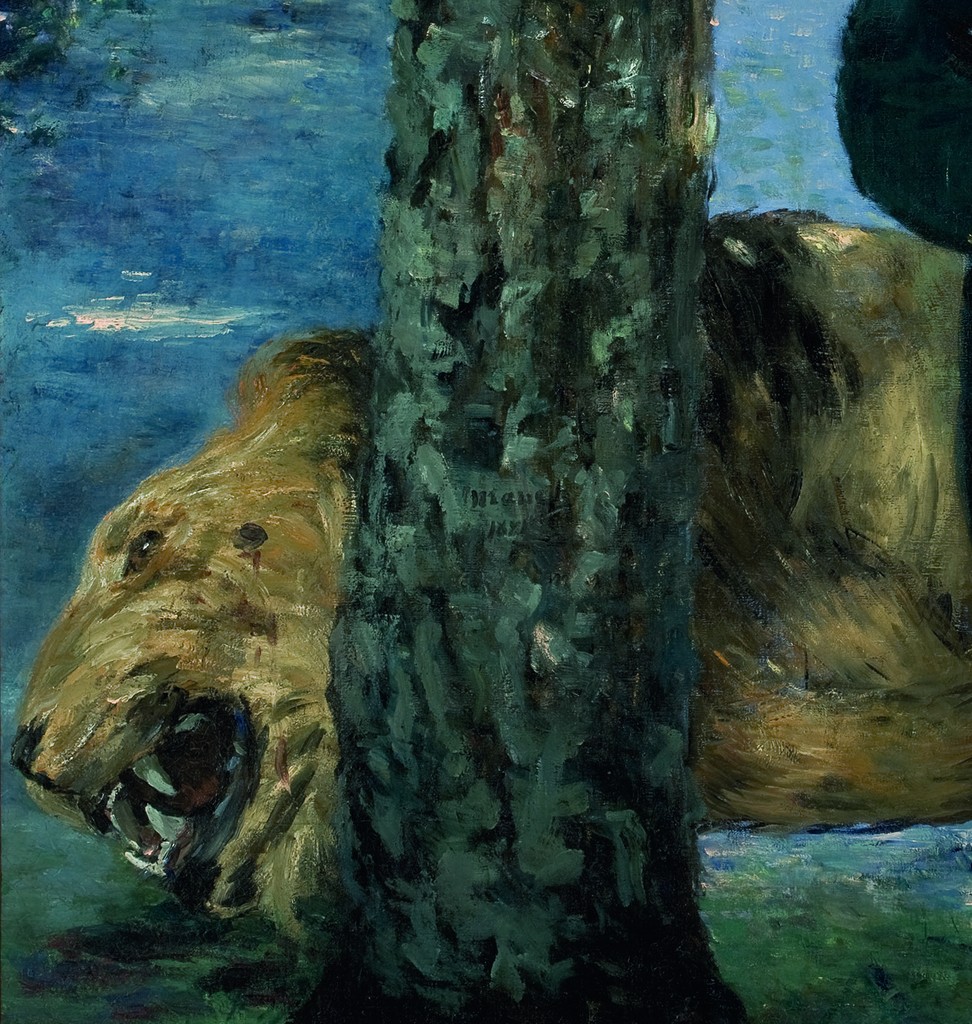
The foreground tree occupies much of the left half. Its trunk widens towards the bottom, where dark patches become particularly dense. Higher up, grey-green and brown strokes break the surface into irregular shapes. Manet placed his signature and the date 1881 on this trunk.[3]
Behind it, the lion skin stretches across the composition. The head lies close to the lower left corner, with an open mouth and conspicuous teeth. A darker mane leads towards the tree. On the other side, the ochre body emerges behind Pertuiset and extends towards the right boundary.
The trunk interrupts our view of the skin, requiring us to connect its separated parts. Its upright weight also anchors the much lower animal shape. The head’s pale brow and dark mouth provide a second focus below the sitter’s face, though the two heads occupy very different positions.
Writing in 1906, Théodore Duret described Pertuiset posing beneath trees in a Paris garden on the boulevard de Clichy during the summer of 1880. He explained that Manet included a lion skin owned by the sitter.[4] This account places the hunting accessories within an arranged portrait. The posing date precedes the 1881 date carried by the finished canvas.
Blue and Violet beneath the Trees
Across the ground, blue and violet passages mingle with green and pale cream strokes. These colours continue behind the figure, around the smaller trees and between the larger dark shapes. The ground has a lively surface even where the represented action is still.
Short, light marks spread horizontally behind Pertuiset’s head and shoulders. Elsewhere, darker patches suggest breaks in the light beneath foliage. Thin trunks rise through these strokes at intervals, giving the background several measures of distance. The large foreground tree remains much more substantial than these narrower uprights.
The dark coat stands apart from the coloured setting, yet small blue and green touches bring some of the surrounding tones into the figure. Similar colours appear near the boots and along the tree. They help connect objects that have otherwise very different outlines and surfaces.
Duret associated the picture with Manet’s interest in the coloured shadows explored by his Impressionist friends, especially the violet effects beneath sunlit trees.[4]
A Portrait in the Role of a Hunter
Pertuiset was Manet’s friend, a collector and dealer of art and arms, and an enthusiastic hunter. MASP’s curatorial account reads the painting as a parody of Romantic hunting heroes and of the formal gestures cultivated in Salon painting.[1]
The arrangement gives that interpretation a visible basis. The sitter presents himself frontally, with his hunting equipment clearly displayed. The gun points away from his line of sight, while the trophy lies behind him. The picture brings the attributes of a hunter into the sustained pose of a portrait.
The relationship between face and costume is especially striking. Dark whiskers, hat and buttoned coat give the figure a substantial silhouette. Pale hands and collar interrupt it at a few carefully placed points. The colourful ground then surrounds this compact dark shape with a much looser pattern of marks.
Comparing Delacroix’s Lion Hunt
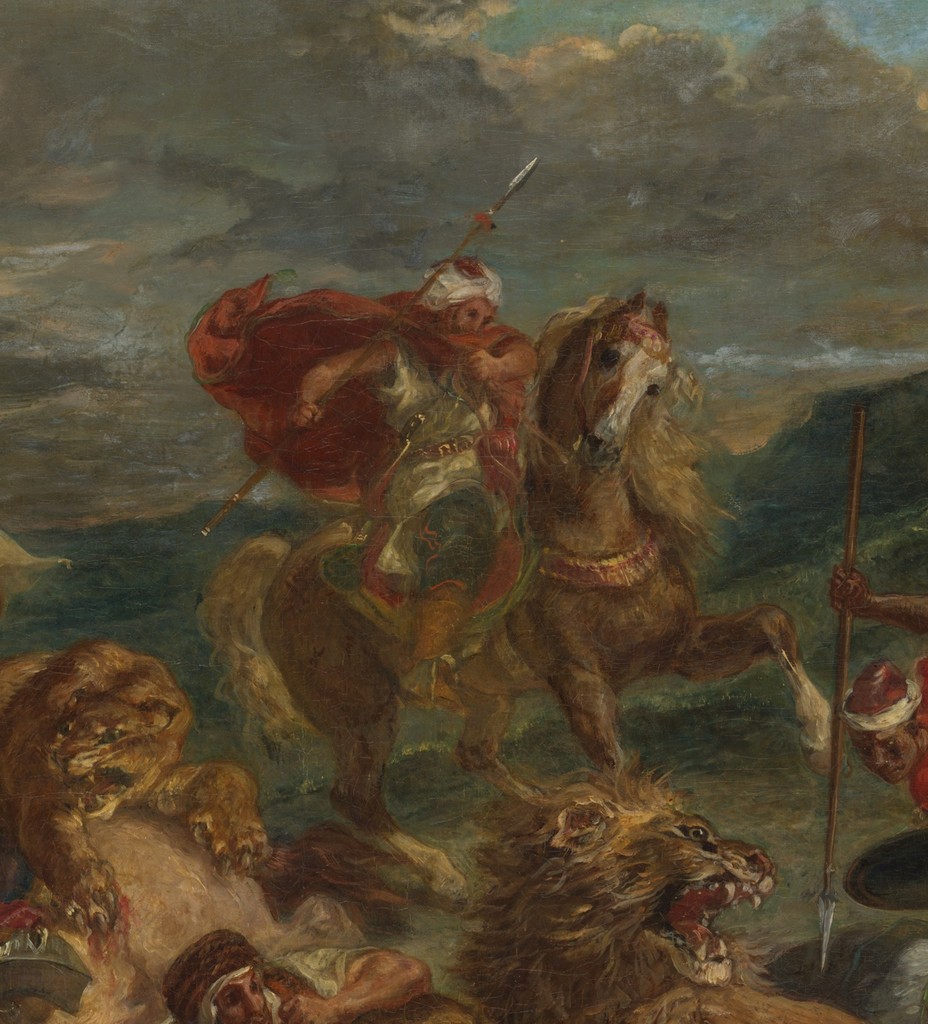
Eugène Delacroix’s Lion Hunt, painted in 1860–61 and now in the Art Institute of Chicago, offers a different treatment of the hunting subject.[5] A mounted figure raises a weapon above a horse whose forelegs lift into the air. Red clothing streams across the central group, carrying movement around the rider and animal.
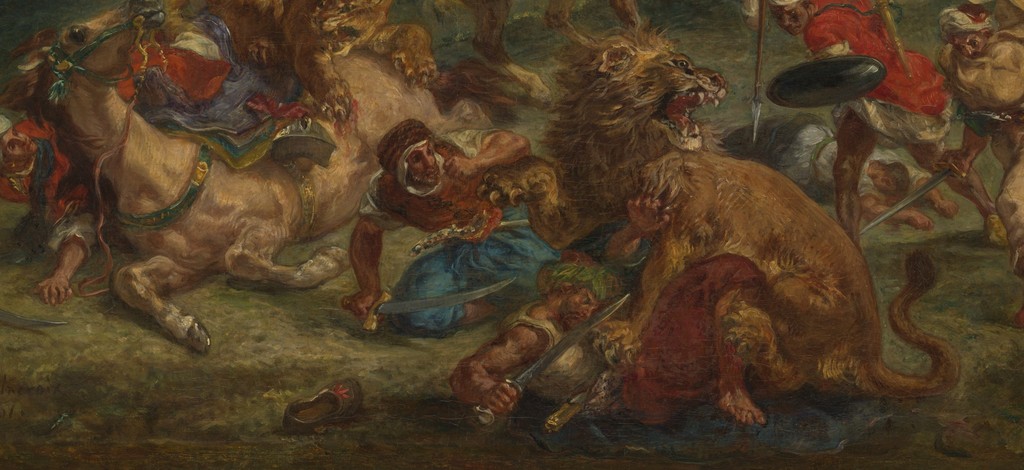
Below, lions, horses, fallen figures and weapons overlap. Curving bodies pull in several directions at once. Near the right, a lion turns its head towards attackers; on the left, another animal presses into the crowded group around a fallen horse. The clouded sky gives this struggle a broad setting without easing the congestion in the foreground.
Manet gives his sitter much more room. Pertuiset’s torso remains comparatively upright, his hands gather at one point, and the gun supplies a single prominent diagonal. The lion skin stretches low behind him. Looking between the works, the viewer moves from an interlocked struggle to an arrangement of a figure and his attributes.
The Art Institute describes Delacroix’s scene as a theatrical construction serving European fantasies about the Arab world, and notes that he never witnessed a lion hunt.[5] The comparison therefore concerns two ways of constructing hunting imagery, with very different distributions of action and stillness.
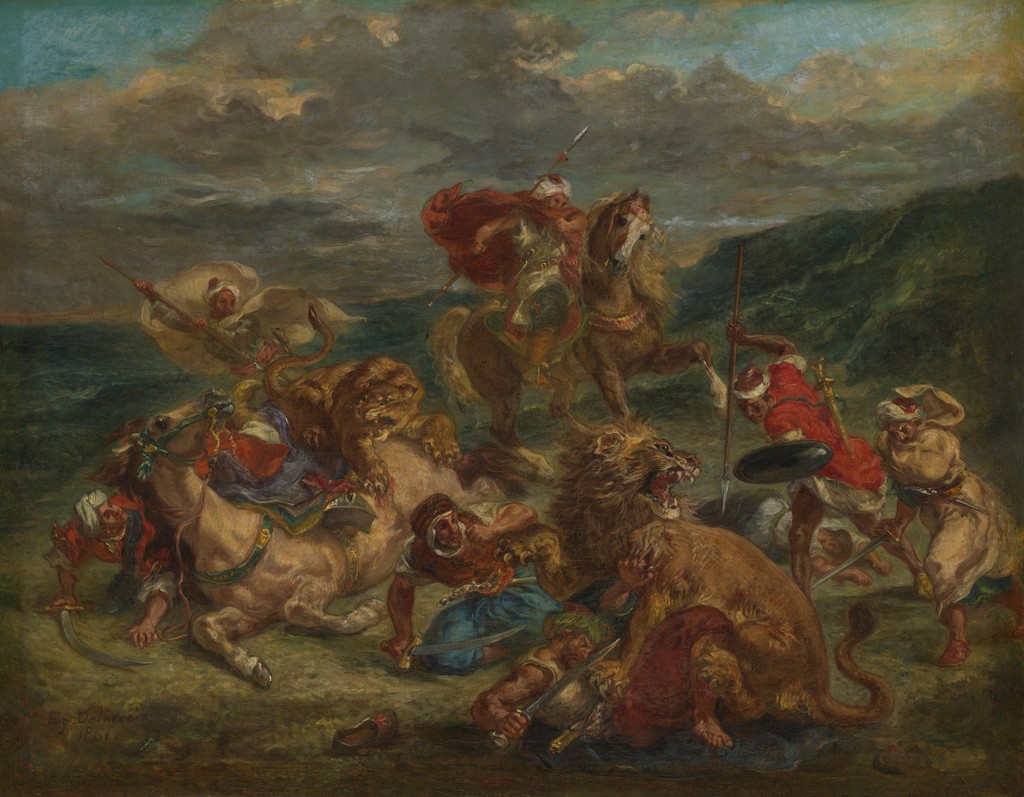
Eugène Delacroix, Lion Hunt, 1860–61. Oil on canvas, 76.5 × 98.5 cm. The Art Institute of Chicago, 1922.404. The Art Institute of Chicago, Potter Palmer Collection, 1922.404. CC0. Image source. CC0 / Public domain. Museum image resized; whole supplied view retained. CC0; no enlargement, recolouring or retouching.
Annotated Details from Monsieur Pertuiset the Lion Hunter
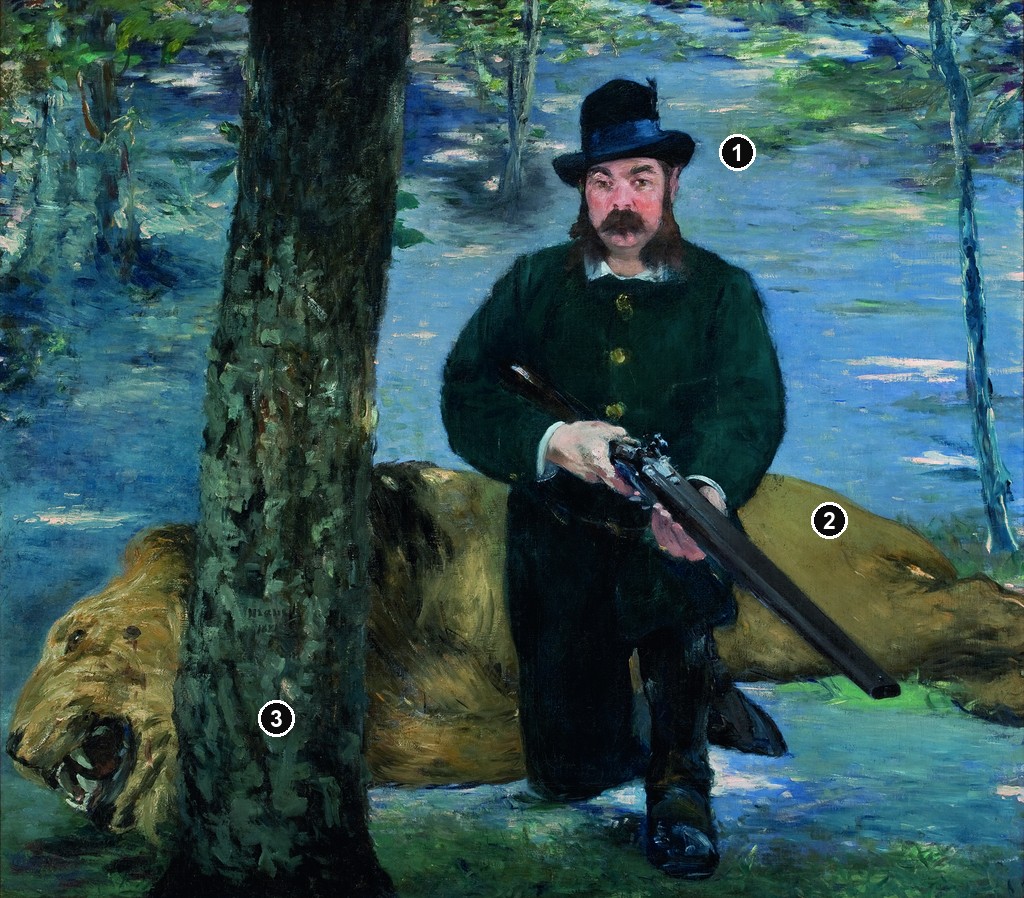
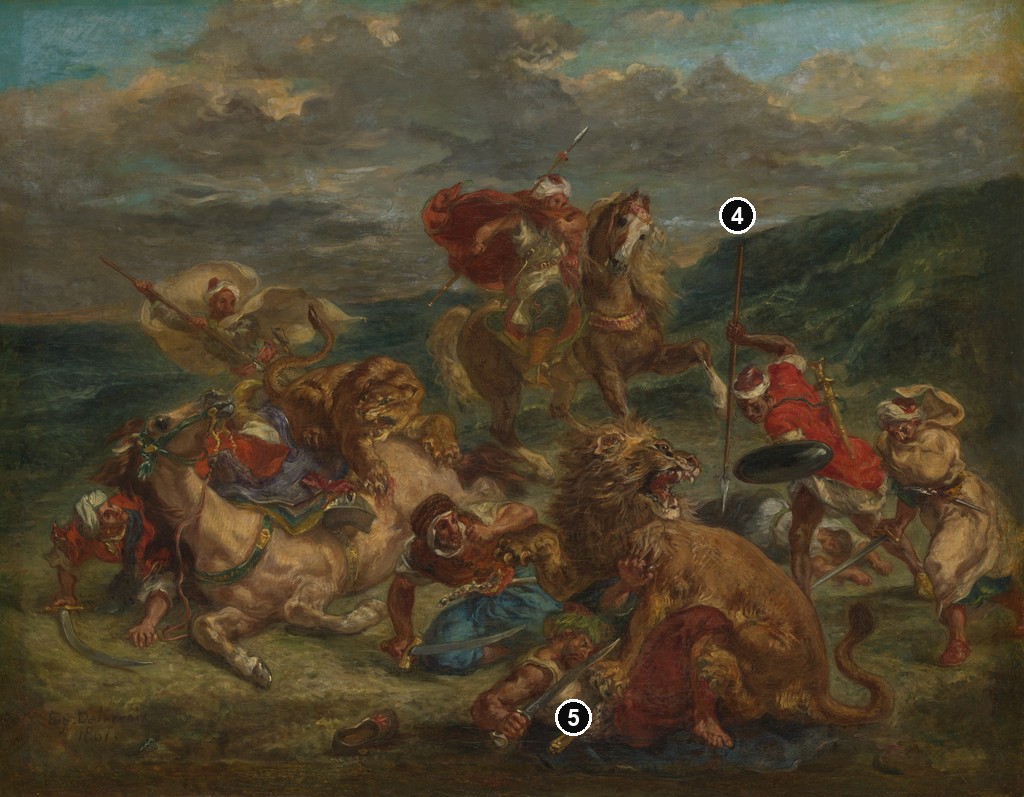
The numbered points identify visible features discussed in this article. Return from each detail to the whole composition. Each caption identifies the work shown.
Monsieur Pertuiset the Lion Hunter
Édouard Manet, Mr. Eugène Pertuiset, the Lion Hunter, 1881. Oil on canvas, 150.5 × 171.5 cm. Museu de Arte de São Paulo Assis Chateaubriand, MASP.00079. MASP, gift of Gastão Vidigal and Geremia Lunardelli, 1950. Photo: João Musa, processed by Jorge Bastos; via Wikimedia Commons, Public Domain Mark 1.0. Image source. Public domain. Numbers added to a separate resized overview. Detail crops from the photograph by João Musa, processed by Jorge Bastos, via Wikimedia Commons; no enlargement, artistic recolouring or retouching.
Delacroix Lion Hunt
Eugène Delacroix, Lion Hunt, 1860–61. Oil on canvas, 76.5 × 98.5 cm. The Art Institute of Chicago, 1922.404. The Art Institute of Chicago, Potter Palmer Collection, 1922.404. CC0. Image source. CC0 / Public domain. Numbers added to a separate resized overview. Detail crops from the Art Institute of Chicago image. CC0; no enlargement, recolouring or retouching.
Details from MONSIEUR PERTUISET THE LION HUNTER
Compare Pertuiset’s face, held gun and trophy skin with the moving riders, lions and figures in Delacroix’s Lion Hunt.
Monsieur Pertuiset the Lion Hunter
Face Hat and Pale Collar
The dark hat and blue band frame the exposed face. Pale collar, pinker cheeks and dark whiskers interrupt the broad coat below.
Hands and Diagonal Gun
The two pale hands gather around the gun. Long parallel barrels extend down towards the right, away from the upright torso.
Tree Trunk and Lion Skin Head
The foreground trunk overlaps the lion skin. Its head lies at the lower left, while the ochre body continues behind the tree and sitter.
Delacroix Lion Hunt
Central Rider and Raised Horse
Red clothing curves around the central mounted figure. The raised weapon and horse’s lifted forelegs carry movement through the group.
Foreground Lions Figures and Weapons
Lions and fallen figures overlap across the foreground. Crossing weapons and curving bodies create several competing directions.
Criticism at the Salon of 1881
Manet exhibited the portrait at the Salon of 1881 as number 1517.[3] Joris-Karl Huysmans disliked both this picture and Manet’s accompanying portrait of Henri Rochefort. He mocked Pertuiset’s kneeling pose by comparing it to rabbit shooting, objected to the lion’s yellowish appearance and dismissed the violet ground as an easy novelty.[6] His complaint shows how closely the painting’s pose and colour were bound together in its reception.
Duret later recounted a more qualified response from Alexandre Cabanel. During the jury’s discussion, Cabanel praised the painting of the head, suggesting that few of his colleagues could equal it. Duret also stated that Cabanel ultimately voted against Manet.[4] The anecdote preserves a distinction between admiration for a passage of painting and support for an award.
Both the Pertuiset and Rochefort portraits were accepted, and Manet received a second-class medal that year.[7] Official recognition thus accompanied continuing criticism. The two responses belong together in the history of Manet’s encounters with the Salon.
The Pertuiset canvas entered MASP through the 1950 gift of Gastão Vidigal and Geremia Lunardelli.[2]
Artworks directory
Explore selected paintings, drawings and prints by Édouard Manet. Search by title or another recorded name.
Frequently Asked Questions
The painting belongs to MASP in São Paulo, accession MASP.00079.[1]
Duret described a portrait posed in a Paris garden, with a lion skin belonging to Pertuiset included behind him.[4]
Yes. Manet received a second-class medal at the Salon, where both his Pertuiset and Henri Rochefort portraits were accepted.[7]
Discussion
Look again at the images and ideas explored in Monsieur Pertuiset the Lion Hunter by Édouard Manet. These editorial prompts invite your observations.
Reader Insights
Follow the barrels from the hands towards the right. How does their direction change the balance of the upright figure and tree?
Connect the lion’s head on the left with the skin behind the sitter. How much of this relationship depends on overlap?
Compare Pertuiset’s held pose with Delacroix’s crowded hunters. Which lines carry movement through each painting?
Join the Conversation
Share a detail, comparison or question about Monsieur Pertuiset the Lion Hunter by Édouard Manet below.
References
- Museu de Arte de São Paulo Assis Chateaubriand, Mr. Eugène Pertuiset, the Lion Hunter, MASP.00079, collection record and curatorial texts of 2017 and 1998. View source.
- J. Paul Getty Museum, Manet and Modern Beauty: The Artist’s Last Years, exhibition checklist, 2019, no.7, p.2. View source.
- Denis Rouart and Daniel Wildenstein, Édouard Manet: Catalogue raisonné, tome I, 1975, no.365, p.272 and illustration p.273. French. View source.
- Théodore Duret, Histoire d’Édouard Manet et de son œuvre, 1906, pp.222–225 and 233–234. French. View source. (in French).
- Art Institute of Chicago, Lion Hunt, Eugène Delacroix, 1860–61, 1922.404, collection record and commentary. View source.
- Joris-Karl Huysmans, “Le Salon officiel de 1881”, in L’Art moderne, 1883, two paragraphs discussing Manet’s portraits. French transcription. View source.
- Ministère de la Culture, “1881 — Sixième exposition”, “Le Salon” section. French. View source. (in French).
- Splash image, Édouard Manet, Mr. Eugène Pertuiset, the Lion Hunter, 1881. Oil on canvas, 150.5 × 171.5 cm. Museu de Arte de São Paulo Assis Chateaubriand, MASP.00079. MASP, gift of Gastão Vidigal and Geremia Lunardelli, 1950. Photo: João Musa, processed by Jorge Bastos; via Wikimedia Commons, Public Domain Mark 1.0. Image source. Public domain. Reproduction resized for web display; whole supplied view retained. No enlargement, artistic recolouring or retouching.


