



 by Tom Gurney
Tom Gurney BSc (Hons) is an art history expert with over 20 years experience
Published on June 19, 2020 / Updated on October 30, 2026
Email: tomgurney1@gmail.com / Phone: +44 7429 011000
A Game of Croquet by Édouard Manet: Introduction
A woman bends over her mallet on a shaded lawn, watched by a seated man and a woman in blue. Farther back, another man extends an arm across the garden. Dense foliage surrounds the four figures, with small coloured balls punctuating the green ground. Édouard Manet painted A Game of Croquet in 1873. The canvas belongs to the Städel Museum in Frankfurt am Main.[1]
At a Glance
- ArtistÉdouard Manet
- TitleA Game of Croquet
- Date1873.[1]
- MediumOil on canvas
- Dimensions72 × 106 cm.[1]
- CollectionStädel Museum, Frankfurt am Main; inventory 1476; acquired 1912, property of the Städelscher Museums-Verein e.V.[1]
This work across Édouard Manet’s career
Contents
- The Seated Man at the Left
- The Woman in Blue
- The Player over the Mallet
- The Man beyond the Players
- Balls and Garden Equipment
- Four Named People in a Garden
- Foliage and the Shaded Lawn
- The Earlier Croquet Party by the Sea
- Acquisition by the Städel
- Annotated details
The Seated Man at the Left
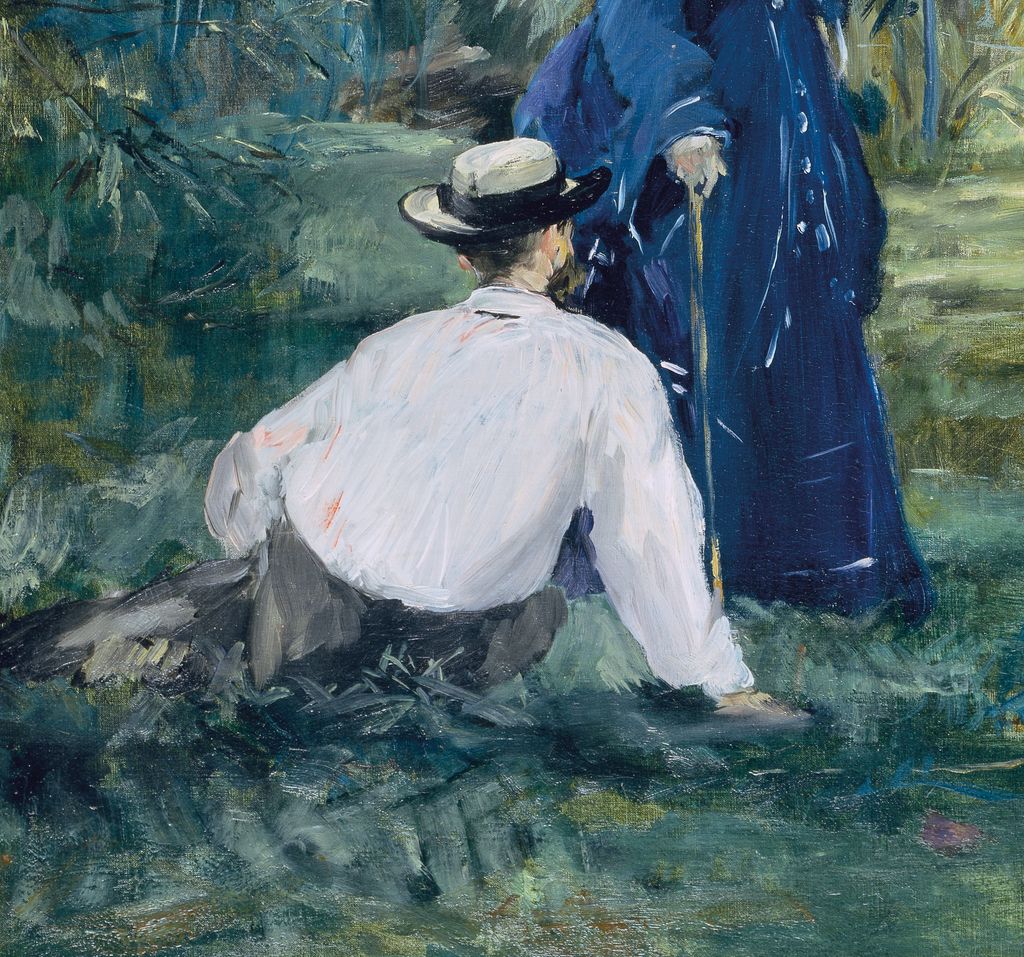
The nearest figure sits low on the grass, with his back turned towards us. His pale shirt spreads into a broad, irregular shape between the darker plants and ground. Small pinkish and grey strokes vary its white surface. A dark band crosses his waist, while his trousers merge into the shaded foreground at the left.
His straw hat has a dark ribbon and a wide brim that partly conceals his head. One arm extends downwards, ending in a hand close to the ground. He occupies a substantial area of the canvas despite remaining seated, and his light shirt draws attention before the eye reaches the smaller man in the distance.
The Woman in Blue
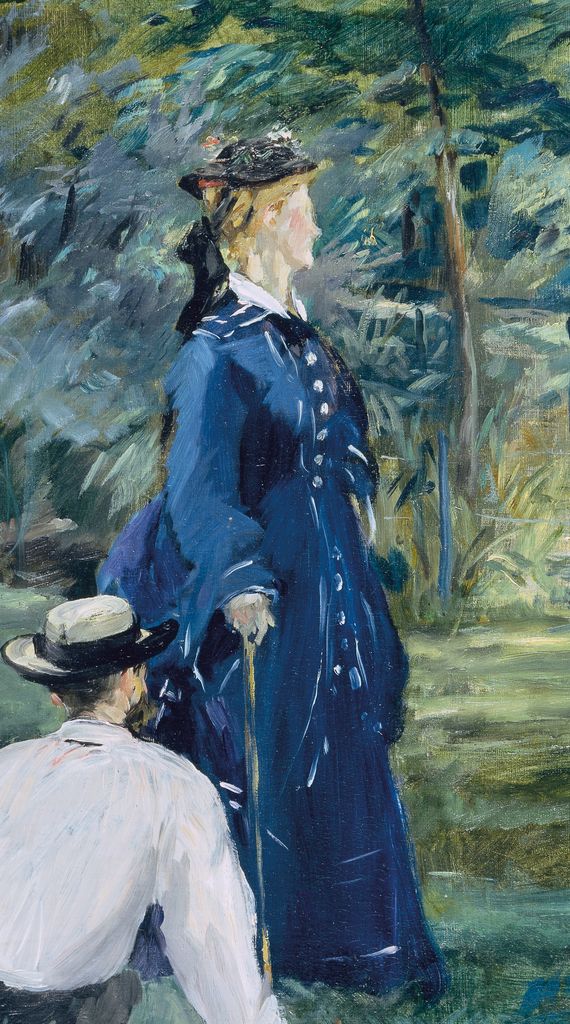
Beside him, a woman stands upright in a deep blue dress. A series of small pale marks follows the front of her clothing, while lighter strokes suggest the collar and folds. Her dark hat has an uneven outline against the lighter vegetation. The face turns to the right, towards the other woman and the open lawn.
One hand holds a long narrow wooden implement beside the skirt. Its straighter line contrasts with the fuller curves of the dress. Her upright position also differs from the seated man below and the bending player farther right. Together, these changes in height and posture make the group easy to separate even where the dark blue fabric meets the surrounding shade.
The Player over the Mallet
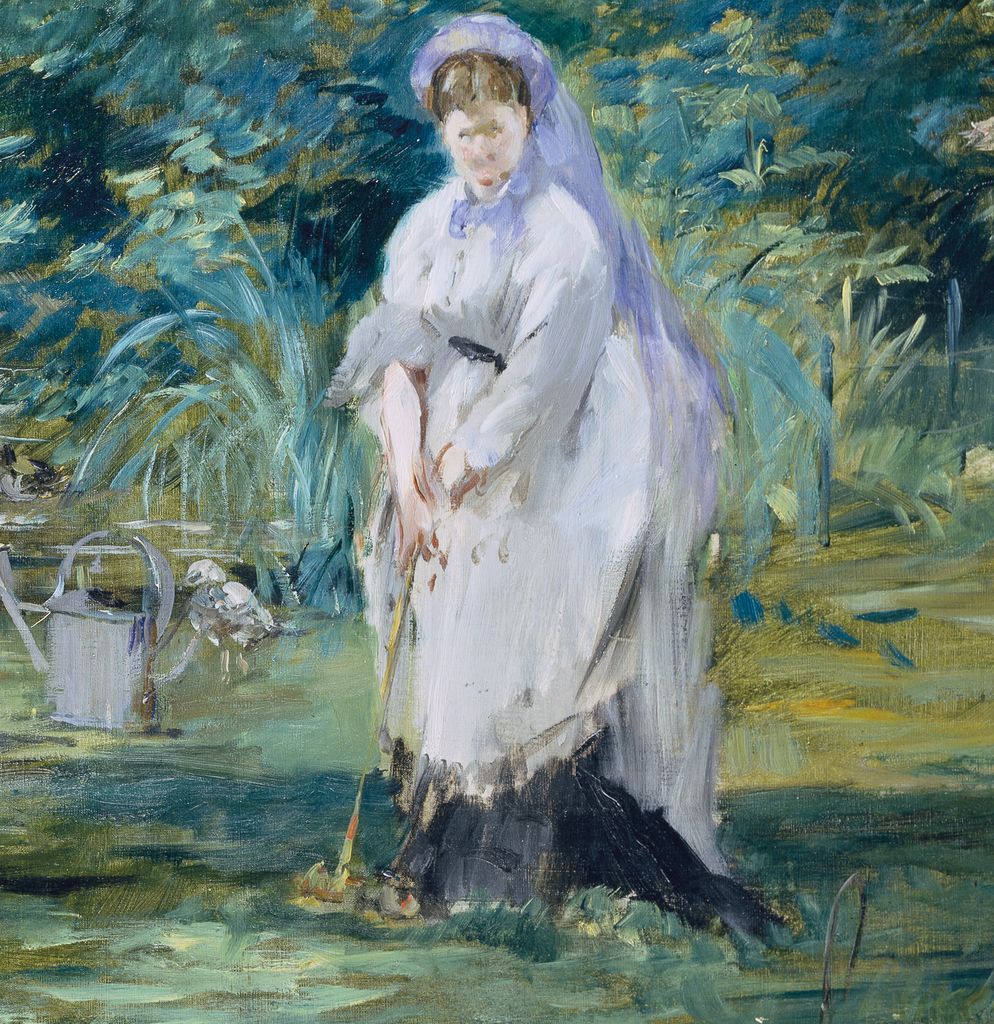
The woman nearer the centre-right bends her head and shoulders forward. Her hands come together around the mallet's long handle, which runs down towards the grass. The pale head of the mallet and nearby coloured touches become small points of attention beneath the much larger shape of her dress.
A dark ribbon marks her waist. Below it, the pale fabric changes into darker folds near the ground, while a violet-blue covering falls behind her head and shoulders. These descending lines connect the head, arms and clothing with the action at her feet. The gesture remains compact: her attention appears directed downwards, while the surrounding people occupy more open or upright positions.
The white clothing stands out sharply against the dark foliage behind it. Within that light shape, grey and warmer strokes distinguish sleeves, folds and overlapping hands. Manet gives the player enough definition to make the action legible without separating every finger or fastening from the surrounding paint.
The Man beyond the Players
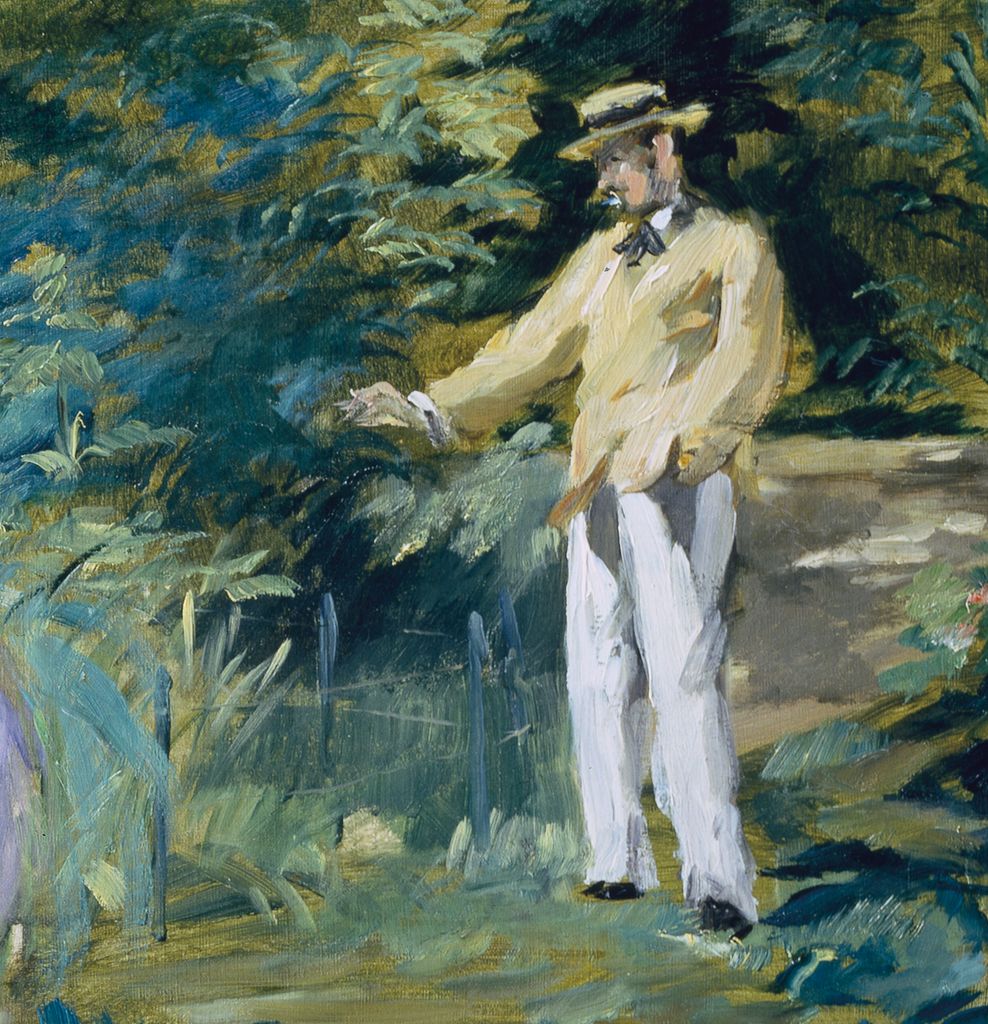
A fourth figure stands farther back at the right. His yellowish jacket, pale trousers and straw hat form a lighter group of shapes among the trees. A dark necktie and hatband interrupt these pale areas. One arm reaches towards the left, while the other stays nearer his body.
His smaller scale establishes a different distance from the seated man in front. The open stretch of lawn between them allows the central woman to stand apart from both. His extended arm also carries movement sideways through the foliage, answering the stronger downward direction of her hands and mallet.
Balls and Garden Equipment
Small yellow, pinkish and orange touches lie across the lawn. Their rounded shapes and brighter colours distinguish them from the many short strokes describing grass and shade. A narrow striped upright near the lower right adds another small, clearly marked form to the playing area.
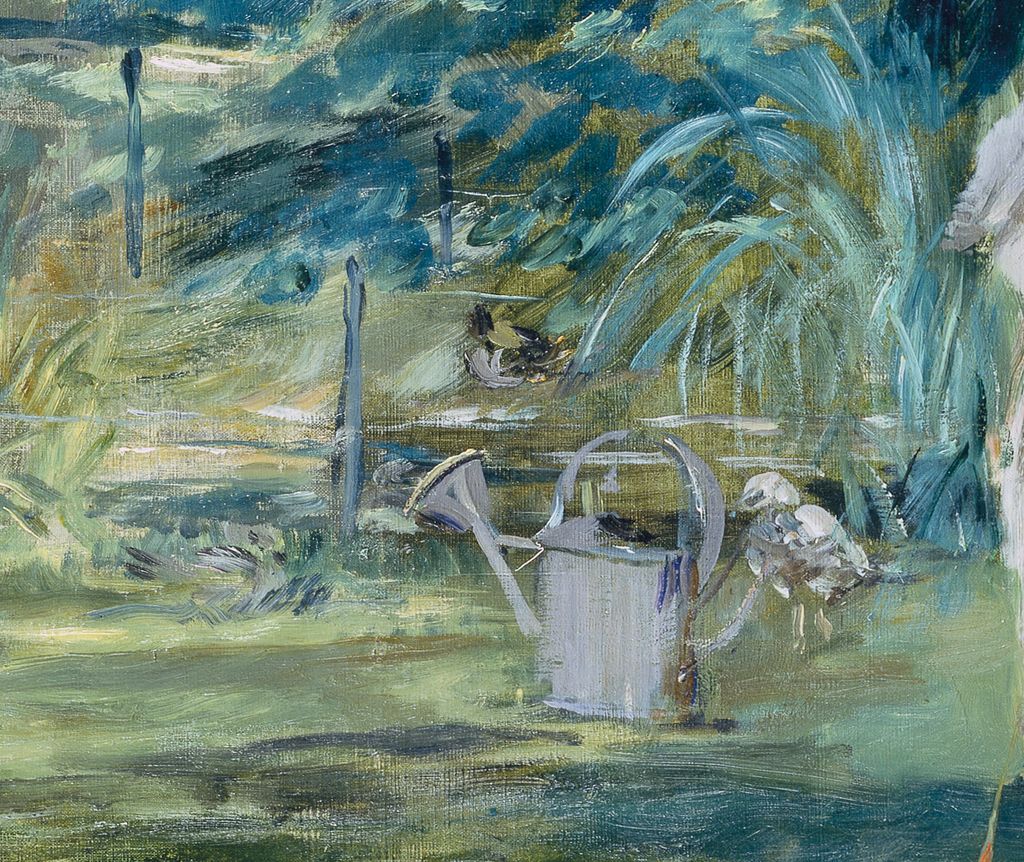
Behind the central player sits a pale watering can, its rounded handle rising above the body and its spout projecting to one side. Light garden furniture appears nearby. These objects place the game within a tended garden, where leisure and ordinary equipment share the same ground. They also create a quieter interval between the two standing women, whose clothing occupies much larger areas of the picture.
Four Named People in a Garden
The Städel identifies the seated man as the painter Alfred Stevens and the man in the background as Paul Roudier, a friend of Manet. Its catalogue names Victorine Meurent and Alice Lecouvé as the two women.[1]
Simon Kelly places this croquet scene in Stevens' garden.[2] The setting helps explain its combination of organised play, planted borders and informal gathering. The composition does not bring the four people into a single row or shared gesture. Their differing positions let the garden remain visible between them, while the pale shirt and dress connect the nearest figure with the active player.
Foliage and the Shaded Lawn
Trees and grasses fill the background, leaving little open sky. Blue-grey, green and darker strokes overlap across this dense screen. Some marks suggest narrow leaves or branches; others remain broad patches that contribute to the surrounding mass. The pale clothing and faces emerge at different points within it.
Across the lawn, longer strokes and dark bands lead between the figures. These passages give the ground a broken surface, with brighter areas alternating with shade. The foliage's lively handling continues around the more easily recognised hats, hands and garments, so the people remain closely connected with their setting.
Writing about Manet's outdoor pictures, Théodore Duret emphasised the continuing importance of figures, with landscape often providing their setting.[3] That relationship is especially clear here: the garden fills the canvas, but the four bodies organise its spaces and give its many small marks a human scale.
Annotated Details from A Game of Croquet
The numbered points identify visible features discussed in this article. Return from each detail to the whole composition. Édouard Manet, A Game of Croquet, 1873. Oil on canvas, 72 × 106 cm. Städel Museum, Frankfurt am Main, inventory 1476; acquired 1912, property of the Städelscher Museums-Verein e.V. Image source. Public domain. Resized without cropping from the supplied museum reproduction.
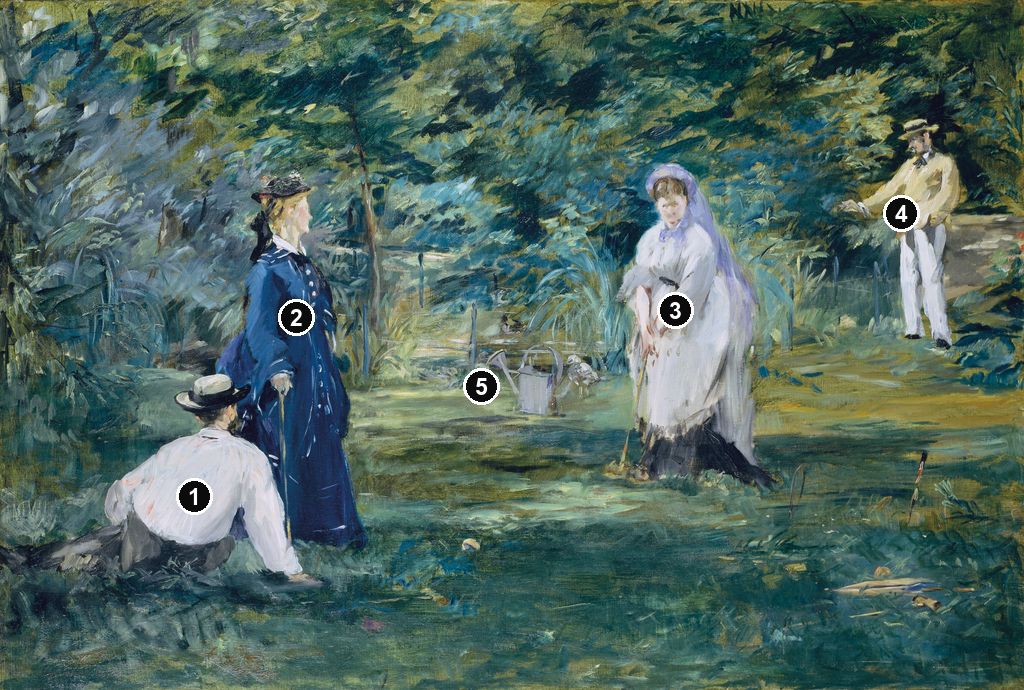
Details from A GAME OF CROQUET
Compare the four figures’ postures with the smaller watering can and equipment in the garden.
The seated man
The pale shirt forms a broad shape above the dark waistband and trousers. The brimmed hat and the arm reaching towards the grass define the seated posture.
The woman in blue
Small pale marks and folds break up the deep blue dress. The upright figure holds a long wooden implement beside the skirt, with her face turned towards the other player.
The player over the mallet
The hands meet around the long handle as the player bends forward. Pale fabric, a dark waist ribbon and lower folds frame the movement towards the grass.
The man in the background
The yellowish jacket and pale trousers stand among the foliage. One arm reaches sideways, while the dark hatband and neckwear punctuate the lighter clothing.
The watering can
The pale can has a rounded handle and a projecting spout. Light garden furniture and nearby plants surround this small object behind the central player.
The Earlier Croquet Party by the Sea
Manet also painted The Croquet Party, dated 1871 by the Nelson-Atkins Museum of Art in Kansas City.[2] Its five principal players stand before a fence, with the sea and ships beyond. Flags and two small dogs introduce further movement into the scene.
The Frankfurt painting offers a more enclosed setting. Trees replace the broad view of sea and sky, and one man sits close to the lower edge. Comparing the two makes the repeated subject easier to recognise without confusing their people or places. In each, croquet provides an activity around which Manet can arrange standing bodies, angled mallets and intervals of open ground.
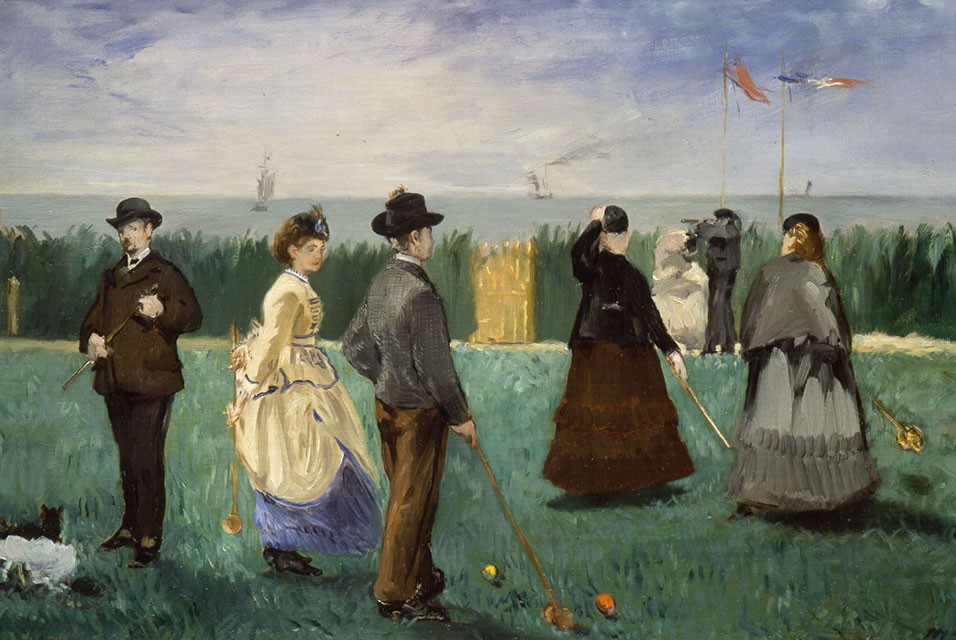
Édouard Manet, The Croquet Party, 1871. Oil on canvas, 45.7 × 73 cm. The Nelson-Atkins Museum of Art, Gift of Marion and Henry Bloch, 2015.13.11. The Nelson-Atkins Museum of Art; reproduction via Wikimedia Commons, uploaded by Wmpearl. Image source. Public domain. Whole supplied reproduction retained at its native width.
Acquisition by the Städel
The Frankfurt painting was acquired in 1912 and remains the property of the Städelscher Museums-Verein. The museum places the purchase within its early twentieth-century acquisition of modern French painting.[1]
Artworks directory
Explore selected paintings, drawings and prints by Édouard Manet. Search by title or another recorded name.
Frequently Asked Questions
The 1873 painting belongs to the Städel Museum in Frankfurt am Main, inventory 1476.[1]
The Städel identifies Alfred Stevens, Paul Roudier, Victorine Meurent and Alice Lecouvé.[1]
No. The Nelson-Atkins work is the earlier 1871 seaside scene; the Frankfurt painting dates to 1873 and shows a garden.[2]
Discussion
Look again at the images and ideas explored in A Game of Croquet by Édouard Manet. These editorial prompts invite your observations.
Reader Insights
Compare the seated man, the bending player and the smaller figure at the back. How do their positions establish depth?
Follow the mallet, balls, watering can and striped upright. Which details help you recognise the game and its garden setting?
Compare the enclosed foliage in Frankfurt with the sea and sky in the earlier painting. How does the setting change the spacing of the figures?
Join the Conversation
Share a detail, comparison or question about A Game of Croquet by Édouard Manet below.
References
- Städel Museum, Die Krocketpartie, current object record, commentary and named-person fields, 1476. German. English companion. View source 1. View source 2.
- Simon Kelly, “Edouard Manet, The Croquet Party, 1871”, curatorial catalogue entry, in French Paintings and Pastels, 1600–1945: The Collections of the Nelson-Atkins Museum of Art, 2021; discussion and fig.2 distinguish the Frankfurt painting. View source.
- Théodore Duret, Histoire d'Édouard Manet et de son œuvre, 1906, p.164. Digitised French text. French. View source. (in French).
- Splash image, Édouard Manet, A Game of Croquet, 1873. Oil on canvas, 72 × 106 cm. Städel Museum, Frankfurt am Main, inventory 1476; acquired 1912, property of the Städelscher Museums-Verein e.V. Image source. Public domain. Resized without cropping from the supplied museum reproduction.


