



 by Tom Gurney
Tom Gurney BSc (Hons) is an art history expert with over 20 years experience
Published on June 19, 2020 / Updated on October 30, 2026
Email: tomgurney1@gmail.com / Phone: +44 7429 011000
Steamboat Leaving Boulogne by Édouard Manet: Introduction
A small steamer sends a white wake across blue water, while dark sailing boats occupy much more of the foreground. Above the steamer, a spreading cloud of smoke gives this modest vessel an unexpectedly large presence. Édouard Manet painted the scene in 1864. Known as Steamboat Leaving Boulogne, it belongs to the Art Institute of Chicago, which now titles it Sea View, Calm Weather.[1]
At a Glance
- ArtistÉdouard Manet
- Familiar titleSteamboat Leaving Boulogne
- Museum titleSea View, Calm Weather
- French titleVue de mer, temps calme
- Date1864
- MediumOil on canvas
- Dimensions73.6 × 92.6 cm
- CollectionArt Institute of Chicago, Potter Palmer Collection
- Reference number1922.425.[1]
- Catalogue numberRouart–Wildenstein I78.[2]
This work across Édouard Manet’s career
Contents
- Sailing Boats Across the Blue
- Finding the Steamboat
- Water and a High Horizon
- Observations at Boulogne and Work in Paris
- Flatness and Photographic Comparisons
- Beside The Kearsarge at Boulogne
- Names and the Chicago Collection
- Annotated details
Sailing Boats Across the Blue
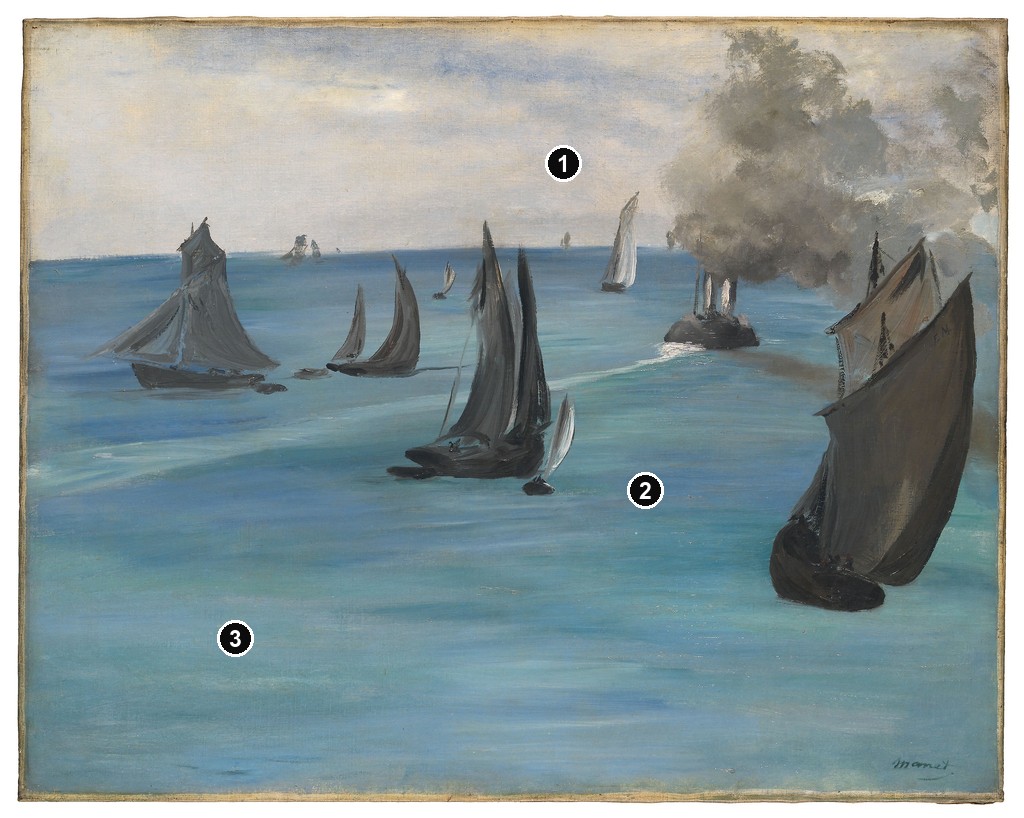
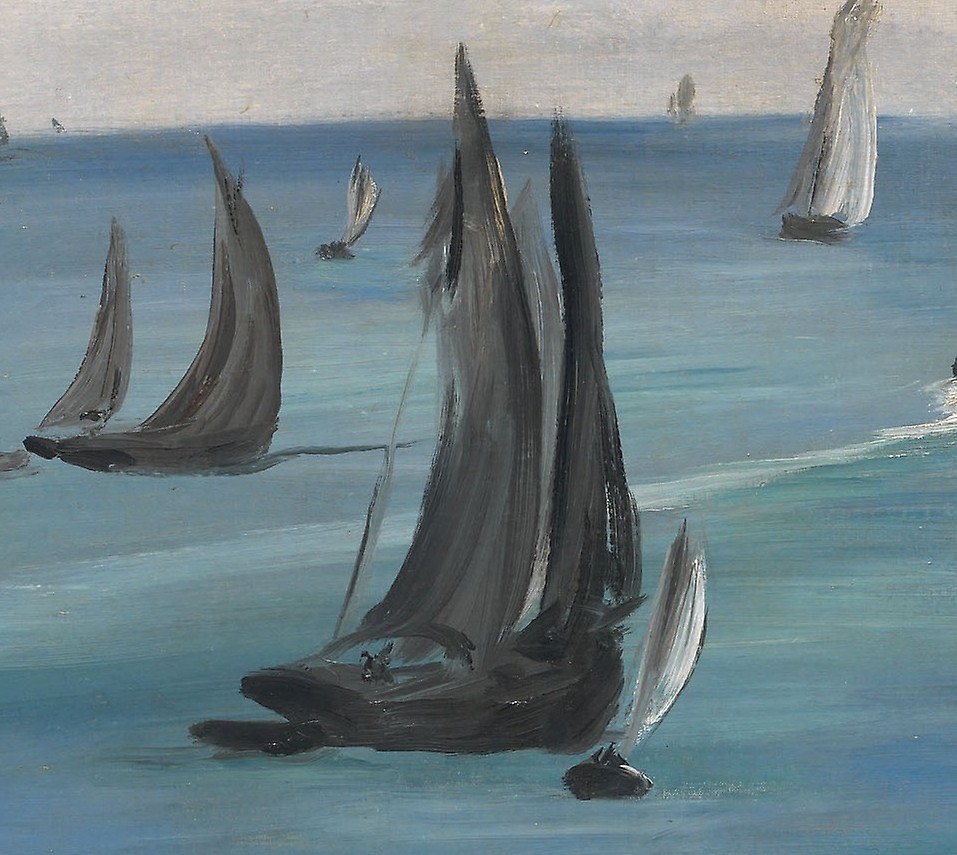
The nearest vessel enters from the right as a large dark shape. Its sails overlap, with a lighter brown passage behind the broad, darker sail at the front. The hull curves beneath them, and the arrangement leans across the water. Part of the vessel meets the picture’s edge, making it feel close enough to extend beyond our view.
Near the centre, a lower hull supports tall, narrow sails. Their dark verticals rise against the pale sky, while a small bright sail beside the boat introduces a sharply different note. This little white shape is conspicuous because so much of the surrounding shipping is painted in grey and black.
Further left, a broad triangular sail spreads over another long hull. Several small dark forms trail beside or behind it. Between this vessel and the central boat, smaller sails repeat the same tapering shapes. Their intervals leave stretches of blue visible, so that the vessels remain separate rather than gathering into a single crowded mass.
The changing scale helps establish distance. Large sails occupy the foreground; small grey shapes stand near the horizon. Manet gives us enough differences in size, overlap and placement to follow the shipping into depth, even though the water remains a remarkably continuous field of colour.
Finding the Steamboat
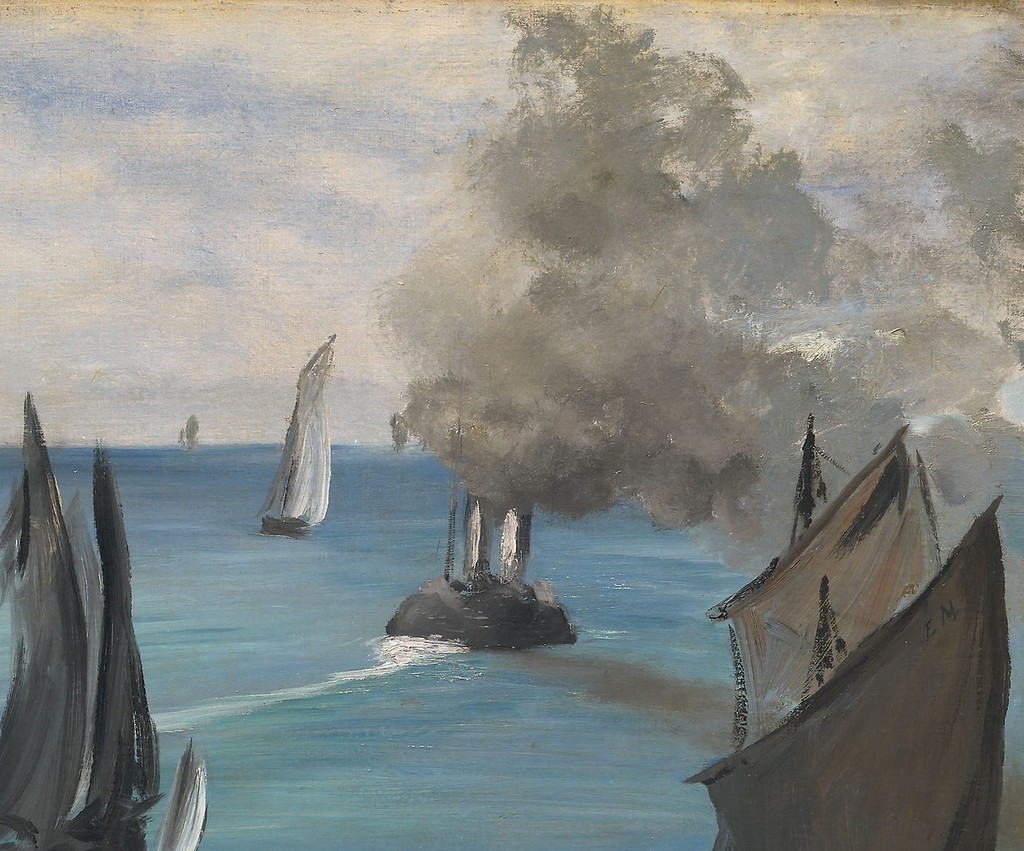
The steamer sits right of centre, beyond the nearest sailing craft. The museum identifies it as a side-wheel packet steamer heading up the English Channel.[1] Its dark, rounded hull is much smaller than the foreground boat, but the upright structures and the smoke above it distinguish its means of movement.
Pale strokes gather at its stern and narrow into a wake that curves towards the left. Against the blue, this light trail supplies a direction that the compact hull alone could scarcely express. It passes between the larger vessels and draws attention through the spaces separating them.
The smoke has a different shape and rhythm. It rises into the sky, then spreads towards the right in irregular grey masses. Some passages are dense and dark; others allow the lighter sky to show through. Its soft, expanding boundary differs from the sailboats’ pointed tops and long, tapering edges.
Wake and smoke make the steamer’s activity visible across a much larger area than its hull occupies. One spreads over the water, the other into the air. Together they connect the small vessel with two broad regions of the painting, giving it presence among nearer, larger boats.
Water and a High Horizon
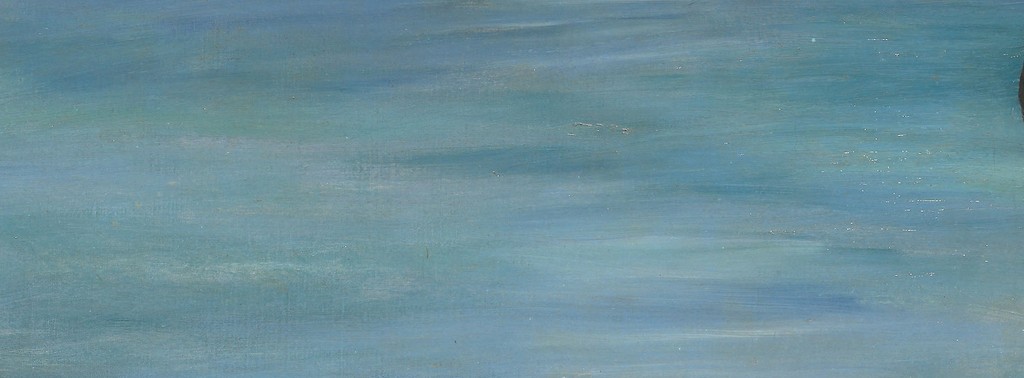
The horizon leaves most of the canvas to the sea. Across the lower half, blue is interrupted by longer pale strokes, greyish passages and patches leaning towards green. These variations remain relatively close in tone. They suggest a surface extending beneath the boats without breaking it into a succession of strongly modelled waves.
The strokes often travel horizontally, giving the water a direction different from the rising sails. Some broaden and fade; others remain visible as short marks within a larger band of colour. The foreground contains more room to follow these individual touches, while distant water is compressed beneath the horizon.
Dark passages appear below or beside some hulls, but they do not become long, complete reflections of every sail. The boats retain unusually distinct silhouettes against their surroundings. Their forms can look almost like shapes placed upon a blue surface, even as their relative scale and distribution establish a view across the sea.
The wake cuts diagonally through this quieter arrangement. Its light line gives the eye a route towards the steamer, while the broad foreground offers no equally insistent channel. We can look across a substantial stretch of water before arriving at the principal moving vessel.
Observations at Boulogne and Work in Paris
Manet visited Boulogne-sur-Mer with his family in 1864. The busy northern French port offered a variety of shipping, from fishing craft to steam vessels. Chicago’s account states that he painted this canvas in Paris using sketches made during the holiday.[1] The observed traffic became material for a composition developed away from the immediate scene.
Juliet Wilson-Bareau and David C. Degener describe the picture’s arrangement as a reconstruction shaped by considerable artistic freedom. Their study also reports X-ray evidence that the sea was painted first and the boats added over it.[3] That sequence helps explain the continuity of the blue field and the strong independence of the darker vessels.
Looking at the finished surface, the difference between those elements remains clear. Water spreads broadly from edge to edge. Sails and hulls interrupt it through more concentrated shapes, while the wake makes a narrow, bright connection between otherwise separate areas. The construction allows large passages of sea to remain visible around and between the boats.
Flatness and Photographic Comparisons
Art historian Nancy Locke proposes a comparison with Gustave Le Gray’s marine photographs, particularly their glossy water and smoke. She draws attention to Manet’s selective treatment of reflections and to the simplified forms of his sailboats.[4] The relationship offers a way to consider his choices without requiring the painting to copy a particular photograph.
The distinction is useful when looking at the foreground. The large right-hand boat has a substantial outline, yet very little surrounding description ties it to a network of reflections. Its dark sail can appear both as cloth catching air and as a broad painted shape. The blue beneath it continues with relatively little interruption.
Depth nevertheless persists. A small sail near the horizon cannot be confused with the huge one at the edge, and the steamer’s wake connects different distances. The painting holds these effects together: the sea reads as a large area of colour, while the boats establish positions within it. The apparent simplicity depends on those relationships remaining legible.
Beside The Kearsarge at Boulogne
Manet’s The “Kearsarge” at Boulogne, also dated 1864, belongs to the Metropolitan Museum of Art in New York.[5] It provides a revealing comparison because a large sailing boat again occupies the right foreground, with a steam-powered vessel further away.
There, the named warship stretches broadly across the view. Its long dark hull, masts and fine rigging have a prominence quite different from the small packet in the Chicago canvas. The surrounding craft help give the warship scale, while the near fishing boat brings a large area of warm brown sail towards the spectator.
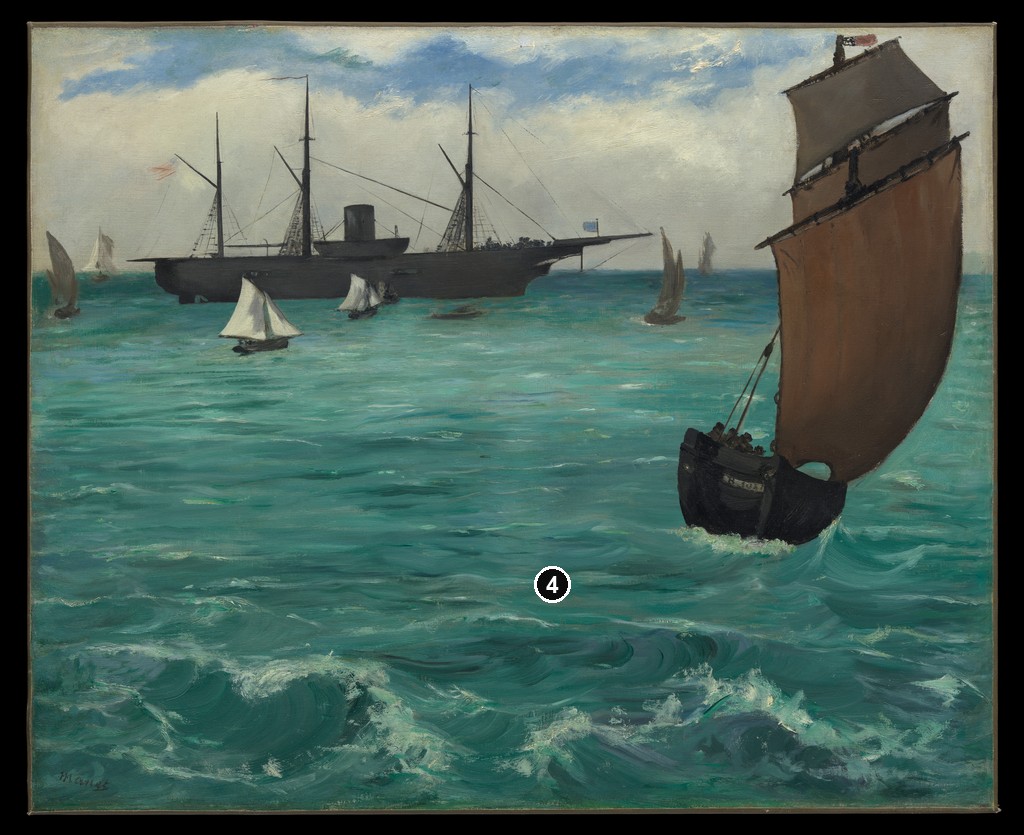
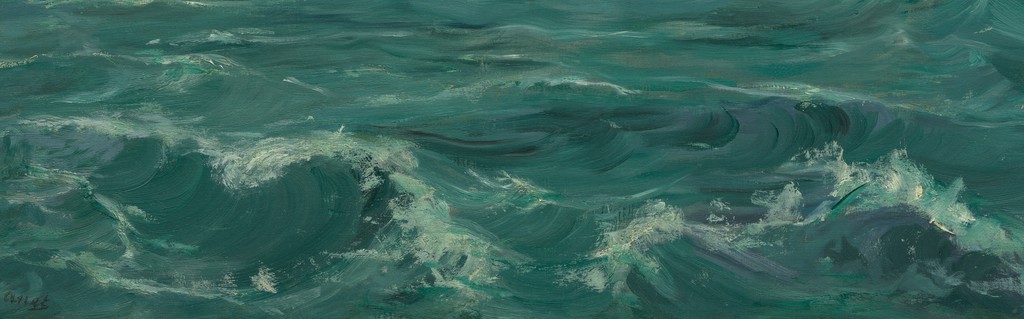
The greatest change is the water. Green and turquoise strokes curl through the Met painting’s foreground, with broken pale marks describing foam. Individual waves swell, turn and sink into darker hollows. Chicago’s longer, more horizontal passages give the sea a calmer and less strongly articulated surface.
Both paintings use differences between near and distant vessels, but they make us attend to different movements. The Met picture brings waves and an approaching fishing boat forward. In Steamboat Leaving Boulogne, the packet’s wake carries attention away through the blue, while its smoke expands above the scattered sails. The shared setting makes these differences of surface and direction clear.
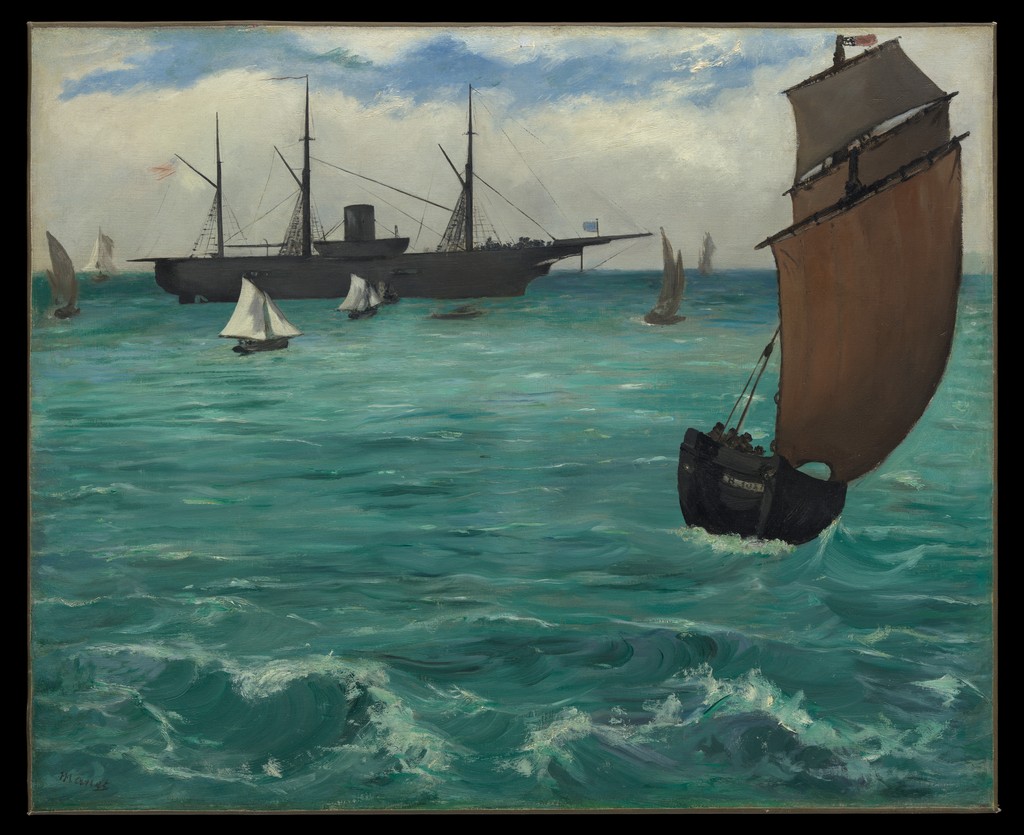
Édouard Manet, The “Kearsarge” at Boulogne, 1864. Metropolitan Museum of Art, New York, 1999.442. Metropolitan Museum of Art, Open Access; CC0 / Public Domain. Image source. CC0 / Public domain. Whole supplied reproduction resized for web display. No enlargement or retouching.
Annotated Details from Steamboat Leaving Boulogne
The numbered points identify visible features discussed in this article. Return from each detail to the whole composition. Each caption identifies the work shown.
Steamboat Leaving Boulogne
Édouard Manet, Sea View, Calm Weather, 1864. Art Institute of Chicago, Potter Palmer Collection, 1922.425. Art Institute of Chicago reproduction via Wikimedia Commons; CC0 / Public Domain. Image source. CC0 / Public domain. Numbers added to a separate resized overview. Detail crops from public-domain reproductions; no enlargement or retouching.
The Kearsarge at Boulogne
Édouard Manet, The “Kearsarge” at Boulogne, 1864. Metropolitan Museum of Art, New York, 1999.442. Metropolitan Museum of Art, Open Access; CC0 / Public Domain. Image source. CC0 / Public domain. Numbers added to a separate resized overview. Detail crops from public-domain reproductions; no enlargement or retouching.
Details from STEAMBOAT LEAVING BOULOGNE
Find the small steamer under the smoke, compare the dark and light sails, then look across the blue water and the curling green waves in The Kearsarge at Boulogne.
Steamboat Leaving Boulogne
The Steamer, Wake and Smoke
The small hull sends a pale wake across the blue water. Above it, grey smoke spreads into a much larger shape, with softer boundaries than the nearby sails.
Dark Sails and a Bright Companion
Tall dark sails rise above a low hull near the centre. The little light sail beside them creates a sharp change of tone against the surrounding blue.
Horizontal Marks Across the Water
Long pale strokes, patches of green and shorter touches interrupt the broad blue foreground. The surface remains more continuous than the curling waves in the comparison.
The Kearsarge at Boulogne
Curling Waves in The Kearsarge at Boulogne
Curving green strokes describe rising and falling waves. Broken pale marks gather as foam, giving the foreground more pronounced movement than the blue water in the Chicago painting.
Names and the Chicago Collection
The Rouart–Wildenstein catalogue records the painting as Sortie du port de Boulogne, with Vue de mer, temps calme as another title. It also lists the canvas in Manet’s independent exhibition near the Pont de l’Alma in 1867.[2] The names place different emphasis on the departure of a vessel and the wider appearance of sea and weather.
The Palmer family gave the painting to the Art Institute in 1922.[1] Its familiar steamboat title continues to direct the viewer towards the small vessel under the smoke. The museum’s current title gives more equal weight to the extensive water that surrounds it.
Artworks directory
Explore selected paintings, drawings and prints by Édouard Manet. Search by title or another recorded name.
Frequently Asked Questions
At the Art Institute of Chicago, under the title Sea View, Calm Weather.[1]
1864.[1]
Discussion
Look again at the images and ideas explored in Steamboat Leaving Boulogne by Édouard Manet. These editorial prompts invite your observations.
Reader Insights
Compare the small dark hull beneath the smoke with the much larger sailing vessel at the right edge.
Follow the pale trail through the water and notice how it differs from the sea’s longer horizontal marks.
Compare the quieter blue field here with the curling green waves in The Kearsarge at Boulogne.
Join the Conversation
Share a detail, comparison or question about Steamboat Leaving Boulogne by Édouard Manet below.
References
- Art Institute of Chicago, Sea View, Calm Weather (Vue de mer, temps calme), 1864, 1922.425, current collection record, commentary and provenance. View source.
- Denis Rouart and Daniel Wildenstein, Édouard Manet: Catalogue raisonné, vol. I (1975), no. 78, pp. 86–87. In French. View source.
- Juliet Wilson-Bareau with David C. Degener, Manet and the American Civil War: The Battle of U.S.S. Kearsarge and C.S.S. Alabama, Metropolitan Museum of Art, 2003, pp. 61–72, especially pp. 67–68. View source.
- Nancy Locke, Visible Specters, Images from the Atmosphere, nonsite.org, no. 14, 15 December 2014, marine discussion around figures 7–9. View source.
- Metropolitan Museum of Art, The “Kearsarge” at Boulogne, 1864, 1999.442, collection record and object details. View source.
- Splash image, Édouard Manet, Sea View, Calm Weather, 1864. Art Institute of Chicago, Potter Palmer Collection, 1922.425. Art Institute of Chicago reproduction via Wikimedia Commons; CC0 / Public Domain. Image source. CC0 / Public domain. Whole supplied reproduction resized for web display. No enlargement or retouching.


